
New IRPWM Chapter 3 C SHORT WELDED RAILS


- Slides: 27
New IRPWM Chapter 3 ‘C’
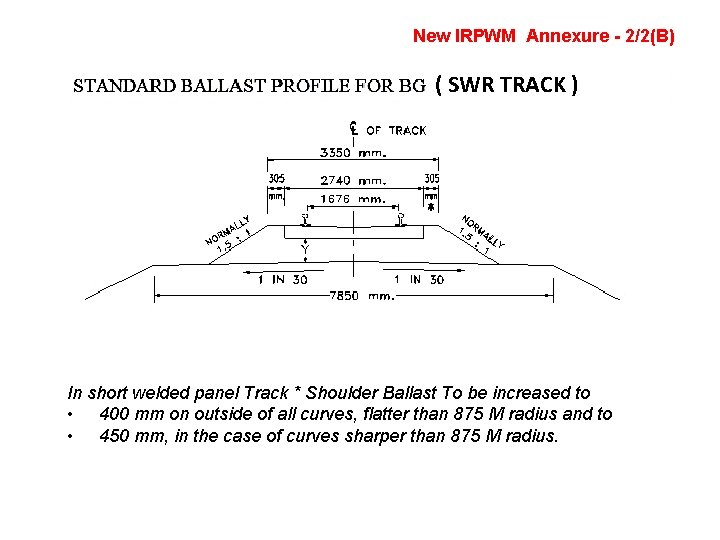
SHORT WELDED RAILS • A welded Rail which expand contract throughout its length due to temperature variation, is called Short Welded Rail. • The length of SWR shall normally be kept upto 39 Metre • New IRPWM Para 317 • SWR shall be laid generally on stable and efficiently drained formation. 100 mm extra width of shoulder ballast over and above the standard ballast section on tangent track shall be provided on outside of curves upto 875 metre radius. In case of sharper curves, the extra width shall be 150 mm. In case of 60 kg/m Rails, LWR profile shall be adopted. • • •
Condition of Laying New IRPWM Para 318 (1) Alignment– • SWR on PSC sleepers shall not be laid on curves sharper than 440 metre radius. • Existing SWR laid on sharper curves may, however, be allowed to continue if there is no difficulty experienced in maintaining these lengths. Chief Track Engineer’s approval should be taken in such cases. (2) Junction with insulated joints and points and crossings– • SWR butting against insulated joints, heel of crossing and stock rail joints, shall be anchored for a length of 39 metre on the approach effectively to arrest creep in either direction.
Condition of Laying New IRPWM Para 318 (3) Laying of SWR on Bridges • (a) SWR maybe continued over girder bridges with un-ballasted decks up to 13. 3 m opening if the length of SWR is symmetrical to the centre line of bridge and up to 6. 1 m opening if the length of SWR is unsymmetrical to the centre line of the bridge. • (b) No fish-plated joint should be located on the girder or within six metre from either abutment. In all such cases rail free fastenings, such as rail free clips shall be used, so that relative movement between rail and sleepers may take place. • (c) 26 m long rolled rail may be laid on bridges with 1. 0 m long fishplate and 06 bolts. Joint gaps to be provided and maintained as per given table (4) Laying of SWR in Level Crossings • In the case of SWR, the short-welded panel may be continued through the level crossing, avoiding fish plated joint on the level crossing and within six metres from the end of level crossing.
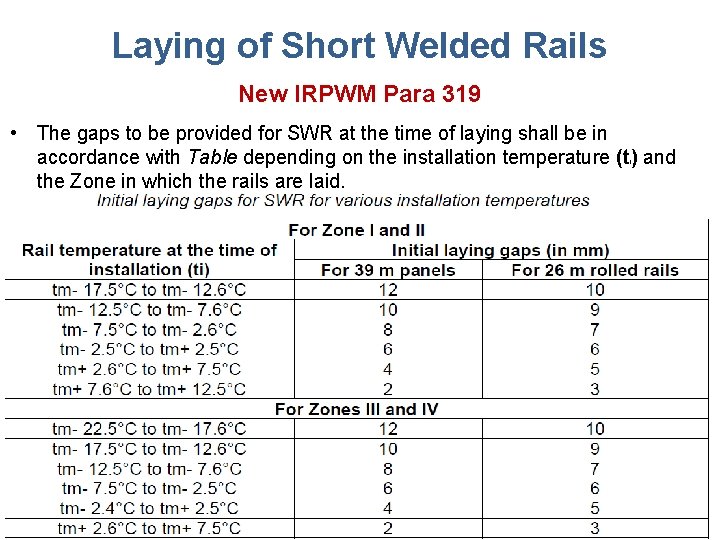
Laying of Short Welded Rails New IRPWM Para 319 • The gaps to be provided for SWR at the time of laying shall be in accordance with Table depending on the installation temperature (t ) and the Zone in which the rails are laid. i
Gap Survey and Adjustment of Gap New IRPWM Para 320 (1) General : • Gap survey and rectification of gaps is to be carried out, in stretches where track develops excessive creep, jammed joints, sun kinks, misalignment, wide gaps, battered and hogged joints, fractures at joints and bending of bolts etc. • In SWR, the gap survey and adjustment should normally be done before the end of February once a year (i. e. before onset of summer).
Gap Survey and Adjustment of Gap New IRPWM Para 320 (2) Gap Survey : • (a) The gap survey shall be conducted on a clear and sunny day in the cool hours of the day in rising rail temperature trend. • (b) The length over which gap survey is to be done should, wherever possible, be divided into suitable sub-sections, each bounded by fixed points such as level crossings, points and crossings etc. • The survey should be completed during as short a time as possible, by employing adequate number of parties so that the rail temperature is not likely to vary appreciably.
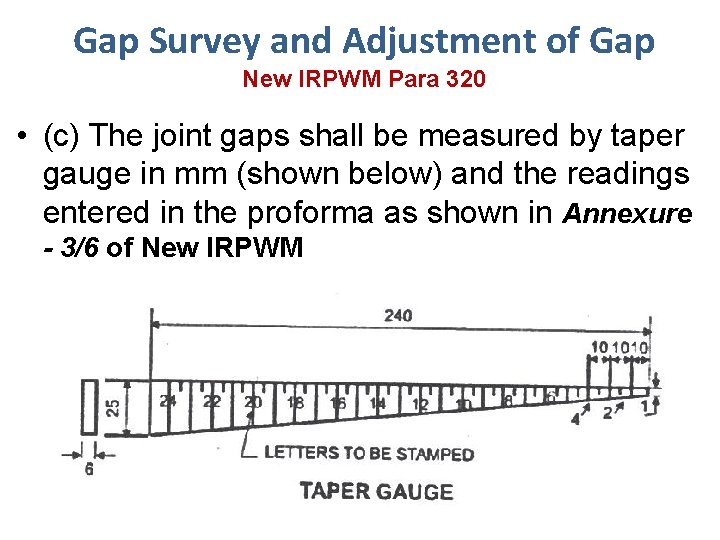
Gap Survey and Adjustment of Gap New IRPWM Para 320 • (c) The joint gaps shall be measured by taper gauge in mm (shown below) and the readings entered in the proforma as shown in Annexure - 3/6 of New IRPWM
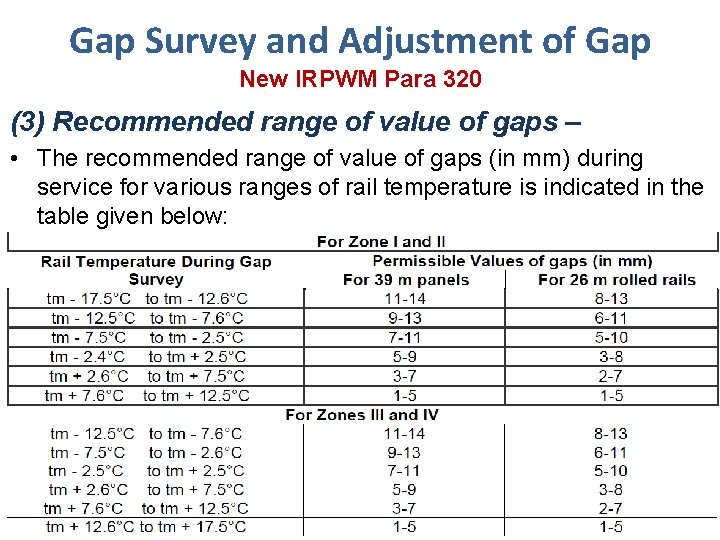
Gap Survey and Adjustment of Gap New IRPWM Para 320 (3) Recommended range of value of gaps – • The recommended range of value of gaps (in mm) during service for various ranges of rail temperature is indicated in the table given below:
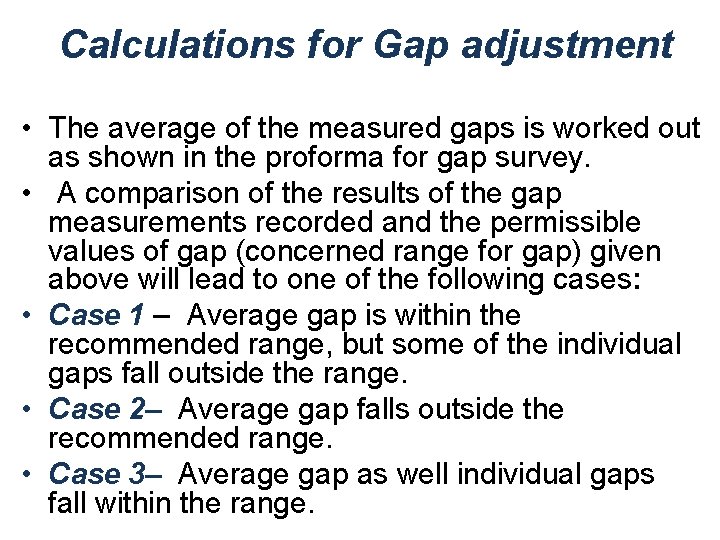
Calculations for Gap adjustment • The average of the measured gaps is worked out as shown in the proforma for gap survey. • A comparison of the results of the gap measurements recorded and the permissible values of gap (concerned range for gap) given above will lead to one of the following cases: • Case 1 – Average gap is within the recommended range, but some of the individual gaps fall outside the range. • Case 2– Average gap falls outside the recommended range. • Case 3– Average gap as well individual gaps fall within the range.
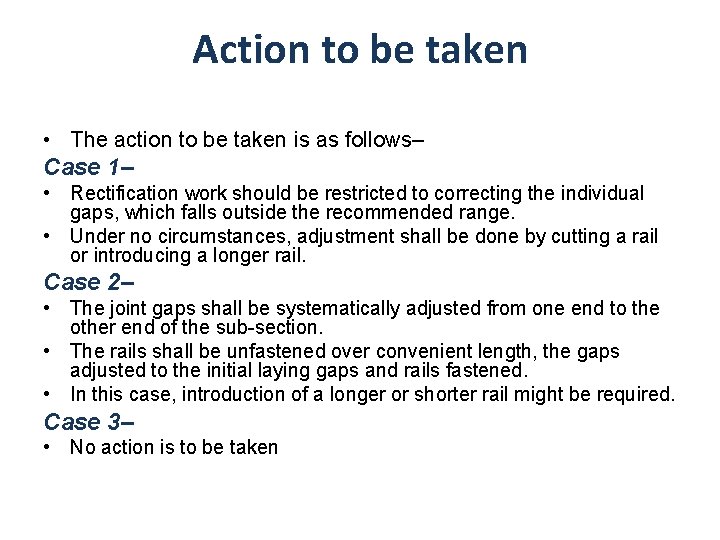
Action to be taken • The action to be taken is as follows– Case 1– • Rectification work should be restricted to correcting the individual gaps, which falls outside the recommended range. • Under no circumstances, adjustment shall be done by cutting a rail or introducing a longer rail. Case 2– • The joint gaps shall be systematically adjusted from one end to the other end of the sub-section. • The rails shall be unfastened over convenient length, the gaps adjusted to the initial laying gaps and rails fastened. • In this case, introduction of a longer or shorter rail might be required. Case 3– • No action is to be taken
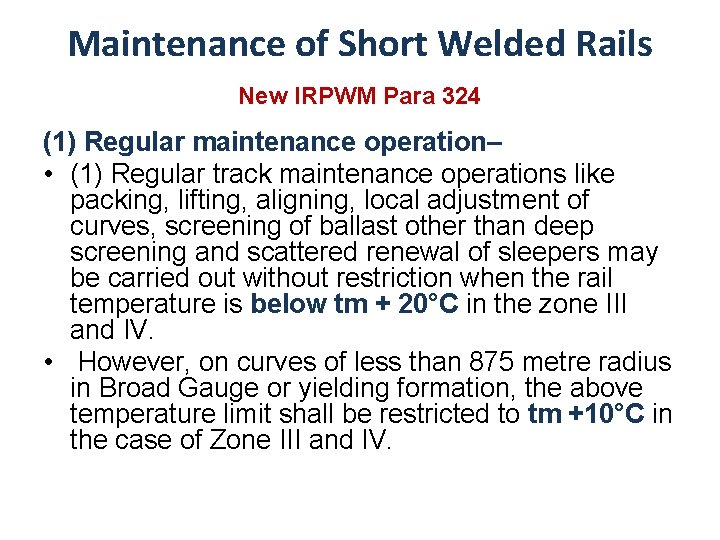
Maintenance of Short Welded Rails New IRPWM Para 324 (1) Regular maintenance operation– • (1) Regular track maintenance operations like packing, lifting, aligning, local adjustment of curves, screening of ballast other than deep screening and scattered renewal of sleepers may be carried out without restriction when the rail temperature is below tm + 20°C in the zone III and IV. • However, on curves of less than 875 metre radius in Broad Gauge or yielding formation, the above temperature limit shall be restricted to tm +10°C in the case of Zone III and IV.
Maintenance of Short Welded Rails contd…. . New IRPWM Para 324 (1) Regular maintenance operation– • (2) If the maintenance operations have to be undertaken at temperature higher than that mentioned in Sub-Para (1) above, not more than 30 sleeper spaces in one continuous stretch shall be opened, leaving at least 30 fully boxed sleeper spaces between adjacent lengths which are opened out. • Before the end of the day’s work, it shall be ensured that the ballast is boxed up.
Maintenance of Short Welded Rails contd…. . New IRPWM Para 324 (1) Regular maintenance operation– • (3) As an additional precaution, during summer months, to be specified by the Chief Engineer, for attention to run down track, even if temperature is less than the temperature specified in Sub-Para (1) above, not more than 30 sleeper spaces in one continuous stretch shall be opened, leaving at least 30 fully boxed sleeper spaces between adjacent lengths which are opened out. • Further, if joint gaps are not available at the time of opening of the track even when rail temperature are less than those specified in clause Sub-Para (1) above not more than 30 sleepers in one continuous stretch should be opened leaving at least 30 boxed sleeper spaces between adjacent length which are opened up.
Maintenance of Short Welded Rails contd…. . New IRPWM Para 324 (1) Major maintenance operation– • (4) Major lifting, major alignment of track, deep screening and renewal of sleepers in continuous length • Each of these operations shall be done under suitable precautions and normally when the rail temperature is below tm + 10°C in the case of Zone III and IV. • If it becomes necessary to undertake such works at rail temperature exceeding the above values, adequate speed restrictions shall be imposed.
Maintenance of Short Welded Rails contd…. . New IRPWM Para 324 • (5) Adequate number of joggled fishplates with special clamps shall be provided to the gangs for use in emergencies. • (6) In the case of any fracture in the weld or in the rail, • the portion of rail with fracture is cut, and removed for a length of not less than 5. 5 m to carry out the re-welding duly introducing a rail piece of equivalent length, also ensuring that no weld lies closer than 4 m from the fishplated joint.
New IRPWM Annexure - 2/2(B) ( SWR TRACK ) In short welded panel Track * Shoulder Ballast To be increased to • 400 mm on outside of all curves, flatter than 875 M radius and to • 450 mm, in the case of curves sharper than 875 M radius.
Creep New IRPWM Para 321 • (1) General– • Rails have a tendency to move gradually in the direction of the dominant traffic. • It is believed to be caused by the ‘ironing out’ of yielding track by the moving load, • Augmented by braking loads, • Impact of the wheels on the running-on ends of the rails, particularly at times when they are in a state of expansion or contraction.
Troubles caused by ‘creep’ • • • (a) Sleepers getting out of square. (b) Distortion of gauge. (c) Loosening of joints. (d) Shearing and breaking of bolts and fishplates. (e) Buckling in extreme cases.
Causes for creep • Some of the avoidable causes to which creep is attributed: • (a) Inadequate toe loads of the fastening and rails not secured properly to sleeper. • (b) Inadequate ballast resistance to the movement of sleepers due to poor or insufficient ballast or other causes. • (c) Inefficient or badly maintained rail joints. • (d) Improper expansion gaps. • (e) Damaged sleepers, uneven spacing of sleepers. • (f) Lack of proper drainage. • (g) Yielding formation. • (h) Loose/uneven packing.
Precautions to reduce Creep • The PSC sleepers with effective elastic fastenings are considered as creep resistant and therefore no other creep anchors are required. • In case, excessive creep is observed on PSC sleeper road, the condition of elastic fastenings, sleepers and adequacy of ballast resistance should be examined. • Action for replacement/ renewal of fittings, sleepers and providing adequate ballast resistance etc. should be taken as necessary.
Creep Record • Creep records should be maintained in the proforma given in Annexure - 3/7. • Entries should be complete as regards kilometerage, section and length of rail, sleeper density. • Periodical readings of creep should be recorded in TMS in the prescribed pro forma. • Frequency of recording of creep should be specified by the Divisional Engineer taking into consideration the rate of creep. • The Assistant Engineer should test check the record frequently, particularly sections which are prone to creep.
Creep Indicator Posts • Creep indicator posts, square to the track should be erected on either side of the track on the cess at suitable intervals of not more than one km apart. • These may be unserviceable rail posts with chisel mark square to the joints. • The top of the post should be about 25 mm above the rail level and the amount of creep one way or the other measured with a fishing cord stretched over the chisel marks.
Adjustment of Creep • Creep in excess of 150 mm shall not be permitted. • Adjustments of creep should be carried out in the following manner: • (a) It is a good practice to adjust creep before the commencement of summer. • It is desirable to pull back the rails during the cool hours of the day. • (b) Careful measurement of expansion gaps, as existing, should be done and appropriate length, which can be dealt with in one operation should be chosen. • The total amount of gap in the length should be equal to the standard expansion gap required for the temperature at the time, multiplied by the number of joints in the length.
Adjustment of Creep Contd…. . • (c) Work should start at the running-on end of the length, commonly just beyond the points and crossings or level crossings. • The work of creep adjustments should be carried out under the protection of engineering signals by the JE/SSE/P. Way as envisaged or under traffic block, on busy routes. • (d) When the value of total gap existing is more than the standard expansion gap required for the temperature at the time of adjustment multiplied by the number of joints, it is necessary to provide closure rails. • When closure rails are put in, a speed restriction of 30 Kmph should be imposed, which should be removed, when closure rail is changed.
THANK YOU