
New Insights into Substance Use Disorders SUD From
New Insights into Substance Use Disorders (SUD) From Brain Imaging Iliyan Ivanov. MD Mount Sinai School of Medicine Alcohol Medical Scholars Program ©AMSP 2012 1
Substance Use Disorders (SUD) They are: • Prevalent Lifetime risk ~ 20% Past year ~8% • Expensive ↓ Work ↑ Health care ↑ Crime • Can be difficult to treat 25 -50% relapse in 3 -6 month Handful of FDA approved Tx ©AMSP 2012 2
SUD Biology & New Tx • SUDs → changes in brain networks • Understanding changes → new Tx • Neuroimaging may ↑ insights for: Brain regions/networks related to SUD Neurochemicals mediating drug effects ©AMSP 2012 3
This Lecture Will Review • Definitions & backgrounds • Biological systems relevant to SUDs • Visualizing brain systems with neuroimaging • Clinical & Tx applications ©AMSP 2012 4
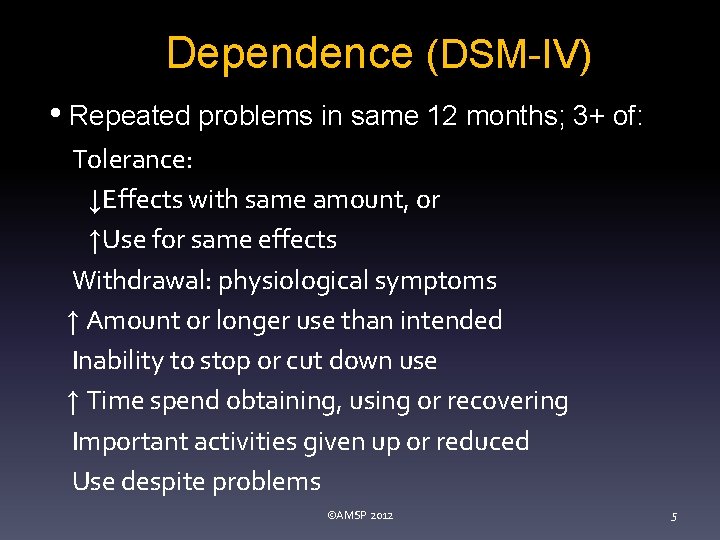
Dependence (DSM-IV) • Repeated problems in same 12 months; 3+ of: Tolerance: ↓Effects with same amount, or ↑Use for same effects Withdrawal: physiological symptoms ↑ Amount or longer use than intended Inability to stop or cut down use ↑ Time spend obtaining, using or recovering Important activities given up or reduced Use despite problems ©AMSP 2012 5
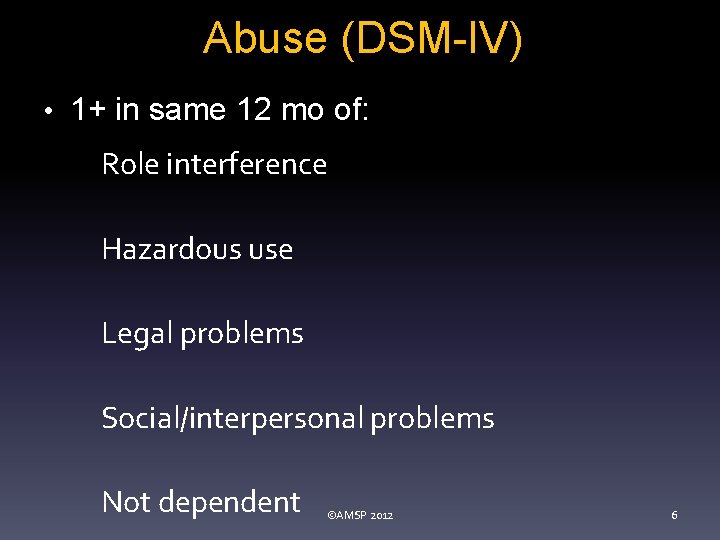
Abuse (DSM-IV) • 1+ in same 12 mo of: Role interference Hazardous use Legal problems Social/interpersonal problems Not dependent ©AMSP 2012 6
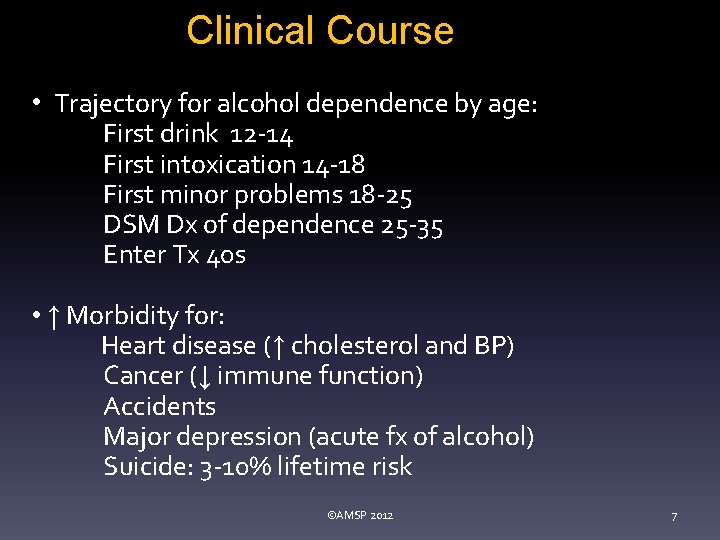
Clinical Course • Trajectory for alcohol dependence by age: First drink 12 -14 First intoxication 14 -18 First minor problems 18 -25 DSM Dx of dependence 25 -35 Enter Tx 40 s • ↑ Morbidity for: Heart disease (↑ cholesterol and BP) Cancer (↓ immune function) Accidents Major depression (acute fx of alcohol) Suicide: 3 -10% lifetime risk ©AMSP 2012 7
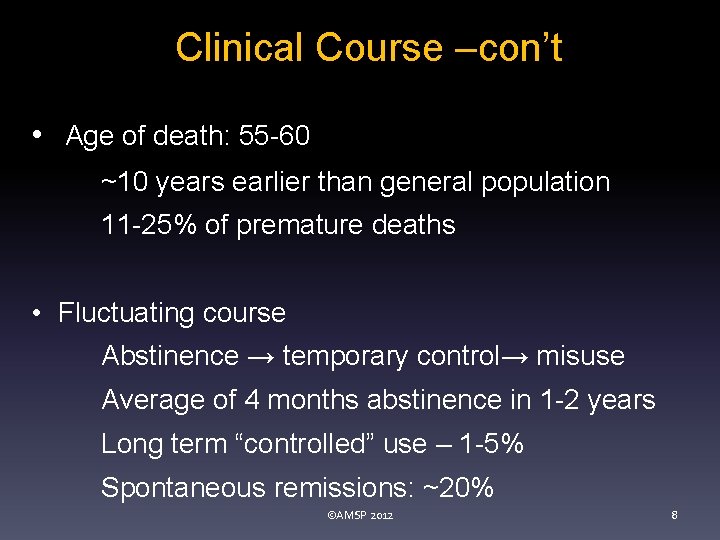
Clinical Course –con’t • Age of death: 55 -60 ~10 years earlier than general population 11 -25% of premature deaths • Fluctuating course Abstinence → temporary control→ misuse Average of 4 months abstinence in 1 -2 years Long term “controlled” use – 1 -5% Spontaneous remissions: ~20% ©AMSP 2012 8
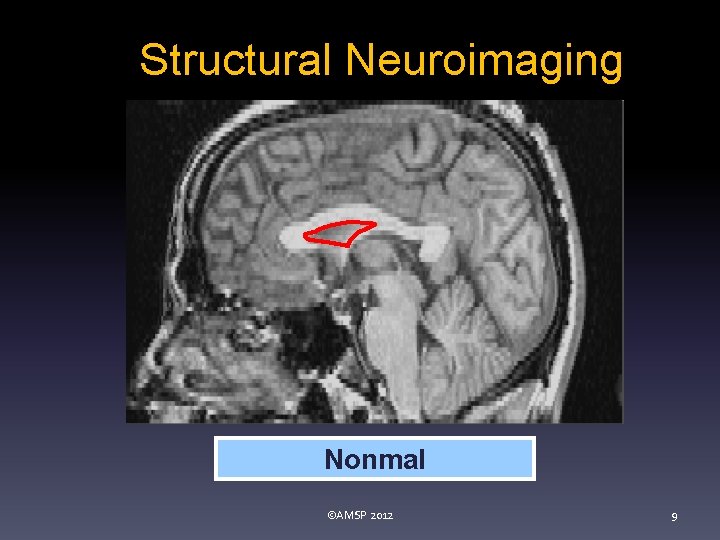
Structural Neuroimaging Nonmal ©AMSP 2012 9
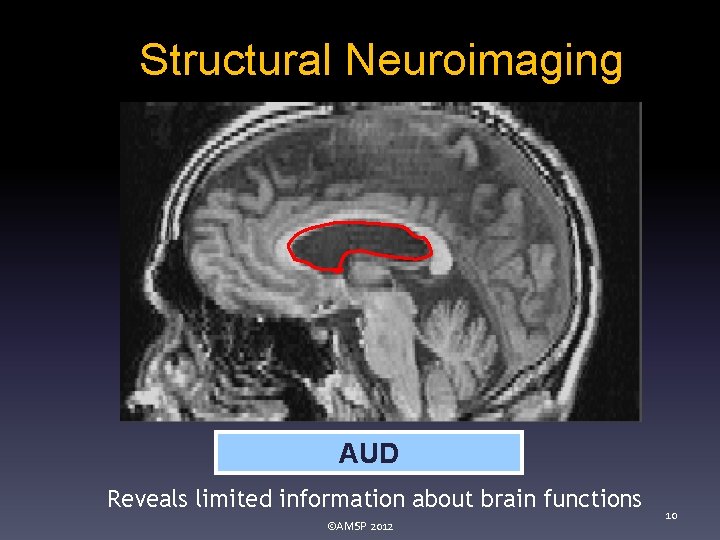
Structural Neuroimaging AUD Reveals limited information about brain functions ©AMSP 2012 10
Imaging Can Show Functioning • Acute drug effects Opioids stimulate opioid receptors Amphet/cocaine ↑ dopamine (DA) Depressants ↑ γ-Aminobutyric acid (GABA) ↓ Glutamate • Positive reinforces→ ↑ acute DA release Natural rewards (e. g. food) → bursts of DA Most drugs ↑ DA 10 fold over natural rewards ©AMSP 2012 11
Stopping Drugs → Opposite Effects • Chronic use may cause ↓ Number of DA receptors in striatum ↓ Blood circulation throughout brain • Stopping use may result in ↑ Number receptors ↓ by chronic use Blood circulation normalizes ©AMSP 2012 12
Regional Drug Effects • Mostly in regions rich in DA (e. g. Striatum) Consist of Caudate Putamen Globus pallidus Divided into Ventral striatum/nucleus accumbens (NAcc) - Motivation - Experience of rewards Dorsal striatum (caudate & putamen) - Decision making - Initiation of action ©AMSP 2012 13
![Drug Effects on the Brain • Drugs target the striatum [11 C] COCAINE UPTAKE](http://slidetodoc.com/presentation_image_h2/6bc0b59a585772488c70a4974af4a381/image-14.jpg "Drug Effects on the Brain • Drugs target the striatum [11 C] COCAINE UPTAKE")
Drug Effects on the Brain • Drugs target the striatum [11 C] COCAINE UPTAKE IN HUMAN STRIATUM 0, 010 3 -4 5 -6 0, 008 % DOSE /cc 1 -2 Min 6 -7 7 -8 8 -9 0, 006 0, 004 STRIATUM 0, 002 0, 000 0 16 32 48 64 80 Time (mins) 9 -10 10 -20 20 -30 14
2 Neurosystems Key to Drug Effects • Behavioral Activation System (BAS) Functions – ↑ person’s actions BAS includes: NAcc, orbito-frontal cortex Activity affects sensitivity to rewards ©AMSP 2012 15
Behavioral Inhibition System (BIS) • Modulate person’s actions - ↑ BIS activity = ↑ inhibition of action - ↓ Activity = ↓ inhibition of action = impulsivity Consists of - Dorso-lateral prefrontal cortex (DLPC) - Inferior frontal cortex (IFC) - Anterior cingulate cortex (ACC) • Changed activity results in ↑ or ↓ impulsivity ©AMSP 2012 16
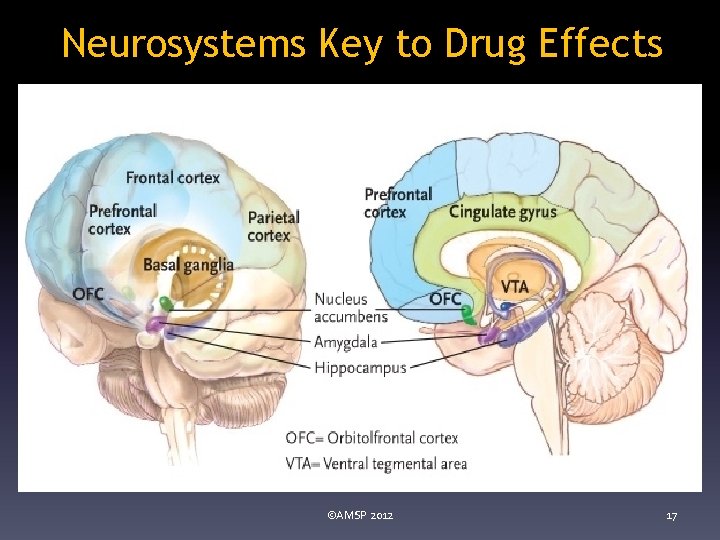
Neurosystems Key to Drug Effects ©AMSP 2012 17
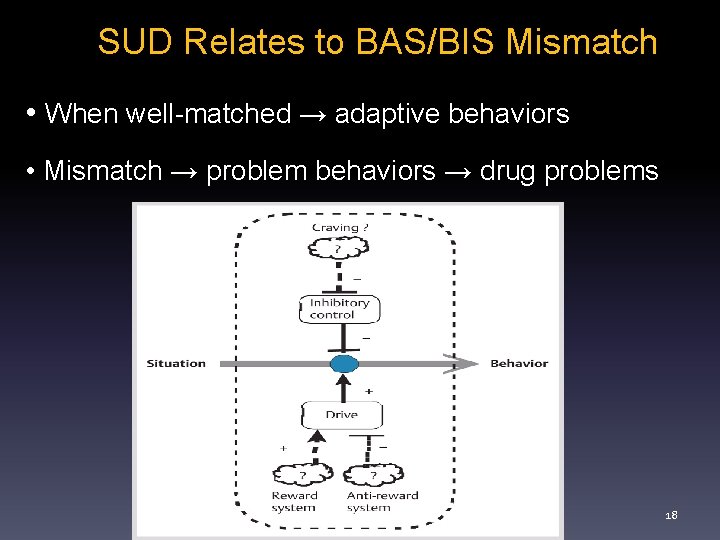
SUD Relates to BAS/BIS Mismatch • When well-matched → adaptive behaviors • Mismatch → problem behaviors → drug problems ©AMSP 2012 18
Functional Neuroimaging of BAS/ BIS • Methods with radioactive chemicals Positron Emission-Tomography (PET) Single Proton Emission Computer Tomography (SPECT) • Visualize Changes in blood flow Distribution of nutrients (glucose) Chemicals binding to brain receptors e. g. DA • Short comings Low resolution (fuzzy brain pix) Expensive Radiation exposure to subjects/staff ©AMSP 2012 19
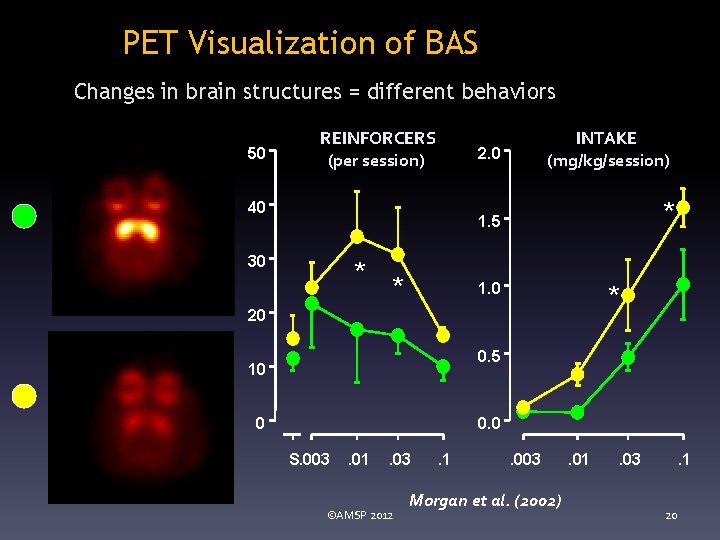
PET Visualization of BAS Changes in brain structures = different behaviors 50 REINFORCERS (per session) INTAKE (mg/kg/session) 2. 0 40 * 1. 5 30 * * 1. 0 * 20 0. 5 10 0 0. 0 S. 003 . 01 . 03 ©AMSP 2012 . 1 . 003 Morgan et al. (2002) . 01 . 03 . 1 20
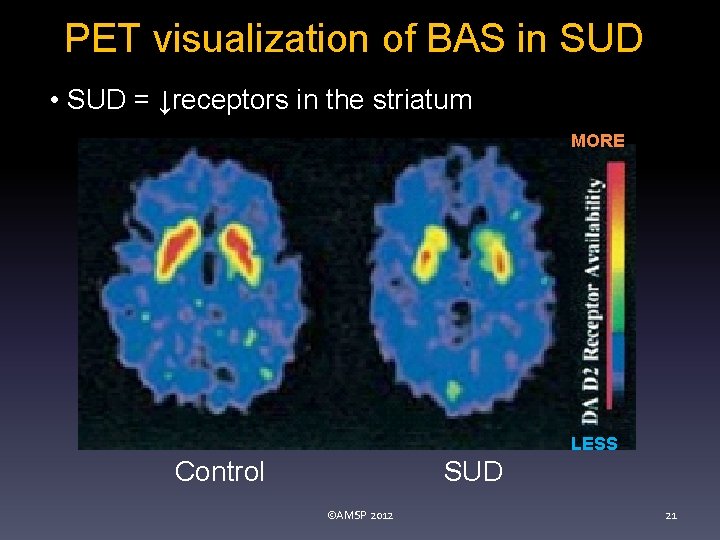
PET visualization of BAS in SUD • SUD = ↓receptors in the striatum MORE LESS Control SUD ©AMSP 2012 21
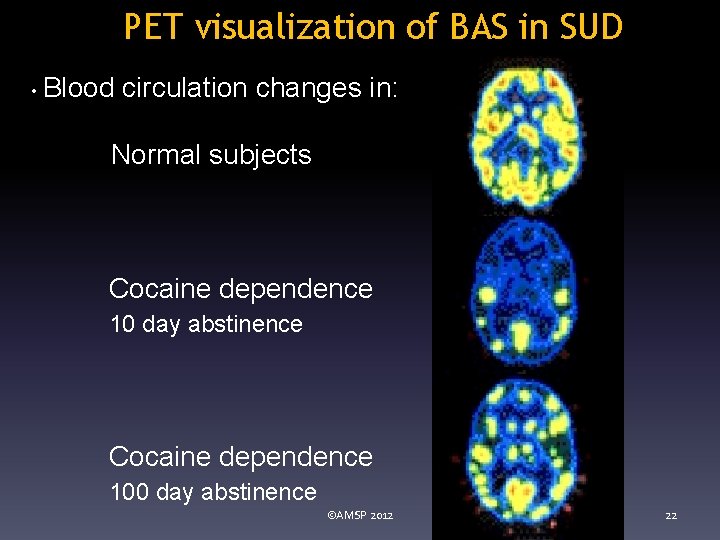
PET visualization of BAS in SUD • Blood circulation changes in: Normal subjects Cocaine dependence 10 day abstinence Cocaine dependence 100 day abstinence ©AMSP 2012 22
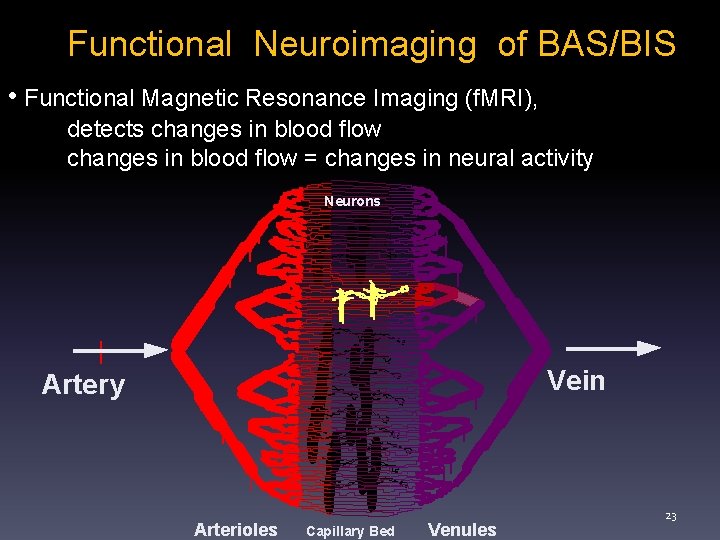
Functional Neuroimaging of BAS/BIS • Functional Magnetic Resonance Imaging (f. MRI), detects changes in blood flow = changes in neural activity Neurons Vein Artery Arterioles Capillary Bed Venules 23
Functional Neuroimaging of BAS/BIS • Other methods Magnetic Resonance Spectroscopy (MRS) - Uses “magnetic signature” of brain molecules - Detect ↑ vs. ↓ concentration of the molecules - ↕ in concentration = cellular dysfunctions MR shows both structure & function - High resolution - Show differences in brain activity during tasks - No radiation exposure • Short comings → expensive ©AMSP 2012 24
f. MRI Best Image of BIS Function • Is best because: Inhibition best studied in “real time” Inhibitory tasks engage cortical-structures PET NOT in real time • Show functions during cognitive task Motor : e. g. don’t press button Cognitive : e. g. name color vs. read word Drug related images (drug vs. neutral cues) ©AMSP 2012 25
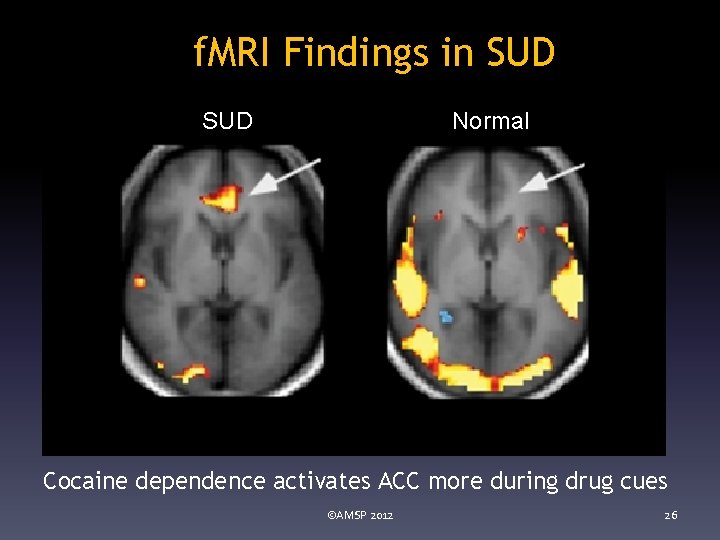
f. MRI Findings in SUD Normal Cocaine dependence activates ACC more during drug cues ©AMSP 2012 26
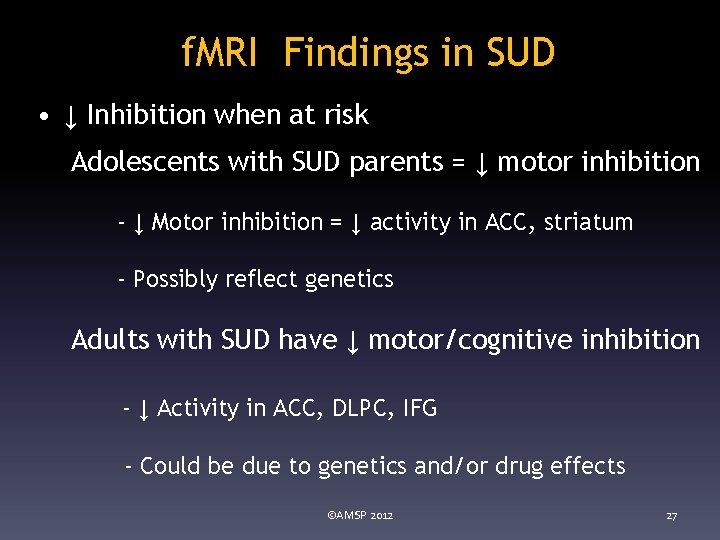
f. MRI Findings in SUD • ↓ Inhibition when at risk Adolescents with SUD parents = ↓ motor inhibition - ↓ Motor inhibition = ↓ activity in ACC, striatum - Possibly reflect genetics Adults with SUD have ↓ motor/cognitive inhibition - ↓ Activity in ACC, DLPC, IFG - Could be due to genetics and/or drug effects ©AMSP 2012 27
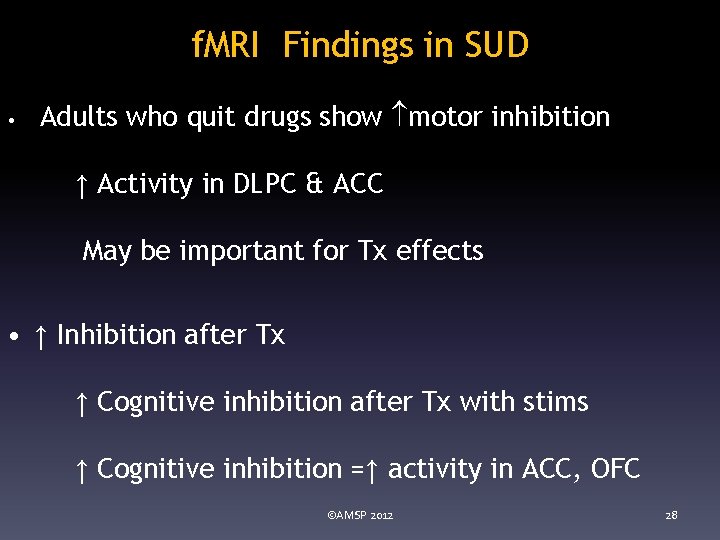
f. MRI Findings in SUD • Adults who quit drugs show motor inhibition ↑ Activity in DLPC & ACC May be important for Tx effects • ↑ Inhibition after Tx ↑ Cognitive inhibition after Tx with stims ↑ Cognitive inhibition =↑ activity in ACC, OFC ©AMSP 2012 28
New Insights in SUD from Neuroimaging • Functional model for SUD • Biological basis of recovery • Visualizing Tx effects ©AMSP 2012 29
SUD Functional Model • ↑ BAS and ↓ BIS high drive & low inhibition • High drive and low inhibition = ↑substance use • ↑ Substance use may lead to SUD • SUD may be related to BAS/BIS mismatch • Mismatch might predate SUD = biological risk ©AMSP 2012 30
Neuroimaging and SUD Recovery • Drug induced physiological symptoms last 48 -72 hrs • Low BAS activity lasts ~ 30 days • Full recovery of BAS activity occurs > 1 year • Even in late sobriety perform worse on tasks • Prescription drugs may “speed up” recovery ©AMSP 2012 31
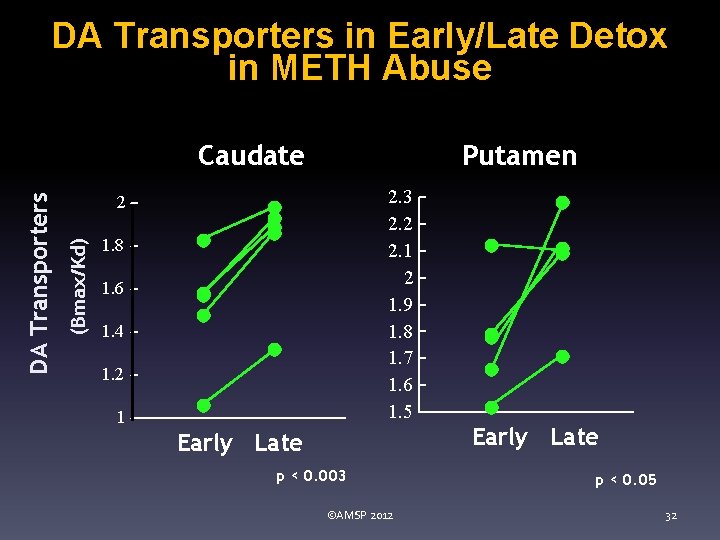
DA Transporters in Early/Late Detox in METH Abuse Putamen 2. 3 2. 2 2. 1 2 1. 9 1. 8 1. 7 1. 6 1. 5 2 (Bmax/Kd) DA Transporters Caudate 1. 8 1. 6 1. 4 1. 2 1 Early Late p < 0. 003 ©AMSP 2012 p < 0. 05 32
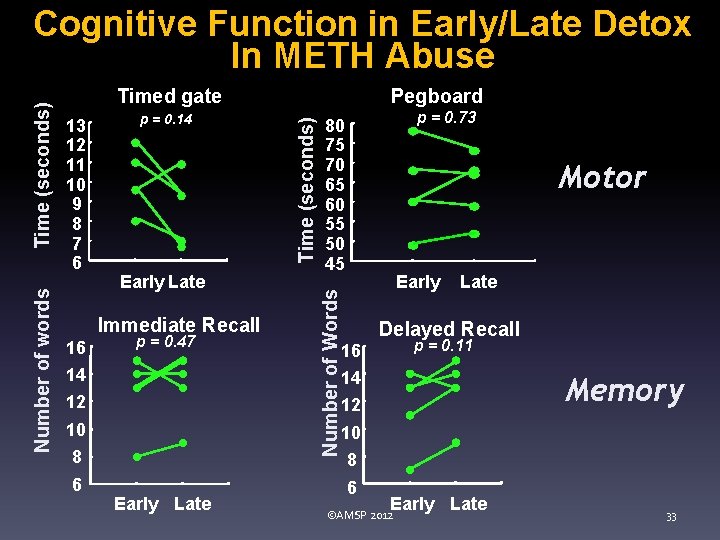
13 12 11 10 9 8 7 6 p = 0. 14 Early Late Immediate Recall 16 p = 0. 47 14 p = 0. 73 80 75 70 65 60 55 50 45 Motor Early Late Delayed Recall p = 0. 11 16 14 12 Memory 12 10 10 8 6 Pegboard Time (seconds) Timed gate Number of Words Number of words Time (seconds) Cognitive Function in Early/Late Detox In METH Abuse Early Late 8 6 Early Late ©AMSP 2012 33
Neuroimaging and Tx Effects on BAS/BIS • Tx may affect brain activity by Meds affect brain function = f. MRI detects changes Behavioral Tx = ↑ cognition ↑ Cognition = ↑ brain activity = detected by f. MRI ©AMSP 2012 34
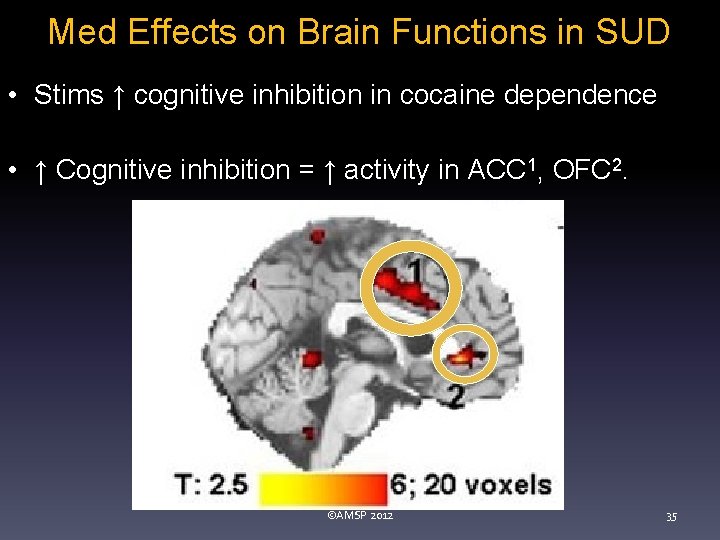
Med Effects on Brain Functions in SUD • Stims ↑ cognitive inhibition in cocaine dependence • ↑ Cognitive inhibition = ↑ activity in ACC 1, OFC 2. ©AMSP 2012 35
Neuroimaging and Behavioral Tx • Mesial (m)PFC → ↕ inhibition with drug cues ↓ Activity in m. PFCR =↓ inhibition = ↑ relapse risk Cognitive Tx → cognitive control Cognitive control → “normalizes” m. PFC activity “Normalized” m. PFC activity = ↓ relapse risk These changes can be tracked by f. MRI ©AMSP 2012 36
Summary • Understanding of SUD biology = new Rx • Neuroimaging knowledge of SUD biology • SUD biology → BAS/BIS functions • BAS/BIS functional mismatch = SUD • Rx for SUD restore BAS/BIS mismatch ©AMSP 2012 37
- Slides: 37