
New injector of KEKATF with photocathode RF Gun
- Slides: 13
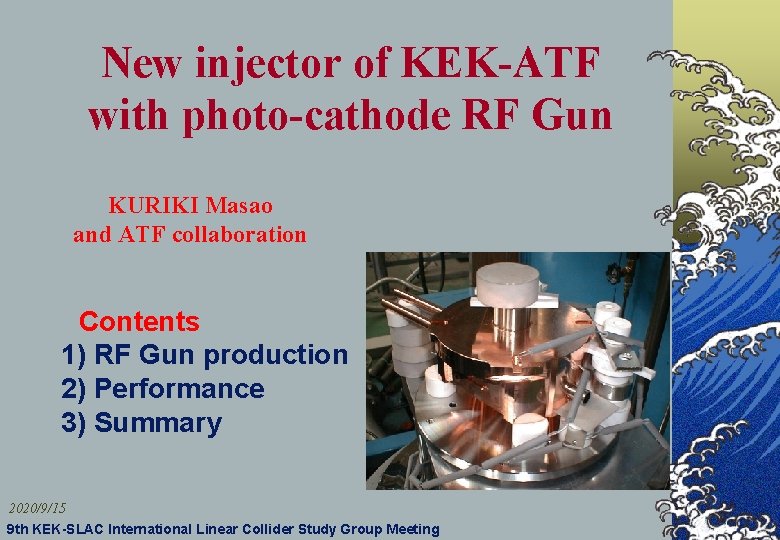
New injector of KEK-ATF with photo-cathode RF Gun KURIKI Masao and ATF collaboration Contents 1) RF Gun production 2) Performance 3) Summary 2020/9/15 9 th KEK-SLAC International Linear Collider Study Group Meeting
RF Gun production s s s We have already an experience making a RF gun in last year that is operated succesfully in Univ. of Tokyo, Tokai lab. Fine machining technology developed for X-band structure was utilized for this production. Blazing was done by a hydrogen atmosphere oven in KEK, so the gun is almost fully made by KEK. 2020/9/15 9 th KEK-SLAC International Linear Collider Study Group Meeting
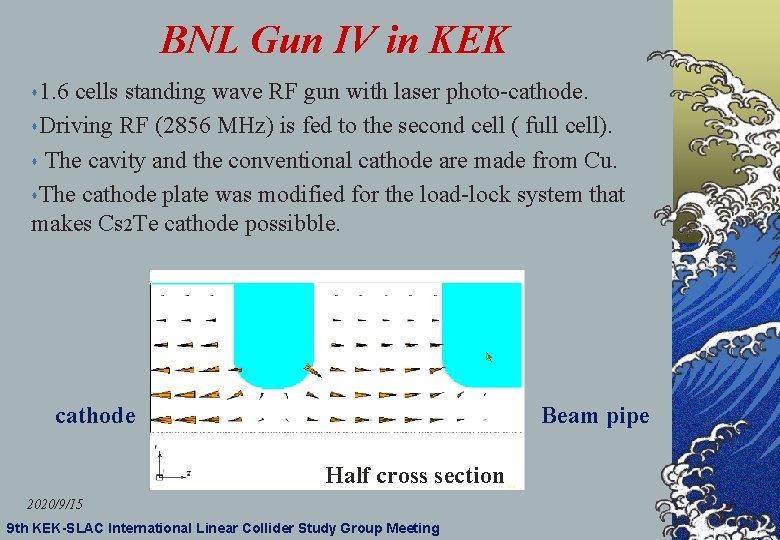
BNL Gun IV in KEK s 1. 6 cells standing wave RF gun with laser photo-cathode. s. Driving RF (2856 MHz) is fed to the second cell ( full cell). s The cavity and the conventional cathode are made from Cu. s. The cathode plate was modified for the load-lock system that makes Cs 2 Te cathode possibble. cathode Beam pipe Half cross section 2020/9/15 9 th KEK-SLAC International Linear Collider Study Group Meeting
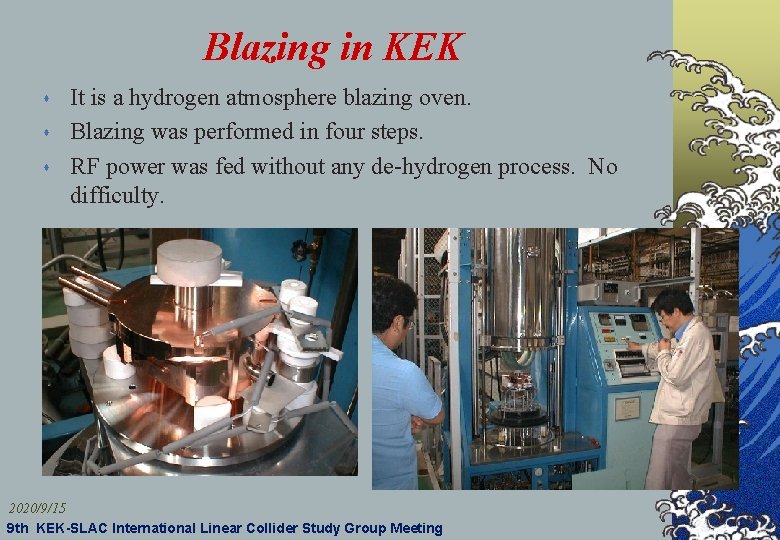
Blazing in KEK s s s It is a hydrogen atmosphere blazing oven. Blazing was performed in four steps. RF power was fed without any de-hydrogen process. No difficulty. 2020/9/15 9 th KEK-SLAC International Linear Collider Study Group Meeting
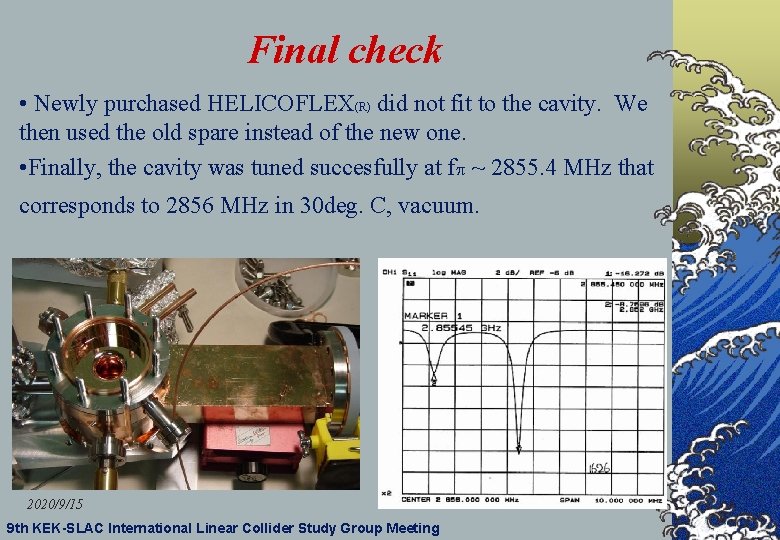
Final check • Newly purchased HELICOFLEX(R) did not fit to the cavity. We then used the old spare instead of the new one. • Finally, the cavity was tuned succesfully at fp ~ 2855. 4 MHz that corresponds to 2856 MHz in 30 deg. C, vacuum. 2020/9/15 9 th KEK-SLAC International Linear Collider Study Group Meeting
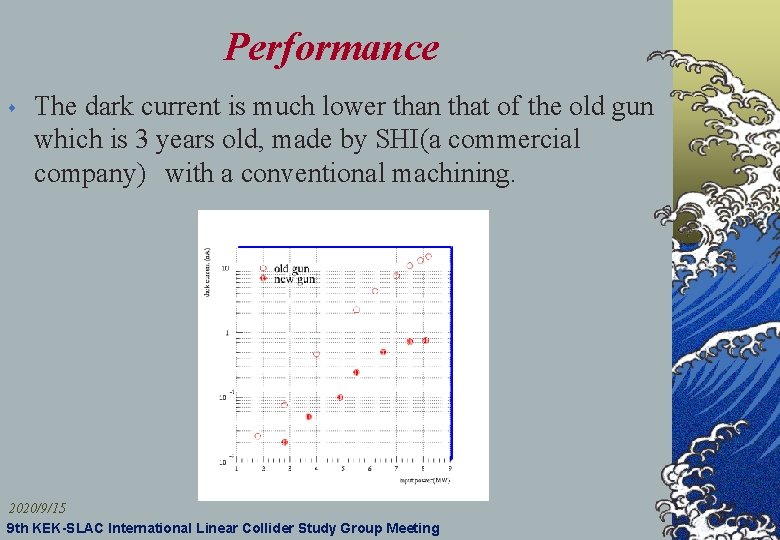
Performance s The dark current is much lower than that of the old gun which is 3 years old, made by SHI(a commercial company) with a conventional machining. 2020/9/15 9 th KEK-SLAC International Linear Collider Study Group Meeting
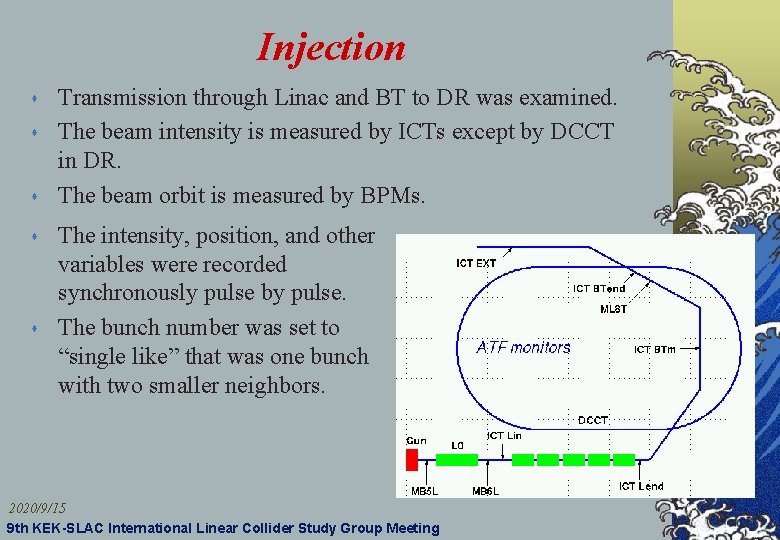
Injection s s s Transmission through Linac and BT to DR was examined. The beam intensity is measured by ICTs except by DCCT in DR. The beam orbit is measured by BPMs. The intensity, position, and other variables were recorded synchronously pulse by pulse. The bunch number was set to “single like” that was one bunch with two smaller neighbors. 2020/9/15 9 th KEK-SLAC International Linear Collider Study Group Meeting
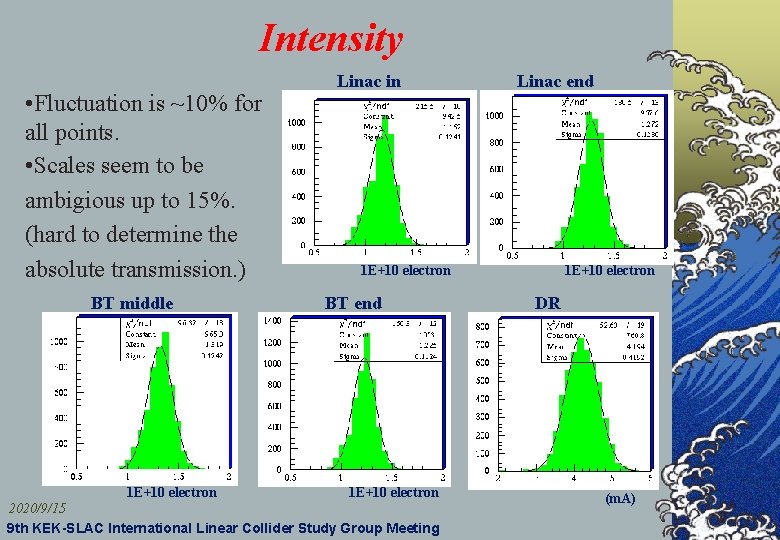
Intensity • Fluctuation is ~10% for all points. • Scales seem to be ambigious up to 15%. (hard to determine the absolute transmission. ) BT middle 1 E+10 electron Linac in Linac end 1 E+10 electron BT end 1 E+10 electron 2020/9/15 9 th KEK-SLAC International Linear Collider Study Group Meeting 1 E+10 electron DR (m. A)
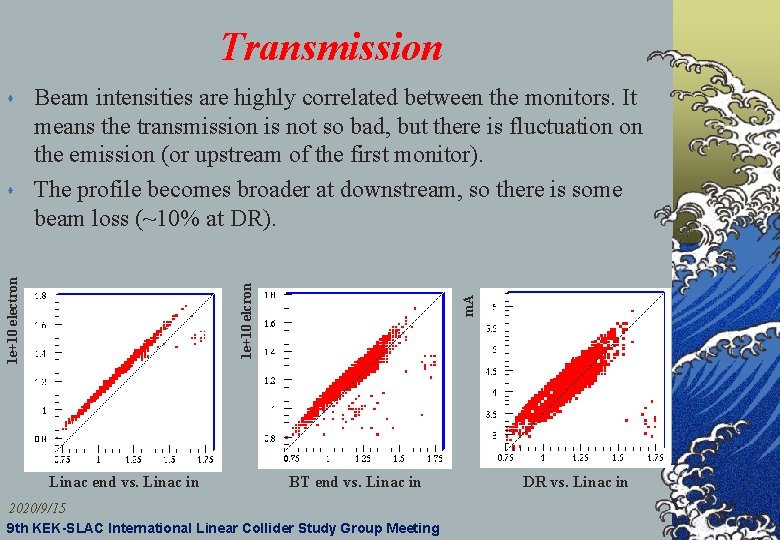
Transmission 1 e+10 elcron 1 e+10 electron s Beam intensities are highly correlated between the monitors. It means the transmission is not so bad, but there is fluctuation on the emission (or upstream of the first monitor). The profile becomes broader at downstream, so there is some beam loss (~10% at DR). Linac end vs. Linac in m. A s BT end vs. Linac in 2020/9/15 9 th KEK-SLAC International Linear Collider Study Group Meeting DR vs. Linac in
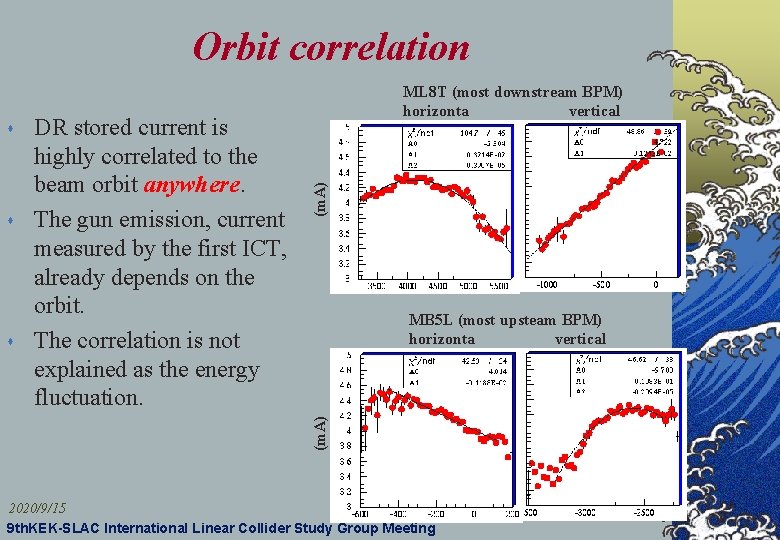
Orbit correlation s MB 5 L (most upsteam BPM) horizonta vertical (m. A) s DR stored current is highly correlated to the beam orbit anywhere. The gun emission, current measured by the first ICT, already depends on the orbit. The correlation is not explained as the energy fluctuation. (m. A) s ML 8 T (most downstream BPM) horizonta vertical 2020/9/15 9 th. KEK-SLAC International Linear Collider Study Group Meeting
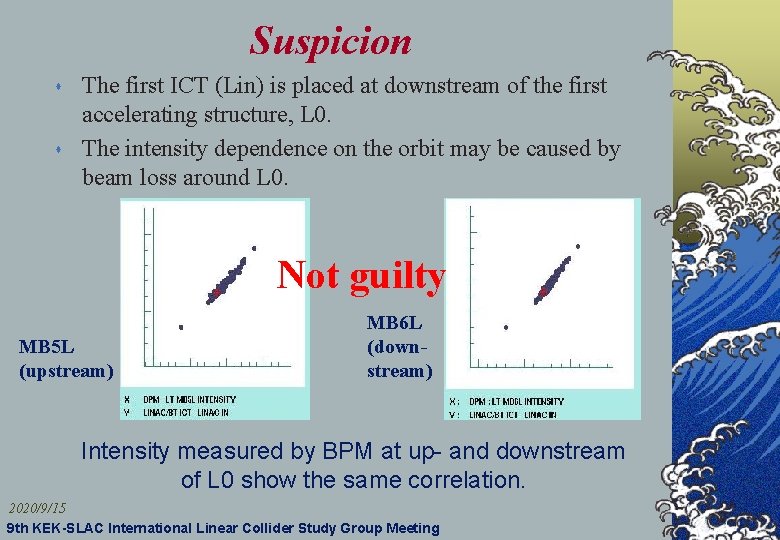
Suspicion s s The first ICT (Lin) is placed at downstream of the first accelerating structure, L 0. The intensity dependence on the orbit may be caused by beam loss around L 0. Not guilty MB 5 L (upstream) MB 6 L (downstream) Intensity measured by BPM at up- and downstream of L 0 show the same correlation. 2020/9/15 9 th KEK-SLAC International Linear Collider Study Group Meeting
Possible reason s s s Fluctuation on the laser power with position shit yields the intensity jitter. Pointing jitter of the laser spot causes the intensity jitter through the transimission position dependence. Observing the intensity by changing laser position manually might help to understand this issue. 2020/9/15 9 th KEK-SLAC International Linear Collider Study Group Meeting
Summary s s s A new RF Gun (BNL IV) is manufactured in KEK including the blazing process. The cavity surface was finished shiny by the state-of -the-art technology established by X-band R&D. Resonant frequency of the cavity was well tuned. Dark current became much lower. Transmission to DR looks not so bad. The intensity jitter is associated with the orbit jitter. Reason is not well understood. 2020/9/15 9 th KEK-SLAC International Linear Collider Study Group Meeting