
New Horizons Competency Based Education The CCC CBE
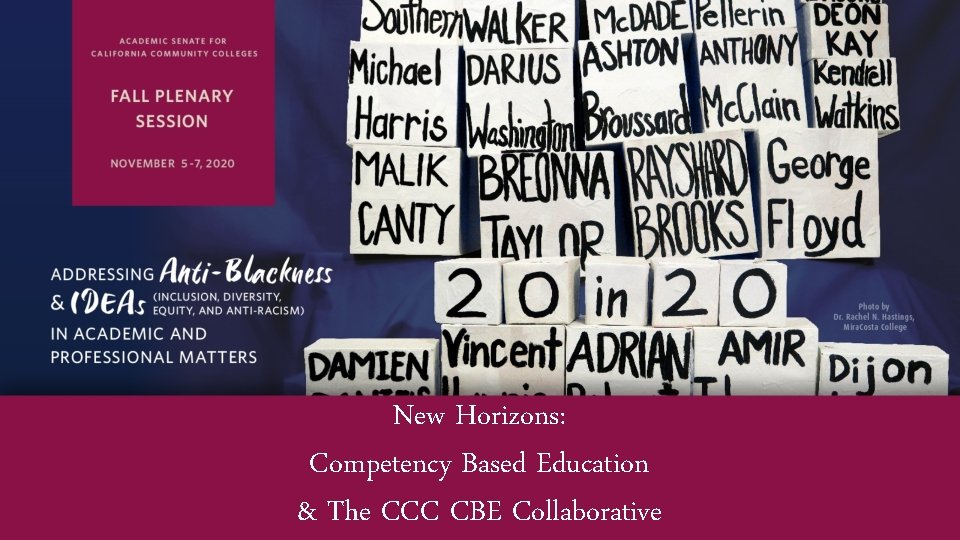
New Horizons: Competency Based Education & The CCC CBE Collaborative
Presenters / Introductions From the Chancellor’s Office • Aisha Lowe, Vice Chancellor for Educational Services and Support • Chantée Guiney, Specialist, Academic Planning and Support From the Student Success Center at the Foundation for CCCs • Nadia Leal-Carrillo, Director of Policy Development • Amparo Diaz, Senior Policy Specialist From ASCCC • Karen Chow, ASCCC Area B Representative • Cheryl Aschenbach, ASCCC Secretary ASCCC Fall Plenary 2020 2
Overview • Direct Assessment Competency-Based Education (DA CBE) • What is it? • Why implement it? Why now? • What are the differences between CBE, CPL, and traditional instruction? • CBE Collaborative • What is it? • What is the timeline • Who at colleges will be involved? • Anticipated Roles of Senate Presidents and Faculty ASCCC Fall Plenary 2020 3
Direct Assessment Competency-Based Education • What is it? • Why implement it? Why now? • What are the differences between CBE, Credit for Prior Learning (CPL), and traditional instruction? ASCCC Fall Plenary 2020 4

What is Competency Based-Education (CBE)? • CBE in CCC context is Direct Assessment Competency-Based Education • “Direct assessment competency-based education” in the California community colleges is an intentional outcomes-based and equityminded approach to earning a college degree in which the expectations of learning are held constant, but time is variable through a flexible, self -paced, high-touch and innovative learning practice (from proposed Title 5 regulations) • CBE is already possible within courses and programs. This effort is to now apply it to design and delivery of entire degree programs • CBE is a change from courses comprising a degree to competencies and sub-competencies within learning modules comprising a degree ASCCC Fall Plenary 2020 5
What is Competency-Based Education (CBE)? • Both the evaluation of student achievement and the award of a degree or credential are based solely on the demonstration and mastery of competencies • Students proceed at their own pace rather than progressing through courses in a traditional academic term timeline; faculty assist and facilitate the progress of each student individually • Students are expected to demonstrate the competency at a high level of achievement (mastery = 80%) • Conventional grades are not necessarily assigned; mastery is recorded • No punitive grades • Establishes “credit-hour equivalencies” between CBE competencies and traditional course student learning outcomes ASCCC Fall Plenary 2020 6
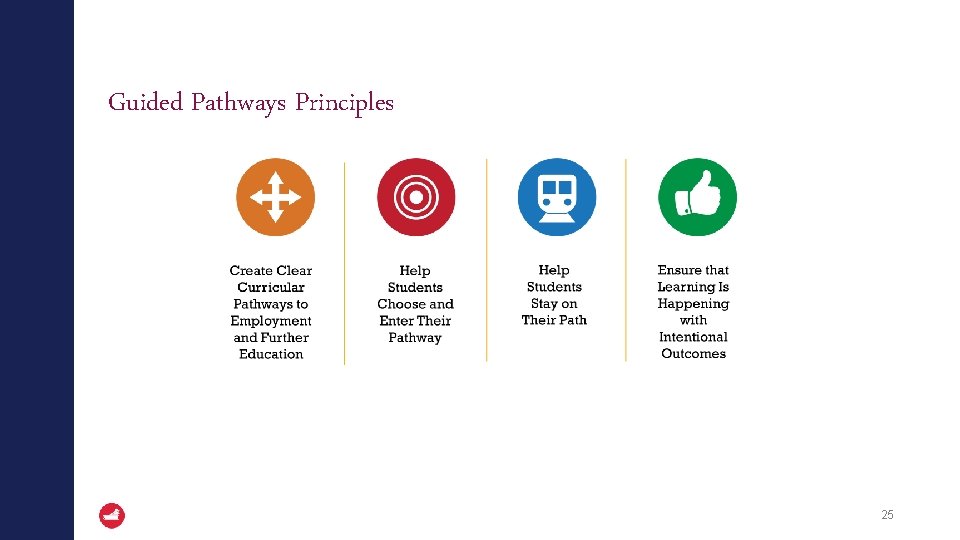
Why Implement It? Why Now? • Vision for Success & Core Commitments • Guided pathways: 4 pillars • Equity Imperative • Increased access and opportunity for working Californians with no college or some college but no degree ASCCC Fall Plenary 2020 Source: Back to College: Part One: California’s Imperative to Re-Engage Adults by California Competes (Oct 2018) 7
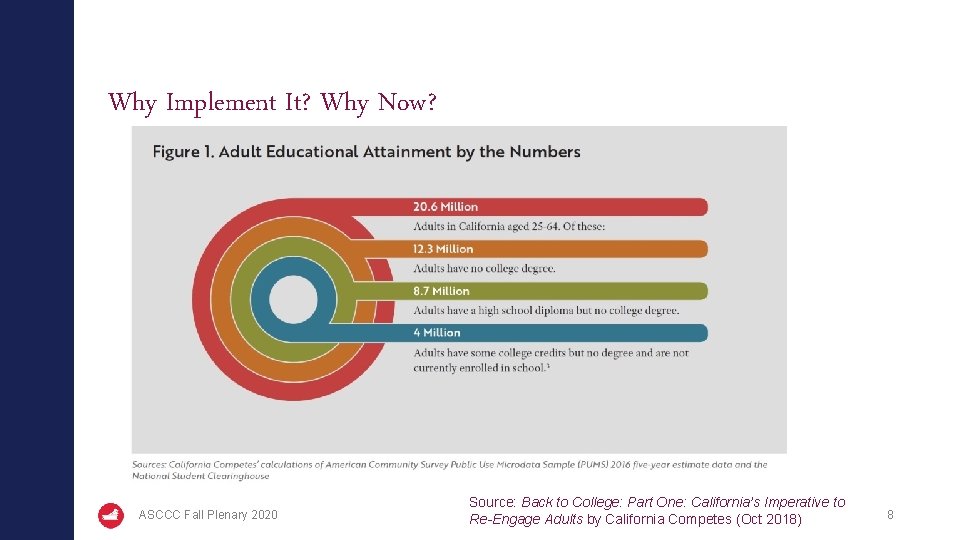
Why Implement It? Why Now? ASCCC Fall Plenary 2020 Source: Back to College: Part One: California’s Imperative to Re-Engage Adults by California Competes (Oct 2018) 8
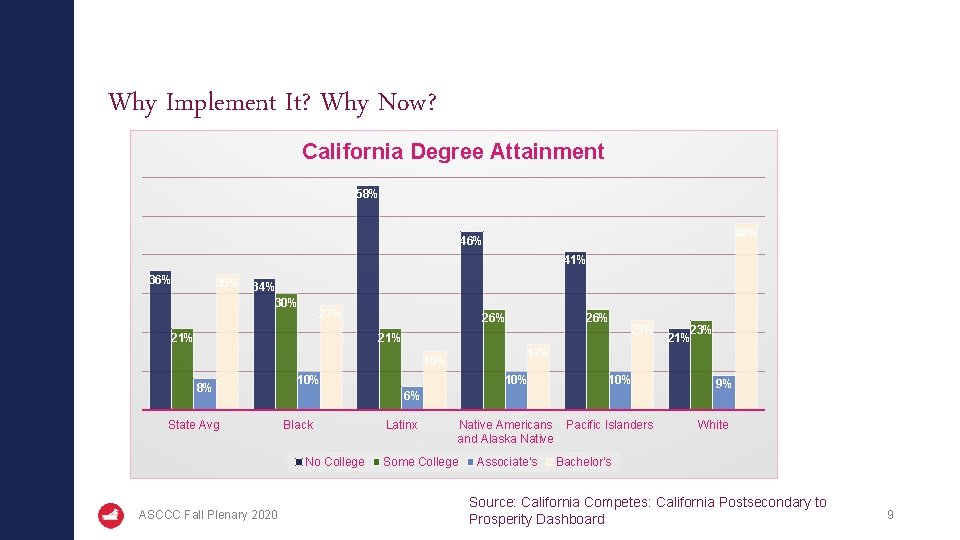
Why Implement It? Why Now? California Degree Attainment 58% 46% 41% 36% 35% 34% 30% 27% 21% 26% 21% State Avg 10% No College ASCCC Fall Plenary 2020 10% 6% Black Latinx 23% 21% 17% 15% 8% 23% Native Americans and Alaska Native Some College Associate's Pacific Islanders 9% White Bachelor's Source: California Competes: California Postsecondary to Prosperity Dashboard 9
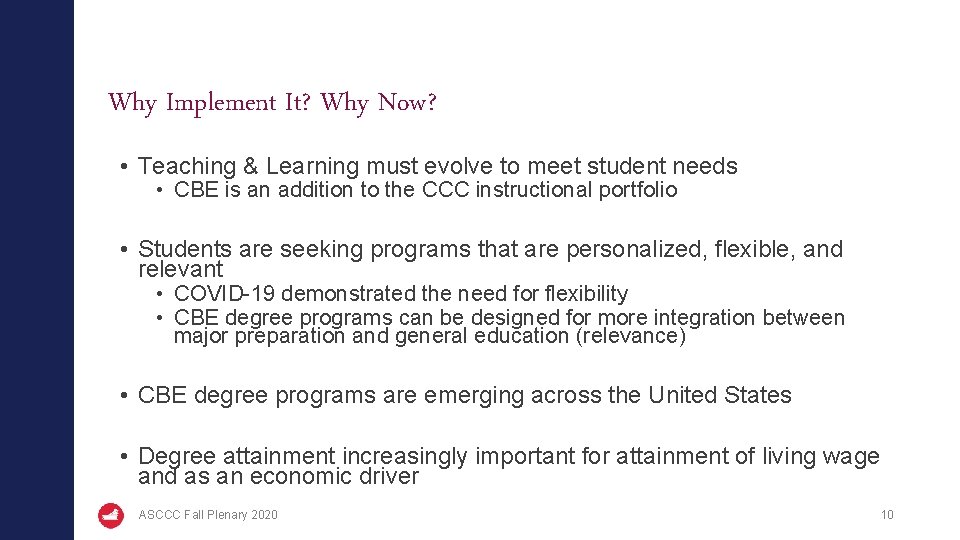
Why Implement It? Why Now? • Teaching & Learning must evolve to meet student needs • CBE is an addition to the CCC instructional portfolio • Students are seeking programs that are personalized, flexible, and relevant • COVID-19 demonstrated the need for flexibility • CBE degree programs can be designed for more integration between major preparation and general education (relevance) • CBE degree programs are emerging across the United States • Degree attainment increasingly important for attainment of living wage and as an economic driver ASCCC Fall Plenary 2020 10
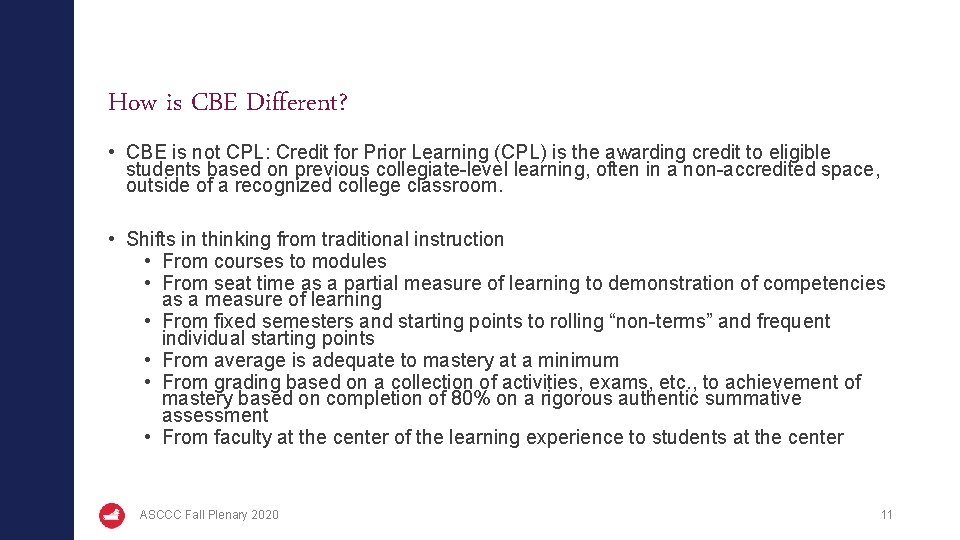
How is CBE Different? • CBE is not CPL: Credit for Prior Learning (CPL) is the awarding credit to eligible students based on previous collegiate-level learning, often in a non-accredited space, outside of a recognized college classroom. • Shifts in thinking from traditional instruction • From courses to modules • From seat time as a partial measure of learning to demonstration of competencies as a measure of learning • From fixed semesters and starting points to rolling “non-terms” and frequent individual starting points • From average is adequate to mastery at a minimum • From grading based on a collection of activities, exams, etc. , to achievement of mastery based on completion of 80% on a rigorous authentic summative assessment • From faculty at the center of the learning experience to students at the center ASCCC Fall Plenary 2020 11

CCC CBE Collaborative What is it? What is the timeline? Who at colleges will be involved? ASCCC Fall Plenary 2020 12

What is the CCC CBE Collaborative? • Colleges working together to implement DA CBE as early adopters • Goals: • Establish a Direct Assessment CBE implementation collaborative of early implementer colleges • Provide funding and implementation support to participating colleges • Create a blueprint (roadmap) for implementation of programs system-wide • Evaluate the implementation process and early student outcomes ASCCC Fall Plenary 2020 13
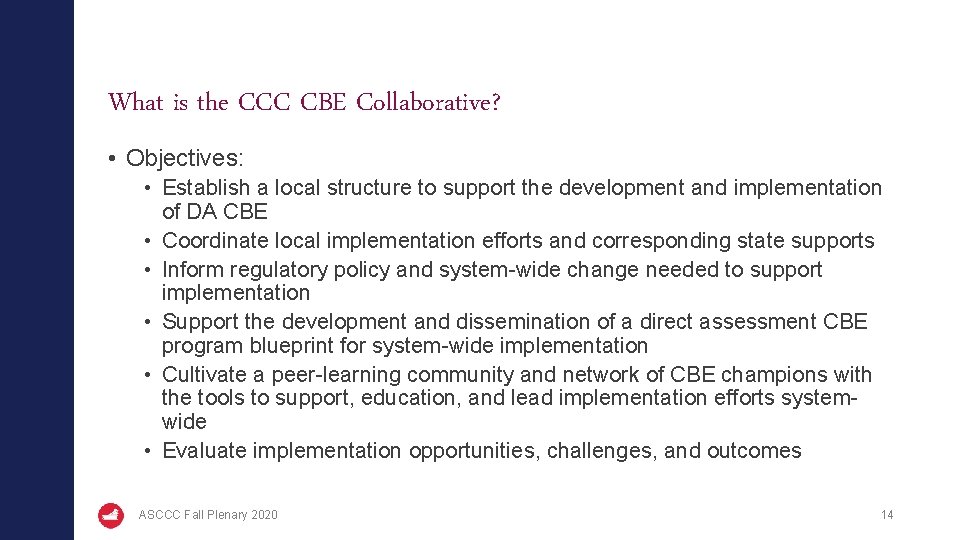
What is the CCC CBE Collaborative? • Objectives: • Establish a local structure to support the development and implementation of DA CBE • Coordinate local implementation efforts and corresponding state supports • Inform regulatory policy and system-wide change needed to support implementation • Support the development and dissemination of a direct assessment CBE program blueprint for system-wide implementation • Cultivate a peer-learning community and network of CBE champions with the tools to support, education, and lead implementation efforts systemwide • Evaluate implementation opportunities, challenges, and outcomes ASCCC Fall Plenary 2020 14
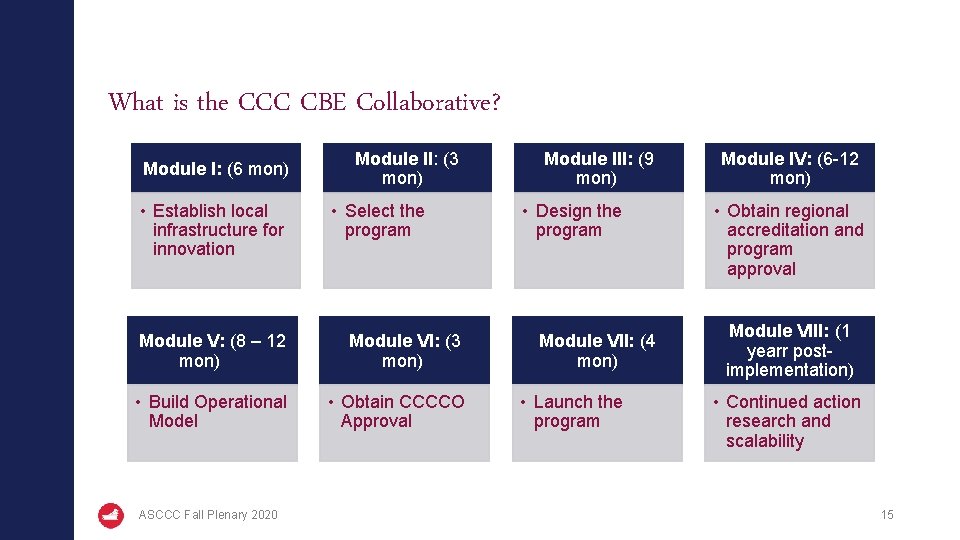
What is the CCC CBE Collaborative? Module I: (6 mon) • Establish local infrastructure for innovation Module II: (3 mon) • Select the program Module V: (8 – 12 mon) Module VI: (3 mon) • Build Operational Model • Obtain CCCCO Approval ASCCC Fall Plenary 2020 Module III: (9 mon) • Design the program Module VII: (4 mon) • Launch the program Module IV: (6 -12 mon) • Obtain regional accreditation and program approval Module VIII: (1 yearr postimplementation) • Continued action research and scalability 15
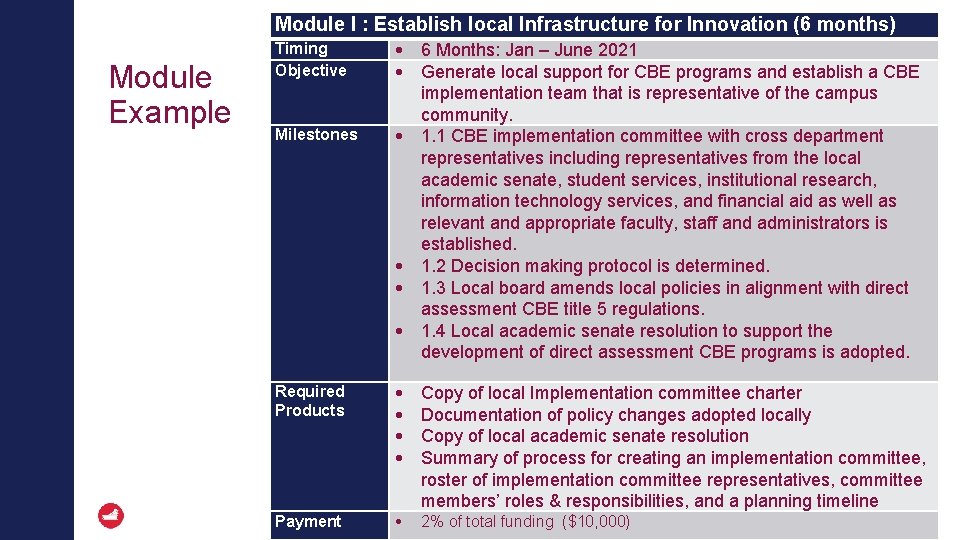
Module I : Establish local Infrastructure for Innovation (6 months) Module Example Timing Objective Milestones • 6 Months: Jan – June 2021 • Generate local support for CBE programs and establish a CBE implementation team that is representative of the campus community. • 1. 1 CBE implementation committee with cross department representatives including representatives from the local academic senate, student services, institutional research, information technology services, and financial aid as well as relevant and appropriate faculty, staff and administrators is established. • 1. 2 Decision making protocol is determined. • 1. 3 Local board amends local policies in alignment with direct assessment CBE title 5 regulations. • 1. 4 Local academic senate resolution to support the development of direct assessment CBE programs is adopted. Required Products • • Copy of local Implementation committee charter Documentation of policy changes adopted locally Copy of local academic senate resolution Summary of process for creating an implementation committee, roster of implementation committee representatives, committee members’ roles & responsibilities, and a planning timeline Payment • 2% of total funding ($10, 000)
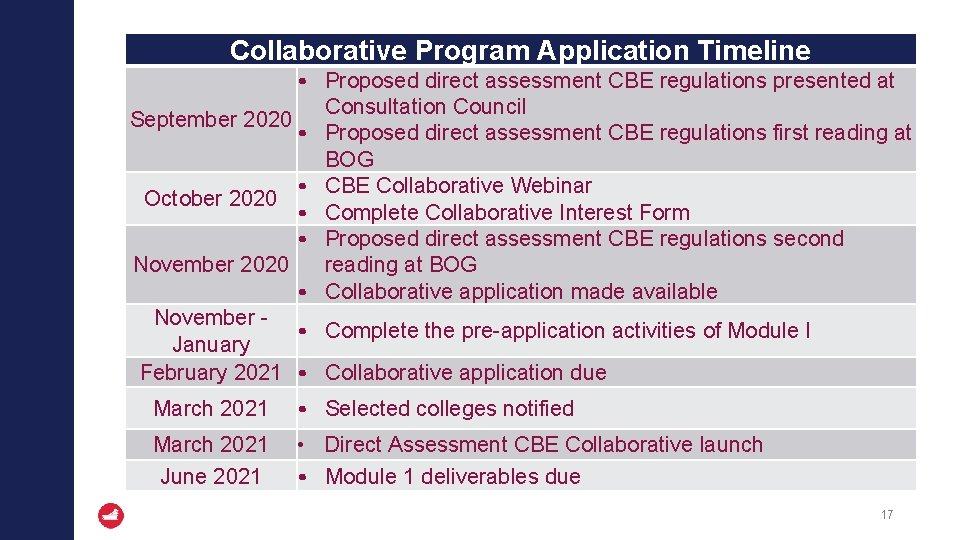
Collaborative Program Application Timeline • Proposed direct assessment CBE regulations presented at Consultation Council September 2020 • Proposed direct assessment CBE regulations first reading at BOG • CBE Collaborative Webinar October 2020 • Complete Collaborative Interest Form • Proposed direct assessment CBE regulations second November 2020 reading at BOG • Collaborative application made available November • Complete the pre-application activities of Module I January February 2021 • Collaborative application due March 2021 • Selected colleges notified March 2021 June 2021 • Direct Assessment CBE Collaborative launch • Module 1 deliverables due 17
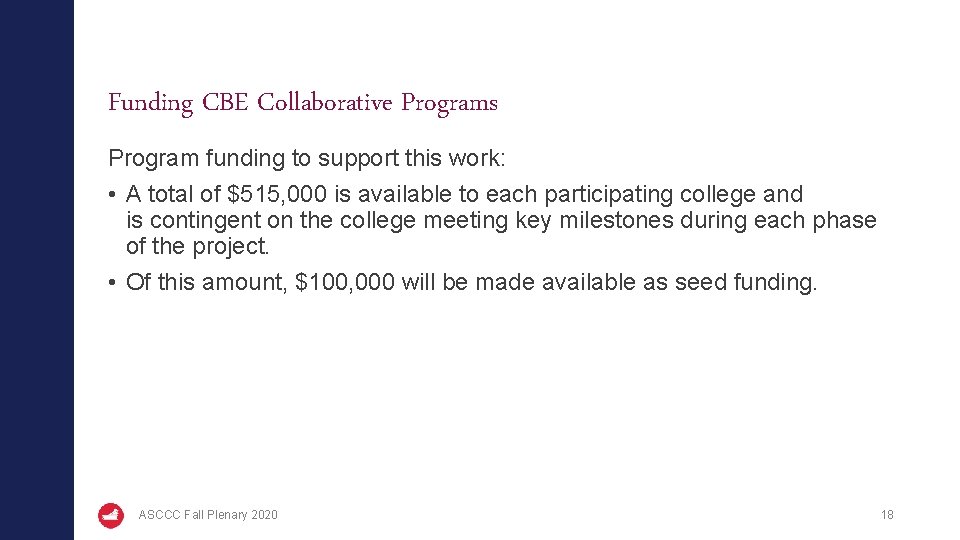
Funding CBE Collaborative Programs Program funding to support this work: • A total of $515, 000 is available to each participating college and is contingent on the college meeting key milestones during each phase of the project. • Of this amount, $100, 000 will be made available as seed funding. ASCCC Fall Plenary 2020 18
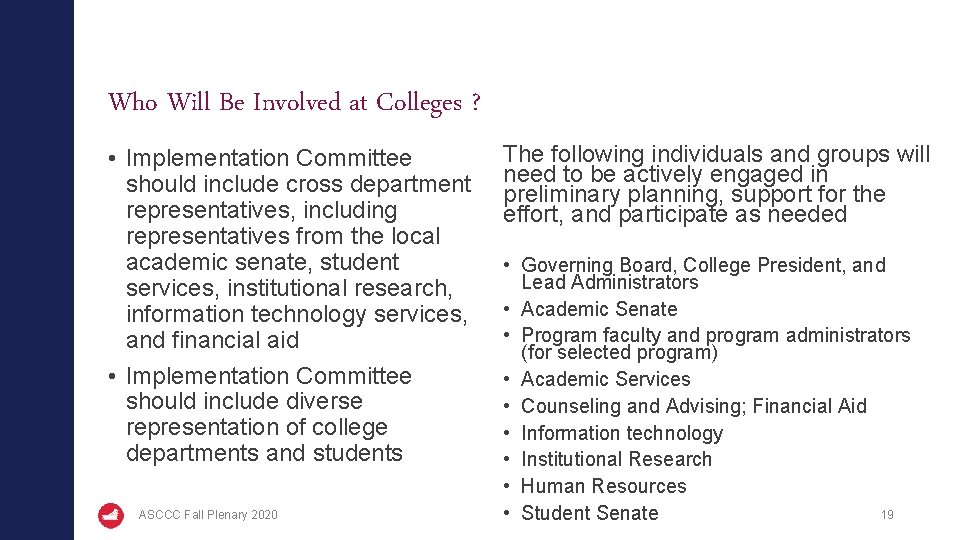
Who Will Be Involved at Colleges ? • Implementation Committee should include cross department representatives, including representatives from the local academic senate, student services, institutional research, information technology services, and financial aid • Implementation Committee should include diverse representation of college departments and students ASCCC Fall Plenary 2020 The following individuals and groups will need to be actively engaged in preliminary planning, support for the effort, and participate as needed • Governing Board, College President, and Lead Administrators • Academic Senate • Program faculty and program administrators (for selected program) • Academic Services • Counseling and Advising; Financial Aid • Information technology • Institutional Research • Human Resources 19 • Student Senate
Anticipated Roles of Senate Presidents and Faculty • CBE Collaborative applications require support from local academic (resolution or action) and signature of senate president • CBE is curriculum… 10+1 is applicable • Curriculum • Program development • Degree and certificate requirements • Standards or policies regarding student preparation and success • +Academic policy development within 10+1 ASCCC Fall Plenary 2020 20
Which faculty will need to be involved? Definitely: • Academic Senate presidents • Curriculum Chairs • Discipline faculty (within a designated major) • General education faculty • Articulation Officers Possibly: • Guided pathways leads • Accreditation leads • Outcomes leads/coordinators • And…? ASCCC Fall Plenary 2020 21

Questions? Thank you!

Appendix Slides ASCCC Academic Academy 2020 23
Vision for Success Core Commitments 1. Focus on students’ goals 1. 2. 3. 4. 5. 6. Increase credential attainment by 20% Increase transfer by 35% to UC & CSU Decrease unit attainment for a degree Increase employment for CTE students Reduce and erase equity gaps Reduce regional gaps 2. Design and decide with the student in mind 3. Pair high expectations and high support 4. Evidence-based decisions 5. Own student performance 6. Enable innovation and action 7. Cross-system partnership 24
Guided Pathways Principles 25
- Slides: 25