
New Historicism Poetics of Culture A new Approach

- Slides: 13
New Historicism Poetics of Culture A new Approach on Literature Humboldt-Universität zu Berlin, Seminar „Poetic Change: � Poe, Whitman, Dickinson“, So. Se 2007 Dozent: Prof. Dr. Martin Klepper Referenten: Anne-Marie Storch, Alexander Florin, 19. 06. 2007
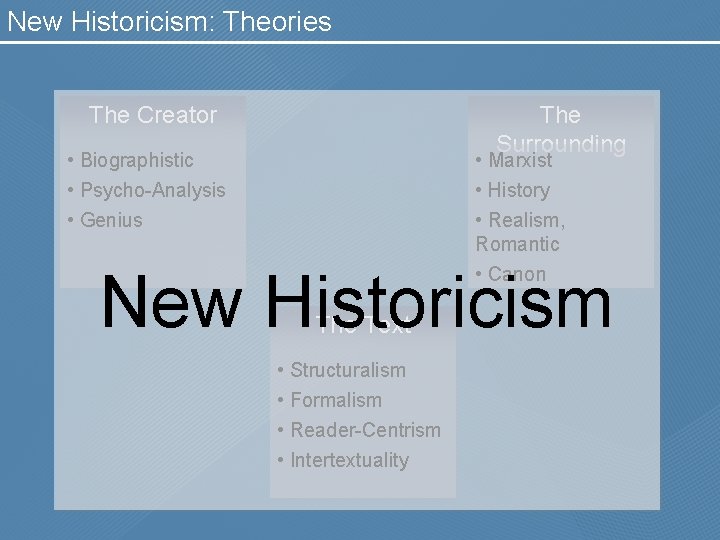
New Historicism: Theories The Creator The Surrounding • Biographistic • Psycho-Analysis • Marxist • History • Genius • Realism, Romantic • Canon New Historicism The Text • Structuralism • Formalism • Reader-Centrism • Intertextuality
New Historicism: Stephen Jay Greenblatt (* Nov 7 th, 1943) • literary critic, theorist and scholar • one of the founders of New Historicism, a set of critical practices that he often refers to as “cultural poetics” • influential since early 1980 s when he introduced the term • wrote and edited numerous books and articles relevant to new historicism, the study of culture, Renaissance studies and Shakespeare studies; considered expert in these fields • most popular work is Will in the World, a Shakespeare-biography (on NY-Times-Bestseller-list for nine weeks) • co-founded literary-cultural journal Representations, which publishes articles by new historicists • educated at Yale University (B. A. 1964, M. phil 1968, Ph. d. 1969) and Pembroke College, Cambridge (B. A. 1966, M. A. 1968) • taught at University of California, Berkeley and Harvard University http: //en. wikipedia. org/wiki/Stephen_Greenblatt
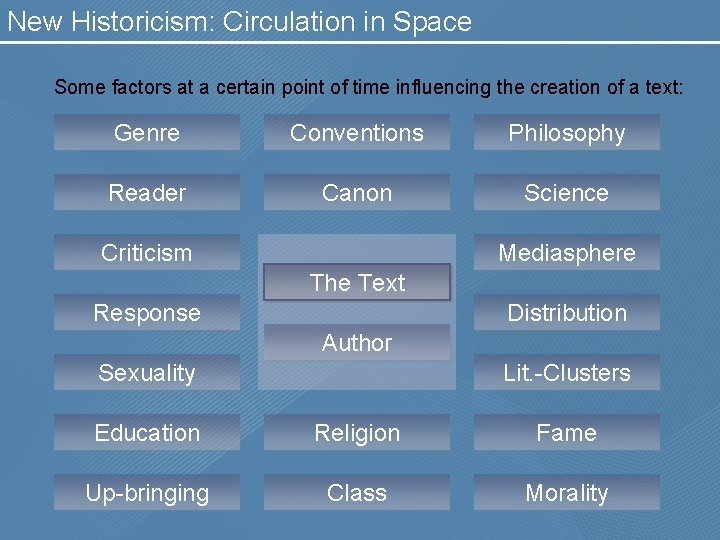
New Historicism: Circulation in Space Some factors at a certain point of time influencing the creation of a text: Genre Conventions Philosophy Reader Canon Science Criticism Mediasphere The Text Response Distribution Author Sexuality Lit. -Clusters Education Religion Fame Up-bringing Class Morality
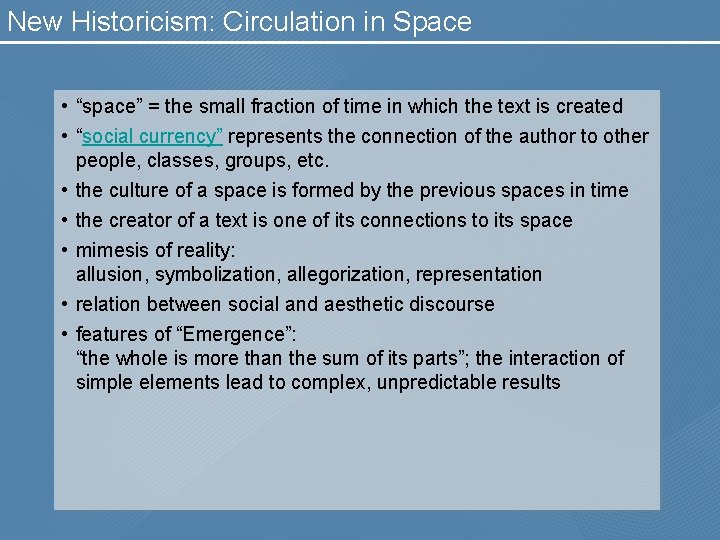
New Historicism: Circulation in Space • “space” = the small fraction of time in which the text is created • “social currency” represents the connection of the author to other people, classes, groups, etc. • the culture of a space is formed by the previous spaces in time • the creator of a text is one of its connections to its space • mimesis of reality: allusion, symbolization, allegorization, representation • relation between social and aesthetic discourse • features of “Emergence”: “the whole is more than the sum of its parts”; the interaction of simple elements lead to complex, unpredictable results
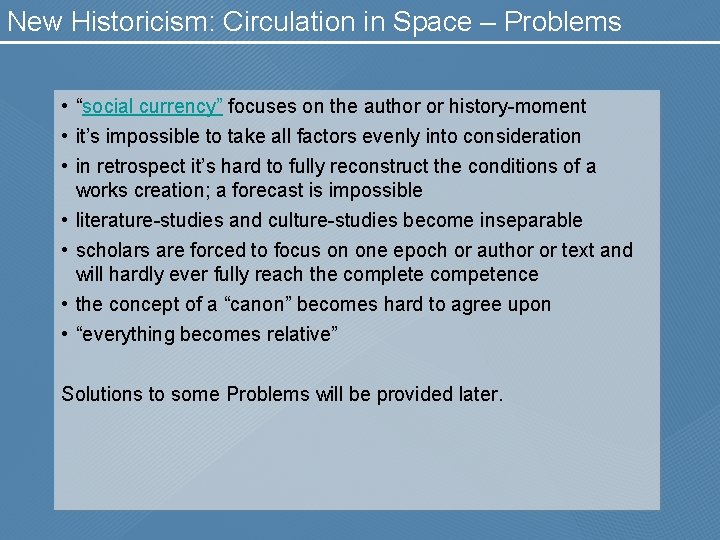
New Historicism: Circulation in Space – Problems • “social currency” focuses on the author or history-moment • it’s impossible to take all factors evenly into consideration • in retrospect it’s hard to fully reconstruct the conditions of a works creation; a forecast is impossible • literature-studies and culture-studies become inseparable • scholars are forced to focus on one epoch or author or text and will hardly ever fully reach the complete competence • the concept of a “canon” becomes hard to agree upon • “everything becomes relative” Solutions to some Problems will be provided later.
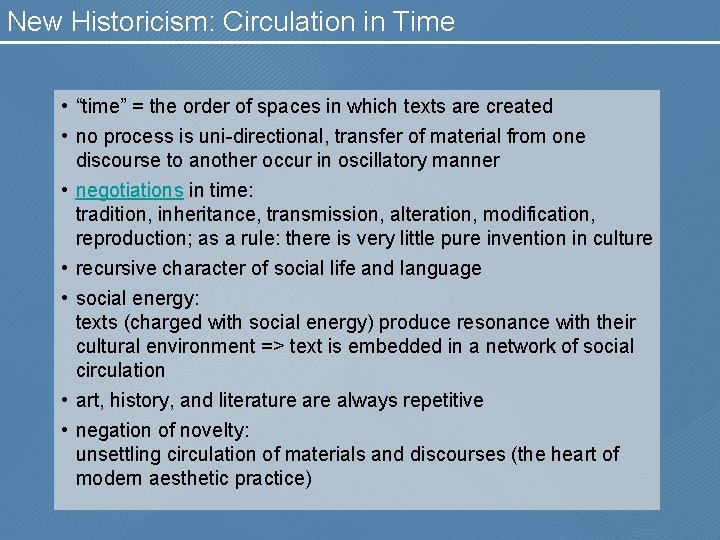
New Historicism: Circulation in Time • “time” = the order of spaces in which texts are created • no process is uni-directional, transfer of material from one discourse to another occur in oscillatory manner • negotiations in time: tradition, inheritance, transmission, alteration, modification, reproduction; as a rule: there is very little pure invention in culture • recursive character of social life and language • social energy: texts (charged with social energy) produce resonance with their cultural environment => text is embedded in a network of social circulation • art, history, and literature always repetitive • negation of novelty: unsettling circulation of materials and discourses (the heart of modern aesthetic practice)
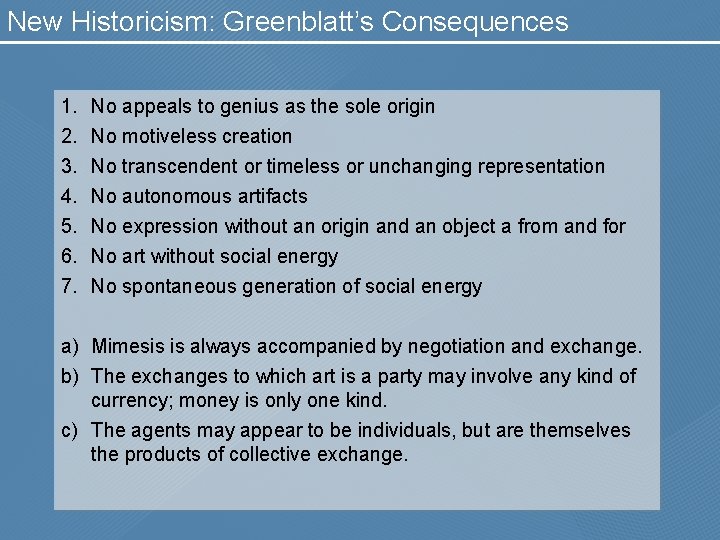
New Historicism: Greenblatt’s Consequences 1. No appeals to genius as the sole origin 2. No motiveless creation 3. 4. 5. 6. 7. No transcendent or timeless or unchanging representation No autonomous artifacts No expression without an origin and an object a from and for No art without social energy No spontaneous generation of social energy a) Mimesis is always accompanied by negotiation and exchange. b) The exchanges to which art is a party may involve any kind of currency; money is only one kind. c) The agents may appear to be individuals, but are themselves the products of collective exchange.
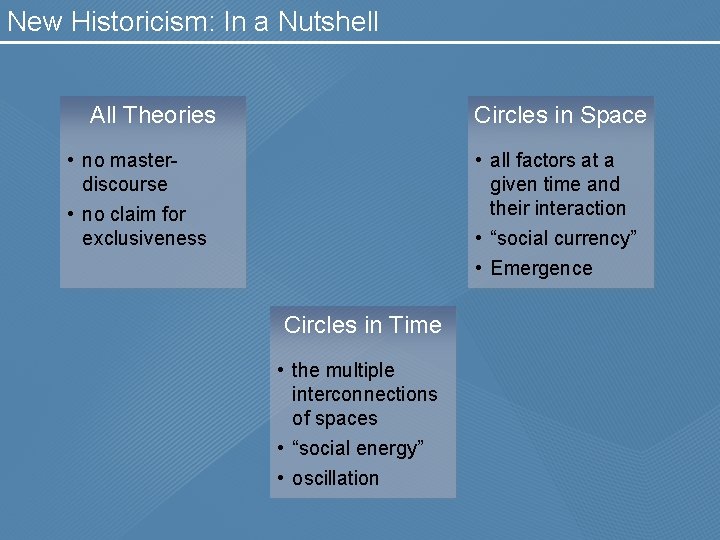
New Historicism: In a Nutshell All Theories Circles in Space • no masterdiscourse • all factors at a given time and their interaction • “social currency” • Emergence • no claim for exclusiveness Circles in Time • the multiple interconnections of spaces • “social energy” • oscillation
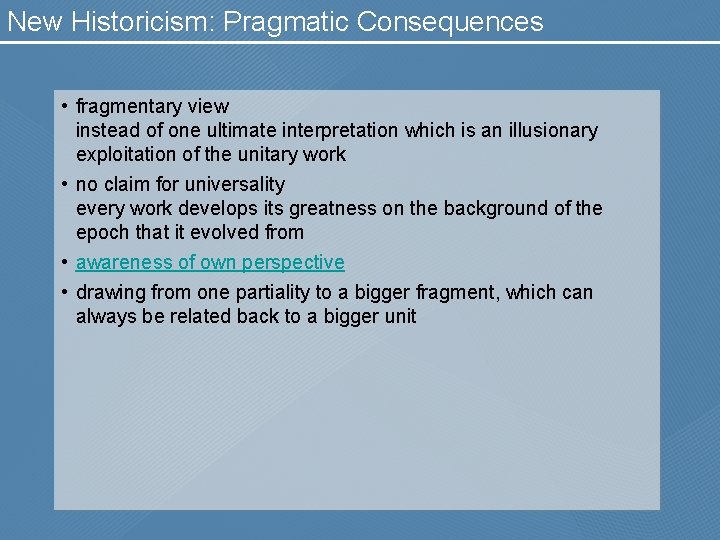
New Historicism: Pragmatic Consequences • fragmentary view instead of one ultimate interpretation which is an illusionary exploitation of the unitary work • no claim for universality every work develops its greatness on the background of the epoch that it evolved from • awareness of own perspective • drawing from one partiality to a bigger fragment, which can always be related back to a bigger unit
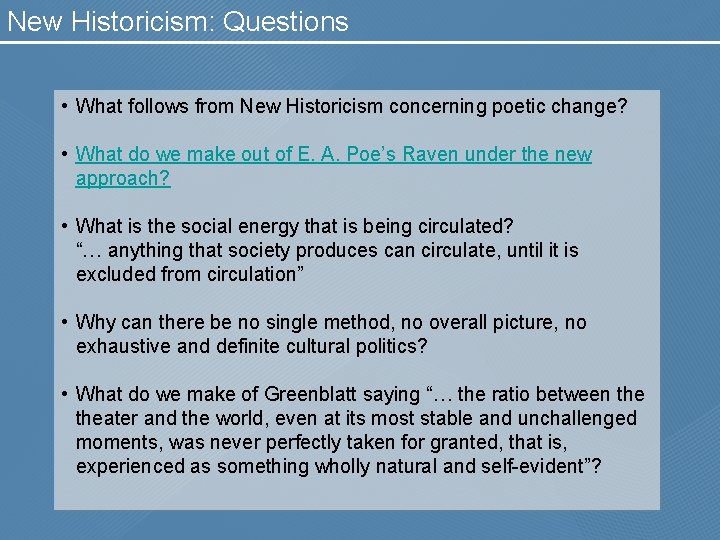
New Historicism: Questions • What follows from New Historicism concerning poetic change? • What do we make out of E. A. Poe’s Raven under the new approach? • What is the social energy that is being circulated? “… anything that society produces can circulate, until it is excluded from circulation” • Why can there be no single method, no overall picture, no exhaustive and definite cultural politics? • What do we make of Greenblatt saying “… the ratio between theater and the world, even at its most stable and unchallenged moments, was never perfectly taken for granted, that is, experienced as something wholly natural and self-evident”?
New Historicism: The End This presentation is online available at: www. zanjero. de/literatur/newhist/