
NEW HAVEN PUBLIC SCHOOLS March 2012 NEW HAVEN
NEW HAVEN PUBLIC SCHOOLS – March 2012 NEW HAVEN SCHOOL CHANGE AND EVALUATION AND DEVELOPMENT PROGRAM New Haven, A City of Great Schools 1
School Change Vision What is the Vision for Transforming Our System? • Students learning through meaningful and coherent experiences in individual classrooms, among different classrooms, and in the rest of their lives • Schools as the centers for learning, where teams of adults take collective and empowered responsibility for students, working separately and together to move students from where ever they start to the highest performance levels, collaborating without fault • The district and schools acting to support development, adaptation, and innovation Portfolio of Schools Talent Community & Parents Each school will be organized and supported on its own unique path to success Adults in the system will be managed as professionals to encourage collaboration, empowerment, and responsibility for outcomes – and this will enable us to attract, develop, and retain the highest caliber staff The work of the school system will be as aligned as possible with the other adults who work on behalf of students, including parents and community organizations, and including community investment in the promise of college What is important about our approach? • Coherent and comprehensive reform strategy, establishing that urban districts of all sizes can engage in performance-driven reform. • Collaborative work with teachers and other stakeholders, setting a tone of collective responsibility and building long-term sustainability. • Designed for persistence, to ensure sustainable and ongoing change to address the many complex challenges facing student learning in New Haven, A City of Great Schools 2
Progress Driven by Collaboration Winter/Spring 2009 Summer 2009 Sept 2009 Fall/Winter 2009 Dec 2009 Mar 2010 Spring 2010 Mounting pressure for school reform in New Haven from all stakeholders – officials, parents, teachers, and community Launch of joint reform discussions, with contract negotiations overlapping and in parallel, and establishment of joint beliefs NHFT reform contract agreement (Approved by 855 to 42) Multi-party committees created by contract agreement (Reform, Teacher Evaluation and Development or TEVAL, and Survey – also PEVAL), with Teacher Committees in parallel District surveys on Central Office effectiveness and on evaluation and coaching First Tiering of Schools, including school turnaround Recommendations on TEVAL and PEVAL approved by NHPS Board of Education First school learning environment survey, including 360 feedback on school leadership Sept 2010 Launch of new school year with revised NHPS evaluation and development systems Ongoing On-going focus on Portfolio, Talent, Community and additional efforts, through multiparty dialog and regular input from field New Haven, A City of Great Schools - Collaboration, not for its own sake, but to accomplish school reform - Agreement about goals, vision, and Norms - On-going mechanisms for dialog and discussion 3
What has “Collaborative Approach” Meant in NHPS? Start with Common Goals • Reform discussions began with a Joint Statement of Beliefs, and have evolved into joint beliefs, vision, and norms. • Similarly, at the start of the TEVAL process, we established common goals for the evaluation and development No Fault Problem -solving • We focus on overcoming real challenges and solving the urgent problems before us, not on placing blame or fault for those problems. Pursuit of Problems • Challenges and problems are opportunities for learning and improvement, and so we seek out both the facts/data and the courageous conversations that will improve learning in the district for our students Valuing Others • We strive to understand how our peers and collaborators see the world, and we recognize their legitimate perspectives and concerns. We avoid the temptation to dismiss individuals and generalize other groups. Constructive Relationships • We explicitly show our support for each other, including by developing each other and by challenging each other to do better. Enduring Partnership • If we have invested meaningful time, listened to each other, and genuinely sought consensus, we move forward together – even when we disagree New Haven, A City of Great Schools 4
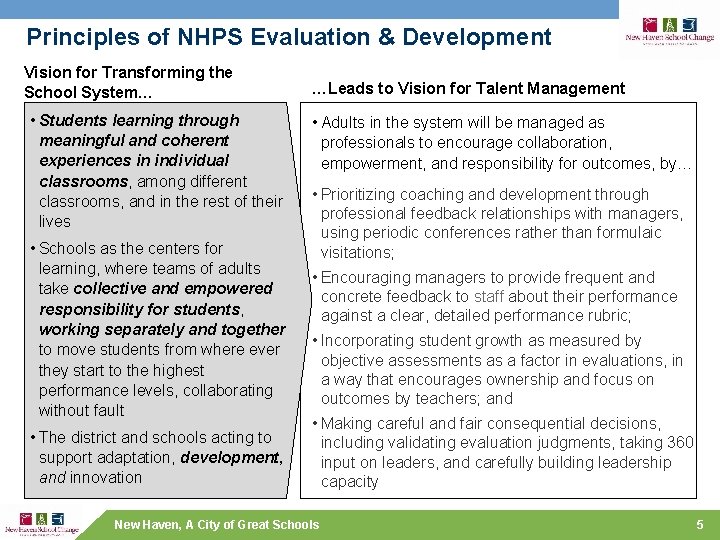
Principles of NHPS Evaluation & Development Vision for Transforming the School System… • Students learning through meaningful and coherent experiences in individual classrooms, among different classrooms, and in the rest of their lives • Schools as the centers for learning, where teams of adults take collective and empowered responsibility for students, working separately and together to move students from where ever they start to the highest performance levels, collaborating without fault • The district and schools acting to support adaptation, development, and innovation …Leads to Vision for Talent Management • Adults in the system will be managed as professionals to encourage collaboration, empowerment, and responsibility for outcomes, by… • Prioritizing coaching and development through professional feedback relationships with managers, using periodic conferences rather than formulaic visitations; • Encouraging managers to provide frequent and concrete feedback to staff about their performance against a clear, detailed performance rubric; • Incorporating student growth as measured by objective assessments as a factor in evaluations, in a way that encourages ownership and focus on outcomes by teachers; and • Making careful and fair consequential decisions, including validating evaluation judgments, taking 360 input on leaders, and carefully building leadership capacity New Haven, A City of Great Schools 5
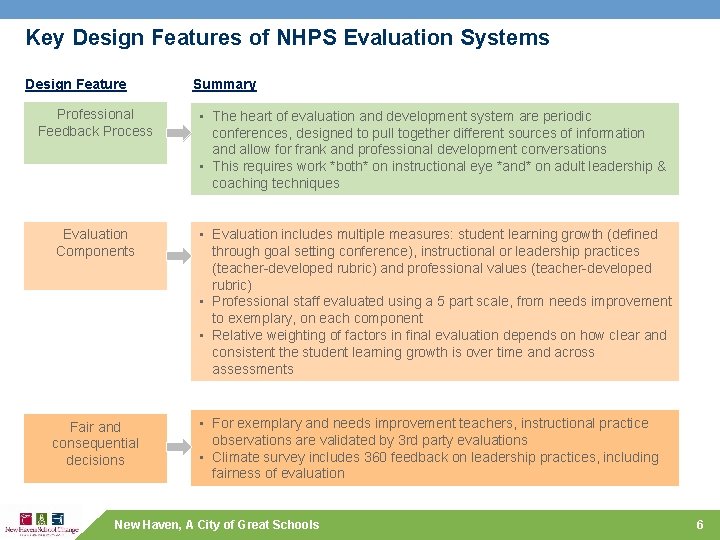
Key Design Features of NHPS Evaluation Systems Design Feature Summary Professional Feedback Process • The heart of evaluation and development system are periodic conferences, designed to pull together different sources of information and allow for frank and professional development conversations • This requires work *both* on instructional eye *and* on adult leadership & coaching techniques Evaluation Components • Evaluation includes multiple measures: student learning growth (defined through goal setting conference), instructional or leadership practices (teacher-developed rubric) and professional values (teacher-developed rubric) • Professional staff evaluated using a 5 part scale, from needs improvement to exemplary, on each component • Relative weighting of factors in final evaluation depends on how clear and consistent the student learning growth is over time and across assessments Fair and consequential decisions • For exemplary and needs improvement teachers, instructional practice observations are validated by 3 rd party evaluations • Climate survey includes 360 feedback on leadership practices, including fairness of evaluation New Haven, A City of Great Schools 6
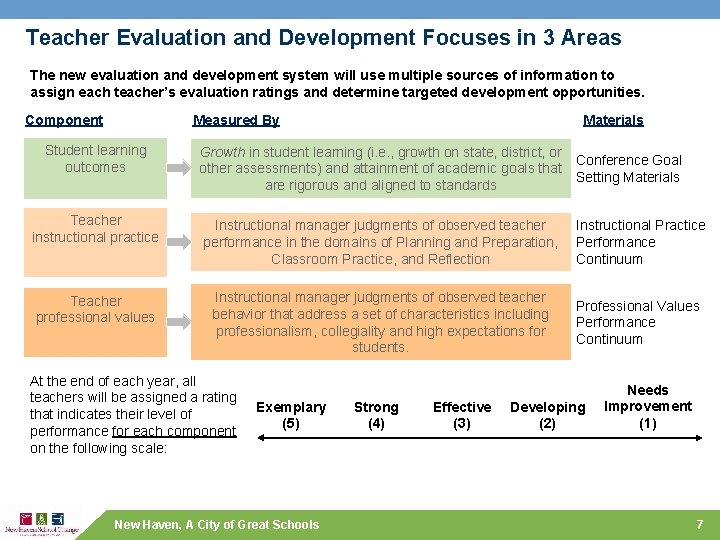
Teacher Evaluation and Development Focuses in 3 Areas The new evaluation and development system will use multiple sources of information to assign each teacher’s evaluation ratings and determine targeted development opportunities. Component Measured By Materials Student learning outcomes Growth in student learning (i. e. , growth on state, district, or other assessments) and attainment of academic goals that are rigorous and aligned to standards Conference Goal Setting Materials Teacher instructional practice Instructional manager judgments of observed teacher performance in the domains of Planning and Preparation, Classroom Practice, and Reflection Instructional Practice Performance Continuum Teacher professional values Instructional manager judgments of observed teacher behavior that address a set of characteristics including professionalism, collegiality and high expectations for students. Professional Values Performance Continuum At the end of each year, all teachers will be assigned a rating that indicates their level of performance for each component on the following scale: Exemplary (5) New Haven, A City of Great Schools Strong (4) Effective (3) Developing (2) Needs Improvement (1) 7
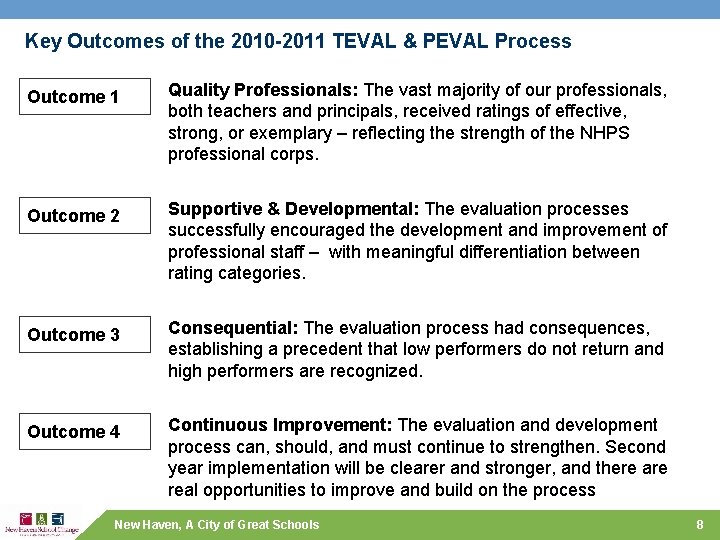
Key Outcomes of the 2010 -2011 TEVAL & PEVAL Process Outcome 1 Quality Professionals: The vast majority of our professionals, both teachers and principals, received ratings of effective, strong, or exemplary – reflecting the strength of the NHPS professional corps. Outcome 2 Supportive & Developmental: The evaluation processes successfully encouraged the development and improvement of professional staff – with meaningful differentiation between rating categories. Outcome 3 Consequential: The evaluation process had consequences, establishing a precedent that low performers do not return and high performers are recognized. Outcome 4 Continuous Improvement: The evaluation and development process can, should, and must continue to strengthen. Second year implementation will be clearer and stronger, and there are real opportunities to improve and build on the process New Haven, A City of Great Schools 8
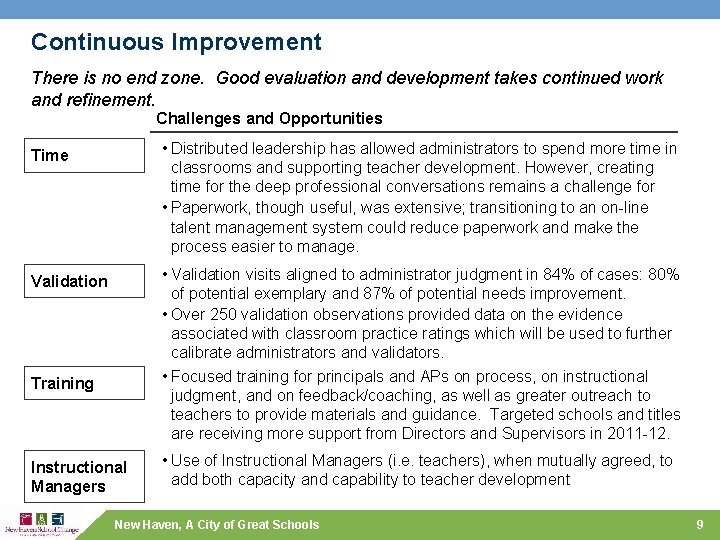
Continuous Improvement There is no end zone. Good evaluation and development takes continued work and refinement. Challenges and Opportunities Time • Distributed leadership has allowed administrators to spend more time in classrooms and supporting teacher development. However, creating time for the deep professional conversations remains a challenge for • Paperwork, though useful, was extensive; transitioning to an on-line talent management system could reduce paperwork and make the process easier to manage. Validation • Validation visits aligned to administrator judgment in 84% of cases: 80% of potential exemplary and 87% of potential needs improvement. • Over 250 validation observations provided data on the evidence associated with classroom practice ratings which will be used to further calibrate administrators and validators. • Focused training for principals and APs on process, on instructional judgment, and on feedback/coaching, as well as greater outreach to teachers to provide materials and guidance. Targeted schools and titles are receiving more support from Directors and Supervisors in 2011 -12. Training Instructional Managers • Use of Instructional Managers (i. e. teachers), when mutually agreed, to add both capacity and capability to teacher development New Haven, A City of Great Schools 9
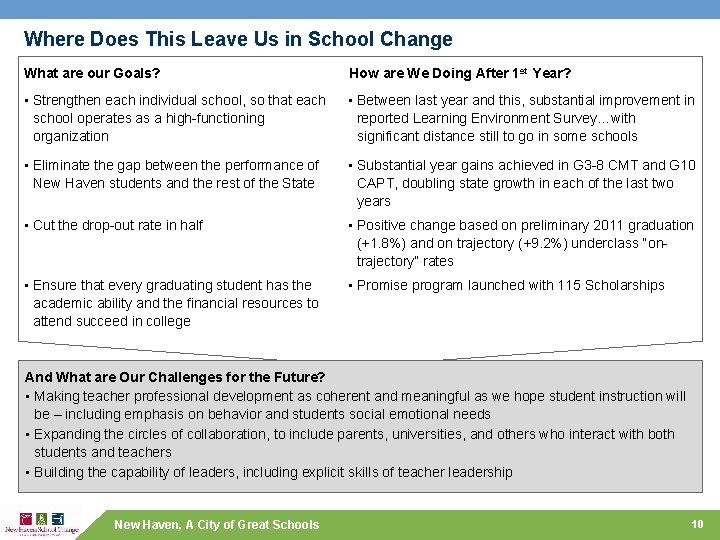
Where Does This Leave Us in School Change What are our Goals? How are We Doing After 1 st Year? • Strengthen each individual school, so that each school operates as a high-functioning organization • Between last year and this, substantial improvement in reported Learning Environment Survey…with significant distance still to go in some schools • Eliminate the gap between the performance of New Haven students and the rest of the State • Substantial year gains achieved in G 3 -8 CMT and G 10 CAPT, doubling state growth in each of the last two years • Cut the drop-out rate in half • Positive change based on preliminary 2011 graduation (+1. 8%) and on trajectory (+9. 2%) underclass “ontrajectory” rates • Ensure that every graduating student has the academic ability and the financial resources to attend succeed in college • Promise program launched with 115 Scholarships And What are Our Challenges for the Future? • Making teacher professional development as coherent and meaningful as we hope student instruction will be – including emphasis on behavior and students social emotional needs • Expanding the circles of collaboration, to include parents, universities, and others who interact with both students and teachers • Building the capability of leaders, including explicit skills of teacher leadership New Haven, A City of Great Schools 10
Appendix - Details of New Haven TEVAL Process New Haven, A City of Great Schools 11
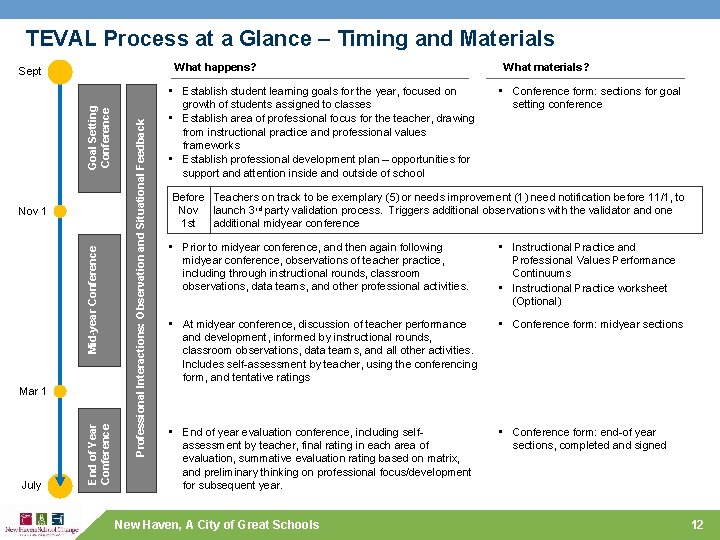
TEVAL Process at a Glance – Timing and Materials What happens? Mid-year Conference Nov 1 July End of Year Conference Mar 1 Professional Interactions: Observation and Situational Feedback Goal Setting Conference Sept • Establish student learning goals for the year, focused on growth of students assigned to classes • Establish area of professional focus for the teacher, drawing from instructional practice and professional values frameworks • Establish professional development plan – opportunities for support and attention inside and outside of school What materials? • Conference form: sections for goal setting conference Before Teachers on track to be exemplary (5) or needs improvement (1) need notification before 11/1, to Nov launch 3 rd party validation process. Triggers additional observations with the validator and one 1 st additional midyear conference • Prior to midyear conference, and then again following midyear conference, observations of teacher practice, including through instructional rounds, classroom observations, data teams, and other professional activities. • Instructional Practice and Professional Values Performance Continuums • Instructional Practice worksheet (Optional) • At midyear conference, discussion of teacher performance and development, informed by instructional rounds, classroom observations, data teams, and all other activities. Includes self-assessment by teacher, using the conferencing form, and tentative ratings • Conference form: midyear sections • End of year evaluation conference, including selfassessment by teacher, final rating in each area of evaluation, summative evaluation rating based on matrix, and preliminary thinking on professional focus/development for subsequent year. • Conference form: end-of year sections, completed and signed New Haven, A City of Great Schools 12
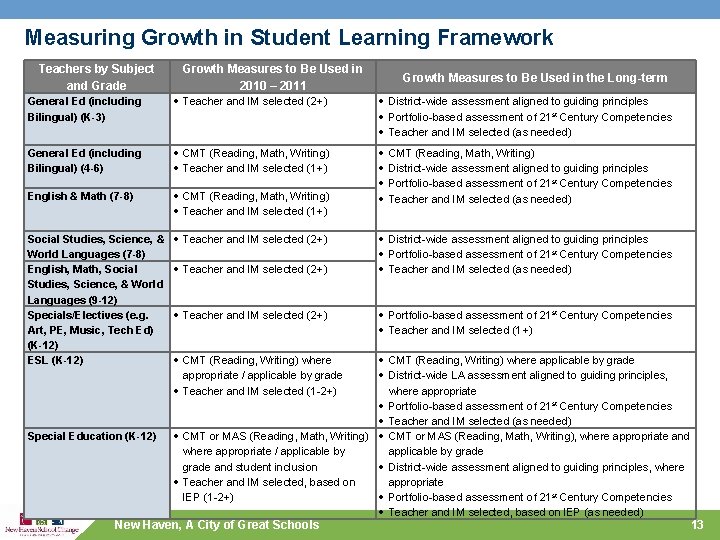
Measuring Growth in Student Learning Framework Teachers by Subject and Grade Growth Measures to Be Used in 2010 – 2011 Growth Measures to Be Used in the Long-term General Ed (including Bilingual) (K-3) Teacher and IM selected (2+) District-wide assessment aligned to guiding principles Portfolio-based assessment of 21 st Century Competencies Teacher and IM selected (as needed) General Ed (including Bilingual) (4 -6) CMT (Reading, Math, Writing) Teacher and IM selected (1+) English & Math (7 -8) CMT (Reading, Math, Writing) Teacher and IM selected (1+) Social Studies, Science, & World Languages (7 -8) English, Math, Social Studies, Science, & World Languages (9 -12) Specials/Electives (e. g. Art, PE, Music, Tech Ed) (K-12) ESL (K-12) Teacher and IM selected (2+) CMT (Reading, Writing) where appropriate / applicable by grade Teacher and IM selected (1 -2+) CMT (Reading, Math, Writing) District-wide assessment aligned to guiding principles Portfolio-based assessment of 21 st Century Competencies Teacher and IM selected (as needed) District-wide assessment aligned to guiding principles Portfolio-based assessment of 21 st Century Competencies Teacher and IM selected (as needed) Portfolio-based assessment of 21 st Century Competencies Teacher and IM selected (1+) CMT (Reading, Writing) where applicable by grade District-wide LA assessment aligned to guiding principles, where appropriate Portfolio-based assessment of 21 st Century Competencies Teacher and IM selected (as needed) Special Education (K-12) CMT or MAS (Reading, Math, Writing), where appropriate and where appropriate / applicable by grade and student inclusion District-wide assessment aligned to guiding principles, where Teacher and IM selected, based on appropriate IEP (1 -2+) Portfolio-based assessment of 21 st Century Competencies Teacher and IM selected, based on IEP (as needed) New Haven, A City of Great Schools 13
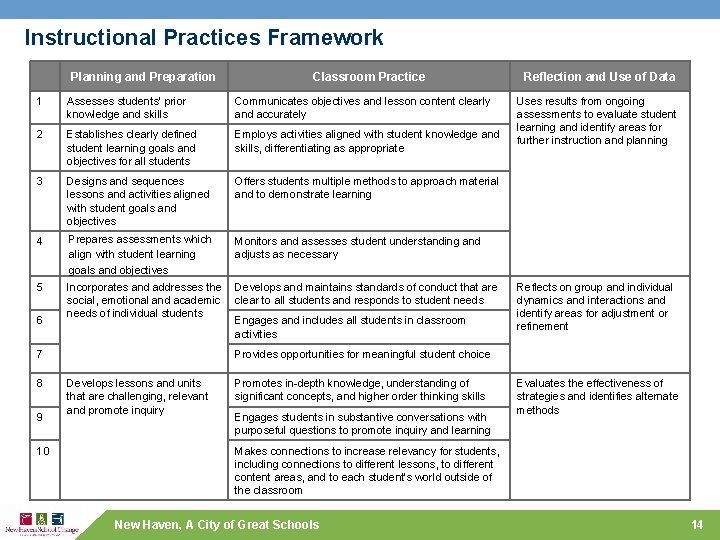
Instructional Practices Framework Planning and Preparation Classroom Practice 1 Assesses students’ prior knowledge and skills Communicates objectives and lesson content clearly and accurately 2 Establishes clearly defined student learning goals and objectives for all students Employs activities aligned with student knowledge and skills, differentiating as appropriate 3 Designs and sequences lessons and activities aligned with student goals and objectives Offers students multiple methods to approach material and to demonstrate learning 4 Prepares assessments which align with student learning goals and objectives Monitors and assesses student understanding and adjusts as necessary 5 Incorporates and addresses the social, emotional and academic needs of individual students Develops and maintains standards of conduct that are clear to all students and responds to student needs 6 7 8 9 10 Engages and includes all students in classroom activities Reflection and Use of Data Uses results from ongoing assessments to evaluate student learning and identify areas for further instruction and planning Reflects on group and individual dynamics and interactions and identify areas for adjustment or refinement Provides opportunities for meaningful student choice Develops lessons and units that are challenging, relevant and promote inquiry Promotes in-depth knowledge, understanding of significant concepts, and higher order thinking skills Engages students in substantive conversations with purposeful questions to promote inquiry and learning Evaluates the effectiveness of strategies and identifies alternate methods Makes connections to increase relevancy for students, including connections to different lessons, to different content areas, and to each student’s world outside of the classroom New Haven, A City of Great Schools 14
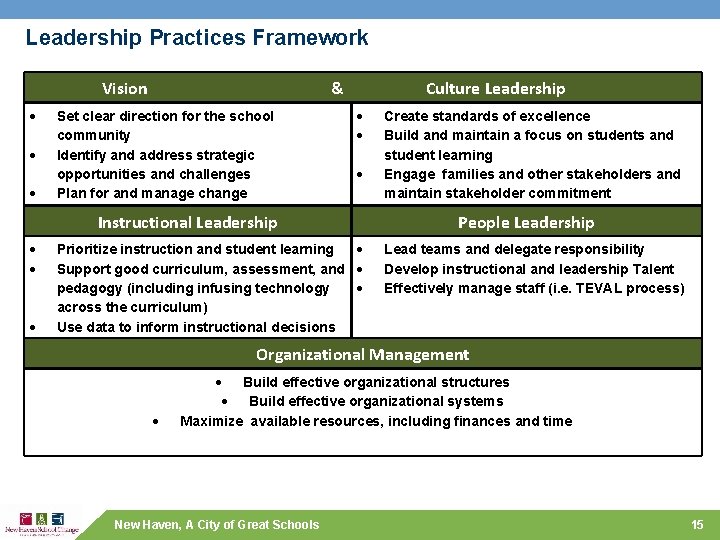
Leadership Practices Framework Vision & Set clear direction for the school community Identify and address strategic opportunities and challenges Plan for and manage change Culture Leadership Instructional Leadership Prioritize instruction and student learning Support good curriculum, assessment, and pedagogy (including infusing technology across the curriculum) Use data to inform instructional decisions Create standards of excellence Build and maintain a focus on students and student learning Engage families and other stakeholders and maintain stakeholder commitment People Leadership Lead teams and delegate responsibility Develop instructional and leadership Talent Effectively manage staff (i. e. TEVAL process) Organizational Management Build effective organizational structures Build effective organizational systems Maximize available resources, including finances and time New Haven, A City of Great Schools 15
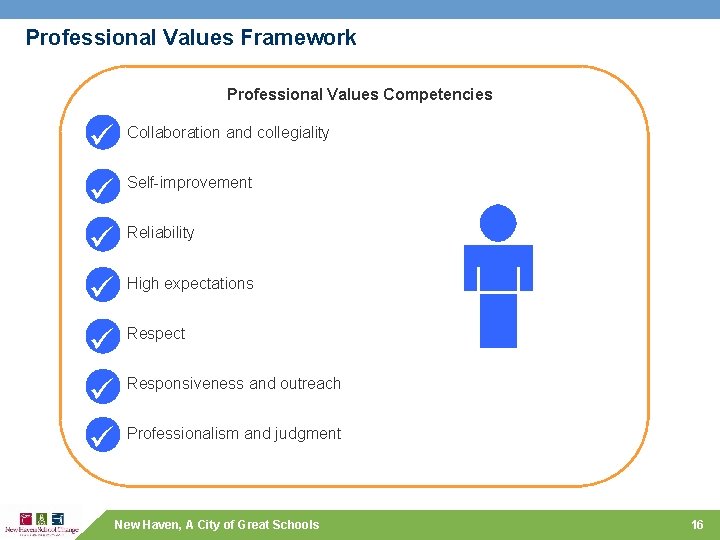
Professional Values Framework Professional Values Competencies Collaboration and collegiality Self-improvement High expectations Respect Responsiveness and outreach Reliability Professionalism and judgment New Haven, A City of Great Schools 16
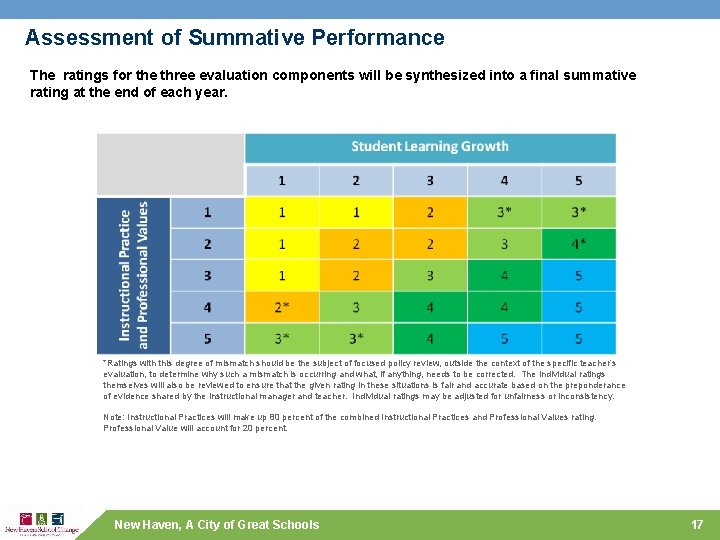
Assessment of Summative Performance The ratings for the three evaluation components will be synthesized into a final summative rating at the end of each year. *Ratings with this degree of mismatch should be the subject of focused policy review, outside the context of the specific teacher’s evaluation, to determine why such a mismatch is occurring and what, if anything, needs to be corrected. The individual ratings themselves will also be reviewed to ensure that the given rating in these situations is fair and accurate based on the preponderance of evidence shared by the instructional manager and teacher. Individual ratings may be adjusted for unfairness or inconsistency. Note: Instructional Practices will make up 80 percent of the combined Instructional Practices and Professional Values rating. Professional Value will account for 20 percent. New Haven, A City of Great Schools 17
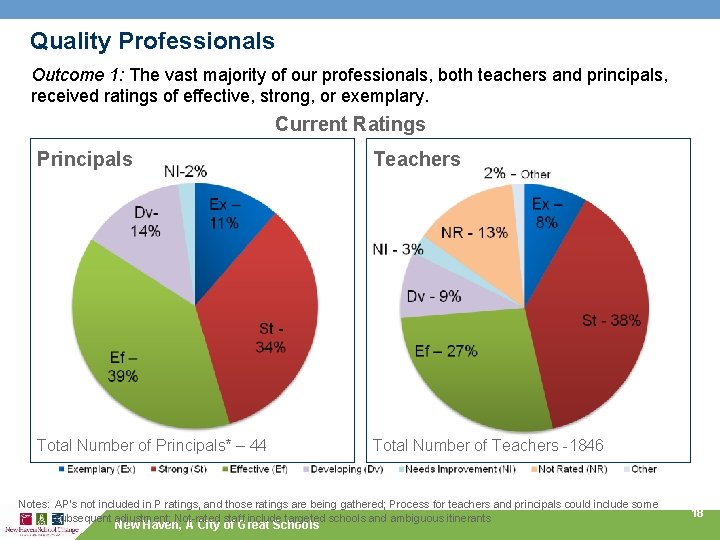
Quality Professionals Outcome 1: The vast majority of our professionals, both teachers and principals, received ratings of effective, strong, or exemplary. Current Ratings Principals Teachers Total Number of Principals* – 44 Total Number of Teachers -1846 Notes: AP’s not included in P ratings, and those ratings are being gathered; Process for teachers and principals could include some subsequent adjustment; Not-rated staff include targeted schools and ambiguous itinerants New Haven, A City of Great Schools 18
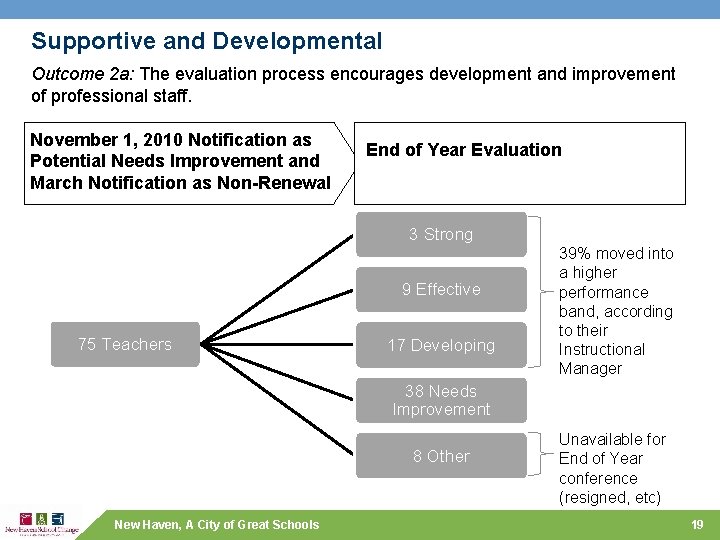
Supportive and Developmental Outcome 2 a: The evaluation process encourages development and improvement of professional staff. November 1, 2010 Notification as Potential Needs Improvement and March Notification as Non-Renewal End of Year Evaluation 3 Strong 9 Effective 75 Teachers 17 Developing 39% moved into a higher performance band, according to their Instructional Manager 38 Needs Improvement 8 Other New Haven, A City of Great Schools Unavailable for End of Year conference (resigned, etc) 19
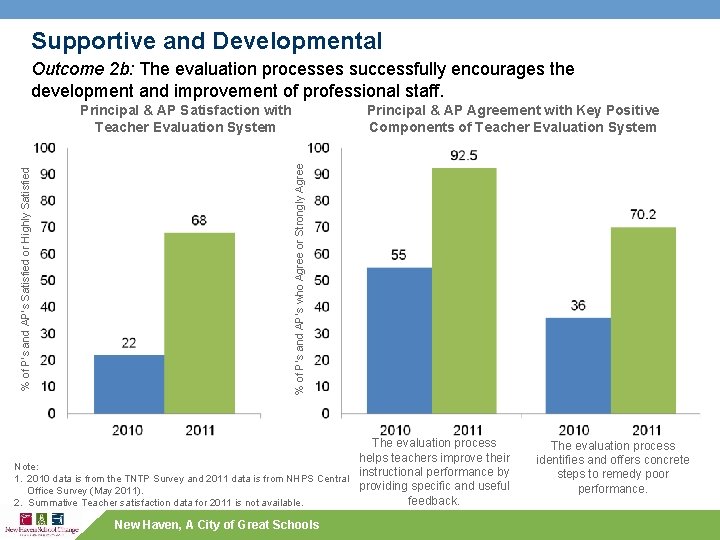
Supportive and Developmental Outcome 2 b: The evaluation processes successfully encourages the development and improvement of professional staff. Principal & AP Agreement with Key Positive Components of Teacher Evaluation System % of P’s and AP’s who Agree or Strongly Agree % of P’s and AP’s Satisfied or Highly Satisfied Principal & AP Satisfaction with Teacher Evaluation System The evaluation process helps teachers improve their Note: instructional performance by 1. 2010 data is from the TNTP Survey and 2011 data is from NHPS Central providing specific and useful Office Survey (May 2011). feedback. 2. Summative Teacher satisfaction data for 2011 is not available. New Haven, A City of Great Schools The evaluation process identifies and offers concrete steps to remedy poor performance. 20
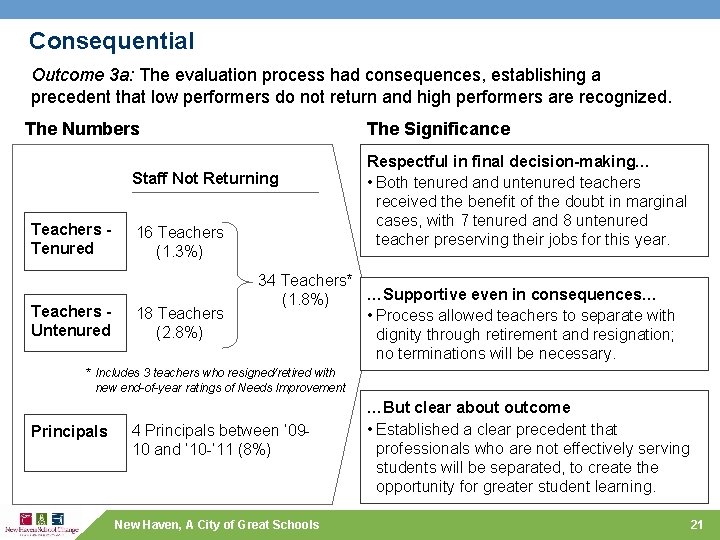
Consequential Outcome 3 a: The evaluation process had consequences, establishing a precedent that low performers do not return and high performers are recognized. The Numbers The Significance Staff Not Returning Teachers Tenured Teachers Untenured 16 Teachers (1. 3%) 18 Teachers (2. 8%) Respectful in final decision-making… • Both tenured and untenured teachers received the benefit of the doubt in marginal cases, with 7 tenured and 8 untenured teacher preserving their jobs for this year. 34 Teachers* …Supportive even in consequences… (1. 8%) • Process allowed teachers to separate with dignity through retirement and resignation; no terminations will be necessary. * Includes 3 teachers who resigned/retired with new end-of-year ratings of Needs Improvement Principals 4 Principals between ‘ 0910 and ‘ 10 -’ 11 (8%) New Haven, A City of Great Schools …But clear about outcome • Established a clear precedent that professionals who are not effectively serving students will be separated, to create the opportunity for greater student learning. 21
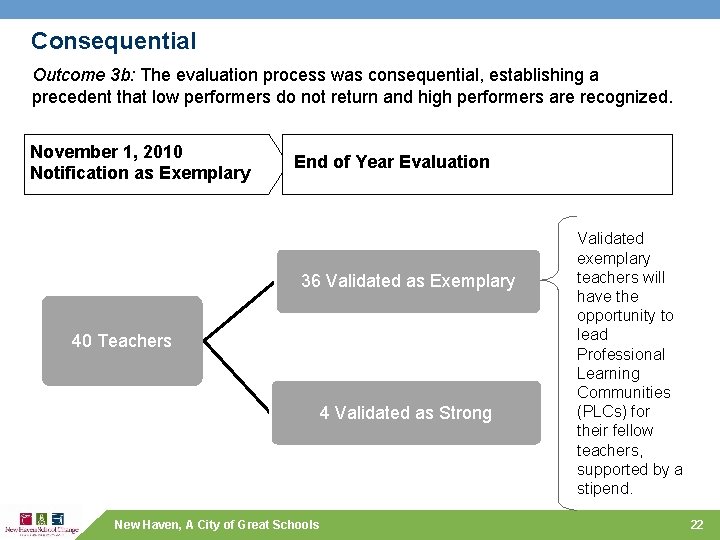
Consequential Outcome 3 b: The evaluation process was consequential, establishing a precedent that low performers do not return and high performers are recognized. November 1, 2010 Notification as Exemplary End of Year Evaluation 36 Validated as Exemplary 40 Teachers 4 Validated as Strong New Haven, A City of Great Schools Validated exemplary teachers will have the opportunity to lead Professional Learning Communities (PLCs) for their fellow teachers, supported by a stipend. 22
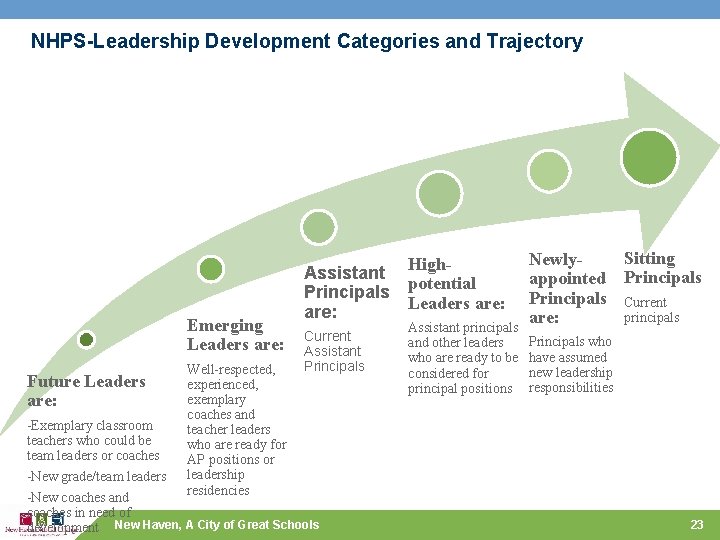
NHPS-Leadership Development Categories and Trajectory Emerging Leaders are: Future Leaders are: -Exemplary classroom teachers who could be team leaders or coaches -New grade/team leaders Well-respected, experienced, exemplary coaches and teacher leaders who are ready for AP positions or leadership residencies Assistant Principals are: Current Assistant Principals -New coaches and coaches in need of development New Haven, A City of Great Schools Highpotential Leaders are: Assistant principals and other leaders who are ready to be considered for principal positions Sitting Newlyappointed Principals Current principals are: Principals who have assumed new leadership responsibilities 23
- Slides: 23