
New Global Connections 1415 1796 Topic 5 Lesson

New Global Connections (1415 -1796) Topic 5, Lesson 3 European Conquests in the Americas

New Global Connections (1415 -1796) Lesson 3 European Conquests in the Americas Learning Objectives • Analyze the results of the first encounters between the Spanish and Native Americans. • Explain how the Aztec and Inca empires were impacted by Spanish conquistadors and European colonization.

New Global Connections (1415 -1796) Topic 5, Lesson 3 European Conquests in the Americas (pg. 285) Key Terms • • • Taíno Hernán Cortés. Tenochtitlán Malinche Moctezuma Francisco Pizarro peninsulares creoles, mestizos, mulattoes,

First Encounters In 1492, Columbus landed in the islands that are now called the West Indies. Soon, Spain conquered and ruled an empire –West Indies, South America, Central America, Mexico, and parts of North America. The conquest transformed the Americas and would have a huge impact on Europe. Read pg. 285 -286 First Encounters. Answer Questions #1 -2

The Tainos Meet Columbus • Taino people lived in West Indies • Friendly towards the Columbus • Columbus enslaved many of them and demanded gold • Soon a wave of conquistadors (conquerors) arrived • They first settled in Hispaniola (DR and Haiti), Cuba, and Puerto Rico • Many Natives were forced to convert to Christianity • Overtime the Taino peoples practically became extinct https: //www. youtube. com/watch? v=NGG-PTo. PE 5 E

First Encounters First Tribute to Columbus (1892) by Spanish artist José Garnelo y Alda represents the first meeting with the Taíno. Hypothesize Do you think the encounter actually appeared like this? Why or why not?

Cortés Conquers the Aztecs Read pg. 286 -288 Cortes Conquers the Aztecs. Answer Questions #3 -6 • From the Caribbean, Spanish explorers explored the coasts of the Americas. • They heard stories of empires rich in gold • Attracted by the promise of riches and spreading Christianity they soon conquered

Cortés Conquers the Aztecs • Hernan Cortés, conquistador and landowner in Cuba arrived in Mexico • He marched to Tenochtitlan (capital of Aztec Empire) Mexico • Malinche—native woman served as his translator • He made alliances with several other local Indians and conquered the Aztecs

Cortés takes Tenochtitlan (1521 -1521) • Cortés reaches Tenochtitlan and meets Montezuma, the Aztec emperor. • Using Indian allies Cortes conquers Tenochtitlan • Cortes makes Montezuma sign over his land treasures • In the fighting Montezuma is killed Cortés and his men were welcomed into Tlaxcala. The Tlaxcalans became allies of the Spanish in the conflict with the Aztecs.

Analyze Maps Why do you think Cortés’s ships sailed so close to the Mexican coast?

Bell Ringer: The Impact of Spanish Colonization Analyze Graphs: What is the estimated population decline between 1519 and 1540? How does it compare with the population change between 1540 and 1580? Why?
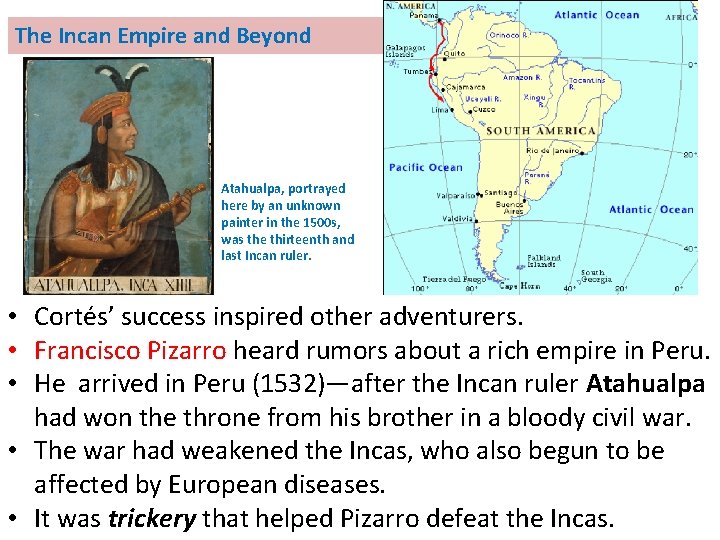
The Incan Empire and Beyond Atahualpa, portrayed here by an unknown painter in the 1500 s, was the thirteenth and last Incan ruler. • Cortés’ success inspired other adventurers. • Francisco Pizarro heard rumors about a rich empire in Peru. • He arrived in Peru (1532)—after the Incan ruler Atahualpa had won the throne from his brother in a bloody civil war. • The war had weakened the Incas, who also begun to be affected by European diseases. • It was trickery that helped Pizarro defeat the Incas.

Conquering the Inca https: //www. youtube. com/watch? v=z. GAWny. H_BYQ • Pizarro and 200 men (Native allies) trick Atahualpa, captured him when he The Inca Empire expanded into the modern countries of Ecuador, Peru, Chile, Bolivia and Argentina. refused to convert • Pizarro conquers with superior weapons, and diseases • Established Lima
The Incan Empire and Beyond Read pg. 288, answer questions 7 -8 • Atahualpa Resists • Pizarro Triumphs

Governing the Spanish Empire Analyze Maps What do all the European land claims in South America have in common? Which country settled the easternmost region? • Settlers and missionaries followed the conquistadors to the Americas. • The huge Spanish empire stretched from California in the north to Argentina in the south. • Spain divided these lands into four provinces, including New Spain (Mexico) and Peru.

Governing the Spanish Empire While the process of extracting silver from the Potosí mines was terribly destructive for Native American and other forced laborers, it proved immensely profitable for Spain.
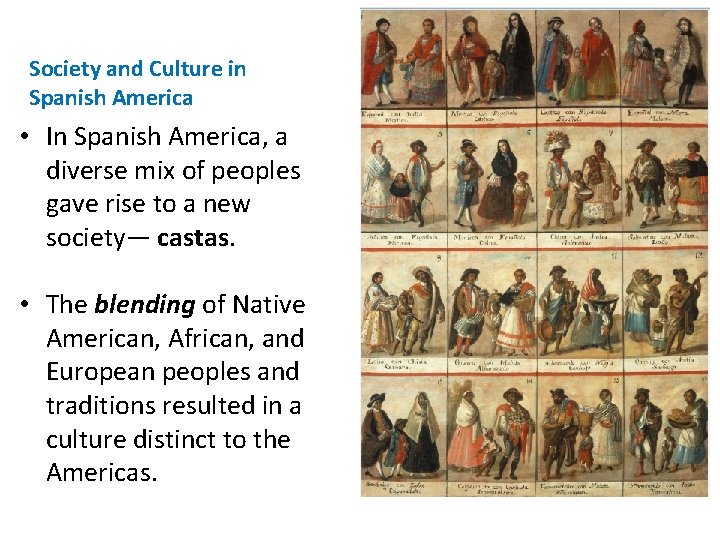
Society and Culture in Spanish America • In Spanish America, a diverse mix of peoples gave rise to a new society— castas. • The blending of Native American, African, and European peoples and traditions resulted in a culture distinct to the Americas.
Society and Culture in Spanish America Read pg. 291 -292 and complete the table. • A Society of Unequal Classes
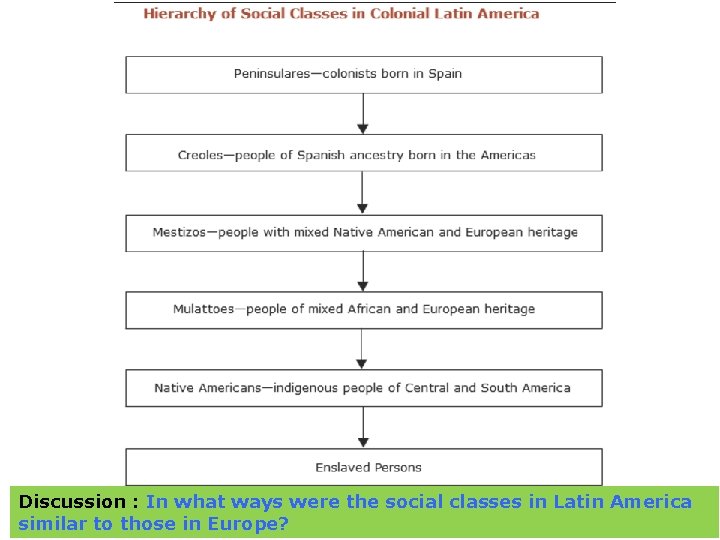
Discussion : In what ways were the social classes in Latin America similar to those in Europe?
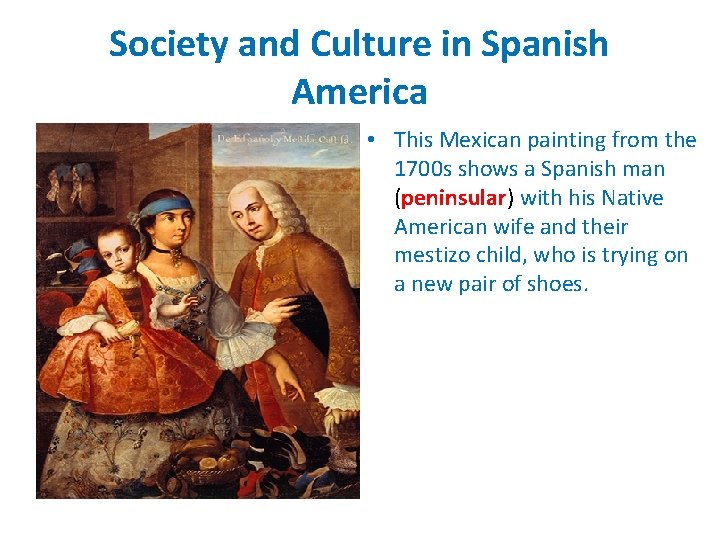
Society and Culture in Spanish America • This Mexican painting from the 1700 s shows a Spanish man (peninsular) with his Native American wife and their mestizo child, who is trying on a new pair of shoes.

Mestizo and Castizo

Mulato and Morisco

Chino and Salta Atras
Society and Culture in Spanish America This Mexican painting from the 1700 s shows a Spanish man with his Native American wife and their mestizo child, who is trying on a new pair of shoes.
The Impact of Spanish Colonization Spanish exploration, colonization, and expansion had a long-lasting impact on Native Americans, Europeans, and others beyond these two groups. By establishing an empire in the Americas, Spain dramatically changed the pattern of global encounter first set in motion by European exploration of Africa’s coasts. For the first time, much of the world was now connected by sea routes, on which traveled ships carrying goods, people, and ideas.
The Impact of Spanish Colonization • • Spain Wins Wealth and Power Native American Suffering and Resistance
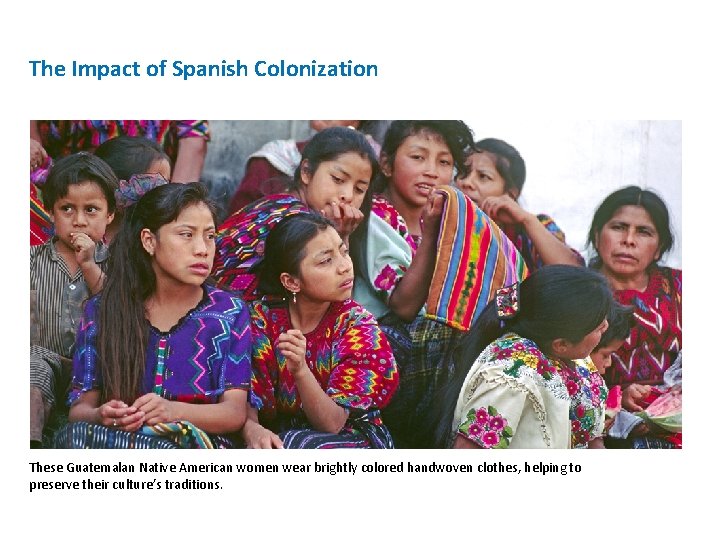
The Impact of Spanish Colonization These Guatemalan Native American women wear brightly colored handwoven clothes, helping to preserve their culture’s traditions.
- Slides: 27