
New global alignment framework for Alice Barrel PWGPP73

New global alignment framework for Alice Barrel (PWGPP-73) R. Shahoyan, 02/07/2015 1
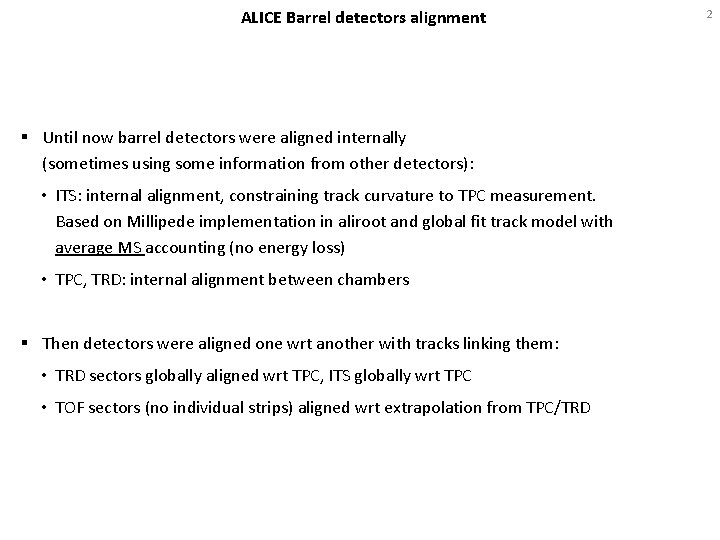
ALICE Barrel detectors alignment § Until now barrel detectors were aligned internally (sometimes using some information from other detectors): • ITS: internal alignment, constraining track curvature to TPC measurement. Based on Millipede implementation in aliroot and global fit track model with average MS accounting (no energy loss) • TPC, TRD: internal alignment between chambers § Then detectors were aligned one wrt another with tracks linking them: • TRD sectors globally aligned wrt TPC, ITS globally wrt TPC • TOF sectors (no individual strips) aligned wrt extrapolation from TPC/TRD 2
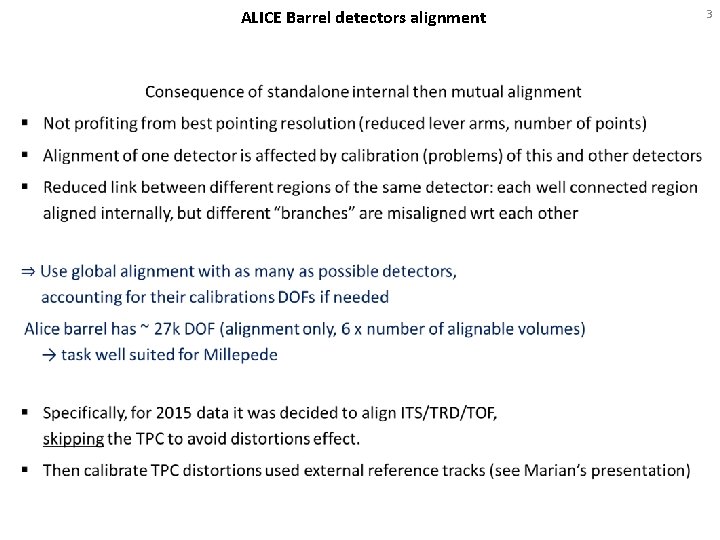
ALICE Barrel detectors alignment 3
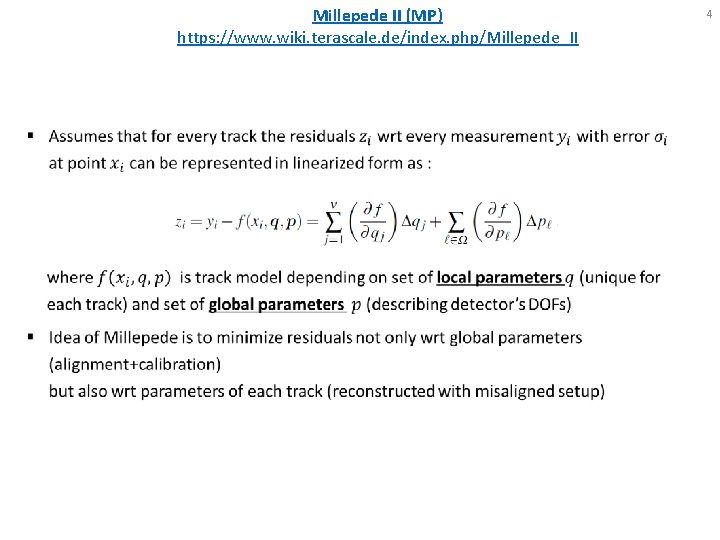
Millepede II (MP) https: //www. wiki. terascale. de/index. php/Millepede_II 4
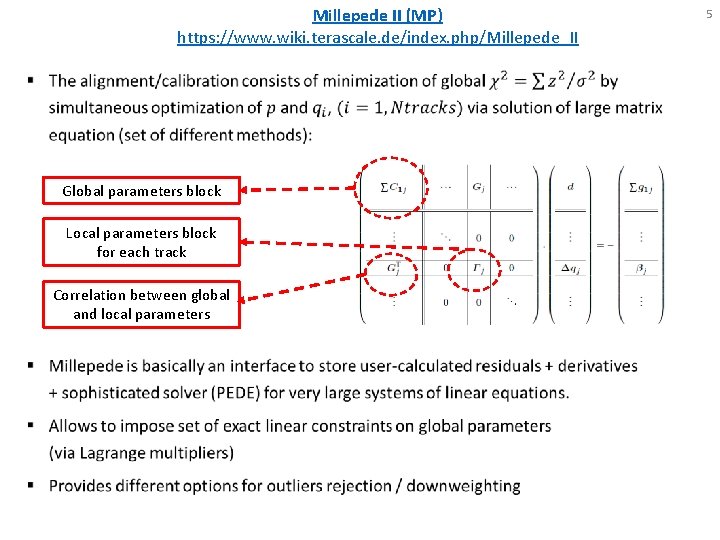
Millepede II (MP) https: //www. wiki. terascale. de/index. php/Millepede_II Global parameters block Local parameters block for each track Correlation between global and local parameters 5
Track model for Alice Millepede § Millepede needs derivatives of track position wrt its parameters (e. g. defined at some reference point). § Kalman track model used in ALICE is not directly applicable to MP since it has no “reference” track parameters and their global covariance matrix per se: instead it provides set of best estimates for track state and its errors at each measured point, related via transport matrix. § LHCb managed to adopt Kalman tracks to MP via very convoluted math, based on analytical smoother, but it is also not appropriate for ALICE, since we use rotations when going from one sensor to another, which prevents from describing transport as really linear transformation § Preferable to use track model as much as possible close to what is used in reconstruction, to minimize systematic effects of model approximations § → Use synthetic track model consisting of usual Ali. External. Track. Param defined in the reference point + corrections (again Ali. External. Track. Param) for kinks due to the mult. scattering between measurements separated by material 6
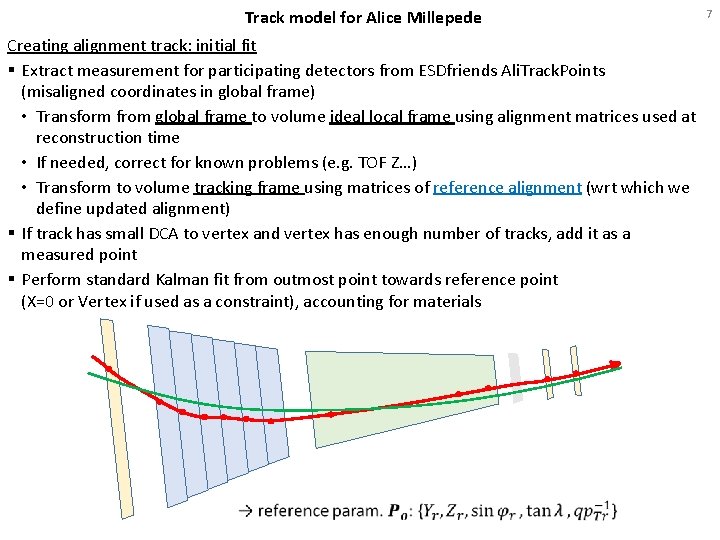
Track model for Alice Millepede Creating alignment track: initial fit § Extract measurement for participating detectors from ESDfriends Ali. Track. Points (misaligned coordinates in global frame) • Transform from global frame to volume ideal local frame using alignment matrices used at reconstruction time • If needed, correct for known problems (e. g. TOF Z…) • Transform to volume tracking frame using matrices of reference alignment (wrt which we define updated alignment) § If track has small DCA to vertex and vertex has enough number of tracks, add it as a measured point § Perform standard Kalman fit from outmost point towards reference point (X=0 or Vertex if used as a constraint), accounting for materials 7
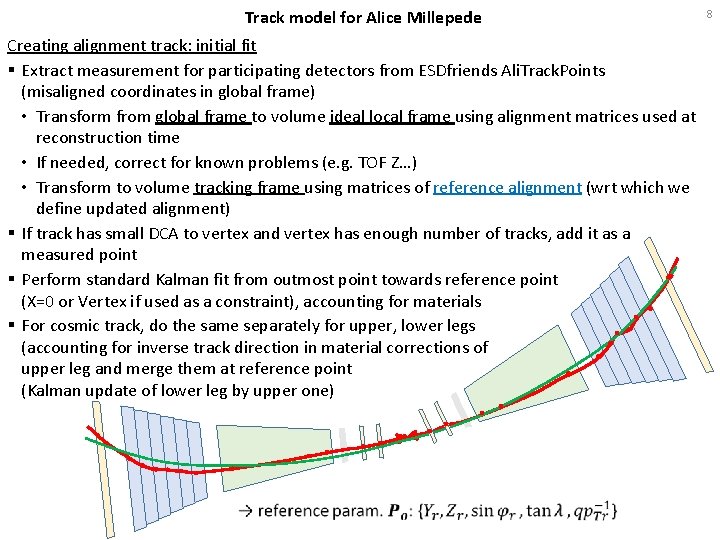
Track model for Alice Millepede Creating alignment track: initial fit § Extract measurement for participating detectors from ESDfriends Ali. Track. Points (misaligned coordinates in global frame) • Transform from global frame to volume ideal local frame using alignment matrices used at reconstruction time • If needed, correct for known problems (e. g. TOF Z…) • Transform to volume tracking frame using matrices of reference alignment (wrt which we define updated alignment) § If track has small DCA to vertex and vertex has enough number of tracks, add it as a measured point § Perform standard Kalman fit from outmost point towards reference point (X=0 or Vertex if used as a constraint), accounting for materials § For cosmic track, do the same separately for upper, lower legs (accounting for inverse track direction in material corrections of upper leg and merge them at reference point (Kalman update of lower leg by upper one) 8
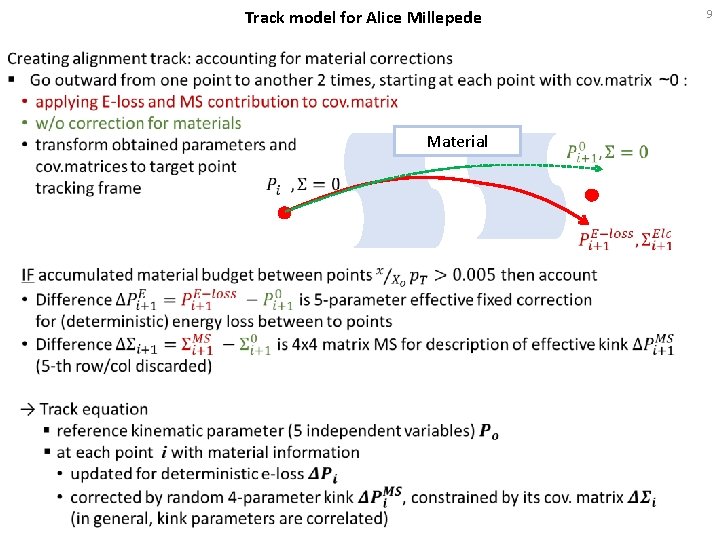
Track model for Alice Millepede 9 Material
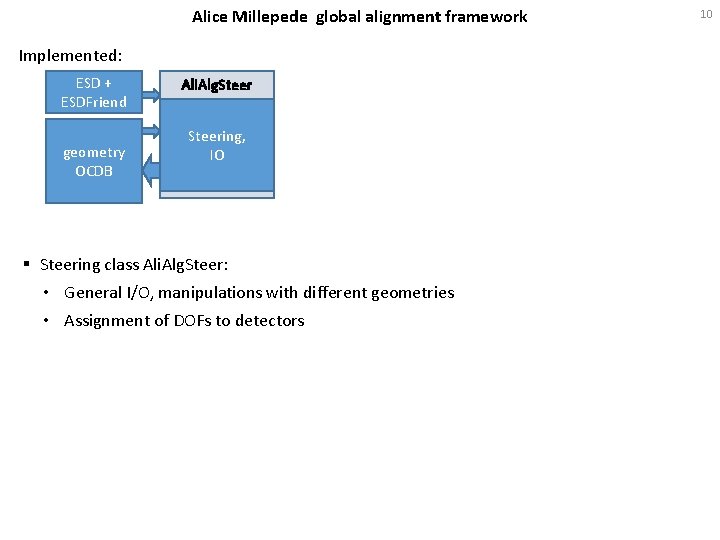
Alice Millepede global alignment framework Implemented: ESD + ESDFriend geometry OCDB Ali. Alg. Steering, IO § Steering class Ali. Alg. Steer: • General I/O, manipulations with different geometries • Assignment of DOFs to detectors 10
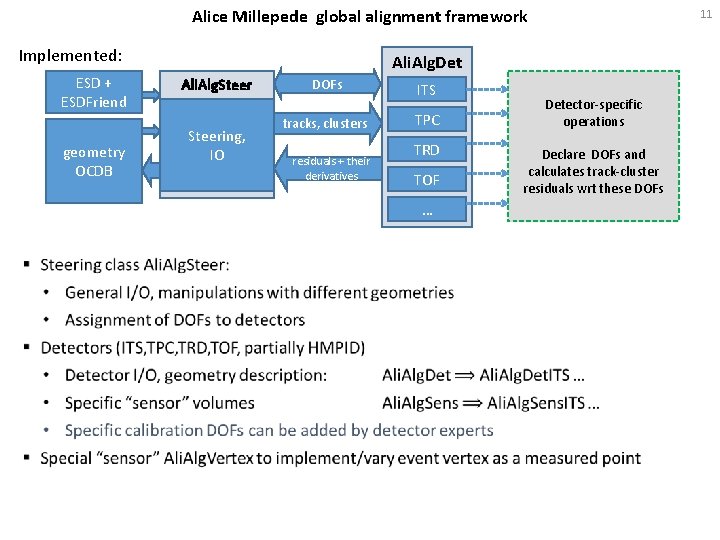
Alice Millepede global alignment framework Implemented: ESD + ESDFriend geometry OCDB Ali. Alg. Det Ali. Alg. Steering, IO DOFs tracks, clusters residuals + their derivatives ITS TPC TRD TOF … 11 Detector-specific operations Declare DOFs and calculates track-cluster residuals wrt these DOFs
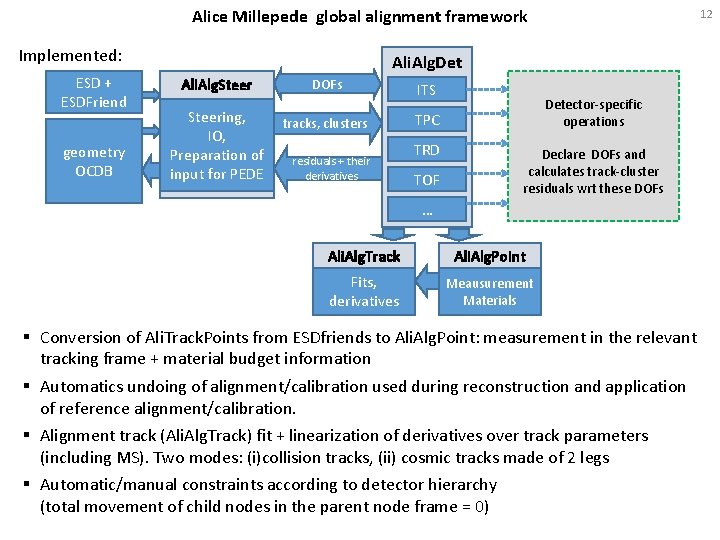
Alice Millepede global alignment framework Implemented: ESD + ESDFriend geometry OCDB 12 Ali. Alg. Det Ali. Alg. Steer DOFs Steering, tracks, clusters IO, Preparation of residuals + their input for PEDE derivatives ITS Detector-specific operations TPC TRD TOF Declare DOFs and calculates track-cluster residuals wrt these DOFs … Ali. Alg. Track Ali. Alg. Point Fits, derivatives Meausurement Materials § Conversion of Ali. Track. Points from ESDfriends to Ali. Alg. Point: measurement in the relevant tracking frame + material budget information § Automatics undoing of alignment/calibration used during reconstruction and application of reference alignment/calibration. § Alignment track (Ali. Alg. Track) fit + linearization of derivatives over track parameters (including MS). Two modes: (i)collision tracks, (ii) cosmic tracks made of 2 legs § Automatic/manual constraints according to detector hierarchy (total movement of child nodes in the parent node frame = 0)
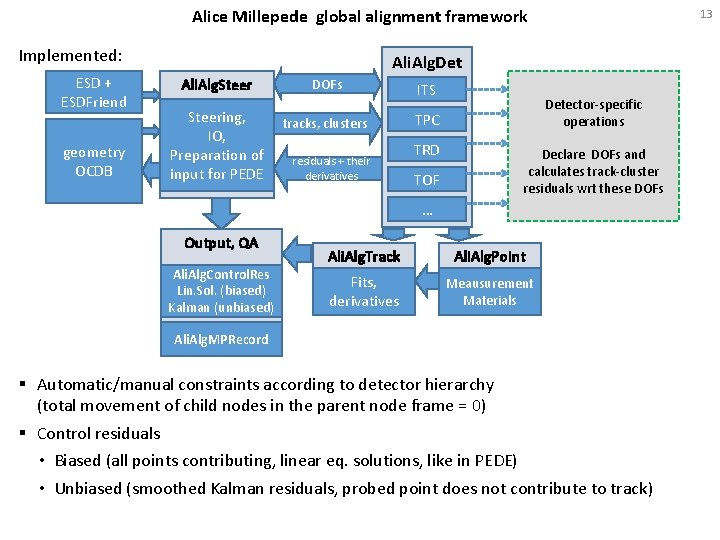
Alice Millepede global alignment framework Implemented: ESD + ESDFriend geometry OCDB 13 Ali. Alg. Det Ali. Alg. Steer DOFs Steering, tracks, clusters IO, Preparation of residuals + their input for PEDE derivatives ITS Detector-specific operations TPC TRD TOF Declare DOFs and calculates track-cluster residuals wrt these DOFs … Output, QA Ali. Alg. Control. Res Lin. Sol. (biased) Kalman (unbiased) Ali. Alg. Track Ali. Alg. Point Fits, derivatives Meausurement Materials Ali. Alg. MPRecord § Automatic/manual constraints according to detector hierarchy (total movement of child nodes in the parent node frame = 0) § Control residuals • Biased (all points contributing, linear eq. solutions, like in PEDE) • Unbiased (smoothed Kalman residuals, probed point does not contribute to track)
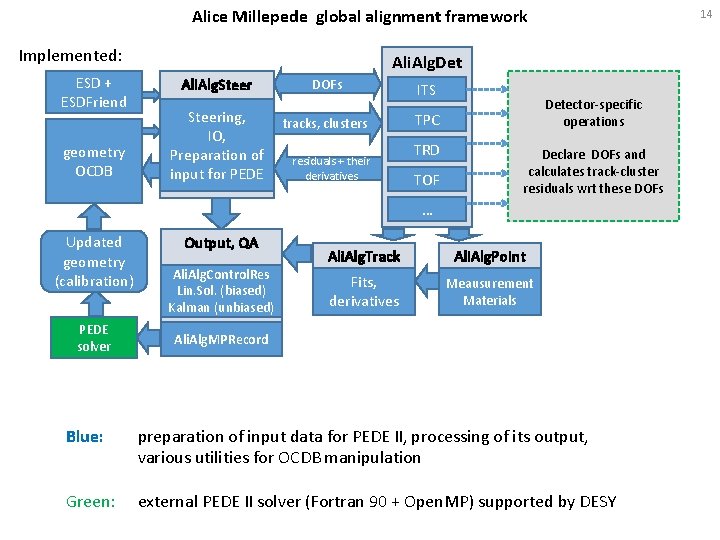
Alice Millepede global alignment framework Implemented: ESD + ESDFriend geometry OCDB 14 Ali. Alg. Det Ali. Alg. Steer DOFs Steering, tracks, clusters IO, Preparation of residuals + their input for PEDE derivatives ITS Detector-specific operations TPC TRD TOF Declare DOFs and calculates track-cluster residuals wrt these DOFs … Updated geometry (calibration) PEDE solver Output, QA Ali. Alg. Control. Res Lin. Sol. (biased) Kalman (unbiased) Ali. Alg. Track Ali. Alg. Point Fits, derivatives Meausurement Materials Ali. Alg. MPRecord Blue: preparation of input data for PEDE II, processing of its output, various utilities for OCDB manipulation Green: external PEDE II solver (Fortran 90 + Open. MP) supported by DESY
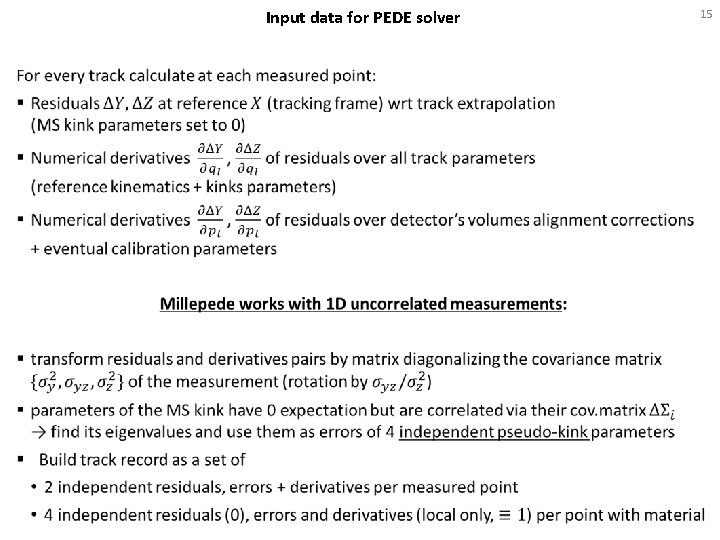
Input data for PEDE solver 15

16 Problems affecting alignment

TGeometry precision § ROOT TGeometry volume positioning/alignment managed by TGeo. HMatrix objects • Each volume i has its Local-to-MARS transition ideal matrix which after alignment becomes aligned matrix where is alignment correction matrix for volume j in global representation, connected with local one as The hierarchy of volumes in geometry branch goes from j = 0 (top node in MARS) • The alignment framework stores by convention these global correction matrices § Alignment procedure produces an incremental corrections for each volume, which must be convoluted with initial alignment as: • Therefore, in case of 0 incremental correction: 17
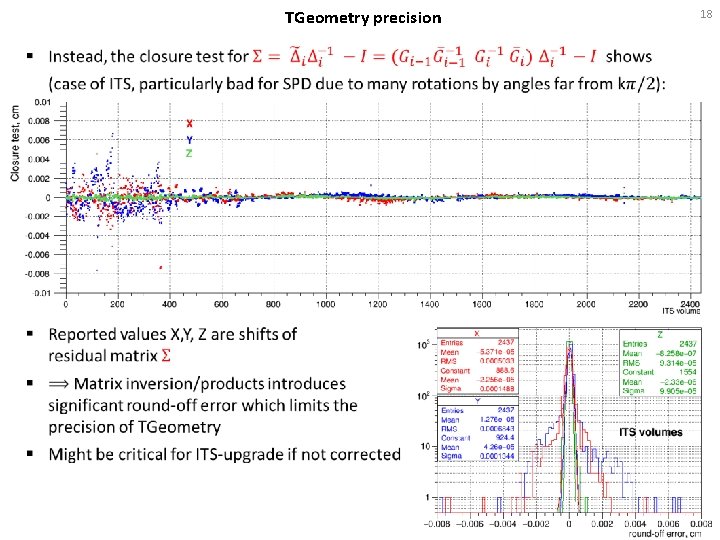
TGeometry precision 18
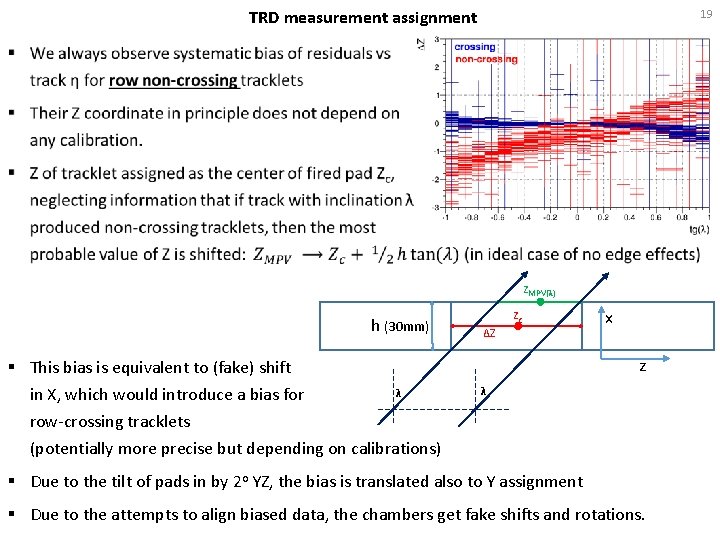
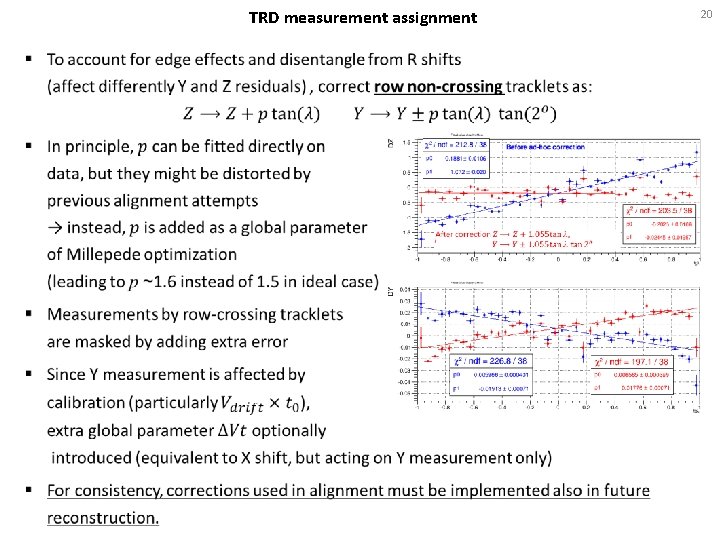
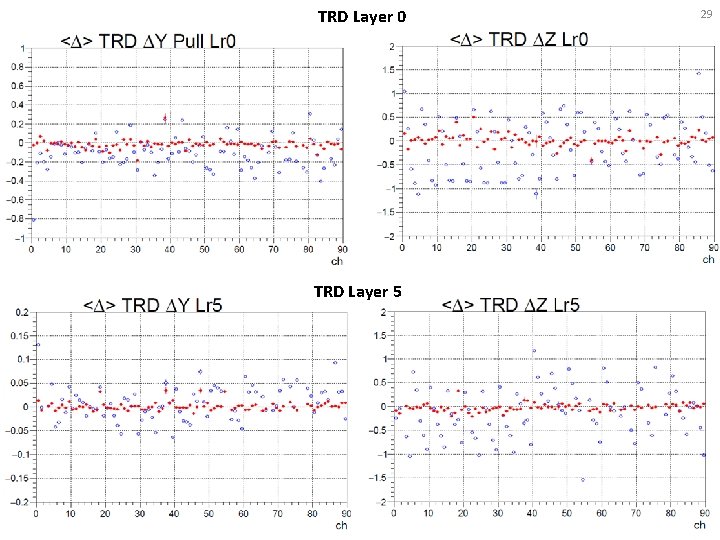
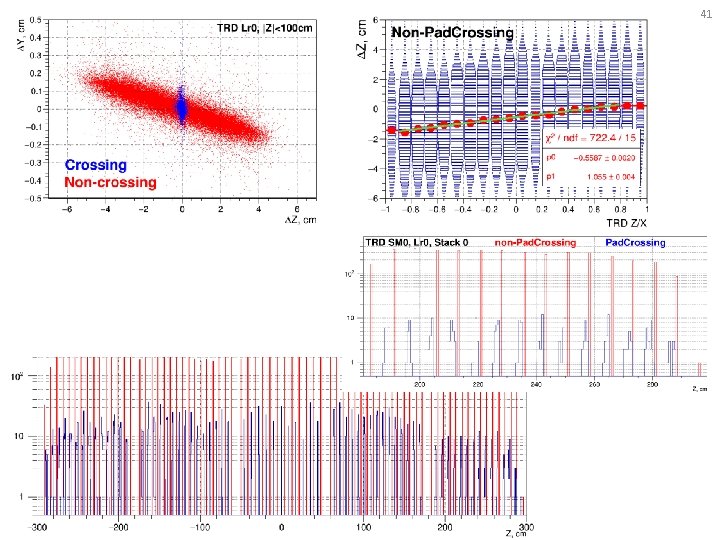
TRD measurement assignment 19 z. MPV(λ) h (30 mm) § This bias is equivalent to (fake) shift λ in X, which would introduce a bias for row-crossing tracklets (potentially more precise but depending on calibrations) zc ΔZ x z λ § Due to the tilt of pads in by 2 o YZ, the bias is translated also to Y assignment § Due to the attempts to align biased data, the chambers get fake shifts and rotations.
TRD measurement assignment 20
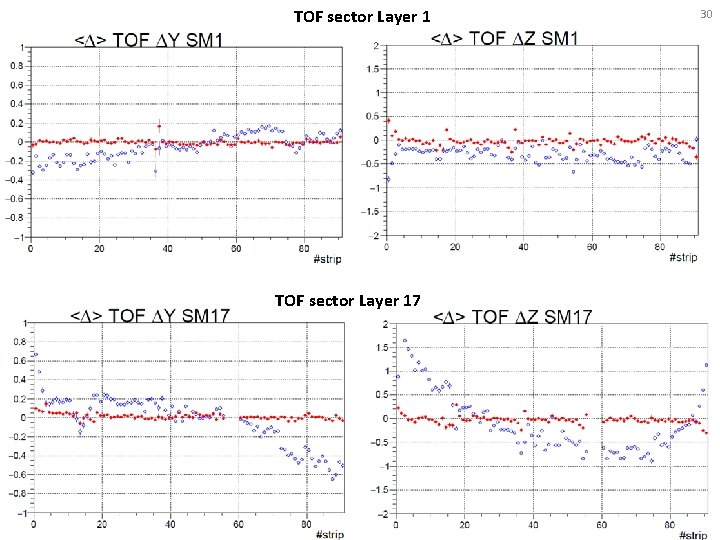
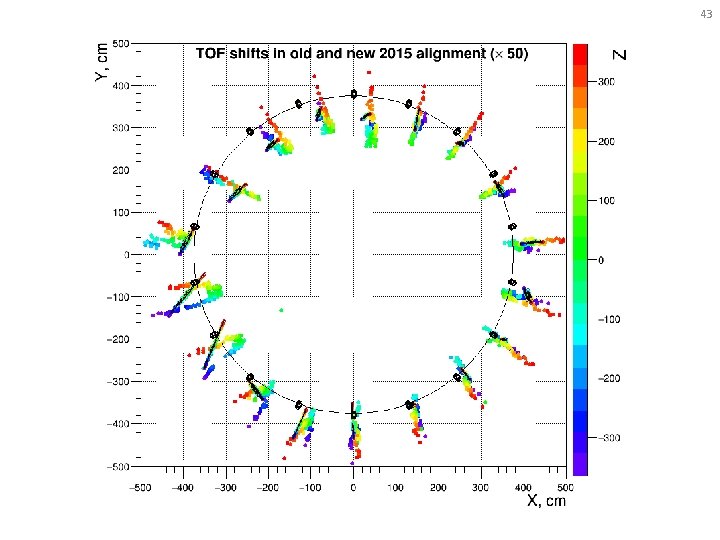
Bug in applying TOF alignment § TOF clusters use r, ϕ and Z in lab, frame § Because the alignment matrix is applied on-the-fly only in calculation of r and ϕ the Z measurement is never corrected for the misalignment (~2 cm) § This should not be critical for TOF matching, since the clusters user only for matching candidate preselection, with large tolerances (to be verified) → TOF trackpoints stored in ESDfriends contain correctly misaligned lab. X, Y but ideal Z! § To account for this Track. Points → Ali. Alg. Point converter in the Ali. Alg. Sens. TOF tries to recover ideal {X, Y, Z} in local frame by accounting for wrong transformations → Some distortions are inevitable due to the rotations in existing TOF alignment (should be limited to ~100µm, will below TOF σ ~ 0. 7 cm) § To be fixed in TOF code, with special bit flag set on Track. Points in ESD friends to signal modified content 21
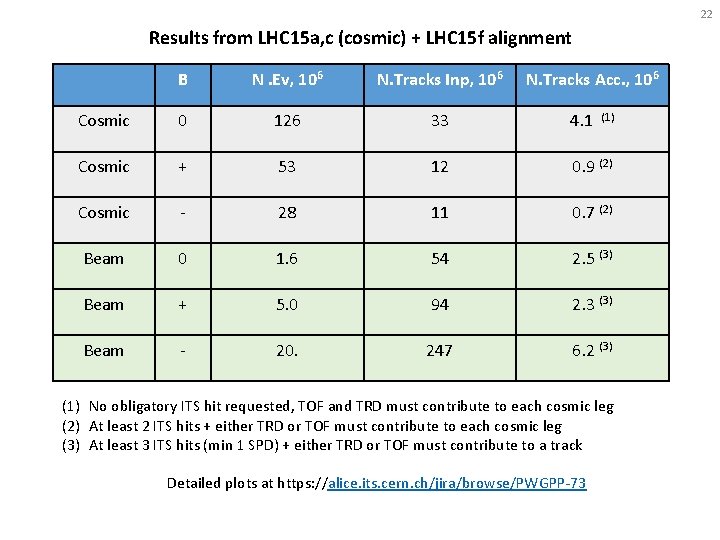
22 Results from LHC 15 a, c (cosmic) + LHC 15 f alignment B N. Ev, 106 N. Tracks Inp, 106 N. Tracks Acc. , 106 Cosmic 0 126 33 4. 1 (1) Cosmic + 53 12 0. 9 (2) Cosmic - 28 11 0. 7 (2) Beam 0 1. 6 54 2. 5 (3) Beam + 5. 0 94 2. 3 (3) Beam - 20. 247 6. 2 (3) (1) No obligatory ITS hit requested, TOF and TRD must contribute to each cosmic leg (2) At least 2 ITS hits + either TRD or TOF must contribute to each cosmic leg (3) At least 3 ITS hits (min 1 SPD) + either TRD or TOF must contribute to a track Detailed plots at https: //alice. its. cern. ch/jira/browse/PWGPP-73
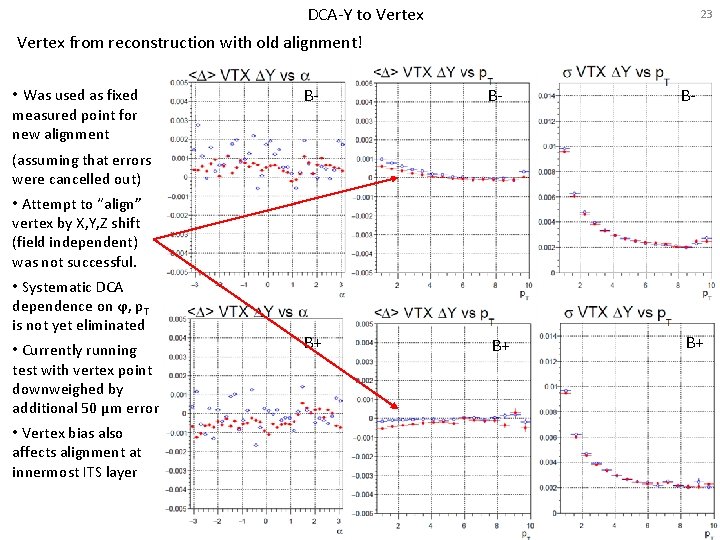
DCA-Y to Vertex 23 Vertex from reconstruction with old alignment! • Was used as fixed measured point for new alignment B- B- B- B+ B+ B+ (assuming that errors were cancelled out) • Attempt to “align” vertex by X, Y, Z shift (field independent) was not successful. • Systematic DCA dependence on ϕ, p. T is not yet eliminated • Currently running test with vertex point downweighed by additional 50 µm error • Vertex bias also affects alignment at innermost ITS layer
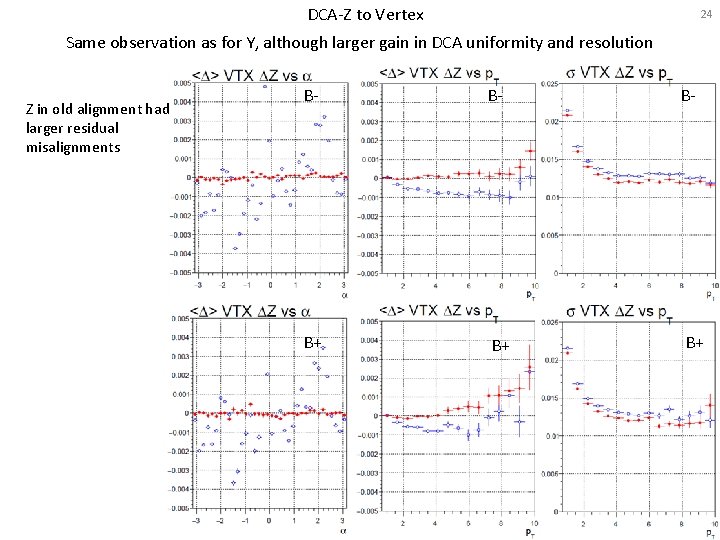
DCA-Z to Vertex 24 Same observation as for Y, although larger gain in DCA uniformity and resolution Z in old alignment had larger residual misalignments B- B- B- B+ B+ B+
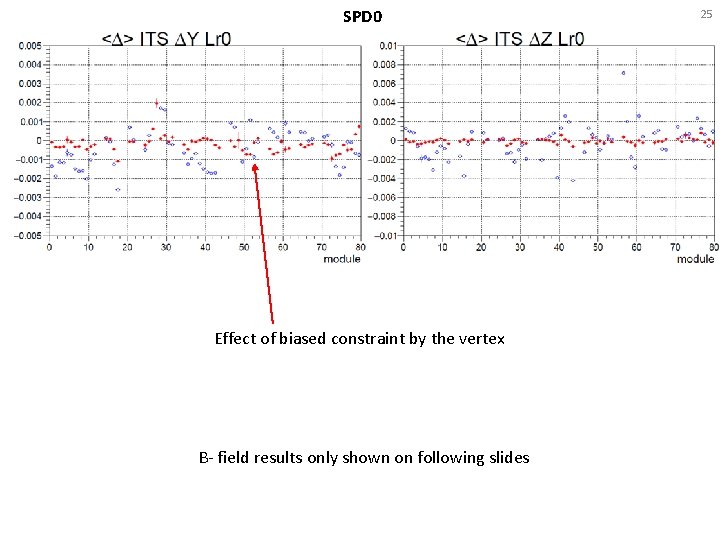
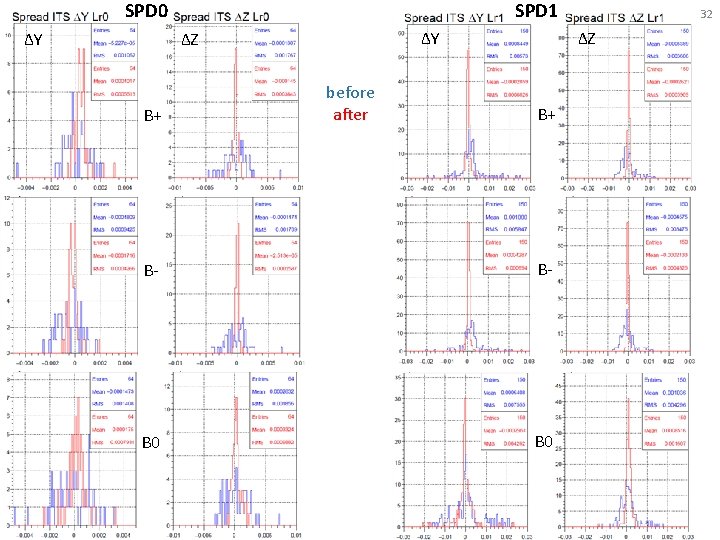
SPD 0 Effect of biased constraint by the vertex B- field results only shown on following slides 25
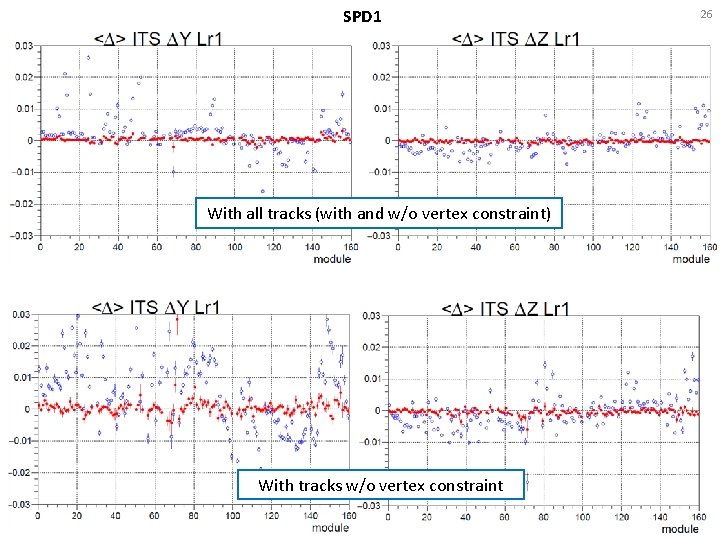
SPD 1 With all tracks (with and w/o vertex constraint) With tracks w/o vertex constraint 26
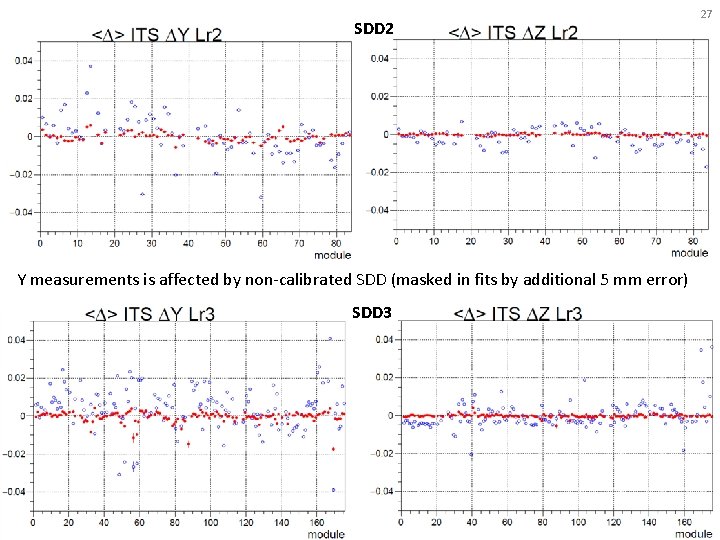
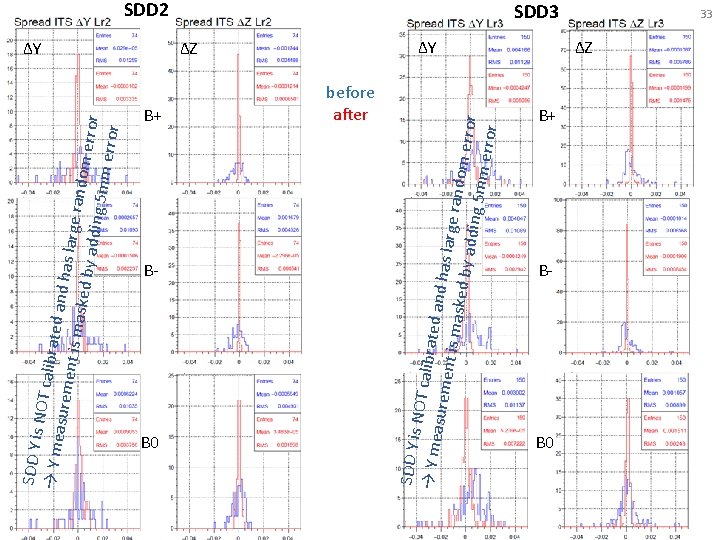
SDD 2 Y measurements is affected by non-calibrated SDD (masked in fits by additional 5 mm error) SDD 3 27
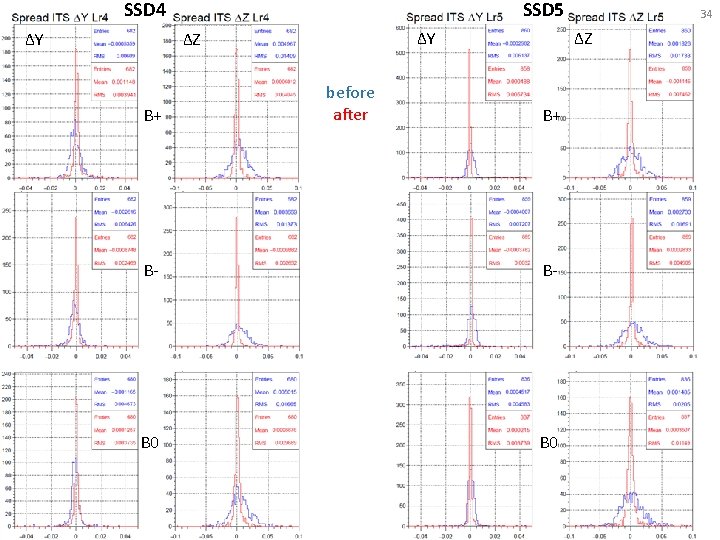
SSD 4 SSD 5 28
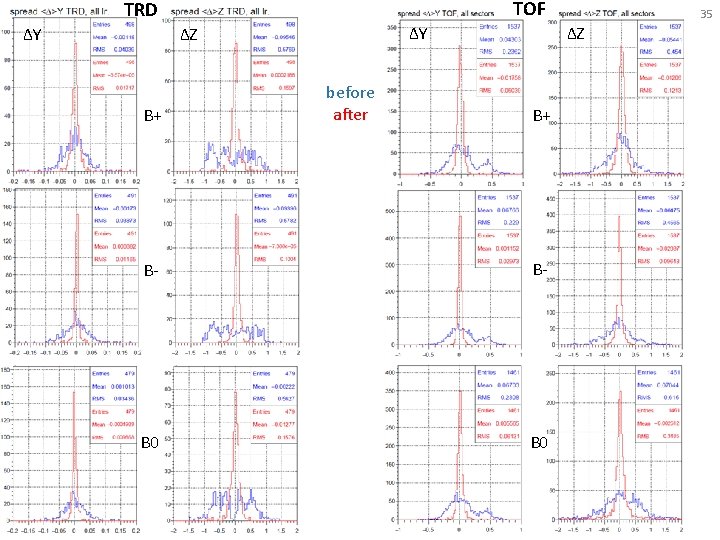
TRD Layer 0 TRD Layer 5 29
TOF sector Layer 17 30
Bin-by-bin (sensor-by-sensor) residuals spread B+ B- B 0 31
SPD 1 SPD 0 ΔY ΔZ B+ before after B+ B- B- B 0 32
SDD Y is N → Y me OT calibrated a asurem ent is m nd has large ra asked b n y addin dom error g 5 mm error ΔY ΔZ B+ B- B 0 before after SDD Y is N → Y me OT calibrated a asurem ent is m nd has large ra asked b n y addin dom error g 5 mm error SDD 2 SDD 3 ΔY ΔZ B+ B- B 0 33
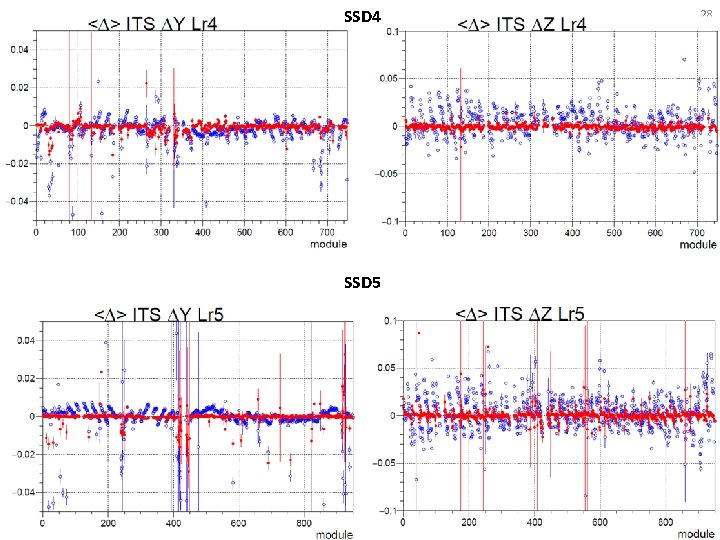
SSD 4 SSD 5 ΔY ΔZ B+ before after B+ B- B- B 0 34
TOF TRD ΔY ΔZ B+ before after B+ B- B- B 0 35
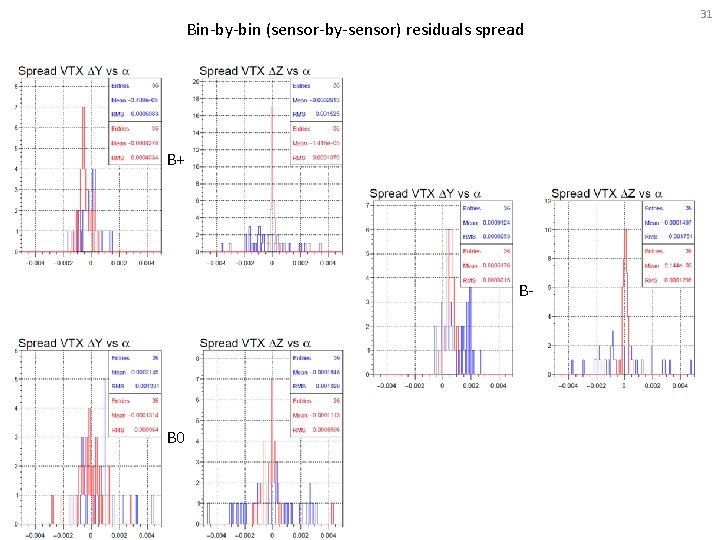
Outlook § Millepede alignment • Try to improve vertex DCA (bias in ϕ, p. T) • Systematic difference between B+, B- and B 0 is still observed: • In the current ITS/TRD/TOF alignment schema only TRD may introduce such dependence via run/field dependent calibrations • Introduce calibration DOF sets for field and run dependent calibration parameters to improve alignment quality (and TRD calibration also) • Finalize HMPID module • Many ITS sensors are not in the data (list in the backup) SPD 0: 6/80, SPD 1: 10/160, SDD 2: 9/84, SDD 3: 21/176, SSD 4: 66/748 SSD 5: 80/950 Need additional alignment if reappear in the future data § For the Run 3 upgrade: problems with ROOT TGeo. HMatrix precision might be critical for ITS upgrade, fix is needed 36
Outlook § Aliroot reconstruction • TRD Z assignment for pad-row non-crossing tracklets must be fixed • Ion-tail cancelation in TRD: correction for B=0 is applied as for B<0 field → to be fixed The corrections themselves (up to ~200 and ~400 µm depending in B sign) to be checked • TOF clusters should receive proper misalignment • Once TPC distortion maps are ready, reconstruct high p. T filtered data with TRD (TOF? ) in the reconstruction, to check the effect on p. T resolution, efficiency. 37

38 BACKUP
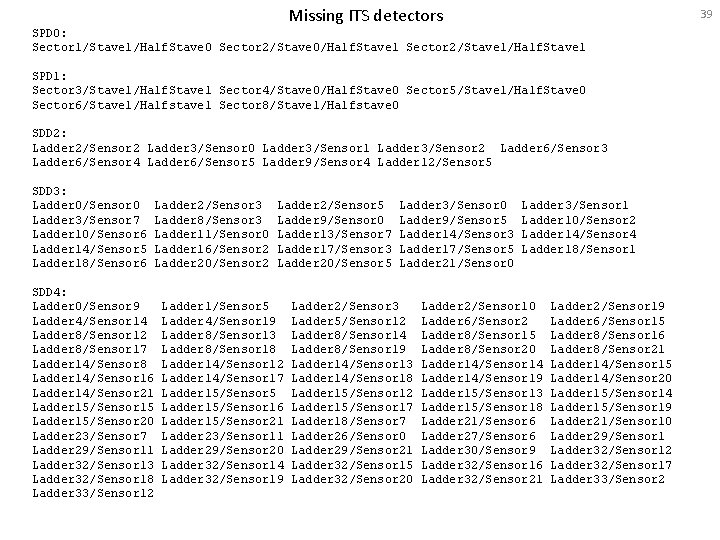
Missing ITS detectors 39 SPD 0: Sector 1/Stave 1/Half. Stave 0 Sector 2/Stave 0/Half. Stave 1 Sector 2/Stave 1/Half. Stave 1 SPD 1: Sector 3/Stave 1/Half. Stave 1 Sector 4/Stave 0/Half. Stave 0 Sector 5/Stave 1/Half. Stave 0 Sector 6/Stave 1/Halfstave 1 Sector 8/Stave 1/Halfstave 0 SDD 2: Ladder 2/Sensor 2 Ladder 3/Sensor 0 Ladder 3/Sensor 1 Ladder 3/Sensor 2 Ladder 6/Sensor 3 Ladder 6/Sensor 4 Ladder 6/Sensor 5 Ladder 9/Sensor 4 Ladder 12/Sensor 5 SDD 3: Ladder 0/Sensor 0 Ladder 3/Sensor 7 Ladder 10/Sensor 6 Ladder 14/Sensor 5 Ladder 18/Sensor 6 SDD 4: Ladder 0/Sensor 9 Ladder 4/Sensor 14 Ladder 8/Sensor 12 Ladder 8/Sensor 17 Ladder 14/Sensor 8 Ladder 14/Sensor 16 Ladder 14/Sensor 21 Ladder 15/Sensor 15 Ladder 15/Sensor 20 Ladder 23/Sensor 7 Ladder 29/Sensor 11 Ladder 32/Sensor 13 Ladder 32/Sensor 18 Ladder 33/Sensor 12 Ladder 2/Sensor 3 Ladder 8/Sensor 3 Ladder 11/Sensor 0 Ladder 16/Sensor 2 Ladder 20/Sensor 2 Ladder 2/Sensor 5 Ladder 9/Sensor 0 Ladder 13/Sensor 7 Ladder 17/Sensor 3 Ladder 20/Sensor 5 Ladder 1/Sensor 5 Ladder 4/Sensor 19 Ladder 8/Sensor 13 Ladder 8/Sensor 18 Ladder 14/Sensor 12 Ladder 14/Sensor 17 Ladder 15/Sensor 5 Ladder 15/Sensor 16 Ladder 15/Sensor 21 Ladder 23/Sensor 11 Ladder 29/Sensor 20 Ladder 32/Sensor 14 Ladder 32/Sensor 19 Ladder 3/Sensor 0 Ladder 9/Sensor 5 Ladder 14/Sensor 3 Ladder 17/Sensor 5 Ladder 21/Sensor 0 Ladder 2/Sensor 3 Ladder 5/Sensor 12 Ladder 8/Sensor 14 Ladder 8/Sensor 19 Ladder 14/Sensor 13 Ladder 14/Sensor 18 Ladder 15/Sensor 12 Ladder 15/Sensor 17 Ladder 18/Sensor 7 Ladder 26/Sensor 0 Ladder 29/Sensor 21 Ladder 32/Sensor 15 Ladder 32/Sensor 20 Ladder 3/Sensor 1 Ladder 10/Sensor 2 Ladder 14/Sensor 4 Ladder 18/Sensor 1 Ladder 2/Sensor 10 Ladder 6/Sensor 2 Ladder 8/Sensor 15 Ladder 8/Sensor 20 Ladder 14/Sensor 14 Ladder 14/Sensor 19 Ladder 15/Sensor 13 Ladder 15/Sensor 18 Ladder 21/Sensor 6 Ladder 27/Sensor 6 Ladder 30/Sensor 9 Ladder 32/Sensor 16 Ladder 32/Sensor 21 Ladder 2/Sensor 19 Ladder 6/Sensor 15 Ladder 8/Sensor 16 Ladder 8/Sensor 21 Ladder 14/Sensor 15 Ladder 14/Sensor 20 Ladder 15/Sensor 14 Ladder 15/Sensor 19 Ladder 21/Sensor 10 Ladder 29/Sensor 1 Ladder 32/Sensor 12 Ladder 32/Sensor 17 Ladder 33/Sensor 2
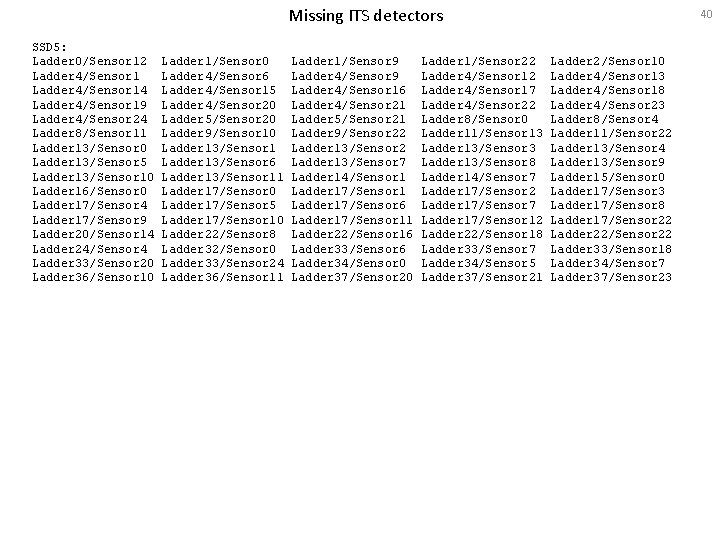
Missing ITS detectors SSD 5: Ladder 0/Sensor 12 Ladder 4/Sensor 14 Ladder 4/Sensor 19 Ladder 4/Sensor 24 Ladder 8/Sensor 11 Ladder 13/Sensor 0 Ladder 13/Sensor 5 Ladder 13/Sensor 10 Ladder 16/Sensor 0 Ladder 17/Sensor 4 Ladder 17/Sensor 9 Ladder 20/Sensor 14 Ladder 24/Sensor 4 Ladder 33/Sensor 20 Ladder 36/Sensor 10 Ladder 1/Sensor 0 Ladder 4/Sensor 6 Ladder 4/Sensor 15 Ladder 4/Sensor 20 Ladder 5/Sensor 20 Ladder 9/Sensor 10 Ladder 13/Sensor 1 Ladder 13/Sensor 6 Ladder 13/Sensor 11 Ladder 17/Sensor 0 Ladder 17/Sensor 5 Ladder 17/Sensor 10 Ladder 22/Sensor 8 Ladder 32/Sensor 0 Ladder 33/Sensor 24 Ladder 36/Sensor 11 Ladder 1/Sensor 9 Ladder 4/Sensor 16 Ladder 4/Sensor 21 Ladder 5/Sensor 21 Ladder 9/Sensor 22 Ladder 13/Sensor 7 Ladder 14/Sensor 1 Ladder 17/Sensor 6 Ladder 17/Sensor 11 Ladder 22/Sensor 16 Ladder 33/Sensor 6 Ladder 34/Sensor 0 Ladder 37/Sensor 20 Ladder 1/Sensor 22 Ladder 4/Sensor 17 Ladder 4/Sensor 22 Ladder 8/Sensor 0 Ladder 11/Sensor 13 Ladder 13/Sensor 8 Ladder 14/Sensor 7 Ladder 17/Sensor 2 Ladder 17/Sensor 7 Ladder 17/Sensor 12 Ladder 22/Sensor 18 Ladder 33/Sensor 7 Ladder 34/Sensor 5 Ladder 37/Sensor 21 40 Ladder 2/Sensor 10 Ladder 4/Sensor 13 Ladder 4/Sensor 18 Ladder 4/Sensor 23 Ladder 8/Sensor 4 Ladder 11/Sensor 22 Ladder 13/Sensor 4 Ladder 13/Sensor 9 Ladder 15/Sensor 0 Ladder 17/Sensor 3 Ladder 17/Sensor 8 Ladder 17/Sensor 22 Ladder 22/Sensor 22 Ladder 33/Sensor 18 Ladder 34/Sensor 7 Ladder 37/Sensor 23
41
42
43
- Slides: 43