
New General Education Curriculum CMO 20 s 2013
- Slides: 53
New General Education Curriculum (CMO 20, s. 2013) CHERRIE MELANIE ANCHETA-DIEGO, CESO III DIRECTOR IV COMMISSION ON HIGHER EDUCATION - REGIONAL OFFICE I Tagapagtaguyod, Kaagapay sa Paglinang ng Yamang-Tao
CHED Memorandum Order No. 20, s. 2013 Entitled “General Education Curriculum: Holistic Understandings, Intellectual and Civic Competencies” • Provides the framework and rationale of the revised GE as a paradigm shift and in the context of the K to 12 curriculum based on the College Readiness Standards • Sets the minimum standards for the general education component of all degree programs that applies to private and public HEIs in the country Tagapagtaguyod, Kaagapay sa Paglinang ng Yamang-Tao
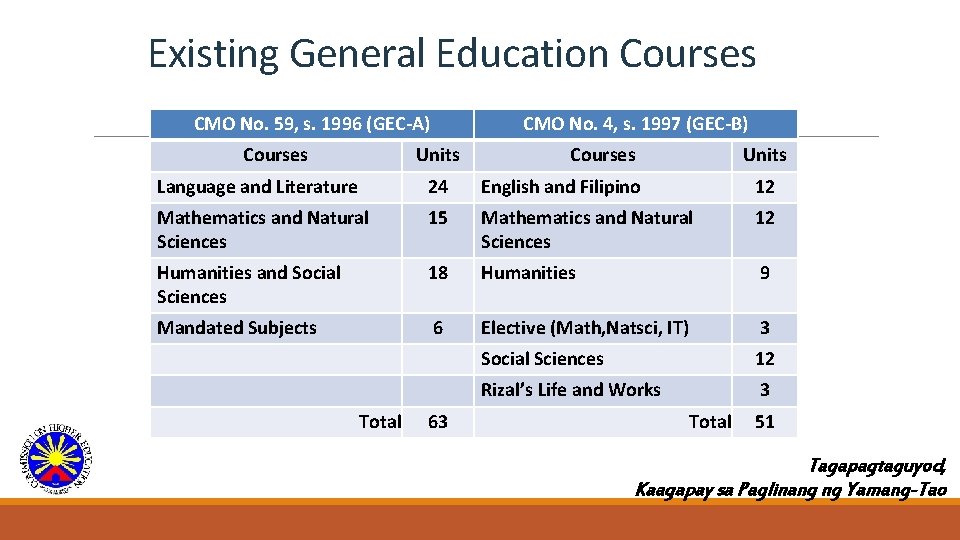
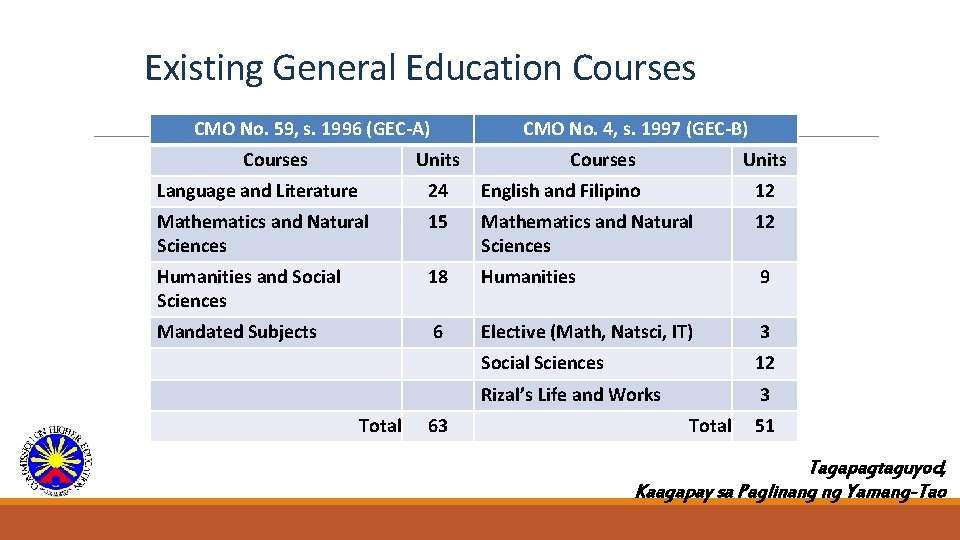
Existing General Education Courses CMO No. 59, s. 1996 (GEC-A) Courses CMO No. 4, s. 1997 (GEC-B) Units Courses Units Language and Literature 24 English and Filipino 12 Mathematics and Natural Sciences 15 Mathematics and Natural Sciences 12 Humanities and Social Sciences 18 Humanities 9 Mandated Subjects 6 Elective (Math, Natsci, IT) 3 Social Sciences 12 Rizal’s Life and Works 3 Total 63 Total 51 Tagapagtaguyod, Kaagapay sa Paglinang ng Yamang-Tao
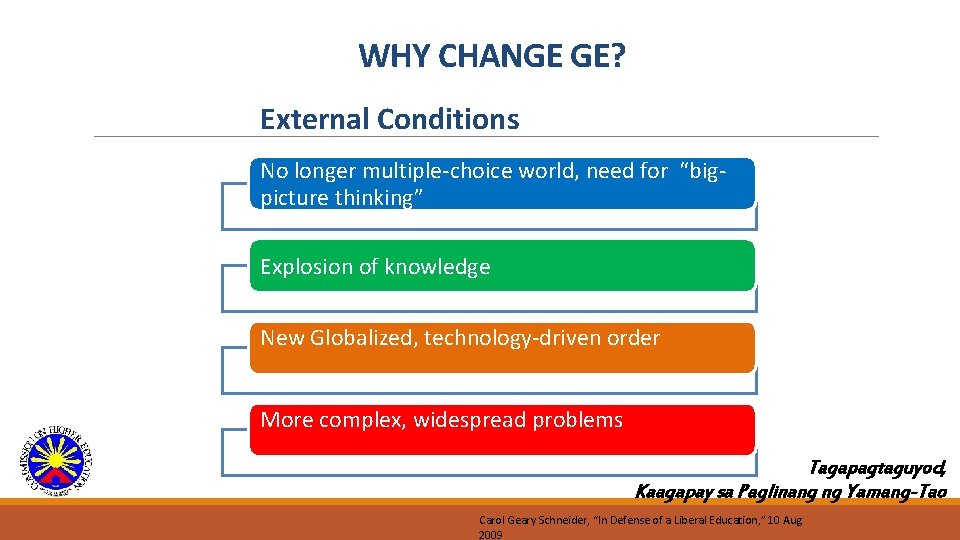
WHY CHANGE GE? External Conditions No longer multiple-choice world, need for “bigpicture thinking” Explosion of knowledge New Globalized, technology-driven order More complex, widespread problems Tagapagtaguyod, Kaagapay sa Paglinang ng Yamang-Tao Carol Geary Schneider, “In Defense of a Liberal Education, ” 10 Aug 2009
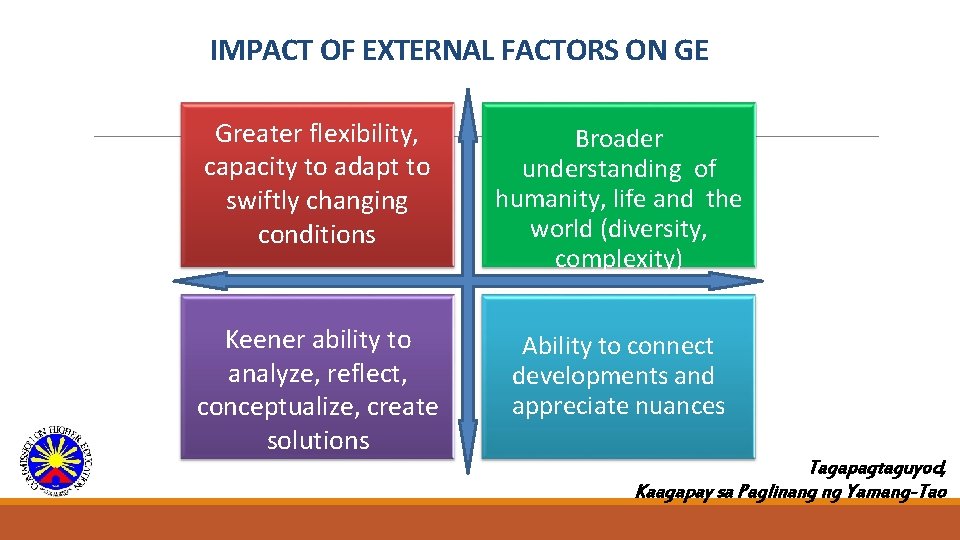
IMPACT OF EXTERNAL FACTORS ON GE Greater flexibility, capacity to adapt to swiftly changing conditions Broader understanding of humanity, life and the world (diversity, complexity) Keener ability to analyze, reflect, conceptualize, create solutions Ability to connect developments and appreciate nuances Tagapagtaguyod, Kaagapay sa Paglinang ng Yamang-Tao
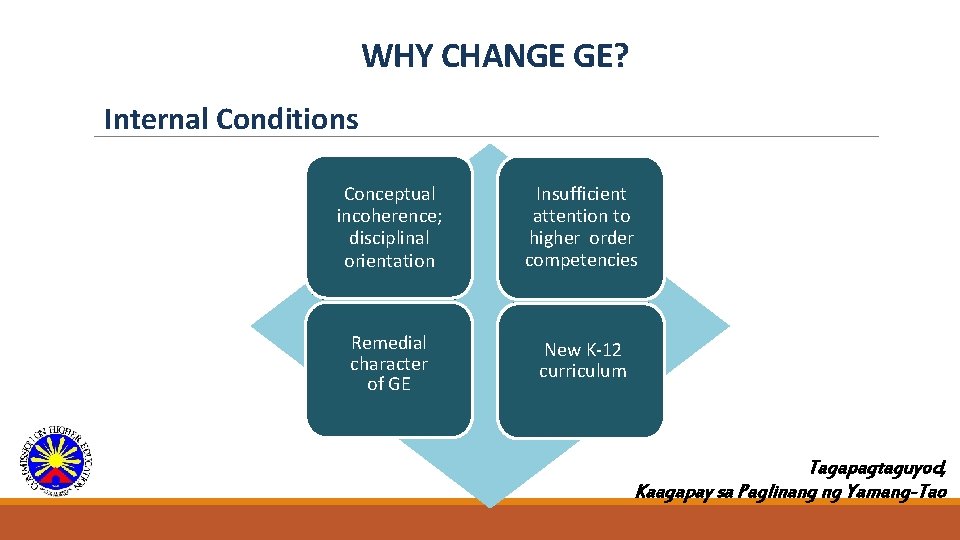
WHY CHANGE GE? Internal Conditions Conceptual incoherence; disciplinal orientation Insufficient attention to higher order competencies Remedial character of GE New K-12 curriculum Tagapagtaguyod, Kaagapay sa Paglinang ng Yamang-Tao
General Education Framework • General Education, the part of the curriculum common to all undergraduate students regardless of their major, exposes them to various domains of knowledge and ways of comprehending social and natural realities • General Education lays the groundwork for the development of a professionally competent, humane and moral person, the foundation for the critical Filipino leader Tagapagtaguyod, Kaagapay sa Paglinang ng Yamang-Tao
General Education Framework • General Education prepares the Filipino for the demands of 21 st Century life and the requisite abilities to anticipate and adapt to swiftly changing situations, to think innovatively, and create solutions. Tagapagtaguyod, Kaagapay sa Paglinang ng Yamang-Tao
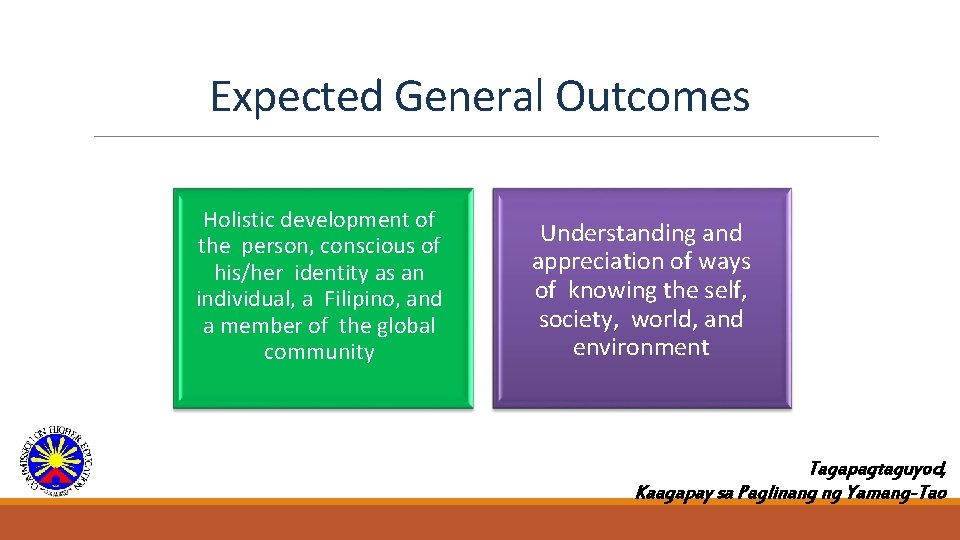
Expected General Outcomes Holistic development of the person, conscious of his/her identity as an individual, a Filipino, and a member of the global community Understanding and appreciation of ways of knowing the self, society, world, and environment Tagapagtaguyod, Kaagapay sa Paglinang ng Yamang-Tao
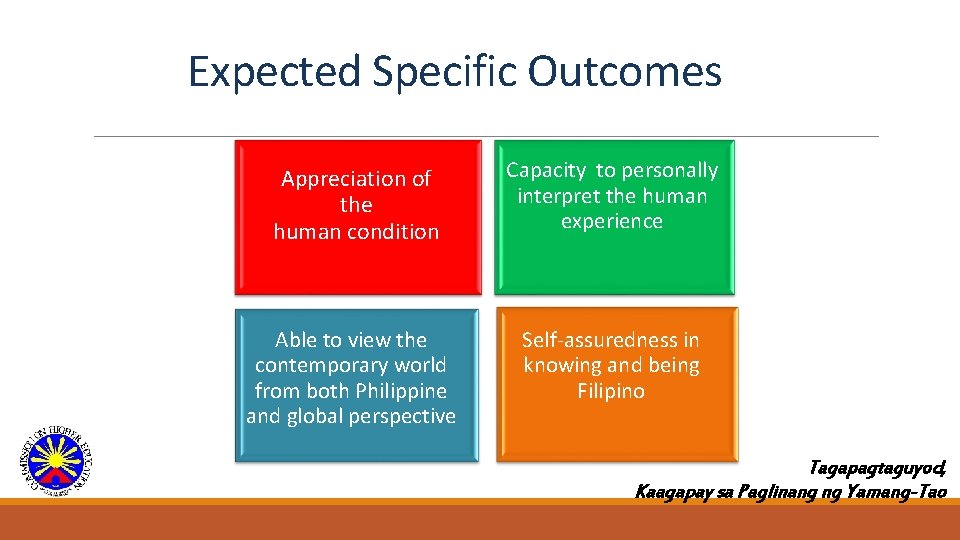
Expected Specific Outcomes Appreciation of the human condition Capacity to personally interpret the human experience Able to view the contemporary world from both Philippine and global perspective Self-assuredness in knowing and being Filipino Tagapagtaguyod, Kaagapay sa Paglinang ng Yamang-Tao
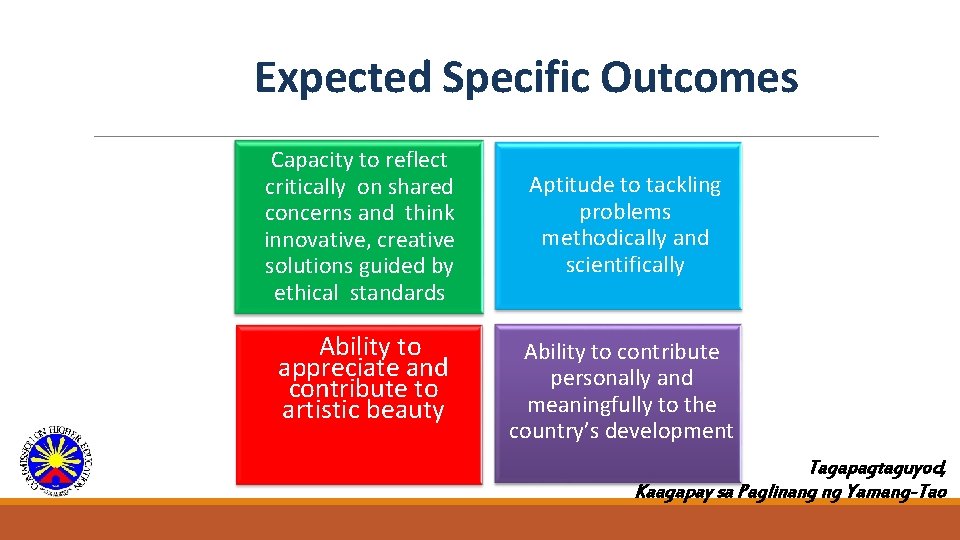
Expected Specific Outcomes Capacity to reflect critically on shared concerns and think innovative, creative solutions guided by ethical standards Ability to appreciate and contribute to artistic beauty Aptitude to tackling problems methodically and scientifically Ability to contribute personally and meaningfully to the country’s development Tagapagtaguyod, Kaagapay sa Paglinang ng Yamang-Tao
Existing General Education Courses CMO No. 59, s. 1996 (GEC-A) Courses CMO No. 4, s. 1997 (GEC-B) Units Courses Units Language and Literature 24 English and Filipino 12 Mathematics and Natural Sciences 15 Mathematics and Natural Sciences 12 Humanities and Social Sciences 18 Humanities 9 Mandated Subjects 6 Elective (Math, Natsci, IT) 3 Social Sciences 12 Rizal’s Life and Works 3 Total 63 Total 51 Tagapagtaguyod, Kaagapay sa Paglinang ng Yamang-Tao
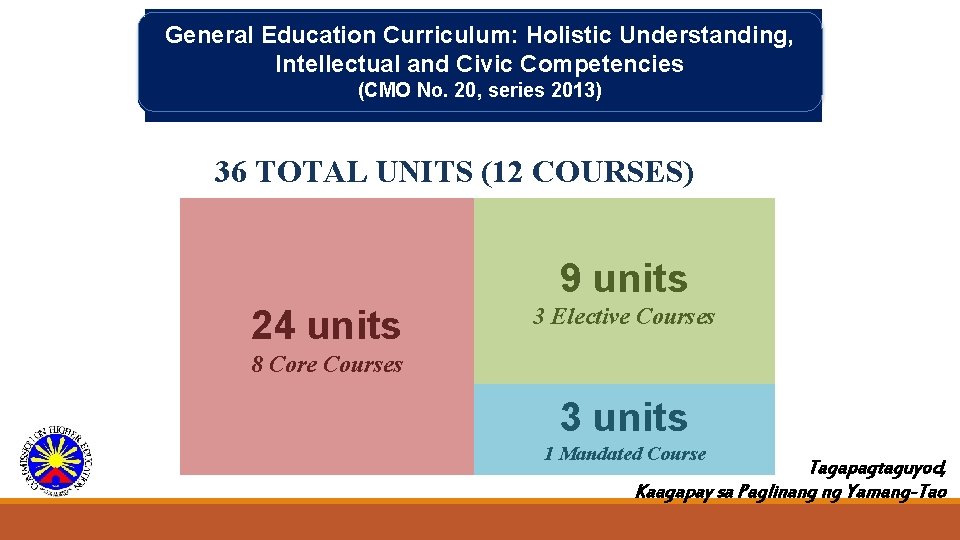
General Education Curriculum: Holistic Understanding, Intellectual and Civic Competencies (CMO No. 20, series 2013) 36 TOTAL UNITS (12 COURSES) 9 units 24 units 3 Elective Courses 8 Core Courses 3 units 1 Mandated Course Tagapagtaguyod, Kaagapay sa Paglinang ng Yamang-Tao
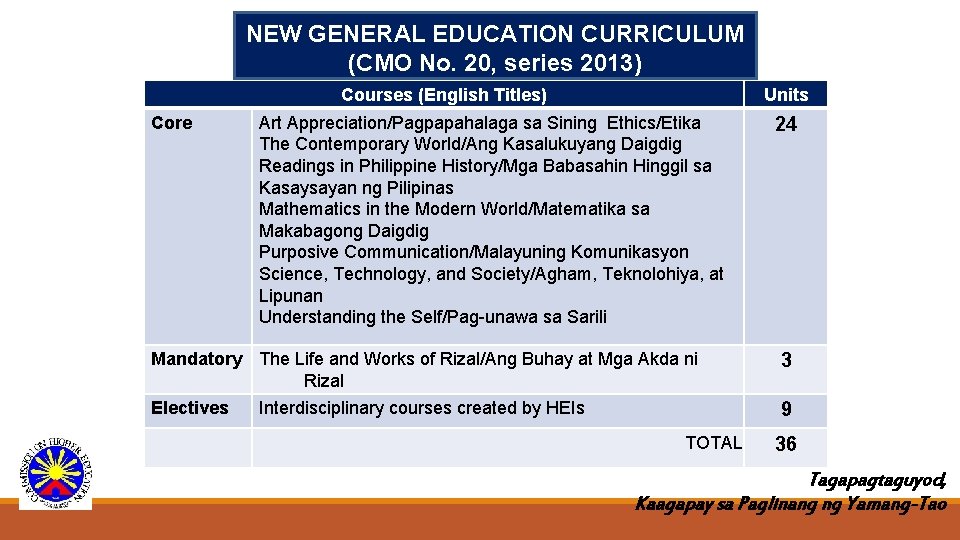
NEW GENERAL EDUCATION CURRICULUM (CMO No. 20, series 2013) Courses (English Titles) Core Units Art Appreciation/Pagpapahalaga sa Sining Ethics/Etika The Contemporary World/Ang Kasalukuyang Daigdig Readings in Philippine History/Mga Babasahin Hinggil sa Kasaysayan ng Pilipinas Mathematics in the Modern World/Matematika sa Makabagong Daigdig Purposive Communication/Malayuning Komunikasyon Science, Technology, and Society/Agham, Teknolohiya, at Lipunan Understanding the Self/Pag-unawa sa Sarili 24 Mandatory The Life and Works of Rizal/Ang Buhay at Mga Akda ni Rizal 3 Electives 9 Interdisciplinary courses created by HEIs TOTAL 36 Tagapagtaguyod, Kaagapay sa Paglinang ng Yamang-Tao
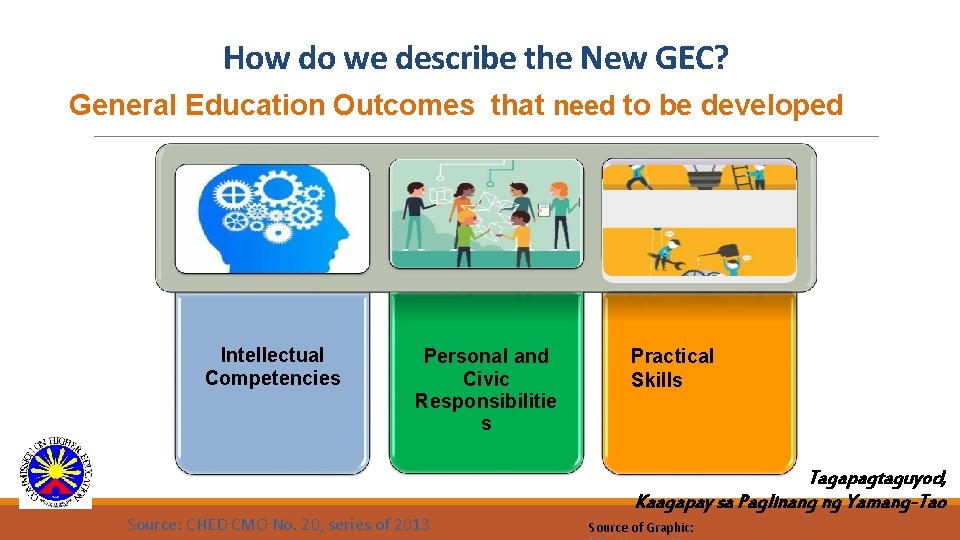
How do we describe the New GEC? General Education Outcomes that need to be developed Intellectual Competencies Personal and Civic Responsibilitie s Source: CHED CMO No. 20, series of 2013 Practical Skills Tagapagtaguyod, Kaagapay sa Paglinang ng Yamang-Tao Source of Graphic:
How do we describe the New GEC? Exposes students to various domains of knowledge and ways of comprehending social and natural realities Core courses are Inter-disciplinary and are stated broadly enough to accommodate a range of perspectives and approaches Courses may be taught in English or Filipino Tagapagtaguyod, Kaagapay sa Paglinang ng Yamang-Tao
How do we describe the New GEC? Sample or model Course Syllabi for the Core Courses were prepared with English and Filipino translation The new GEC will be implemented in AY 20182019 Need not be taken all in one year; can be scheduled across years for optimum effectiveness Tagapagtaguyod, Kaagapay sa Paglinang ng Yamang-Tao
Clarification on the Status of P. E. and other Mandated/Legislated courses in the New General Education CHED issued a Memorandum to all HEIs on the Status of P. E. and other Mandated/Legislated Courses Physical Education (P. E. ) per RA 5708 and National Service Training Program (NSTP) per RA 9163 are required to be taken by all students Tagapagtaguyod, Kaagapay sa Paglinang ng Yamang-Tao
Clarification on the Status of P. E. and other Mandated/Legislated courses in the New General Education Philippine Constitution, Agrarian/Land Reform, Population Education and Family Planning, Taxation, and Climate Change and Environmental Awareness - HEIs are enjoined to comply with the laws on mandated courses by integrating or incorporating the topics, discussions, contexts, and concepts on the mandated topics in the New GE. These topics are geared toward strengthening citizenship education and compliance with the provisions of various existing laws.
Filipino Courses In compliance with the Supreme Court en banc Resolution dated April 21, 2015 which issued a Temporary Restraining Order (TRO) enjoining CHED from implementing and enforcing the provision of CMO No. 20, series of 2013, insofar as it excluded from the curriculum for college of Filipino and Panitikan as core courses: CHED issued the following : Tagapagtaguyod, Kaagapay sa Paglinang ng Yamang-Tao
Filipino Courses 1. Clarificatory Memo on the implementation of the said CMO- All are enjoined to take due note of, and continue implementing the provision of CMO No. 59, series of 1996 (GEC-A for fields of study related to Humanities, Social Sciences and Communication – 9 units of Filipino) and CMO No. 4, series of 1997 (GEC-B for students majoring in fields other than Humanities, Social Sciences and Communication- 6 Units of Filipino)
Filipino Courses 2. CHED Memorandum Order No. 57, series of 2017 Status Quo on the implementation of CMO No. 4, series of 1997 and CMO No. 59, series of 1996 during the pendency of the Supreme Court TRO Tagapagtaguyod, Kaagapay sa Paglinang ng Yamang-Tao
Filipino Courses 1. CHED Memorandum dated July 11, 2017 -deferment of the inclusion of 9 units of GE Electives starting AY 2018 -2019 as repscribed in CMO No. 20, series of 2013 in order to provide flexibility in the GE Curriculum until further notice from the Commission, while the Supreme Court TRO is in effect and while awaiting the Supreme Court’s resolution of the case
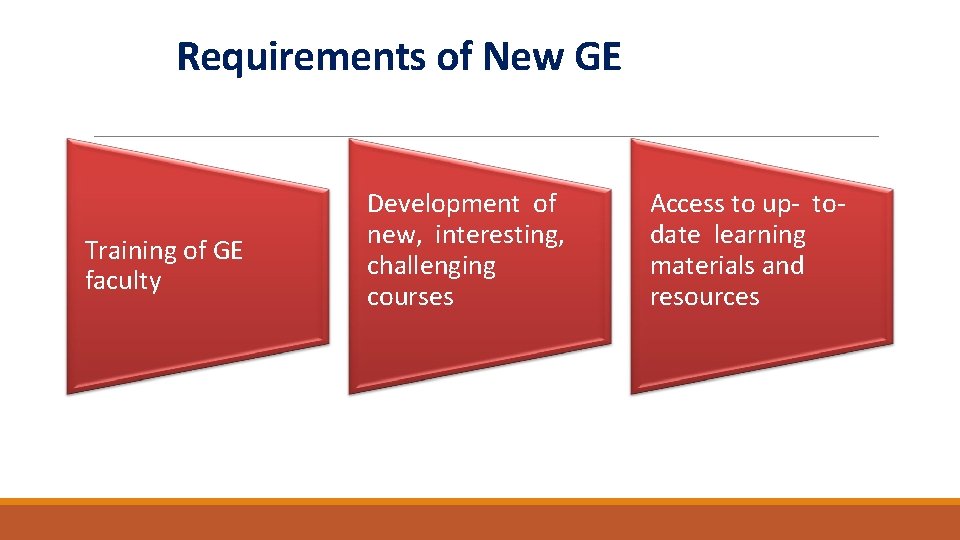
Requirements of New GE Training of GE faculty Development of new, interesting, challenging courses Access to up- todate learning materials and resources
CHED Initiative To assist higher education institutions (HEIs) transition to the new GEC, CHED commissioned experts to develop SAMPLE COURSE SYLLABI with up -to-date and appropriate readings, materials, and resources for each of the nine (9) new GE core courses based on the provisions of CMO 20, series of 2013.
CHED Initiative Implement a GE Faculty Training to Support HEIs in the Teaching of the New General Education Core Courses Objectives a)Train an initial group of GE faculty to teach the GE core courses b)Produce GE faculty who can serve as trainors of other GE faculty c)Train GE faculty from HEIs nationwide to teach the new GE core courses
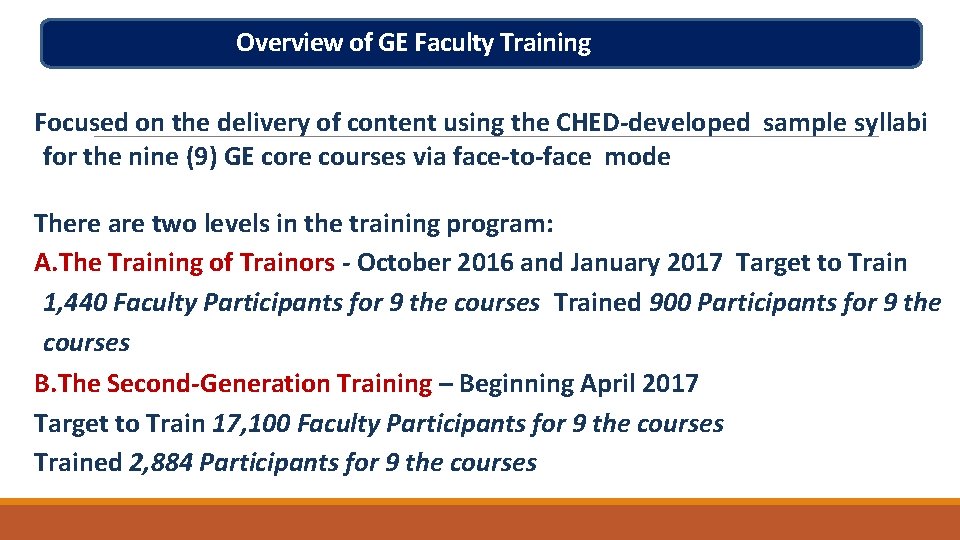
Overview of GE Faculty Training Focused on the delivery of content using the CHED-developed sample syllabi for the nine (9) GE core courses via face-to-face mode There are two levels in the training program: A. The Training of Trainors - October 2016 and January 2017 Target to Train 1, 440 Faculty Participants for 9 the courses Trained 900 Participants for 9 the courses B. The Second-Generation Training – Beginning April 2017 Target to Train 17, 100 Faculty Participants for 9 the courses Trained 2, 884 Participants for 9 the courses
IMPERATIVES FOR THE REVISION OF THE EXISTING HIGHER EDUCATION CURRICULA Tagapagtaguyod, Kaagapay sa Paglinang ng Yamang-Tao
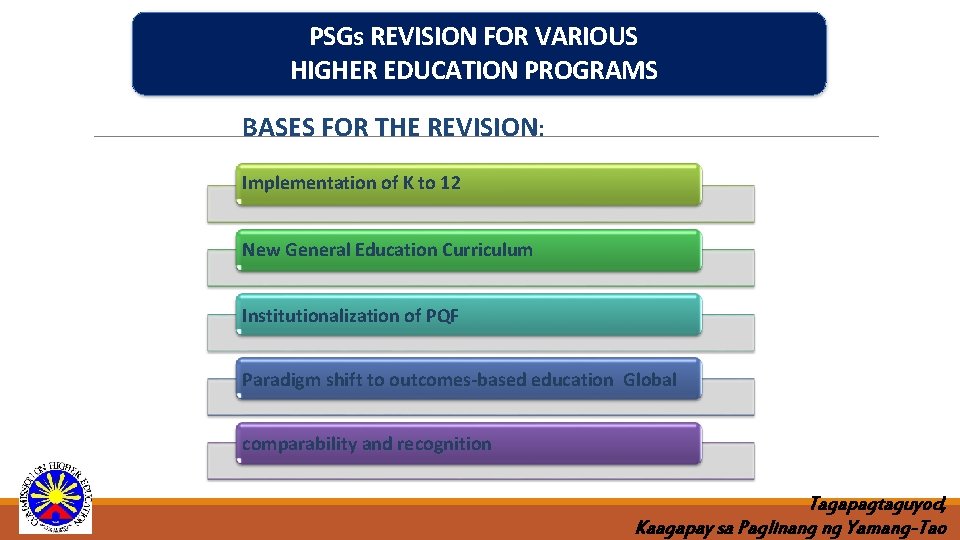
PSGs REVISION FOR VARIOUS HIGHER EDUCATION PROGRAMS BASES FOR THE REVISION: Implementation of K to 12 New General Education Curriculum Institutionalization of PQF Paradigm shift to outcomes-based education Global comparability and recognition Tagapagtaguyod, Kaagapay sa Paglinang ng Yamang-Tao
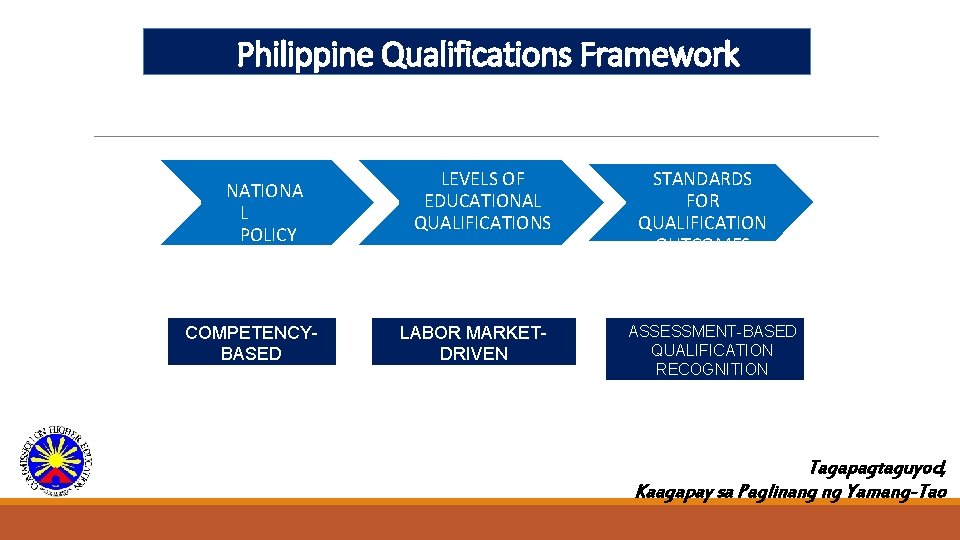
Philippine Qualifications Framework NATIONA L POLICY COMPETENCYBASED LEVELS OF EDUCATIONAL QUALIFICATIONS LABOR MARKETDRIVEN STANDARDS FOR QUALIFICATION OUTCOMES ASSESSMENT-BASED QUALIFICATION RECOGNITION Tagapagtaguyod, Kaagapay sa Paglinang ng Yamang-Tao
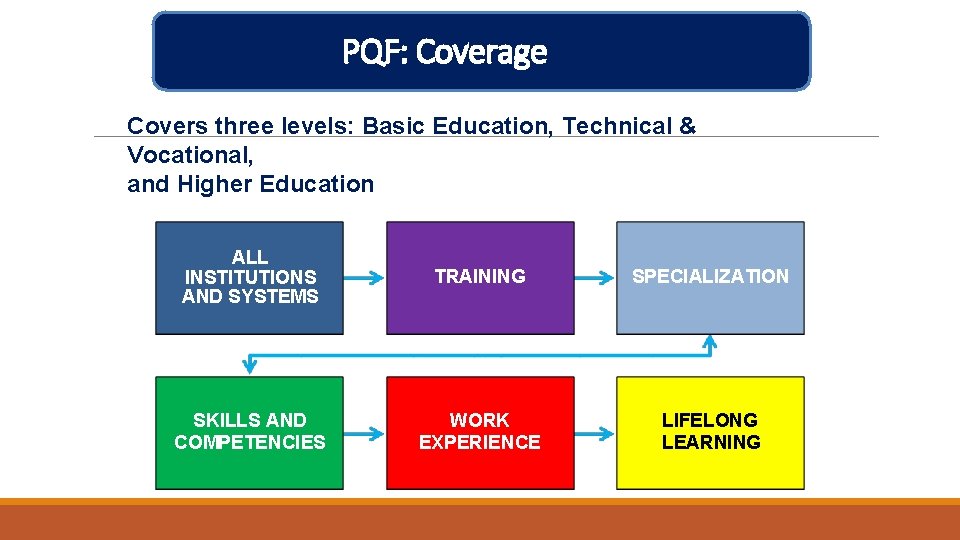
PQF: Coverage Covers three levels: Basic Education, Technical & Vocational, and Higher Education ALL INSTITUTIONS AND SYSTEMS TRAINING SPECIALIZATION SKILLS AND COMPETENCIES WORK EXPERIENCE LIFELONG LEARNING
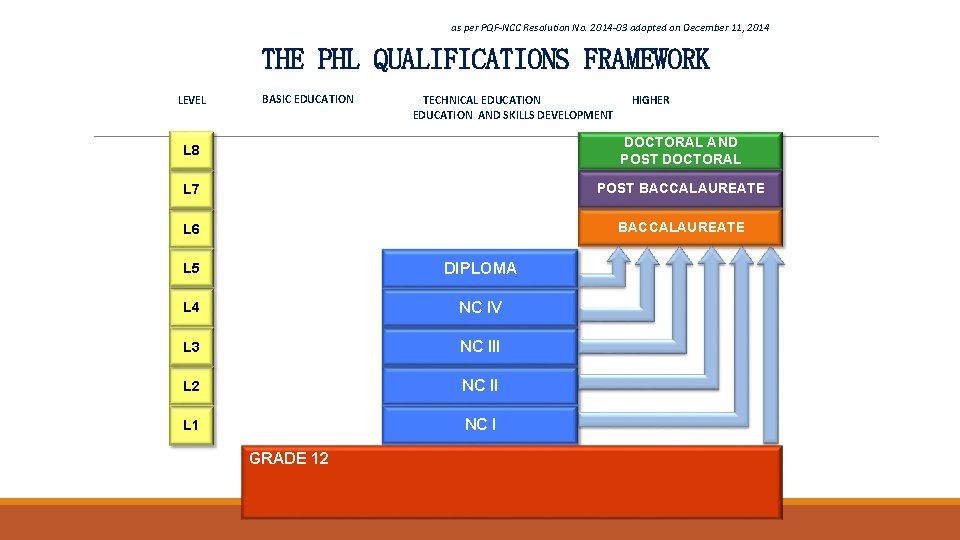
as per PQF-NCC Resolution No. 2014 -03 adopted on December 11, 2014 THE PHL QUALIFICATIONS FRAMEWORK LEVEL BASIC EDUCATION TECHNICAL EDUCATION AND SKILLS DEVELOPMENT HIGHER L 8 DOCTORAL AND POST DOCTORAL L 7 POST BACCALAUREATE L 6 BACCALAUREATE L 5 DIPLOMA L 4 NC IV L 3 NC III L 2 NC II L 1 NC I GRADE 12
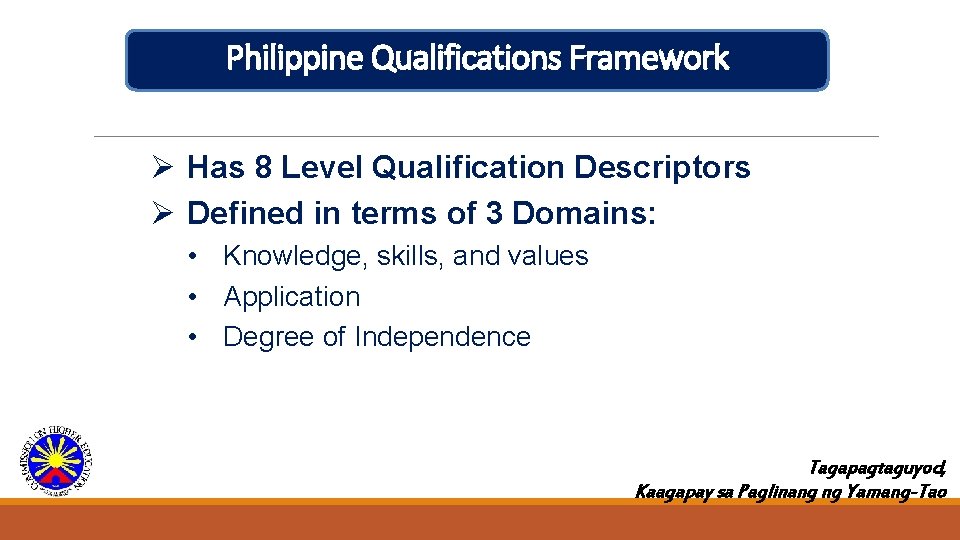
Philippine Qualifications Framework Has 8 Level Qualification Descriptors Defined in terms of 3 Domains: • Knowledge, skills, and values • Application • Degree of Independence Tagapagtaguyod, Kaagapay sa Paglinang ng Yamang-Tao
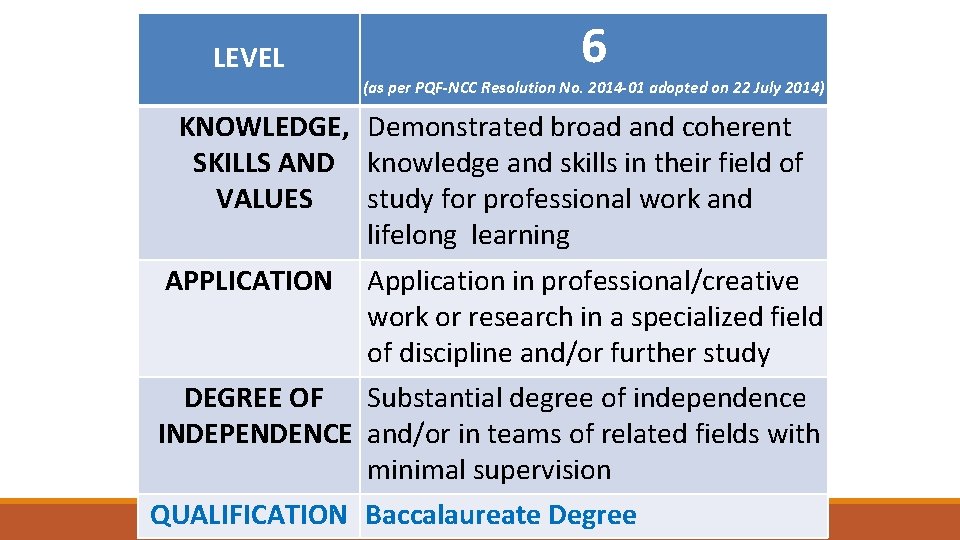
LEVEL 6 (as per PQF-NCC Resolution No. 2014 -01 adopted on 22 July 2014) KNOWLEDGE, Demonstrated broad and coherent SKILLS AND knowledge and skills in their field of VALUES study for professional work and lifelong learning APPLICATION Application in professional/creative work or research in a specialized field of discipline and/or further study DEGREE OF Substantial degree of independence INDEPENDENCE and/or in teams of related fields with minimal supervision QUALIFICATION Baccalaureate Degree
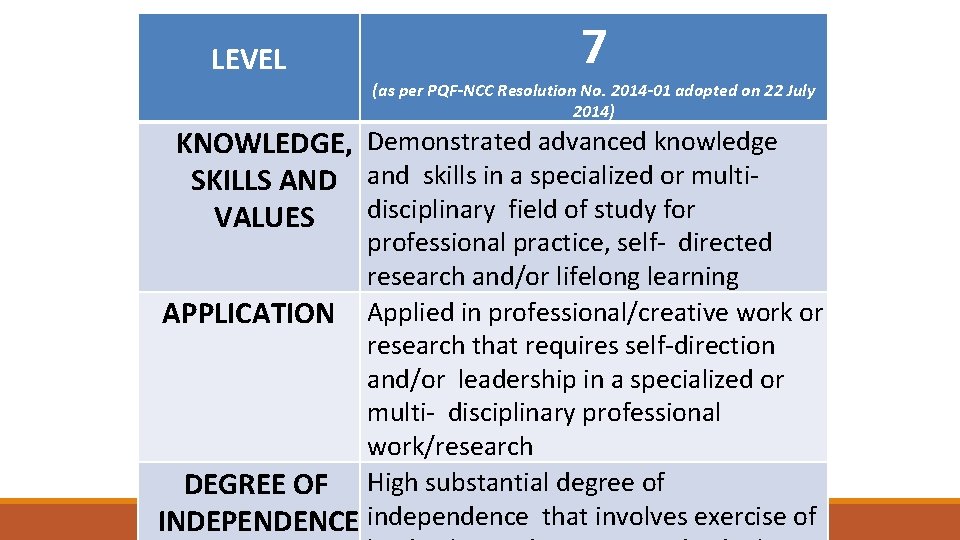
LEVEL 7 (as per PQF-NCC Resolution No. 2014 -01 adopted on 22 July 2014) KNOWLEDGE, Demonstrated advanced knowledge SKILLS AND and skills in a specialized or multidisciplinary field of study for VALUES professional practice, self- directed research and/or lifelong learning APPLICATION Applied in professional/creative work or research that requires self-direction and/or leadership in a specialized or multi- disciplinary professional work/research DEGREE OF High substantial degree of INDEPENDENCE independence that involves exercise of
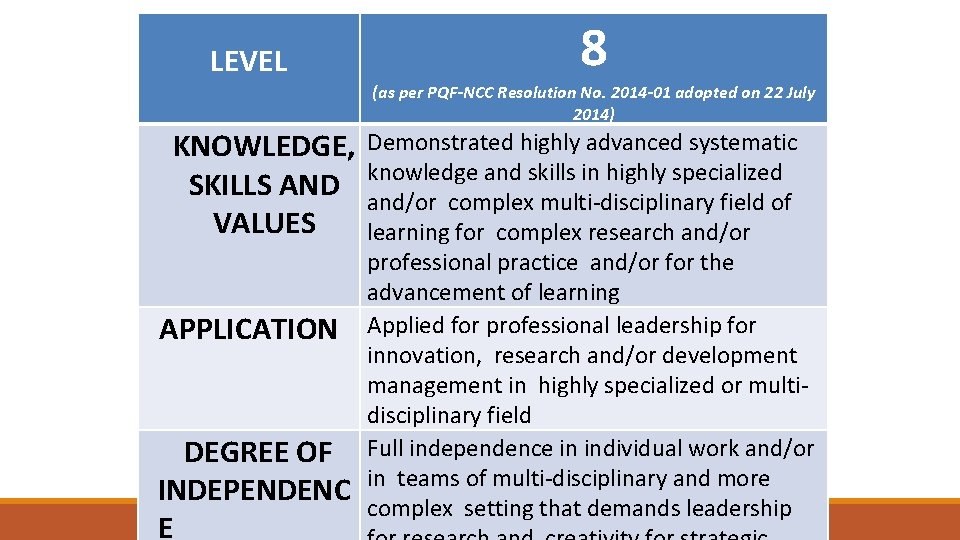
LEVEL 8 (as per PQF-NCC Resolution No. 2014 -01 adopted on 22 July 2014) KNOWLEDGE, SKILLS AND VALUES APPLICATION DEGREE OF INDEPENDENC E Demonstrated highly advanced systematic knowledge and skills in highly specialized and/or complex multi-disciplinary field of learning for complex research and/or professional practice and/or for the advancement of learning Applied for professional leadership for innovation, research and/or development management in highly specialized or multidisciplinary field Full independence in individual work and/or in teams of multi-disciplinary and more complex setting that demands leadership
Paradigm Shift to Outcomes-based Education (OBE) • OBE - an approach that focuses and organizes the educational system around what is essential for all learners to know, value and be able to do to achieve a desired level of competencies • It is “open to incorporating discipline-based learning areas that currently structure HEI curricula” • For the HEIs, this means describing the attributes of their ideal graduates based on their visions and missions as part of their institutional goals or outcomes, and using these as bases for developing specific program outcomes Tagapagtaguyod, Kaagapay sa Paglinang ng Yamang-Tao
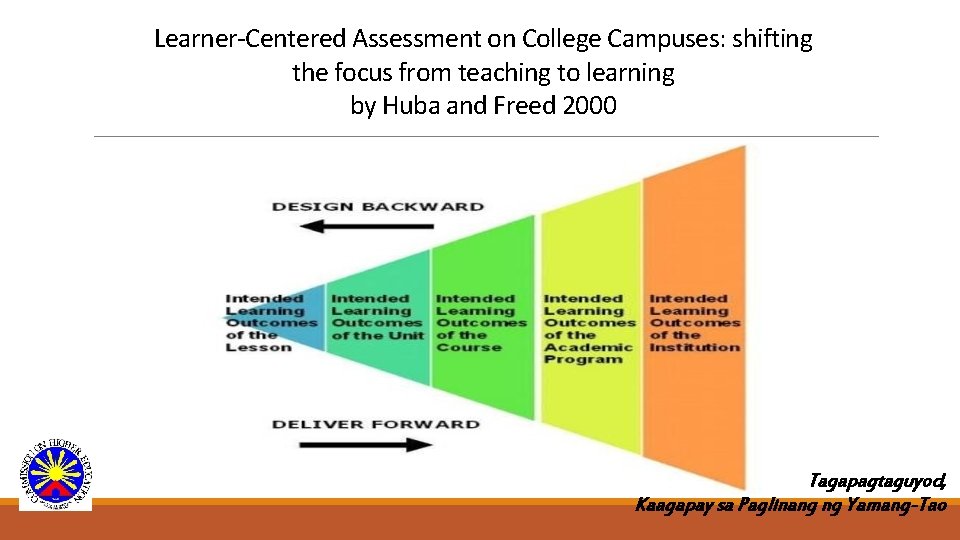
Learner-Centered Assessment on College Campuses: shifting the focus from teaching to learning by Huba and Freed 2000 Tagapagtaguyod, Kaagapay sa Paglinang ng Yamang-Tao
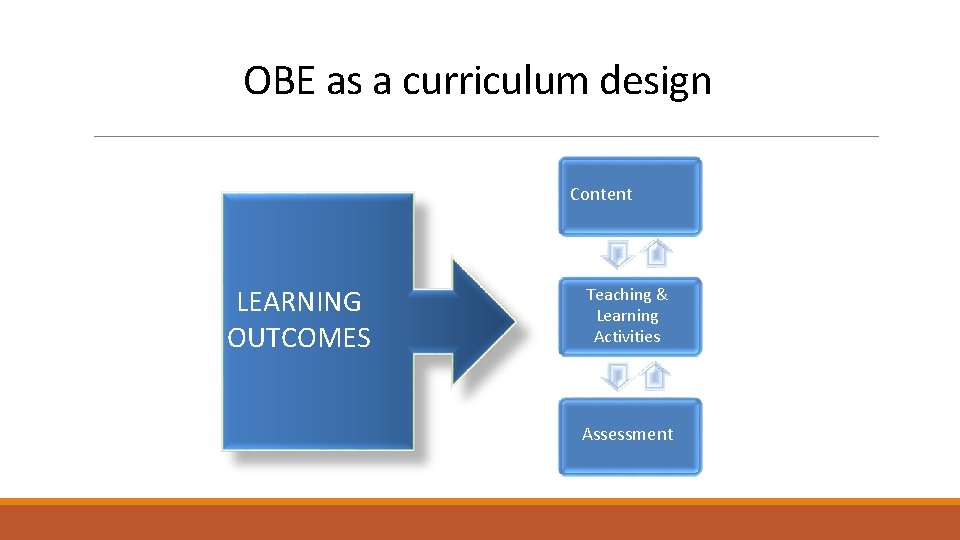
OBE as a curriculum design Content LEARNING OUTCOMES Teaching & Learning Activities Assessment
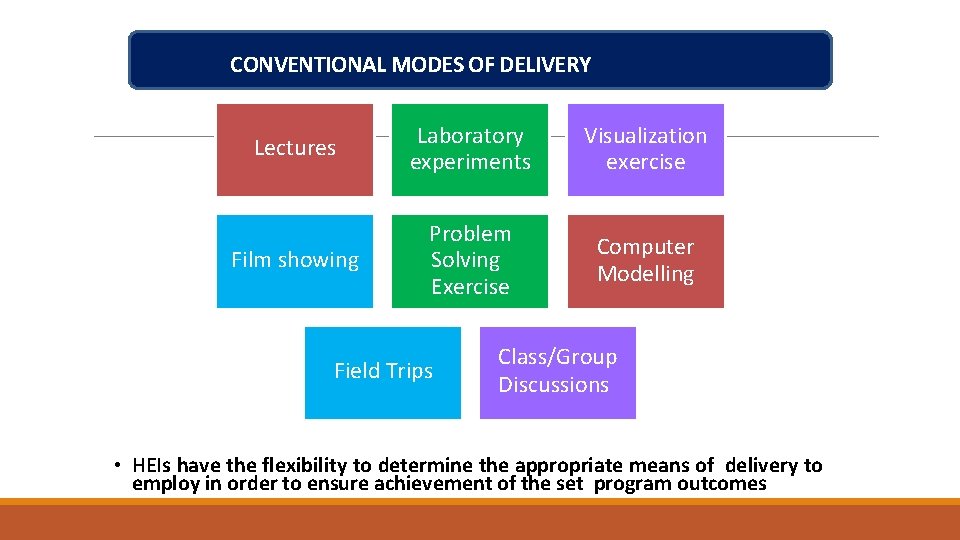
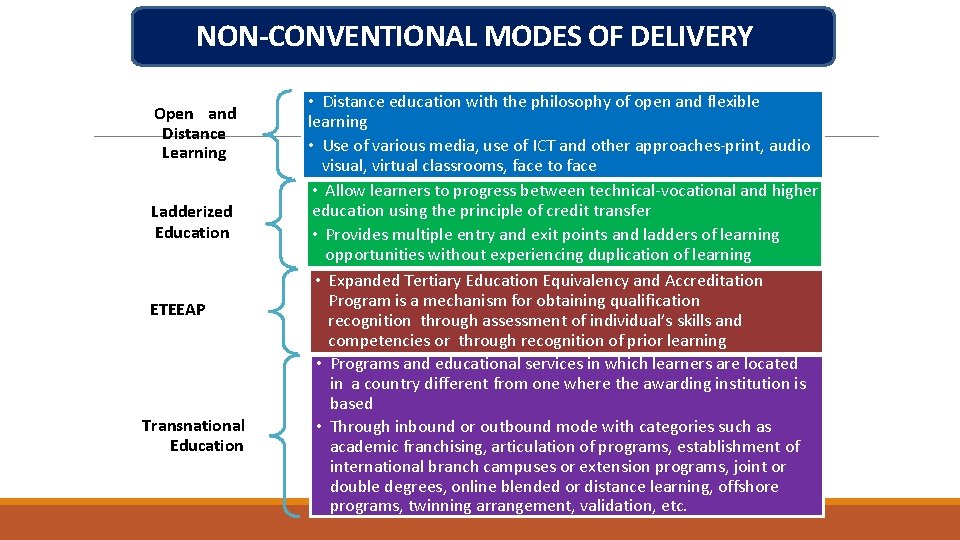
DELIVERY OF UNDERGRADUATE EDUCATION – Conventional and Non-conventional modes – Learner-centered/outcomes-based approach – Minimum standards are expressed as minimum set of program outcomes in terms of knowledge, skills and values which the learners are expected to demonstrate at the end of the learning experience or at the time of graduation – HEIs are allowed to design curricula suited to their own contexts and missions and determine the appropriate means of delivery, support facilities and educational resources to ensure achievement of the set program outcomes
CONVENTIONAL MODES OF DELIVERY Lectures Laboratory experiments Visualization exercise Film showing Problem Solving Exercise Computer Modelling Field Trips Class/Group Discussions • HEIs have the flexibility to determine the appropriate means of delivery to employ in order to ensure achievement of the set program outcomes
NON-CONVENTIONAL MODES OF DELIVERY Open and Distance Learning Ladderized Education ETEEAP Transnational Education • Distance education with the philosophy of open and flexible learning • Use of various media, use of ICT and other approaches-print, audio visual, virtual classrooms, face to face • Allow learners to progress between technical-vocational and higher education using the principle of credit transfer • Provides multiple entry and exit points and ladders of learning opportunities without experiencing duplication of learning • Expanded Tertiary Education Equivalency and Accreditation Program is a mechanism for obtaining qualification recognition through assessment of individual’s skills and competencies or through recognition of prior learning • Programs and educational services in which learners are located in a country different from one where the awarding institution is based • Through inbound or outbound mode with categories such as academic franchising, articulation of programs, establishment of international branch campuses or extension programs, joint or double degrees, online blended or distance learning, offshore programs, twinning arrangement, validation, etc.
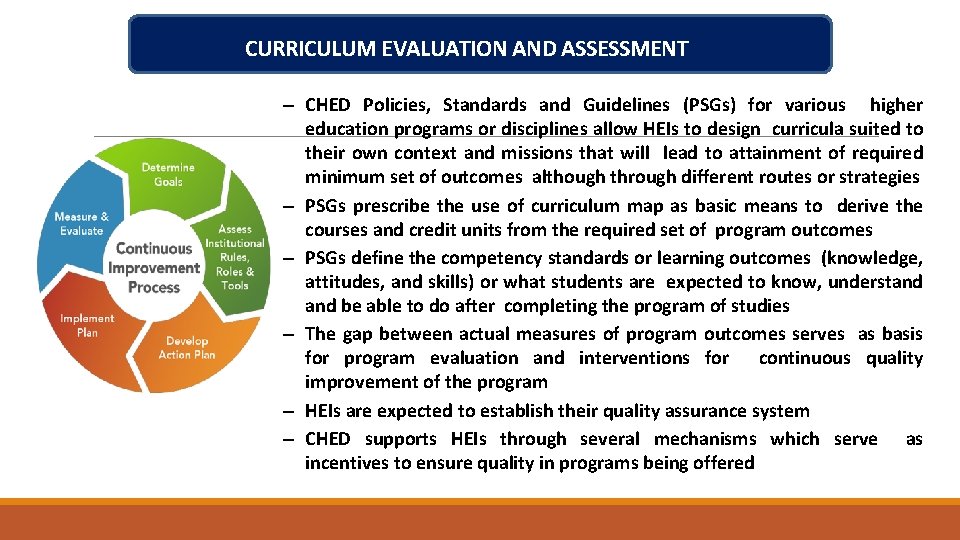
CURRICULUM EVALUATION AND ASSESSMENT – CHED Policies, Standards and Guidelines (PSGs) for various higher education programs or disciplines allow HEIs to design curricula suited to their own context and missions that will lead to attainment of required minimum set of outcomes although through different routes or strategies – PSGs prescribe the use of curriculum map as basic means to derive the courses and credit units from the required set of program outcomes – PSGs define the competency standards or learning outcomes (knowledge, attitudes, and skills) or what students are expected to know, understand be able to do after completing the program of studies – The gap between actual measures of program outcomes serves as basis for program evaluation and interventions for continuous quality improvement of the program – HEIs are expected to establish their quality assurance system – CHED supports HEIs through several mechanisms which serve as incentives to ensure quality in programs being offered
Policies, Standards and Guidelines (Issued as CMO)
UPDATES on PSG revisions Since year 2014, the Technical Panels and Technical Committees have been working on the revision of the Policies, Standards and Guidelines guided by the provisions of CHED Administrative Order No. 1, series of 2014, entitled “Revised Guidelines in the formulation of CHED Polices, Standards and Guidelines (PSGs) of Baccalaureate Level Academic Programs”. CHED has prepared a Handbook for the implementation of Outcomes-based Education and Institutional Sustainability Assessment (ISA) which serves as a guide and reference for the higher education institutions in the transition towards outcomes-based and typology-based quality assurance.
Major Elements of PSGs Program Specifications • Program Description – Degree Name; Nature of the Field of Study; Program Goals; Specific Professions/ Careers/ Occupations for Graduates • Program Outcomes/Set of Learning Outcomes – Common to all programs in all types of schools; Common to the discipline; Specific to a subdiscipline and a major; based on HEI’s mission and vision • Sample Performance Indicators
Major Elements of PSGs Curriculum • Curriculum Description • Sample Curriculum Map • Sample Means of Curriculum Delivery • Sample Syllabi for Selected Core Courses
Major Elements of PSGs Minimum Required Resources • Administration • Faculty • Library • Laboratory and Physical Facilities
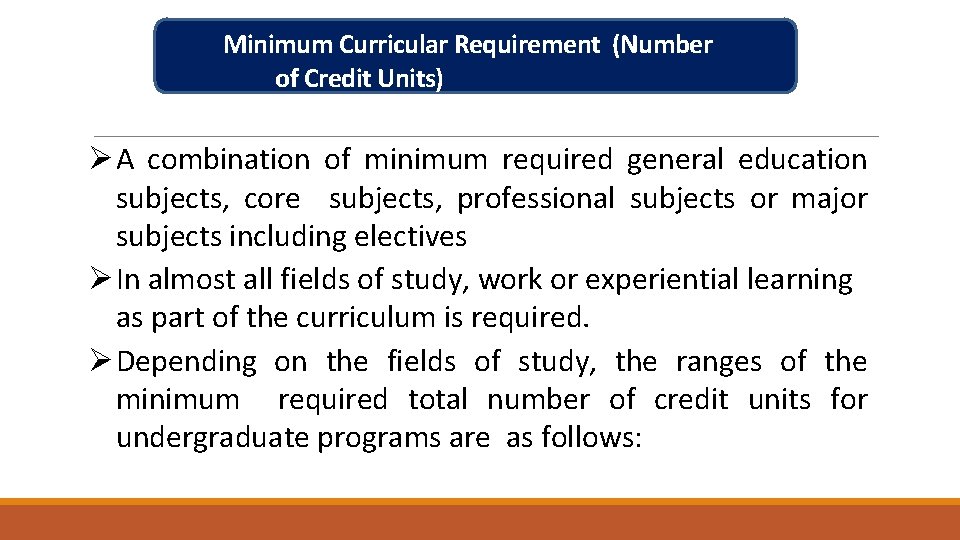
Minimum Curricular Requirement (Number of Credit Units) A combination of minimum required general education subjects, core subjects, professional subjects or major subjects including electives In almost all fields of study, work or experiential learning as part of the curriculum is required. Depending on the fields of study, the ranges of the minimum required total number of credit units for undergraduate programs are as follows:
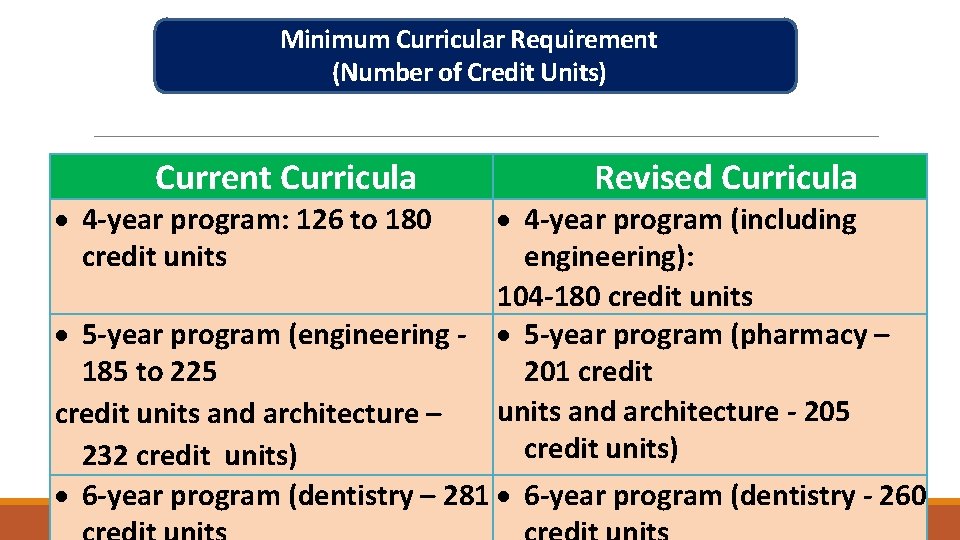
Minimum Curricular Requirement (Number of Credit Units) Current Curricula 4 -year program: 126 to 180 credit units Revised Curricula 4 -year program (including engineering): 104 -180 credit units 5 -year program (engineering - 5 -year program (pharmacy – 185 to 225 201 credit units and architecture - 205 credit units and architecture – credit units) 232 credit units) 6 -year program (dentistry – 281 6 -year program (dentistry - 260
PSGs
References: 1. CMO 20, S. 2013 (on new GEC) 2. CMO 46, S. 2012 (on adoption of Outcomes-Based Education 3. Biglete, A. (2017). Curricular Reforms in Higher Education, Presentation during the Coordinative Meeting of Technical Staff for Northern Luzon Cluster, Vigan City, Ilocos Sur. Tagapagtaguyod, Kaagapay sa Paglinang ng Yamang-Tao
End of Presentation Tagapagtaguyod, Kaagapay sa Paglinang ng Yamang-Tao