
New Gas Separation Process Presented by Andrea Tran
New Gas Separation Process Presented by Andrea Tran & Conner Cruson
Outline �Conventional processing �Membrane technology �Amine vs. Membrane �Introduction of the new technology �Advantages/Disadvantages of new process

Conventional processing
Overview of Gas plant processing �Field operations/Inlet receiving �Inlet compression �Gas treating �Dehydration �Hydrocarbon recovery �Outlet compression
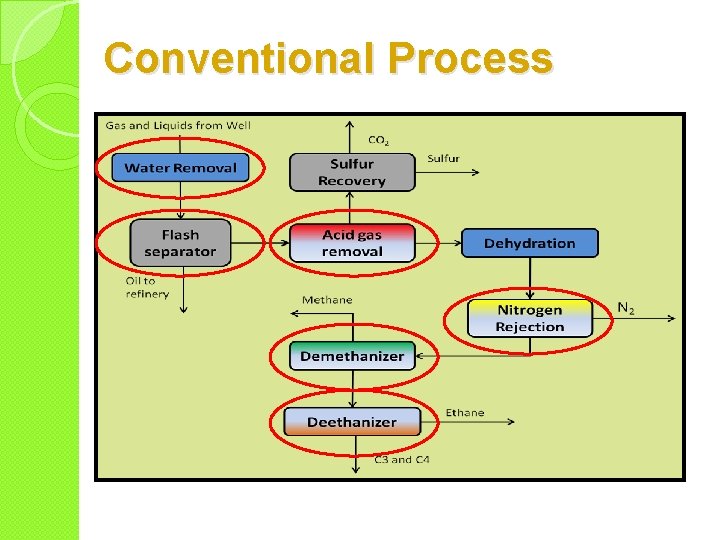
Conventional Process

Demethanizer unit
De-ethanizer unit
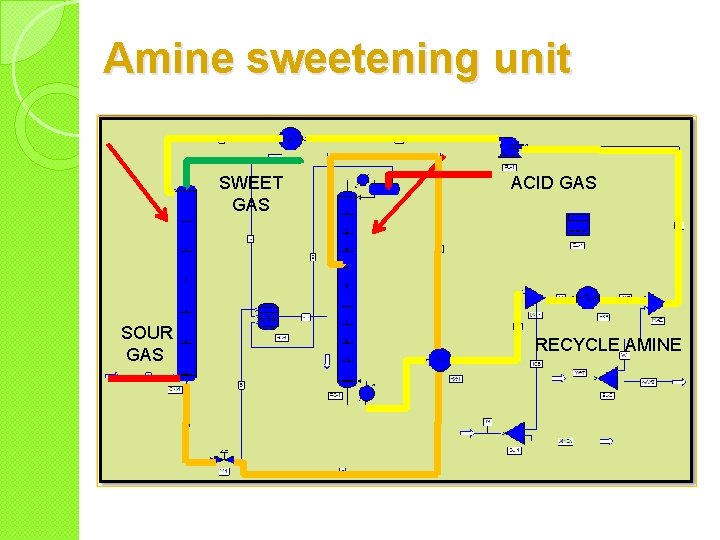
Amine sweetening unit SWEET GAS SOUR GAS ACID GAS RECYCLE AMINE
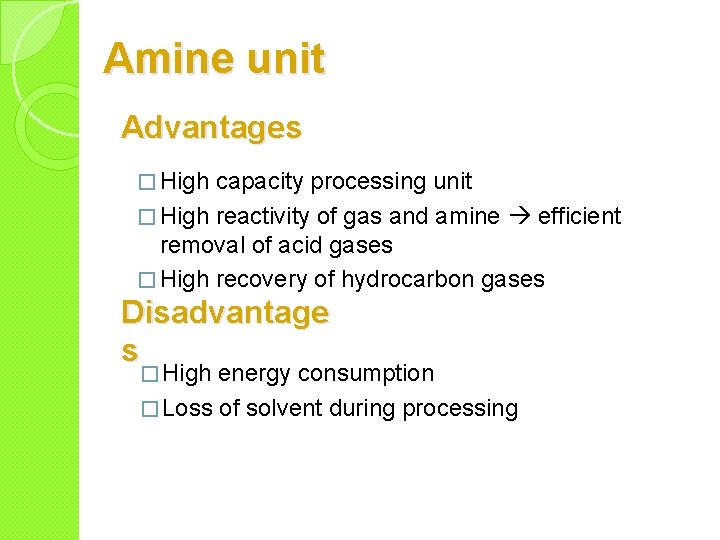
Amine unit Advantages � High capacity processing unit � High reactivity of gas and amine efficient removal of acid gases � High recovery of hydrocarbon gases Disadvantage s � High energy consumption � Loss of solvent during processing
Other alternatives
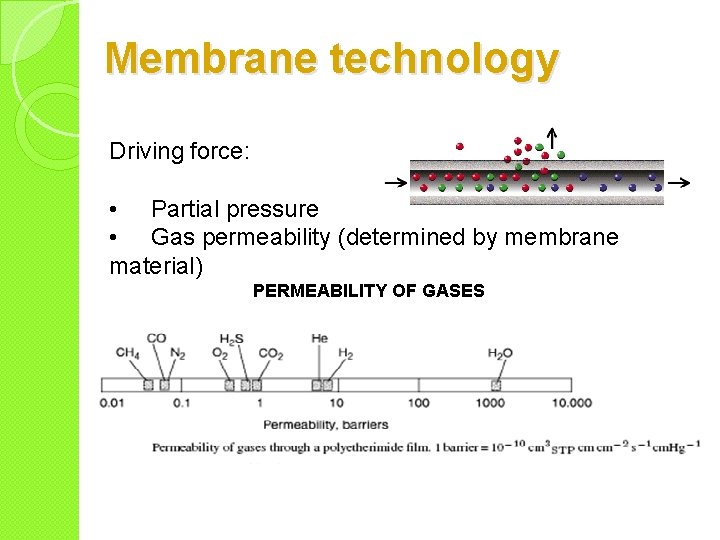
Membrane technology Driving force: • Partial pressure • Gas permeability (determined by membrane material) PERMEABILITY OF GASES
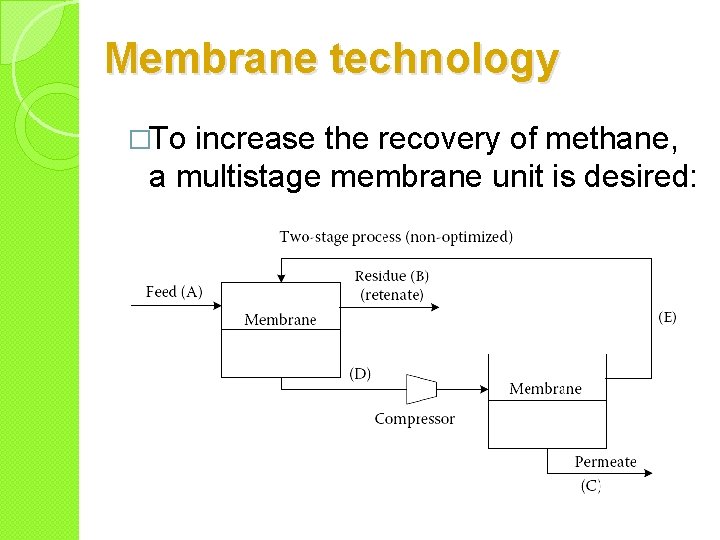
Membrane technology �To increase the recovery of methane, a multistage membrane unit is desired:
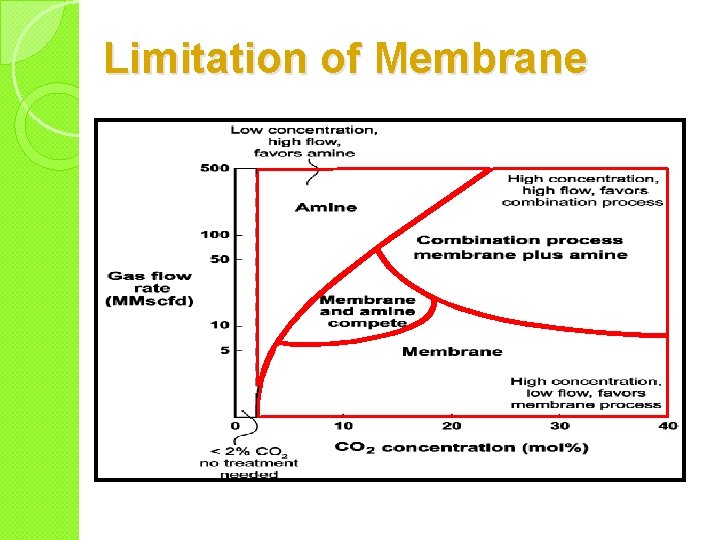
Limitation of Membrane
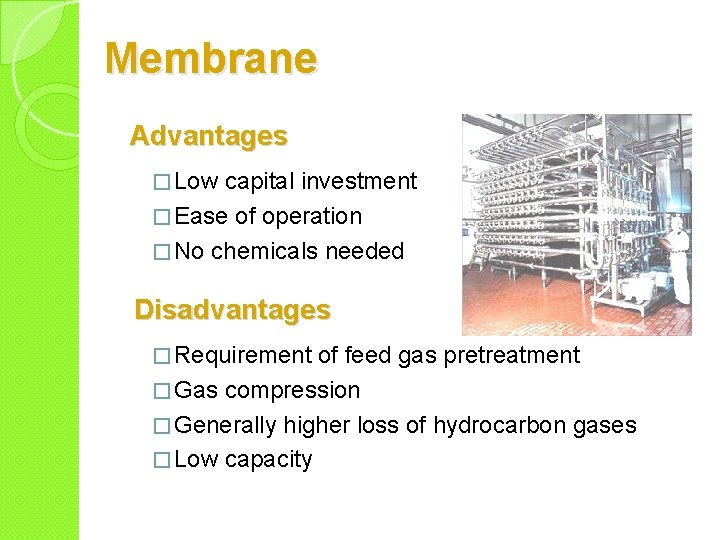
Membrane Advantages � Low capital investment � Ease of operation � No chemicals needed Disadvantages � Requirement of feed gas pretreatment � Gas compression � Generally higher loss of hydrocarbon gases � Low capacity

Our new technology
Objective �Replace the amine treatment �Reduce the overall cost of gas processing �Reduce green house gas emissions
Process design �Technical information cannot be disclosed at this time due to IP protection issue. �Only results and economics will be compared.
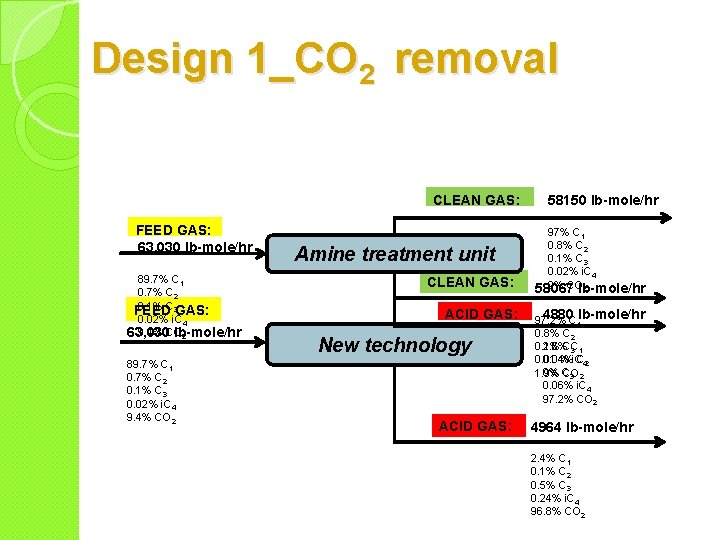
Design 1_CO 2 removal CLEAN GAS: FEED GAS: 63, 030 lb-mole/hr 89. 7% C 1 0. 7% C 2 0. 1% C 3 GAS: FEED 0. 02% i. C 4 9. 4% CO 63, 030 lb-mole/hr 2 89. 7% C 1 0. 7% C 2 0. 1% C 3 0. 02% i. C 4 9. 4% CO 2 Amine treatment unit CLEAN GAS: ACID GAS: New technology ACID GAS: 58150 lb-mole/hr 97% C 1 0. 8% C 2 0. 1% C 3 0. 02% i. C 4 2% COlb-mole/hr 2 58067 4880 lb-mole/hr 97. 2% C 1 0. 8% C 2 2. 6% C 0. 1% C 3 1 0. 04% C 42 0. 01 % i. C 0% C 3 2 1. 9% CO 0. 06% i. C 4 97. 2% CO 2 4964 lb-mole/hr 2. 4% C 1 0. 1% C 2 0. 5% C 3 0. 24% i. C 4 96. 8% CO 2
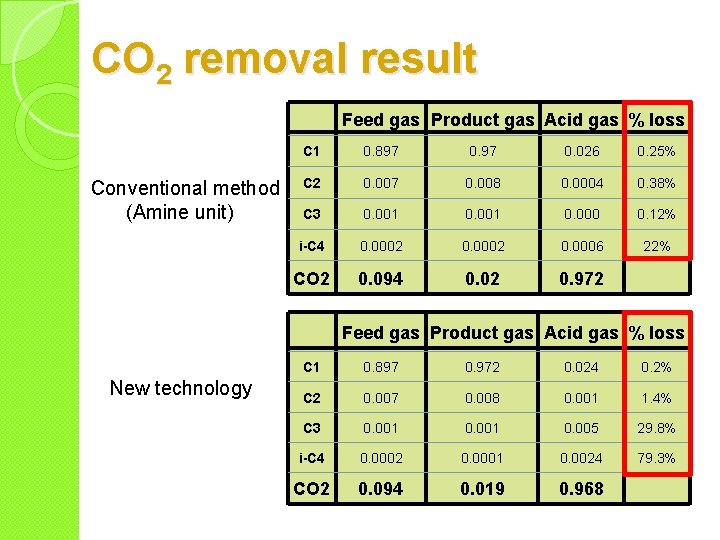
CO 2 removal result Feed gas Product gas Acid gas % loss Conventional method (Amine unit) C 1 0. 897 0. 026 0. 25% C 2 0. 007 0. 008 0. 0004 0. 38% C 3 0. 001 0. 000 0. 12% i-C 4 0. 0002 0. 0006 22% CO 2 0. 094 0. 02 0. 972 Feed gas Product gas Acid gas % loss New technology C 1 0. 897 0. 972 0. 024 0. 2% C 2 0. 007 0. 008 0. 001 1. 4% C 3 0. 001 0. 005 29. 8% i-C 4 0. 0002 0. 0001 0. 0024 79. 3% CO 2 0. 094 0. 019 0. 968
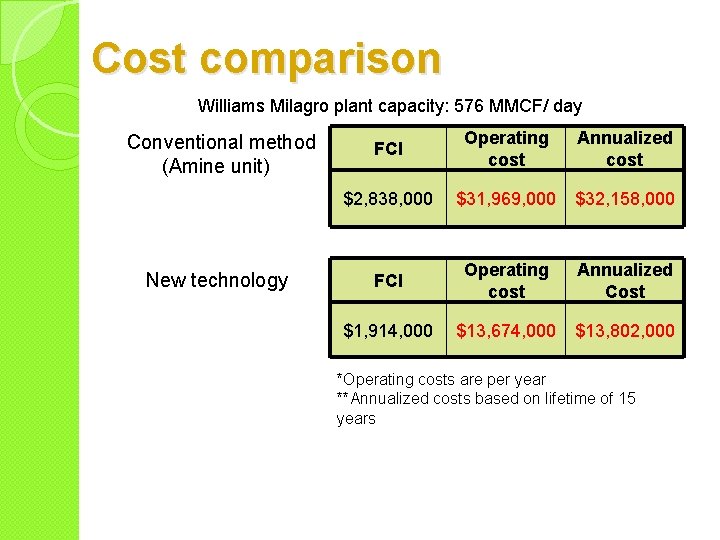
Cost comparison Williams Milagro plant capacity: 576 MMCF/ day Conventional method (Amine unit) New technology FCI Operating cost Annualized cost $2, 838, 000 $31, 969, 000 $32, 158, 000 FCI Operating cost Annualized Cost $1, 914, 000 $13, 674, 000 $13, 802, 000 *Operating costs are per year **Annualized costs based on lifetime of 15 years
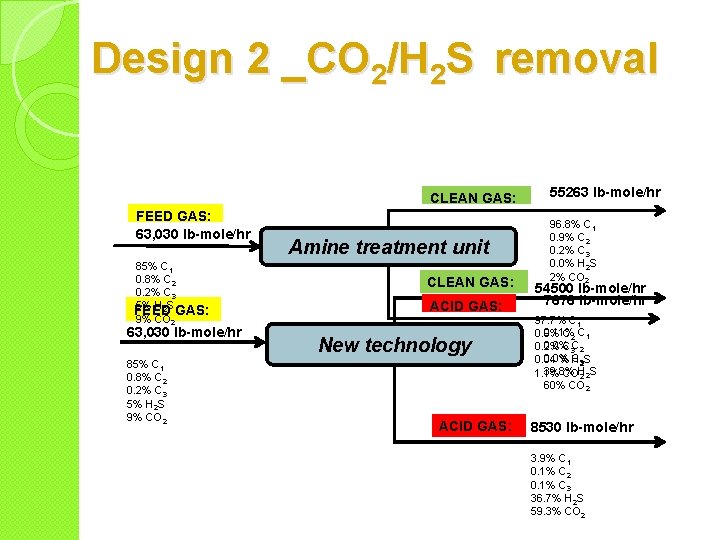
Design 2 _CO 2/H 2 S removal CLEAN GAS: FEED GAS: 63, 030 lb-mole/hr 85% C 1 0. 8% C 2 0. 2% C 3 5% H 2 S GAS: FEED 9% CO 2 63, 030 lb-mole/hr 85% C 1 0. 8% C 2 0. 2% C 3 5% H 2 S 9% CO 2 Amine treatment unit CLEAN GAS: ACID GAS: New technology ACID GAS: 55263 lb-mole/hr 96. 8% C 1 0. 9% C 2 0. 2% C 3 0. 0% H 2 S 2% CO 2 54500 lb-mole/hr 7676 lb-mole/hr 97. 7% C 1 0. 11% C 0. 9% C 1 2 0. 0% C 0. 2% C 2 3 0. 0% C 32 S 0. 04 % H 39. 8% H S 1. 1% CO 22 60% CO 2 8530 lb-mole/hr 3. 9% C 1 0. 1% C 2 0. 1% C 3 36. 7% H 2 S 59. 3% CO 2
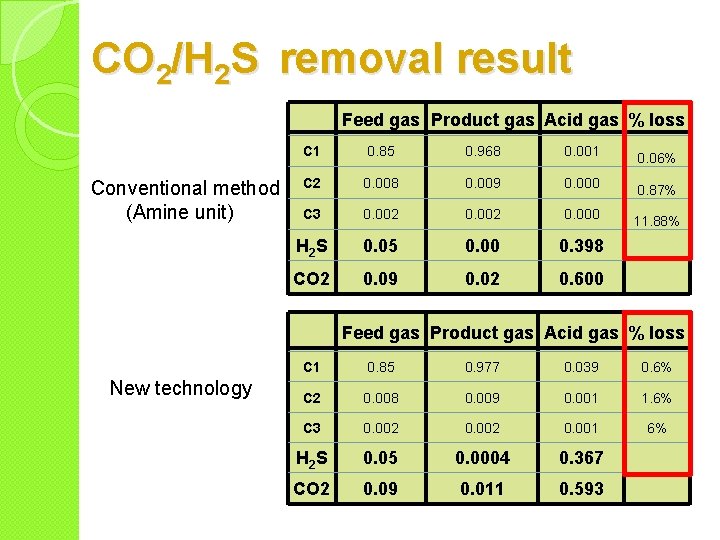
CO 2/H 2 S removal result Feed gas Product gas Acid gas % loss Conventional method (Amine unit) C 1 0. 85 0. 968 0. 001 0. 06% C 2 0. 008 0. 009 0. 000 0. 87% C 3 0. 002 0. 000 11. 88% H 2 S 0. 05 0. 00 0. 398 CO 2 0. 09 0. 02 0. 600 Feed gas Product gas Acid gas % loss New technology C 1 0. 85 0. 977 0. 039 0. 6% C 2 0. 008 0. 009 0. 001 1. 6% C 3 0. 002 0. 001 6% H 2 S 0. 05 0. 0004 0. 367 CO 2 0. 09 0. 011 0. 593
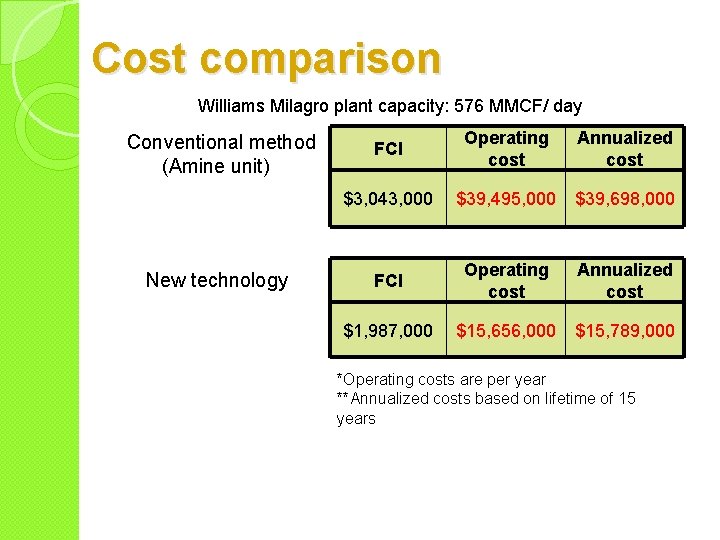
Cost comparison Williams Milagro plant capacity: 576 MMCF/ day Conventional method (Amine unit) New technology FCI Operating cost Annualized cost $3, 043, 000 $39, 495, 000 $39, 698, 000 FCI Operating cost Annualized cost $1, 987, 000 $15, 656, 000 $15, 789, 000 *Operating costs are per year **Annualized costs based on lifetime of 15 years
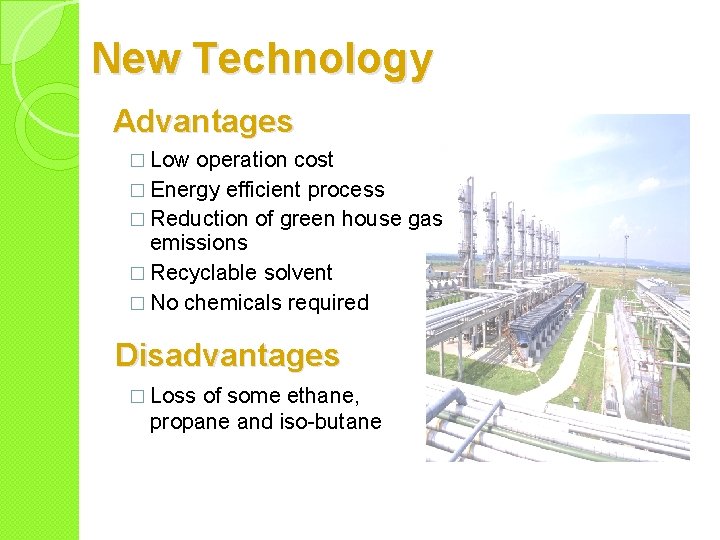
New Technology Advantages � Low operation cost � Energy efficient process � Reduction of green house gas emissions � Recyclable solvent � No chemicals required Disadvantages � Loss of some ethane, propane and iso-butane
Conclusion �The new process designificantly reduces the energy consumption. �The new process conditioning efficiency is comparable to the amine process, some loss of propane and butane. �The new process is environmentally friendly.

Q&A
- Slides: 26