
New Forms of Entertainment The Early 1900s marked
- Slides: 8
New Forms of Entertainment • The Early 1900’s marked a change in American culture. • The U. S. was becoming more urban, and the people in cities began looking for different types of recreation off the streets from where they lived and worked. • These factors would bring about a new commercial recreation industry designed to supply CHEAP entertainment for every American.
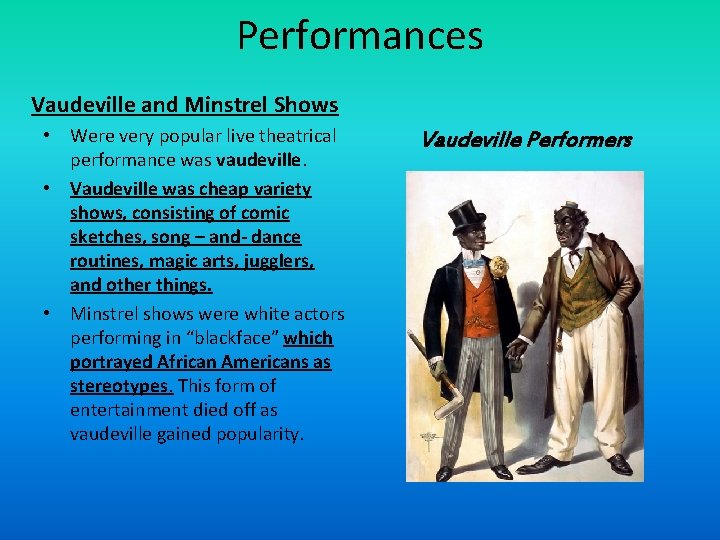
Performances Vaudeville and Minstrel Shows • Were very popular live theatrical performance was vaudeville. • Vaudeville was cheap variety shows, consisting of comic sketches, song – and- dance routines, magic arts, jugglers, and other things. • Minstrel shows were white actors performing in “blackface” which portrayed African Americans as stereotypes. This form of entertainment died off as vaudeville gained popularity. Vaudeville Performers
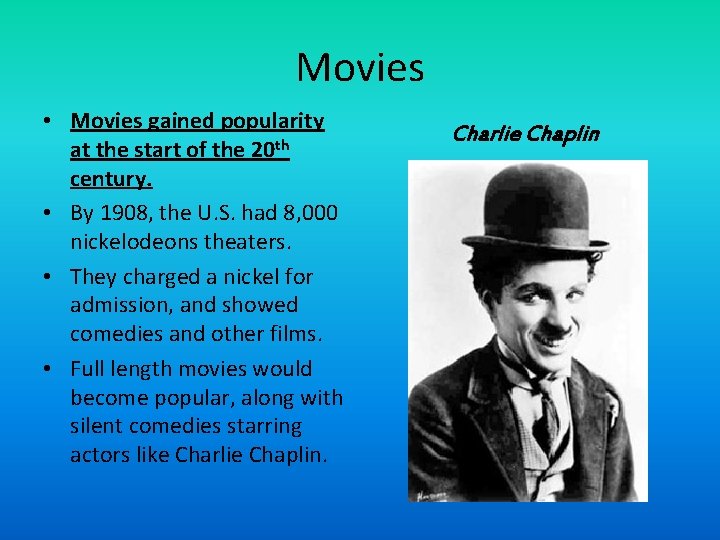
Movies • Movies gained popularity at the start of the 20 th century. • By 1908, the U. S. had 8, 000 nickelodeons theaters. • They charged a nickel for admission, and showed comedies and other films. • Full length movies would become popular, along with silent comedies starring actors like Charlie Chaplin
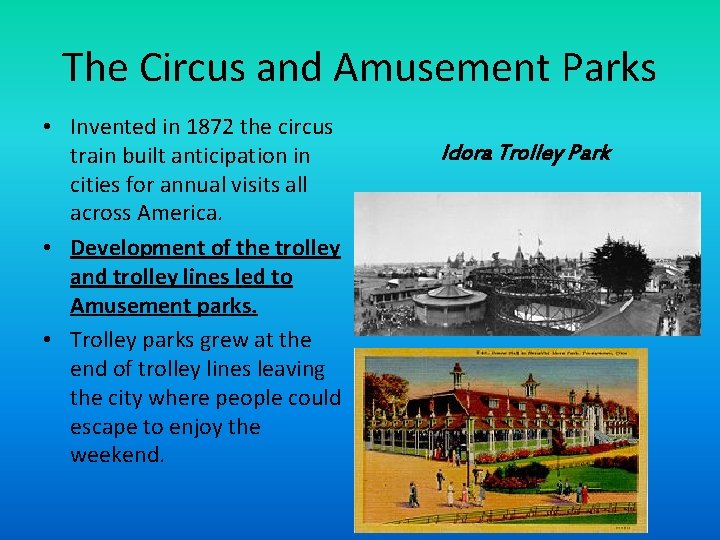
The Circus and Amusement Parks • Invented in 1872 the circus train built anticipation in cities for annual visits all across America. • Development of the trolley and trolley lines led to Amusement parks. • Trolley parks grew at the end of trolley lines leaving the city where people could escape to enjoy the weekend. Idora Trolley Park
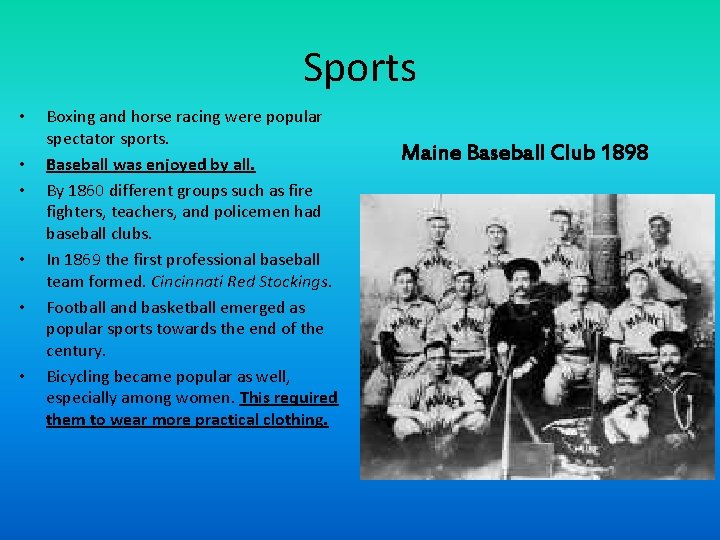
Sports • • • Boxing and horse racing were popular spectator sports. Baseball was enjoyed by all. By 1860 different groups such as fire fighters, teachers, and policemen had baseball clubs. In 1869 the first professional baseball team formed. Cincinnati Red Stockings. Football and basketball emerged as popular sports towards the end of the century. Bicycling became popular as well, especially among women. This required them to wear more practical clothing. Maine Baseball Club 1898
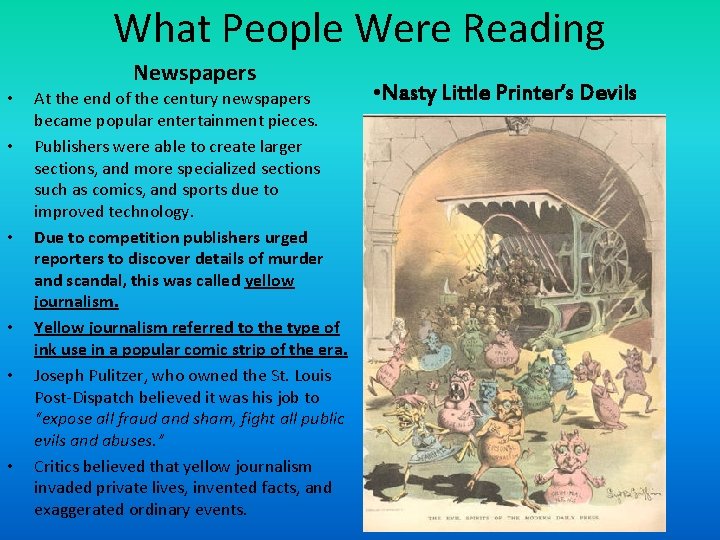
What People Were Reading Newspapers • • • At the end of the century newspapers became popular entertainment pieces. Publishers were able to create larger sections, and more specialized sections such as comics, and sports due to improved technology. Due to competition publishers urged reporters to discover details of murder and scandal, this was called yellow journalism. Yellow journalism referred to the type of ink use in a popular comic strip of the era. Joseph Pulitzer, who owned the St. Louis Post-Dispatch believed it was his job to “expose all fraud and sham, fight all public evils and abuses. ” Critics believed that yellow journalism invaded private lives, invented facts, and exaggerated ordinary events. • Nasty Little Printer’s Devils
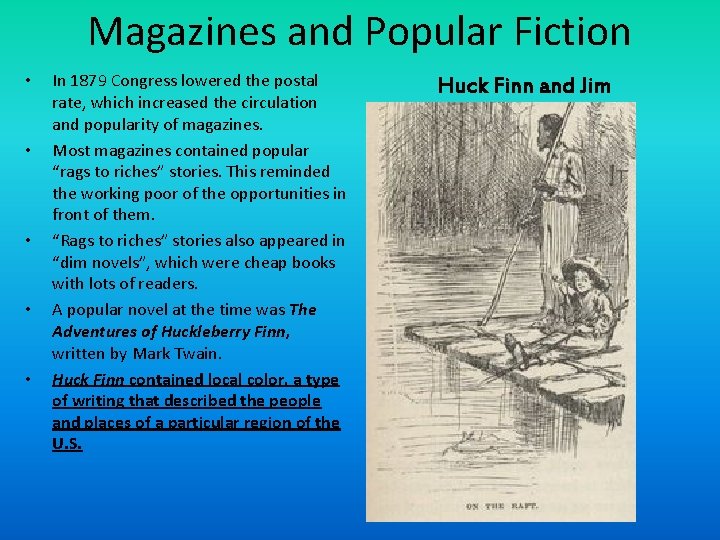
Magazines and Popular Fiction • • • In 1879 Congress lowered the postal rate, which increased the circulation and popularity of magazines. Most magazines contained popular “rags to riches” stories. This reminded the working poor of the opportunities in front of them. “Rags to riches” stories also appeared in “dim novels”, which were cheap books with lots of readers. A popular novel at the time was The Adventures of Huckleberry Finn, written by Mark Twain. Huck Finn contained local color, a type of writing that described the people and places of a particular region of the U. S. Huck Finn and Jim
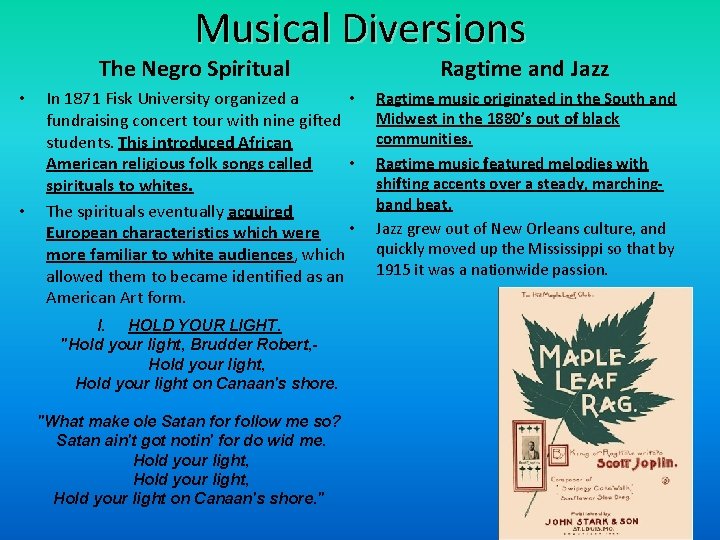
Musical Diversions The Negro Spiritual • • • In 1871 Fisk University organized a fundraising concert tour with nine gifted students. This introduced African • American religious folk songs called spirituals to whites. The spirituals eventually acquired • European characteristics which were more familiar to white audiences, which allowed them to became identified as an American Art form. I. HOLD YOUR LIGHT. "Hold your light, Brudder Robert, Hold your light on Canaan's shore. "What make ole Satan for follow me so? Satan ain't got notin' for do wid me. Hold your light, Hold your light on Canaan's shore. " Ragtime and Jazz Ragtime music originated in the South and Midwest in the 1880’s out of black communities. Ragtime music featured melodies with shifting accents over a steady, marchingband beat. Jazz grew out of New Orleans culture, and quickly moved up the Mississippi so that by 1915 it was a nationwide passion.