
New Formation Specifications for Heavy Axle Load Case






- Slides: 101
New Formation Specifications for Heavy Axle Load (Case Study For Availability Of Blanket Material)
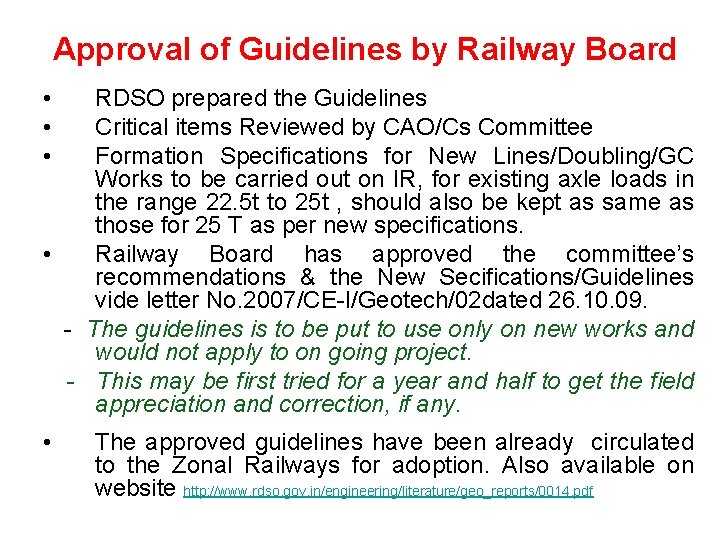
Approval of Guidelines by Railway Board • • • RDSO prepared the Guidelines Critical items Reviewed by CAO/Cs Committee Formation Specifications for New Lines/Doubling/GC Works to be carried out on IR, for existing axle loads in the range 22. 5 t to 25 t , should also be kept as same as those for 25 T as per new specifications. • Railway Board has approved the committee’s recommendations & the New Secifications/Guidelines vide letter No. 2007/CE-I/Geotech/02 dated 26. 10. 09. - The guidelines is to be put to use only on new works and would not apply to on going project. - This may be first tried for a year and half to get the field appreciation and correction, if any. • The approved guidelines have been already circulated to the Zonal Railways for adoption. Also available on website http: //www. rdso. gov. in/engineering/literature/geo_reports/0014. pdf
Formation Heavy Axle Load • New Formation Specifications vis a vis Existing GE: G-1 2003 • Availability of blanket material • Cost Comparison (New Formation specification verses Existing Guidelines)
The Existing ‘Guidelines of Earthwork in Railway Projects, GE: G-1, July 2003 stipulates : (A) Type of Soil SUBGRADE Blanket Thickness For 22. 5 T axle Load Rocky sub grade, GW, SW GP, SP, GM & GM-GC GC, SM, SM-SC CL, ML, CI, MI, CL-ML NIL 45 cm 60 cm 100 cm CH, MH soils Unsuitable for use in top 3 m of bank – Organic soils, Dispersive soils will be treated as Unsuitable Soils etc.
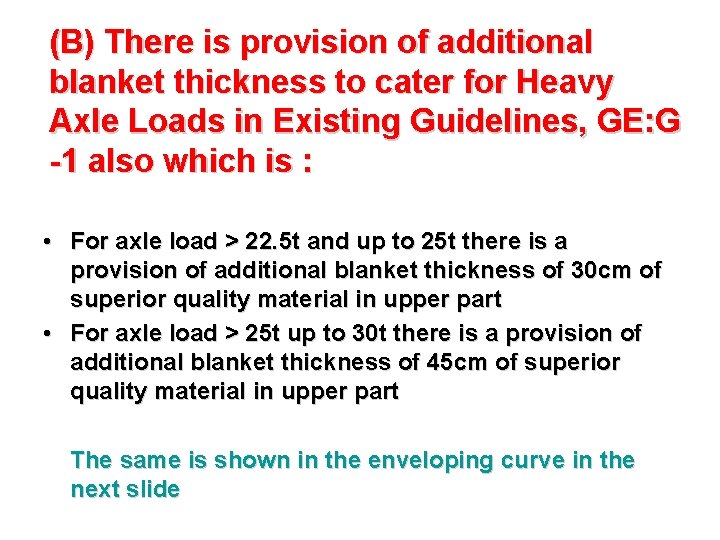
(B) There is provision of additional blanket thickness to cater for Heavy Axle Loads in Existing Guidelines, GE: G -1 also which is : • For axle load > 22. 5 t and up to 25 t there is a provision of additional blanket thickness of 30 cm of superior quality material in upper part • For axle load > 25 t up to 30 t there is a provision of additional blanket thickness of 45 cm of superior quality material in upper part The same is shown in the enveloping curve in the next slide
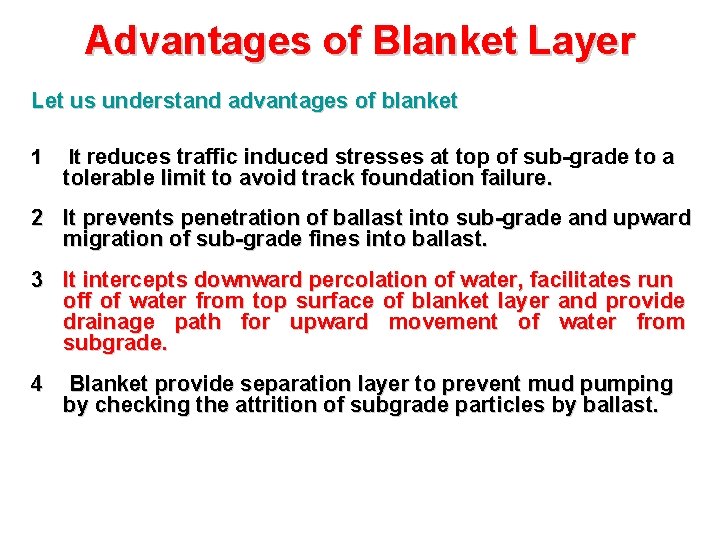
Advantages of Blanket Layer Let us understand advantages of blanket 1 It reduces traffic induced stresses at top of sub-grade to a tolerable limit to avoid track foundation failure. 2 It prevents penetration of ballast into sub-grade and upward migration of sub-grade fines into ballast. 3 It intercepts downward percolation of water, facilitates run off of water from top surface of blanket layer and provide drainage path for upward movement of water from subgrade. 4 Blanket provide separation layer to prevent mud pumping by checking the attrition of subgrade particles by ballast.
New Specification & Guidelines of Formation for Heavy Axle Loads’ Consists of: 1. Soil Exploration Surveys 2. Methodology for Ground Improvement 3. Formation Layers Thickness & Material Specification including blanket 4. Quality Assurance Tests
Concept adopted in New Specifications / Design • It is with objective of selecting the granular layer thickness based on threshold strength of the subgrade soil. • To limit the stress on the subgrade soils to less than a threshold stress • To prevent subgrade failure due to excessive plastic deformation, which is more pertinent in case of cohesive soils viz – clay type soil. • CBR value and particle size distribution are governing factor for the formation design.
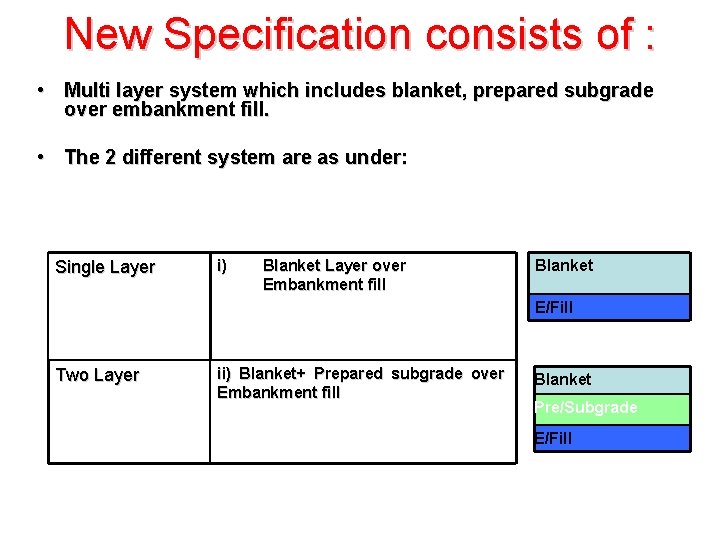
New Specification consists of : • Multi layer system which includes blanket, prepared subgrade over embankment fill. • The 2 different system are as under: Single Layer i) Blanket Layer over Embankment fill Blanket E/Fill Two Layer ii) Blanket+ Prepared subgrade over Embankment fill Blanket Pre/Subgrade E/Fill
Subsoil Requirements 1. We have talked about the multilayer system however subsoil parameters are equally important since subsoil is the foundation of the Formation 2. Ground Conditions requirements are given below 2. 1 Ground Soil/Sub-soil Strata should have Minimum Undrained shear strength of soil, = 25 KPa or SPT (Nvalue > 5) 2. 2 Otherwise Ground Improvement is required, if Undrained shear strength of soil, < 25 KPa or SPT (N-value < 5)
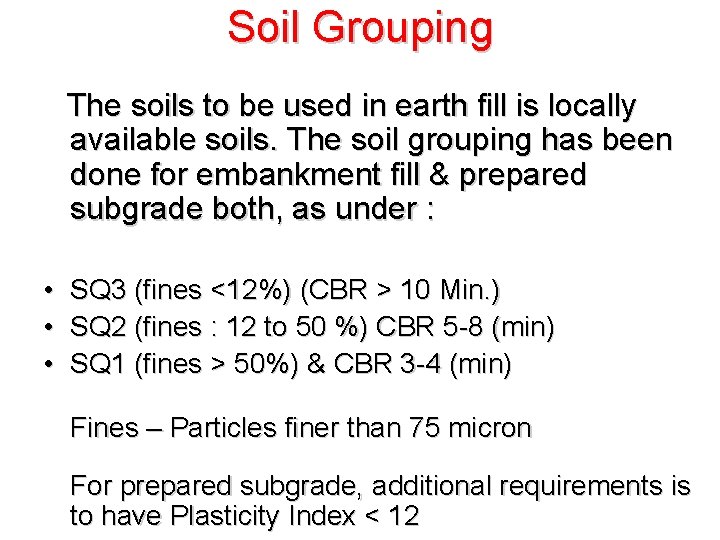
Soil Grouping The soils to be used in earth fill is locally available soils. The soil grouping has been done for embankment fill & prepared subgrade both, as under : • • • SQ 3 (fines <12%) (CBR > 10 Min. ) SQ 2 (fines : 12 to 50 %) CBR 5 -8 (min) SQ 1 (fines > 50%) & CBR 3 -4 (min) Fines – Particles finer than 75 micron For prepared subgrade, additional requirements is to have Plasticity Index < 12
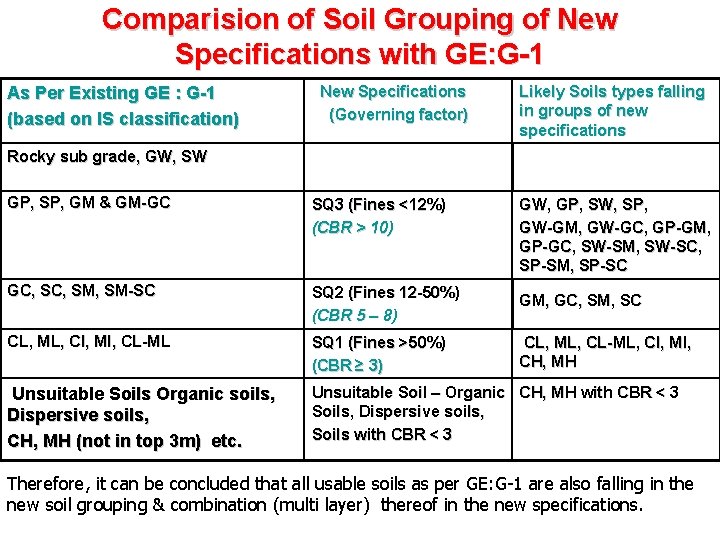
Comparision of Soil Grouping of New Specifications with GE: G-1 As Per Existing GE : G-1 (based on IS classification) New Specifications (Governing factor) Likely Soils types falling in groups of new specifications Rocky sub grade, GW, SW GP, SP, GM & GM-GC SQ 3 (Fines <12%) (CBR > 10) GW, GP, SW, SP, GW-GM, GW-GC, GP-GM, GP-GC, SW-SM, SW-SC, SP-SM, SP-SC GC, SM, SM-SC SQ 2 (Fines 12 -50%) (CBR 5 – 8) GM, GC, SM, SC CL, ML, CI, MI, CL-ML SQ 1 (Fines >50%) (CBR ≥ 3) CL, ML, CL-ML, CI, MI, CH, MH Unsuitable Soils Organic soils, Dispersive soils, CH, MH (not in top 3 m) etc. Unsuitable Soil – Organic CH, MH with CBR < 3 Soils, Dispersive soils, Soils with CBR < 3 Therefore, it can be concluded that all usable soils as per GE: G-1 are also falling in the new soil grouping & combination (multi layer) thereof in the new specifications.
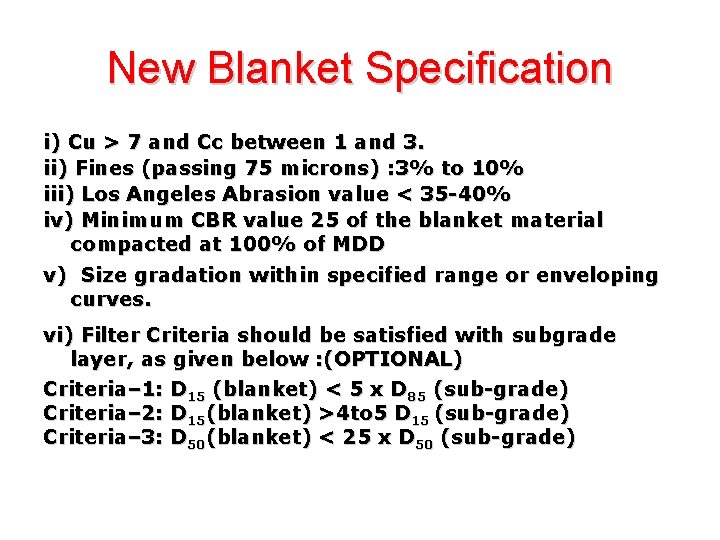
New Blanket Specification i) Cu > 7 and Cc between 1 and 3. ii) Fines (passing 75 microns) : 3% to 10% iii) Los Angeles Abrasion value < 35 -40% iv) Minimum CBR value 25 of the blanket material compacted at 100% of MDD v) Size gradation within specified range or enveloping curves. vi) Filter Criteria should be satisfied with subgrade layer, as given below : (OPTIONAL) Criteria– 1: D 15 (blanket) < 5 x D 85 (sub-grade) Criteria– 2: D 15(blanket) >4 to 5 D 15 (sub-grade) Criteria– 3: D 50(blanket) < 25 x D 50 (sub-grade)
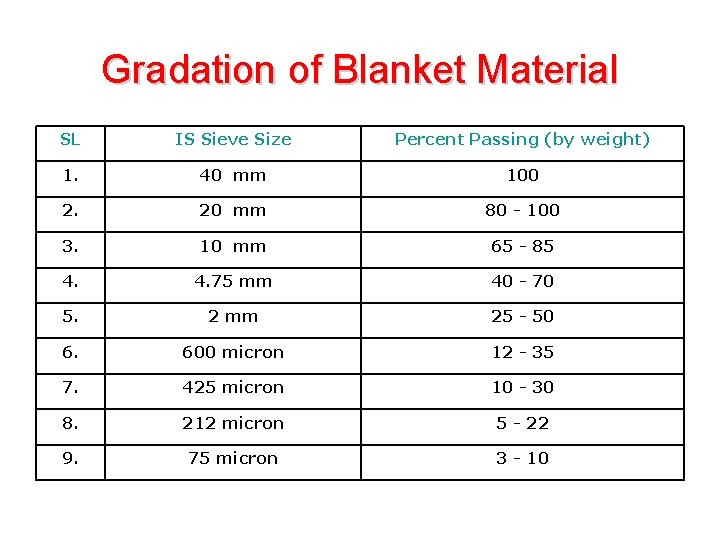
Gradation of Blanket Material SL IS Sieve Size Percent Passing (by weight) 1. 40 mm 100 2. 20 mm 80 - 100 3. 10 mm 65 - 85 4. 75 mm 40 - 70 5. 2 mm 25 - 50 6. 600 micron 12 - 35 7. 425 micron 10 - 30 8. 212 micron 5 - 22 9. 75 micron 3 - 10
Gradation of Blanket Material & Comparison with Highway Granular Sub-base
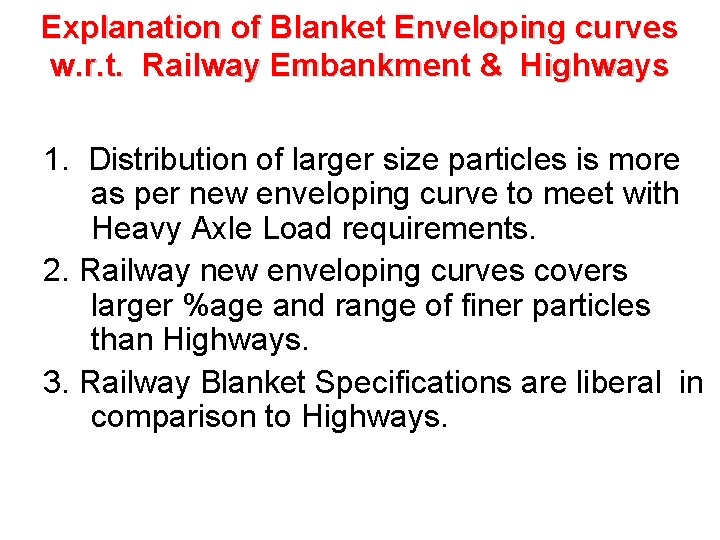
Explanation of Blanket Enveloping curves w. r. t. Railway Embankment & Highways 1. Distribution of larger size particles is more as per new enveloping curve to meet with Heavy Axle Load requirements. 2. Railway new enveloping curves covers larger %age and range of finer particles than Highways. 3. Railway Blanket Specifications are liberal in comparison to Highways.
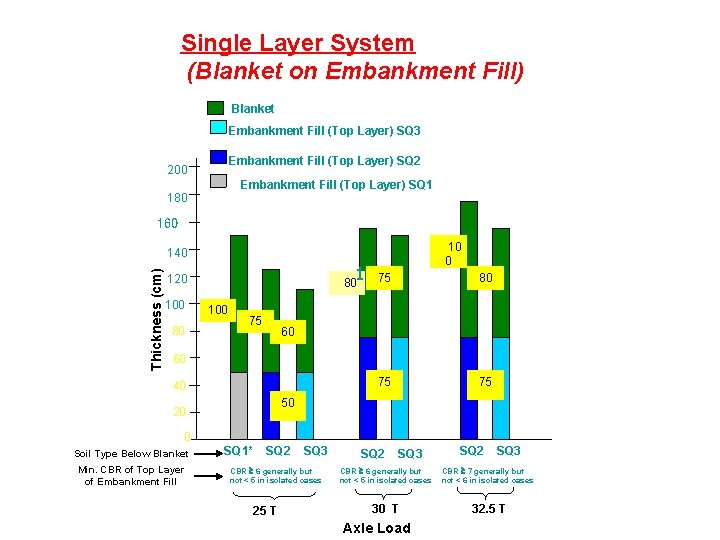
Single Layer System (Blanket on Embankment Fill) Blanket Embankment Fill (Top Layer) SQ 3 Embankment Fill (Top Layer) SQ 2 200 180 160 Embankment Fill (Top Layer) SQ 1 10 0 Thickness (cm) 140 1 120 100 80 100 75 75 80 75 75 60 60 40 50 20 0 Soil Type Below Blanket Min. CBR of Top Layer of Embankment Fill SQ 1* SQ 2 SQ 3 CBR 6 generally but not < 5 in isolated cases 25 T SQ 2 SQ 3 CBR 6 generally but not < 5 in isolated cases CBR 7 generally but not < 6 in isolated cases 30 T 32. 5 T Axle Load
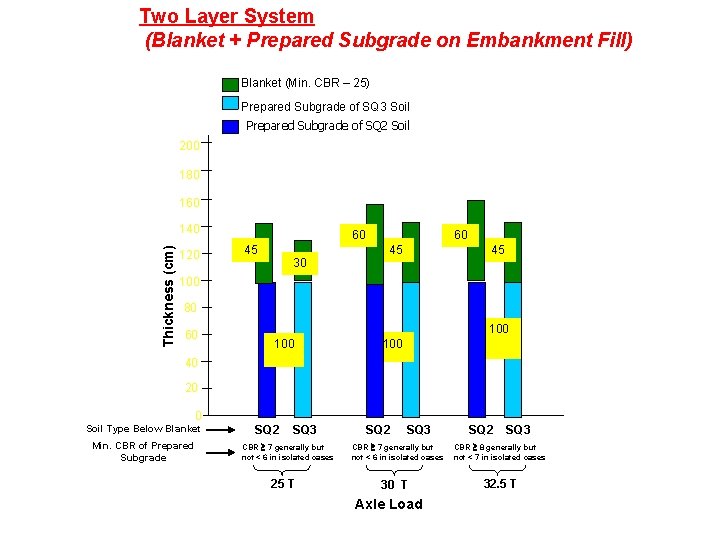
Two Layer System (Blanket + Prepared Subgrade on Embankment Fill) Blanket (Min. CBR – 25) Prepared Subgrade of SQ 3 Soil Prepared Subgrade of SQ 2 Soil 200 180 160 Thickness (cm) 140 120 60 45 45 30 100 80 60 100 40 20 0 Soil Type Below Blanket Min. CBR of Prepared Subgrade SQ 2 SQ 3 CBR 7 generally but not < 6 in isolated cases 25 T SQ 2 SQ 3 CBR 7 generally but not < 6 in isolated cases 30 T Axle Load SQ 2 SQ 3 CBR 8 generally but not < 7 in isolated cases 32. 5 T
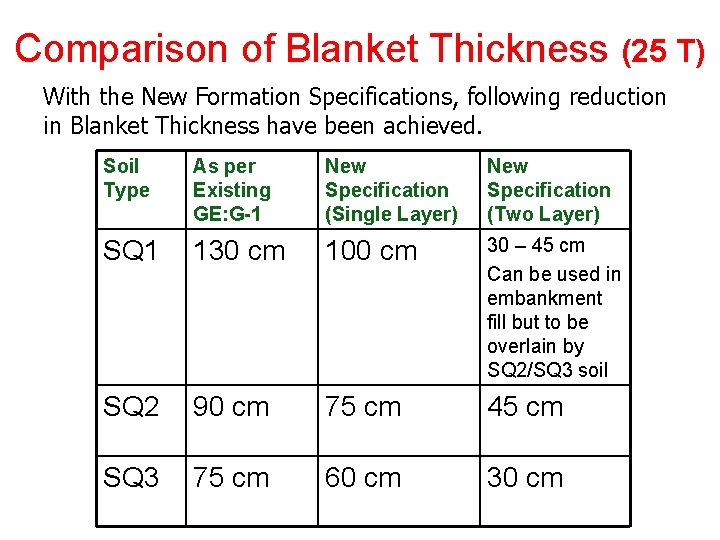
Comparison of Blanket Thickness (25 T) With the New Formation Specifications, following reduction in Blanket Thickness have been achieved. Soil Type As per Existing GE: G-1 New Specification (Single Layer) New Specification (Two Layer) SQ 1 130 cm 100 cm 30 – 45 cm Can be used in embankment fill but to be overlain by SQ 2/SQ 3 soil SQ 2 90 cm 75 cm 45 cm SQ 3 75 cm 60 cm 30 cm
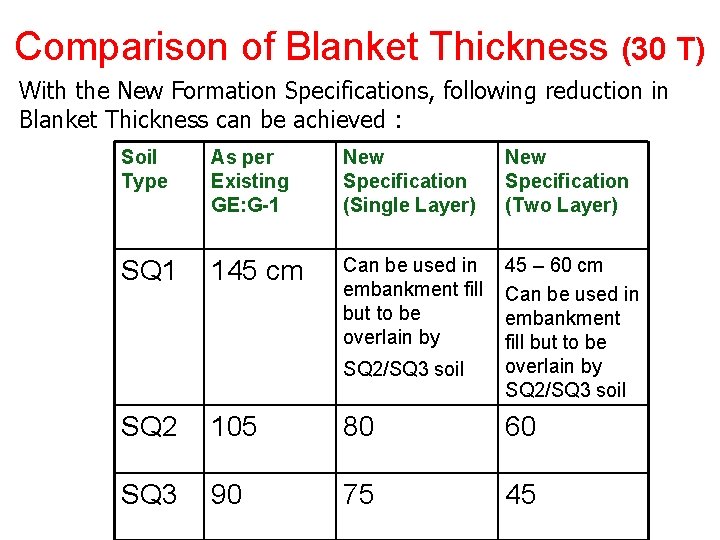
Comparison of Blanket Thickness (30 T) With the New Formation Specifications, following reduction in Blanket Thickness can be achieved : Soil Type As per Existing GE: G-1 New Specification (Single Layer) New Specification (Two Layer) SQ 1 145 cm Can be used in embankment fill but to be overlain by 45 – 60 cm Can be used in embankment fill but to be overlain by SQ 2/SQ 3 soil SQ 2 105 80 60 SQ 3 90 75 45
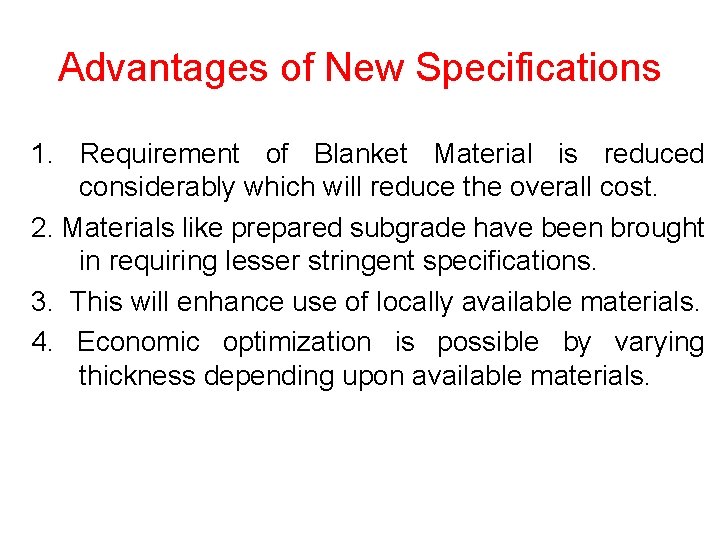
Advantages of New Specifications 1. Requirement of Blanket Material is reduced considerably which will reduce the overall cost. 2. Materials like prepared subgrade have been brought in requiring lesser stringent specifications. 3. This will enhance use of locally available materials. 4. Economic optimization is possible by varying thickness depending upon available materials.
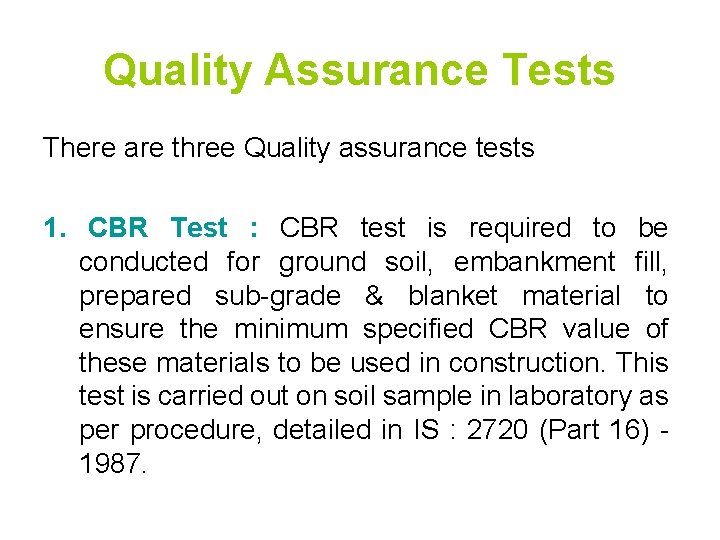
Quality Assurance Tests There are three Quality assurance tests 1. CBR Test : CBR test is required to be conducted for ground soil, embankment fill, prepared sub-grade & blanket material to ensure the minimum specified CBR value of these materials to be used in construction. This test is carried out on soil sample in laboratory as per procedure, detailed in IS : 2720 (Part 16) - 1987.
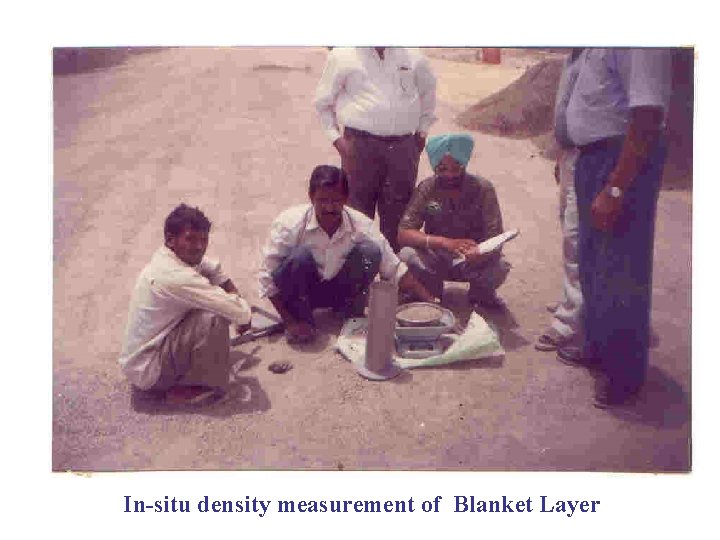
Quality Assurance Tests 2. Compaction Test: Heavy compaction Test is required to be conducted to determine the Maximum Dry Density of soil. In-situ density is measured in the field by Sand Replacement Method (IS: 2720 – part 28) or Core Cutter Method (IS: 2720 – part 29) to calculate the degree of compaction w. r. t. MDD.
Quality Assurance Tests 3. Plate Load test for Ev 2 Value (Optional) EV 2 – Elastic Modulus at 2 nd Loading in Plate Load Test is required to be conducted insitu for measurement of EV 2, as per procedure detailed in German Code DIN: 18134, 2001, titled – “Determining Deformation & Strength Characteristics Of Soil By Plate Loading Test”.
Case study Mechanical Production of Blanket Material • Most of the time naturally available materials do not meet the desired specifications of blanket material. • Blanket material can be produced by mechanical process from crushing or blending method or combination of these two methods.
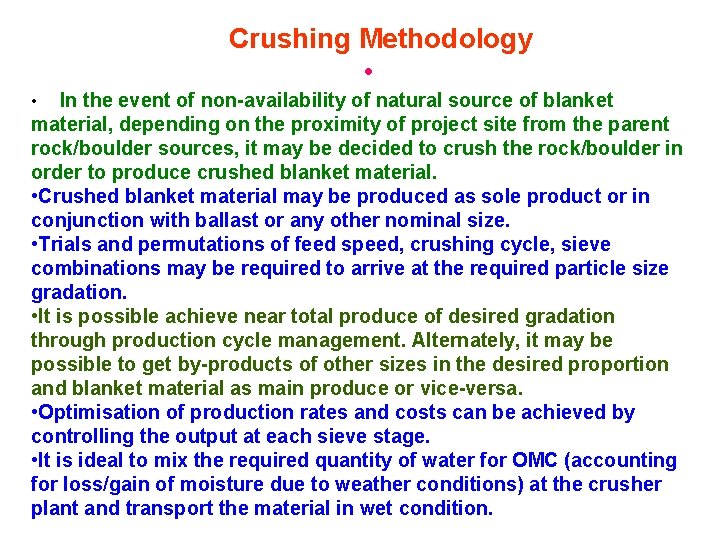
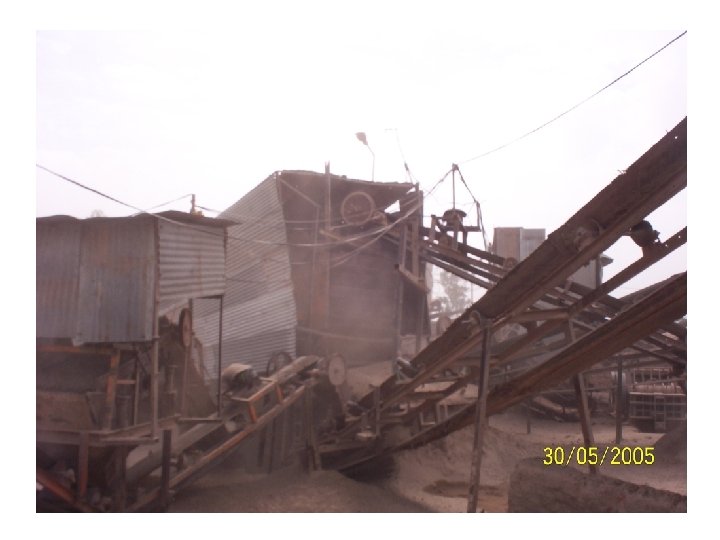
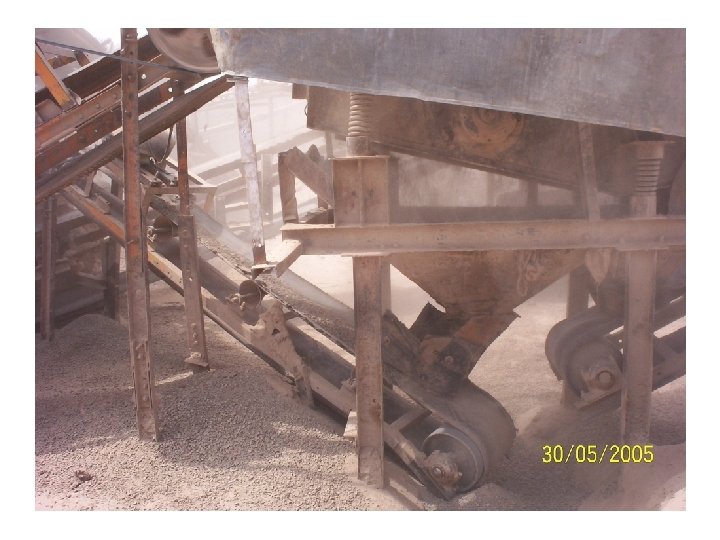
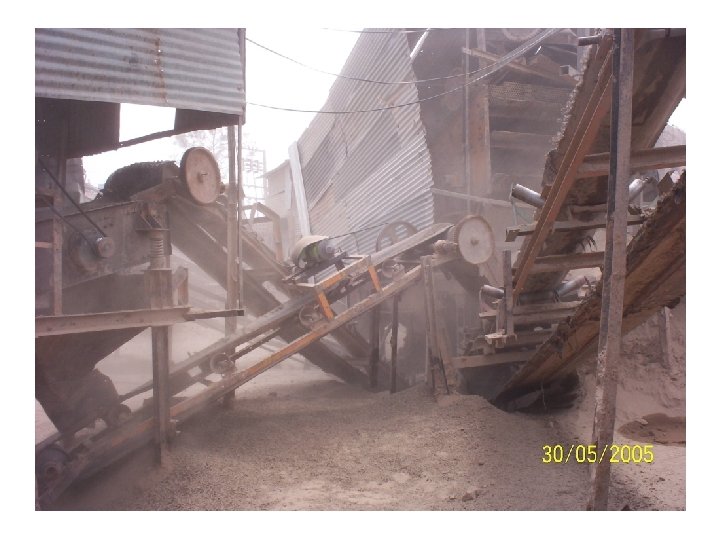
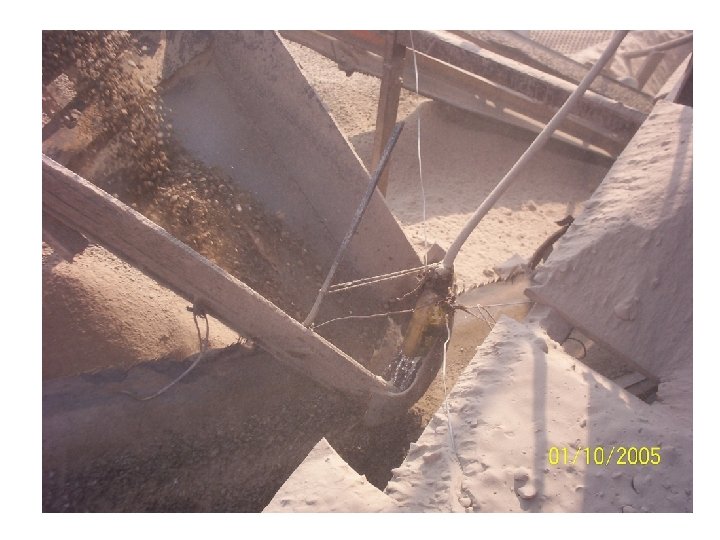
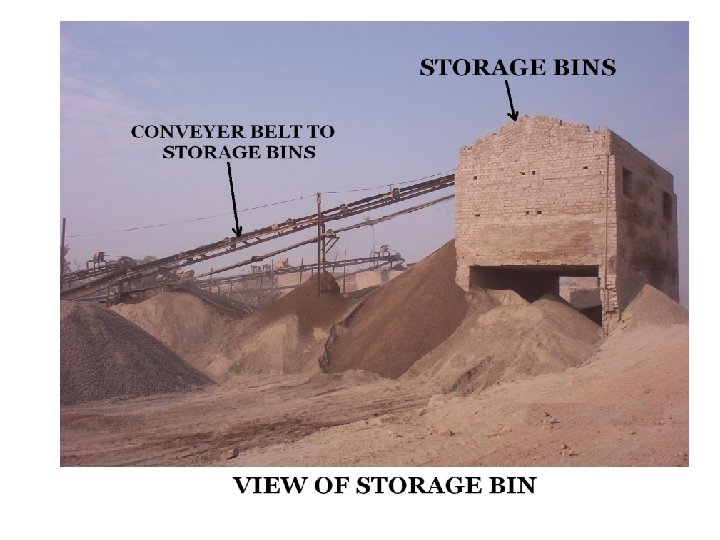
Crushing Methodology • Rock Boulders are crushed & sieved from different sieves to produce aggregates of different sizes. • Trials and permutations of feed speed, crushing cycle, sieve combinations may be required to arrive at the required particle size gradation. • These aggregates are mixed in pre-determined proportions over conveyers and mixed with water, stored.
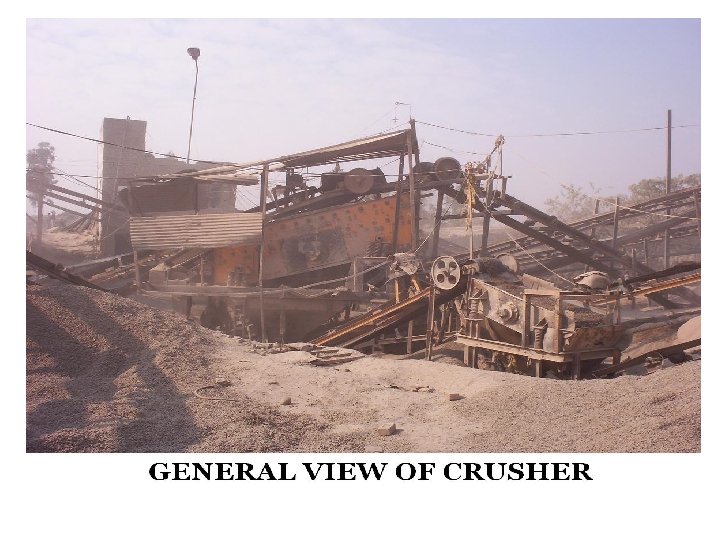
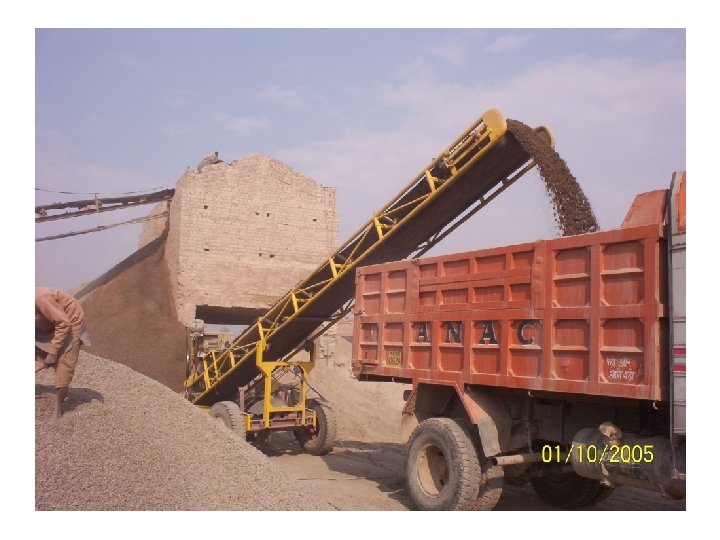
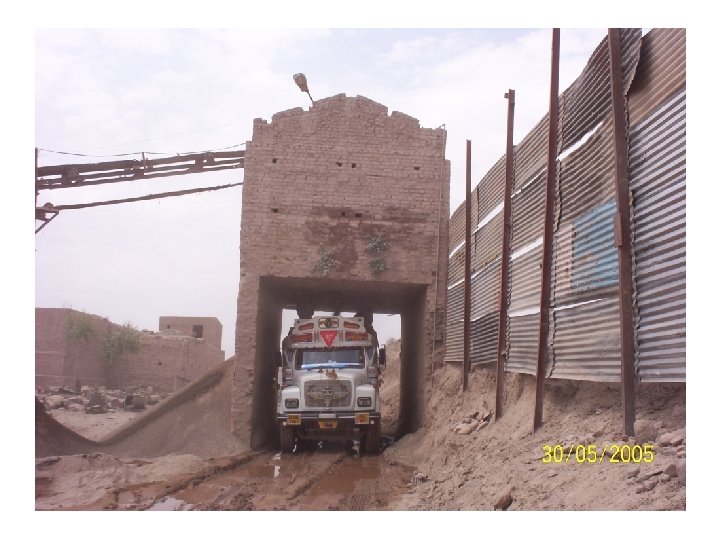
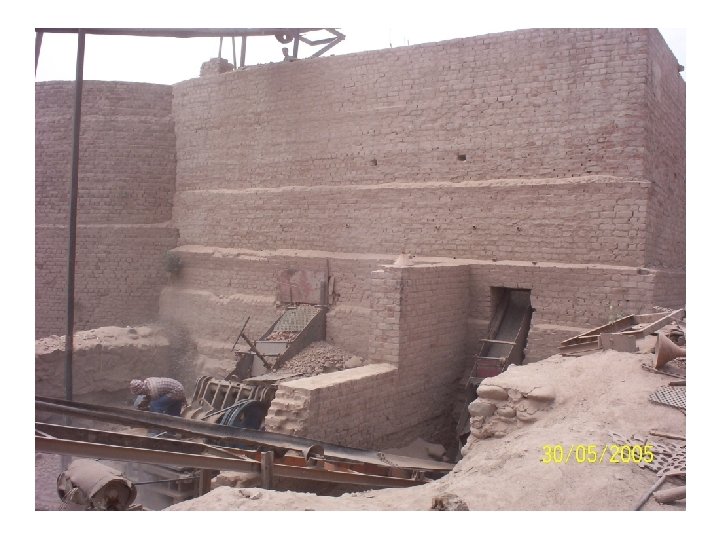
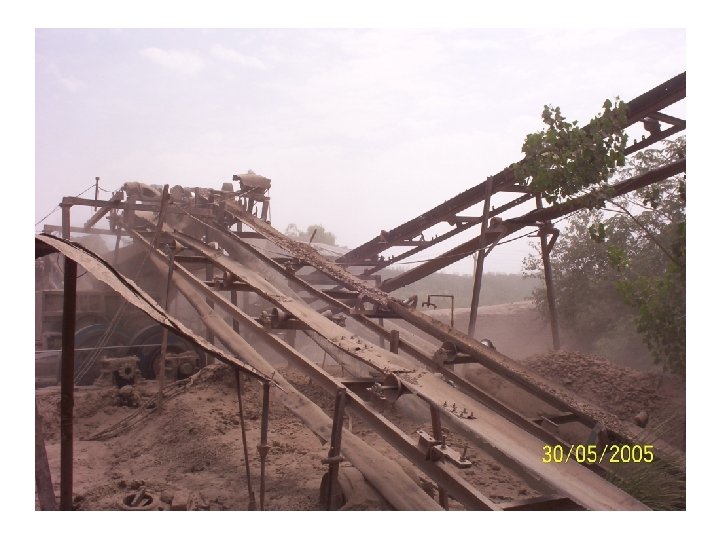
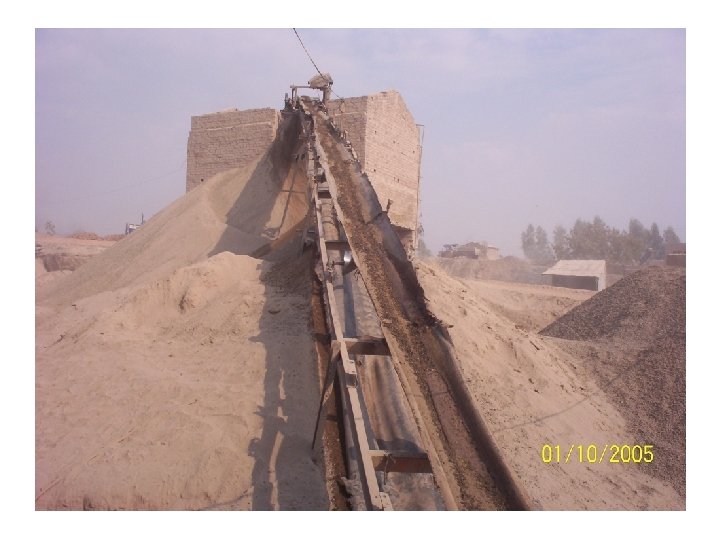
Blanketing in Chandigarh – Ludhiana New BG Line Crusher Plant visited in the month of May 2005 & Nov. 2009 at Chandigarh to inspect crushing methodology for production of blanket material. Details are as follows: Name of crusher owner: Site : Make of crusher: Source of stone: Plant capacity: Hargobind Stone crusher Panchkula, Chandigarh Gurudev, Lalkuwan, Delhi River Ghaggar 830 cft/hour (Approximately)
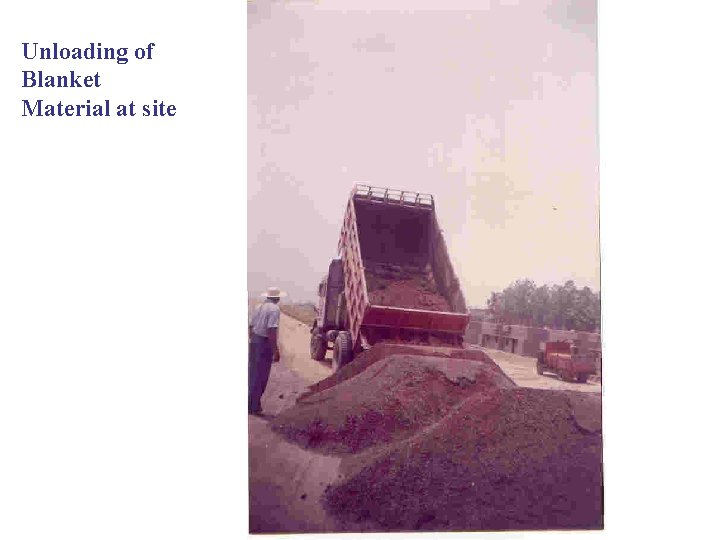
Unloading of Blanket Material at site
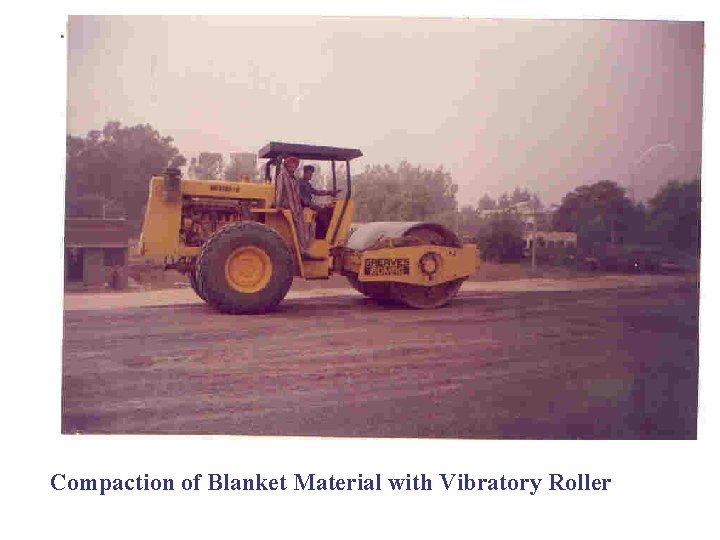
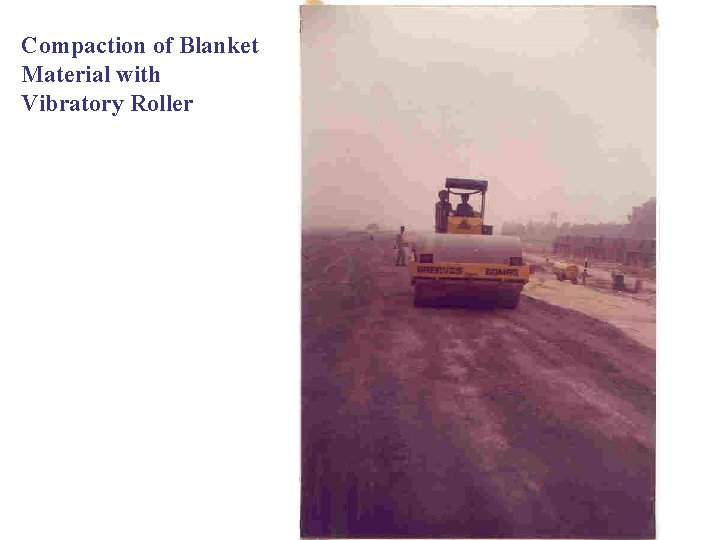
Compaction of Blanket Material with Vibratory Roller
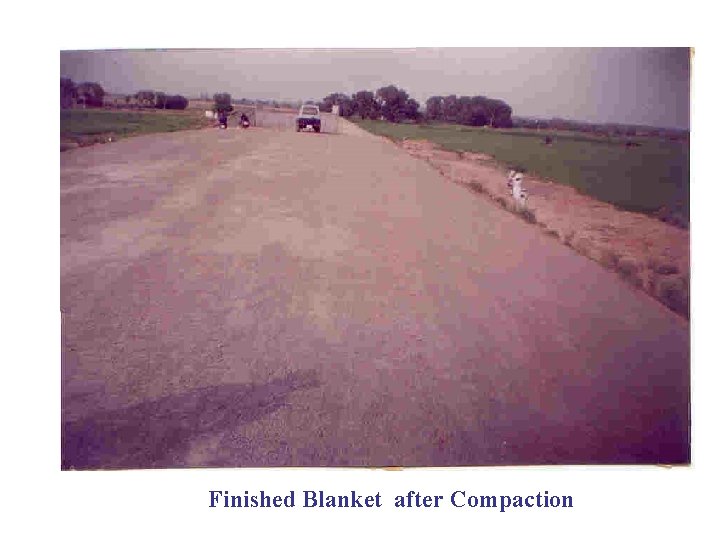
Finished Blanket after Compaction
In-situ density measurement of Blanket Layer
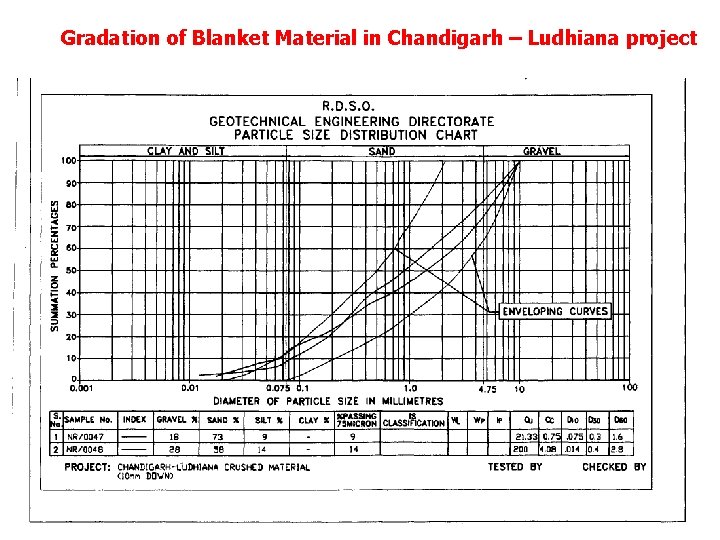
Gradation of Blanket Material in Chandigarh – Ludhiana project
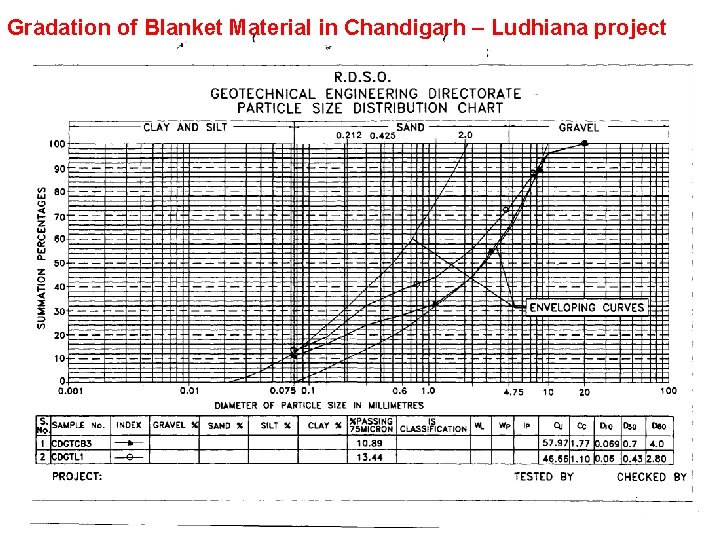
Gradation of Blanket Material in Chandigarh – Ludhiana project
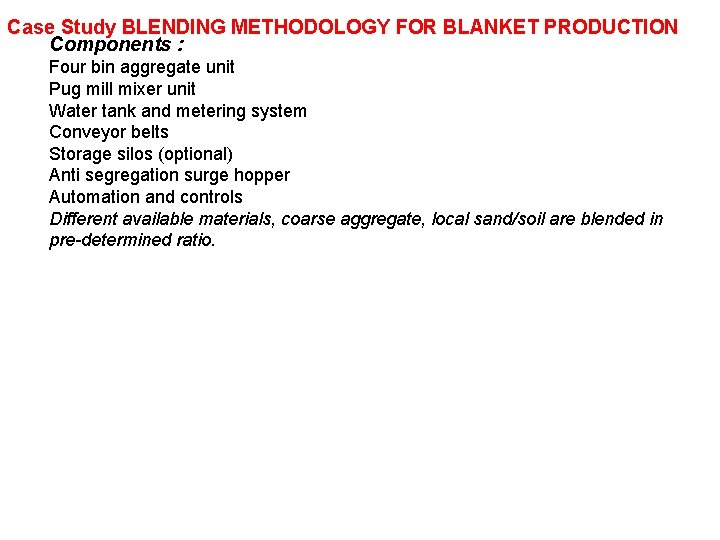
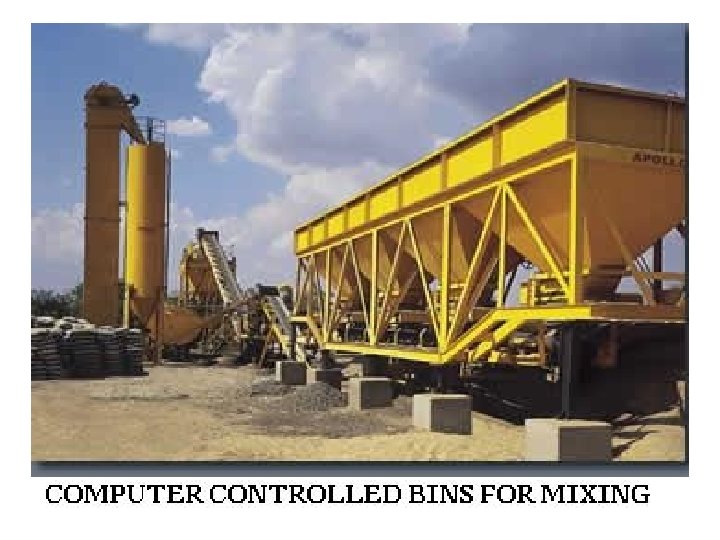
Case Study BLENDING METHODOLOGY FOR BLANKET PRODUCTION Components : Four bin aggregate unit Pug mill mixer unit Water tank and metering system Conveyor belts Storage silos (optional) Anti segregation surge hopper Automation and controls Different available materials, coarse aggregate, local sand/soil are blended in pre-determined ratio.
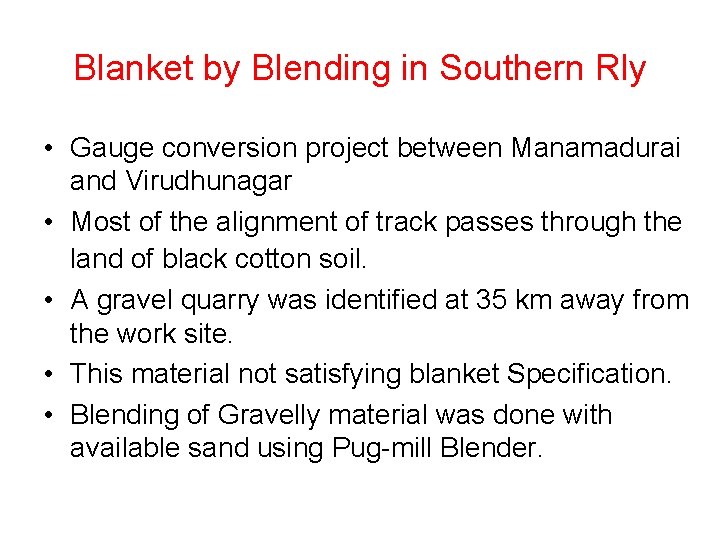
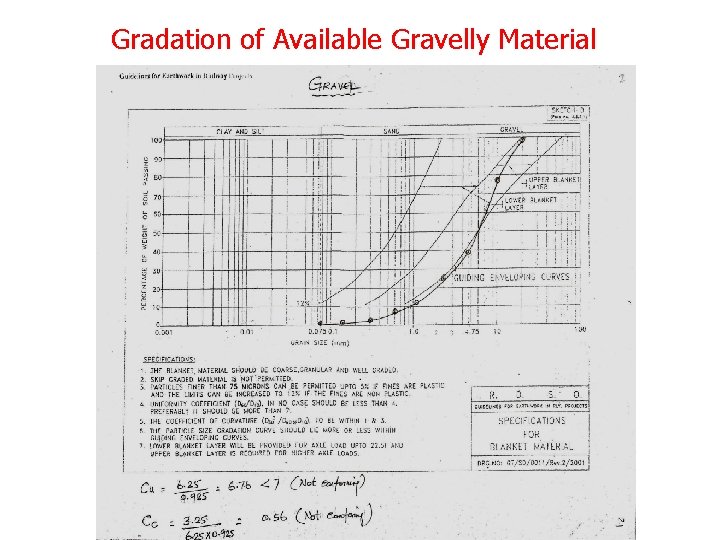
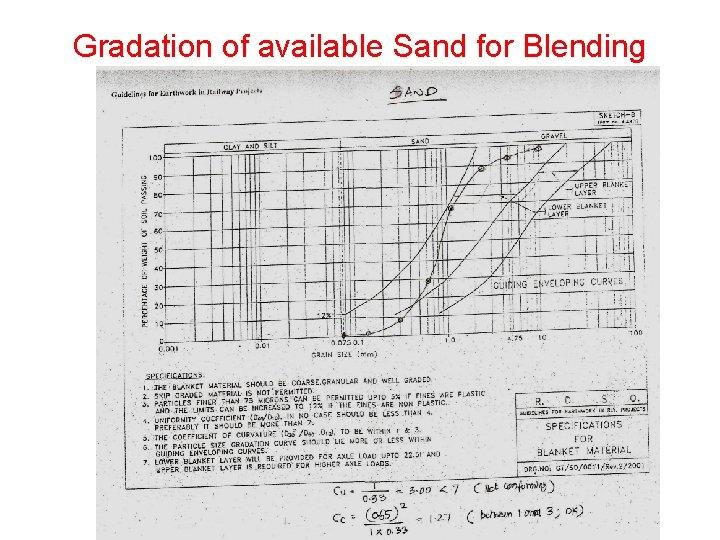
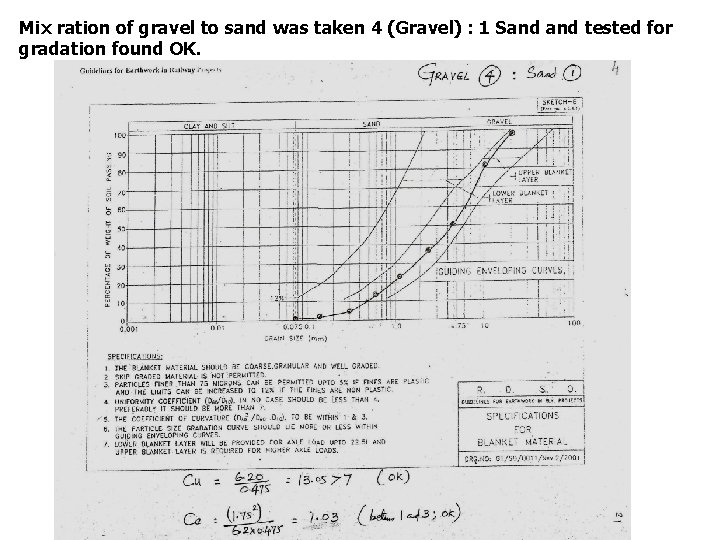
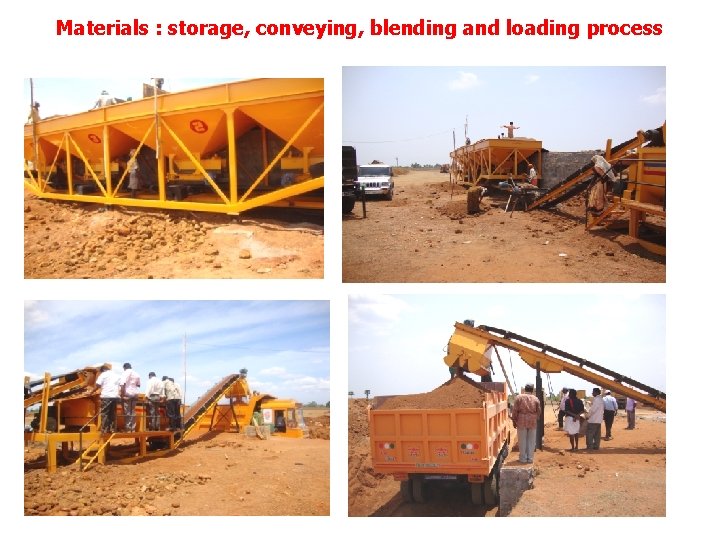
Blanket by Blending in Southern Rly • Gauge conversion project between Manamadurai and Virudhunagar • Most of the alignment of track passes through the land of black cotton soil. • A gravel quarry was identified at 35 km away from the work site. • This material not satisfying blanket Specification. • Blending of Gravelly material was done with available sand using Pug-mill Blender.
Gradation of Available Gravelly Material
Gradation of available Sand for Blending
Mix ration of gravel to sand was taken 4 (Gravel) : 1 Sand tested for gradation found OK.
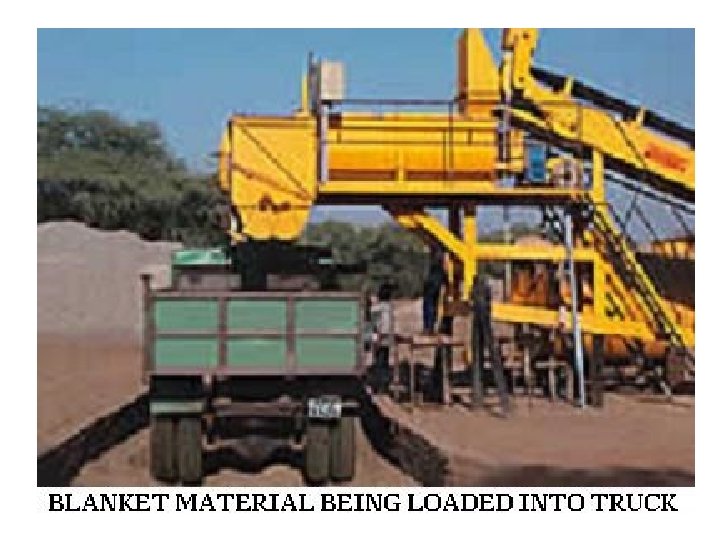
Materials : storage, conveying, blending and loading process
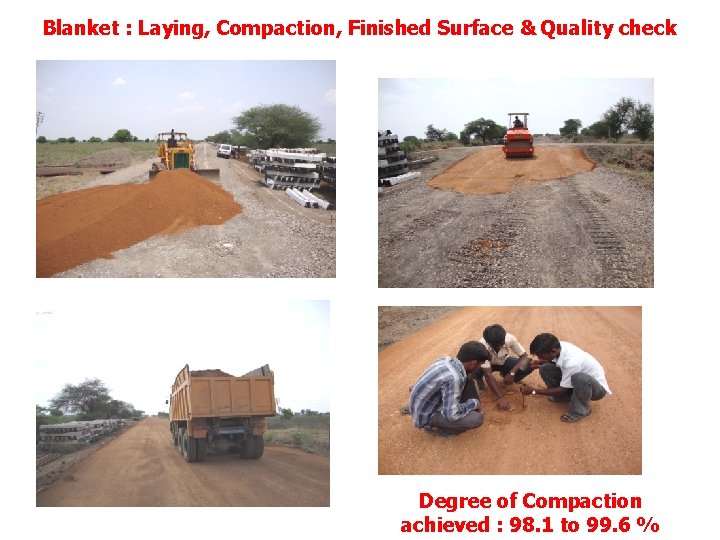
Blanket : Laying, Compaction, Finished Surface & Quality check Degree of Compaction achieved : 98. 1 to 99. 6 %
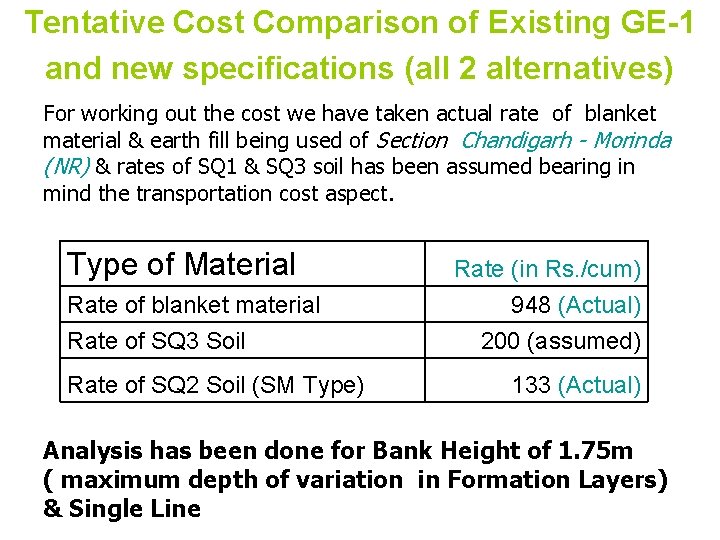
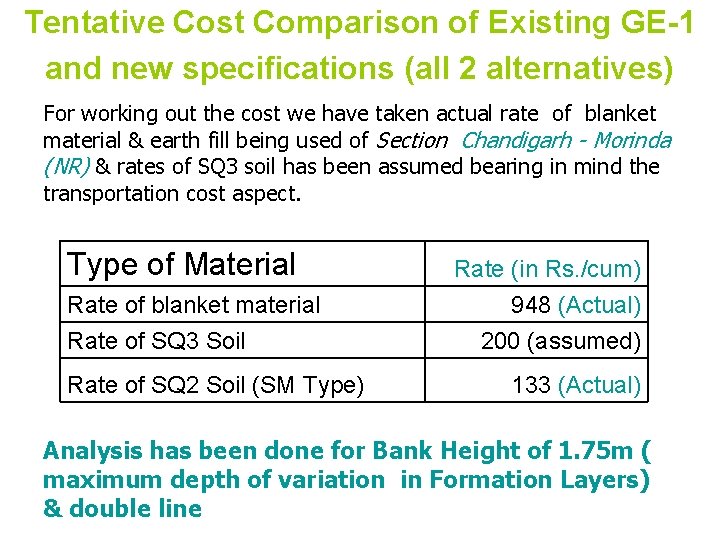
Tentative Cost Comparison of Existing GE-1 and new specifications (all 2 alternatives) For working out the cost we have taken actual rate of blanket material & earth fill being used of Section Chandigarh - Morinda (NR) & rates of SQ 1 & SQ 3 soil has been assumed bearing in mind the transportation cost aspect. Type of Material Rate of blanket material Rate of SQ 3 Soil Rate of SQ 2 Soil (SM Type) Rate (in Rs. /cum) 948 (Actual) 200 (assumed) 133 (Actual) Analysis has been done for Bank Height of 1. 75 m ( maximum depth of variation in Formation Layers) & Single Line
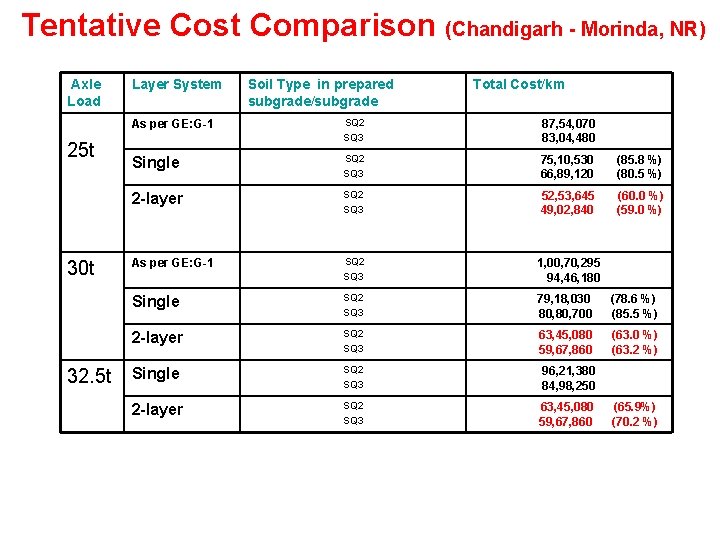
Tentative Cost Comparison (Chandigarh - Morinda, NR) Axle Load 25 t 30 t 32. 5 t Layer System Soil Type in prepared subgrade/subgrade Total Cost/km As per GE: G-1 SQ 2 SQ 3 87, 54, 070 83, 04, 480 Single SQ 2 SQ 3 75, 10, 530 66, 89, 120 (85. 8 %) (80. 5 %) 2 -layer SQ 2 SQ 3 52, 53, 645 49, 02, 840 (60. 0 %) (59. 0 %) As per GE: G-1 SQ 2 SQ 3 1, 00, 70, 295 94, 46, 180 Single SQ 2 SQ 3 79, 18, 030 80, 700 (78. 6 %) (85. 5 %) 2 -layer SQ 2 SQ 3 63, 45, 080 59, 67, 860 (63. 0 %) (63. 2 %) Single SQ 2 SQ 3 96, 21, 380 84, 98, 250 2 -layer SQ 2 SQ 3 63, 45, 080 59, 67, 860 (65. 9%) (70. 2 %)
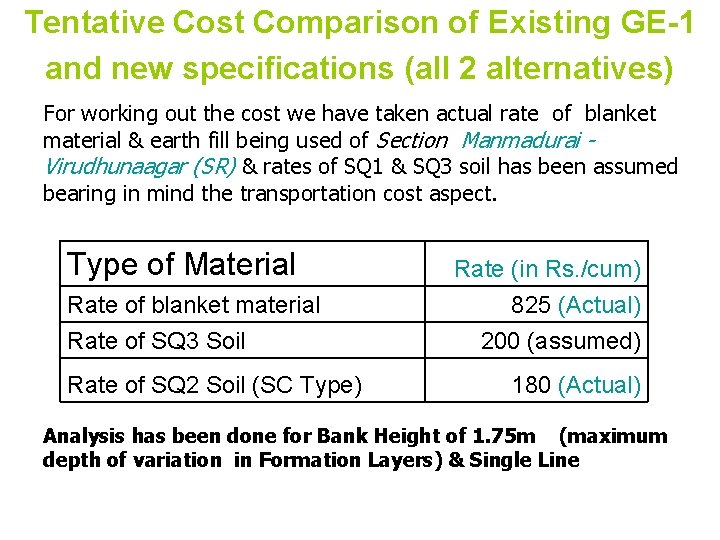
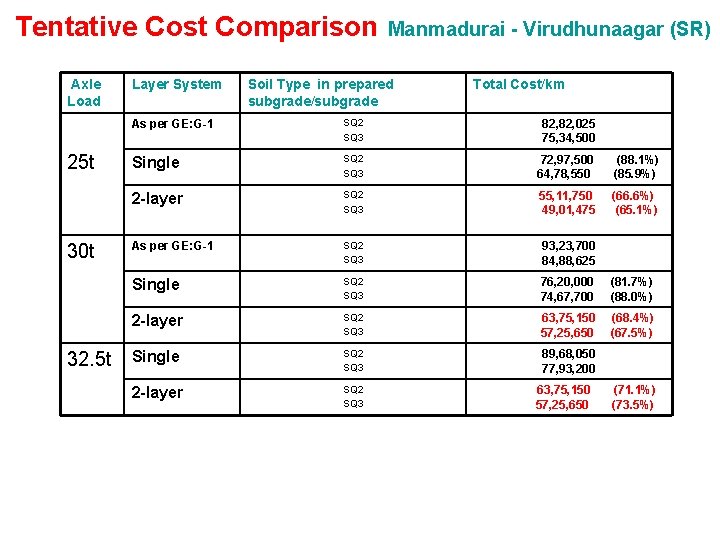
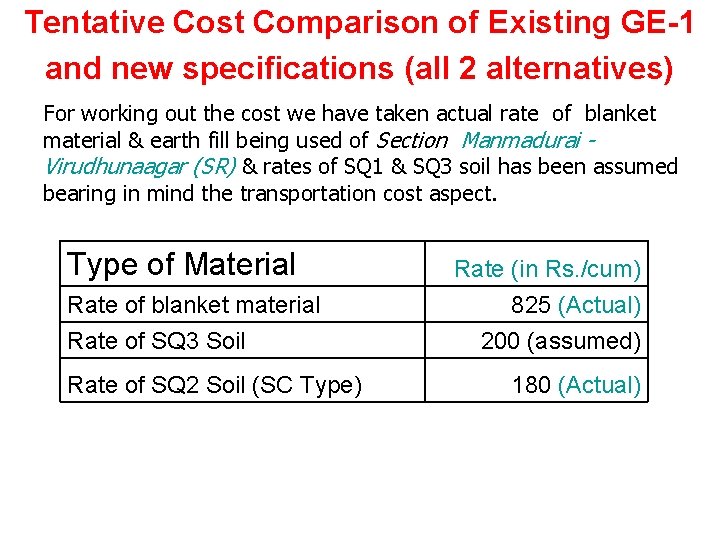
Tentative Cost Comparison of Existing GE-1 and new specifications (all 2 alternatives) For working out the cost we have taken actual rate of blanket material & earth fill being used of Section Manmadurai Virudhunaagar (SR) & rates of SQ 1 & SQ 3 soil has been assumed bearing in mind the transportation cost aspect. Type of Material Rate of blanket material Rate of SQ 3 Soil Rate of SQ 2 Soil (SC Type) Rate (in Rs. /cum) 825 (Actual) 200 (assumed) 180 (Actual) Analysis has been done for Bank Height of 1. 75 m (maximum depth of variation in Formation Layers) & Single Line
Tentative Cost Comparison Axle Load 25 t Layer System 32. 5 t Soil Type in prepared subgrade/subgrade Total Cost/km As per GE: G-1 SQ 2 SQ 3 82, 025 75, 34, 500 Single SQ 2 SQ 3 72, 97, 500 64, 78, 550 (88. 1%) (85. 9%) 2 -layer SQ 2 SQ 3 55, 11, 750 49, 01, 475 (66. 6%) (65. 1%) As per GE: G-1 SQ 2 SQ 3 93, 23, 700 84, 88, 625 Single SQ 2 SQ 3 76, 20, 000 74, 67, 700 (81. 7%) (88. 0%) 2 -layer SQ 2 SQ 3 63, 75, 150 57, 25, 650 (68. 4%) (67. 5%) Single SQ 2 SQ 3 89, 68, 050 77, 93, 200 2 -layer SQ 2 SQ 3 30 t Manmadurai - Virudhunaagar (SR) 63, 75, 150 57, 25, 650 (71. 1%) (73. 5%)
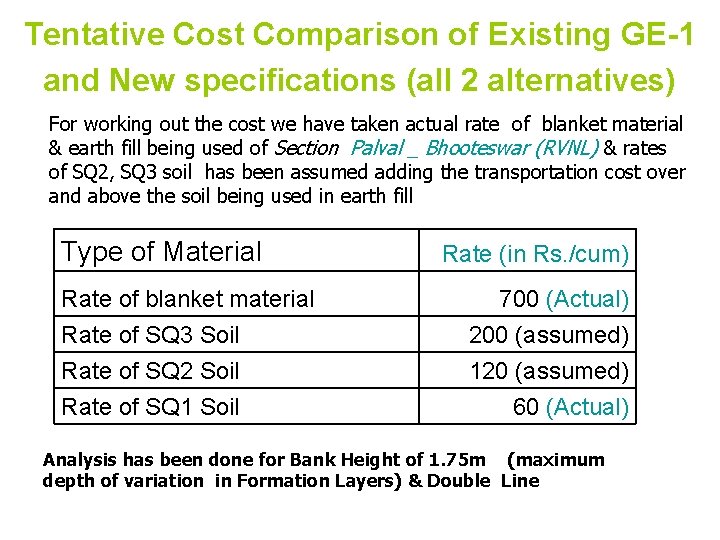
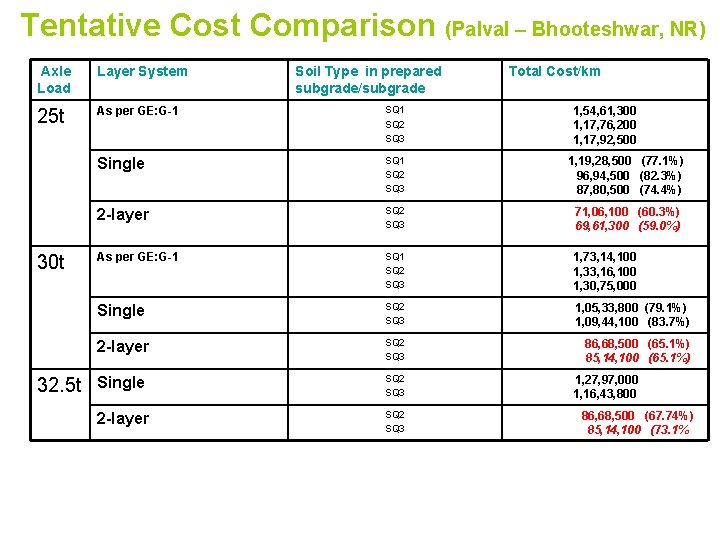
Tentative Cost Comparison of Existing GE-1 and New specifications (all 2 alternatives) For working out the cost we have taken actual rate of blanket material & earth fill being used of Section Palval _ Bhooteswar (RVNL) & rates of SQ 2, SQ 3 soil has been assumed adding the transportation cost over and above the soil being used in earth fill Type of Material Rate of blanket material Rate (in Rs. /cum) 700 (Actual) Rate of SQ 3 Soil Rate of SQ 2 Soil 200 (assumed) 120 (assumed) Rate of SQ 1 Soil 60 (Actual) Analysis has been done for Bank Height of 1. 75 m (maximum depth of variation in Formation Layers) & Double Line
Tentative Cost Comparison (Palval – Bhooteshwar, NR) Axle Load Layer System 25 t As per GE: G-1 SQ 2 SQ 3 Single SQ 1 SQ 2 SQ 3 1, 19, 28, 500 (77. 1%) 96, 94, 500 (82. 3%) 87, 80, 500 (74. 4%) 2 -layer SQ 2 SQ 3 71, 06, 100 (60. 3%) 69, 61, 300 (59. 0%) As per GE: G-1 SQ 2 SQ 3 1, 73, 14, 100 1, 33, 16, 100 1, 30, 75, 000 Single SQ 2 SQ 3 1, 05, 33, 800 (79. 1%) 1, 09, 44, 100 (83. 7%) 2 -layer SQ 2 SQ 3 86, 68, 500 (65. 1%) 85, 14, 100 (65. 1%) Single SQ 2 SQ 3 2 -layer SQ 2 SQ 3 30 t 32. 5 t Soil Type in prepared subgrade/subgrade Total Cost/km 1, 54, 61, 300 1, 17, 76, 200 1, 17, 92, 500 1, 27, 97, 000 1, 16, 43, 800 86, 68, 500 (67. 74%) 85, 14, 100 (73. 1%
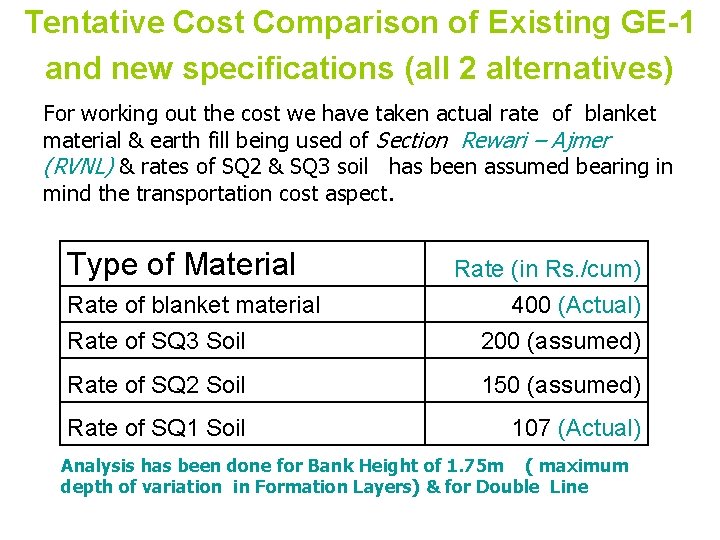
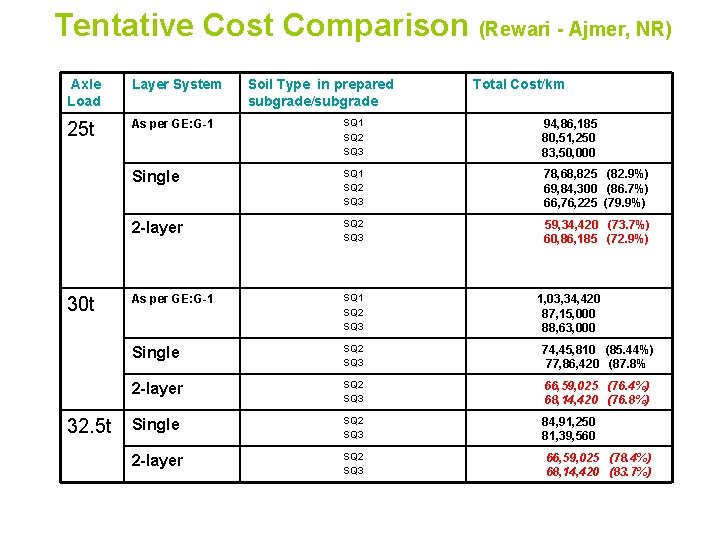
Tentative Cost Comparison of Existing GE-1 and new specifications (all 2 alternatives) For working out the cost we have taken actual rate of blanket material & earth fill being used of Section Rewari – Ajmer (RVNL) & rates of SQ 2 & SQ 3 soil has been assumed bearing in mind the transportation cost aspect. Type of Material Rate (in Rs. /cum) Rate of blanket material Rate of SQ 3 Soil 400 (Actual) 200 (assumed) Rate of SQ 2 Soil 150 (assumed) Rate of SQ 1 Soil 107 (Actual) Analysis has been done for Bank Height of 1. 75 m ( maximum depth of variation in Formation Layers) & for Double Line
Tentative Cost Comparison (Rewari - Ajmer, NR) Axle Load Layer System Soil Type in prepared subgrade/subgrade Total Cost/km 25 t As per GE: G-1 SQ 2 SQ 3 94, 86, 185 80, 51, 250 83, 50, 000 Single SQ 1 SQ 2 SQ 3 78, 68, 825 (82. 9%) 69, 84, 300 (86. 7%) 66, 76, 225 (79. 9%) 2 -layer SQ 2 SQ 3 59, 34, 420 (73. 7%) 60, 86, 185 (72. 9%) As per GE: G-1 SQ 2 SQ 3 Single SQ 2 SQ 3 74, 45, 810 (85. 44%) 77, 86, 420 (87. 8% 2 -layer SQ 2 SQ 3 66, 59, 025 (76. 4%) 68, 14, 420 (76. 8%) Single SQ 2 SQ 3 84, 91, 250 81, 39, 560 2 -layer SQ 2 SQ 3 30 t 32. 5 t 1, 03, 34, 420 87, 15, 000 88, 63, 000 66, 59, 025 (78. 4%) 68, 14, 420 (83. 7%)
THANKS
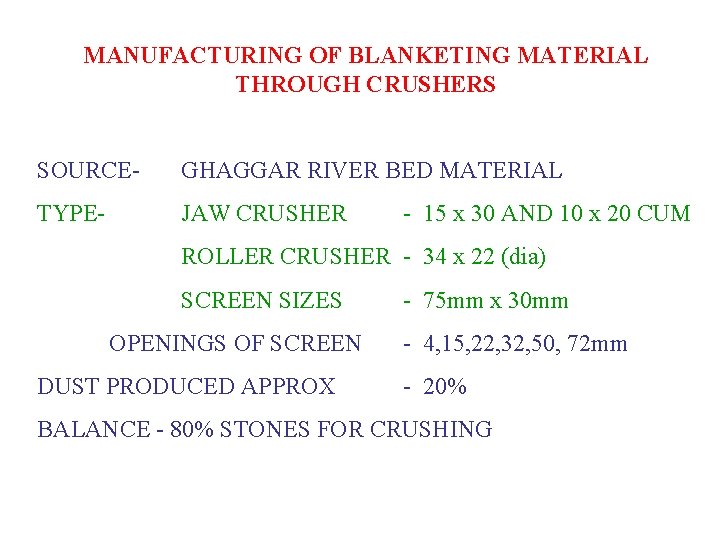
MANUFACTURING OF BLANKETING MATERIAL THROUGH CRUSHERS SOURCE- GHAGGAR RIVER BED MATERIAL TYPE- JAW CRUSHER - 15 x 30 AND 10 x 20 CUM ROLLER CRUSHER - 34 x 22 (dia) SCREEN SIZES OPENINGS OF SCREEN DUST PRODUCED APPROX - 75 mm x 30 mm - 4, 15, 22, 32, 50, 72 mm - 20% BALANCE - 80% STONES FOR CRUSHING
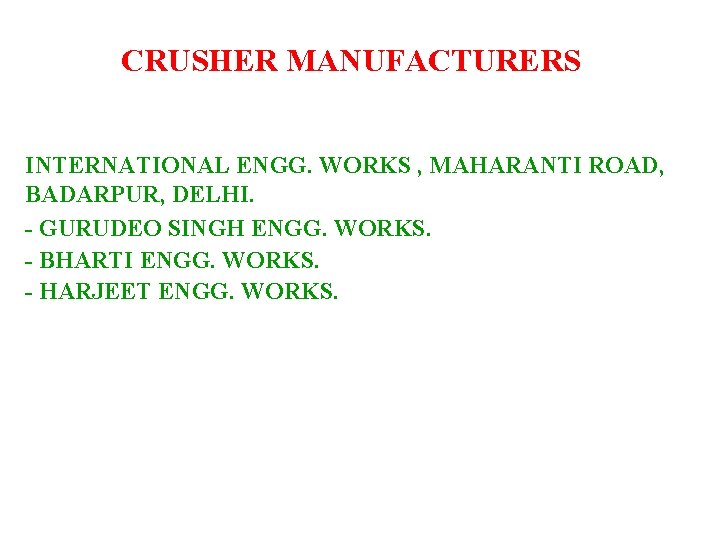
CRUSHER MANUFACTURERS INTERNATIONAL ENGG. WORKS , MAHARANTI ROAD, BADARPUR, DELHI. - GURUDEO SINGH ENGG. WORKS. - BHARTI ENGG. WORKS. - HARJEET ENGG. WORKS.
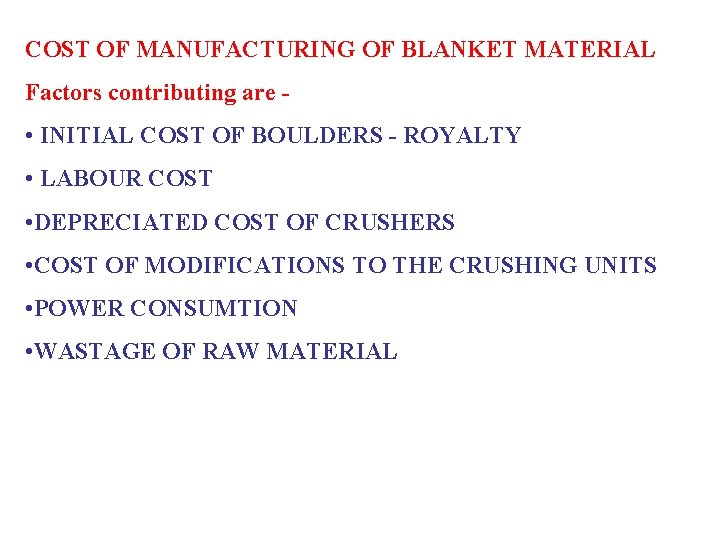
COST OF MANUFACTURING OF BLANKET MATERIAL Factors contributing are - • INITIAL COST OF BOULDERS - ROYALTY • LABOUR COST • DEPRECIATED COST OF CRUSHERS • COST OF MODIFICATIONS TO THE CRUSHING UNITS • POWER CONSUMTION • WASTAGE OF RAW MATERIAL
Mechanical Production of Blanket Material
Blending Methodology • Blanket material could be obtained by proper blending of two or more soils or in combination with soils and crushed material like stone chips or quarry dust. • Before approving such sources, trials for blending to judge the final product, needs to be done. Detail methodology of blending to be adopted to produce large quantity of blanket material with consistent quality, needs also to be laid down in advance. • Blending of either natural or crushed materials in a pre decided ratio could be adopted. • Theoretical and laboratory trials are required in order to establish the desirable ratio of the blending materials. This exercise may be done in advance before finalizing the contracts for such a material.
The methodology of blending trials is explained below: • Identify the usable materials/soils. • Take equal weight of the soils for sieve analysis. • Write down the weight retained at each sieving stage for all the soils. • Apportion a percentage component to each soil and work out a theoretical mix. • Draw particle size distribution curve of the mix to find out desirability of gradation. • If not successful, make another trial, and so on. • Trials and plotting work can also be done using simple computer programs. • Mechanical blenders using simple technology are now available in the market. • Two types of mechanical blenders are quite common:
Drum type blenders Drum type machines may involve weigh batching or manual feeding of material. They involve more moving parts. Hence, these machines are both manpower and maintenance intensive. They may pose a problem of segregation of material and as such do not afford any cost advantage either in the short or long run. These may be suitable for small quantities and not for large-scale production as required in construction projects. Pug mill type blenders: For continuous production of mix in large quantities, the best way is to feed the aggregates/ soils of pre decided gradation by way of 3 or 4 bins with conveyor belt. The required output grading can be achieved by adjustment of gate openings of bins. The use of pug mill type blenders is found very cost effective, as the manpower involvement is very little and only 4 -5 people can run a plant of 100 tph. The pug mill blender consists of:
The other important features of this technology are: Automatic feeding of soils/aggregates under gravity Arrangement for precise control of mixing of water Either direct loading into trucks, or optional storage at plant Availability of domestic manufacturers, and low cost of set up Advantage of removal and relocation with ease
World Railway Practice • UIC (Mainly European Rlys) • AAR (American & Canadian Rly) • Australian Railways
THICKNESS OF STRUCTURAL LAYERS –Sub Grade -BLANKET - UIC PRACTICES • It Is A Multilayer Concept. • Soils Are Divided Into QS 0, QS 1, QS 2, QS 3 Types. • QS 0 Soils Are Avoidable.
THICKNESS OF STRUCTURAL LAYERS –Sub Grade - BLANKET - UIC PRACTICES • QS 1 Soils Are Equivalent To Cohesive Soils, Fines > 40% (CH, CI, CL, MH, MI, ML, SC, GM, SM) & CBR (min) 2 -3 • QS 2 Type Of Soils Contain Fines 15%-40% (SW-SM, GW-GM Etc. And Moderately Hard Crushed Rocks) & CBR >5 (min) • QS 3 Type Of Soils, Fines < 15% (GW, GP, SW, SP & Hard Crushed Rocks) CBR 10 -17(min)
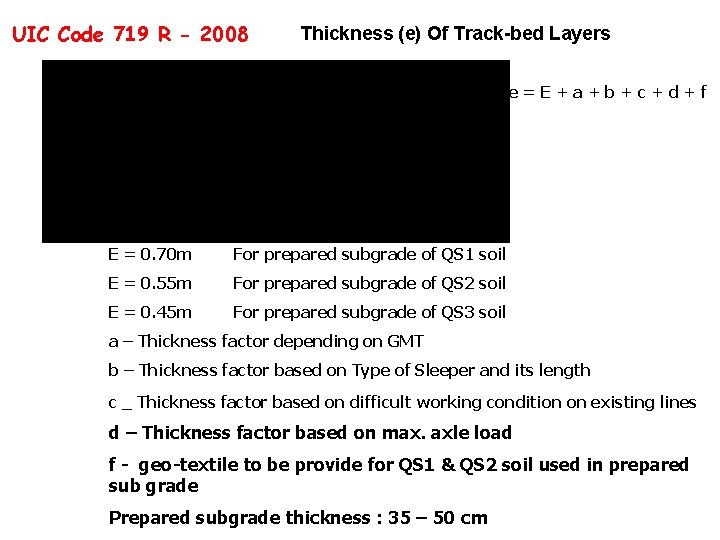
UIC Code 719 R - 2008 Thickness (e) Of Track-bed Layers e=E+a+b+c+d+f E = 0. 70 m For prepared subgrade of QS 1 soil E = 0. 55 m For prepared subgrade of QS 2 soil E = 0. 45 m For prepared subgrade of QS 3 soil a – Thickness factor depending on GMT b – Thickness factor based on Type of Sleeper and its length c _ Thickness factor based on difficult working condition on existing lines d – Thickness factor based on max. axle load f - geo-textile to be provide for QS 1 & QS 2 soil used in prepared sub grade Prepared subgrade thickness : 35 – 50 cm
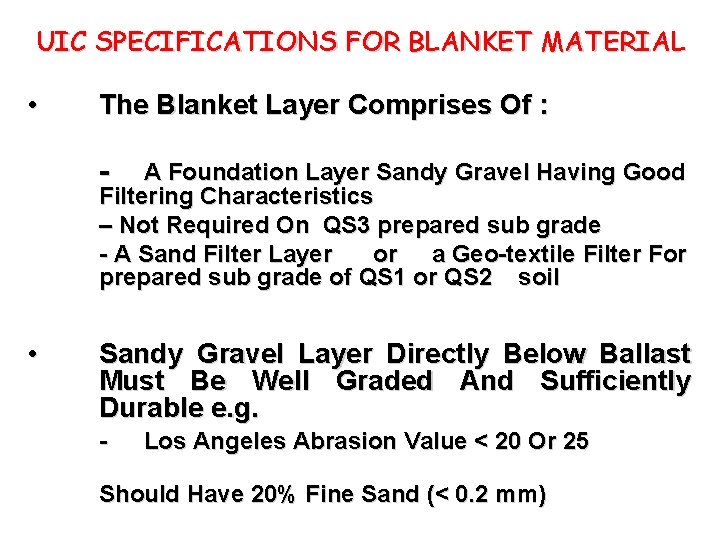
UIC SPECIFICATIONS FOR BLANKET MATERIAL • The Blanket Layer Comprises Of : - A Foundation Layer Sandy Gravel Having Good Filtering Characteristics – Not Required On QS 3 prepared sub grade - A Sand Filter Layer or a Geo-textile Filter For prepared sub grade of QS 1 or QS 2 soil • Sandy Gravel Layer Directly Below Ballast Must Be Well Graded And Sufficiently Durable e. g. - Los Angeles Abrasion Value < 20 Or 25 Should Have 20% Fine Sand (< 0. 2 mm)
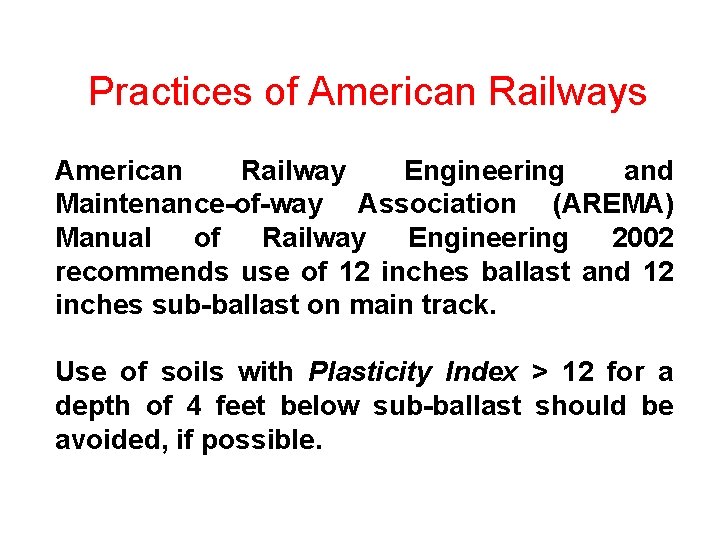
Practices of American Railways American Railway Engineering and Maintenance-of-way Association (AREMA) Manual of Railway Engineering 2002 recommends use of 12 inches ballast and 12 inches sub-ballast on main track. Use of soils with Plasticity Index > 12 for a depth of 4 feet below sub-ballast should be avoided, if possible.
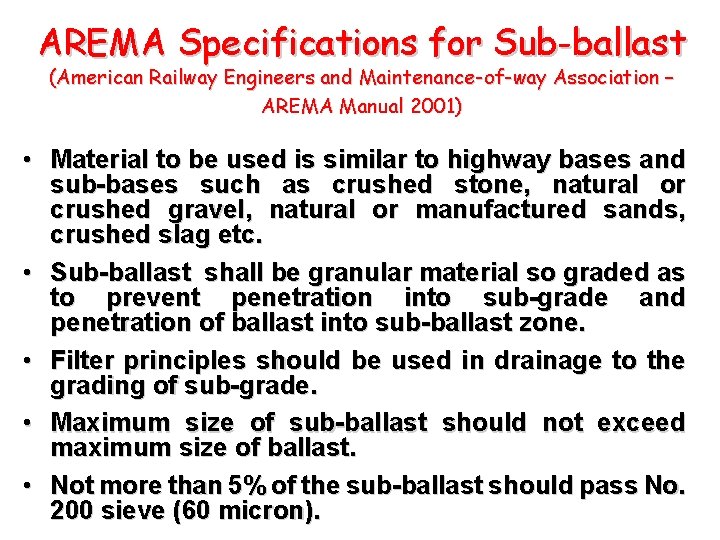
AREMA Specifications for Sub-ballast (American Railway Engineers and Maintenance-of-way Association – AREMA Manual 2001) • Material to be used is similar to highway bases and sub-bases such as crushed stone, natural or crushed gravel, natural or manufactured sands, crushed slag etc. • Sub-ballast shall be granular material so graded as to prevent penetration into sub-grade and penetration of ballast into sub-ballast zone. • Filter principles should be used in drainage to the grading of sub-grade. • Maximum size of sub-ballast should not exceed maximum size of ballast. • Not more than 5% of the sub-ballast should pass No. 200 sieve (60 micron).
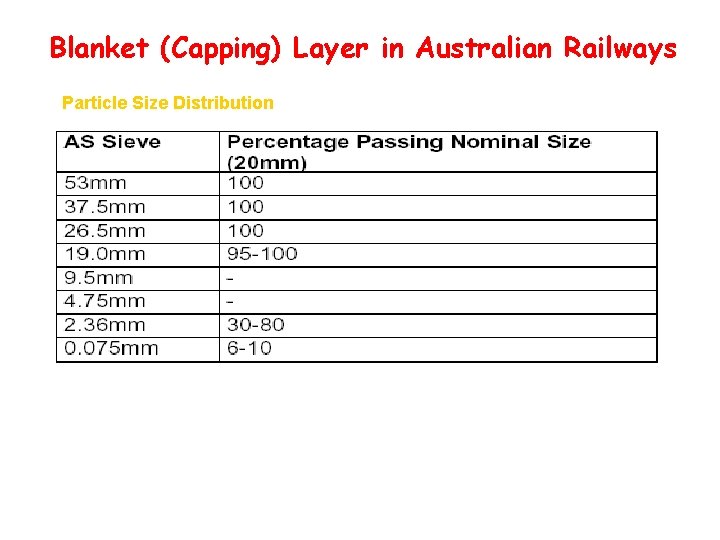
Blanket (Capping) Layer in Australian Railways
Blanket (Capping) Layer in Australian Railways Particle Size Distribution Atterberg Limits Liquid Limit : Maximum 30 (35 for arid areas) Plastic Limit : Maximum 20 Plasticity Index : 2 - 10 (2 - 15 for arid areas) Linear Shrinkage : Maximum 3% Maximum Dry Density : Minimum 2. 0 t/cum Soaked CBR : Minimum 50 on material compacted to 95% (min. ) Maximum Dry Density
Case study for Blending of Blanket Material NHAI project site between Sultanpur-Utratia Bye Pass Road, near Lucknow was visited in the month of June 2005 in connection with production of blanket by blending. Details are as follows: (i) Name of work executing agency: (ii) Location: Atlanta, Mumbai Amar Saheed Path, Lucknow
(iii) Makes of blender: Gujrat Appolo Equipment Ahemdabad (iv) Plant capacity: 160 ton per hour (v) Approximate cost: 50 lakhs (vi) Number of persons for operating the plant: 7 vii) Alternative Power supply: Can be operated by 125 KVA Genarator viii Number of bins: Four (ix) Salient features: Four bins, pug mills, wet mix computerized blender
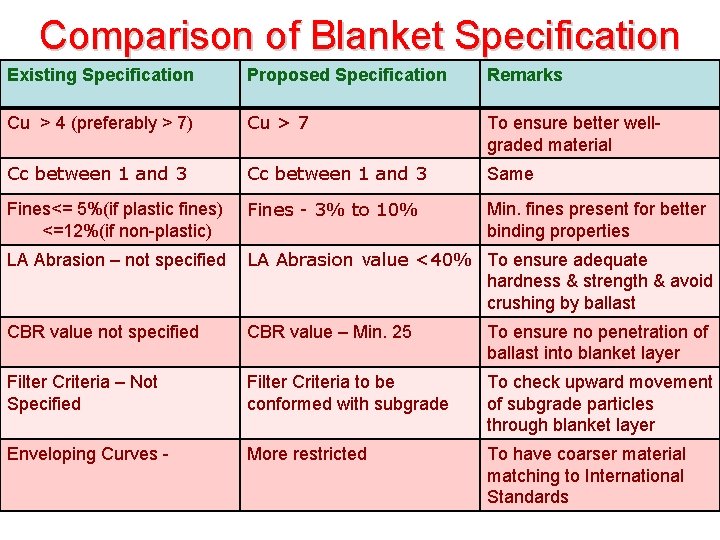
Comparison of Blanket Specification Existing Specification Proposed Specification Remarks Cu > 4 (preferably > 7) Cu > 7 To ensure better wellgraded material Cc between 1 and 3 Same Fines<= 5%(if plastic fines) <=12%(if non-plastic) Fines - 3% to 10% Min. fines present for better binding properties LA Abrasion – not specified LA Abrasion value <40% To ensure adequate hardness & strength & avoid crushing by ballast CBR value not specified CBR value – Min. 25 To ensure no penetration of ballast into blanket layer Filter Criteria – Not Specified Filter Criteria to be conformed with subgrade To check upward movement of subgrade particles through blanket layer Enveloping Curves - More restricted To have coarser material matching to International Standards
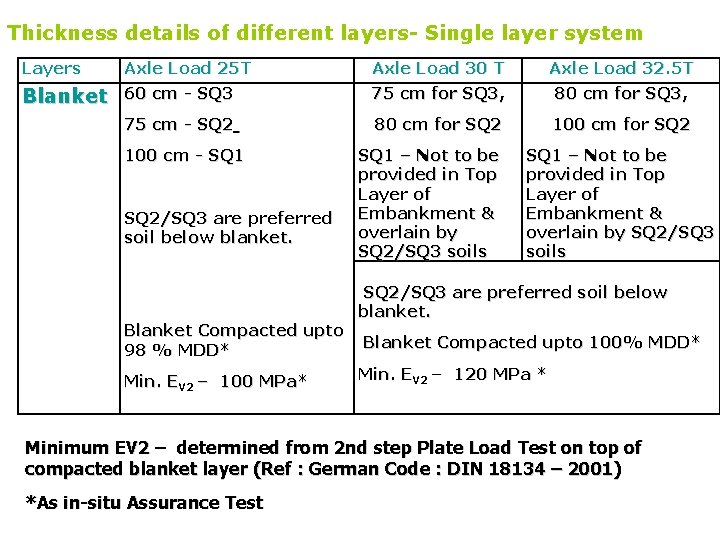
Thickness details of different layers- Single layer system Layers Axle Load 25 T Axle Load 30 T Axle Load 32. 5 T Blanket 60 cm - SQ 3 75 cm for SQ 3, 80 cm for SQ 3, 75 cm - SQ 2 80 cm for SQ 2 100 cm - SQ 1 SQ 2/SQ 3 are preferred soil below blanket. Blanket Compacted upto 98 % MDD* Min. EV 2 – 100 MPa* SQ 1 – Not to be provided in Top Layer of Embankment & overlain by SQ 2/SQ 3 soils SQ 2/SQ 3 are preferred soil below blanket. Blanket Compacted upto 100% MDD* Min. EV 2 – 120 MPa * Minimum EV 2 – determined from 2 nd step Plate Load Test on top of compacted blanket layer (Ref : German Code : DIN 18134 – 2001) *As in-situ Assurance Test
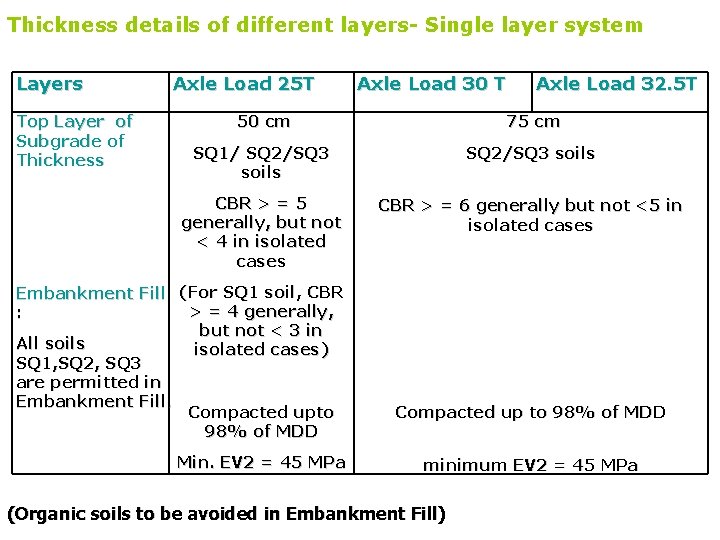
Thickness details of different layers- Single layer system Layers Top Layer of Subgrade of Thickness Axle Load 25 T Axle Load 30 T Axle Load 32. 5 T 50 cm 75 cm SQ 1/ SQ 2/SQ 3 soils CBR > = 5 generally, but not < 4 in isolated cases CBR > = 6 generally but not <5 in isolated cases Embankment Fill (For SQ 1 soil, CBR > = 4 generally, : but not < 3 in All soils isolated cases) SQ 1, SQ 2, SQ 3 are permitted in Embankment Fill. Compacted upto 98% of MDD Min. EV 2 = 45 MPa Compacted up to 98% of MDD minimum EV 2 = 45 MPa (Organic soils to be avoided in Embankment Fill)
Typical Embankment X-section for Single Layer System (Blanket on Embankment Fill)
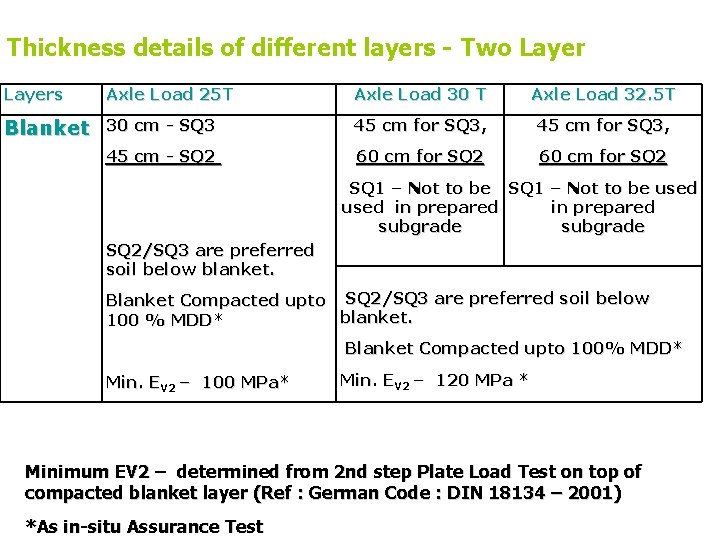
Thickness details of different layers - Two Layers Axle Load 25 T Axle Load 30 T Axle Load 32. 5 T Blanket 30 cm - SQ 3 45 cm for SQ 3, 45 cm - SQ 2 60 cm for SQ 2 SQ 1 – Not to be used in prepared subgrade SQ 2/SQ 3 are preferred soil below blanket. Blanket Compacted upto SQ 2/SQ 3 are preferred soil below blanket. 100 % MDD* Blanket Compacted upto 100% MDD* Min. EV 2 – 100 MPa* Min. EV 2 – 120 MPa * Minimum EV 2 – determined from 2 nd step Plate Load Test on top of compacted blanket layer (Ref : German Code : DIN 18134 – 2001) *As in-situ Assurance Test
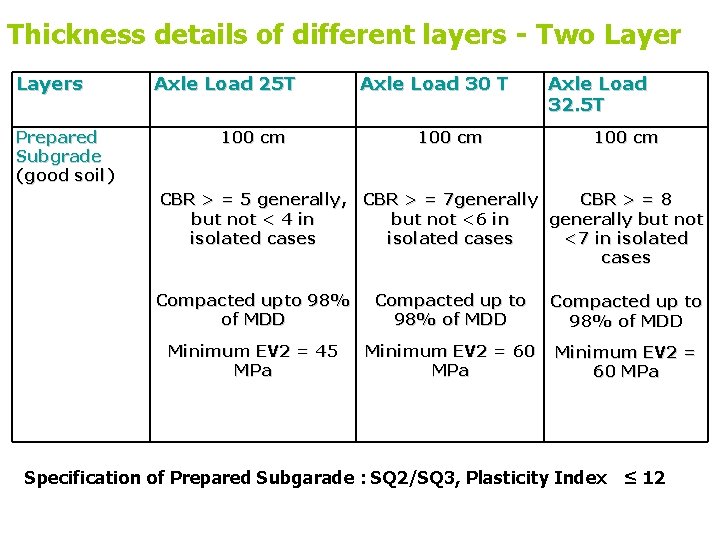
Thickness details of different layers - Two Layers Prepared Subgrade (good soil) Axle Load 25 T 100 cm Axle Load 30 T 100 cm Axle Load 32. 5 T 100 cm CBR > = 5 generally, CBR > = 7 generally CBR > = 8 but not < 4 in but not <6 in generally but not isolated cases <7 in isolated cases Compacted upto 98% of MDD Compacted up to 98% of MDD Minimum EV 2 = 45 MPa Minimum EV 2 = 60 MPa Specification of Prepared Subgarade : SQ 2/SQ 3, Plasticity Index ≤ 12
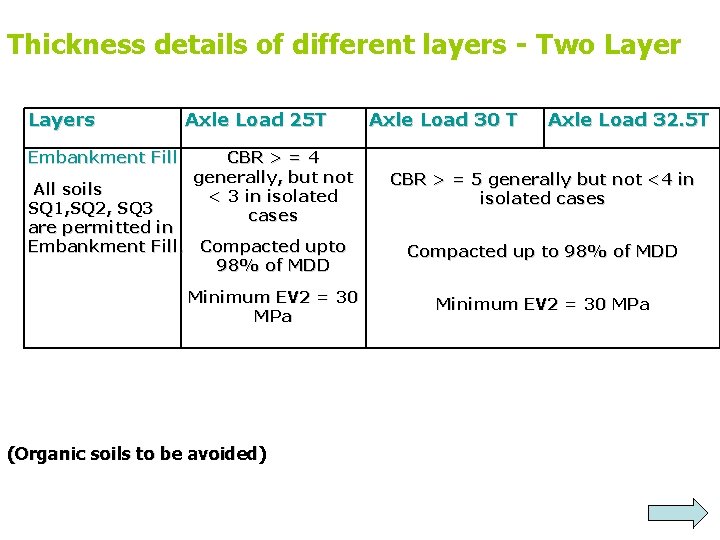
Thickness details of different layers - Two Layers Embankment Fill Axle Load 25 T CBR > = 4 generally, but not < 3 in isolated cases All soils SQ 1, SQ 2, SQ 3 are permitted in Embankment Fill. Compacted upto 98% of MDD Minimum EV 2 = 30 MPa (Organic soils to be avoided) Axle Load 30 T Axle Load 32. 5 T CBR > = 5 generally but not <4 in isolated cases Compacted up to 98% of MDD Minimum EV 2 = 30 MPa
Typical Embankment X-section for Two Layer System (Blanket + Prepared Subgrade on Embankment Fill)
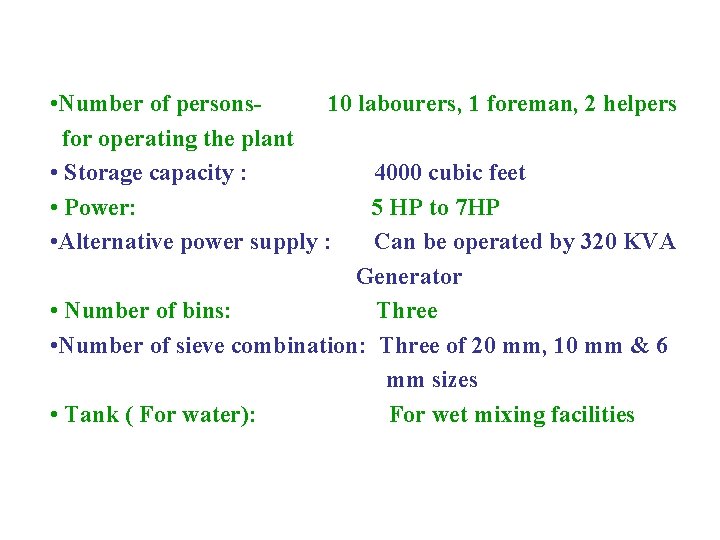
• Number of persons 10 labourers, 1 foreman, 2 helpers for operating the plant • Storage capacity : 4000 cubic feet • Power: 5 HP to 7 HP • Alternative power supply : Can be operated by 320 KVA Generator • Number of bins: Three • Number of sieve combination: Three of 20 mm, 10 mm & 6 mm sizes • Tank ( For water): For wet mixing facilities
Field Trials of Proposed Formation Specifications • Railway Board has Ordered for conducting Field Trials of the recommended Formation Specifications to study the implications of introduction of new specifications and quality assurance tests • Trial sites have been selected – * Udhana – Jalgaon doubling project, WR * Bina – Bhopal 3 rd Line, executed by RVNL
Review Committee • Railway Board nominated committee of CAO/C of WR, SR, NCR, Sr. EDGE/RDSO & RVNL to deliberate availability of materials and costs aspects & Formation Specifications for New linew/Doubling/GC for axle loads in range of 22. 5 to 25 t. • Committee recommended : - Three layer system consisting of blanket, crusher run & prepared subgrade over embankment fill is not considered necessary from materials availability & cost considerations. - There will be no difficulty in getting adequate quality soil for construction of formation all over India. - Blanket Specifications are slightly improved over previous one but with lesser requirement in quantity. - Blanket material can produced be mechanically, as done in Highway Organization like NHAI.
Recommendations of Review Committee - Cost of earthwork would vary from region to region but no significant addition in cost of earthwork in formation is envisaged on account of new specifications. - The rate of blanket material will go up primarily due to mechanical production and blending. However, on a holistic view, the increase in cost may not be very significant especially when compared to the additional advantage accrued with such better specification. - Formation Specifications for New Lines/Doubling/GC Works to be carried out on IR, for existing axle loads in the range 22. 5 t to 25 t should be also be kept as same as those for 25 T as per new specifications.
Crushing Methodology • In the event of non-availability of natural source of blanket material, depending on the proximity of project site from the parent rock/boulder sources, it may be decided to crush the rock/boulder in order to produce crushed blanket material. • Crushed blanket material may be produced as sole product or in conjunction with ballast or any other nominal size. • Trials and permutations of feed speed, crushing cycle, sieve combinations may be required to arrive at the required particle size gradation. • It is possible achieve near total produce of desired gradation through production cycle management. Alternately, it may be possible to get by-products of other sizes in the desired proportion and blanket material as main produce or vice-versa. • Optimisation of production rates and costs can be achieved by controlling the output at each sieve stage. • It is ideal to mix the required quantity of water for OMC (accounting for loss/gain of moisture due to weather conditions) at the crusher plant and transport the material in wet condition. •
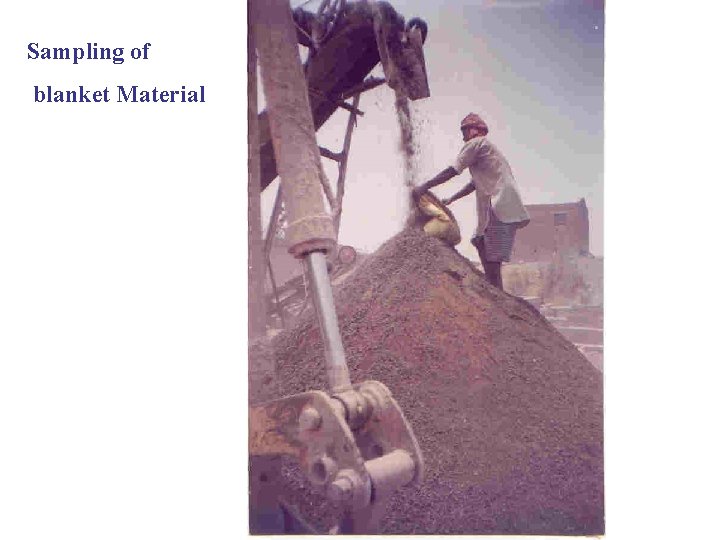
Sampling of blanket Material
Compaction of Blanket Material with Vibratory Roller
Tentative Cost Comparison of Existing GE-1 and new specifications (all 2 alternatives) For working out the cost we have taken actual rate of blanket material & earth fill being used of Section Chandigarh - Morinda (NR) & rates of SQ 3 soil has been assumed bearing in mind the transportation cost aspect. Type of Material Rate of blanket material Rate of SQ 3 Soil Rate of SQ 2 Soil (SM Type) Rate (in Rs. /cum) 948 (Actual) 200 (assumed) 133 (Actual) Analysis has been done for Bank Height of 1. 75 m ( maximum depth of variation in Formation Layers) & double line
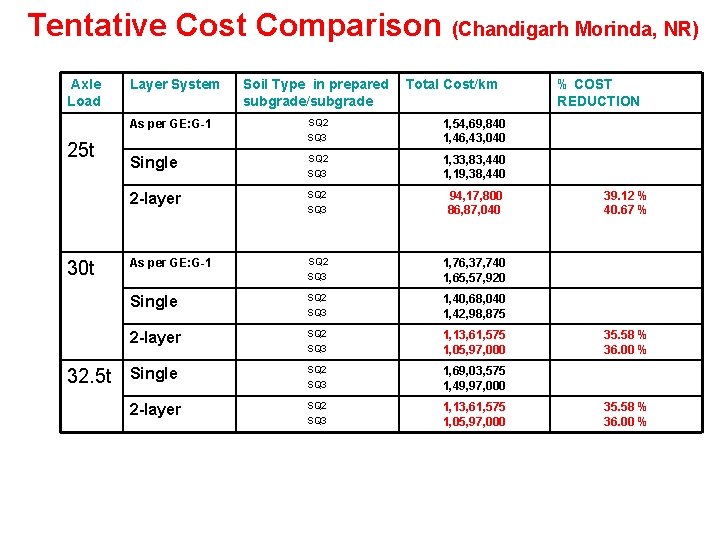
Tentative Cost Comparison (Chandigarh Morinda, NR) Axle Load 25 t 30 t 32. 5 t Layer System Soil Type in prepared subgrade/subgrade Total Cost/km As per GE: G-1 SQ 2 SQ 3 1, 54, 69, 840 1, 46, 43, 040 Single SQ 2 SQ 3 1, 33, 83, 440 1, 19, 38, 440 2 -layer SQ 2 SQ 3 94, 17, 800 86, 87, 040 As per GE: G-1 SQ 2 SQ 3 1, 76, 37, 740 1, 65, 57, 920 Single SQ 2 SQ 3 1, 40, 68, 040 1, 42, 98, 875 2 -layer SQ 2 SQ 3 1, 13, 61, 575 1, 05, 97, 000 Single SQ 2 SQ 3 1, 69, 03, 575 1, 49, 97, 000 2 -layer SQ 2 SQ 3 1, 13, 61, 575 1, 05, 97, 000 % COST REDUCTION 39. 12 % 40. 67 % 35. 58 % 36. 00 %
Tentative Cost Comparison of Existing GE-1 and new specifications (all 2 alternatives) For working out the cost we have taken actual rate of blanket material & earth fill being used of Section Manmadurai Virudhunaagar (SR) & rates of SQ 1 & SQ 3 soil has been assumed bearing in mind the transportation cost aspect. Type of Material Rate of blanket material Rate of SQ 3 Soil Rate of SQ 2 Soil (SC Type) Rate (in Rs. /cum) 825 (Actual) 200 (assumed) 180 (Actual)
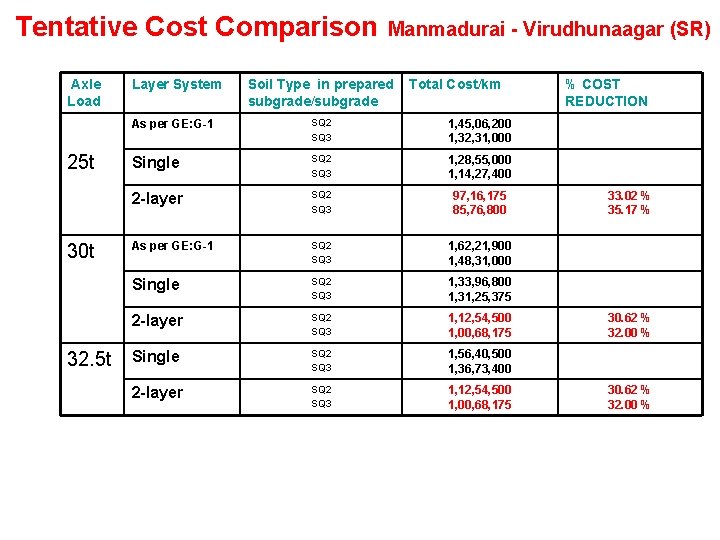
Tentative Cost Comparison Axle Load 25 t Layer System 32. 5 t Soil Type in prepared subgrade/subgrade Total Cost/km As per GE: G-1 SQ 2 SQ 3 1, 45, 06, 200 1, 32, 31, 000 Single SQ 2 SQ 3 1, 28, 55, 000 1, 14, 27, 400 2 -layer SQ 2 SQ 3 97, 16, 175 85, 76, 800 As per GE: G-1 SQ 2 SQ 3 1, 62, 21, 900 1, 48, 31, 000 Single SQ 2 SQ 3 1, 33, 96, 800 1, 31, 25, 375 2 -layer SQ 2 SQ 3 1, 12, 54, 500 1, 00, 68, 175 Single SQ 2 SQ 3 1, 56, 40, 500 1, 36, 73, 400 2 -layer SQ 2 SQ 3 1, 12, 54, 500 1, 00, 68, 175 30 t Manmadurai - Virudhunaagar (SR) % COST REDUCTION 33. 02 % 35. 17 % 30. 62 % 32. 00 %