
NEW DRUGS THEIR DEVELOPMENT AND EVALUATION 1 Sources
- Slides: 23
NEW DRUGS THEIR DEVELOPMENT AND EVALUATION
1. Sources of New Drugs : These include : A. Older Approach : 1. Natural products e. g. plants, microbes, Traditional medicine e. g. herbs 2. Chemical synthesis : which includes a. Chemical modification of structure of known drugs to get new molecules with different activity e. g. sulfonamides were modified to produce thiazide diuretics and oral hypoglycemic sulfonylureas b. Rational drug design based on understanding of molecular structure and biological mechanisms e. g. H 2 -blockers, ACE inhibitors
B. Newer technology : this includes : 1. Molecular modelling aided by 3 -dimensional computer graphics : to allow rational design of new drug structure based on new and known molecules in order to enhance drug selectivity. 2. Biotechnology : This employs gene amplification to produce large amounts of drugs. It includes : DNA recombinant technology: cloning is done by inserting specific genes (that code for either proteins or hormones production) into either : bacteria e. g. E. coli, or yeasts, or mammalian cells e. g. human insulin, human growth hormone, interferons, rt-PA (recombinant tissue plasminogen activator)
2. Characterization of new drug : by determining its chemical, physical, and pharmaceutical properties. 3. Drug screening: a. in-vitro : by receptor binding studies and cellular effects. b. in-vivo : by testing its effect on different body systems and on disease models in animals. This screening defines the pharmacological profile or actions of the drug on different tissues; thus the drug becomes initial LEAD compound. Lead compound is then optimized by analogue synthesis to get better pharmacokinetics and selectivity; thus it is called the candidate lead compound which then proceeds to preclinical toxicity tests in animal. Drug synthesis, characterization, & screening to get candidate lead compound need about 2 years to complete.
4. Preclinical toxicity tests in animals : Usually take about 2 years. The aims of these tests is to identify all potential organs of toxicity & to predict the most relevant toxicity to be monitored in man in clinical studies. These tests include : A. Acute toxicity tests : - several large doses are used, some of them in toxic range, in order to determine the type of toxic effects and also the number of deaths seen in animals over hours or days (up to 2 weeks).
- usually 2 species of animals (rats, hamsters, rabbits, dogs, guinea pigs) are used. Animals are divided into several groups; one dose of candidate drug is given to each group; two routes of administration are employed for each dose of drug (one of the routes being expected route of use in man). Quantitative estimates of acute toxicity : 1. maximum tolerated dose(“no-effect dose”): this is maximum dose at which no toxic effect occurs. 2. minimal lethal dose : this is minimal toxic dose to cause death. 3. median lethal dose LD 50 , & TI.
These doses are used to calculate the initial dose for use in future clinical studies in man; usually 1/10 to 1/100 of no-effect dose is used. B. Subacute toxicity tests : Usually 3 doses in effective dose range are employed in 2 species of animals (one rodent and the other is non-rodent). For each group of animals, dose is repeated daily for 1 - 3 months, depending on duration of use in man. At end of this period : Physiological tests, clinical chemistry, hematology tests are done, and autopsy with histopathology of different tissues is done.
C. Chronic toxicity tests : - these need 6 months to 2 years of daily exposure to drug. 2 species(rodent and non-rodent) & 3 doses in effective range are used. They are needed when drug is intended for prolonged clinical use in man. The aim of subacute and chronic toxicity tests is to show which tissues or organs are susceptible to drug toxicity with continued use. Acute & subacute toxicity tests must be completed before clinical studies in man, but chronic toxicity tests may accompany clinical trials of the drug.
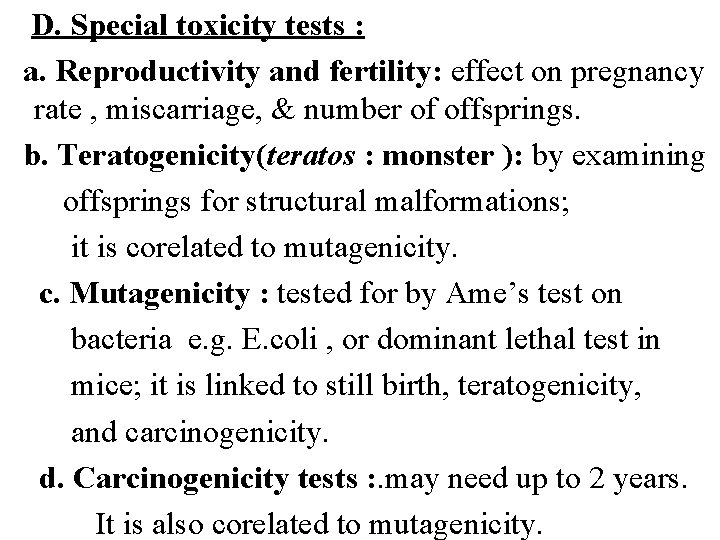
D. Special toxicity tests : a. Reproductivity and fertility: effect on pregnancy rate , miscarriage, & number of offsprings. b. Teratogenicity(teratos : monster ): by examining offsprings for structural malformations; it is corelated to mutagenicity. c. Mutagenicity : tested for by Ame’s test on bacteria e. g. E. coli , or dominant lethal test in mice; it is linked to still birth, teratogenicity, and carcinogenicity. d. Carcinogenicity tests : . may need up to 2 years. It is also corelated to mutagenicity.
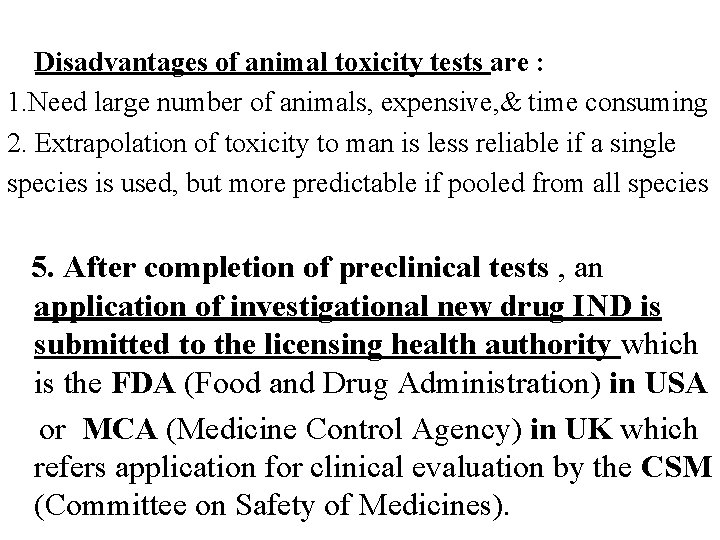
Disadvantages of animal toxicity tests are : 1. Need large number of animals, expensive, & time consuming 2. Extrapolation of toxicity to man is less reliable if a single species is used, but more predictable if pooled from all species 5. After completion of preclinical tests , an application of investigational new drug IND is submitted to the licensing health authority which is the FDA (Food and Drug Administration) in USA or MCA (Medicine Control Agency) in UK which refers application for clinical evaluation by the CSM (Committee on Safety of Medicines).
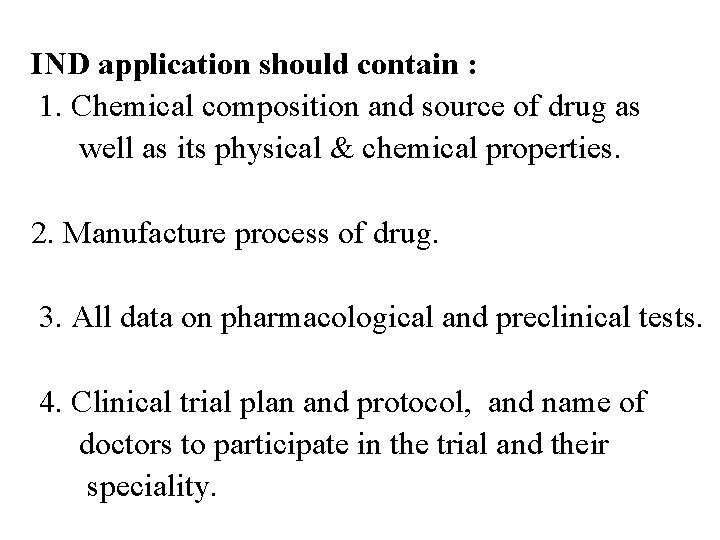
IND application should contain : 1. Chemical composition and source of drug as well as its physical & chemical properties. 2. Manufacture process of drug. 3. All data on pharmacological and preclinical tests. 4. Clinical trial plan and protocol, and name of doctors to participate in the trial and their speciality.
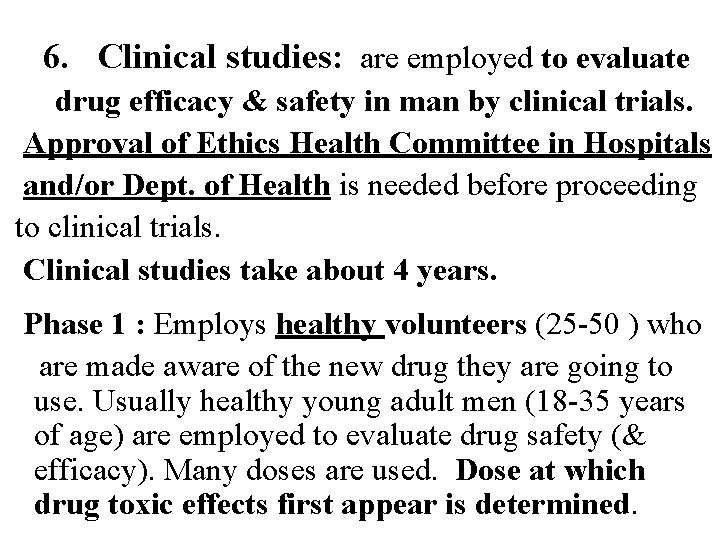
6. Clinical studies: are employed to evaluate drug efficacy & safety in man by clinical trials. Approval of Ethics Health Committee in Hospitals and/or Dept. of Health is needed before proceeding to clinical trials. Clinical studies take about 4 years. Phase 1 : Employs healthy volunteers (25 -50 ) who are made aware of the new drug they are going to use. Usually healthy young adult men (18 -35 years of age) are employed to evaluate drug safety (& efficacy). Many doses are used. Dose at which drug toxic effects first appear is determined.
Phase 1 is waived ( or patient volunteers used) in case of very toxic drugs e. g. anticancer drugs. Pharmacokinetic parameters are determined in phase 1. Evaluation is done by trained clinical pharmacologists. Phase 2: Study on small group of patients (100 -200) suffering from the target disease. It is done in special clinical centers( e. g. University hospitals). Data on efficacy in patients , effective dose range, & safety (wide range of toxic effects) are obtained. Single blind trial design, placebo, & positive control are used but are not rigid requirement to eliminate bias.
Phase 3 : Formal controlled clinical trial on large number of patients ( > 1500 ) to obtain statistical evidence of efficacy and safety. It is a carefully & ethically designed experiment that aims to answer specific question(s) about a treatment. It requires: 1. Equivalent groups of patients: constructed by random allocation or table of random numbers. 2. These groups are treated concurrently and in parallel with different treatments (new drug, placebo, standard treatment as positive control); trial design is double-blind. 3. The effect is recorded objectively by specialists in the field of the disease & result evaluated statistically for significance
Attention is paid to confounding factors that may affect evaluation and produce bias. These factors are : 1. Other diseases or drugs or social habits : these are excluded e. g. patients with renal failure, alcohol abuse, pregnancy, children, & interacting drugs. 2. Variable course of disease : many diseases wax and wane in their course; this bias is eliminated by cross-over trial design employing large enough number of patients over a sufficient period of time when the disease is still active.
In this cross-over trial, patients are divided into 3 groups to receive new drug, placebo, & standard drug treatment, respectively; each group will receive serially all treatments for one week, with another week being allowed for drug washout from body before next drug treatment is given. 3. Subject (patient) & observer evaluation bias : Subject or patient bias is reduced by use of placebo (Latin word: I shall please) or dummy , and cross-over trial design while observer bias during evaluation of response is prevented by double-blind design of trial.
Placebo : it is an inert substance e. g. starch or lactose that is made to look identical to the dose form of new drug regarding shape, colour, texture, size, &weight. It is used as negative control to eliminate bias due to influence of psychological effect of taking new medication on drug effect. Placebo reactor : some patients ( 20 -40%) might give to some extent a subjective or objective response to placebo treatment. It implies that suggestion may induce a patient response that might affect drug therapeutic action.
In double blind trial design, neither the observing doctor or patient know about nature of drug treatment given to different groups of patients; the code is available at third party (e. g. hospital administrator or chief nurse, or stored in computer ). Decoding is done after completing the data collection at end of trial. Role of statistician : 1. Protect against bias : due to errors of allocation or errors of assessment (evaluation). 2. Increased efficiency of the trial by deciding on minimum number of patients needed to provide the relevant information. This sample size is influenced by variation in data as determined from earlier trials.
3. Using appropriate statistical analysis of data so as to avoid Type 1 error(rejecting incorrectly the null hypothesis) or type 2 error(accepting incorrectly the null hypothesis). Ethics of trial ( must fulfil Declaration of Helsinki on ethics of clinical research in 1966): 1. The aim and method of clinical trial is explained simply and clearly to patients. Patient written consent for inclusion in trial must be obtained. However, during trial, patient must be agnostic about drug he is receiving. 2. Retaining right for doctor to withdraw patient out of trial, if needed; and all drug treatments are known as far as possible to be harmless to patients.
7. If the drug was found sufficiently effective and safe in clinical studies , then New Drug Application (NDA) is submitted to FDA by the drug owner (usually a pharmaceutical company). This NDA contains all preclinical and clinical data on drug evaluation, & the proposed indication for drug use. Revision of NDA is done by licensing health authority FDA; it may take 3 years ( or longer up to 5 years) in order to grant approval & license for drug marketing in the community by owner.
In case of urgent need (e. g. cancer chemotherapy) , the process of preclinical and clinical testing and FDA review may be accelarated. For serious diseases, the FDA may permit controlled marketing of new drug before phase 3 clinical studies are completed. For life-threatening diseases, FDA may permit controlled marketing even before completing phase 2 clinical study.
8. Postmarketing surveillance (Pharmacovigilance) : also called phase 4 clinical study. It is done after release of drug for use by community , thus large number of people are exposed to drug for long time. Usually it takes up to 8 years , but there is no fixed time limit for it according to the need. It is aimed at detecting rare or unusual adverse effects that are usually missed during the formal clinical trial. Early reporting of such drug adverse effects is important in order to prevent drug disasters in community e. g. thalidomide.
9. After expiry of the patent (usually no more than 14 years after being given license for drug marketing) , other pharmaceutical companies have the right to synthesize and market the drug without paying any fees to the owner pharmaceuical company; thus other trade names (“generics”) become available. However , the proprietory trade name first given by the owner pharmaceutical company remains protected.