
New Directions in Detector Development at MIT Lincoln
![SQUID Preamplifiers for Ricochet Experiment Nuclear monitoring concept [1] Images of fabricated readout chips](https://slidetodoc.com/presentation_image_h2/db477babb277d51743642c3823e8043a/image-14.jpg "SQUID Preamplifiers for Ricochet Experiment Nuclear monitoring concept [1] Images of fabricated readout chips")
- Slides: 15
New Directions in Detector Development at MIT Lincoln Laboratory Christopher Leitz christopher. leitz@ll. mit. edu 9 November 2019
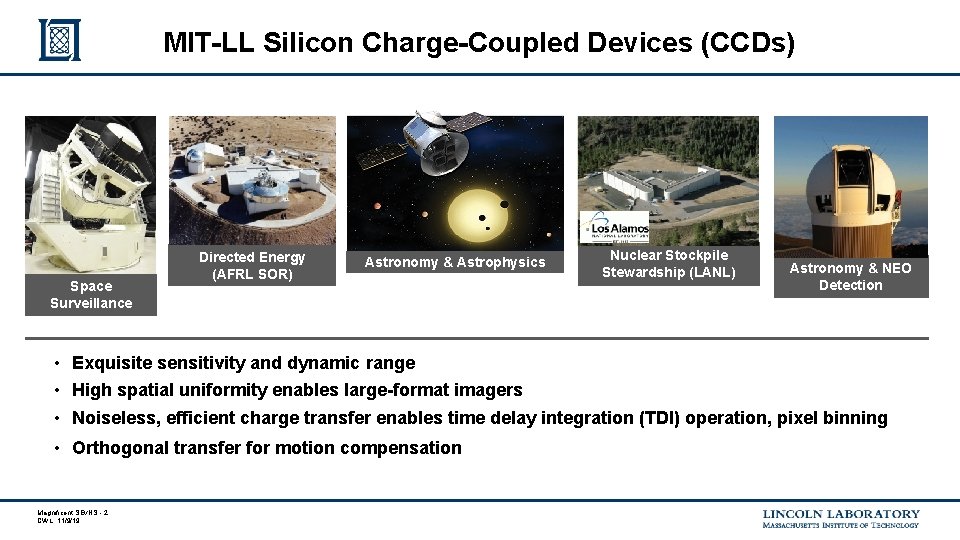
MIT-LL Silicon Charge-Coupled Devices (CCDs) Space Surveillance Directed Energy (AFRL SOR) Astronomy & Astrophysics Nuclear Stockpile Stewardship (LANL) Astronomy & NEO Detection • Exquisite sensitivity and dynamic range • High spatial uniformity enables large-format imagers • Noiseless, efficient charge transfer enables time delay integration (TDI) operation, pixel binning • Orthogonal transfer for motion compensation Magnificent SEνNS - 2 CWL 11/9/19
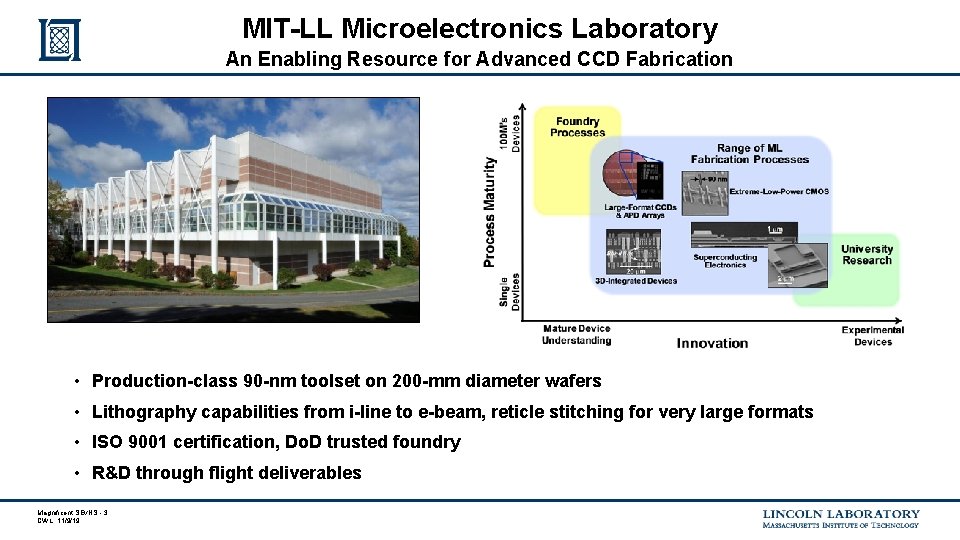
MIT-LL Microelectronics Laboratory An Enabling Resource for Advanced CCD Fabrication • Production-class 90 -nm toolset on 200 -mm diameter wafers • Lithography capabilities from i-line to e-beam, reticle stitching for very large formats • ISO 9001 certification, Do. D trusted foundry • R&D through flight deliverables Magnificent SEνNS - 3 CWL 11/9/19
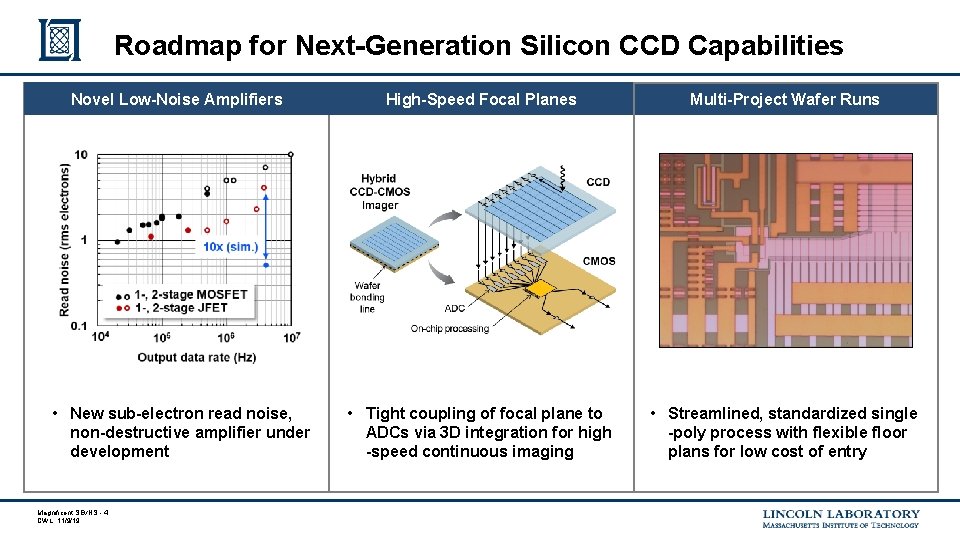
Roadmap for Next-Generation Silicon CCD Capabilities Novel Low-Noise Amplifiers High-Speed Focal Planes Multi-Project Wafer Runs • New sub-electron read noise, non-destructive amplifier under development • Tight coupling of focal plane to ADCs via 3 D integration for high -speed continuous imaging • Streamlined, standardized single -poly process with flexible floor plans for low cost of entry Magnificent SEνNS - 4 CWL 11/9/19
Outline • Background • Germanium image sensors • Superconducting detectors Magnificent SEνNS - 5 CWL 11/9/19
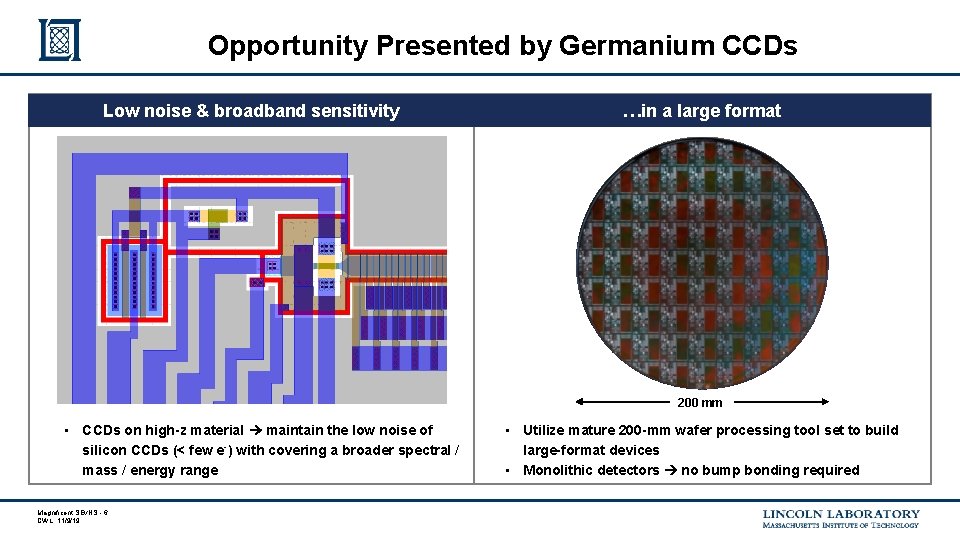
Opportunity Presented by Germanium CCDs Low noise & broadband sensitivity …in a large format 200 mm • CCDs on high-z material maintain the low noise of silicon CCDs (< few e-) with covering a broader spectral / mass / energy range Magnificent SEνNS - 6 CWL 11/9/19 • Utilize mature 200 -mm wafer processing tool set to build large-format devices • Monolithic detectors no bump bonding required
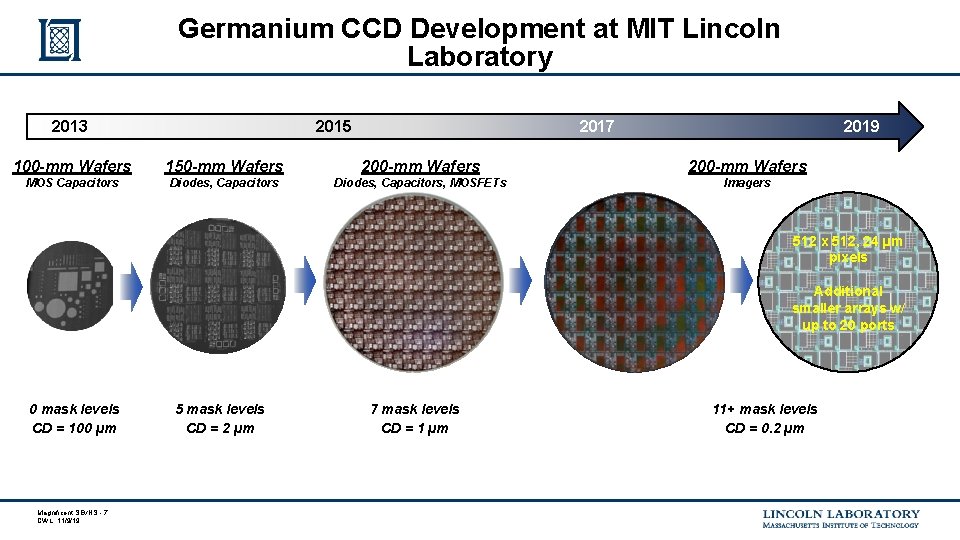
Germanium CCD Development at MIT Lincoln Laboratory 2015 2013 2019 2017 100 -mm Wafers 150 -mm Wafers 200 -mm Wafers MOS Capacitors Diodes, Capacitors, MOSFETs Imagers 512 x 512, 24 µm pixels Additional smaller arrays w/ up to 20 ports 0 mask levels CD = 100 µm Magnificent SEνNS - 7 CWL 11/9/19 5 mask levels CD = 2 µm 7 mask levels CD = 1 µm 11+ mask levels CD = 0. 2 µm
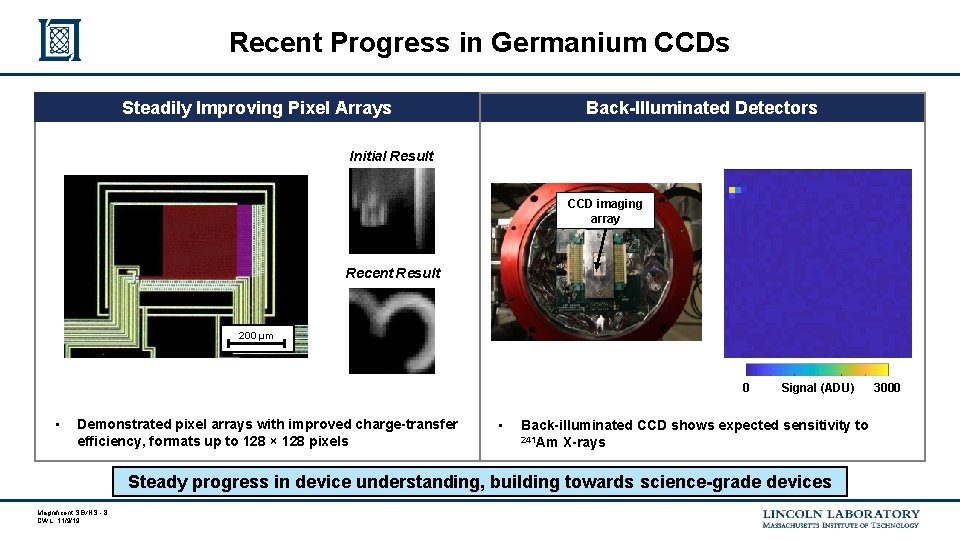
Recent Progress in Germanium CCDs Steadily Improving Pixel Arrays Back-Illuminated Detectors Initial Result CCD imaging array Recent Result 200 µm 0 • Demonstrated pixel arrays with improved charge-transfer efficiency, formats up to 128 × 128 pixels • Signal (ADU) Back-illuminated CCD shows expected sensitivity to 241 Am X-rays Steady progress in device understanding, building towards science-grade devices Magnificent SEνNS - 8 CWL 11/9/19 3000
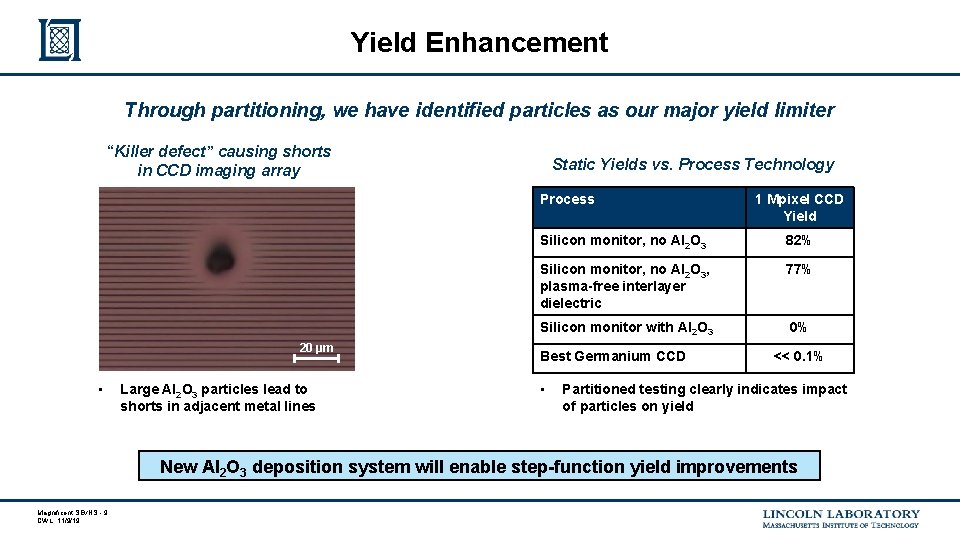
Yield Enhancement Through partitioning, we have identified particles as our major yield limiter “Killer defect” causing shorts in CCD imaging array Static Yields vs. Process Technology Process 20 µm • Large Al 2 O 3 particles lead to shorts in adjacent metal lines 1 Mpixel CCD Yield Silicon monitor, no Al 2 O 3 82% Silicon monitor, no Al 2 O 3, plasma-free interlayer dielectric 77% Silicon monitor with Al 2 O 3 0% Best Germanium CCD • << 0. 1% Partitioned testing clearly indicates impact of particles on yield New Al 2 O 3 deposition system will enable step-function yield improvements Magnificent SEνNS - 9 CWL 11/9/19
Outline • Background • Germanium image sensors • Superconducting detectors Magnificent SEνNS - 10 CWL 11/9/19
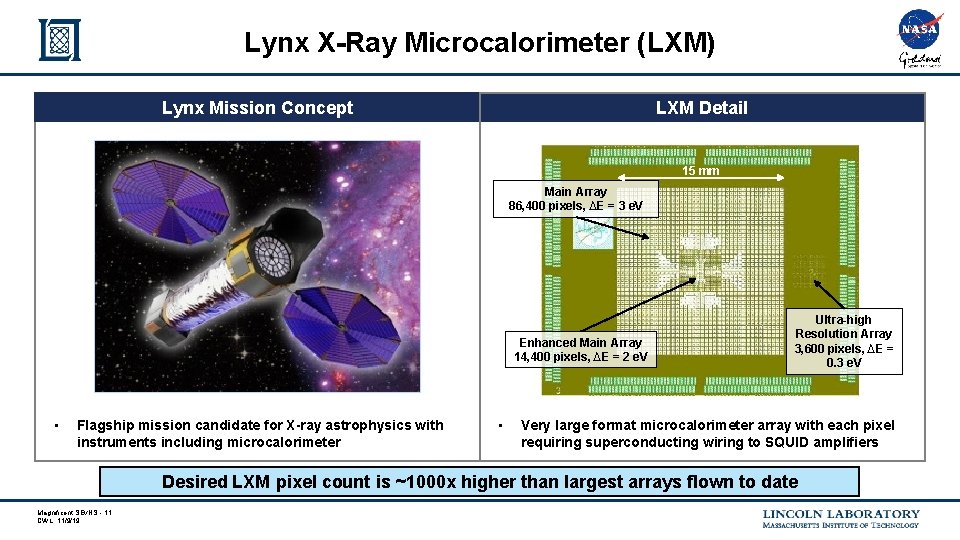
Lynx X-Ray Microcalorimeter (LXM) Lynx Mission Concept LXM Detail 15 mm Main Array 86, 400 pixels, ∆E = 3 e. V Enhanced Main Array 14, 400 pixels, ∆E = 2 e. V • Flagship mission candidate for X-ray astrophysics with instruments including microcalorimeter • Ultra-high Resolution Array 3, 600 pixels, ∆E = 0. 3 e. V Very large format microcalorimeter array with each pixel requiring superconducting wiring to SQUID amplifiers Desired LXM pixel count is ~1000 x higher than largest arrays flown to date Magnificent SEνNS - 11 CWL 11/9/19
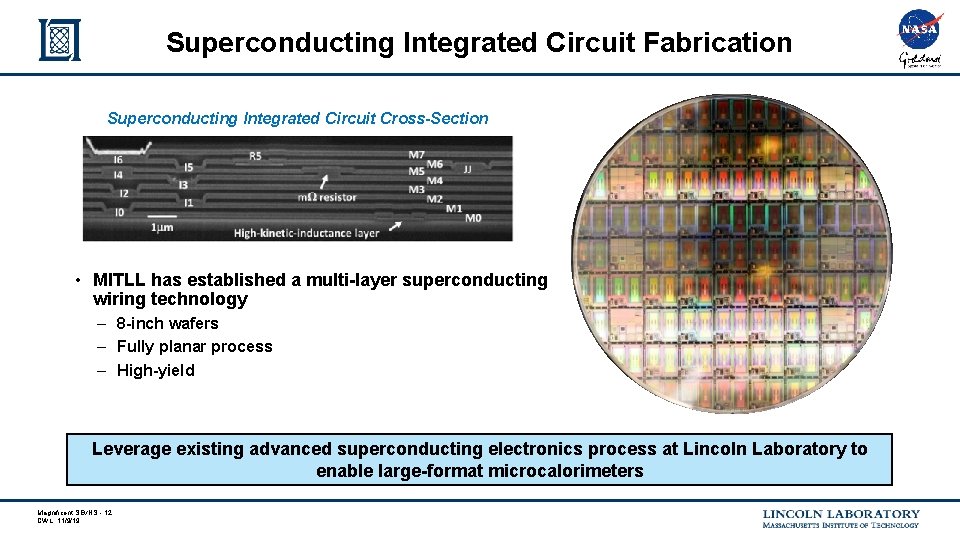
Superconducting Integrated Circuit Fabrication Superconducting Integrated Circuit Cross-Section • MITLL has established a multi-layer superconducting wiring technology – 8 -inch wafers – Fully planar process – High-yield Leverage existing advanced superconducting electronics process at Lincoln Laboratory to enable large-format microcalorimeters Magnificent SEνNS - 12 CWL 11/9/19
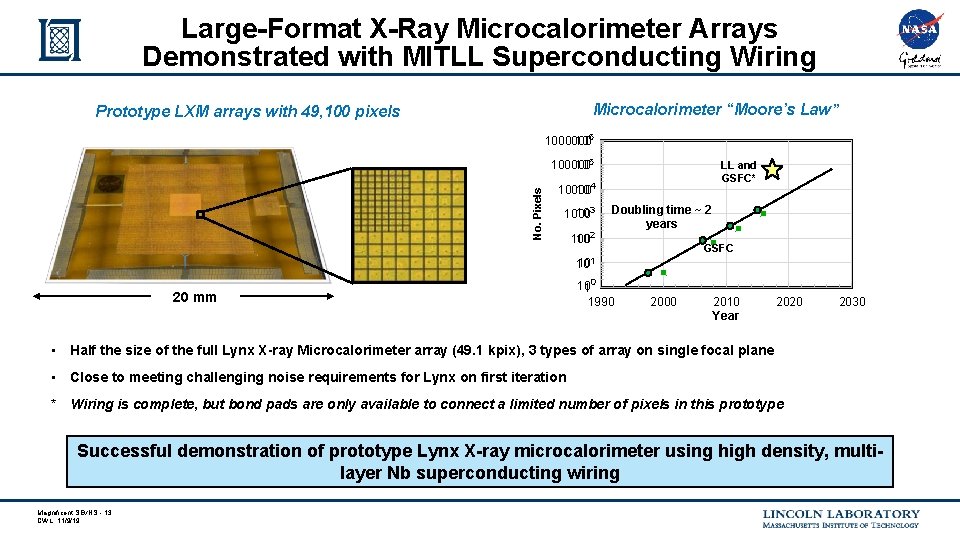
Large-Format X-Ray Microcalorimeter Arrays Demonstrated with MITLL Superconducting Wiring Microcalorimeter “Moore’s Law” Prototype LXM arrays with 49, 100 pixels 1000000 106 No. Pixels 100000 105 LL and GSFC* 10000 104 103 1000 102 Doubling time ~ 2 years GSFC 101 10 20 mm 0 10 1 1990 2000 2010 Year 2020 2030 • Half the size of the full Lynx X-ray Microcalorimeter array (49. 1 kpix), 3 types of array on single focal plane • Close to meeting challenging noise requirements for Lynx on first iteration * Wiring is complete, but bond pads are only available to connect a limited number of pixels in this prototype Successful demonstration of prototype Lynx X-ray microcalorimeter using high density, multilayer Nb superconducting wiring Magnificent SEνNS - 13 CWL 11/9/19
SQUID Preamplifiers for Ricochet Experiment Nuclear monitoring concept [1] Images of fabricated readout chips • Ricochet experiment: PI Joseph Formaggio (MIT); goal is to detect neutrinos emitted from a nuclear reactor using coherent elastic neutrino-nucleus scattering • Prototype detector uses a transition edge sensor (30 g Zn absorber) and SQUID preamplifiers, the latter fabricated at MITLL For more details, see Steve Weber’s talk Monday at 11: 30 Magnificent SEνNS - 14 CWL 11/9/19 [1] Carr, R. , et al. , “Neutrino-Based Tools for Nuclear Verification and Diplomacy in North Korea, ” Science & Global Security 27(1) (2019) 15.
Summary • MITLL seeks to continue to improve the capabilities of CCDs through development of low-noise and high-speed readouts, fabricated in a streamlined single-poly process • We are also maturing germanium CCDs to exploit the unique properties of this material for low-noise detectors • We have begun to leverage our mature superconducting electronics fabrication processes to fabricate microcalorimeters for scientific and national security applications Magnificent SEνNS - 15 CWL 11/9/19