
New Developments in The Community Multiscale Air Quality
- Slides: 15
New Developments in The Community Multiscale Air Quality (CMAQ) Model • • • Jonathan Pleim, Shawn Roselle, Jeffrey Young, Gerald Gipson, Prakash Bhave, Rohit Mathur USEPA/ORD NOAA/ARL Research Triangle Park, NC Although this work was reviewed by EPA and approved for publication, it may not necessarily reflect official Agency policy
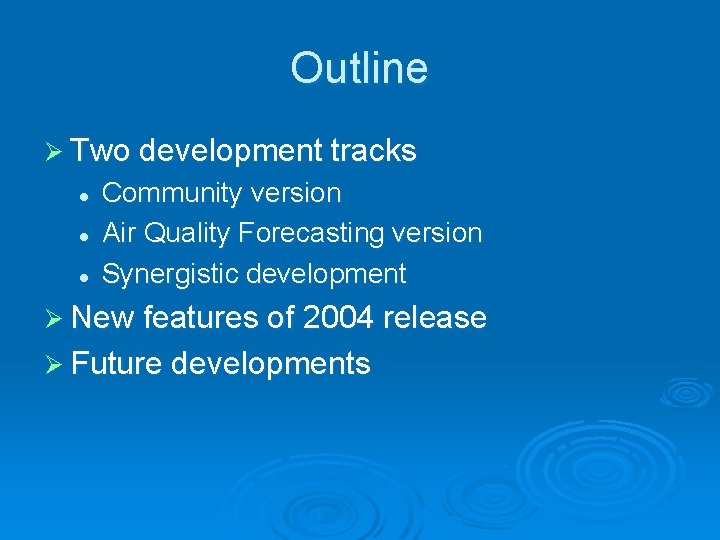
Outline Ø Two development tracks l l l Community version Air Quality Forecasting version Synergistic development Ø New features of 2004 release Ø Future developments
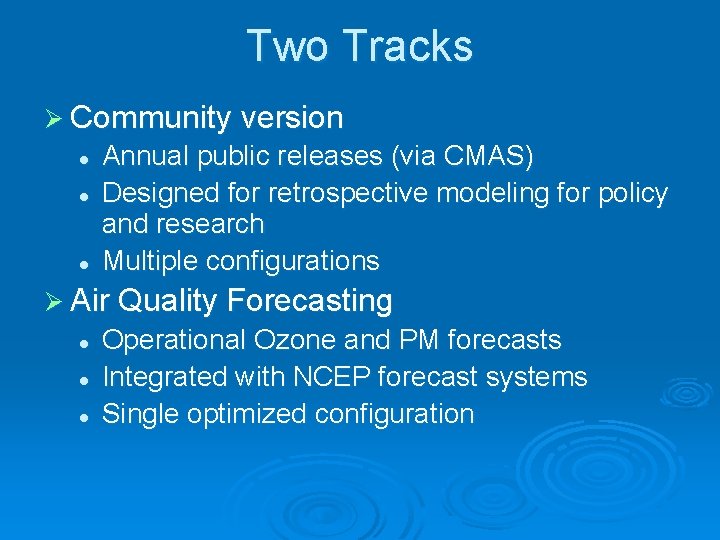
Two Tracks Ø Community version l l l Annual public releases (via CMAS) Designed for retrospective modeling for policy and research Multiple configurations Ø Air Quality Forecasting l l l Operational Ozone and PM forecasts Integrated with NCEP forecast systems Single optimized configuration
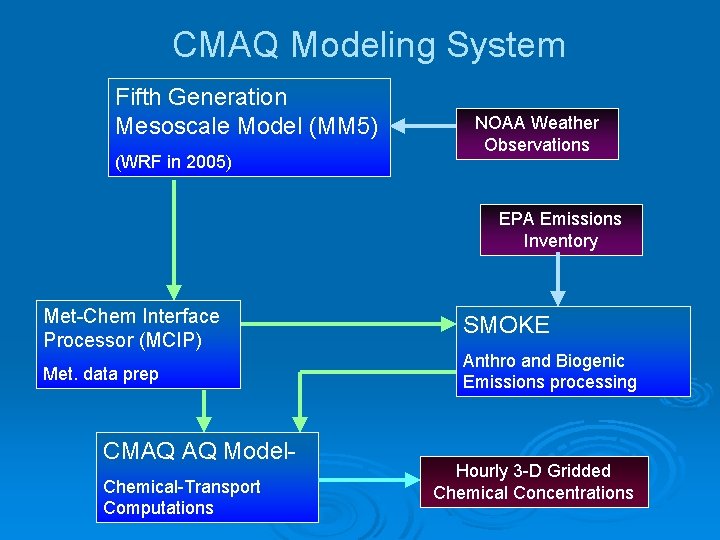
CMAQ Modeling System Fifth Generation Mesoscale Model (MM 5) (WRF in 2005) NOAA Weather Observations EPA Emissions Inventory Met-Chem Interface Processor (MCIP) Met. data prep CMAQ AQ Model. Chemical-Transport Computations SMOKE Anthro and Biogenic Emissions processing Hourly 3 -D Gridded Chemical Concentrations
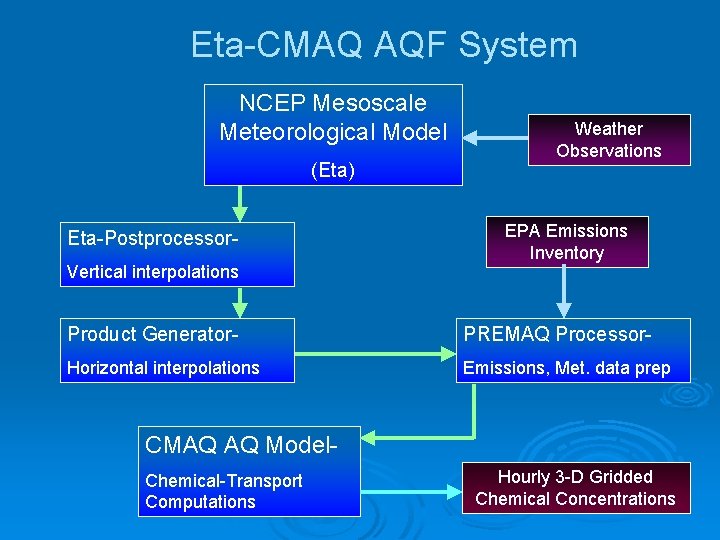
Eta-CMAQ AQF System NCEP Mesoscale Meteorological Model (Eta) Eta-Postprocessor. Vertical interpolations Weather Observations EPA Emissions Inventory Product Generator- PREMAQ Processor- Horizontal interpolations Emissions, Met. data prep CMAQ AQ Model. Chemical-Transport Computations Hourly 3 -D Gridded Chemical Concentrations
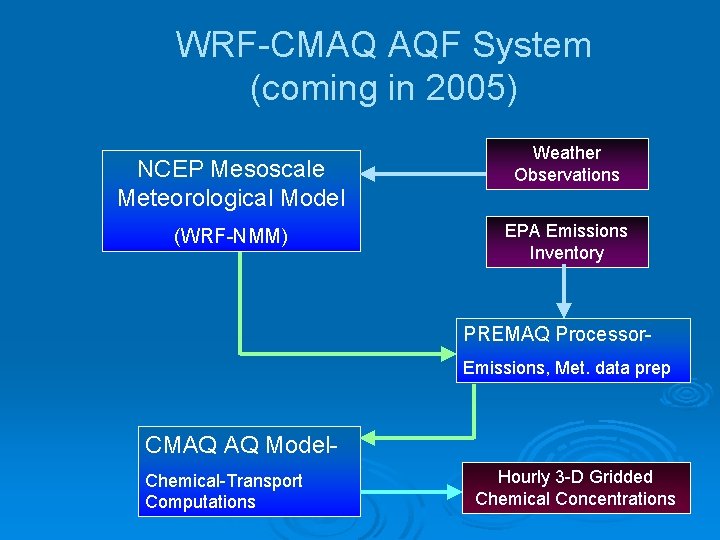
WRF-CMAQ AQF System (coming in 2005) NCEP Mesoscale Meteorological Model (WRF-NMM) Weather Observations EPA Emissions Inventory PREMAQ Processor. Emissions, Met. data prep CMAQ AQ Model. Chemical-Transport Computations Hourly 3 -D Gridded Chemical Concentrations
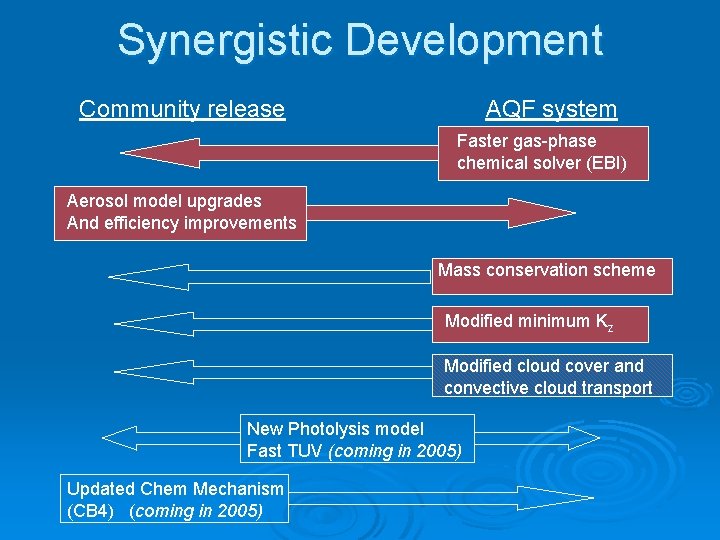
Synergistic Development Community release AQF system Faster gas-phase chemical solver (EBI) Aerosol model upgrades And efficiency improvements Mass conservation scheme Modified minimum Kz Modified cloud cover and convective cloud transport New Photolysis model Fast TUV (coming in 2005) Updated Chem Mechanism (CB 4) (coming in 2005)
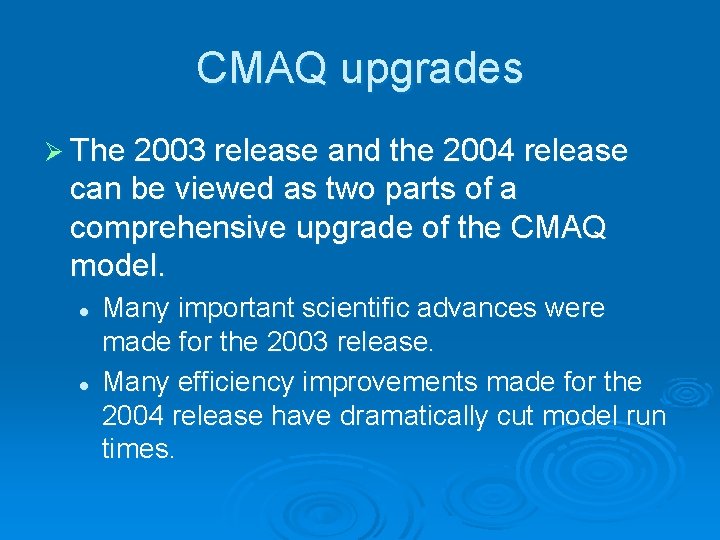
CMAQ upgrades Ø The 2003 release and the 2004 release can be viewed as two parts of a comprehensive upgrade of the CMAQ model. l l Many important scientific advances were made for the 2003 release. Many efficiency improvements made for the 2004 release have dramatically cut model run times.
New Features of the 2004 CMAQ Release (version 4. 4) Ø Aerosols Coagulation: Replaced numerical calculations for coagulation coefficients with look-up tables l Secondary Organic Aerosols: Improved the “initial guess” for the gas-particle equilibrium solver About a factor of 2 speedup in Aerosol module l Thermodynamics: Corrections to ISORROPIA reduce instabilities in dry conditions (w/ A. Nenes) Details of Aerosol changes will be presented by Prakash Bhave l
New for 2004 (cont) Ø Gas Phase Chemistry l l l Added new highly accurate generalized solver: ROS 3 – a Rosenbrock solver by Sandu et al. (1997) QSSA discontinued since ROS 3 is faster and more accurate The Euler Backward Iterative (EBI) replaces MEBI for CB 4 and SAPRC 99 • EBI is mechanism specific but we have an EBI solver generator • EBI about twice as fast as MEBI for CB 4 w/o aerosols
Corrections Ø Corrected error in PPM vertical advection which miscomputed flux divergence for nonuniform grid spacing l l Did not conserve mass About 10% error in ground-level concentrations Ø Corrected dry deposition velocity that was in flux form (velocity x air density) l Correction reduces dry deposition flux by about 10%
Other Updates Ø The Plume-in-Grid feature now includes aerosols (see Godowitch’s poster) Ø Computational efficiency has been improved through collaboration with Sandia National Laboratory l l Improved MPP scalability through revision of the parallel I/O system Code optimization
Expected Upgrades for 2005 Extension of the aerosol module to include sea salt with heterogeneous interactions with gasphase species Ø Updates to the CB 4 gas-phase chemical mechanism Ø Linkage to the WRF meteorology model Ø A new hybrid local and non-local closure PBL model Ø New Photolysis model – Fast TUV Ø Generalized aqueous chemistry solver Ø
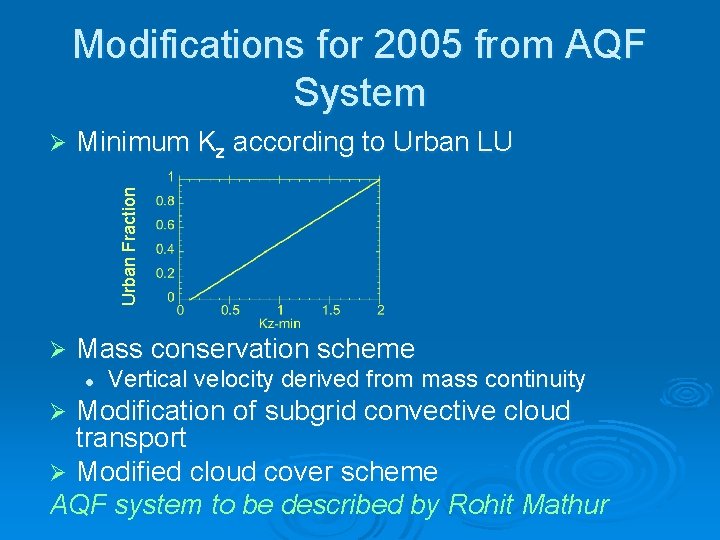
Modifications for 2005 from AQF System Minimum Kz according to Urban LU Ø Mass conservation scheme Urban Fraction Ø l Vertical velocity derived from mass continuity Modification of subgrid convective cloud transport Ø Modified cloud cover scheme AQF system to be described by Rohit Mathur Ø
Additional Capabilities for 2005 Release Ø Sulfate tracking model l Accounting of production pathways Ø Primary carbonaceous aerosols source apportionment l Source types or geographic regions Ø Toxics and Mercury will be included in release