
New Criticism A poem must not mean But
New Criticism A poem must not mean/ But be” (Archibald Mc. Leish) - “It’s never what a poem says which matters, but what it is” (I. A. Richards) (Formalism, Liberal Humanism, Practical Criticism) Course Instructor: Raj Thakur
q. Distinctive Features: “Words The on the page” “text itself”, close reading of the text Autotelic Form text , text as a self sufficient entity and Organic Form Non-conceptual Aesthetic literary meaning humanistic idealisation of literature
New Criticism Origin/Background: Classical Aesthetics Preoccupation with Form: § Plato’s dialectics towards Socratic wisdom by his imagery, metaphor, setting and tone § Aristotelian emphasis on “orderly arrangement of parts” , a “beautiful whole” § Horace’s debunking of the ‘would be poet’- “In short, be your subject what it will, let it be simple and unified”

q. Background: Anti- Romantic Credo in Modern Literary Criticism: § T. S. Eliot's New Classicism Impersonal Theory of Poetry § Objective Correlative § Championing of Metaphysical Poets (Unified Sensibility) § Ø Retreat from Realism, Naturalism, Romanticism and the rise of literary and artistic movements like Imagism § Futurism, Cubism (subject to objective and scientific scholarship) §
ØInfluence of T. E. Hulme, Ezra. Pound, Irving Babbit: T. E. Hulme’s new Kind of classicism“Romanticism and Classicism” (1924)- “dry hard classical verse” to replace sentimentalism in literature (derivative name of Imagism) § Ezra Pound and Imagism § Irving Babbit and ‘New Humanism’. Rousseau and Romanticism (1919): calls for restraint and emphasis on classical, Christian outlook sans Rousseau’s negative influence §
q. Influence of Russian Formalism: Emphasis on the ‘special use of language’ Distinction between ‘practical language and ‘literary’ language in terms of latter’s constructed quality- “speech organized on its phonic texture” Poetry as an “organized violence committed on speech” (Roman Jakobson) Shklovsky’s ‘Defamiliarization’, ostranenie: ‘making strange’ and ‘laying bare’ of the formand devices
q. Different Schools of New Criticism: (spanned around 1920 -1970) v British School: o I A Richards : Principle of Literary Criticism (1924): exclusive theoretical base for ‘literary’ study o Science and Poetry (9126): strict demarcation between ‘emotive’ language of poetry and ‘referntial’ language if non- literary discourses o Practical Criticism (1929): lecture room experimwentclose reading of the poem
Ø William Empson: Seven Types of Ambiguity (1930): • Emphasizing on ‘ambiguity’ as a poetic trope of richness rather than fault Ø F. R. Leavis-: defense against the destructive ‘technologico Benthamite’

q. American School : Political backdrop: ‘Agrarians’ and ‘The Fugitives’, The Southern New Critics (majorly John Crow Ransom and Cleanth Brooks) movement hostile to the hard- nosed industrialism and materialism of the North. Ø John Crowe Ransom: The New Criticism (1941) • “Criticism Inc. ”: literary criticism as a business of professionals, • criticism as ‘scientific', 'precise’ and ‘systematic’ •
ØCleanth Brooks Understanding Poetry (1938) Understanding Fiction (1943) • Emphasis on dramatic propriety, ‘Irony’ and ‘Paradox’ • The Well Wrought Urn: Studies in the structure of Poetry (1947): textualizes eponymous urn of Keats ode in the context of the dramatic organic element of the whole • Focus on the “Structurality of the Structure” , • • Text is sucked to structure
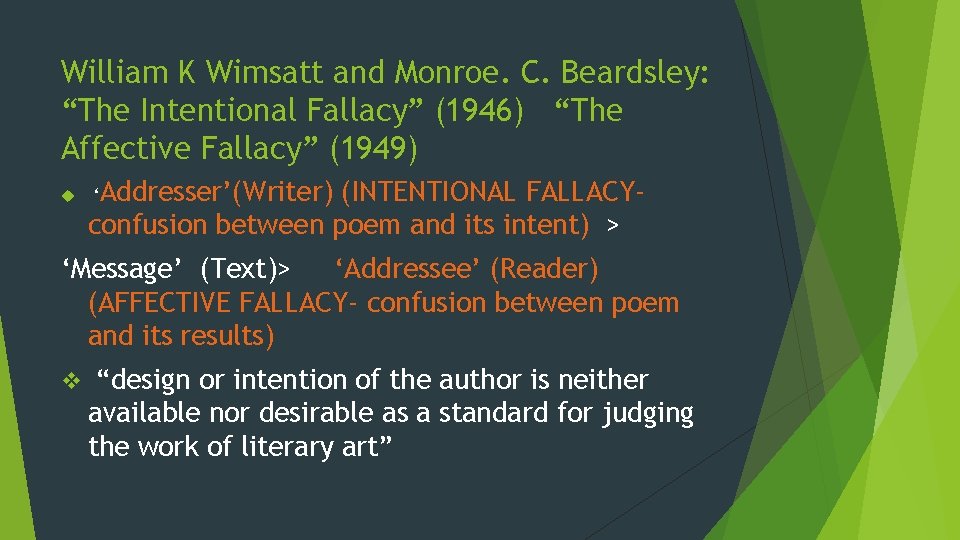
William K Wimsatt and Monroe. C. Beardsley: “The Intentional Fallacy” (1946) “The Affective Fallacy” (1949) ‘Addresser’(Writer) (INTENTIONAL FALLACYconfusion between poem and its intent) > ‘Message’ (Text)> ‘Addressee’ (Reader) (AFFECTIVE FALLACY- confusion between poem and its results) v “design or intention of the author is neither available nor desirable as a standard for judging the work of literary art”
- Slides: 11