
New Covenant Theology An Examination of Reformed Baptist
New Covenant Theology
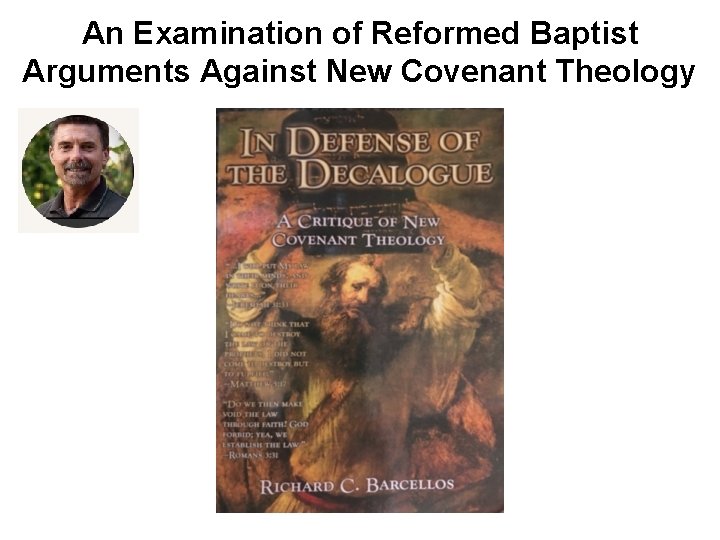
An Examination of Reformed Baptist Arguments Against New Covenant Theology
Chapter 7 NCT and Canonics • In this chapter, Barcellos seems to be making a very similar set of arguments to those made earlier in the book which we already dealt with (p. 87): – New Covenant theologians… basic claim seems to be that only those portions of the Old Testament repeated in the New Testament become covenant law and are therefore binding for the Christian. – However, Christ taught us that the whole Old Testament, not just those portions repeated in the New Testament had a place in His kingdom (Mat. 5: 17 -20) • Since we have already addressed these specific arguments, would someone in the class like to briefly address them again now?
Chapter 7 NCT and Canonics • Barcellos then gives one further argument from scripture that he had not previously referenced: – “Paul, Christ’s apostle to the Gentiles, also said that the whole Old Testament was ‘profitable for… righteousness, that the man of God may be complete, thoroughly equipped for every good work’ (2 Tim. 3: 16 -17)” (pp. 87 -88, ellipsis original) • Actually, in 2 Tim. 3: 16 -17, Paul says that: • Scripture is profitable for teaching, for reproof, for correction, and for training in righteousness, (2 Tim. 3: 16) • All scripture is profitable, not just the “whole Old Testament”.
Chapter 7 NCT and Canonics • Perhaps Barcellos would argue that the only scriptures that were available at the time Paul wrote this was the OT. But that is actually not the case: – In 1 Tim 5: 18, Paul cites Luke 10: 7 as scripture: The laborer deserves his wages. – Peter, writing around the same time that Paul wrote 2 Timothy, refers to Paul’s writings in 2 Pet. 3: 16 as scripture – on a par with the OT Scriptures. • We can all agree that all scripture (even all of the OT) is profitable for NT Christians, but even Barcellos would have to admit that many OT scriptures, while profitable, are not binding on NT Christians.
Chapter 8 NCT and Historical Theology • In this chapter, Barcellos criticizes some of what he perceives to be NCT’s views on some of the views and writings of Christians in church history: – The Westminster and London Baptist Confessions – John Calvin’s views on the Decalogue and the Sabbath – John Bunyan’s views on the Sabbath
The Westminster and London Baptist Confessions • Barcellos states that : New Covenant Theologians often chide these historic Reformed confessions concerning their view of the relationship between Old Covenant and New Covenant law… they are claimed to be flat in their approach to the issues related to continuity and discontinuity. (p. 89) • Barcellos then goes on to quote portions of the London Baptist Confession (LBC) of 1689 where it mentions differences between the Old and New Covenant: – The Sabbath changes from Saturday to Sunday – Recognition that the “ceremonial laws” of the Old Covenant have been “abrogated” • Barcellos concludes, therefore, that the LBC of 1689 is not “flat” and that NCT’s characterizations of it are unfounded and oversimplified. • What do you think about Barcellos’ claim that the LBC of 1689 properly recognizes the differences between the Old and New Covenants?
A Brief Look at What We Said Earlier in this Class About the Westminster (1646) and London Baptist Confessions (1689) • These two confessions of faith have been used by many Reformed denominations and churches in the English speaking world since the Reformation to define what they believe to be orthodox biblical teaching. • I, and I think most of you, would be in complete agreement with the vast majority of what is taught in these documents. • That being said, the documents are not scripture and therefore they are fallible – as illustrated by the fact that the London Baptist Confession of 1689 was written to correct erroneous teachings in the Westminster Confession of Faith. • Indeed, these two confessions themselves both teach: – The Supreme Judge, by which all controversies of religion are to be determined… can be no other but the Holy Spirit speaking in the Scripture. (WCF 1. 10) • It is in this spirit that we, like the noble-minded Bereans of Acts 17: 11, will be examining the scriptures to see if the things written in these documents concerning the Sabbath are true.
NCT and John Calvin • Barcellos spends ten pages in chapter eight (pp. 91 -100) trying to prove that John Calvin does not endorse the same view of the Sabbath as NCT. • I have never claimed to hold the same view of the Sabbath as John Calvin, and I don’t remember ever reading anything written by NCT writers where they made such a claim. • We all have great respect for John Calvin and historical role in bringing about the Reformation and I believe that much of what Calvin taught was “spot on”. • But at the same time, I don’t feel any pressure to believe something just because Calvin taught it. There are number of areas where we and Barcellos would all disagree with Calvin (for example his views on infant baptism). • Consequently I don’t see any need to try to address the arguments that Barcellos raises in these ten pages.
NCT and John Bunyan • Barcellos spends the remaining eight pages of chapter eight (pp. 101 -107) trying to prove that John Bunyan does not endorse the exact same view of the Sabbath as NCT. • And, as with Calvin, I have never claimed to hold the same view of the Sabbath as John Bunyan either. • Consequently I don’t see any need to try to address the arguments that Barcellos raises in his eight pages examining the Sabbath views of John Bunyan.
A Word on Comparing Our Views With Great Men in Church History • Since Barcellos spent so much time in Chapter eight criticizing NCT for either criticizing and/or claiming to line up with respected figures in church history, I want to make a few comments on the effort that many Christians and theologians make to find those in church history who hold their particular views. • First of all, one of the foundational principles of the Reformation which we, as a church, hold to is the principle known historically as Sola Scriptura: that Scripture Alone is our supreme authority in spiritual matters. • Therefore, though it is comforting to discover that there are great men in church history who believed what we believe, ultimately the only thing that determines whether or not a theological idea is true is whether or not it is taught in scripture.
A Word on Comparing Our Views With Great Men in Church History • I would go so far as to say that even if we can’t identify a single person in church history who is known to have believed a particular theological idea – this does not prove (or disprove) that the idea is false because: – We can’t know what everyone in the history of the church believed, therefore we can never be certain that no one ever held to a particular theological idea. – But even if we could know that not a single person in the entire history of the church ever believed a particular idea, if that idea is taught in scripture as true, then it’s true, period: Let God be true though every one were a liar… (Rom. 3: 4) • Do you agree? Why or why not?
A Word on Comparing Our Views With Great Men in Church History • One other comment about the effort that some make to find respected figures in church history who hold their particular views: James White, who teaches one of my favorite series on church history, is fond of saying that the object of doing a historical analysis of the early Fathers is not to make them look like us, but to let them be who they were in their own place in history. • I think it’s important to recognize that God has saved individuals throughout the history of the church (and throughout the world today) who, while they share our essential beliefs concerning the gospel, hold many beliefs in other non-essential areas that are different than what we believe.
A Word on Comparing Our Views With Great Men in Church History • This is not to say that doctrinal differences aren’t important – they are! • But we just need to recognize there were many great men in history who would be in serious disagreement with many of the views that we hold today: • That doesn’t mean that we’re (necessarily) wrong • And it doesn’t mean that God wasn’t at work in their lives when they did the great things that they did.
Preview of Things to Come… • Next week. I plan to give a big picture overview of the entire series and wrap up this topic. • After that, Stephen is going to give me a short break and teach a series on the “one another” passages of scripture. • After that I plan to start a new series on Church History.

Other Questions?
- Slides: 16