
New BEE Codes 2014 How will the new

New BEE Codes 2014 How will the new codes impact your business?
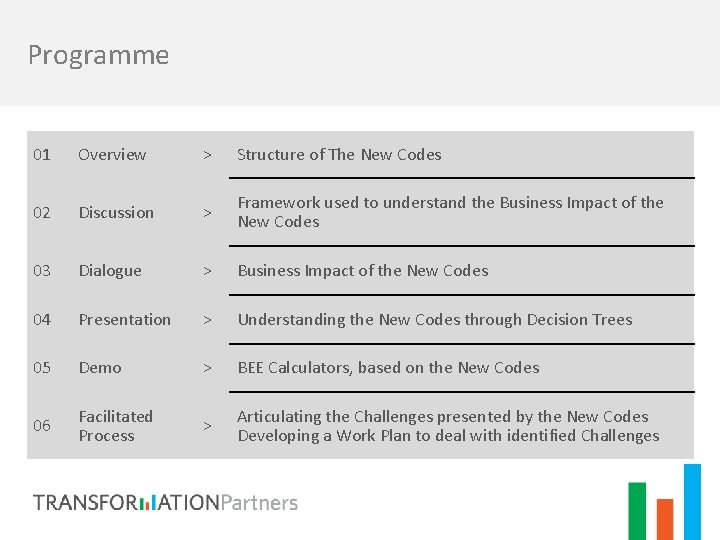
Programme 01 Overview > Structure of The New Codes 02 Discussion > Framework used to understand the Business Impact of the New Codes 03 Dialogue > Business Impact of the New Codes 04 Presentation > Understanding the New Codes through Decision Trees 05 Demo > BEE Calculators, based on the New Codes 06 Facilitated Process > Articulating the Challenges presented by the New Codes Developing a Work Plan to deal with identified Challenges

Structure of the New Codes
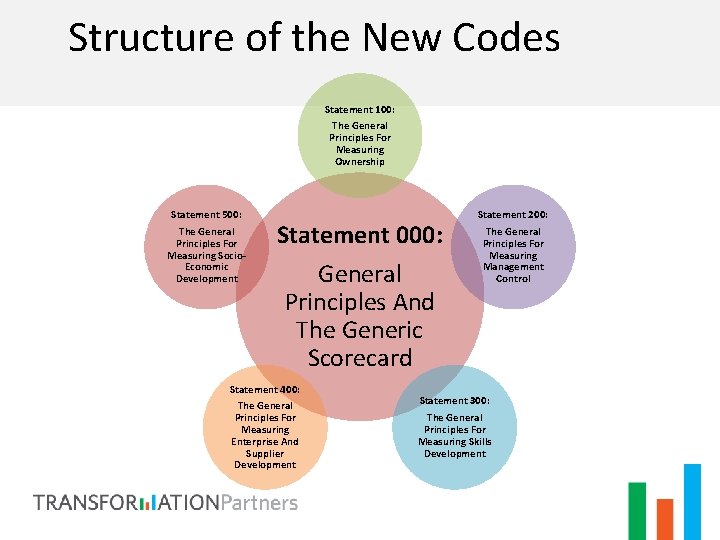
Structure of the New Codes Statement 100: The General Principles For Measuring Ownership Statement 500: The General Principles For Measuring Socio. Economic Development Statement 000: General Principles And The Generic Scorecard Statement 400: The General Principles For Measuring Enterprise And Supplier Development Statement 200: The General Principles For Measuring Management Control Statement 300: The General Principles For Measuring Skills Development
Framework used to understand the Business Impact of the New Codes
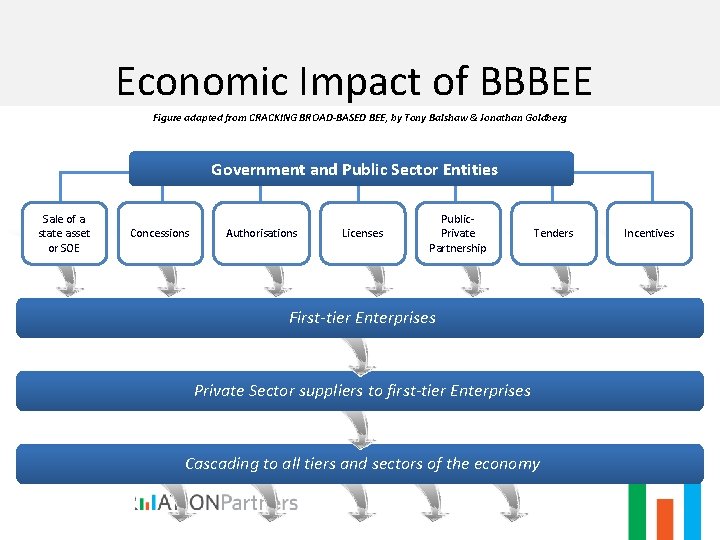
Economic Impact of BBBEE Figure adapted from CRACKING BROAD-BASED BEE, by Tony Balshaw & Jonathan Goldberg Government and Public Sector Entities Sale of a state asset or SOE Concessions Authorisations Licenses Public. Private Partnership Tenders First-tier Enterprises Private Sector suppliers to first-tier Enterprises Cascading to all tiers and sectors of the economy Incentives
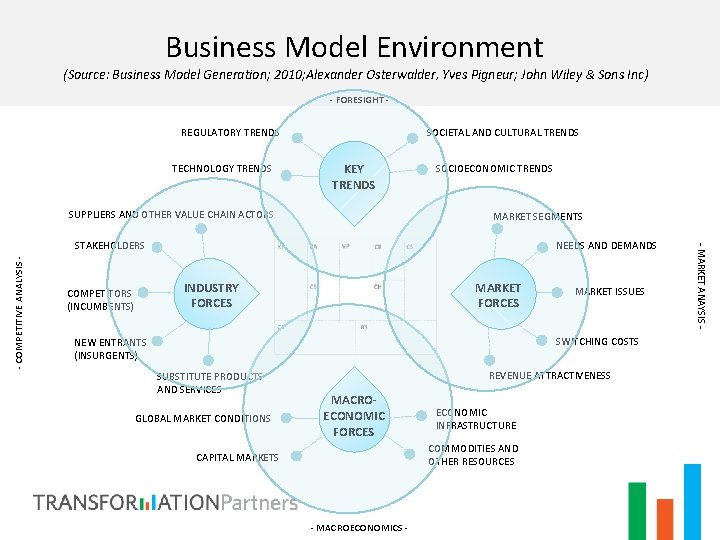
Business Model Environment (Source: Business Model Generation; 2010; Alexander Osterwalder, Yves Pigneur; John Wiley & Sons Inc) - FORESIGHT - REGULATORY TRENDS TECHNOLOGY TRENDS SOCIETAL AND CULTURAL TRENDS KEY TRENDS SUPPLIERS AND OTHER VALUE CHAIN ACTORS SOCIOECONOMIC TRENDS MARKET SEGMENTS - COMPETITIVE ANALYSIS - NEEDS AND DEMANDS INDUSTRY FORCES COMPETITORS (INCUMBENTS) MARKET FORCES MARKET ISSUES SWITCHING COSTS NEW ENTRANTS (INSURGENTS) SUBSTITUTE PRODUCTS AND SERVICES GLOBAL MARKET CONDITIONS REVENUE ATTRACTIVENESS MACROECONOMIC FORCES ECONOMIC INFRASTRUCTURE COMMODITIES AND OTHER RESOURCES CAPITAL MARKETS - MACROECONOMICS - - MARKET ANAYSIS - STAKEHOLDERS

Business Model Canvas
Business Impact of the New Codes
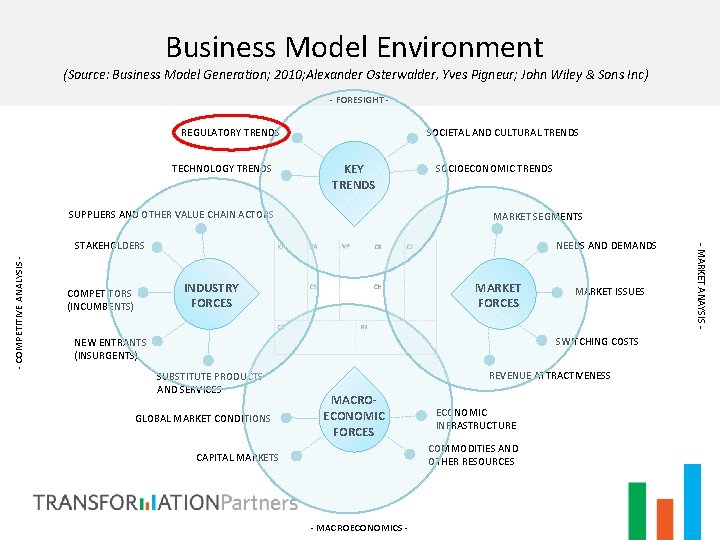
Business Model Environment (Source: Business Model Generation; 2010; Alexander Osterwalder, Yves Pigneur; John Wiley & Sons Inc) - FORESIGHT - REGULATORY TRENDS TECHNOLOGY TRENDS SOCIETAL AND CULTURAL TRENDS KEY TRENDS SUPPLIERS AND OTHER VALUE CHAIN ACTORS SOCIOECONOMIC TRENDS MARKET SEGMENTS - COMPETITIVE ANALYSIS - NEEDS AND DEMANDS INDUSTRY FORCES COMPETITORS (INCUMBENTS) MARKET FORCES MARKET ISSUES SWITCHING COSTS NEW ENTRANTS (INSURGENTS) SUBSTITUTE PRODUCTS AND SERVICES GLOBAL MARKET CONDITIONS REVENUE ATTRACTIVENESS MACROECONOMIC FORCES ECONOMIC INFRASTRUCTURE COMMODITIES AND OTHER RESOURCES CAPITAL MARKETS - MACROECONOMICS - - MARKET ANAYSIS - STAKEHOLDERS
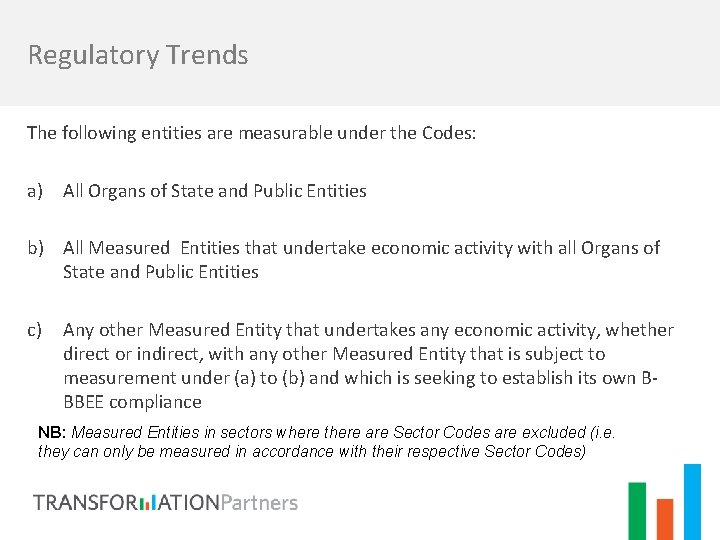
Regulatory Trends The following entities are measurable under the Codes: a) All Organs of State and Public Entities b) All Measured Entities that undertake economic activity with all Organs of State and Public Entities c) Any other Measured Entity that undertakes any economic activity, whether direct or indirect, with any other Measured Entity that is subject to measurement under (a) to (b) and which is seeking to establish its own BBBEE compliance NB: Measured Entities in sectors where there are Sector Codes are excluded (i. e. they can only be measured in accordance with their respective Sector Codes)
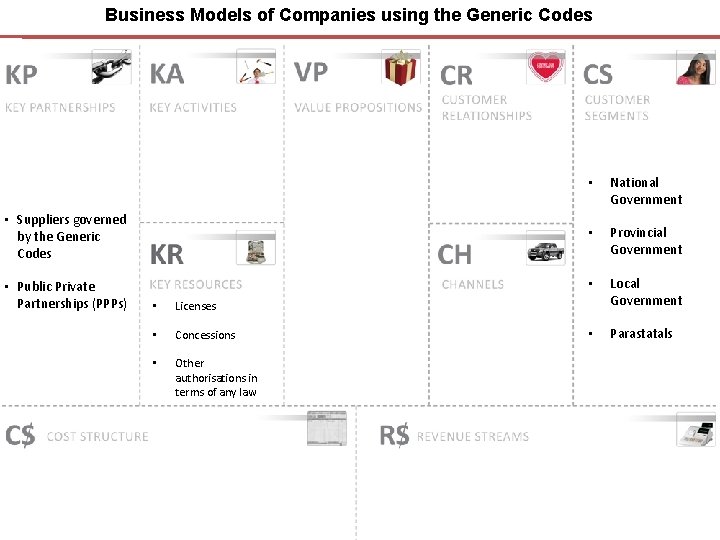
Business Models of Companies using the Generic Codes • Suppliers governed by the Generic Codes • Public Private Partnerships (PPPs) • Licenses • Concessions • Other authorisations in terms of any law • National Government • Provincial Government • Local Government • Parastatals
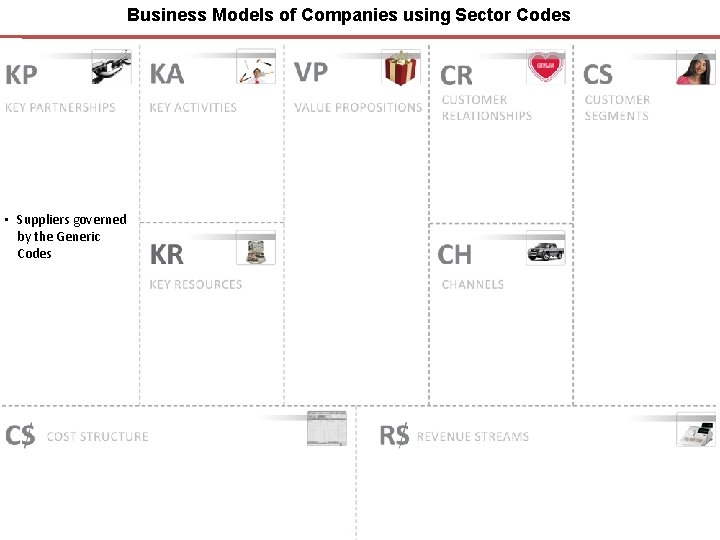
Business Models of Companies using Sector Codes • Suppliers governed by the Generic Codes
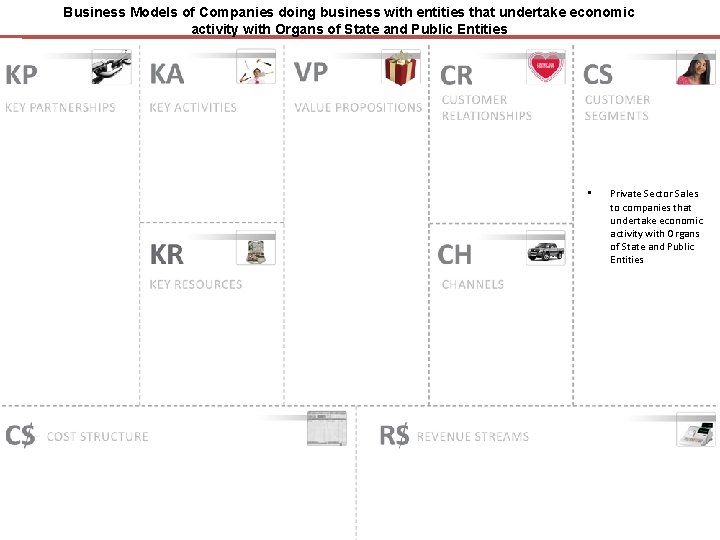
Business Models of Companies doing business with entities that undertake economic activity with Organs of State and Public Entities • Private Sector Sales to companies that undertake economic activity with Organs of State and Public Entities
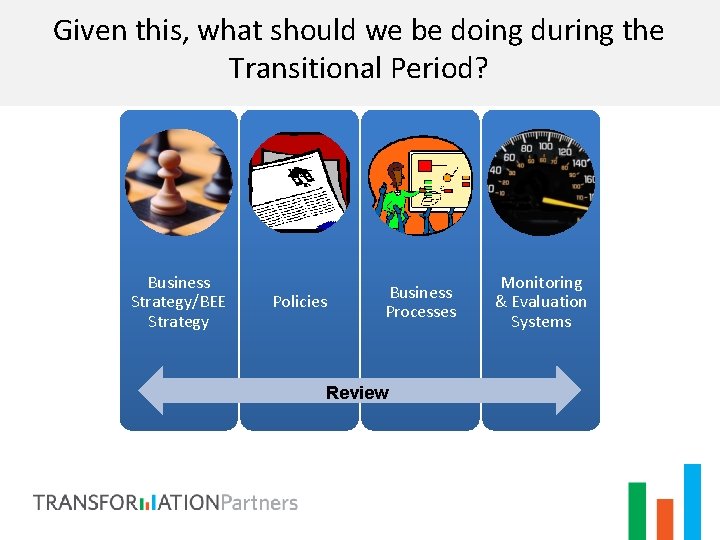
Given this, what should we be doing during the Transitional Period? Business Strategy/BEE Strategy Policies Business Processes Review Monitoring & Evaluation Systems
Understanding the New Codes through Decision Trees
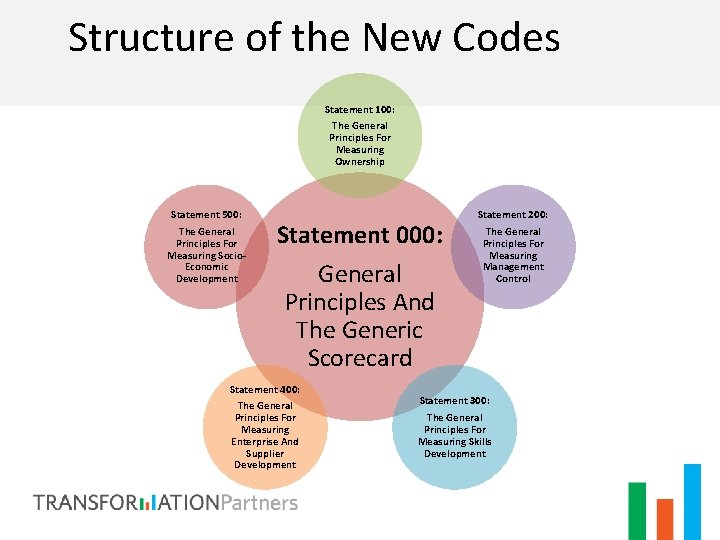
Structure of the New Codes Statement 100: The General Principles For Measuring Ownership Statement 500: The General Principles For Measuring Socio. Economic Development Statement 000: General Principles And The Generic Scorecard Statement 400: The General Principles For Measuring Enterprise And Supplier Development Statement 200: The General Principles For Measuring Management Control Statement 300: The General Principles For Measuring Skills Development
Statement 000 General Principles And The Generic Scorecard
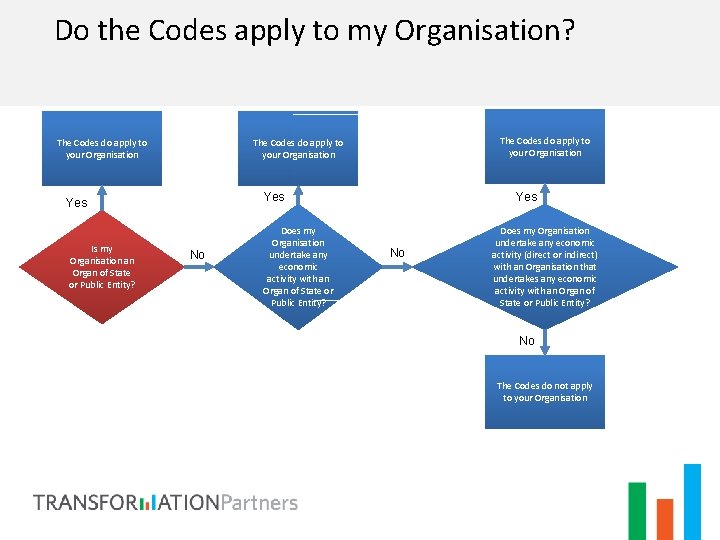
Do the Codes apply to my Organisation? The Codes do apply to your Organisation Yes Is my Organisation an Organ of State or Public Entity? The Codes do apply to your Organisation No Does my Organisation undertake any economic activity with an Organ of State or Public Entity? Yes No Does my Organisation undertake any economic activity (direct or indirect) with an Organisation that undertakes any economic activity with an Organ of State or Public Entity? No The Codes do not apply to your Organisation
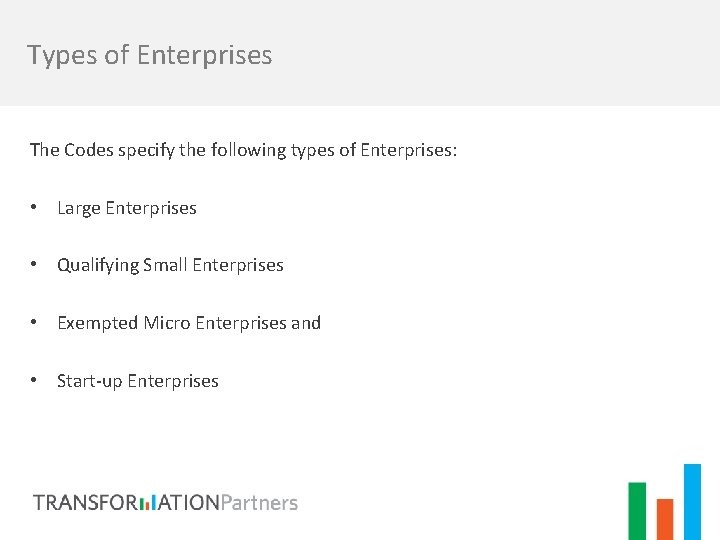
Types of Enterprises The Codes specify the following types of Enterprises: • Large Enterprises • Qualifying Small Enterprises • Exempted Micro Enterprises and • Start-up Enterprises
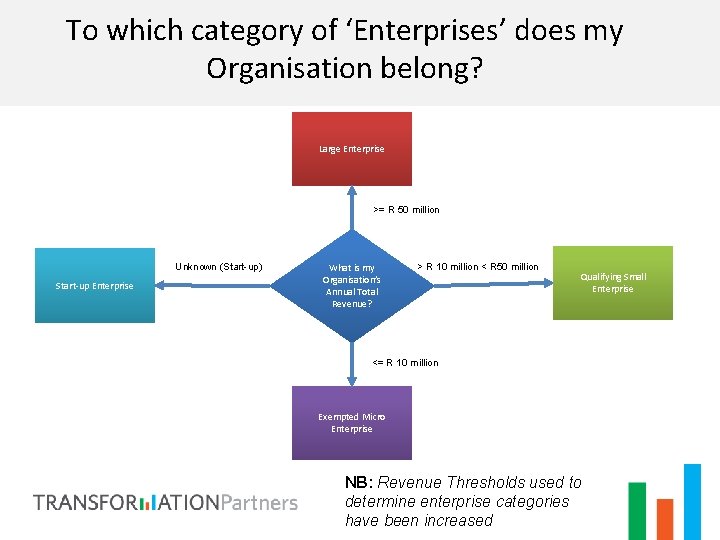
To which category of ‘Enterprises’ does my Organisation belong? Large Enterprise >= R 50 million Unknown (Start-up) Start-up Enterprise What is my Organisation’s Annual Total Revenue? > R 10 million < R 50 million Qualifying Small Enterprise <= R 10 million Exempted Micro Enterprise NB: Revenue Thresholds used to determine enterprise categories have been increased
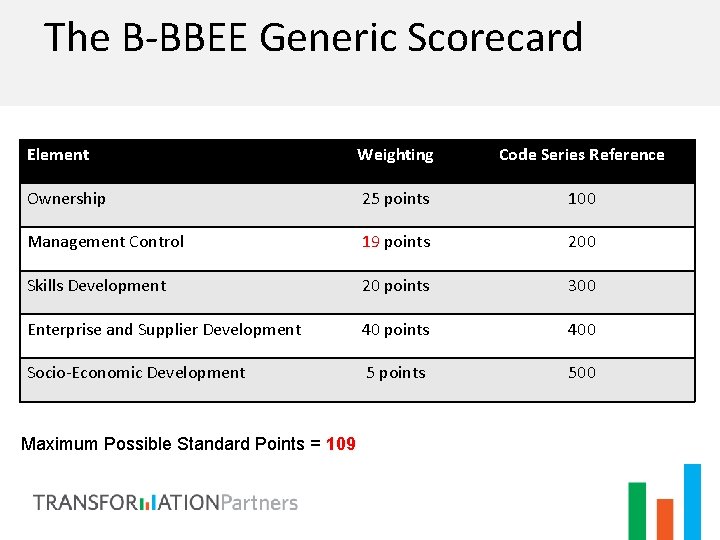
The B-BBEE Generic Scorecard Element Weighting Code Series Reference Ownership 25 points 100 Management Control 19 points 200 Skills Development 20 points 300 Enterprise and Supplier Development 40 points 400 Socio-Economic Development 5 points 500 Maximum Possible Standard Points = 109
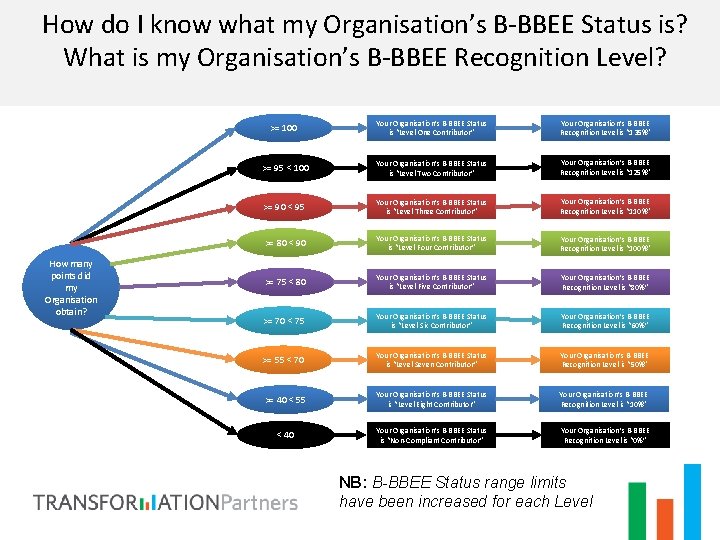
How do I know what my Organisation’s B-BBEE Status is? What is my Organisation’s B-BBEE Recognition Level? How many points did my Organisation obtain? >= 100 Your Organisation’s B-BBEE Status is “Level One Contributor” Your Organisation’s B-BBEE Recognition Level is “ 135%” >= 95 < 100 Your Organisation’s B-BBEE Status is “Level Two Contributor” Your Organisation’s B-BBEE Recognition Level is “ 125%” >= 90 < 95 Your Organisation’s B-BBEE Status is “Level Three Contributor” Your Organisation’s B-BBEE Recognition Level is “ 110%” >= 80 < 90 Your Organisation’s B-BBEE Status is “Level Four Contributor” Your Organisation’s B-BBEE Recognition Level is “ 100%” >= 75 < 80 Your Organisation’s B-BBEE Status is “Level Five Contributor” Your Organisation’s B-BBEE Recognition Level is “ 80%” >= 70 < 75 Your Organisation’s B-BBEE Status is “Level Six Contributor” Your Organisation’s B-BBEE Recognition Level is “ 60%” >= 55 < 70 Your Organisation’s B-BBEE Status is “Level Seven Contributor” Your Organisation’s B-BBEE Recognition Level is “ 50%” >= 40 < 55 Your Organisation’s B-BBEE Status is “Level Eight Contributor” Your Organisation’s B-BBEE Recognition Level is “ 10%” < 40 Your Organisation’s B-BBEE Status is “Non-Compliant Contributor” Your Organisation’s B-BBEE Recognition Level is “ 0%” NB: B-BBEE Status range limits have been increased for each Level
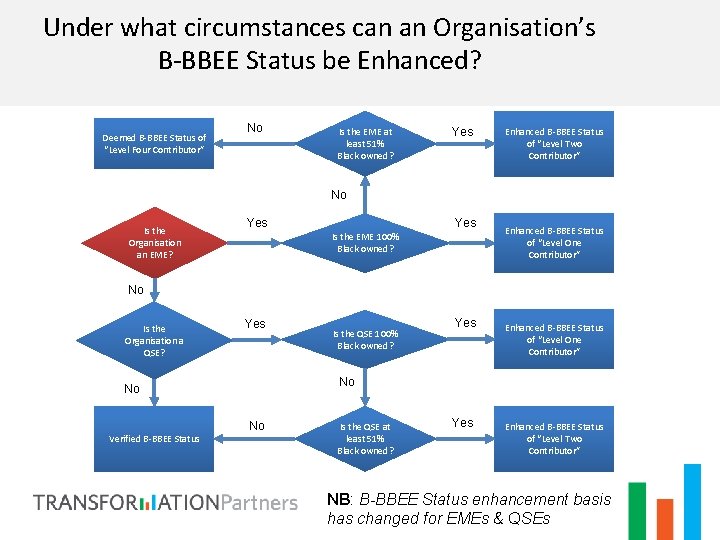
Under what circumstances can an Organisation’s B-BBEE Status be Enhanced? Deemed B-BBEE Status of “Level Four Contributor” No Is the EME at least 51% Black owned? Yes Enhanced B-BBEE Status of “Level Two Contributor” No Is the Organisation an EME? Yes Is the EME 100% Black owned? Enhanced B-BBEE Status of “Level One Contributor” No Is the Organisation a QSE? Yes Enhanced B-BBEE Status of “Level One Contributor” No No No Verified B-BBEE Status Is the QSE 100% Black owned? Is the QSE at least 51% Black owned? Yes Enhanced B-BBEE Status of “Level Two Contributor” NB: B-BBEE Status enhancement basis has changed for EMEs & QSEs
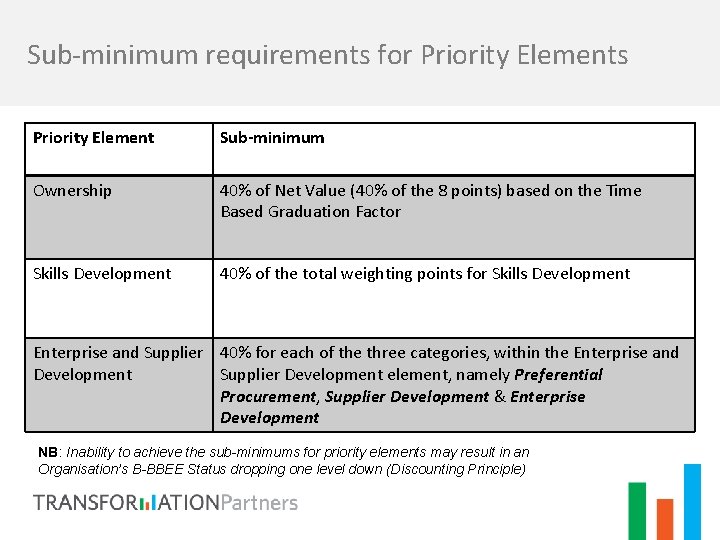
Sub-minimum requirements for Priority Elements Priority Element Sub-minimum Ownership 40% of Net Value (40% of the 8 points) based on the Time Based Graduation Factor Skills Development 40% of the total weighting points for Skills Development Enterprise and Supplier 40% for each of the three categories, within the Enterprise and Development Supplier Development element, namely Preferential Procurement, Supplier Development & Enterprise Development NB: Inability to achieve the sub-minimums for priority elements may result in an Organisation’s B-BBEE Status dropping one level down (Discounting Principle)
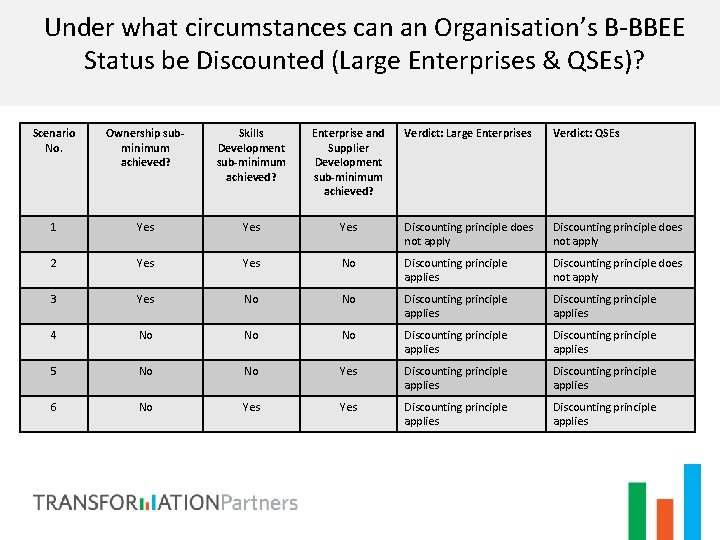
Under what circumstances can an Organisation’s B-BBEE Status be Discounted (Large Enterprises & QSEs)? Scenario No. Ownership subminimum achieved? Skills Development sub-minimum achieved? Enterprise and Supplier Development sub-minimum achieved? Verdict: Large Enterprises Verdict: QSEs 1 Yes Yes Discounting principle does not apply 2 Yes No Discounting principle applies Discounting principle does not apply 3 Yes No No Discounting principle applies 4 No No No Discounting principle applies 5 No No Yes Discounting principle applies 6 No Yes Discounting principle applies
Statement 100 The General Principles For Measuring Ownership
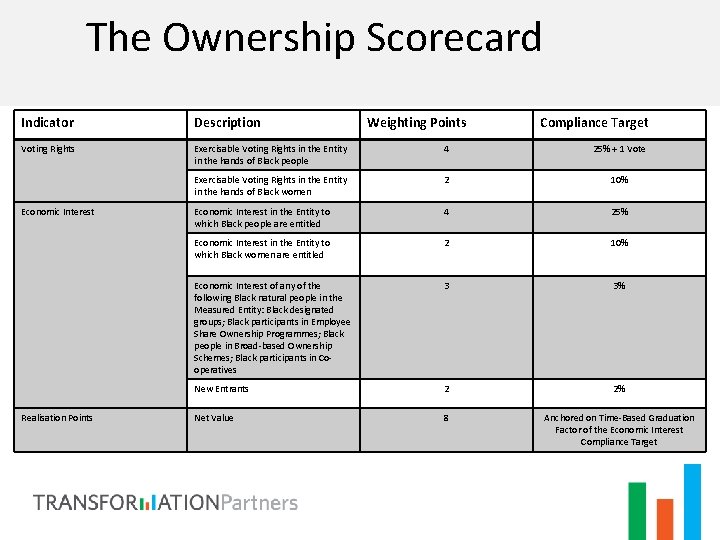
The Ownership Scorecard Indicator Description Voting Rights Exercisable Voting Rights in the Entity in the hands of Black people 4 25% + 1 Vote Exercisable Voting Rights in the Entity in the hands of Black women 2 10% Economic Interest in the Entity to which Black people are entitled 4 25% Economic Interest in the Entity to which Black women are entitled 2 10% Economic Interest of any of the following Black natural people in the Measured Entity: Black designated groups; Black participants in Employee Share Ownership Programmes; Black people in Broad-based Ownership Schemes; Black participants in Cooperatives 3 3% New Entrants 2 2% Net Value 8 Anchored on Time-Based Graduation Factor of the Economic Interest Compliance Target Economic Interest Realisation Points Weighting Points Compliance Target
Statement 200 The General Principles For Measuring Management Control
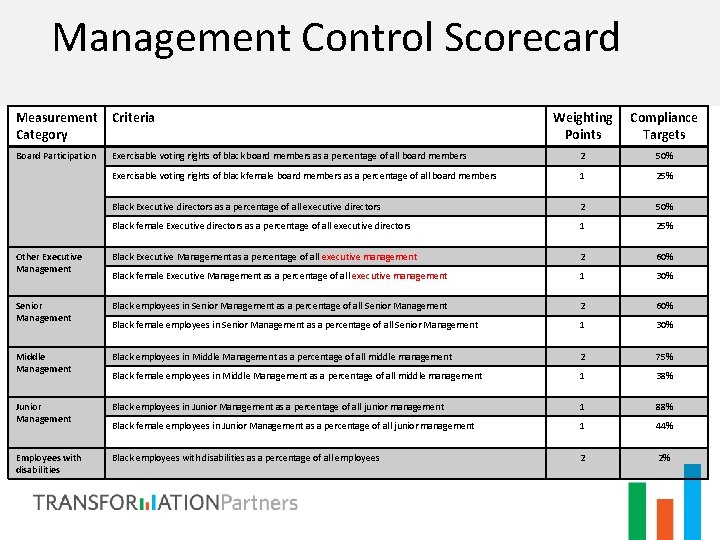
Management Control Scorecard Measurement Category Criteria Weighting Points Compliance Targets Board Participation Exercisable voting rights of black board members as a percentage of all board members 2 50% Exercisable voting rights of black female board members as a percentage of all board members 1 25% Black Executive directors as a percentage of all executive directors 2 50% Black female Executive directors as a percentage of all executive directors 1 25% Other Executive Management Black Executive Management as a percentage of all executive management 2 60% Black female Executive Management as a percentage of all executive management 1 30% Senior Management Black employees in Senior Management as a percentage of all Senior Management 2 60% Black female employees in Senior Management as a percentage of all Senior Management 1 30% Middle Management Black employees in Middle Management as a percentage of all middle management 2 75% Black female employees in Middle Management as a percentage of all middle management 1 38% Junior Management Black employees in Junior Management as a percentage of all junior management 1 88% Black female employees in Junior Management as a percentage of all junior management 1 44% Employees with disabilities Black employees with disabilities as a percentage of all employees 2 2%
Statement 300 The General Principles For Measuring Skills Development
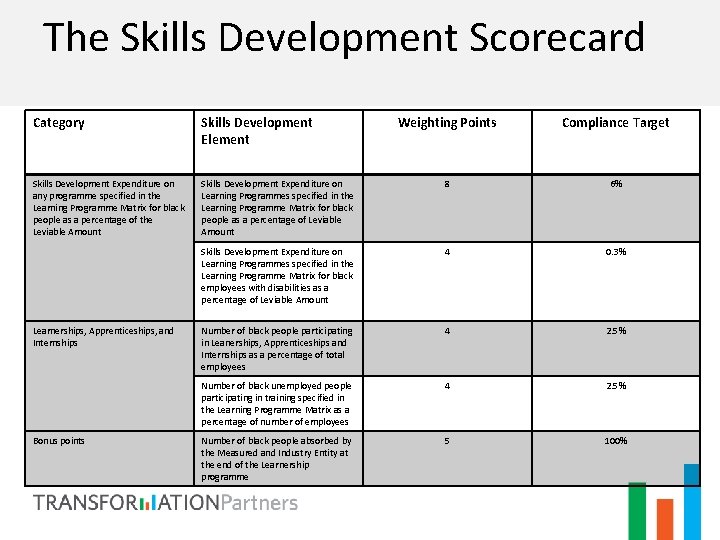
The Skills Development Scorecard Category Skills Development Element Skills Development Expenditure on any programme specified in the Learning Programme Matrix for black people as a percentage of the Leviable Amount Learnerships, Apprenticeships, and Internships Bonus points Weighting Points Compliance Target Skills Development Expenditure on Learning Programmes specified in the Learning Programme Matrix for black people as a percentage of Leviable Amount 8 6% Skills Development Expenditure on Learning Programmes specified in the Learning Programme Matrix for black employees with disabilities as a percentage of Leviable Amount 4 0. 3% Number of black people participating in Leanerships, Apprenticeships and Internships as a percentage of total employees 4 2. 5% Number of black unemployed people participating in training specified in the Learning Programme Matrix as a percentage of number of employees 4 2. 5% Number of black people absorbed by the Measured and Industry Entity at the end of the Learnership programme 5 100%
Statement 400 The General Principles For Measuring Enterprise And Supplier Development
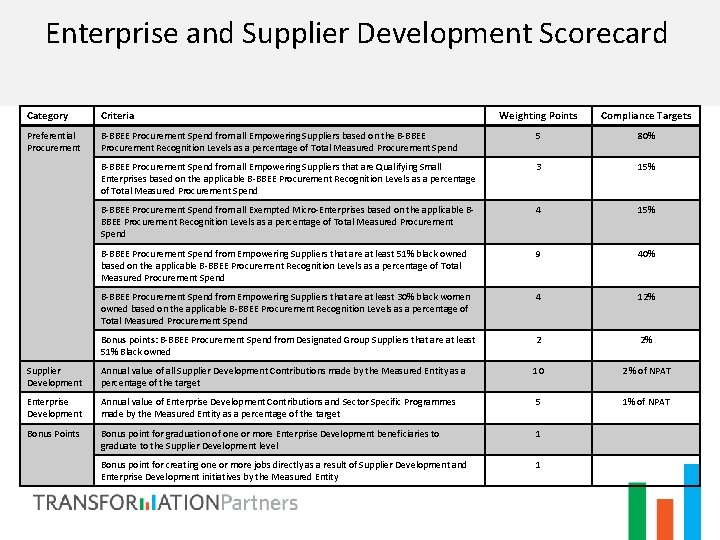
Enterprise and Supplier Development Scorecard Category Criteria Weighting Points Compliance Targets Preferential Procurement B-BBEE Procurement Spend from all Empowering Suppliers based on the B-BBEE Procurement Recognition Levels as a percentage of Total Measured Procurement Spend 5 80% B-BBEE Procurement Spend from all Empowering Suppliers that are Qualifying Small Enterprises based on the applicable B-BBEE Procurement Recognition Levels as a percentage of Total Measured Procurement Spend 3 15% B-BBEE Procurement Spend from all Exempted Micro-Enterprises based on the applicable BBBEE Procurement Recognition Levels as a percentage of Total Measured Procurement Spend 4 15% B-BBEE Procurement Spend from Empowering Suppliers that are at least 51% black owned based on the applicable B-BBEE Procurement Recognition Levels as a percentage of Total Measured Procurement Spend 9 40% B-BBEE Procurement Spend from Empowering Suppliers that are at least 30% black women owned based on the applicable B-BBEE Procurement Recognition Levels as a percentage of Total Measured Procurement Spend 4 12% Bonus points: B-BBEE Procurement Spend from Designated Group Suppliers that are at least 51% Black owned 2 2% Supplier Development Annual value of all Supplier Development Contributions made by the Measured Entity as a percentage of the target 10 2 % of NPAT Enterprise Development Annual value of Enterprise Development Contributions and Sector Specific Programmes made by the Measured Entity as a percentage of the target 5 1% of NPAT Bonus Points Bonus point for graduation of one or more Enterprise Development beneficiaries to graduate to the Supplier Development level 1 Bonus point for creating one or more jobs directly as a result of Supplier Development and Enterprise Development initiatives by the Measured Entity 1
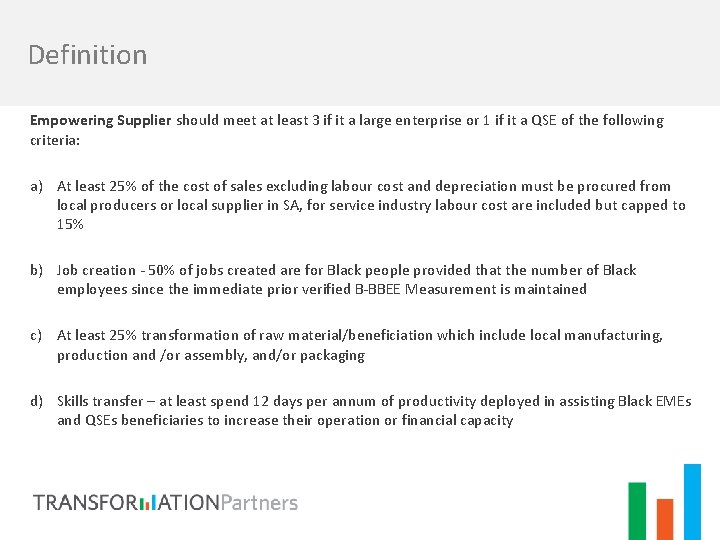
Definition Empowering Supplier should meet at least 3 if it a large enterprise or 1 if it a QSE of the following criteria: a) At least 25% of the cost of sales excluding labour cost and depreciation must be procured from local producers or local supplier in SA, for service industry labour cost are included but capped to 15% b) Job creation - 50% of jobs created are for Black people provided that the number of Black employees since the immediate prior verified B-BBEE Measurement is maintained c) At least 25% transformation of raw material/beneficiation which include local manufacturing, production and /or assembly, and/or packaging d) Skills transfer – at least spend 12 days per annum of productivity deployed in assisting Black EMEs and QSEs beneficiaries to increase their operation or financial capacity
Statement 500 The General Principles for Measuring Socio-Economic Development
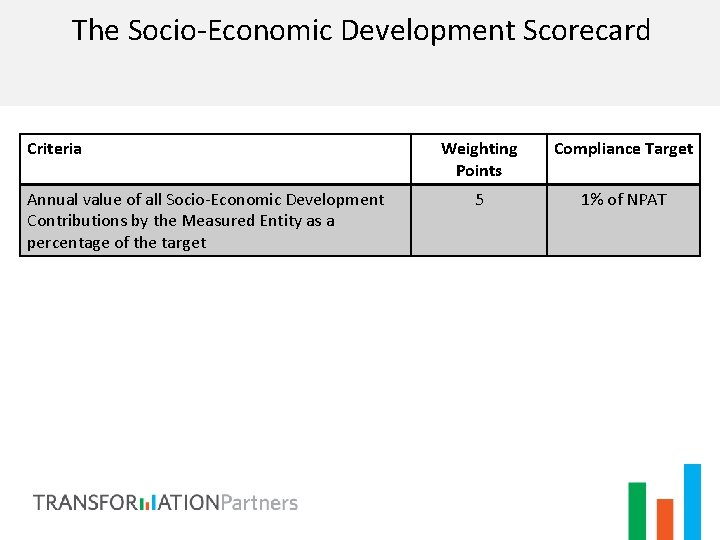
The Socio-Economic Development Scorecard Criteria Annual value of all Socio-Economic Development Contributions by the Measured Entity as a percentage of the target Weighting Points Compliance Target 5 1% of NPAT
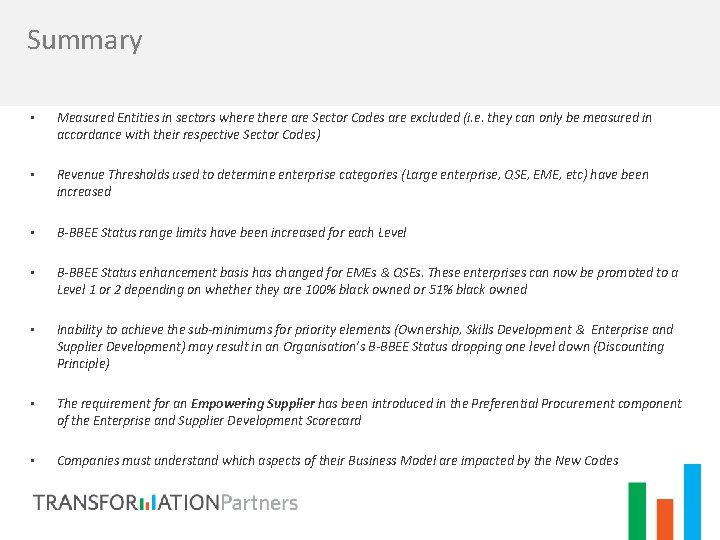
Summary • Measured Entities in sectors where there are Sector Codes are excluded (i. e. they can only be measured in accordance with their respective Sector Codes) • Revenue Thresholds used to determine enterprise categories (Large enterprise, QSE, EME, etc) have been increased • B-BBEE Status range limits have been increased for each Level • B-BBEE Status enhancement basis has changed for EMEs & QSEs. These enterprises can now be promoted to a Level 1 or 2 depending on whether they are 100% black owned or 51% black owned • Inability to achieve the sub-minimums for priority elements (Ownership, Skills Development & Enterprise and Supplier Development) may result in an Organisation’s B-BBEE Status dropping one level down (Discounting Principle) • The requirement for an Empowering Supplier has been introduced in the Preferential Procurement component of the Enterprise and Supplier Development Scorecard • Companies must understand which aspects of their Business Model are impacted by the New Codes
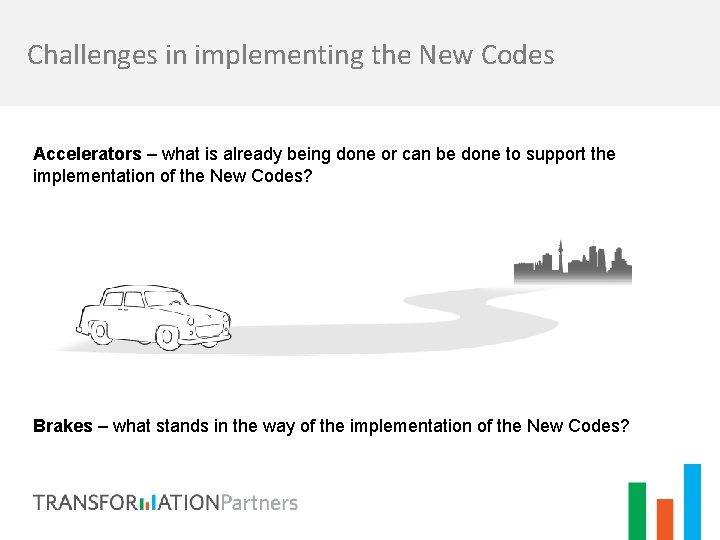
Challenges in implementing the New Codes Accelerators – what is already being done or can be done to support the implementation of the New Codes? Brakes – what stands in the way of the implementation of the New Codes?
Work Plan to deal with Challenges What needs to be done, to work towards the successful implementation of the New Codes?
Q & A with the Panel

Thank You
- Slides: 43