
New AMI API to Resolve Dependent Model Parameter
- Slides: 5
New AMI API to Resolve Dependent Model Parameter Fangyi Rao, Agilent Technologies 1 12/19/2021
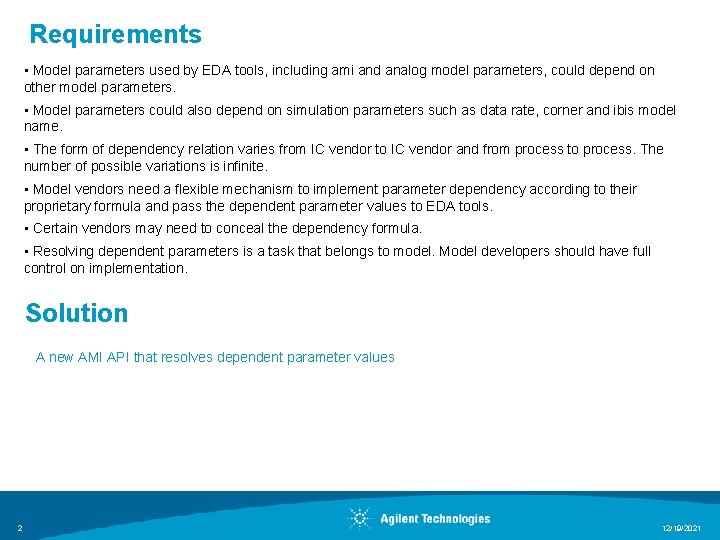
Requirements • Model parameters used by EDA tools, including ami and analog model parameters, could depend on other model parameters. • Model parameters could also depend on simulation parameters such as data rate, corner and ibis model name. • The form of dependency relation varies from IC vendor to IC vendor and from process to process. The number of possible variations is infinite. • Model vendors need a flexible mechanism to implement parameter dependency according to their proprietary formula and pass the dependent parameter values to EDA tools. • Certain vendors may need to conceal the dependency formula. • Resolving dependent parameters is a task that belongs to model. Model developers should have full control on implementation. Solution A new AMI API that resolves dependent parameter values 2 12/19/2021
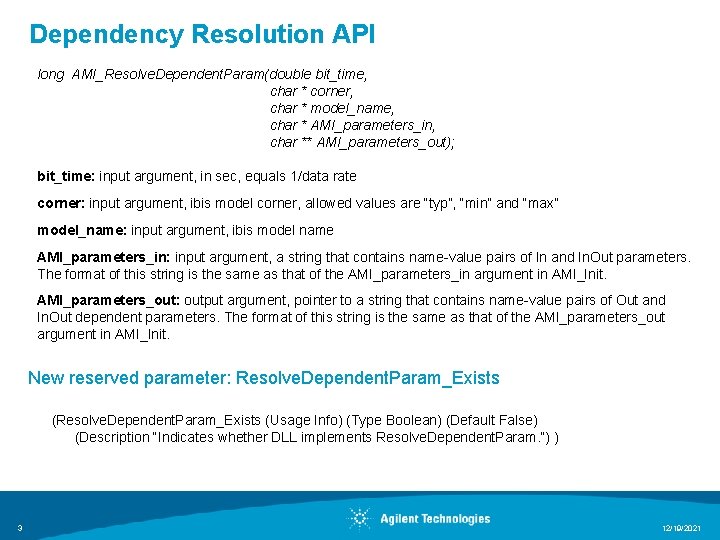
Dependency Resolution API long AMI_Resolve. Dependent. Param(double bit_time, char * corner, char * model_name, char * AMI_parameters_in, char ** AMI_parameters_out); bit_time: input argument, in sec, equals 1/data rate corner: input argument, ibis model corner, allowed values are “typ”, “min” and “max” model_name: input argument, ibis model name AMI_parameters_in: input argument, a string that contains name-value pairs of In and In. Out parameters. The format of this string is the same as that of the AMI_parameters_in argument in AMI_Init. AMI_parameters_out: output argument, pointer to a string that contains name-value pairs of Out and In. Out dependent parameters. The format of this string is the same as that of the AMI_parameters_out argument in AMI_Init. New reserved parameter: Resolve. Dependent. Param_Exists (Usage Info) (Type Boolean) (Default False) (Description “Indicates whether DLL implements Resolve. Dependent. Param. ”) ) 3 12/19/2021
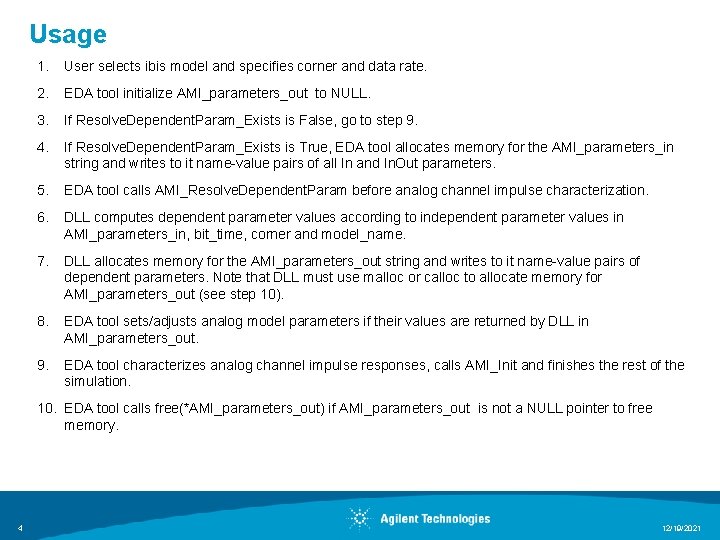
Usage 1. User selects ibis model and specifies corner and data rate. 2. EDA tool initialize AMI_parameters_out to NULL. 3. If Resolve. Dependent. Param_Exists is False, go to step 9. 4. If Resolve. Dependent. Param_Exists is True, EDA tool allocates memory for the AMI_parameters_in string and writes to it name-value pairs of all In and In. Out parameters. 5. EDA tool calls AMI_Resolve. Dependent. Param before analog channel impulse characterization. 6. DLL computes dependent parameter values according to independent parameter values in AMI_parameters_in, bit_time, corner and model_name. 7. DLL allocates memory for the AMI_parameters_out string and writes to it name-value pairs of dependent parameters. Note that DLL must use malloc or calloc to allocate memory for AMI_parameters_out (see step 10). 8. EDA tool sets/adjusts analog model parameters if their values are returned by DLL in AMI_parameters_out. 9. EDA tool characterizes analog channel impulse responses, calls AMI_Init and finishes the rest of the simulation. 10. EDA tool calls free(*AMI_parameters_out) if AMI_parameters_out is not a NULL pointer to free memory. 4 12/19/2021
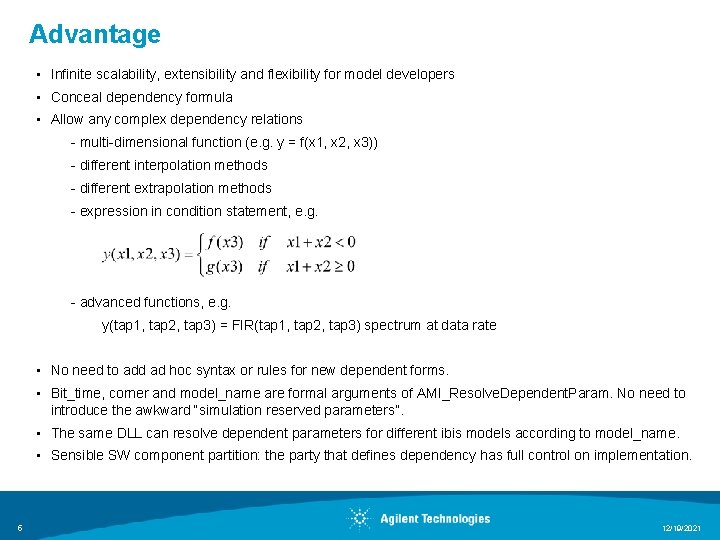
Advantage • Infinite scalability, extensibility and flexibility for model developers • Conceal dependency formula • Allow any complex dependency relations - multi-dimensional function (e. g. y = f(x 1, x 2, x 3)) - different interpolation methods - different extrapolation methods - expression in condition statement, e. g. - advanced functions, e. g. y(tap 1, tap 2, tap 3) = FIR(tap 1, tap 2, tap 3) spectrum at data rate • No need to add ad hoc syntax or rules for new dependent forms. • Bit_time, corner and model_name are formal arguments of AMI_Resolve. Dependent. Param. No need to introduce the awkward “simulation reserved parameters”. • The same DLL can resolve dependent parameters for different ibis models according to model_name. • Sensible SW component partition: the party that defines dependency has full control on implementation. 5 12/19/2021