
New algorithms for ADC Linearity Test Greatly reduce







- Slides: 91
New algorithms for ADC Linearity Test: Greatly reduce test time while maintaining or even improving test accuracy Degang Chen Iowa State University 1
Why ADC • ADC is the largest volume mixed-signal function • Widely embedded in many large circuits and systems • ADC performance is critical to overall system performance • ADC test is one of the most challenging and most costly tests 2
ADC test challenges and costs Many specs to be tested Require multiple accurate signal sources May require accurate timing control Need complex and accurate test circuitry Require long test time, especially for high performance ADCs for most ADCs, INL/DNL test take the longest time and is a dominant cost component • • • 3
Existing strategies • Built-in-self-test of ADC – Sunter et al, polynomial fitting – Roberts and students, on-chip signal sources – Cheng et al, loop back and control circuitry – Provost etal, on-chip linear ramp generators – Azais, on-chip ramps and histogram test – Arabi, oscillation based BIST – Jiang et al, DDEM source for histogram test 4
Existing strategies • Relax signal source requirements – Parthasarathy et al, low linearity ramp + slope error correction – Finland group, improved the above – Jin et al, stimulus error identification and removal – Alegria et al, small amp waves together with accurate steps 5
Existing strategies • Reduce data acquisition time – Jin et al, Kalman filter + histogram – Wegener et al, linear model + ID – Yu et al, pipeline model ID + reconstruction – Bernard et al, attentive test – Adamo et al, low freq INL – Chatterjee et al, reduced code test + reconstruction 6
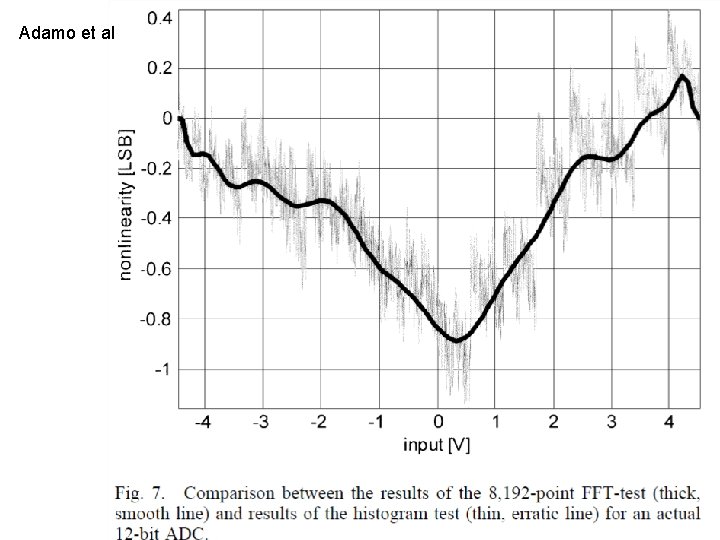
Low freq INL from FFT Adamo et al, Janik et al, Attivissimo et al, Kerzerho et al, Stefani et al, Wu et al • Chebyshev polynomial fitting – Use HD in FFT to estimate polynomial coeff – Use Chebyshev polynomial to predict low freq INL • Low pass filtering – Use reduced data set in sine wave histogram test – SHT produces “noisy” INL – Take FFT of noisy INL, ideal low pass filter – Take IFFT to find low freq INL • Moving average filter 7
Adamo et al 8
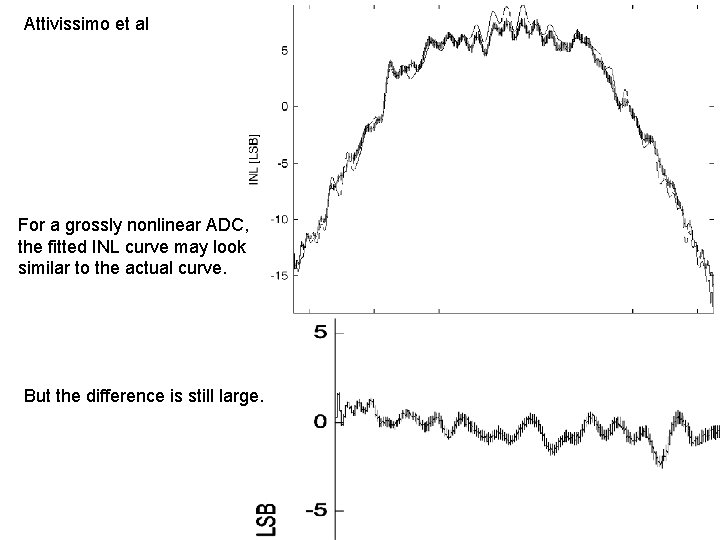
Attivissimo et al For a grossly nonlinear ADC, the fitted INL curve may look similar to the actual curve. But the difference is still large. 9
Complexity • Number of data points in FFT: M • Number of terms in curve fitting: Nh • Complexity: – Nh 2*M to set up equation – Nh 3 for matrix inversion 10
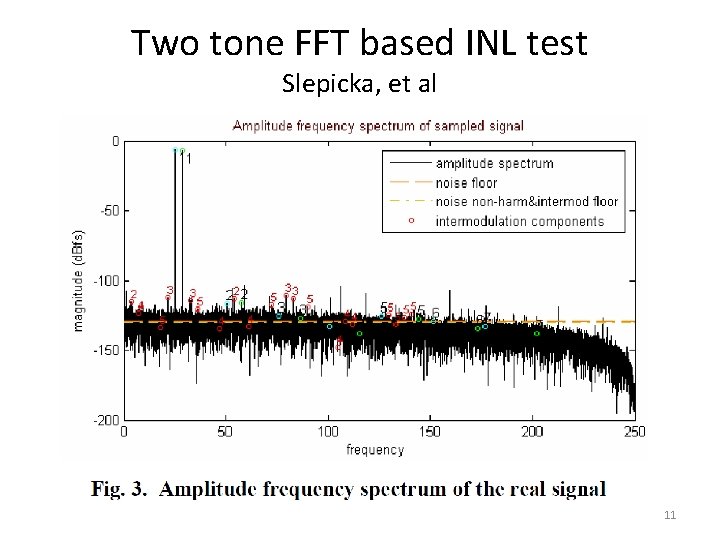
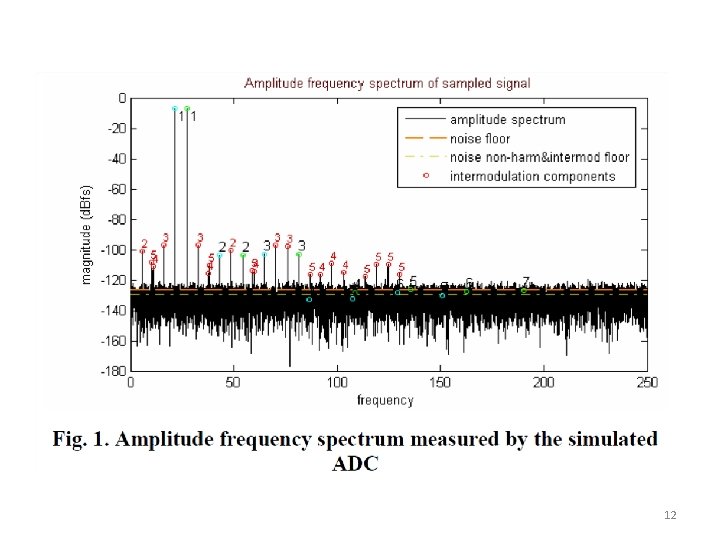
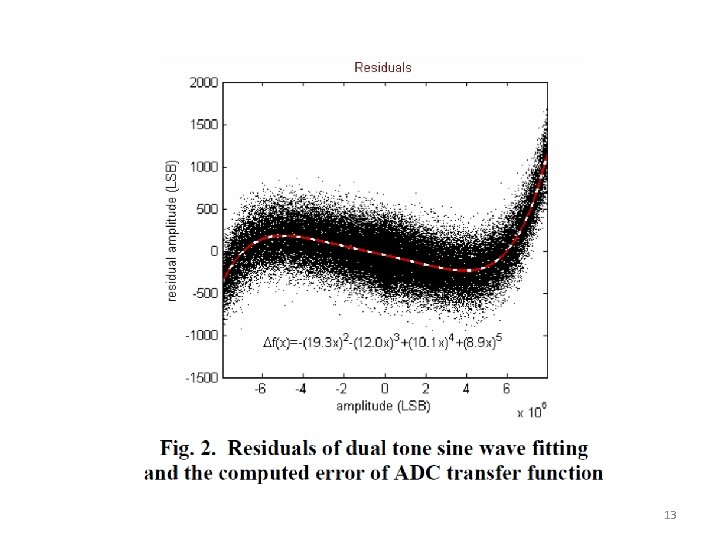
Two tone FFT based INL test Slepicka, et al 11
12
13
Chatterjee and students • Alternate ADC testing – Based on linear regression model – Use large numbers of known good ADC to train – Fit new ADC response to model and detect diff – Worked with TI for years on this – Is TI putting this into production test? • Basic challenge: customer question • Relation to new algorithm: none 14
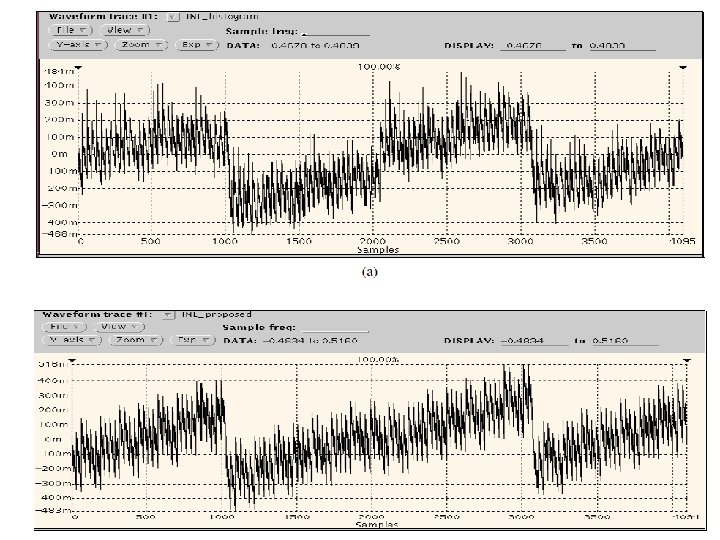
Chatterjee and students, (2) • Reduced code test – Based on characterization, find a subset of codes that are more prone to process variations – Use piecewise linear ramps to test code bin width of these codes – Use SAR structure’s linear model to reconstruct full code INL • Significant INL test time reduction: up to 75% • Measurement results for 12 bit ADC 15
16
Chatterjee and students, (3) • Complexity – Algorithm and hardware rely on knowledge of trouble spots – Not clear if it will catch unpredicted PVT effects • Limited measurement results – Same 5 devices in multiple papers – All devices are good devices: INL/DNL ± 0. 5 LSB – No marginal or bad devices measured • Limited comparison – Only compared max INL, min INL, max DNL, min DNL – Peaks happen at different locations – INL curve shape and individual INL values not compared 17
Goals of new INL Test Solution • Greatly reduce, or eliminate, data acquisition time for INL/DNL test • Maintain, or even significantly improve, test validity or test accuracy • Flexible on type of stimulus • Efficient in computation • Adaptable to various ADC structures 18
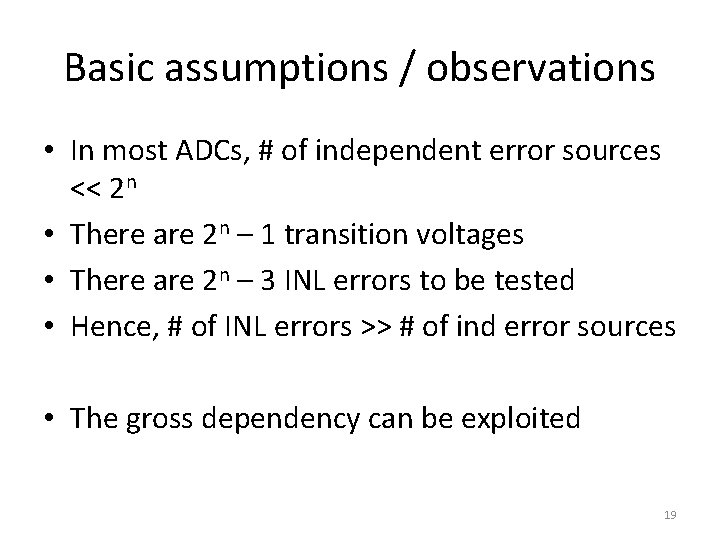
Basic assumptions / observations • In most ADCs, # of independent error sources << 2 n • There are 2 n – 1 transition voltages • There are 2 n – 3 INL errors to be tested • Hence, # of INL errors >> # of ind error sources • The gross dependency can be exploited 19
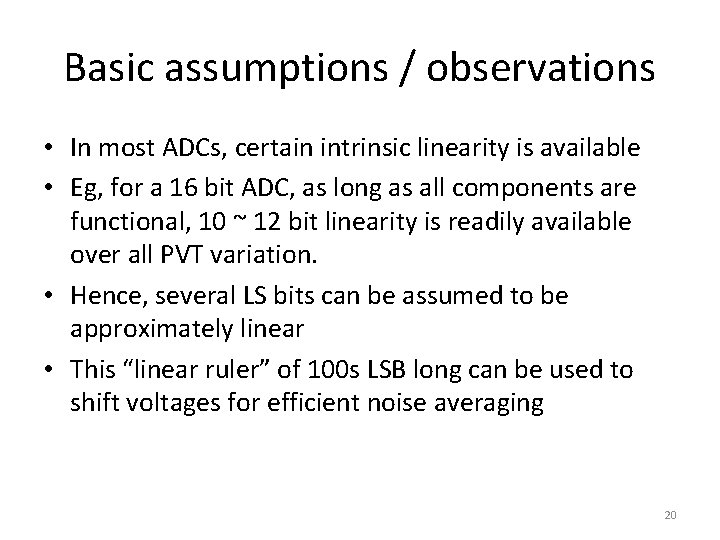
Basic assumptions / observations • In most ADCs, certain intrinsic linearity is available • Eg, for a 16 bit ADC, as long as all components are functional, 10 ~ 12 bit linearity is readily available over all PVT variation. • Hence, several LS bits can be assumed to be approximately linear • This “linear ruler” of 100 s LSB long can be used to shift voltages for efficient noise averaging 20
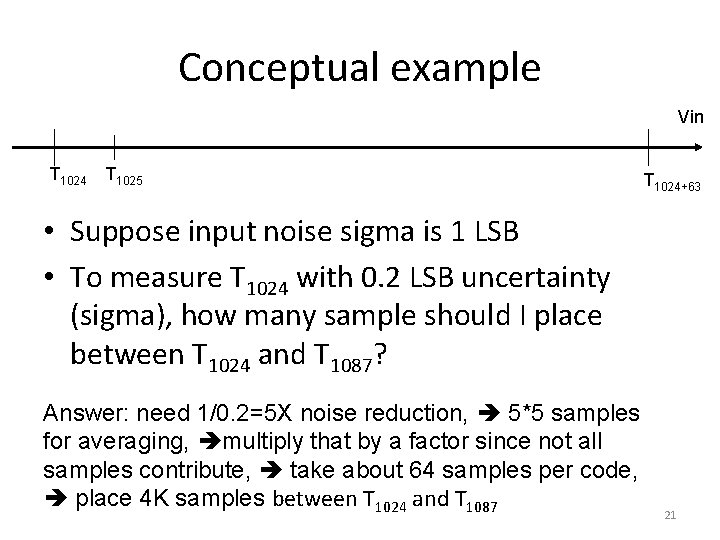
Conceptual example Vin T 1024 T 1025 T 1024+63 • Suppose input noise sigma is 1 LSB • To measure T 1024 with 0. 2 LSB uncertainty (sigma), how many sample should I place between T 1024 and T 1087? Answer: need 1/0. 2=5 X noise reduction, 5*5 samples for averaging, multiply that by a factor since not all samples contribute, take about 64 samples per code, place 4 K samples between T 1024 and T 1087 21
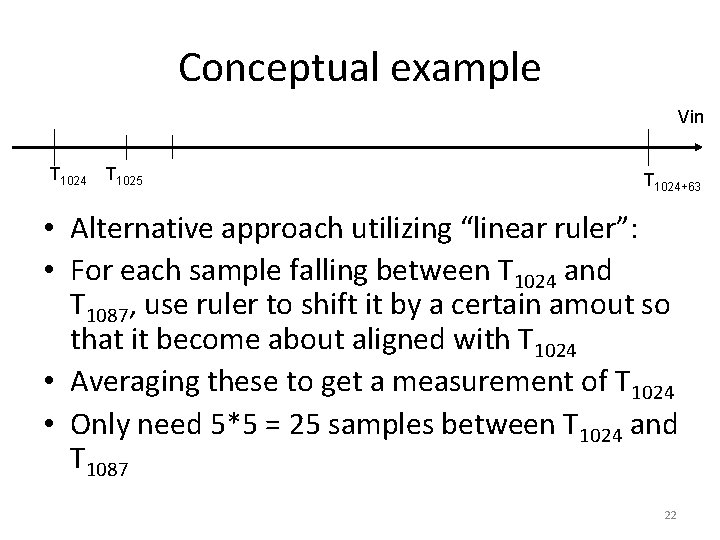
Conceptual example Vin T 1024 T 1025 T 1024+63 • Alternative approach utilizing “linear ruler”: • For each sample falling between T 1024 and T 1087, use ruler to shift it by a certain amout so that it become about aligned with T 1024 • Averaging these to get a measurement of T 1024 • Only need 5*5 = 25 samples between T 1024 and T 1087 22
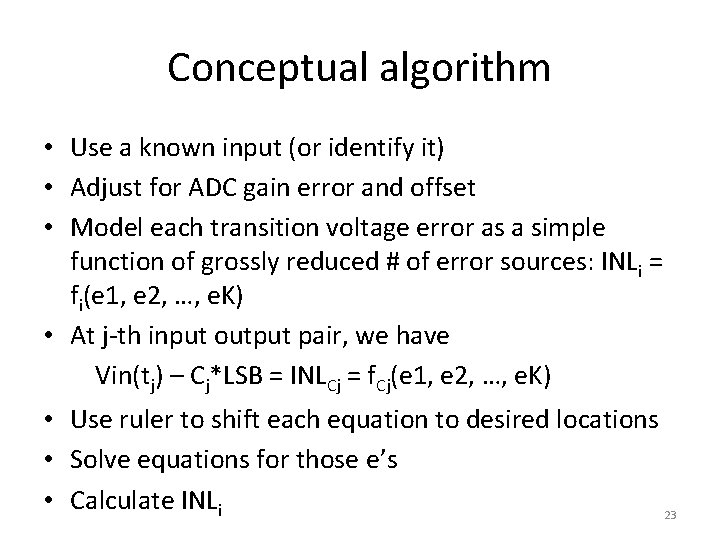
Conceptual algorithm • Use a known input (or identify it) • Adjust for ADC gain error and offset • Model each transition voltage error as a simple function of grossly reduced # of error sources: INLi = fi(e 1, e 2, …, e. K) • At j-th input output pair, we have Vin(tj) – Cj*LSB = INLCj = f. Cj(e 1, e 2, …, e. K) • Use ruler to shift each equation to desired locations • Solve equations for those e’s • Calculate INLi 23
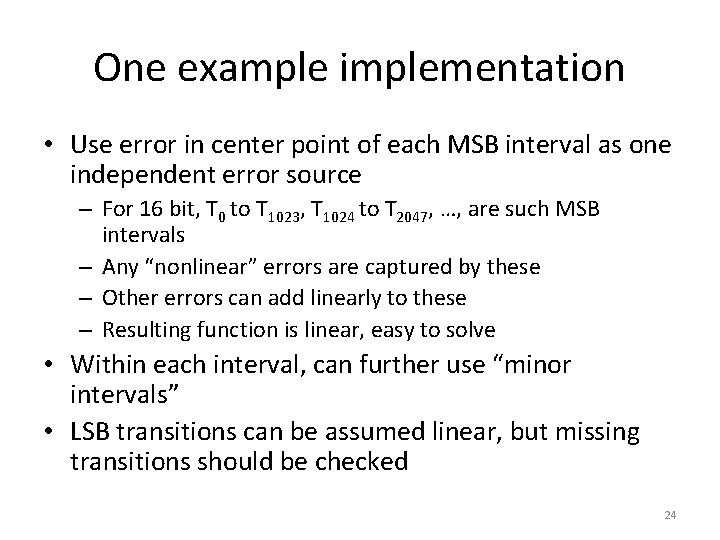
One example implementation • Use error in center point of each MSB interval as one independent error source – For 16 bit, T 0 to T 1023, T 1024 to T 2047, …, are such MSB intervals – Any “nonlinear” errors are captured by these – Other errors can add linearly to these – Resulting function is linear, easy to solve • Within each interval, can further use “minor intervals” • LSB transitions can be assumed linear, but missing transitions should be checked 24
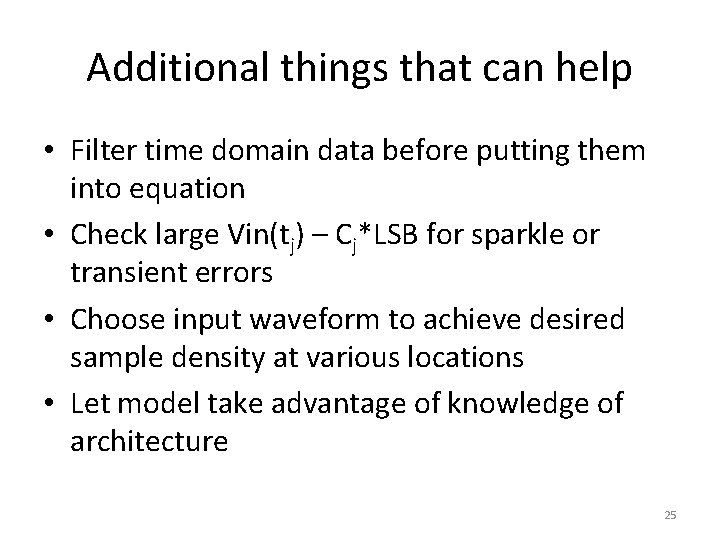
Additional things that can help • Filter time domain data before putting them into equation • Check large Vin(tj) – Cj*LSB for sparkle or transient errors • Choose input waveform to achieve desired sample density at various locations • Let model take advantage of knowledge of architecture 25
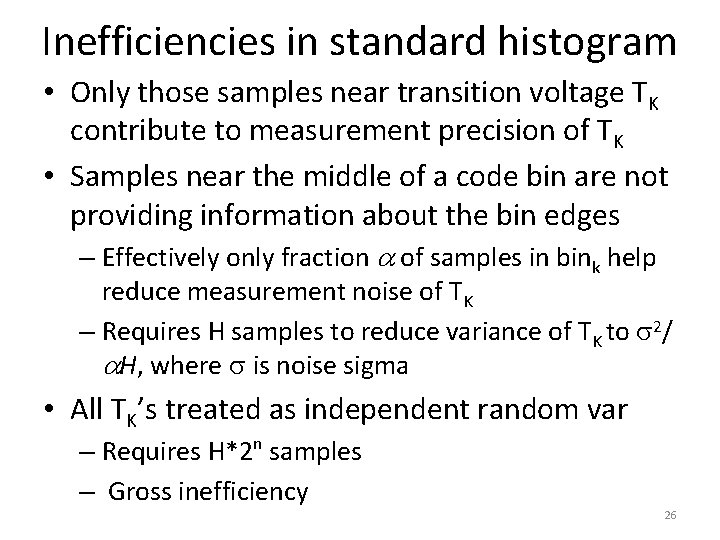
Inefficiencies in standard histogram • Only those samples near transition voltage TK contribute to measurement precision of TK • Samples near the middle of a code bin are not providing information about the bin edges – Effectively only fraction a of samples in bink help reduce measurement noise of TK – Requires H samples to reduce variance of TK to s 2/ a. H, where s is noise sigma • All TK’s treated as independent random var – Requires H*2 n samples – Gross inefficiency 26
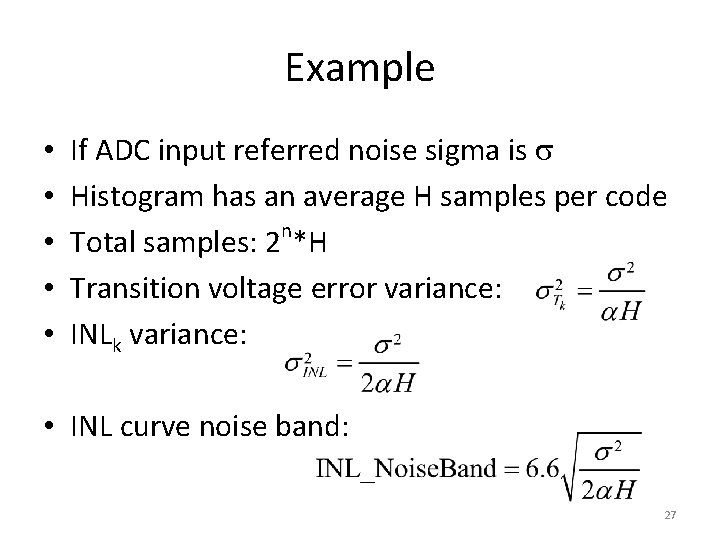
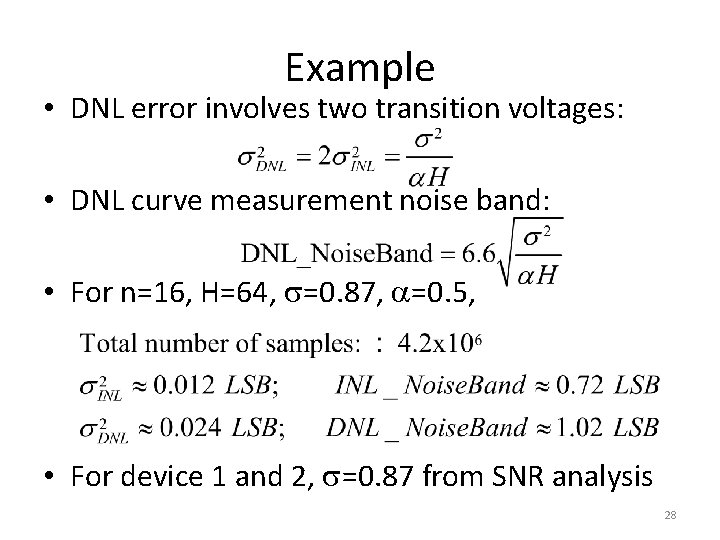
Example • • • If ADC input referred noise sigma is s Histogram has an average H samples per code Total samples: 2 n*H Transition voltage error variance: INLk variance: • INL curve noise band: 27
Example • DNL error involves two transition voltages: • DNL curve measurement noise band: • For n=16, H=64, s=0. 87, a=0. 5, • For device 1 and 2, s=0. 87 from SNR analysis 28
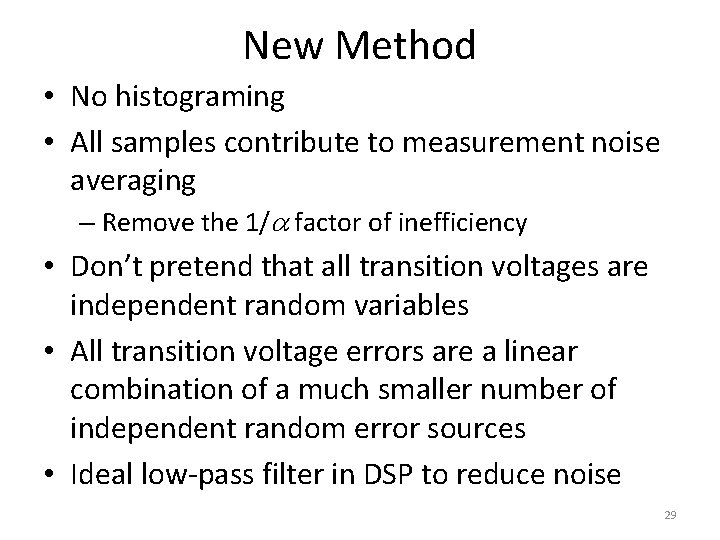
New Method • No histograming • All samples contribute to measurement noise averaging – Remove the 1/a factor of inefficiency • Don’t pretend that all transition voltages are independent random variables • All transition voltage errors are a linear combination of a much smaller number of independent random error sources • Ideal low-pass filter in DSP to reduce noise 29
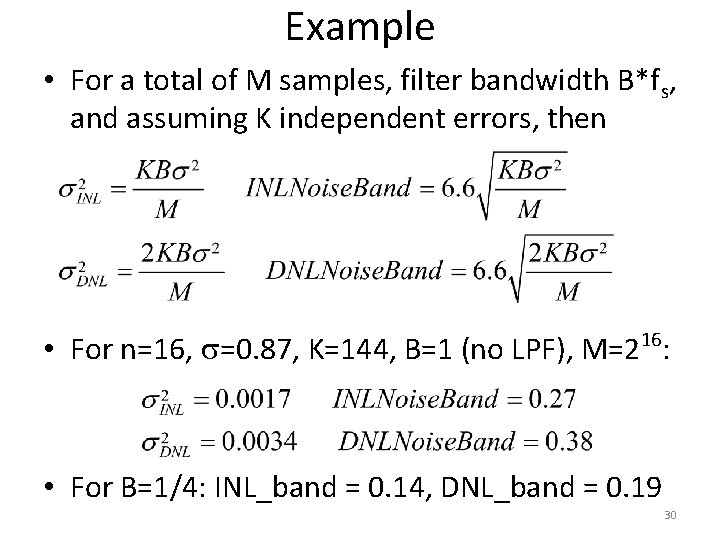
Example • For a total of M samples, filter bandwidth B*fs, and assuming K independent errors, then • For n=16, s=0. 87, K=144, B=1 (no LPF), M=216: • For B=1/4: INL_band = 0. 14, DNL_band = 0. 19 30
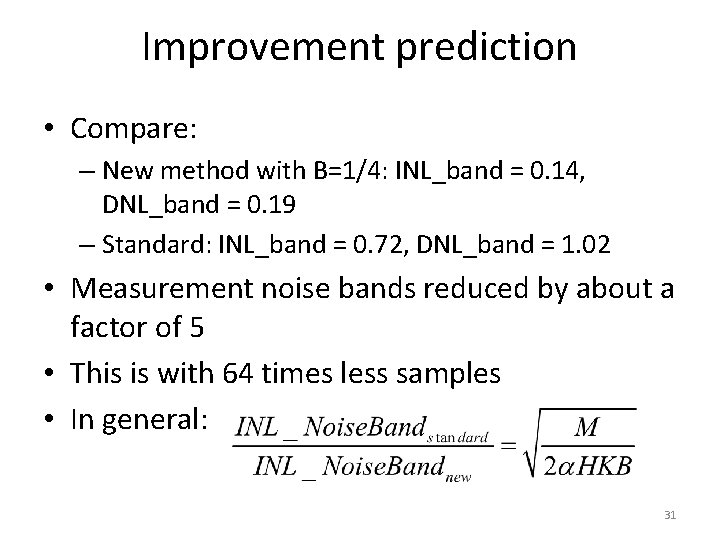
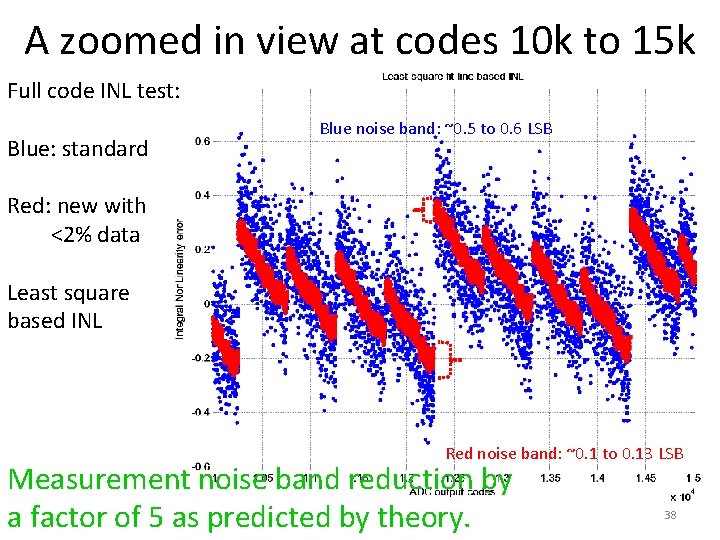
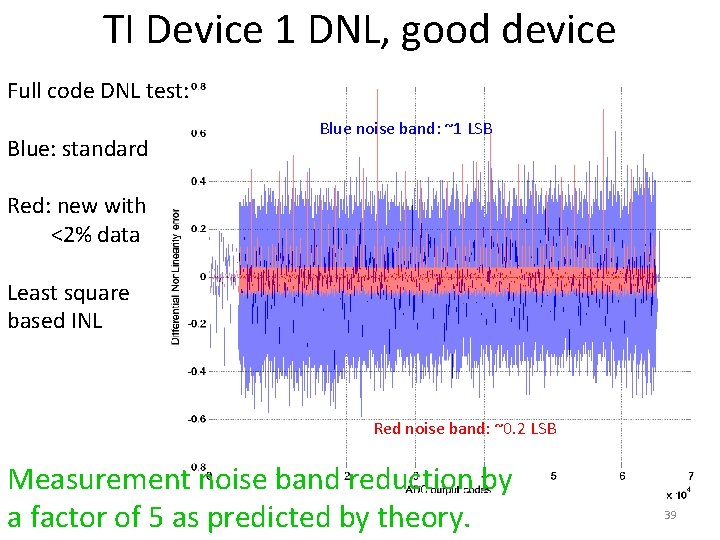
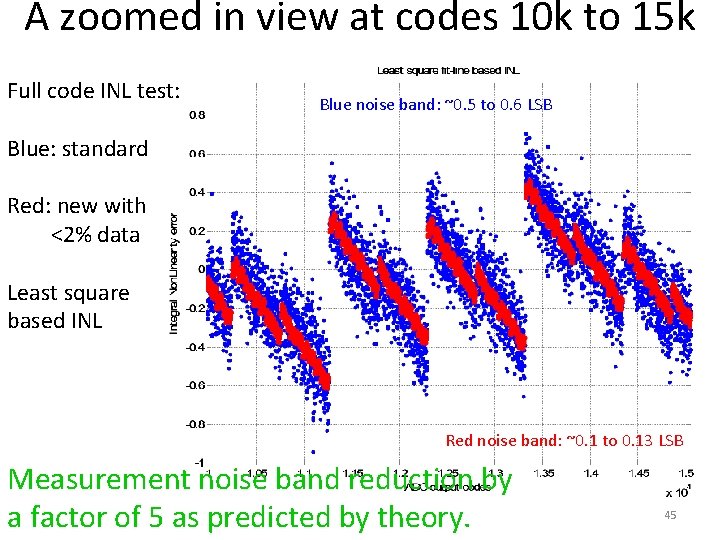
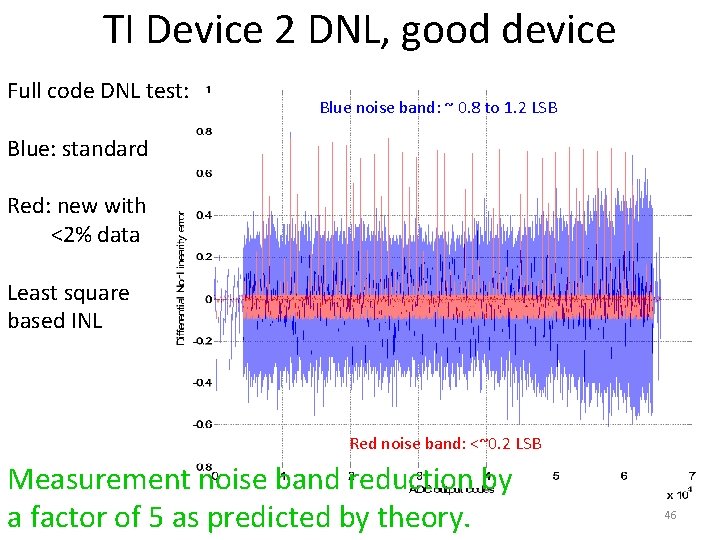
Improvement prediction • Compare: – New method with B=1/4: INL_band = 0. 14, DNL_band = 0. 19 – Standard: INL_band = 0. 72, DNL_band = 1. 02 • Measurement noise bands reduced by about a factor of 5 • This is with 64 times less samples • In general: 31
Evaluation of new algorithm • Did extensive simulation – New algorithm achieves much better test accuracy with much reduced # of samples, as compared to standard histogram method – Simulation on various ADC architectures: SAR, pipeline, sub-ranging, moderately high resolution flash • Measurement results – ISU, TI, NSC – Various resolutions 32
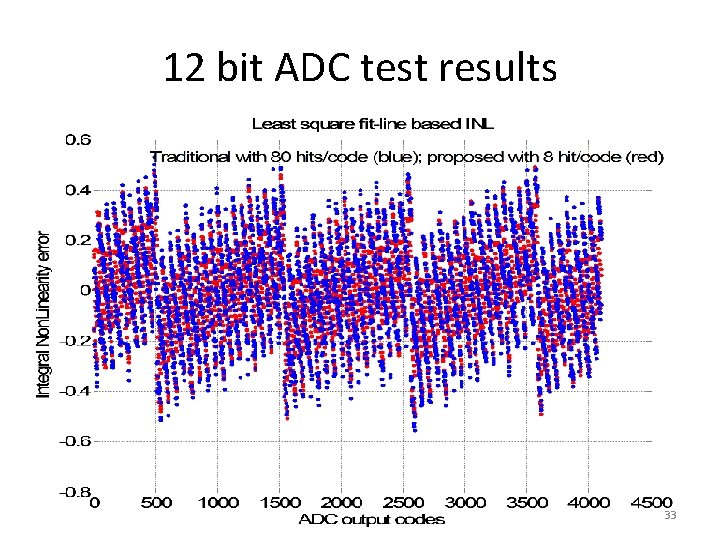
12 bit ADC test results 33
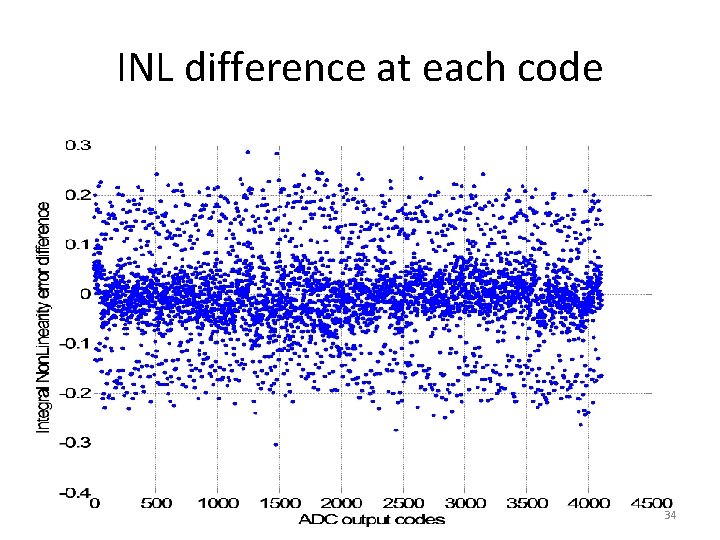
INL difference at each code 34
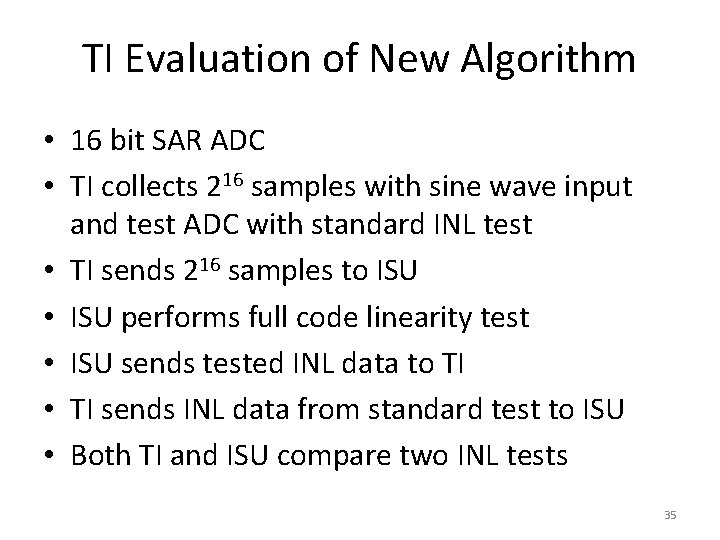
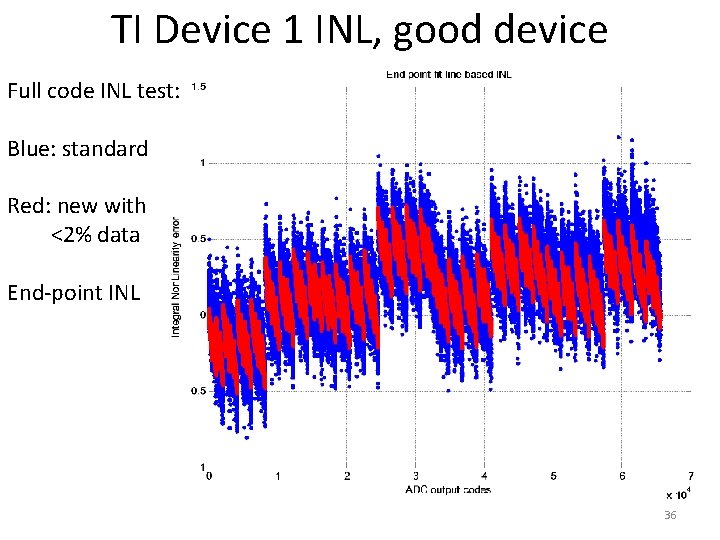
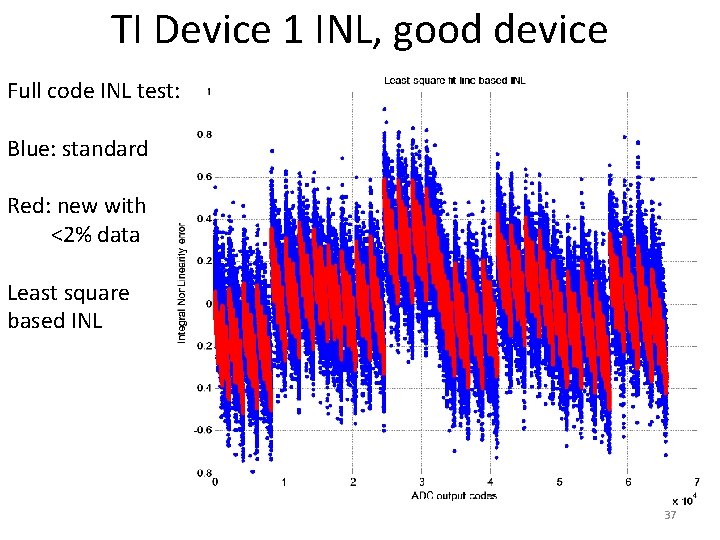
TI Evaluation of New Algorithm • 16 bit SAR ADC • TI collects 216 samples with sine wave input and test ADC with standard INL test • TI sends 216 samples to ISU • ISU performs full code linearity test • ISU sends tested INL data to TI • TI sends INL data from standard test to ISU • Both TI and ISU compare two INL tests 35
TI Device 1 INL, good device Full code INL test: Blue: standard Red: new with <2% data End-point INL 36
TI Device 1 INL, good device Full code INL test: Blue: standard Red: new with <2% data Least square based INL 37
A zoomed in view at codes 10 k to 15 k Full code INL test: Blue: standard Blue noise band: ~0. 5 to 0. 6 LSB Red: new with <2% data Least square based INL Red noise band: ~0. 1 to 0. 13 LSB Measurement noise band reduction by a factor of 5 as predicted by theory. 38
TI Device 1 DNL, good device Full code DNL test: Blue: standard Blue noise band: ~1 LSB Red: new with <2% data Least square based INL Red noise band: ~0. 2 LSB Measurement noise band reduction by a factor of 5 as predicted by theory. 39
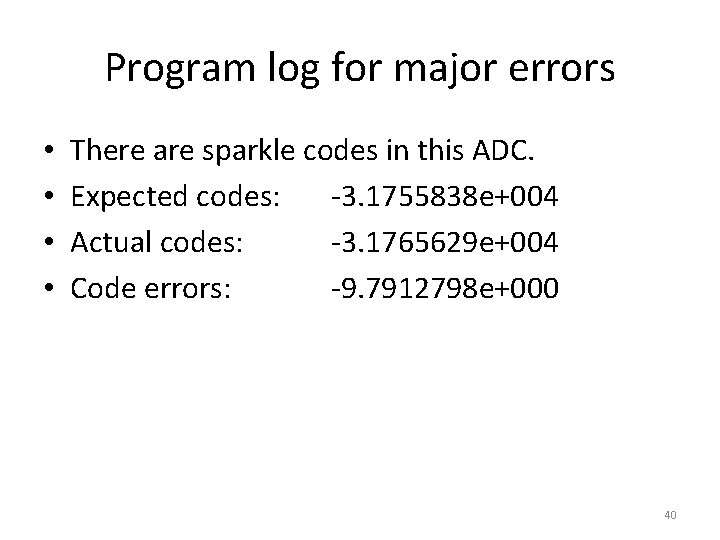
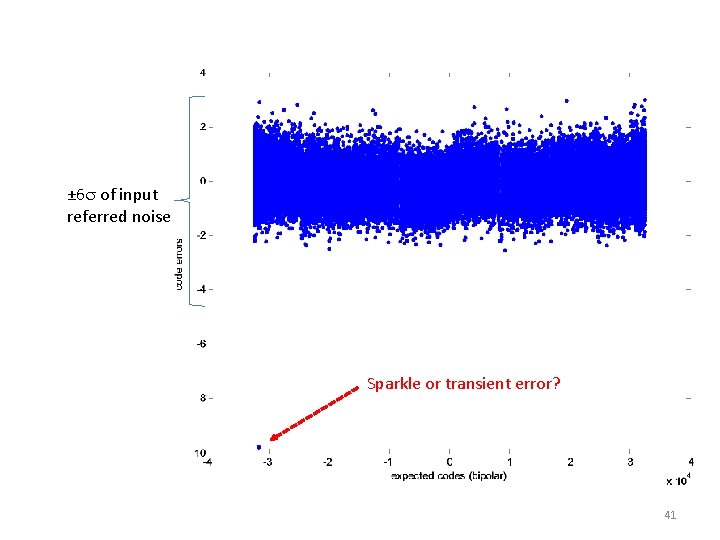
Program log for major errors • • There are sparkle codes in this ADC. Expected codes: -3. 1755838 e+004 Actual codes: -3. 1765629 e+004 Code errors: -9. 7912798 e+000 40
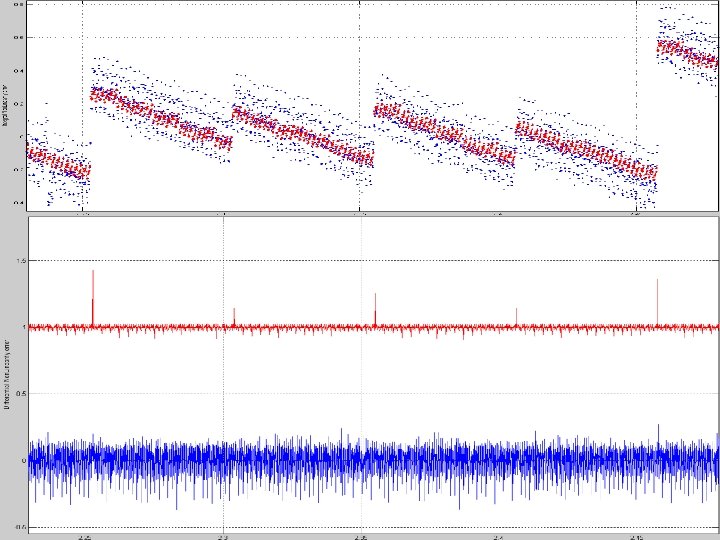
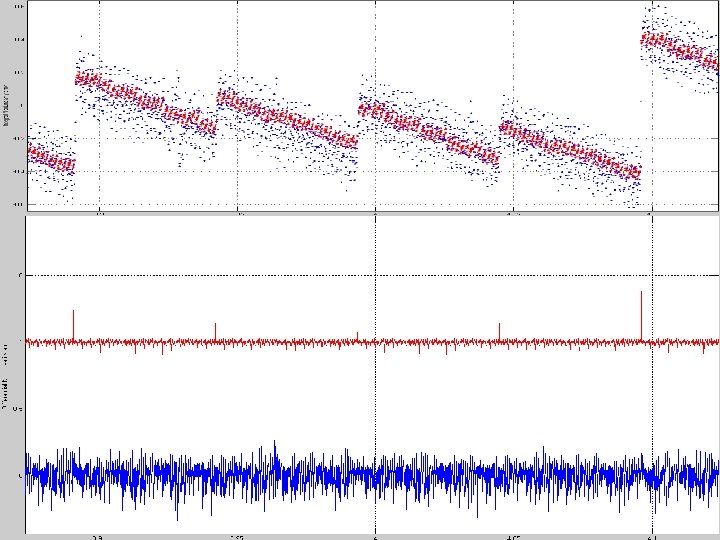
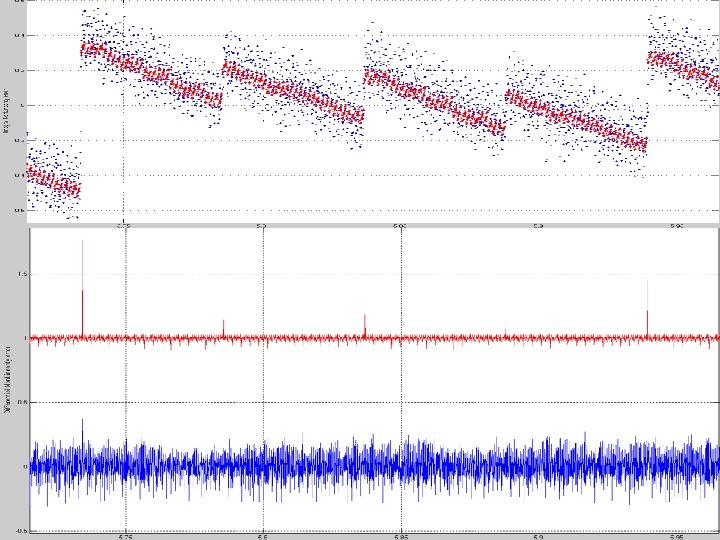
± 6 s of input referred noise Sparkle or transient error? 41
Device 1 with 214 samples • Further reduce #samples by a factor of 4 • Keep same number of ind error sources • Same filtering • Theory expect noise band to double 42
43
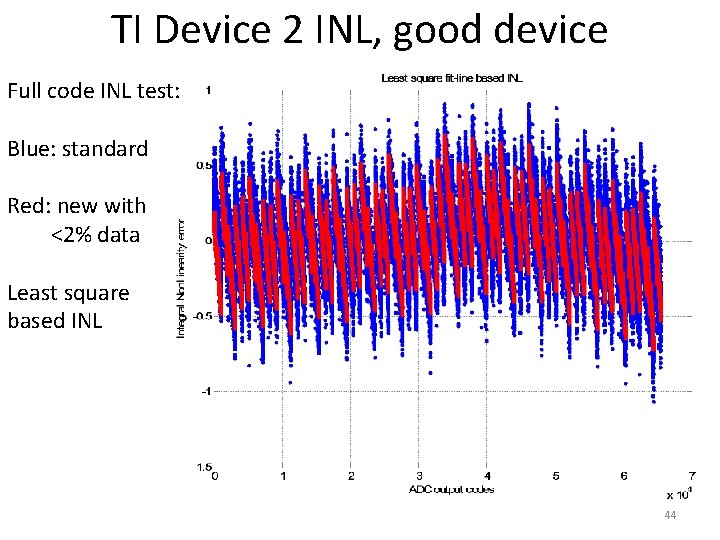
TI Device 2 INL, good device Full code INL test: Blue: standard Red: new with <2% data Least square based INL 44
A zoomed in view at codes 10 k to 15 k Full code INL test: Blue noise band: ~0. 5 to 0. 6 LSB Blue: standard Red: new with <2% data Least square based INL Red noise band: ~0. 1 to 0. 13 LSB Measurement noise band reduction by a factor of 5 as predicted by theory. 45
TI Device 2 DNL, good device Full code DNL test: Blue noise band: ~ 0. 8 to 1. 2 LSB Blue: standard Red: new with <2% data Least square based INL Red noise band: <~0. 2 LSB Measurement noise band reduction by a factor of 5 as predicted by theory. 46
Program log for major errors • • There are sparkle codes in this ADC. Expected codes: -2. 6234594 e+004 Actual codes: -2. 6267029 e+004 Code errors: -3. 2435467 e+001 47
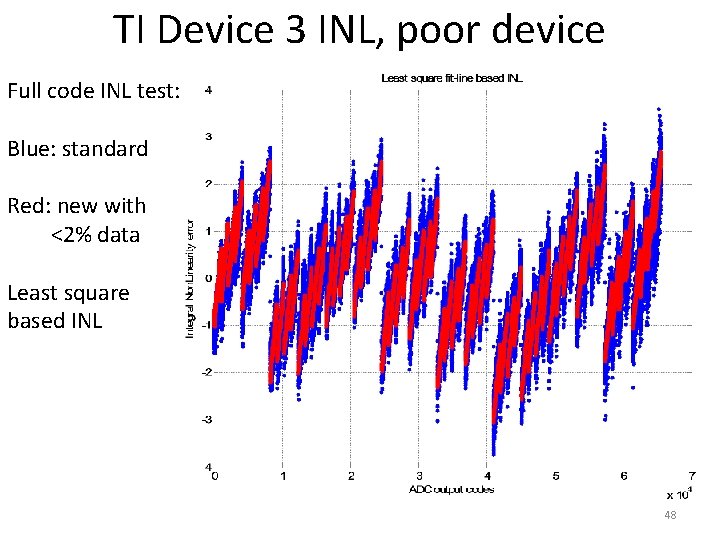
TI Device 3 INL, poor device Full code INL test: Blue: standard Red: new with <2% data Least square based INL 48
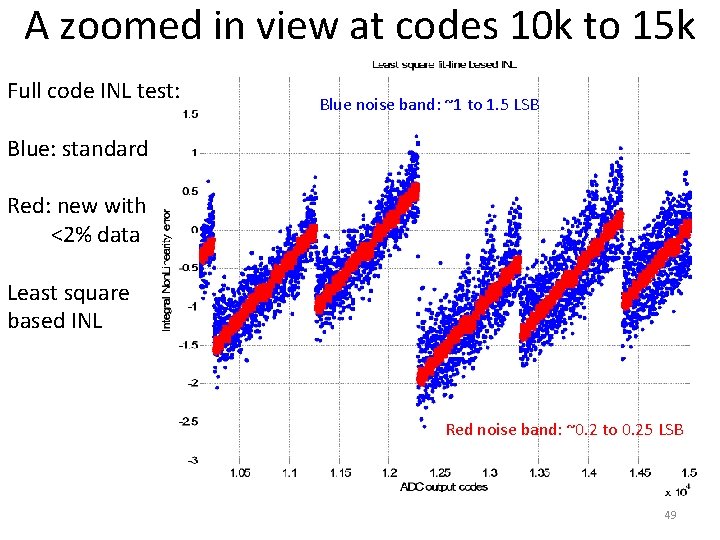
A zoomed in view at codes 10 k to 15 k Full code INL test: Blue noise band: ~1 to 1. 5 LSB Blue: standard Red: new with <2% data Least square based INL Red noise band: ~0. 2 to 0. 25 LSB 49
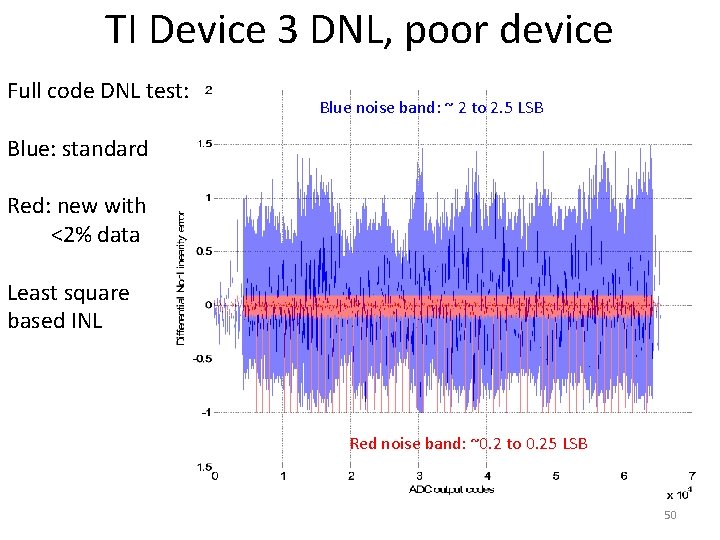
TI Device 3 DNL, poor device Full code DNL test: Blue noise band: ~ 2 to 2. 5 LSB Blue: standard Red: new with <2% data Least square based INL Red noise band: ~0. 2 to 0. 25 LSB 50
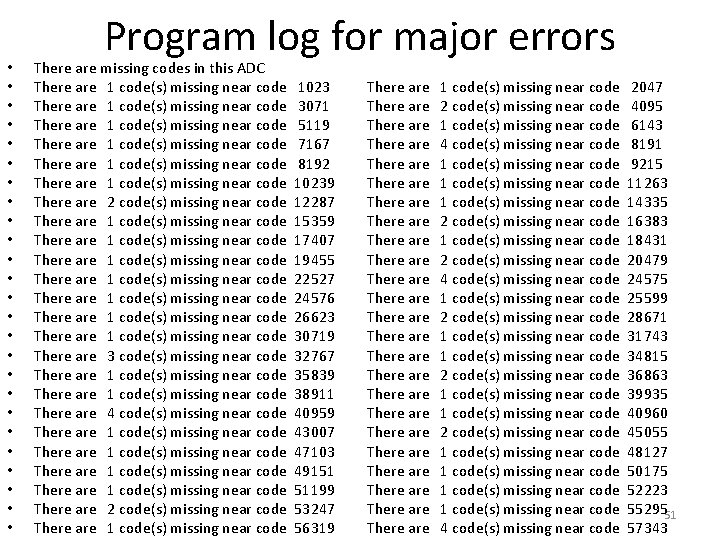
• • • • • • • Program log for major errors There are missing codes in this ADC There are 1 code(s) missing near code There are 1 code(s) missing near code There are 2 code(s) missing near code There are 1 code(s) missing near code There are 1 code(s) missing near code There are 3 code(s) missing near code There are 1 code(s) missing near code There are 4 code(s) missing near code There are 1 code(s) missing near code There are 2 code(s) missing near code There are 1 code(s) missing near code 1023 3071 5119 7167 8192 10239 12287 15359 17407 19455 22527 24576 26623 30719 32767 35839 38911 40959 43007 47103 49151 51199 53247 56319 There are There are There are There are There are There are 1 code(s) missing near code 2 code(s) missing near code 1 code(s) missing near code 4 code(s) missing near code 1 code(s) missing near code 2 code(s) missing near code 4 code(s) missing near code 1 code(s) missing near code 2 code(s) missing near code 1 code(s) missing near code 1 code(s) missing near code 4 code(s) missing near code 2047 4095 6143 8191 9215 11263 14335 16383 18431 20479 24575 25599 28671 31743 34815 36863 39935 40960 45055 48127 50175 52223 5529551 57343
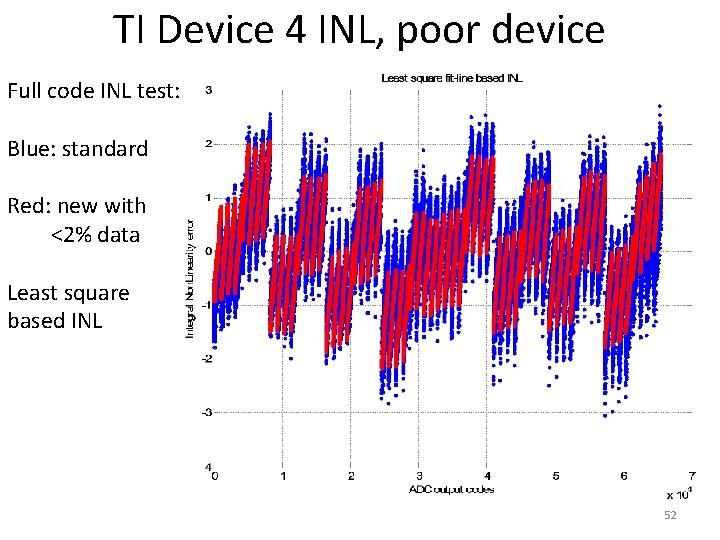
TI Device 4 INL, poor device Full code INL test: Blue: standard Red: new with <2% data Least square based INL 52
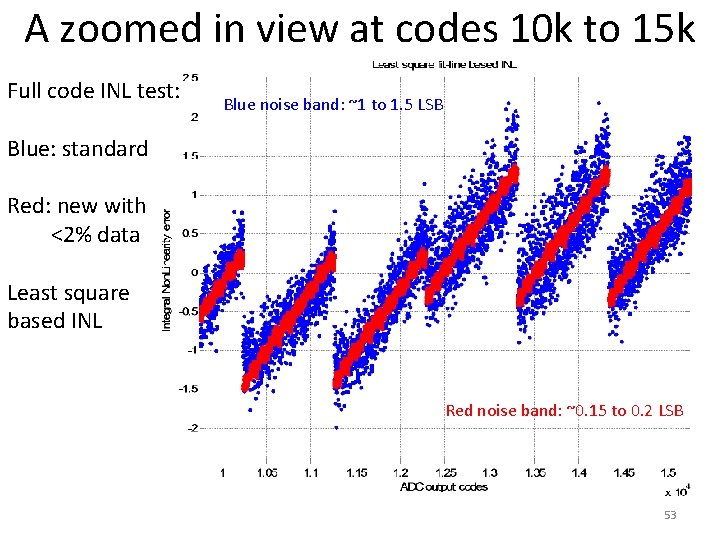
A zoomed in view at codes 10 k to 15 k Full code INL test: Blue noise band: ~1 to 1. 5 LSB Blue: standard Red: new with <2% data Least square based INL Red noise band: ~0. 15 to 0. 2 LSB 53
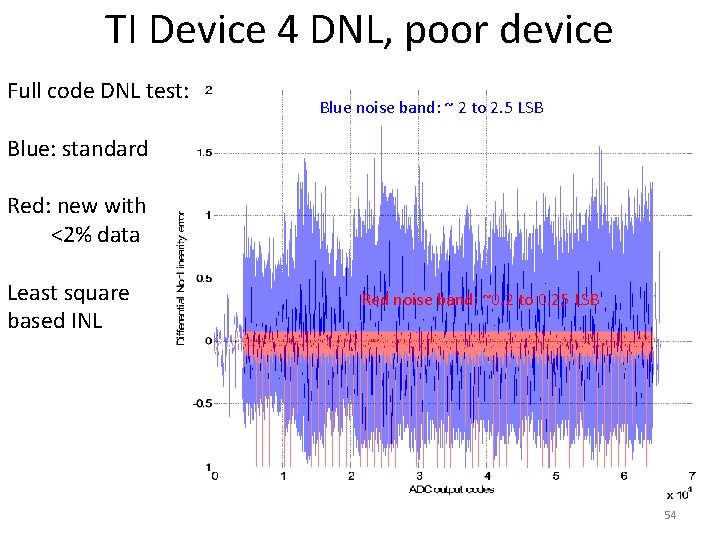
TI Device 4 DNL, poor device Full code DNL test: Blue noise band: ~ 2 to 2. 5 LSB Blue: standard Red: new with <2% data Least square based INL Red noise band: ~0. 2 to 0. 25 LSB 54
Observations • INL curves – Very similar shape – Measurement noise band reduced as predicted – Still non-trial differences – Is new method accurate? • DNL curves – Clear patterns in new method – Pattern corresponds well with INL curves – No clear pattern in standard histogram method 55
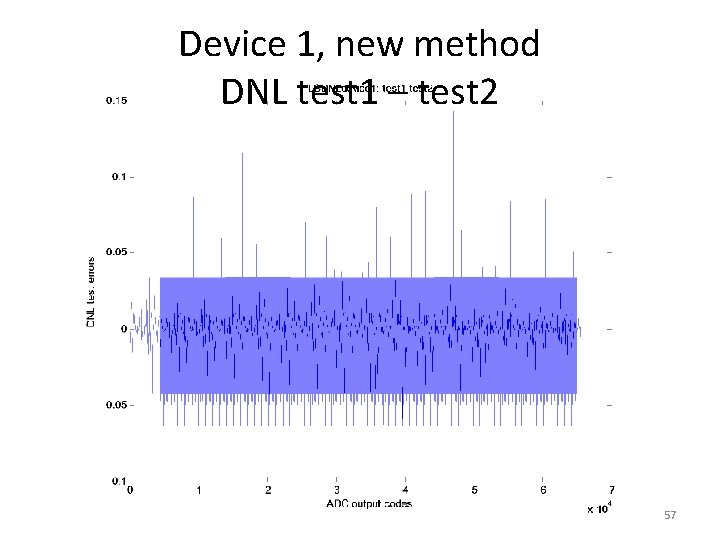
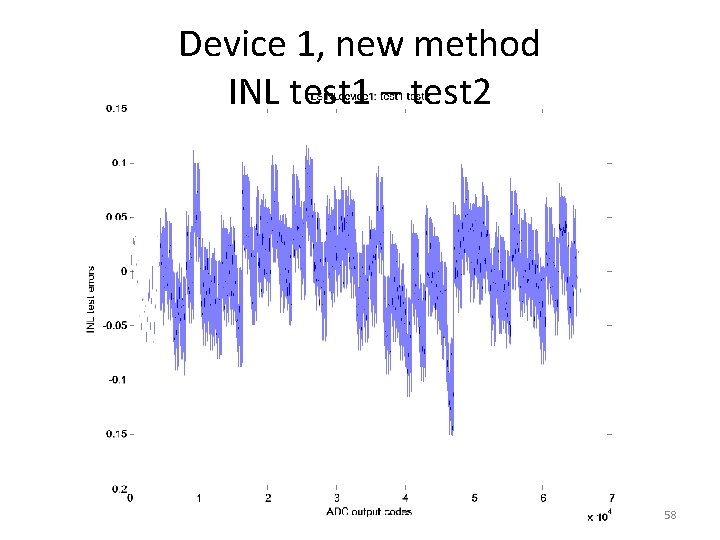
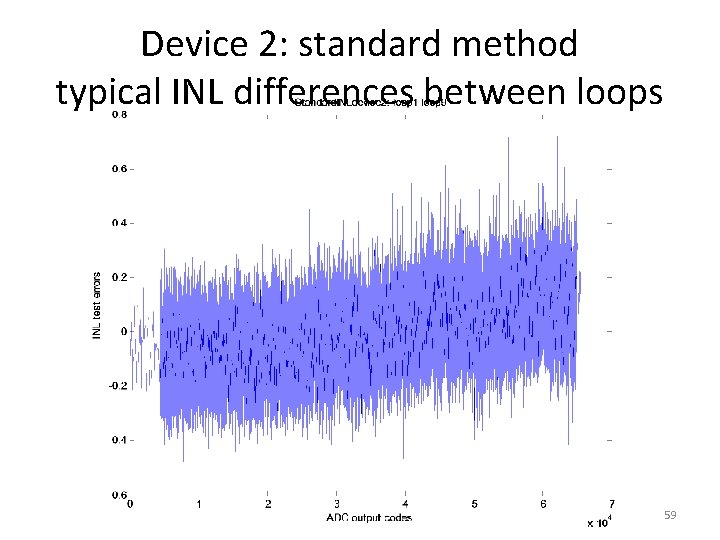
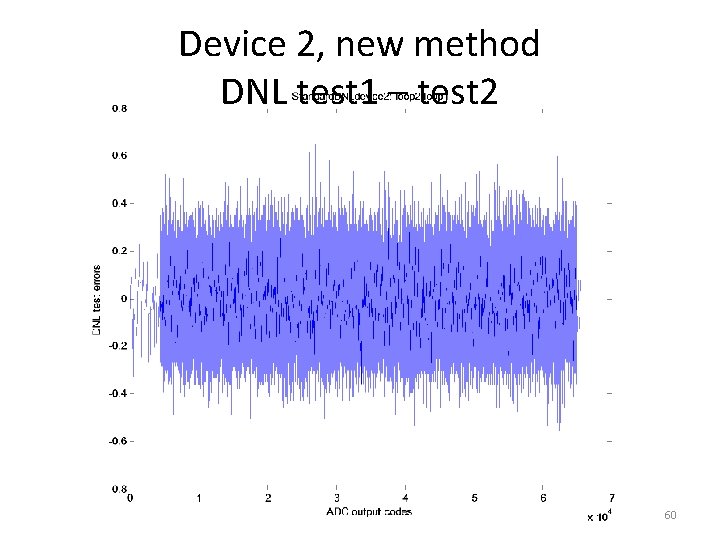
Assess test precision • Compare differences from run to run • Repeat standard method many times and use average results for comparison 56
Device 1, new method DNL test 1 – test 2 57
Device 1, new method INL test 1 – test 2 58
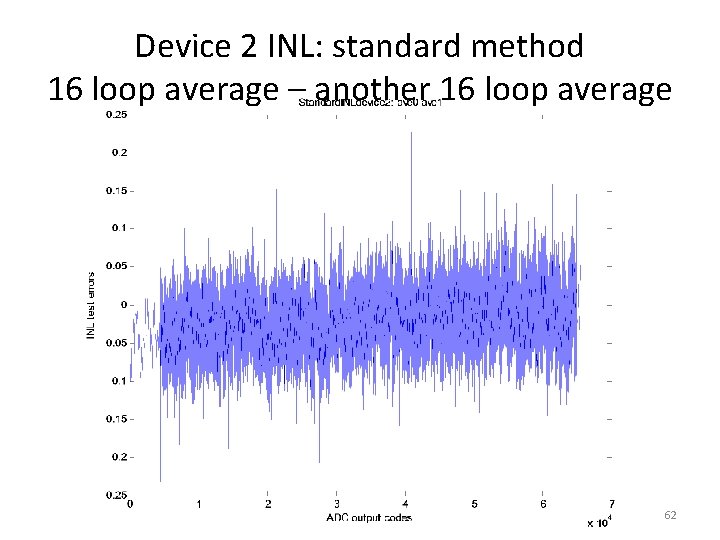
Device 2: standard method typical INL differences between loops 59
Device 2, new method DNL test 1 – test 2 60
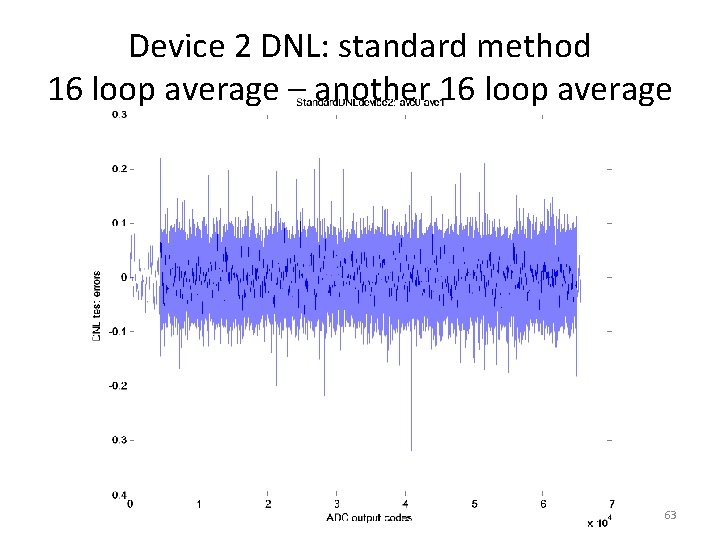
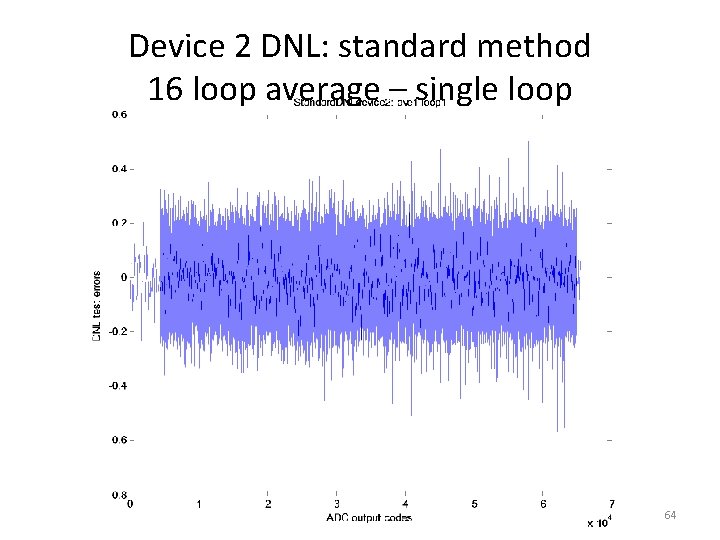
Averaging the standard method • For device 1 and 2, the standard method is applied to each device 16 loops • The 16 loops were repeated at another time, producing two groups of 16 runs for each device • Two averages of 16 loops were obtained, and one average of 32 loops was obtained • Average to average, average to single loop, and average to new method were compared 61
Device 2 INL: standard method 16 loop average – another 16 loop average 62
Device 2 DNL: standard method 16 loop average – another 16 loop average 63
Device 2 DNL: standard method 16 loop average – single loop 64
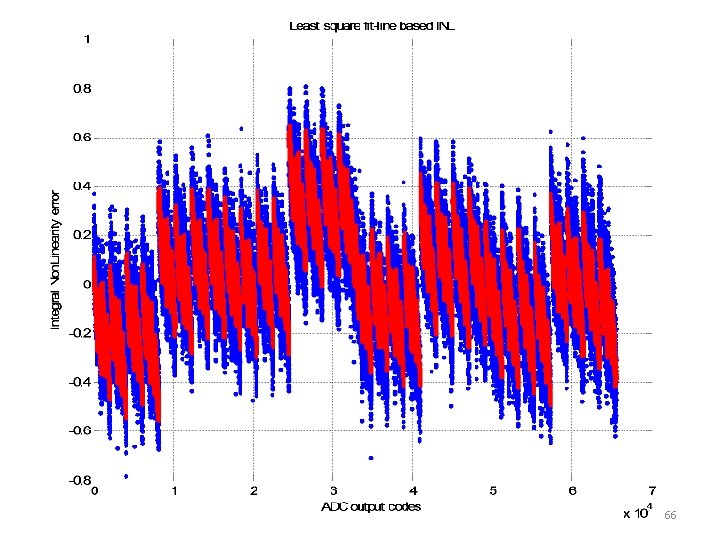
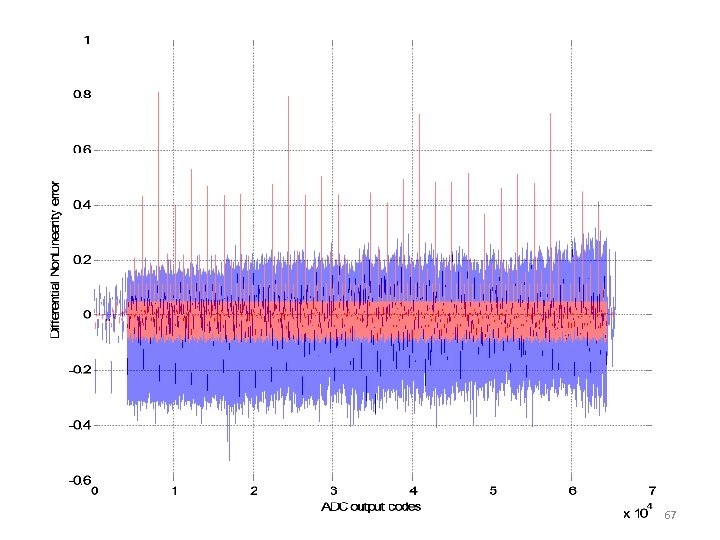
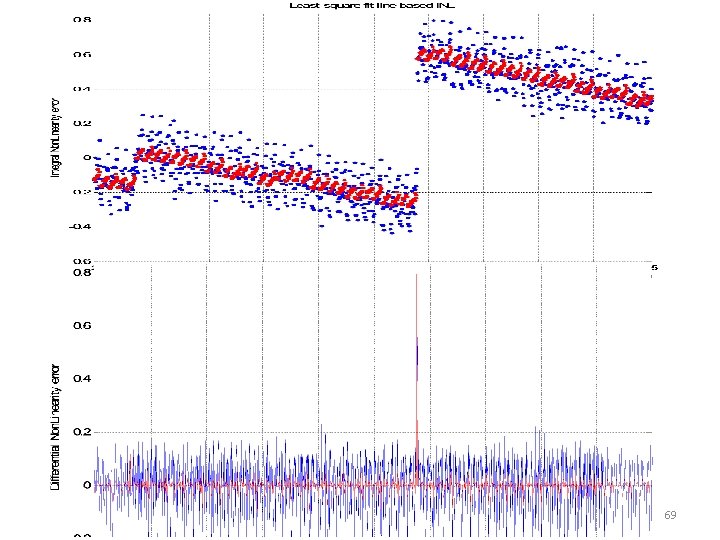
Device 1 INL/DNL comparison Red: new method with 64 K samples Blue: 16 loop average of standard method each with 64*64 K samples 65
66
67
68
69
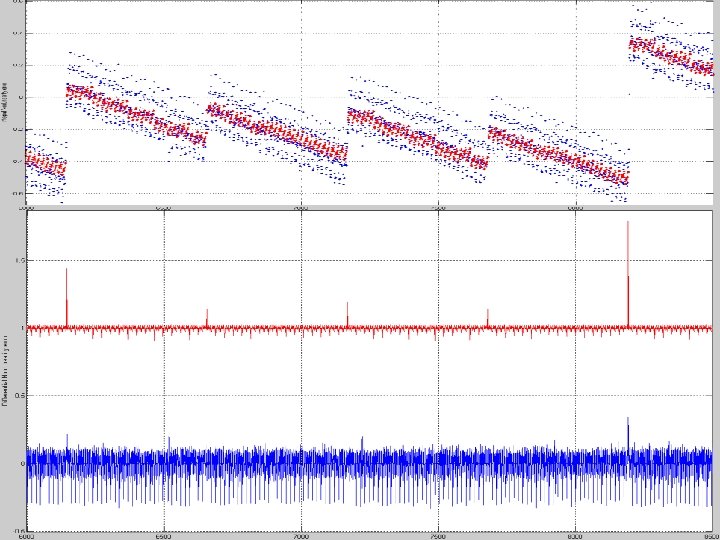
Device 1 INL/DNL comparison Red: new method with 64 K samples Blue: 32 loop average of standard method each with 64*64 K samples 70
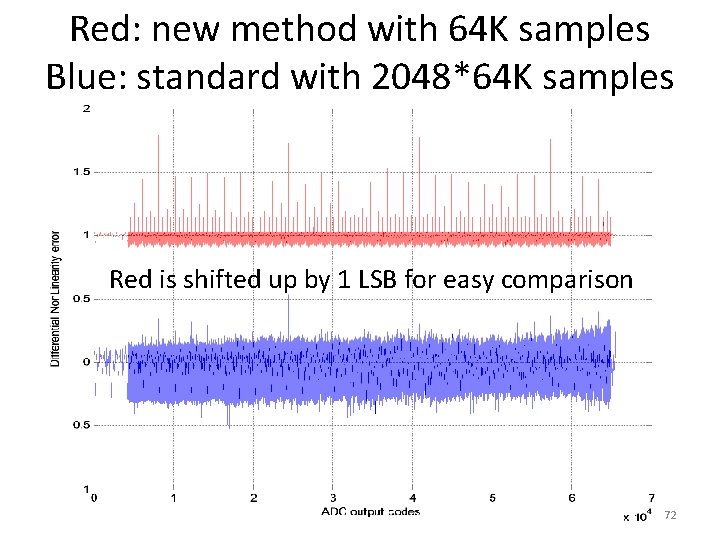
Red: new method with 64 K samples Blue: standard with 2048*64 K samples 71
Red: new method with 64 K samples Blue: standard with 2048*64 K samples Red is shifted up by 1 LSB for easy comparison 72
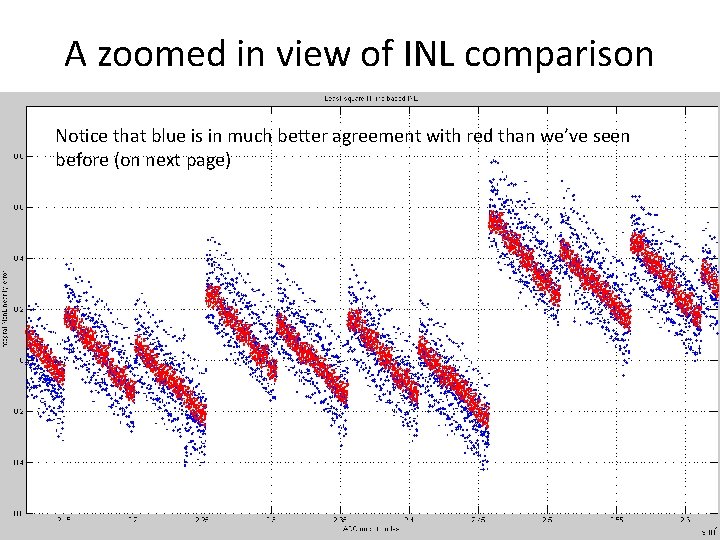
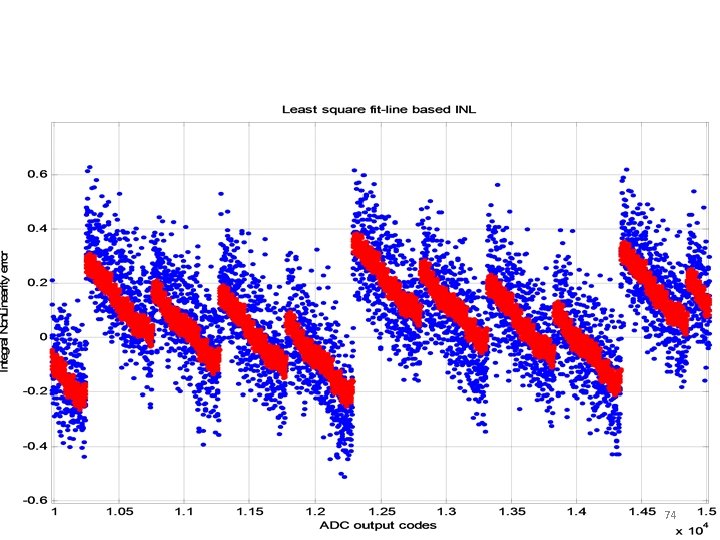
A zoomed in view of INL comparison Notice that blue is in much better agreement with red than we’ve seen before (on next page) 73
74
75
76
77
78
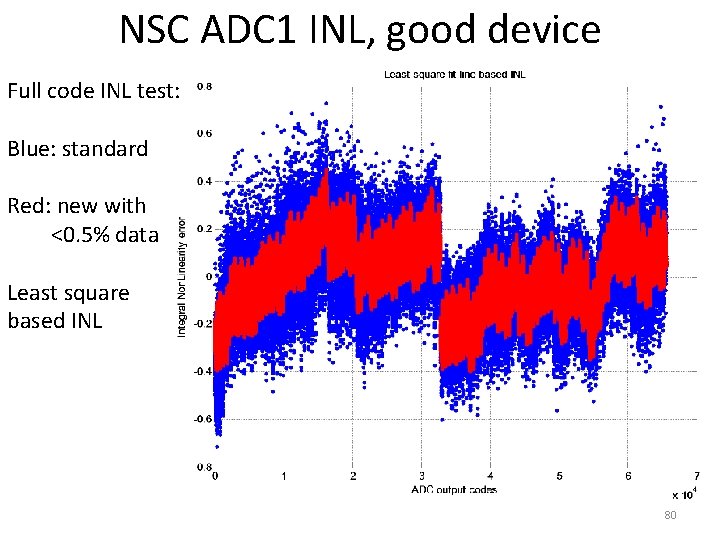
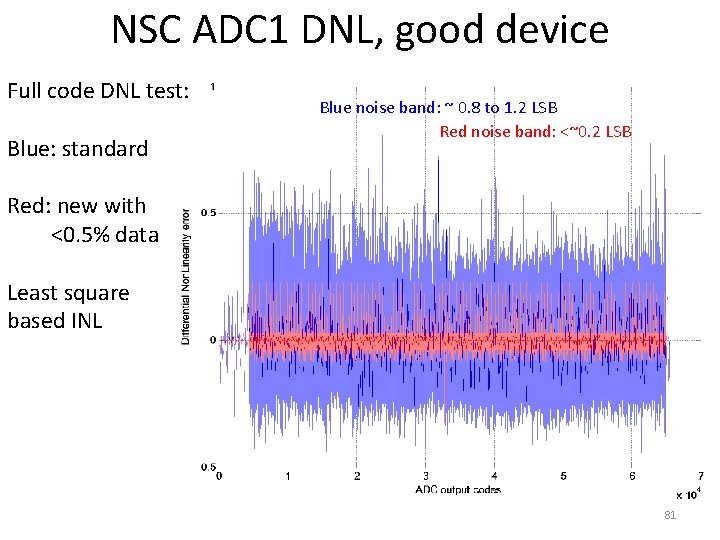
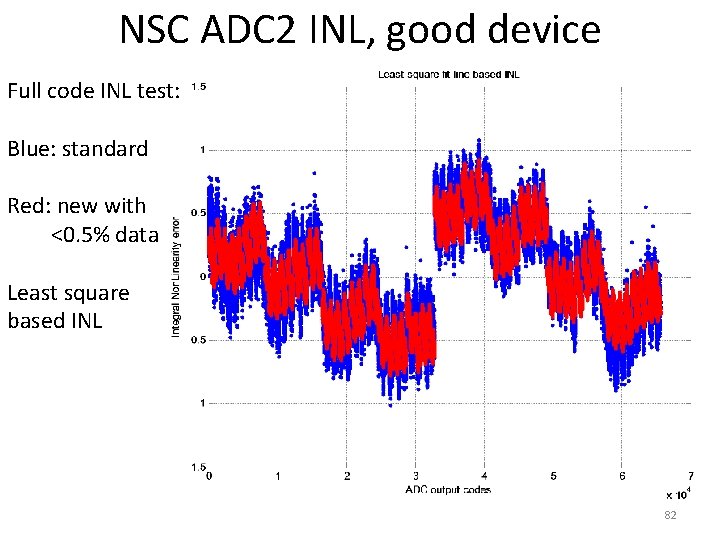
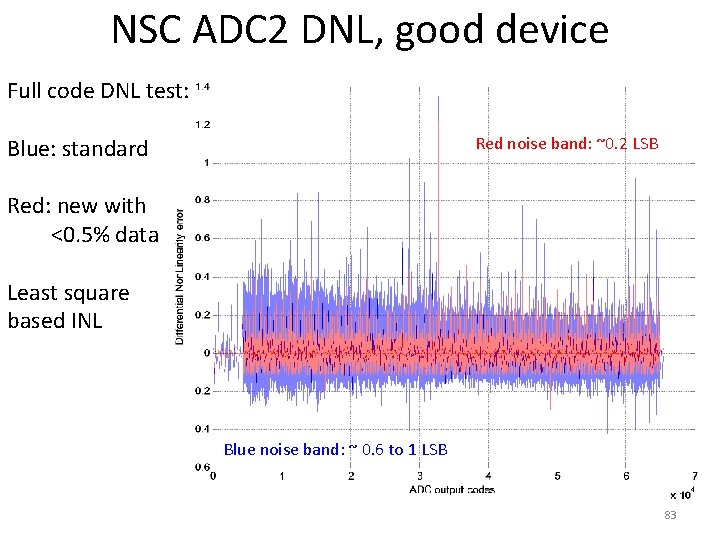
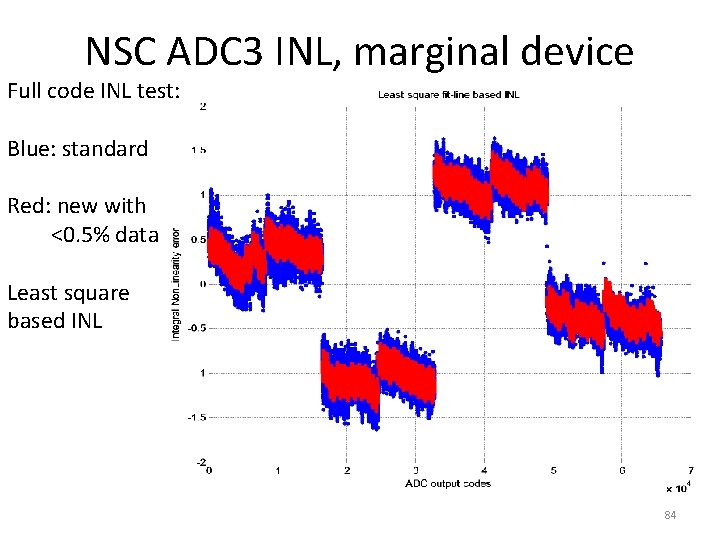
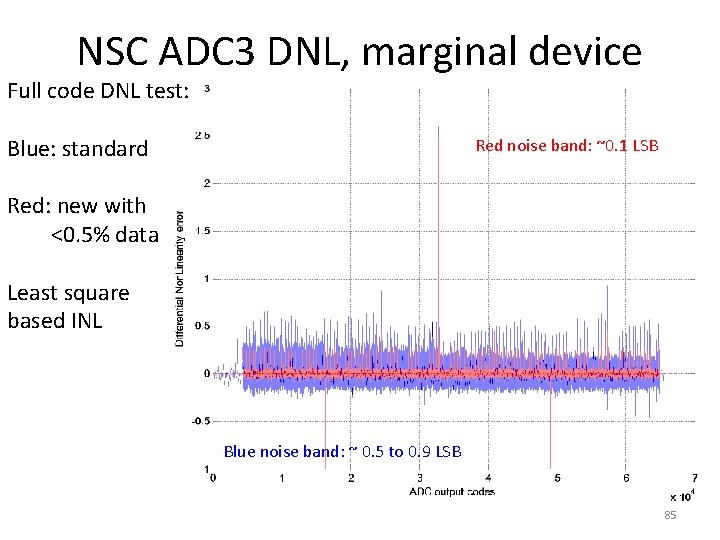
Validation with NSC ADC’s • 16 bit SAR ADC – 215 samples for spectral testing – New method uses these 215 samples for INL test – Standard method use 128 sample per code, or a total of 223 samples for INL test – That is 256 X more than new method • Comparison of results suggests that the new method is highly likely to be more accurate! 79
NSC ADC 1 INL, good device Full code INL test: Blue: standard Red: new with <0. 5% data Least square based INL 80
NSC ADC 1 DNL, good device Full code DNL test: Blue: standard Blue noise band: ~ 0. 8 to 1. 2 LSB Red noise band: <~0. 2 LSB Red: new with <0. 5% data Least square based INL 81
NSC ADC 2 INL, good device Full code INL test: Blue: standard Red: new with <0. 5% data Least square based INL 82
NSC ADC 2 DNL, good device Full code DNL test: Red noise band: ~0. 2 LSB Blue: standard Red: new with <0. 5% data Least square based INL Blue noise band: ~ 0. 6 to 1 LSB 83
NSC ADC 3 INL, marginal device Full code INL test: Blue: standard Red: new with <0. 5% data Least square based INL 84
NSC ADC 3 DNL, marginal device Full code DNL test: Blue: standard Red noise band: ~0. 1 LSB Red: new with <0. 5% data Least square based INL Blue noise band: ~ 0. 5 to 0. 9 LSB 85
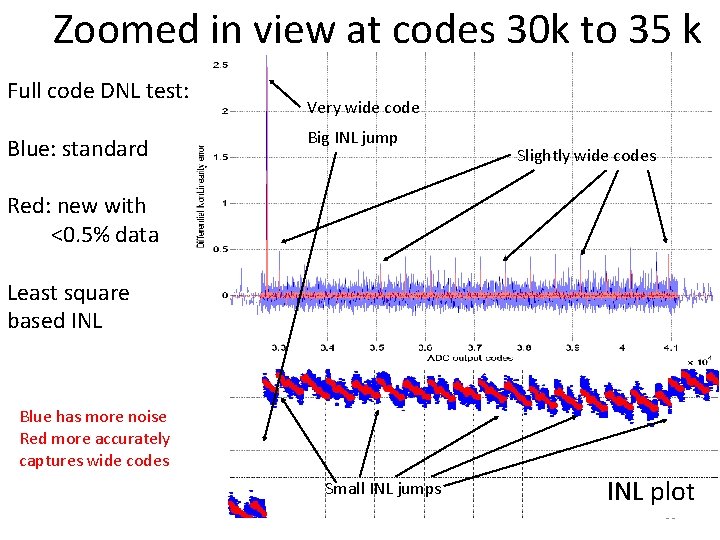
Zoomed in view at codes 30 k to 35 k Full code DNL test: Blue: standard Very wide code Big INL jump Slightly wide codes Red: new with <0. 5% data Least square based INL Blue has more noise Red more accurately captures wide codes Small INL jumps INL plot 86
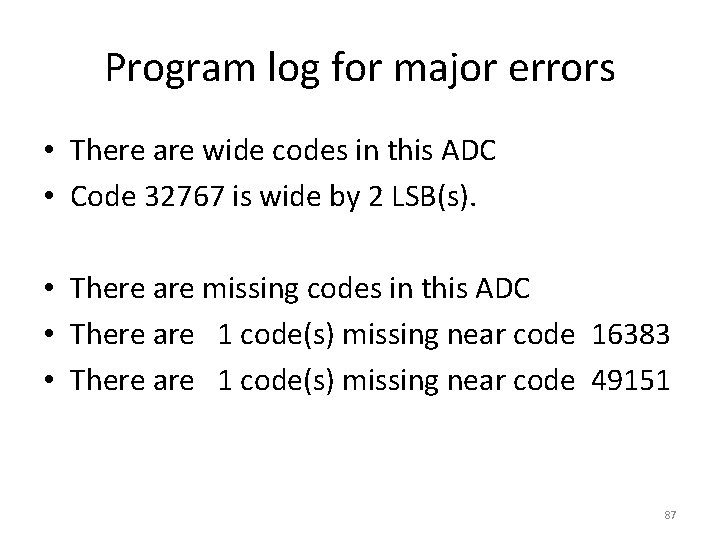
Program log for major errors • There are wide codes in this ADC • Code 32767 is wide by 2 LSB(s). • There are missing codes in this ADC • There are 1 code(s) missing near code 16383 • There are 1 code(s) missing near code 49151 87
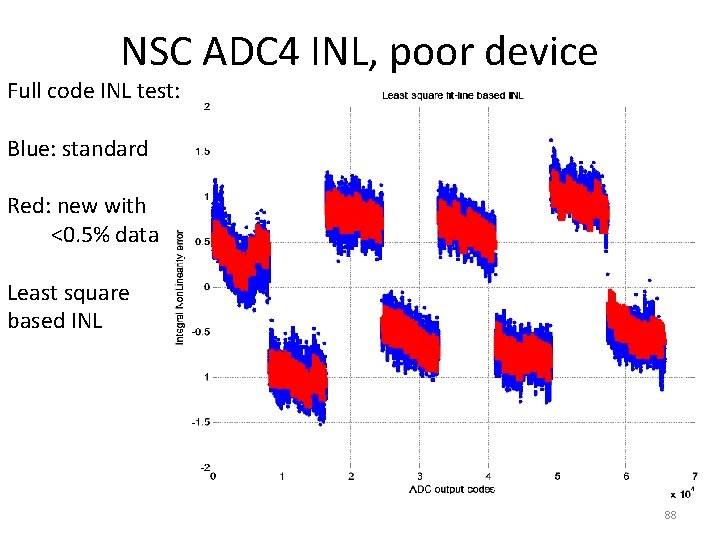
NSC ADC 4 INL, poor device Full code INL test: Blue: standard Red: new with <0. 5% data Least square based INL 88
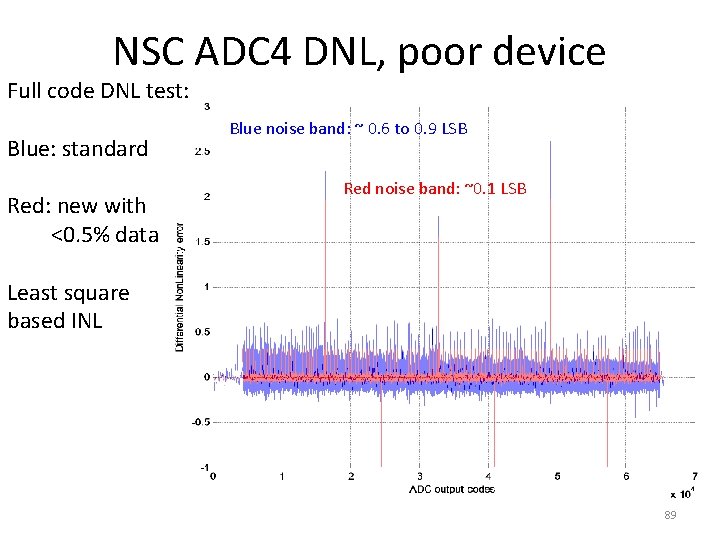
NSC ADC 4 DNL, poor device Full code DNL test: Blue: standard Red: new with <0. 5% data Blue noise band: ~ 0. 6 to 0. 9 LSB Red noise band: ~0. 1 LSB Least square based INL 89
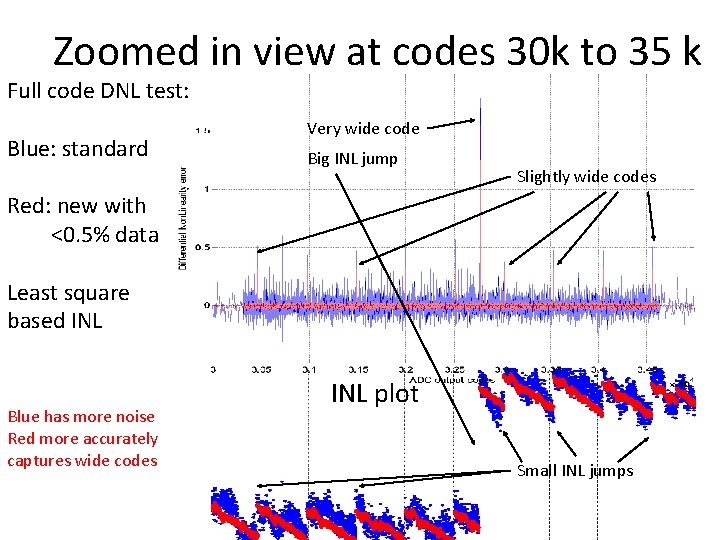
Zoomed in view at codes 30 k to 35 k Full code DNL test: Blue: standard Very wide code Big INL jump Slightly wide codes Red: new with <0. 5% data Least square based INL Blue has more noise Red more accurately captures wide codes INL plot Small INL jumps 90
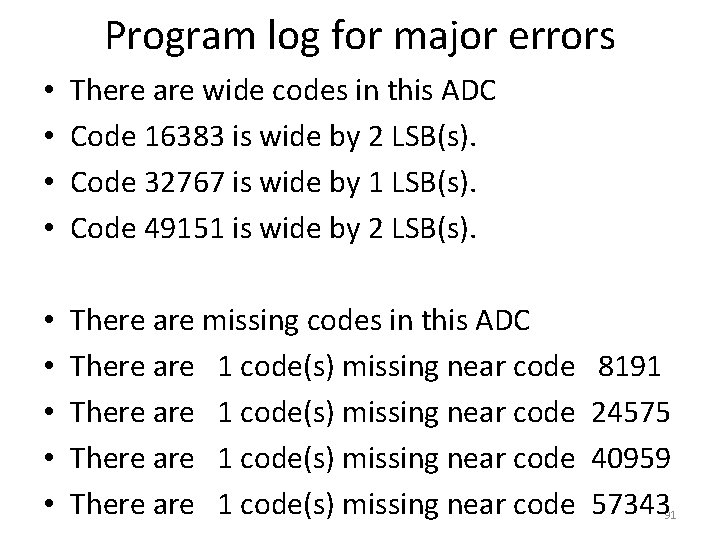
Program log for major errors • • There are wide codes in this ADC Code 16383 is wide by 2 LSB(s). Code 32767 is wide by 1 LSB(s). Code 49151 is wide by 2 LSB(s). • • • There are missing codes in this ADC There are 1 code(s) missing near code 8191 24575 40959 57343 91