
New A level Geology starting from September 2017
New A level Geology starting from September 2017

Contact details Subject Officer: Dave Evans david. evans@eduqas. co. uk Subject Support Officer: Sarah Price sarah. price@eduqas. co. uk 029 2026 5103

INTRODUCING EDUQAS • In light of the diverging qualifications between England Wales, WJEC has developed a new brand: Eduqas. • Eduqas will be the brand that provides schools with WJEC’s newly reformed Ofqual regulated GCSEs, AS and A levels. • Eduqas enables teachers to clearly distinguish between legacy qualifications in Wales and reformed qualifications in England. • Eduqas qualifications will primarily be available in England but also in Northern Ireland, Isle of Man and the Channel Islands at any schools offering Ofqual regulated qualifications.
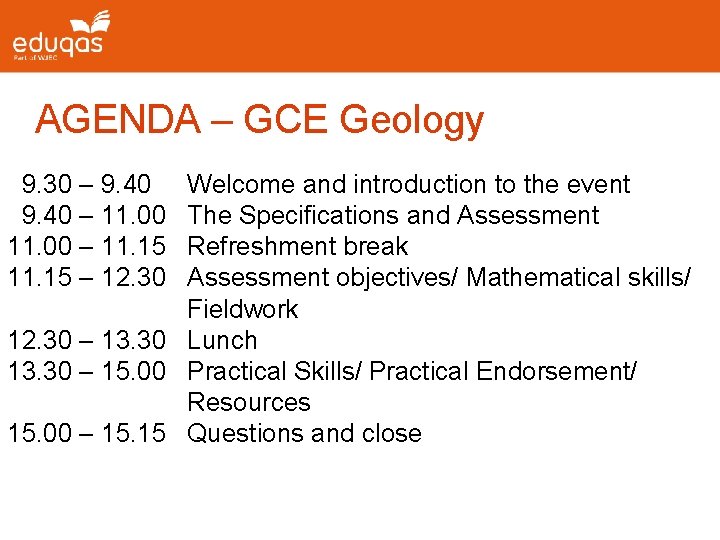
AGENDA – GCE Geology 9. 30 – 9. 40 – 11. 00 – 11. 15 – 12. 30 Welcome and introduction to the event The Specifications and Assessment Refreshment break Assessment objectives/ Mathematical skills/ Fieldwork 12. 30 – 13. 30 Lunch 13. 30 – 15. 00 Practical Skills/ Practical Endorsement/ Resources 15. 00 – 15. 15 Questions and close
Specification - A level
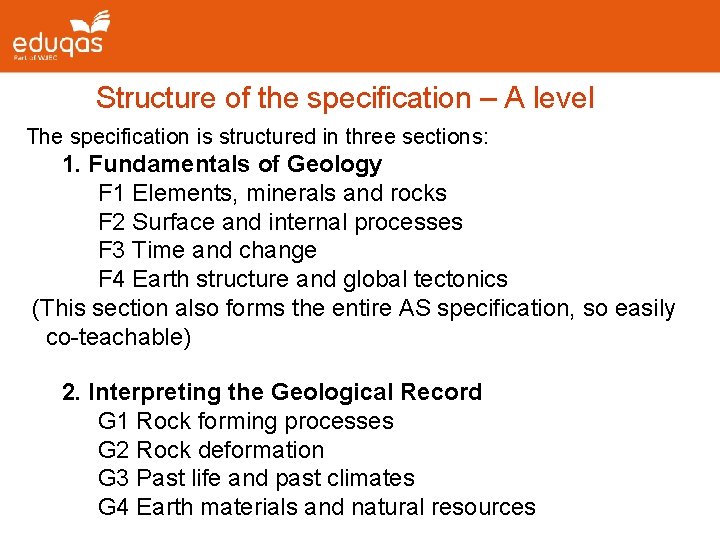
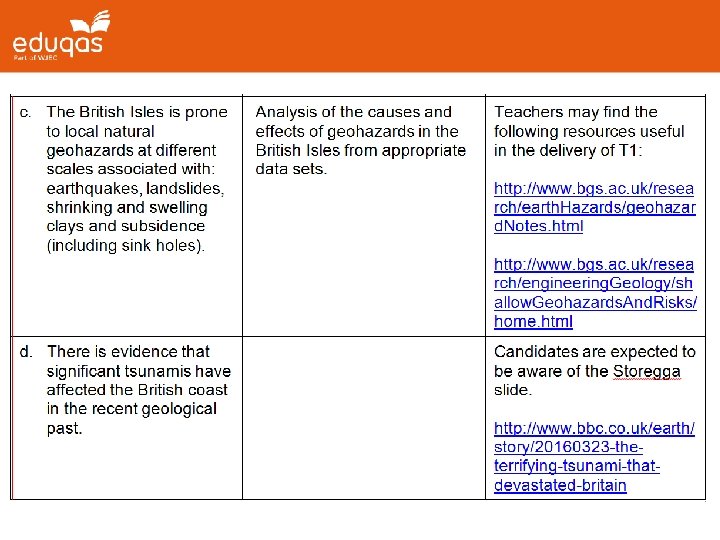
Structure of the specification – A level The specification is structured in three sections: 1. Fundamentals of Geology F 1 Elements, minerals and rocks F 2 Surface and internal processes F 3 Time and change F 4 Earth structure and global tectonics (This section also forms the entire AS specification, so easily co-teachable) 2. Interpreting the Geological Record G 1 Rock forming processes G 2 Rock deformation G 3 Past life and past climates G 4 Earth materials and natural resources
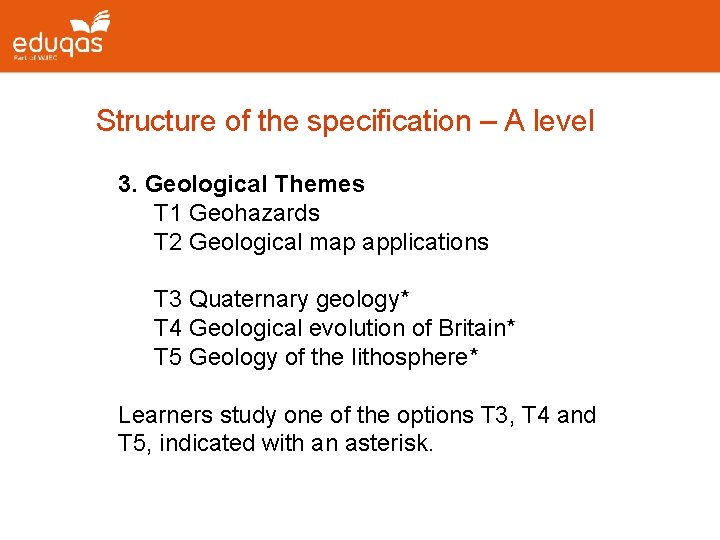
Structure of the specification – A level 3. Geological Themes T 1 Geohazards T 2 Geological map applications T 3 Quaternary geology* T 4 Geological evolution of Britain* T 5 Geology of the lithosphere* Learners study one of the options T 3, T 4 and T 5, indicated with an asterisk.
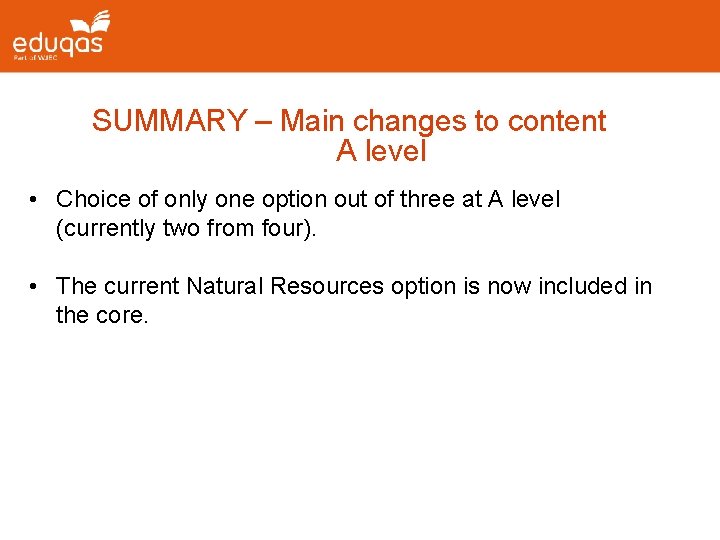
SUMMARY – Main changes to content A level • Choice of only one option out of three at A level (currently two from four). • The current Natural Resources option is now included in the core.
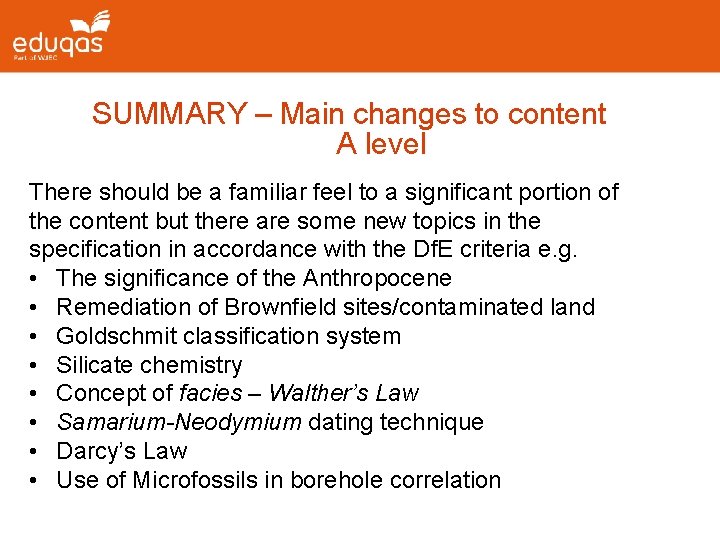
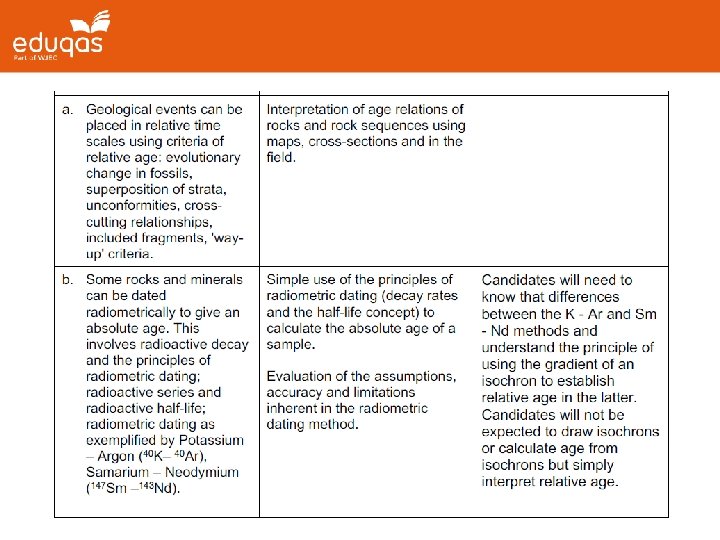
SUMMARY – Main changes to content A level There should be a familiar feel to a significant portion of the content but there are some new topics in the specification in accordance with the Df. E criteria e. g. • The significance of the Anthropocene • Remediation of Brownfield sites/contaminated land • Goldschmit classification system • Silicate chemistry • Concept of facies – Walther’s Law • Samarium-Neodymium dating technique • Darcy’s Law • Use of Microfossils in borehole correlation
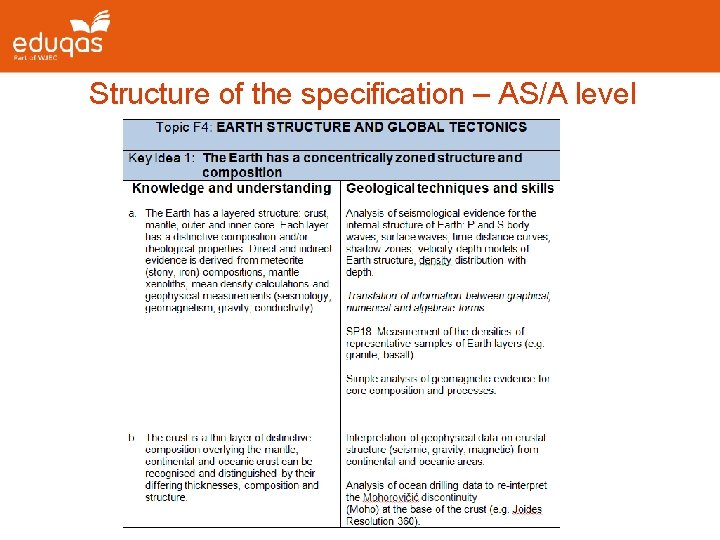
Structure of the specification – AS/A level
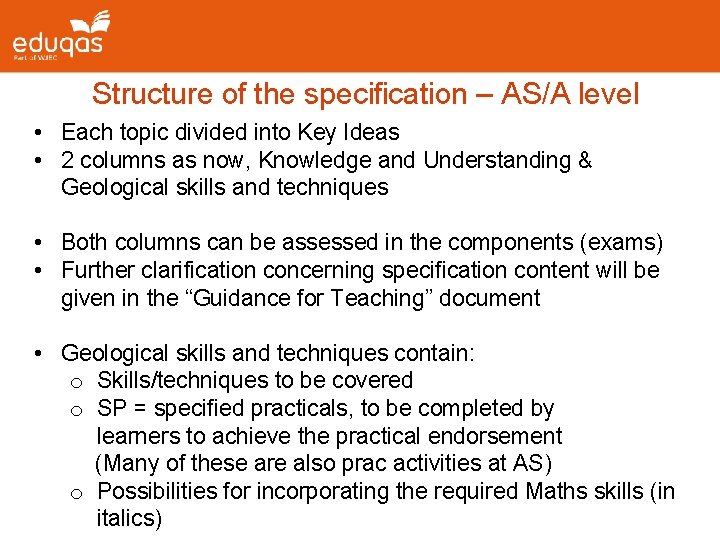
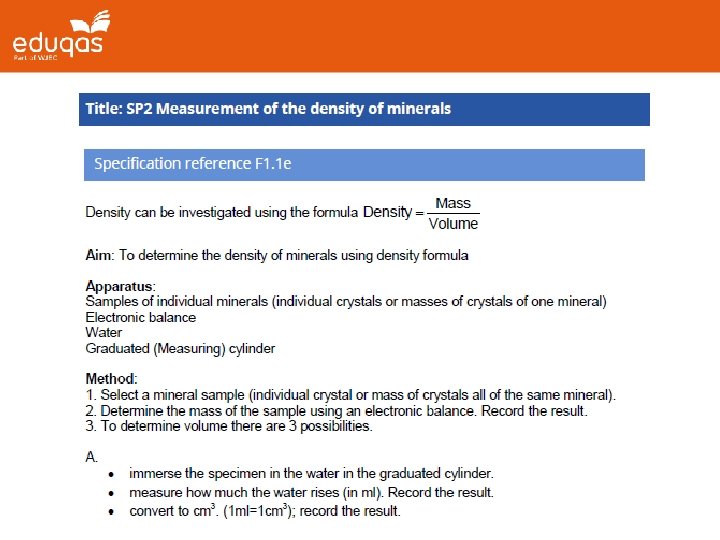
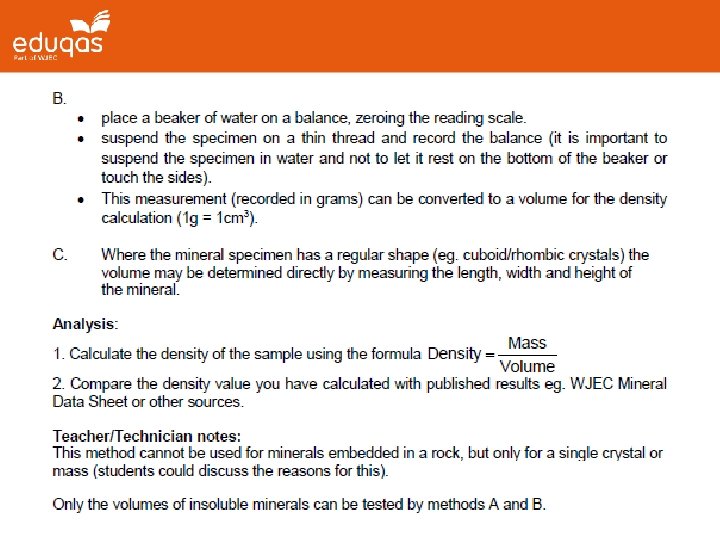
Structure of the specification – AS/A level • Each topic divided into Key Ideas • 2 columns as now, Knowledge and Understanding & Geological skills and techniques • Both columns can be assessed in the components (exams) • Further clarification concerning specification content will be given in the “Guidance for Teaching” document • Geological skills and techniques contain: o Skills/techniques to be covered o SP = specified practicals, to be completed by learners to achieve the practical endorsement (Many of these are also prac activities at AS) o Possibilities for incorporating the required Maths skills (in italics)
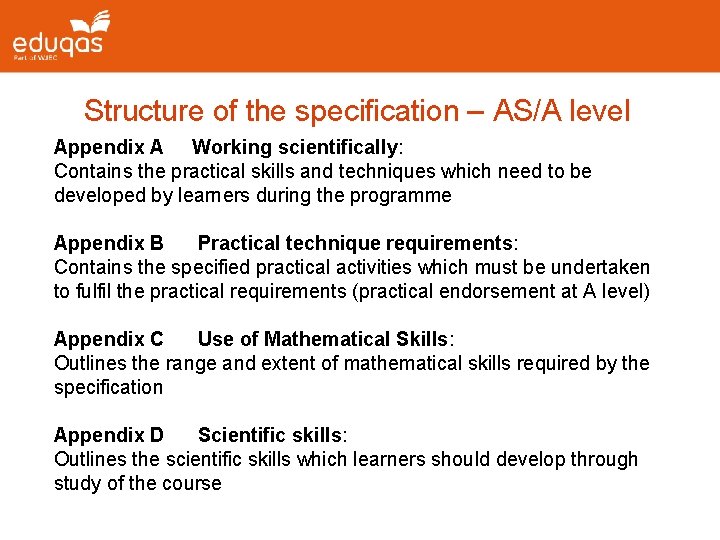
Structure of the specification – AS/A level Appendix A Working scientifically: Contains the practical skills and techniques which need to be developed by learners during the programme Appendix B Practical technique requirements: Contains the specified practical activities which must be undertaken to fulfil the practical requirements (practical endorsement at A level) Appendix C Use of Mathematical Skills: Outlines the range and extent of mathematical skills required by the specification Appendix D Scientific skills: Outlines the scientific skills which learners should develop through study of the course
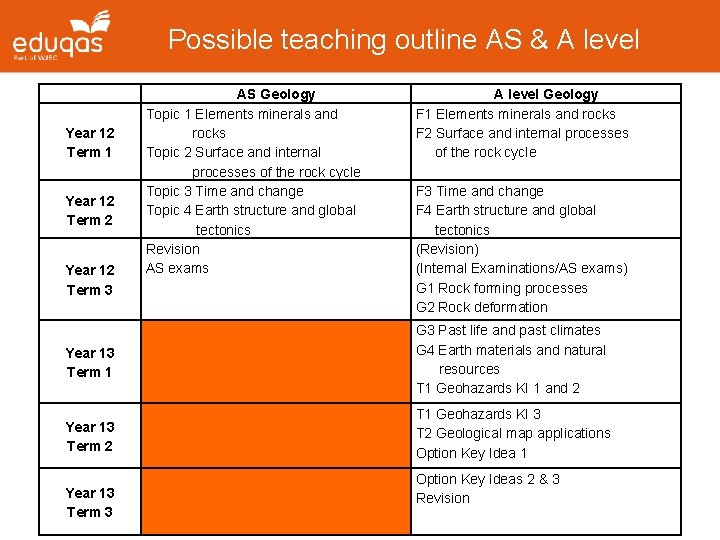
Possible teaching outline AS & A level Year 12 Term 1 Year 12 Term 2 Year 12 Term 3 AS Geology Topic 1 Elements minerals and rocks Topic 2 Surface and internal processes of the rock cycle Topic 3 Time and change Topic 4 Earth structure and global tectonics Revision AS exams A level Geology F 1 Elements minerals and rocks F 2 Surface and internal processes of the rock cycle G 3 Past life and past climates G 4 Earth materials and natural resources T 1 Geohazards KI 1 and 2 T 1 Geohazards KI 3 T 2 Geological map applications Option Key Idea 1 Option Key Ideas 2 & 3 Revision Year 13 Term 1 Year 13 Term 2 Year 13 Term 3 F 3 Time and change F 4 Earth structure and global tectonics (Revision) (Internal Examinations/AS exams) G 1 Rock forming processes G 2 Rock deformation
Guidance for teaching
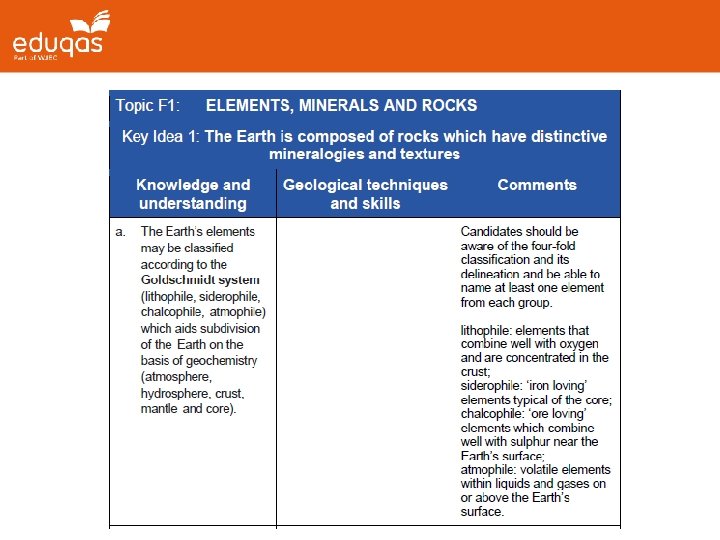
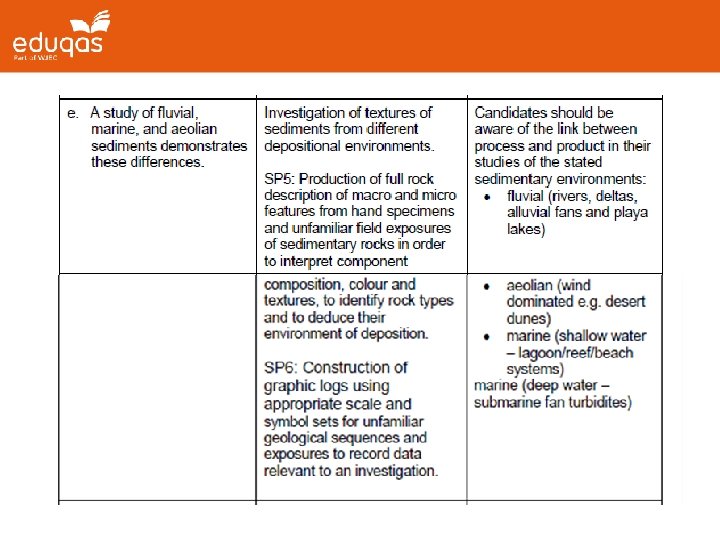
Guidance for teaching “Guidance for teaching” is a digital resource book to assist teachers in the planning and delivery of the specifications It is located on the Digital Resources section of the Eduqas Geology webpage It has 3 aspects • Further comment on the subject content in the specification • Information regarding each of the Specified Practicals • Explanation and exemplification of the required Maths skills
Summary of Assessment - A level
Summary of assessment – A level Component 1: Geological Investigations Written examination: 2 hours 15 minutes 35% of qualification Section A: Two stimulus response questions requiring short and structured answers. Section B: Investigation of the geology of an area shown on an accompanying simplified geological map, involving • the interpretation of hand specimens and photographs of minerals, rocks and fossils • map interpretation and cross-section construction • the completion of questions using short, structured and extended answers. This component assess the first two sections of the specification, Fundamentals of Geology and Interpreting the Geological Record.
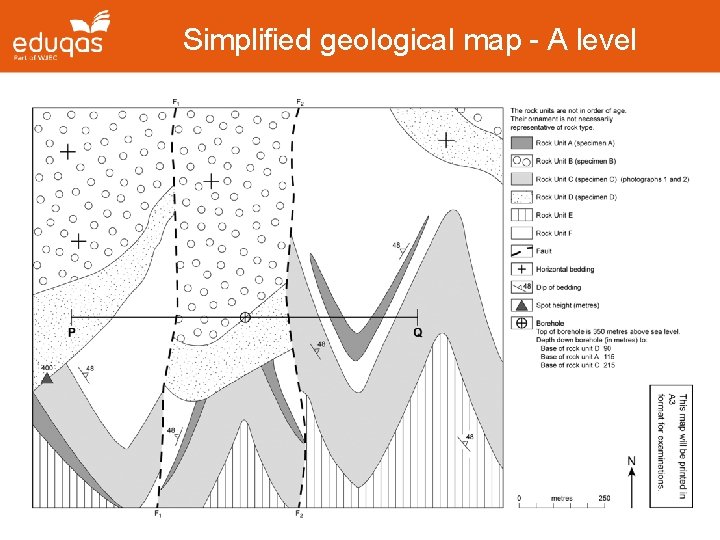
Simplified geological map - A level
Summary of assessment – A level Component 2: Geological Principles and Processes Written examination: 1 hour 45 minutes 30% of qualification Six stimulus response questions requiring short, structured and extended answers. This component assess the first two sections of the specification, Fundamentals of Geology and Interpreting the Geological Record.
Summary of assessment – A level Component 3: Geological Applications Written examination: 2 hours 35% of qualification Section A: Geohazards. Two stimulus response questions requiring short and structured answers. Section A assesses theme T 1 Geohazards and also assumes an understanding of the first two sections of the specification, Fundamentals of Geology and Interpreting the Geological Record.
Summary of assessment – A level Component 3: Geological Applications Written examination: 2 hours 35% of qualification Section B: Geological map applications. An investigation of the geology of an area shown on a Geological Survey map extract using stimulus response questions requiring short, structured and extended answers. Section B assesses theme T 2 Geological map applications and also assumes an understanding of the first two sections of the specification, Fundamentals of Geology and Interpreting the Geological Record, and theme T 1 Geohazards.
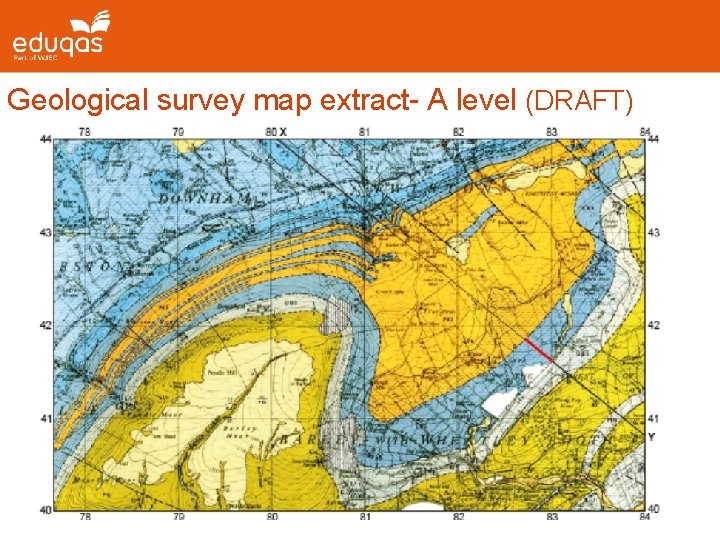
Geological survey map extract- A level (DRAFT)
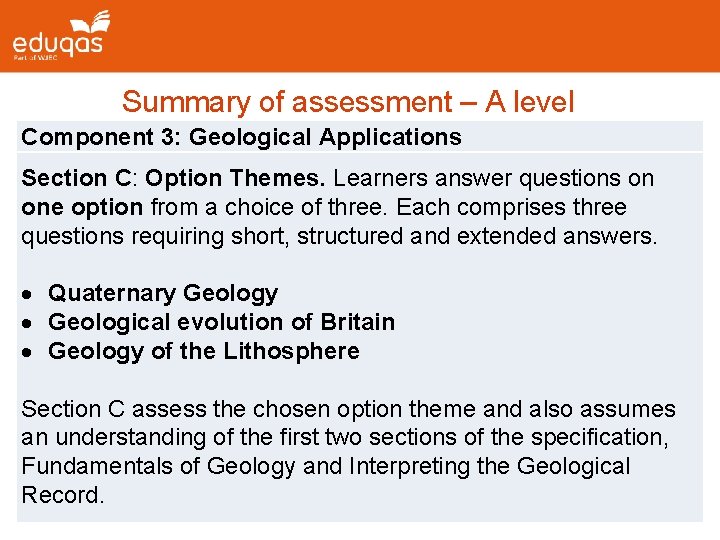
Summary of assessment – A level Component 3: Geological Applications Section C: Option Themes. Learners answer questions on one option from a choice of three. Each comprises three questions requiring short, structured and extended answers. Quaternary Geology Geological evolution of Britain Geology of the Lithosphere Section C assess the chosen option theme and also assumes an understanding of the first two sections of the specification, Fundamentals of Geology and Interpreting the Geological Record.
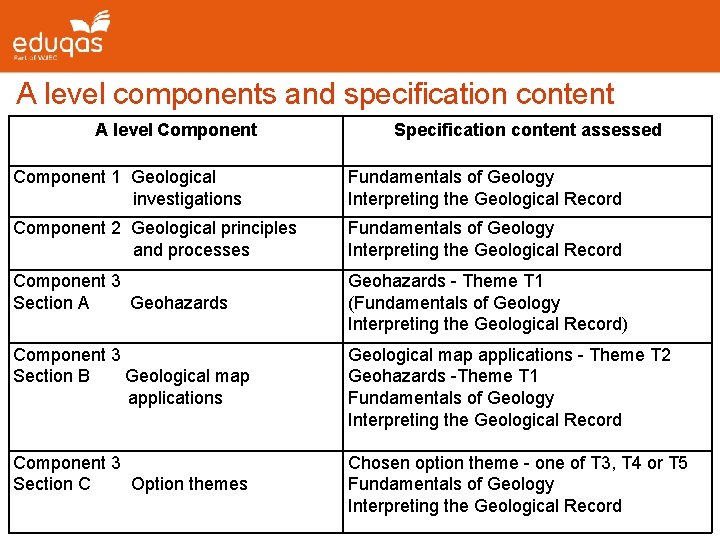
A level components and specification content A level Component Specification content assessed Component 1 Geological investigations Fundamentals of Geology Interpreting the Geological Record Component 2 Geological principles and processes Fundamentals of Geology Interpreting the Geological Record Component 3 Section A Geohazards - Theme T 1 (Fundamentals of Geology Interpreting the Geological Record) Component 3 Section B Geological map applications Geological map applications - Theme T 2 Geohazards -Theme T 1 Fundamentals of Geology Interpreting the Geological Record Component 3 Section C Option themes Chosen option theme - one of T 3, T 4 or T 5 Fundamentals of Geology Interpreting the Geological Record
Summary of Assessment – AS
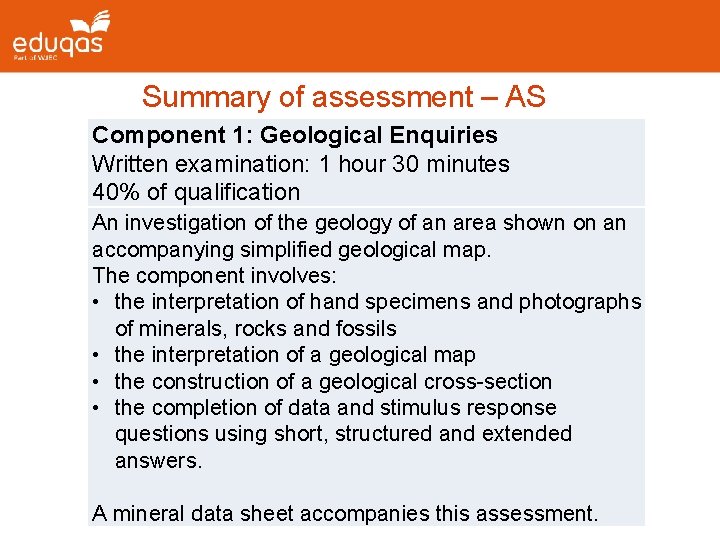
Summary of assessment – AS Component 1: Geological Enquiries Written examination: 1 hour 30 minutes 40% of qualification An investigation of the geology of an area shown on an accompanying simplified geological map. The component involves: • the interpretation of hand specimens and photographs of minerals, rocks and fossils • the interpretation of a geological map • the construction of a geological cross-section • the completion of data and stimulus response questions using short, structured and extended answers. A mineral data sheet accompanies this assessment.
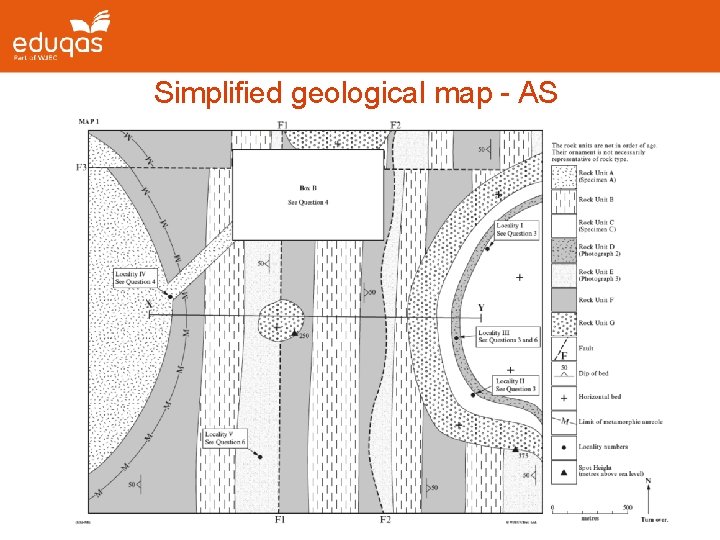
Simplified geological map - AS
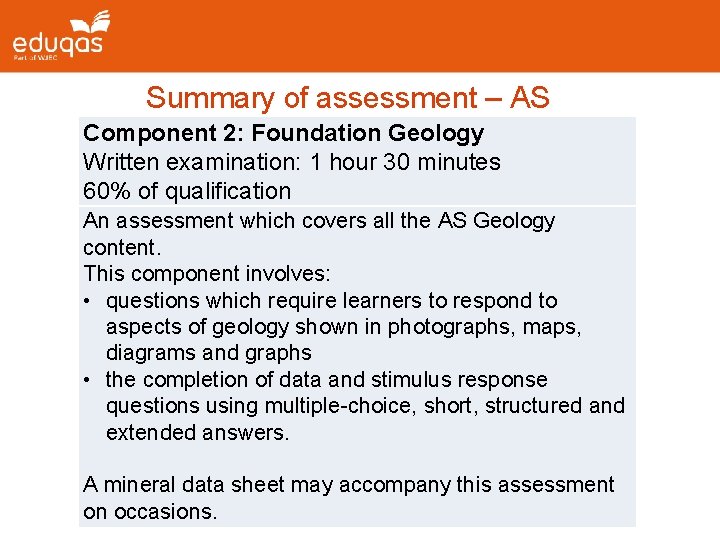
Summary of assessment – AS Component 2: Foundation Geology Written examination: 1 hour 30 minutes 60% of qualification An assessment which covers all the AS Geology content. This component involves: • questions which require learners to respond to aspects of geology shown in photographs, maps, diagrams and graphs • the completion of data and stimulus response questions using multiple-choice, short, structured and extended answers. A mineral data sheet may accompany this assessment on occasions.
Problem-solving in novel situations • As in the current specification, problem–solving lies at the heart of Eduqas AS and A level specifications in Geology • This approach aims to develop learners who are able to apply their knowledge and understanding of the contents of this specification by exploring contexts and situations that are not explicitly indicated in the specification • Learners should expect to be assessed on the details of both columns of the specification. However in line with the ethos required by Df. E, learners should also expect to answer questions that set the content in novel situations not explicit in the specification
Making Entries • AS: All components will be available in 2018 (and each year thereafter). The qualification will be awarded for the first time in summer 2018. • A level: All components will be available in 2019 (and each year thereafter). The qualification will be awarded for the first time in summer 2019. • All components must be taken at the end of the course. • Where candidates wish to re-sit the qualification, all components must be re-taken.
Styles of exam questions in Eduqas AS and A level Geology
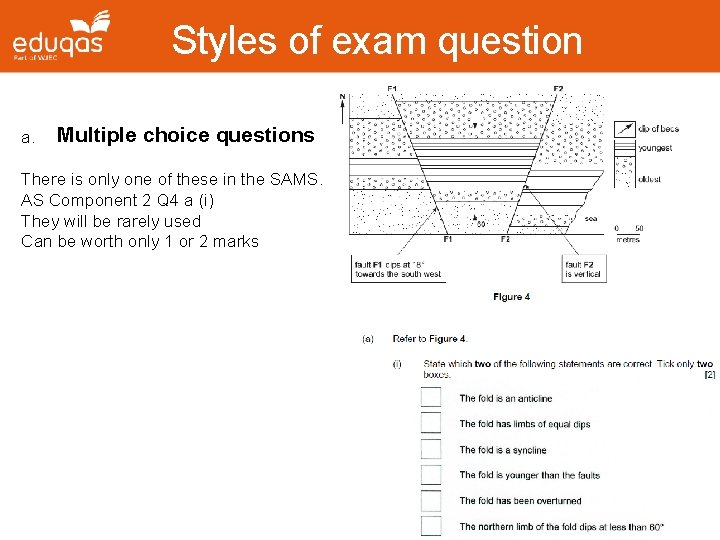
Styles of exam question a. Multiple choice questions There is only one of these in the SAMS. AS Component 2 Q 4 a (i) They will be rarely used Can be worth only 1 or 2 marks
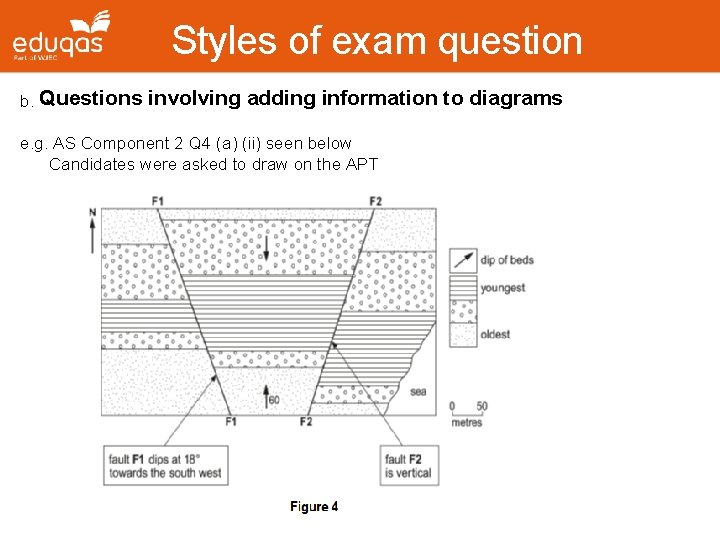
Styles of exam question b. Questions involving adding information to diagrams e. g. AS Component 2 Q 4 (a) (ii) seen below Candidates were asked to draw on the APT
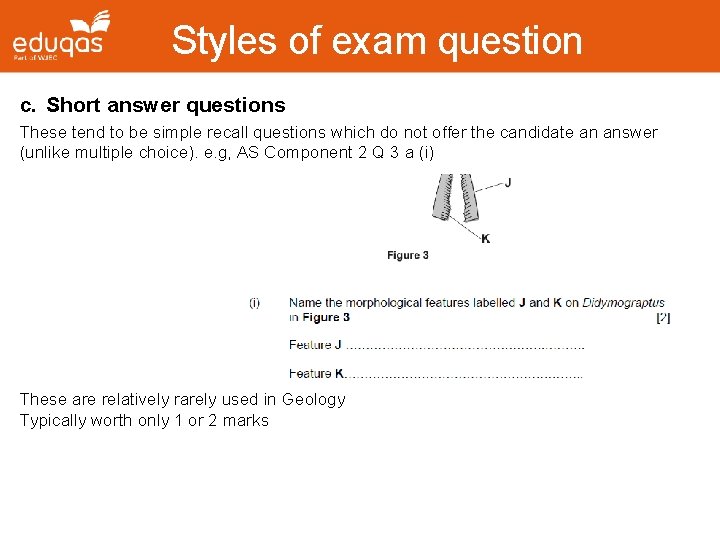
Styles of exam question c. Short answer questions These tend to be simple recall questions which do not offer the candidate an answer (unlike multiple choice). e. g, AS Component 2 Q 3 a (i) These are relatively rarely used in Geology Typically worth only 1 or 2 marks
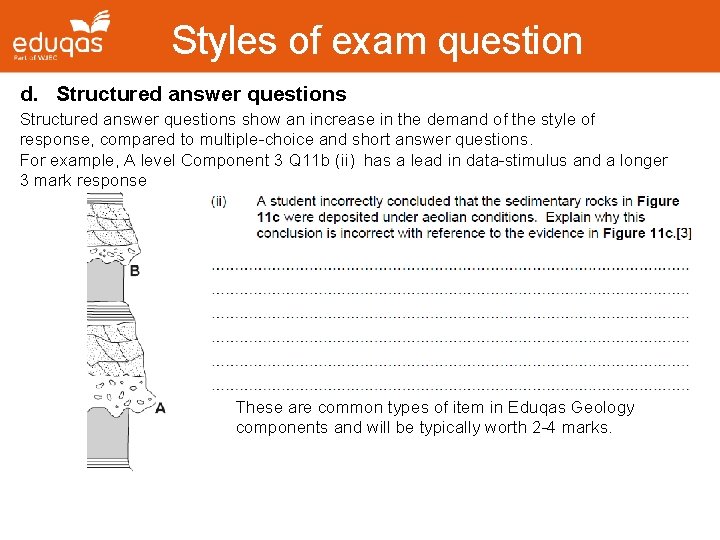
Styles of exam question d. Structured answer questions show an increase in the demand of the style of response, compared to multiple-choice and short answer questions. For example, A level Component 3 Q 11 b (ii) has a lead in data-stimulus and a longer 3 mark response These are common types of item in Eduqas Geology components and will be typically worth 2 -4 marks.
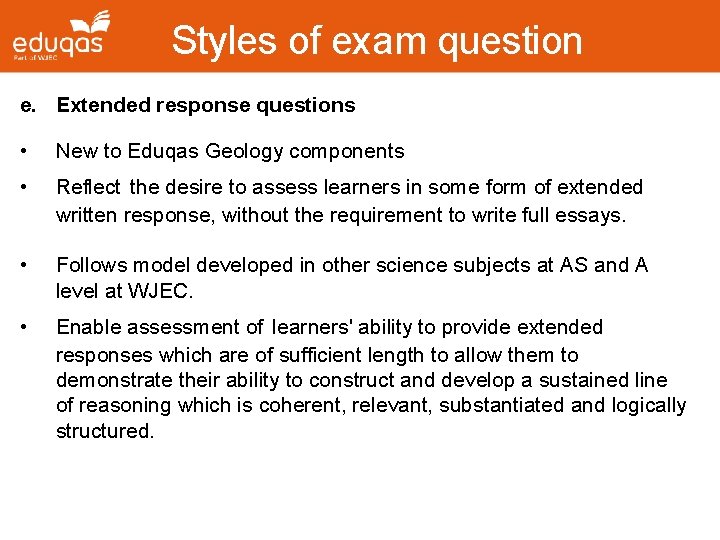
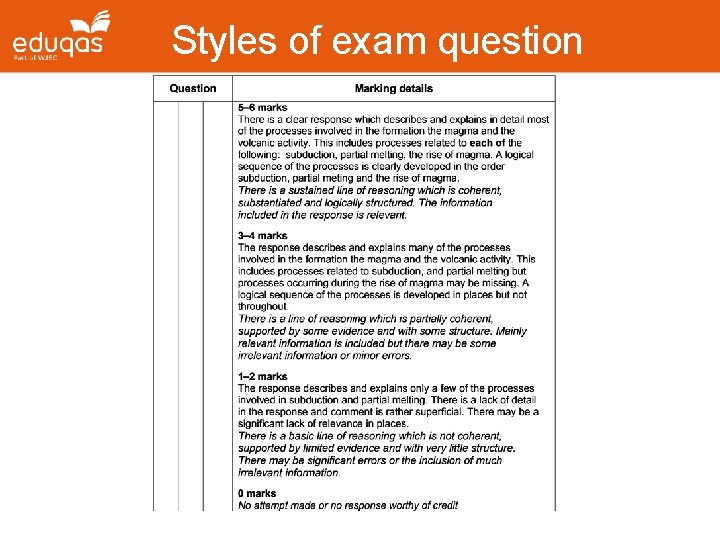
Styles of exam question e. Extended response questions • New to Eduqas Geology components • Reflect the desire to assess learners in some form of extended written response, without the requirement to write full essays. • Follows model developed in other science subjects at AS and A level at WJEC. • Enable assessment of learners' ability to provide extended responses which are of sufficient length to allow them to demonstrate their ability to construct and develop a sustained line of reasoning which is coherent, relevant, substantiated and logically structured.
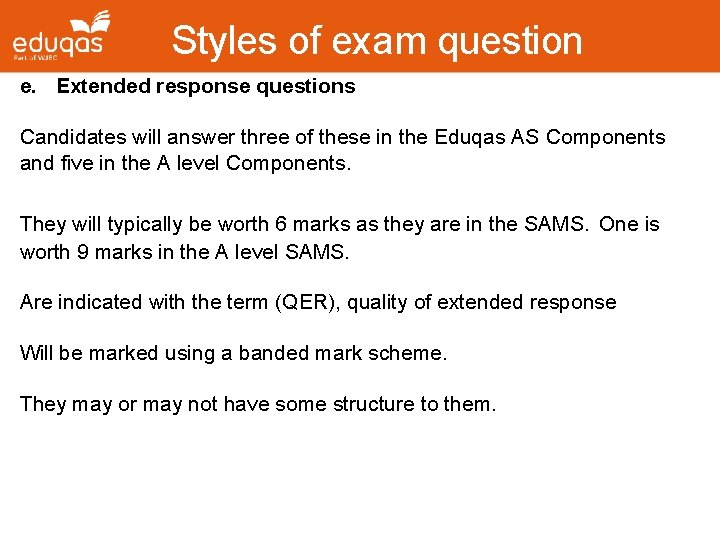
Styles of exam question e. Extended response questions Candidates will answer three of these in the Eduqas AS Components and five in the A level Components. They will typically be worth 6 marks as they are in the SAMS. One is worth 9 marks in the A level SAMS. Are indicated with the term (QER), quality of extended response Will be marked using a banded mark scheme. They may or may not have some structure to them.
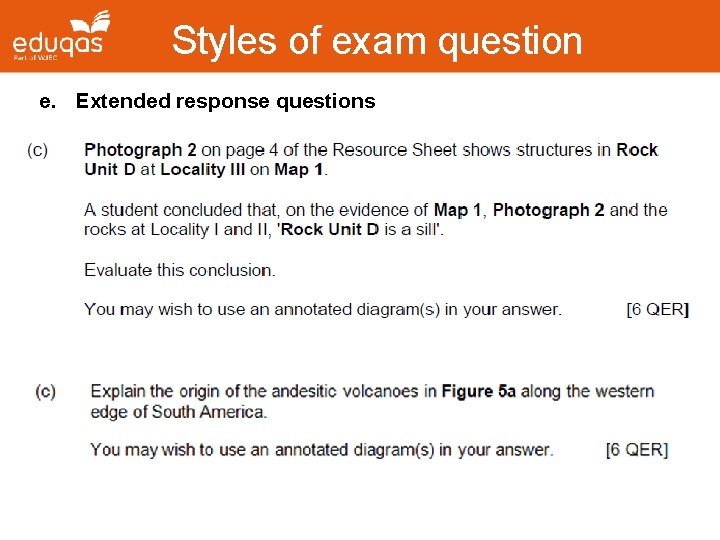
Styles of exam question e. Extended response questions
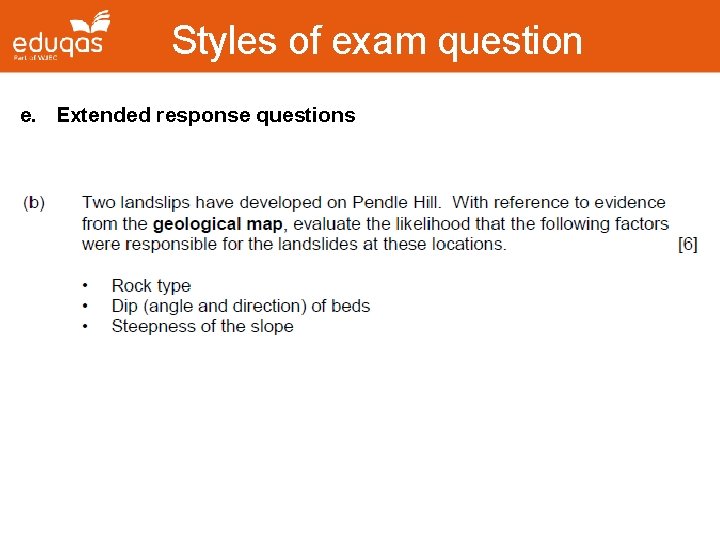
Styles of exam question e. Extended response questions
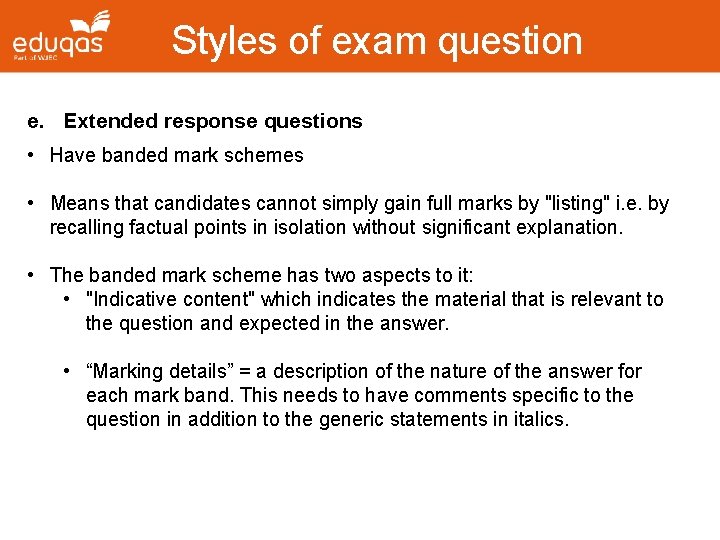
Styles of exam question e. Extended response questions • Have banded mark schemes • Means that candidates cannot simply gain full marks by "listing" i. e. by recalling factual points in isolation without significant explanation. • The banded mark scheme has two aspects to it: • "Indicative content" which indicates the material that is relevant to the question and expected in the answer. • “Marking details” = a description of the nature of the answer for each mark band. This needs to have comments specific to the question in addition to the generic statements in italics.
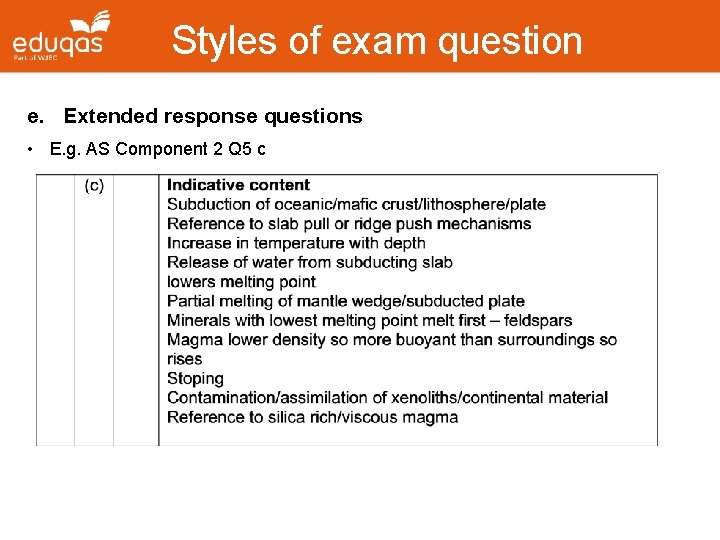
Styles of exam question e. Extended response questions • E. g. AS Component 2 Q 5 c
Styles of exam question
Assessment Objectives
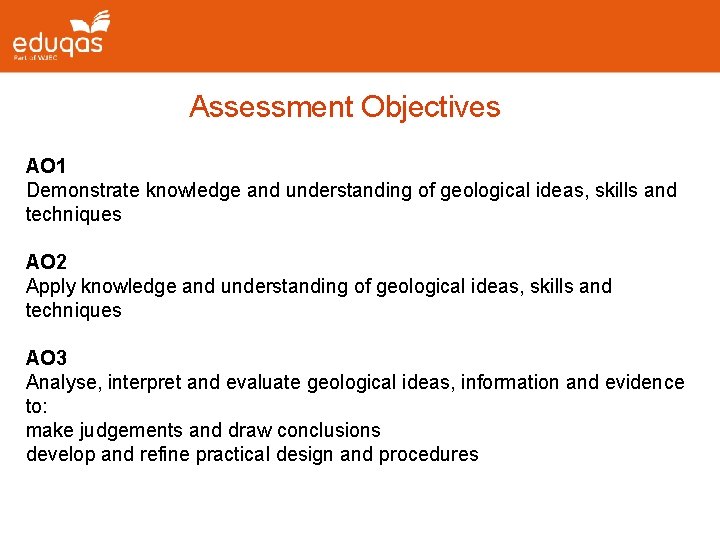
Assessment Objectives AO 1 Demonstrate knowledge and understanding of geological ideas, skills and techniques AO 2 Apply knowledge and understanding of geological ideas, skills and techniques AO 3 Analyse, interpret and evaluate geological ideas, information and evidence to: make judgements and draw conclusions develop and refine practical design and procedures
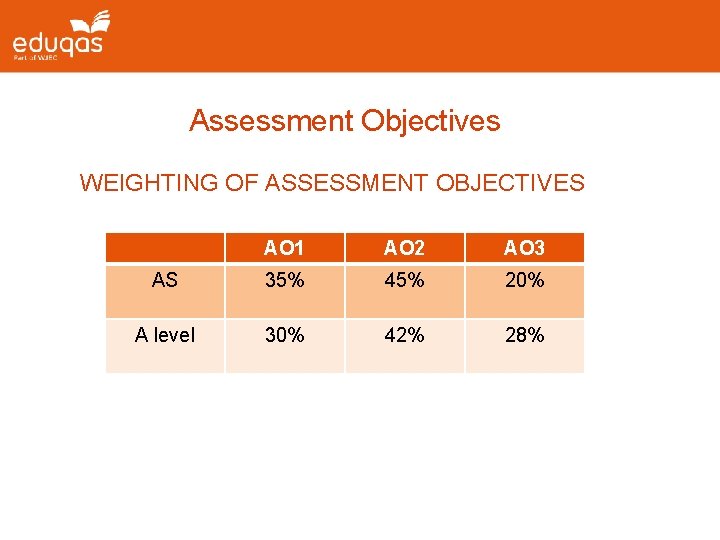
Assessment Objectives WEIGHTING OF ASSESSMENT OBJECTIVES AO 1 AO 2 AO 3 AS 35% 45% 20% A level 30% 42% 28%
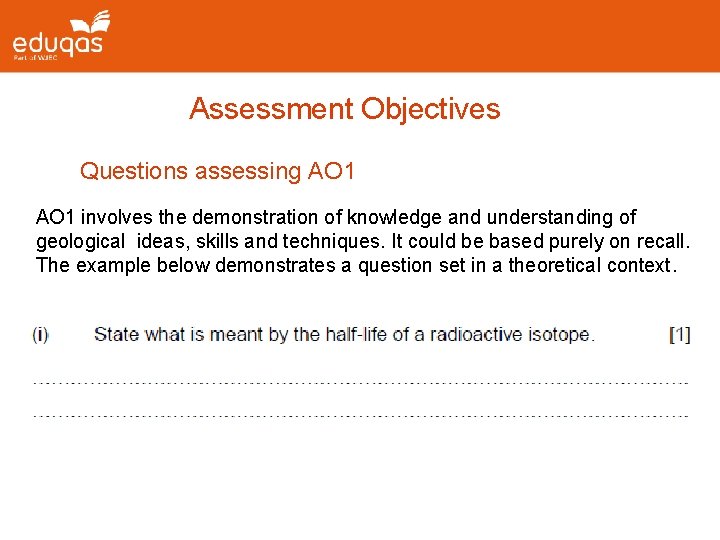
Assessment Objectives Questions assessing AO 1 involves the demonstration of knowledge and understanding of geological ideas, skills and techniques. It could be based purely on recall. The example below demonstrates a question set in a theoretical context.
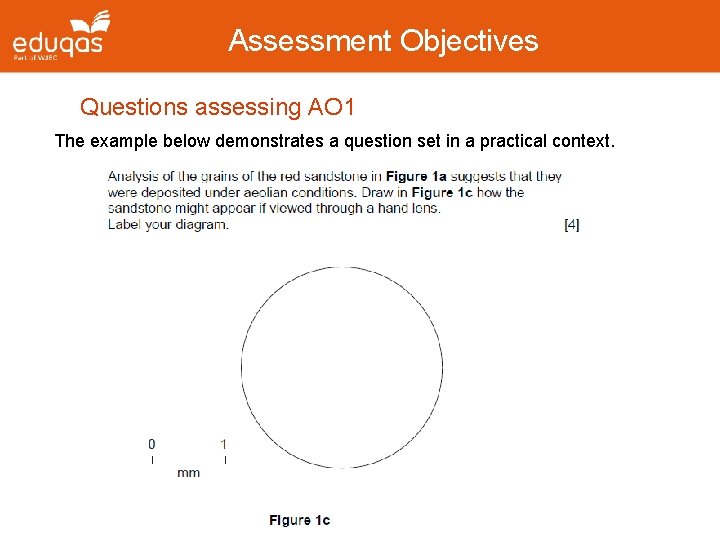
Assessment Objectives Questions assessing AO 1 The example below demonstrates a question set in a practical context.
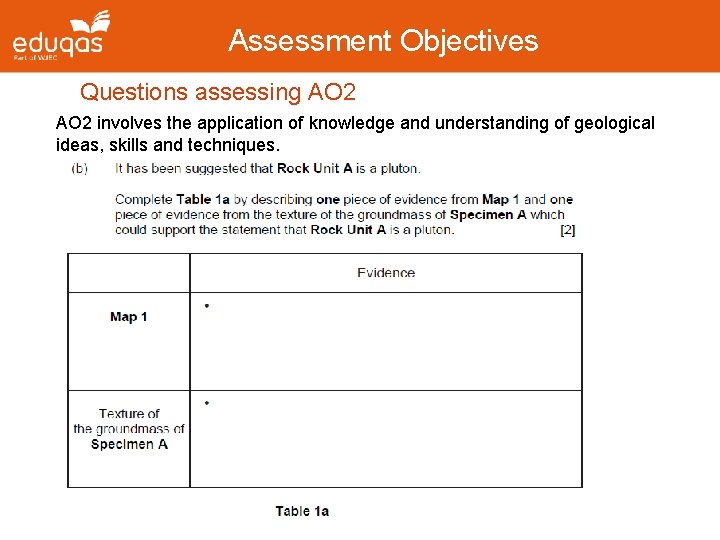
Assessment Objectives Questions assessing AO 2 involves the application of knowledge and understanding of geological ideas, skills and techniques.
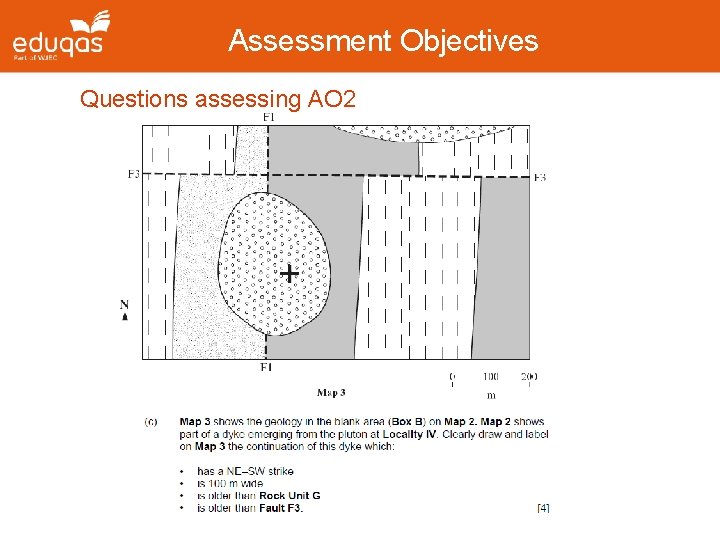
Assessment Objectives Questions assessing AO 2
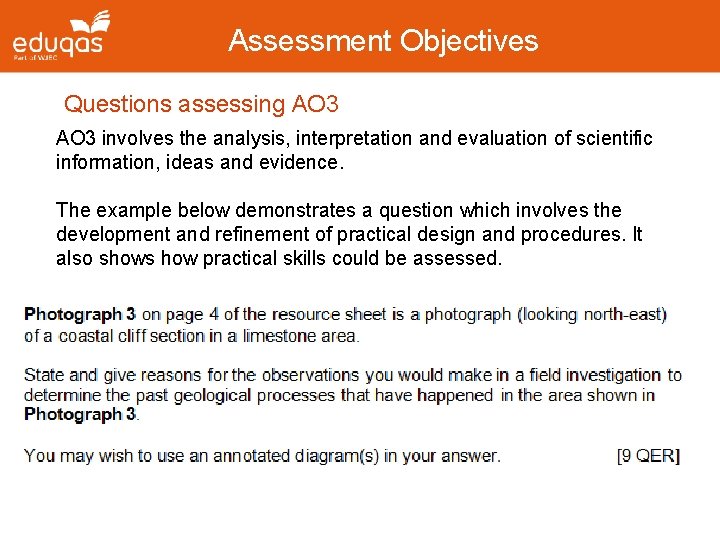
Assessment Objectives Questions assessing AO 3 involves the analysis, interpretation and evaluation of scientific information, ideas and evidence. The example below demonstrates a question which involves the development and refinement of practical design and procedures. It also shows how practical skills could be assessed.
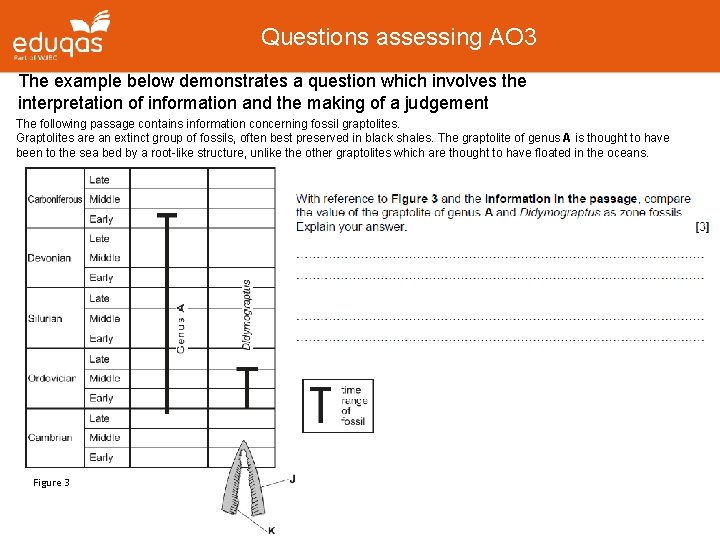
Questions assessing AO 3 The example below demonstrates a question which involves the interpretation of information and the making of a judgement The following passage contains information concerning fossil graptolites. Graptolites are an extinct group of fossils, often best preserved in black shales. The graptolite of genus A is thought to have been to the sea bed by a root-like structure, unlike the other graptolites which are thought to have floated in the oceans. Figure 3
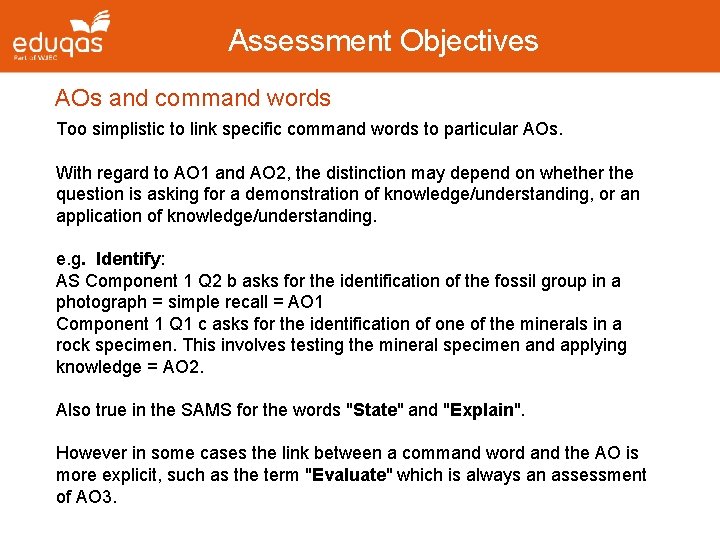
Assessment Objectives AOs and command words Too simplistic to link specific command words to particular AOs. With regard to AO 1 and AO 2, the distinction may depend on whether the question is asking for a demonstration of knowledge/understanding, or an application of knowledge/understanding. e. g. Identify: AS Component 1 Q 2 b asks for the identification of the fossil group in a photograph = simple recall = AO 1 Component 1 Q 1 c asks for the identification of one of the minerals in a rock specimen. This involves testing the mineral specimen and applying knowledge = AO 2. Also true in the SAMS for the words "State" and "Explain". However in some cases the link between a command word and the AO is more explicit, such as the term "Evaluate" which is always an assessment of AO 3.
Mathematical Skills
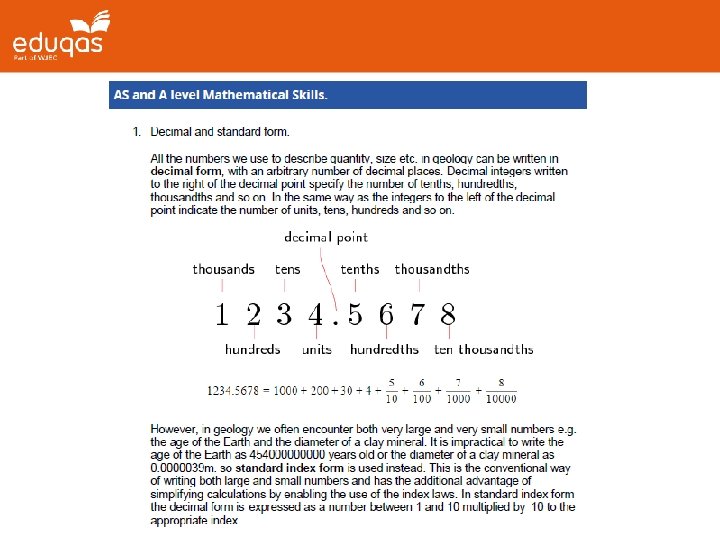
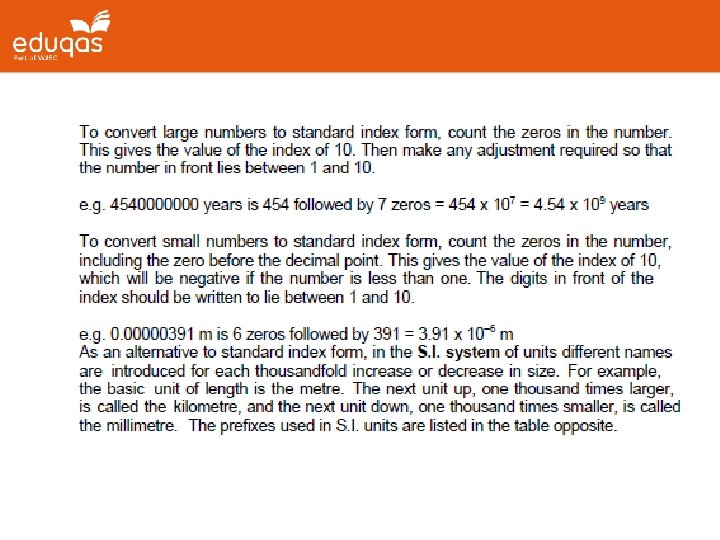
Mathematical Skills The list in Appendix C of the specification outlines the range and extent of mathematical skills required by WJEC Eduqas Geology. The specific exemplifications are to aid understanding and could be developed in other areas of the specification content. i. e teachers do not have to teach specified maths skill within specific topics in the course. Teachers have freedom to decide how to incorporate the maths skills. The subject content section of the specification does suggest some possibilities as a guide. Learners will be expected to apply mathematical skills in novel contexts.
Mathematical Skills Mathematical skills are divided into four categories 1. Number 2. Statistics and probability 3. Algebra and graphs 4. Geometry and measures All the skills are explained and exemplified addressed in the “Guidance for Teaching” document. A sample of each of these categories is shown on the following slides.
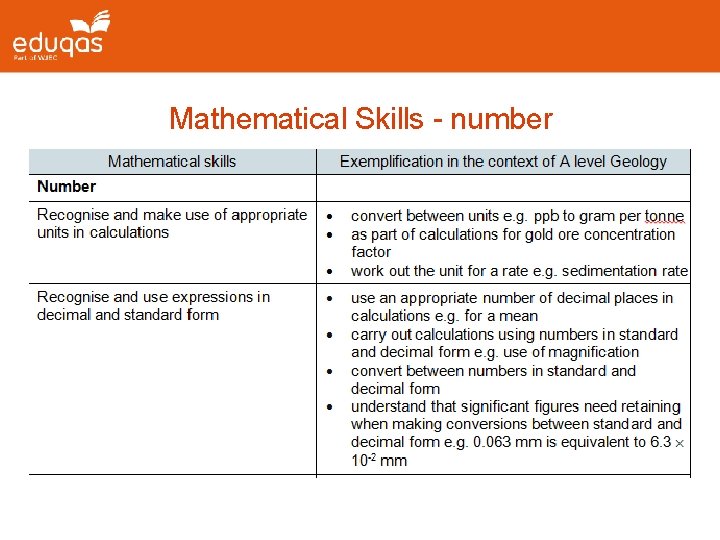
Mathematical Skills - number
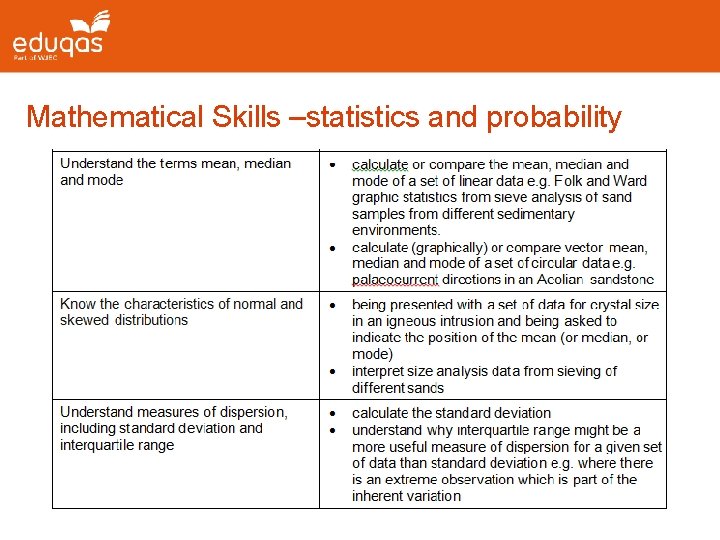
Mathematical Skills –statistics and probability
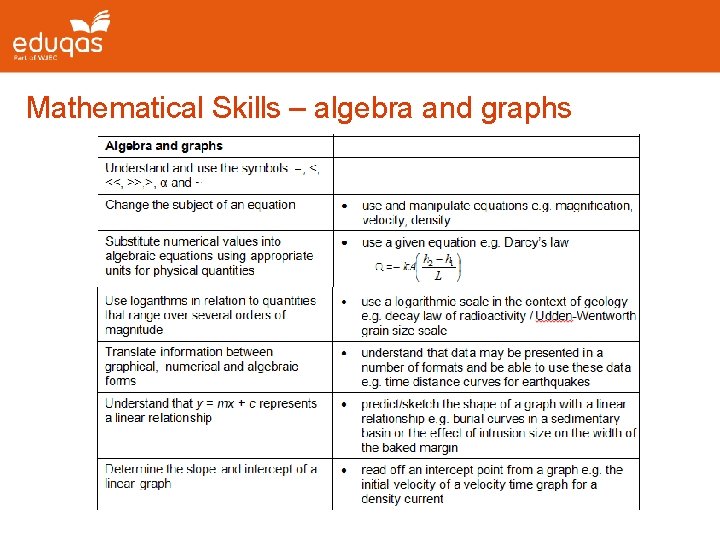
Mathematical Skills – algebra and graphs
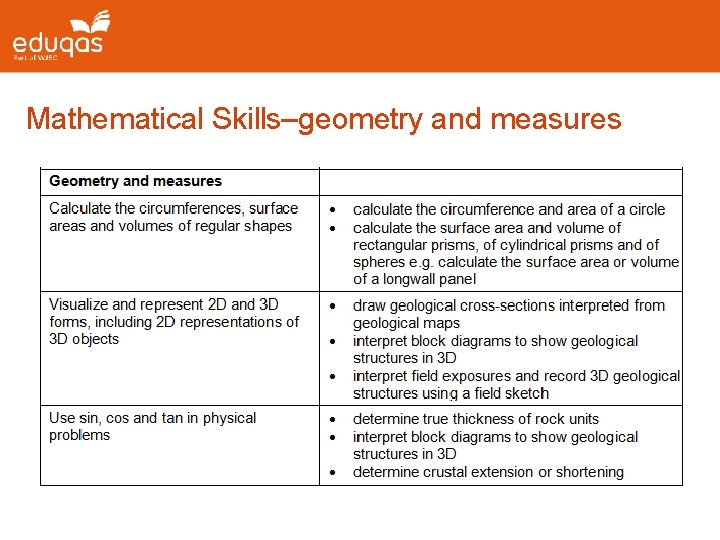
Mathematical Skills–geometry and measures
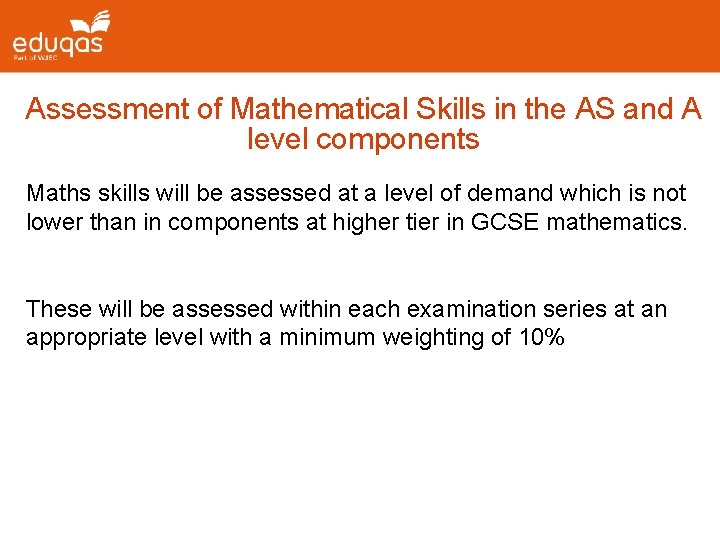
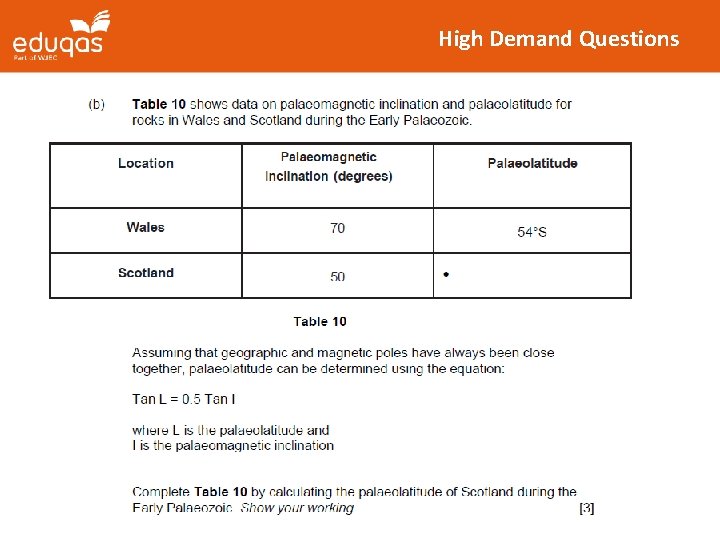
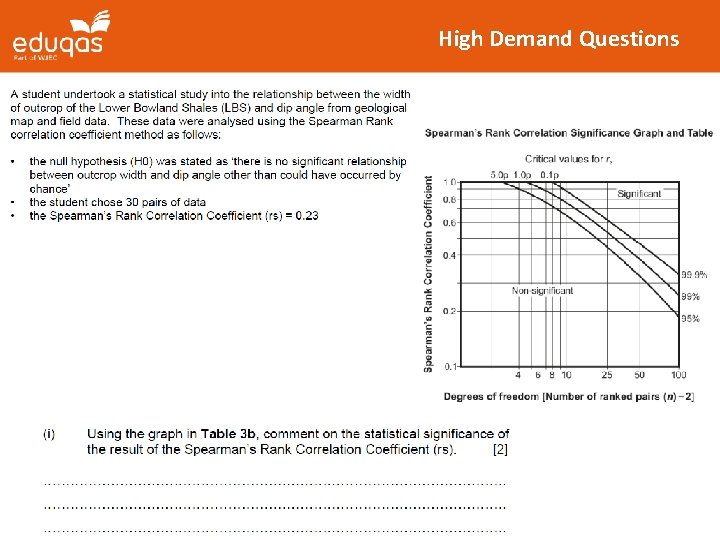
Assessment of Mathematical Skills in the AS and A level components Maths skills will be assessed at a level of demand which is not lower than in components at higher tier in GCSE mathematics. These will be assessed within each examination series at an appropriate level with a minimum weighting of 10%
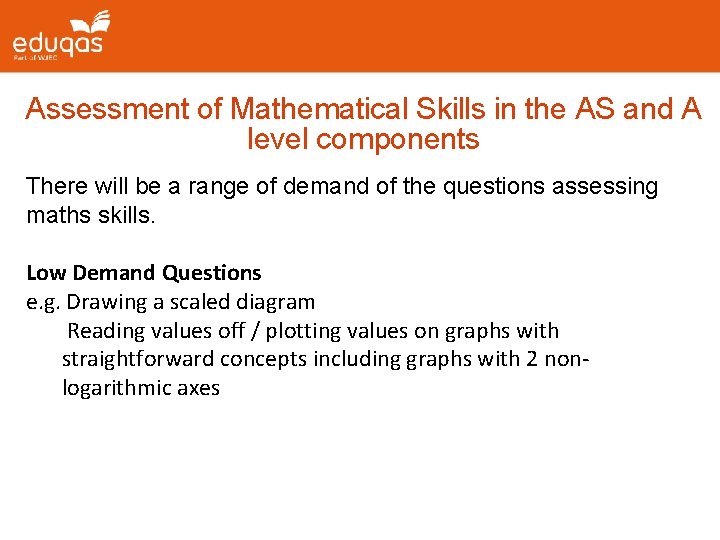
Assessment of Mathematical Skills in the AS and A level components There will be a range of demand of the questions assessing maths skills. Low Demand Questions e. g. Drawing a scaled diagram Reading values off / plotting values on graphs with straightforward concepts including graphs with 2 nonlogarithmic axes
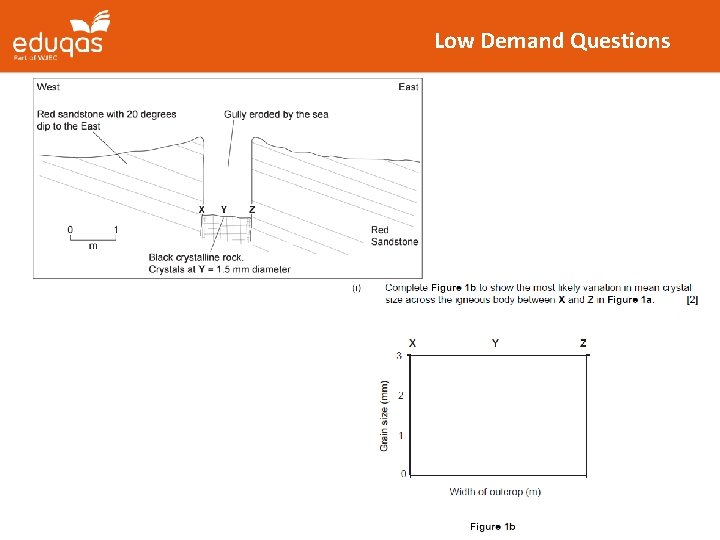
Low Demand Questions
Assessment of Mathematical Skills in the AS and A level components Standard Demand Questions e. g. Mathematical calculations which require one stage of calculation, without the use of a provided formula Interpretation of block diagrams/maps to show geological structures, or drawing geological cross-sections interpreted from geological maps Reading off or plotting values on graphs involving more demanding concepts, such as triangular graphs and graphs with logarithmic plots
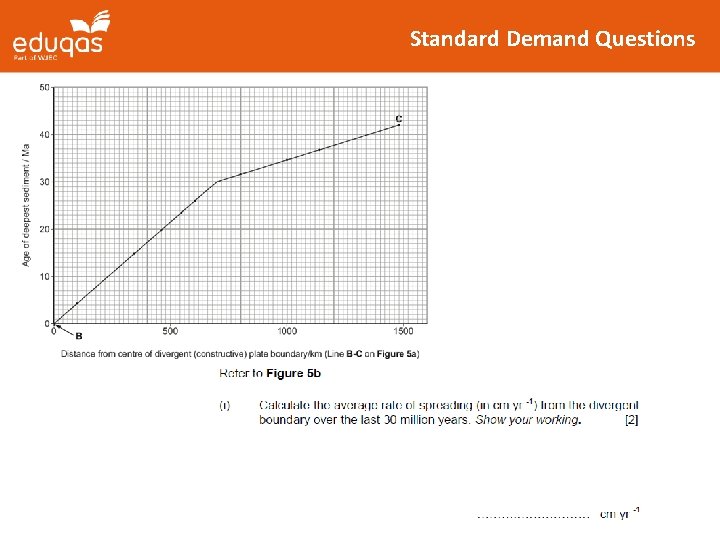
Standard Demand Questions
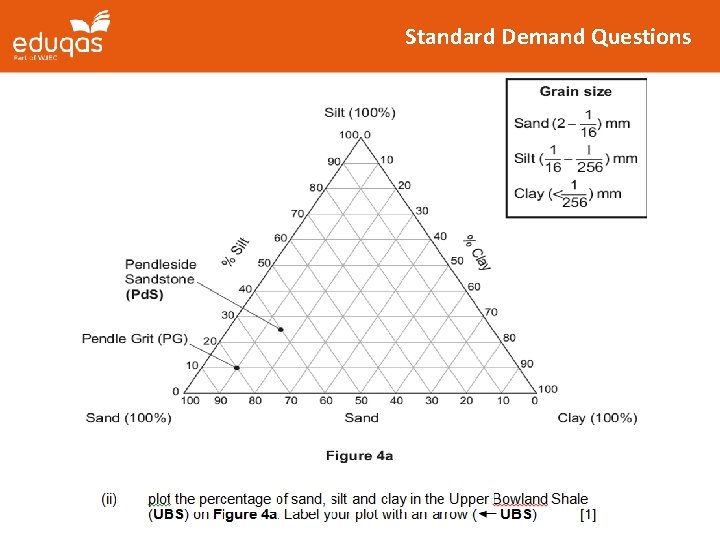
Standard Demand Questions
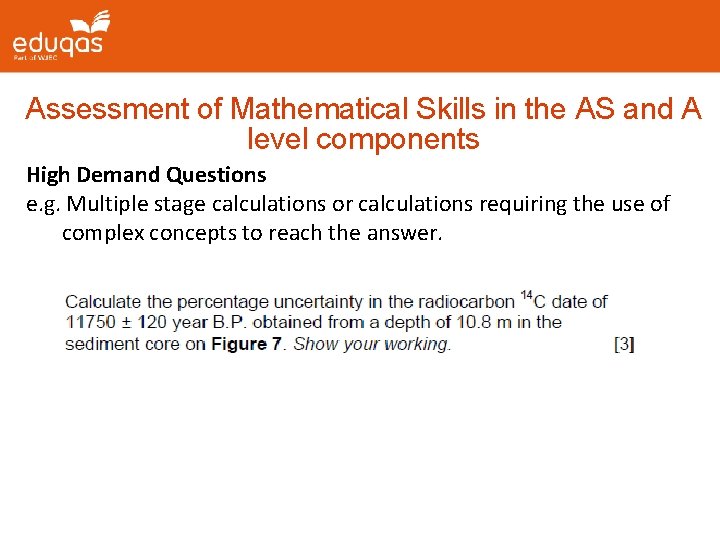
Assessment of Mathematical Skills in the AS and A level components High Demand Questions e. g. Multiple stage calculations or calculations requiring the use of complex concepts to reach the answer.
High Demand Questions
High Demand Questions
Fieldwork in AS and A level Geology
Fieldwork in AS /A level Geology Learners are required to undertake a minimum of two days of work in the field for AS and four days for A level in order to develop their field observation and practical skills. Each centre must provide a fieldwork statement form to WJEC that details the fieldwork carried out in each assessment cycle. It will be available from the website and is submitted after fieldwork as been completed. It indicates that all learners have been given the opportunity to take part in the required fieldwork and is signed by the teacher/countersigned by the Head of Centre
Fieldwork in AS /A level Geology To develop learners' problem solving skills, it is expected that learners should have opportunities to carry out a directed investigations to answer geological problems, such as: o What does evidence from these localities reveal about the relative time sequence of geological events in this area? o What does the sedimentological and paleontological evidence indicate about the changes in the environments of deposition of the sedimentary rocks at this locality? Centres should feel able to devise alternative examples of directed investigations relevant to the field locations used.
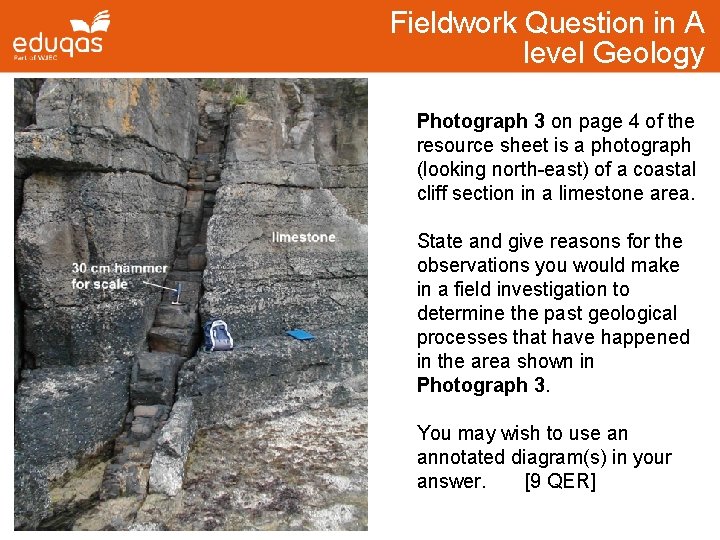
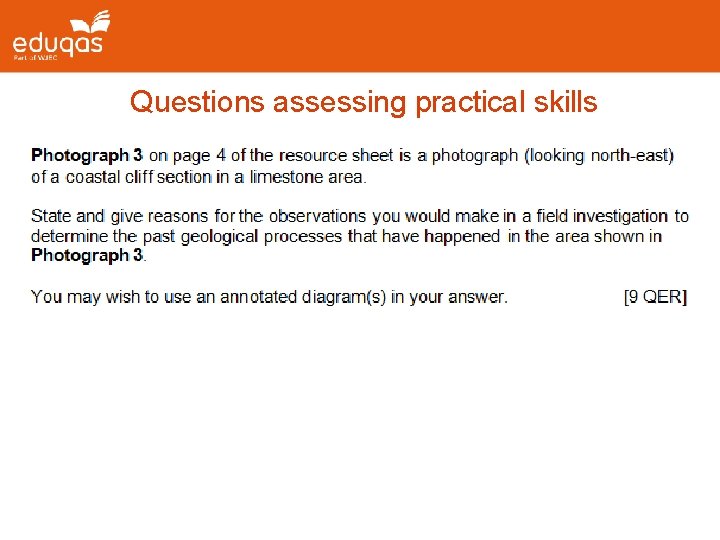
Fieldwork Question in A level Geology Photograph 3 on page 4 of the resource sheet is a photograph (looking north-east) of a coastal cliff section in a limestone area. State and give reasons for the observations you would make in a field investigation to determine the past geological processes that have happened in the area shown in Photograph 3. You may wish to use an annotated diagram(s) in your answer. [9 QER]

Practical Skills & Techniques
Practical Skills & Techniques Practical work is an intrinsic part of geology, and is highly valued by higher education. It should be developed throughout the course and an investigative approach promoted The list in Appendix A of the specification outlines the range and extent of practical skills and techniques required by WJEC Eduqas Geology.
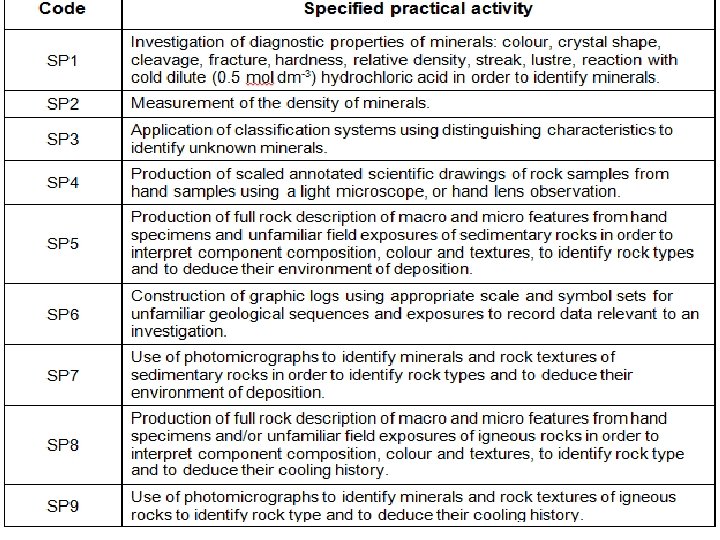
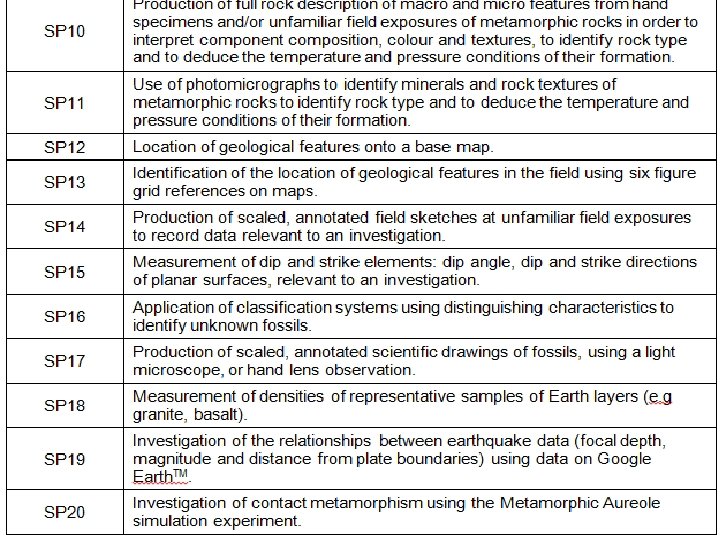
Practical Skills & Techniques Specified practical activities are identified in the specification with the letters SP (letter P at AS). Specified practical activities are stated in Appendix B of the specification. The completion of these specified practical activities will develop the practical skills and techniques required In addition the successful completion of the specified practical activities is necessary for the awarding of the practical endorsement (A level only).
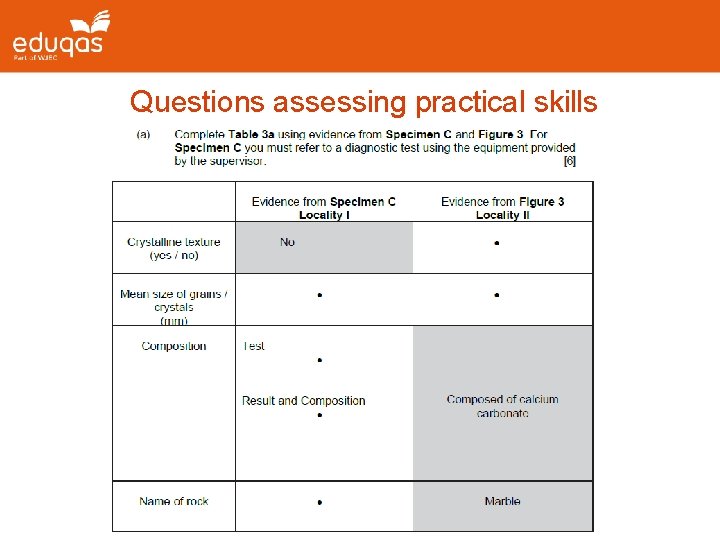
Assessment of Practical Skills & Techniques in the AS and A level components The practical skills and techniques skills will be assessed within each exam series with a weighting of approximately 50% This should be no surprise since geology is a highly practical science subject. Note also that all marks awarded for maths skills are also practical skills marks.
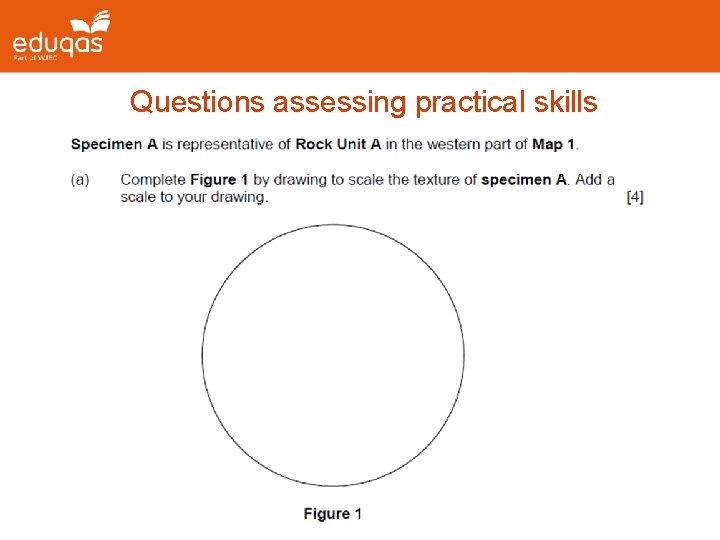
Questions assessing practical skills
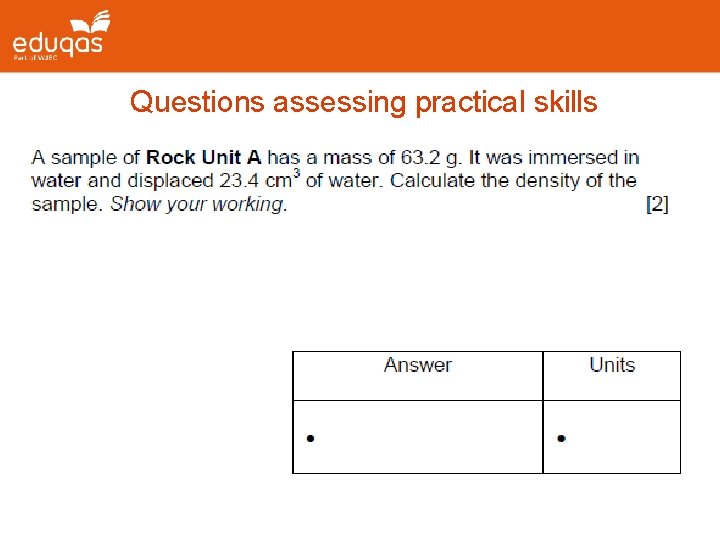
Questions assessing practical skills
Questions assessing practical skills
Questions assessing practical skills
The Practical Endorsement in A level Geology
Practical Endorsement • An assessment of practical competency • Reported separately to qualification grade. it does not contribute to the final grade • It is not part of the AS • It will appear on learners’ certificates as a separately reported grade, alongside the overall grade issued for the A level • It will be either reported as a pass or not reported.
Practical Endorsement • It requires learners to keep an appropriate record of their practical activities • It is teacher assessed against Common Practical Assessment Criteria • A monitoring visit by a geology teaching specialist will take place It follows the same procedure as the current practical endorsement in A level Biology, Chemistry and Physics.
Practical Endorsement In order to achieve a PASS, learners will need to: • Develop the competencies by carrying out the 20 specified practical activities which cover all of the techniques required • Consistently and routinely exhibit the competencies • Keep an appropriate record of their practical activities Some of these practical activities should be repeated over the two years e. g. describing sedimentary rocks, taking dip and strike readings
Practical Endorsement THE COMPETENCIES 1. Follows written procedures 2. Applies investigative approaches and methods when using instruments and equipment 3. Safely uses a range of practical equipment and materials 4. Makes and records observations 5. Researches, references and reports
Practical Endorsement ‘Portfolio of practical work’ • It is compulsory that learners keep a record of their practical work in a ‘portfolio’ • This should be a working document which does not need to be formally assessed • Students should track the development of their practical skills – the student record
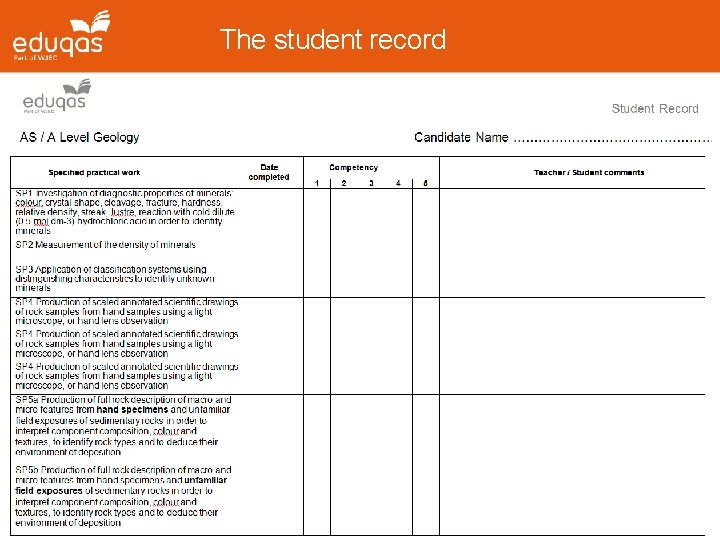
The student record
Practical Endorsement STUDENT RECORD At front of ‘portfolio’ Track their progress of the techniques and their development of the competencies Self assessment opportunity Teacher comment opportunity
Practical Endorsement TEACHER RECORDS 1. Attendance register 2. Plan of practical activities including a record of the competencies achieved – see handout Easier to assess which students have not achieved a competency Teacher comments can be added to the student record in the front of the ‘portfolio’
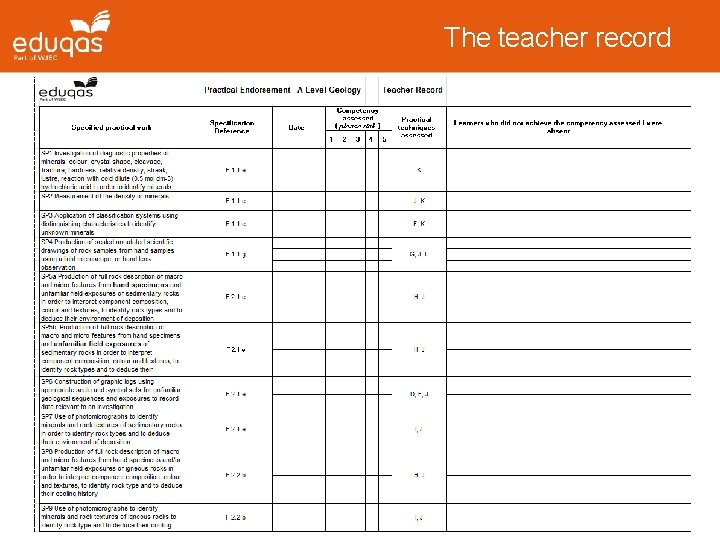
The teacher record
Practical Endorsement MONITORING VISIT (BY PRIOR ARRANGEMENT) Observation of class doing a practical Review of ‘portfolio’ Review of teacher records Review of student records Discussion with teacher Discussion with students
Eduqas Resources to support the new AS and A level Geology
• Detailed “Guidance for Teaching” document • Guidance on each of the specified practicals • Guidance on teaching the mathematical skills • Digital resources for teaching • Use of SAMs for new WJEC AS / A level Geology specifications • Useful subject web pages • Question paper database • Easily contactable subject officer / subject support officer • E mail bulletins

Resources website http: //www. eduqas. co. uk/resources
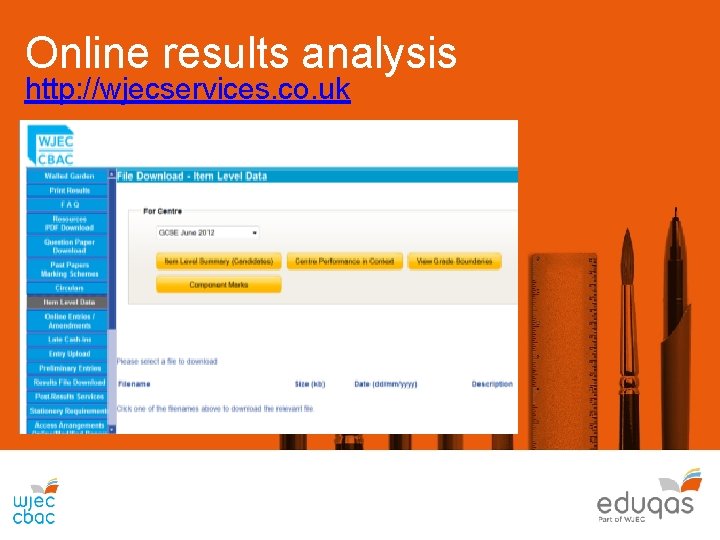
Online results analysis http: //wjecservices. co. uk
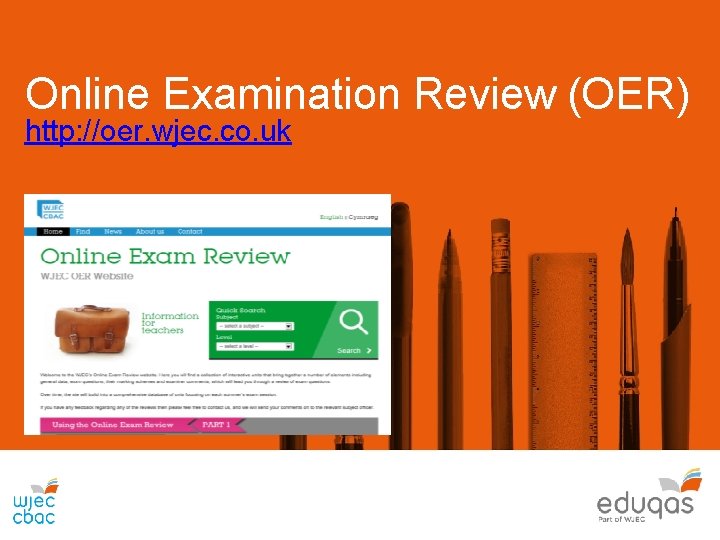
Online Examination Review (OER) http: //oer. wjec. co. uk

Any Questions?
- Slides: 108