
Nevada Department of Corrections Introduction to Restraints Objectives
Nevada Department of Corrections Introduction to Restraints
• Objectives: ◦ Refer to the POST Performance Objectives Introduction to Restraints
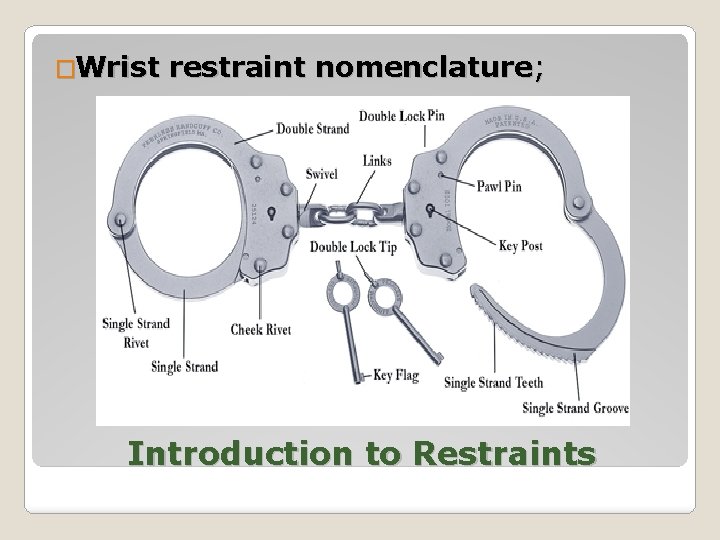
�Wrist restraint nomenclature; Introduction to Restraints
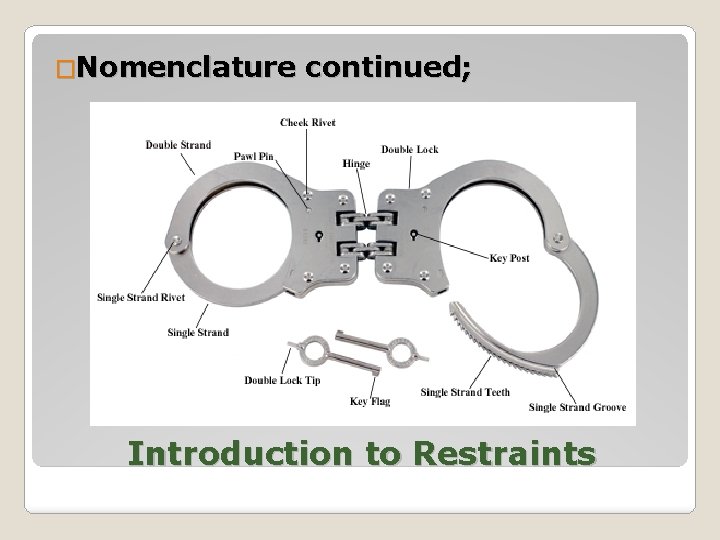
�Nomenclature continued; Introduction to Restraints
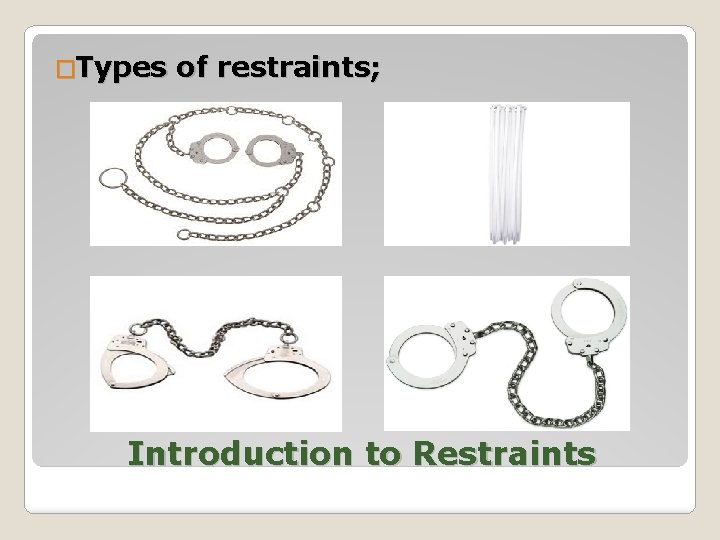
�Types of restraints; Introduction to Restraints
�Preparation. ◦ During any type of compliant handcuffing, the officer should; ◦ Assume a defensive stance. ◦ Be aware of the inmates entire body and be ready to respond. Introduction to Restraints
�Preparation continued, ◦ Order the subject to turn and face away. ◦ Advise the subject they are being placed into restraints. ◦ Move to the position of advantage. �(Defensive stance behind the inmate off to either side at a 45 degree angle. ) Introduction to Restraints
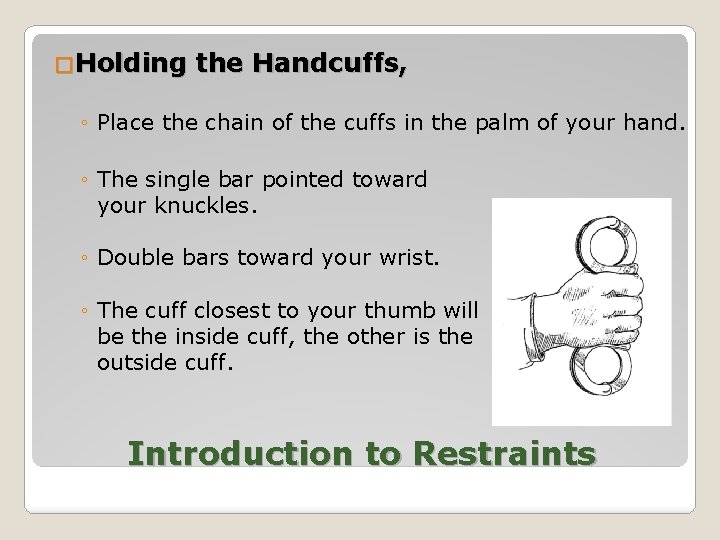
�Holding the Handcuffs, ◦ Place the chain of the cuffs in the palm of your hand. ◦ The single bar pointed toward your knuckles. ◦ Double bars toward your wrist. ◦ The cuff closest to your thumb will be the inside cuff, the other is the outside cuff. Introduction to Restraints
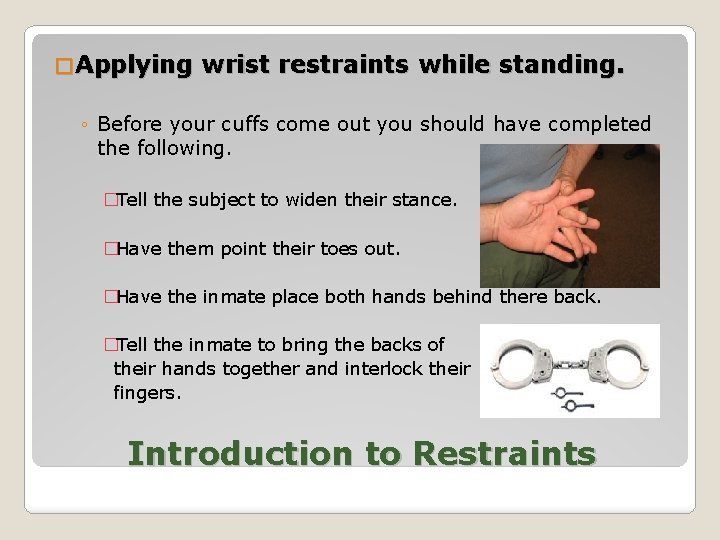
� Applying wrist restraints while standing. ◦ Before your cuffs come out you should have completed the following. �Tell the subject to widen their stance. �Have them point their toes out. �Have the inmate place both hands behind there back. �Tell the inmate to bring the backs of their hands together and interlock their fingers. Introduction to Restraints
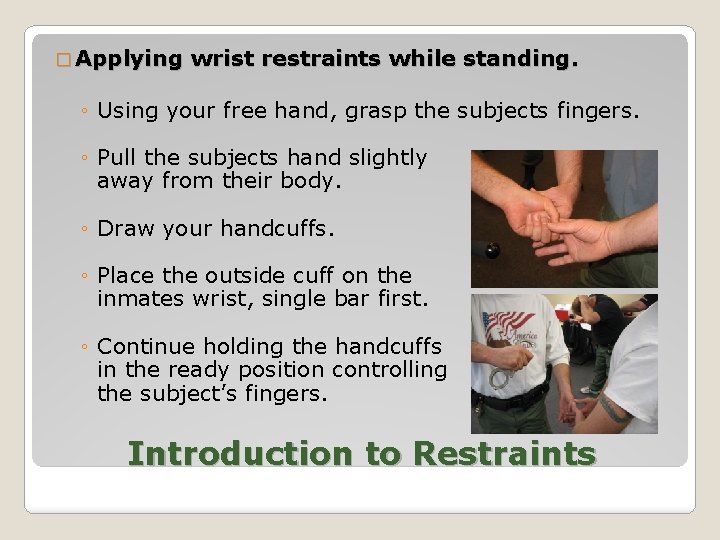
� Applying wrist restraints while standing. ◦ Using your free hand, grasp the subjects fingers. ◦ Pull the subjects hand slightly away from their body. ◦ Draw your handcuffs. ◦ Place the outside cuff on the inmates wrist, single bar first. ◦ Continue holding the handcuffs in the ready position controlling the subject’s fingers. Introduction to Restraints
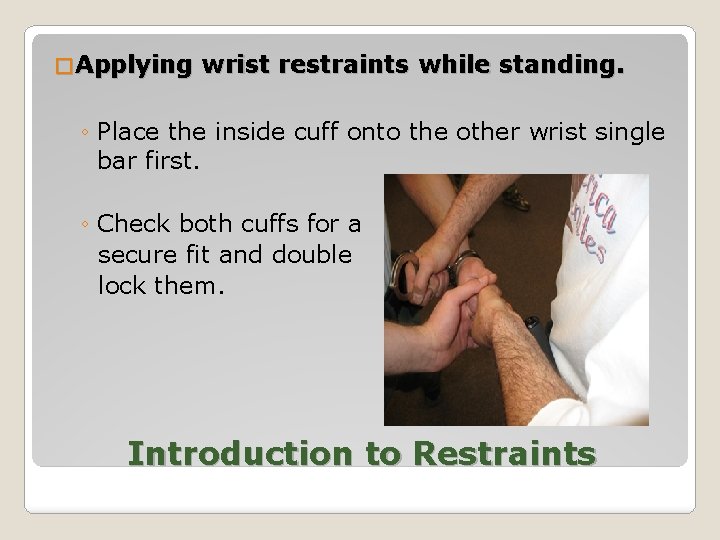
� Applying wrist restraints while standing. ◦ Place the inside cuff onto the other wrist single bar first. ◦ Check both cuffs for a secure fit and double lock them. Introduction to Restraints
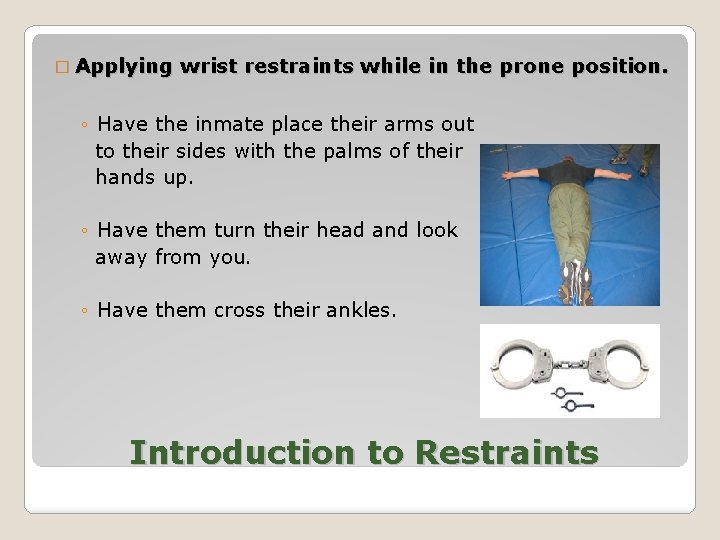
� Applying wrist restraints while in the prone position. ◦ Have the inmate place their arms out to their sides with the palms of their hands up. ◦ Have them turn their head and look away from you. ◦ Have them cross their ankles. Introduction to Restraints
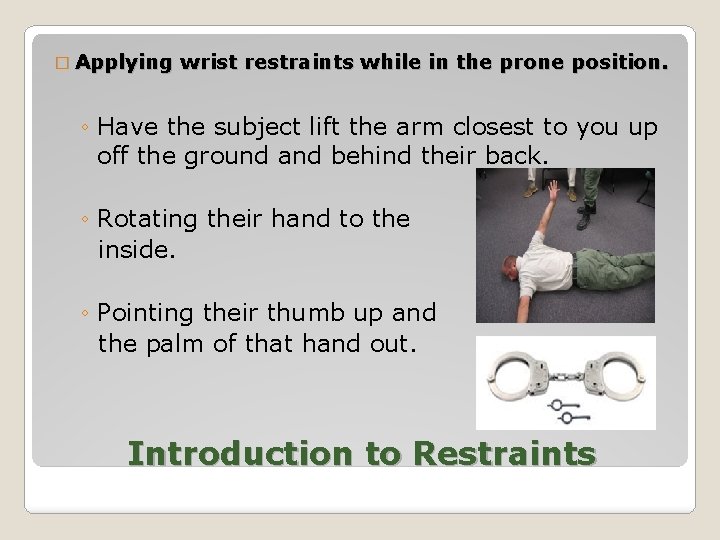
� Applying wrist restraints while in the prone position. ◦ Have the subject lift the arm closest to you up off the ground and behind their back. ◦ Rotating their hand to the inside. ◦ Pointing their thumb up and the palm of that hand out. Introduction to Restraints
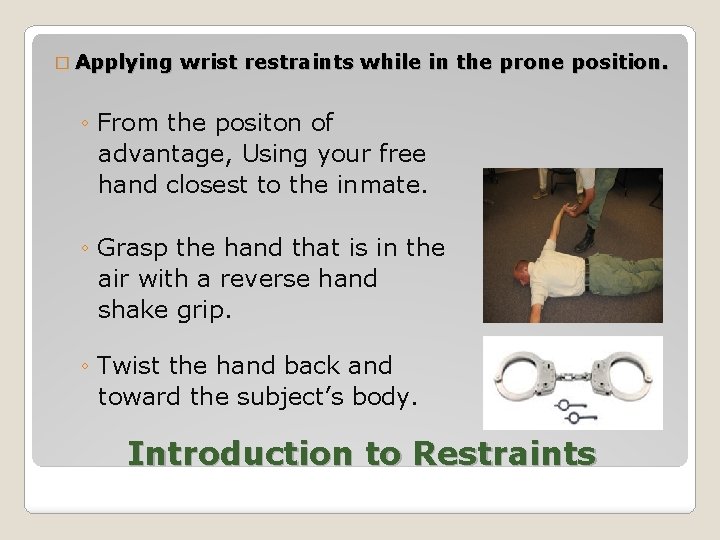
� Applying wrist restraints while in the prone position. ◦ From the positon of advantage, Using your free hand closest to the inmate. ◦ Grasp the hand that is in the air with a reverse hand shake grip. ◦ Twist the hand back and toward the subject’s body. Introduction to Restraints
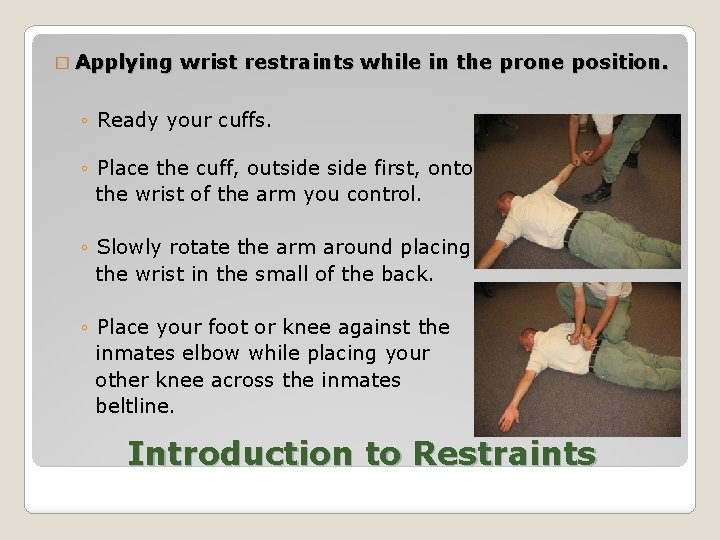
� Applying wrist restraints while in the prone position. ◦ Ready your cuffs. ◦ Place the cuff, outside first, onto the wrist of the arm you control. ◦ Slowly rotate the arm around placing the wrist in the small of the back. ◦ Place your foot or knee against the inmates elbow while placing your other knee across the inmates beltline. Introduction to Restraints
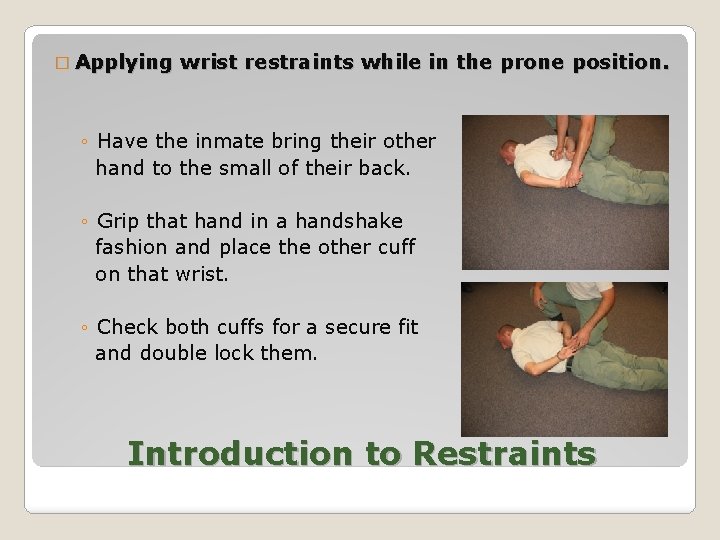
� Applying wrist restraints while in the prone position. ◦ Have the inmate bring their other hand to the small of their back. ◦ Grip that hand in a handshake fashion and place the other cuff on that wrist. ◦ Check both cuffs for a secure fit and double lock them. Introduction to Restraints
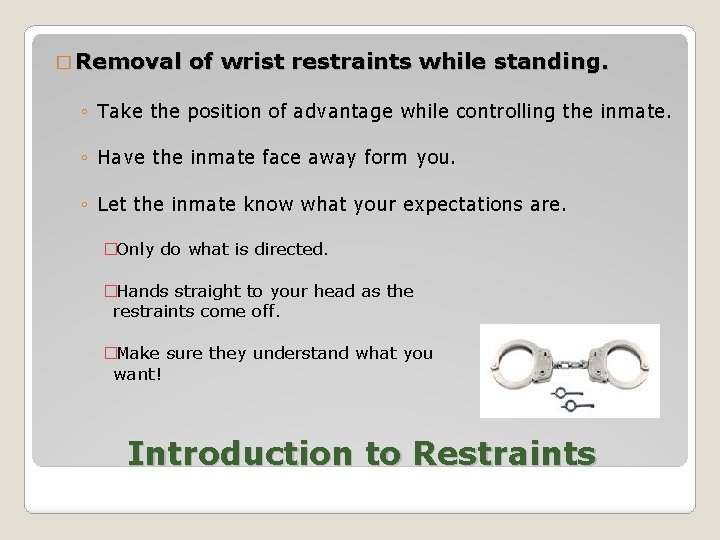
� Removal of wrist restraints while standing. ◦ Take the position of advantage while controlling the inmate. ◦ Have the inmate face away form you. ◦ Let the inmate know what your expectations are. �Only do what is directed. �Hands straight to your head as the restraints come off. �Make sure they understand what you want! Introduction to Restraints
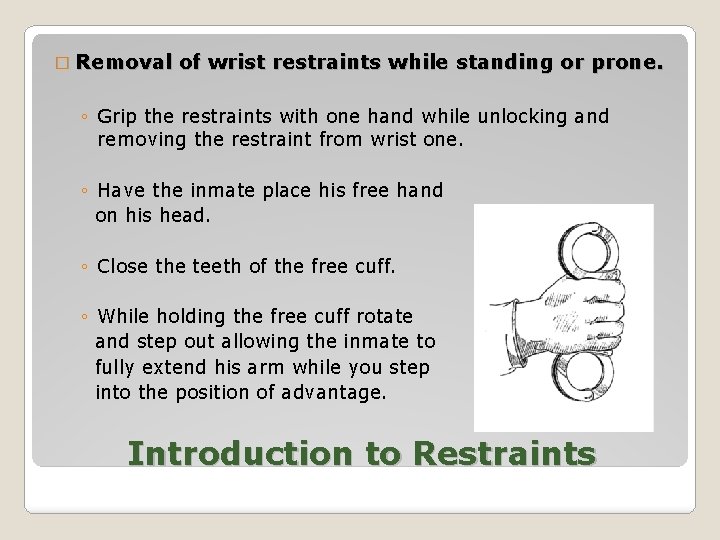
� Removal of wrist restraints while standing or prone. ◦ Grip the restraints with one hand while unlocking and removing the restraint from wrist one. ◦ Have the inmate place his free hand on his head. ◦ Close the teeth of the free cuff. ◦ While holding the free cuff rotate and step out allowing the inmate to fully extend his arm while you step into the position of advantage. Introduction to Restraints
� Removal of wrist restraints while standing or prone. ◦ Remove the restraint form wrist two. ◦ Order the inmate to place his second hand on his head and interlock his fingers. ◦ Take a step back, close the door…allow the inmate to relax once the possibility of threat is gone. Introduction to Restraints
�Applying waist restraints. ◦ Have the inmate face away from you. ◦ Tell the subject to widen their stance. ◦ Have them point their toes out. ◦ Hands are either placed on the wall or interlocked on the top of the head. Introduction to Restraints
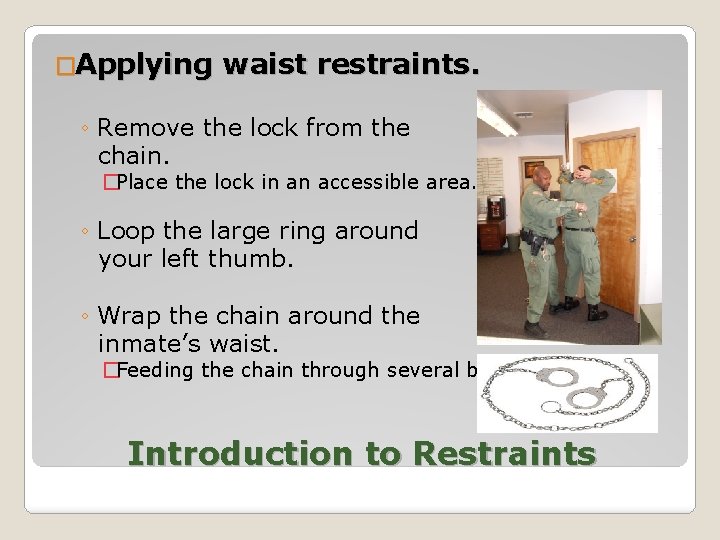
�Applying waist restraints. ◦ Remove the lock from the chain. �Place the lock in an accessible area. ◦ Loop the large ring around your left thumb. ◦ Wrap the chain around the inmate’s waist. �Feeding the chain through several belt loops. Introduction to Restraints
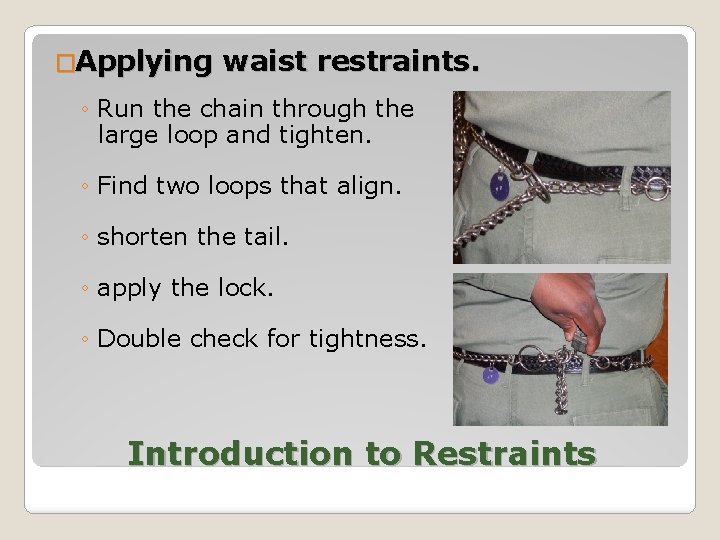
�Applying waist restraints. ◦ Run the chain through the large loop and tighten. ◦ Find two loops that align. ◦ shorten the tail. ◦ apply the lock. ◦ Double check for tightness. Introduction to Restraints
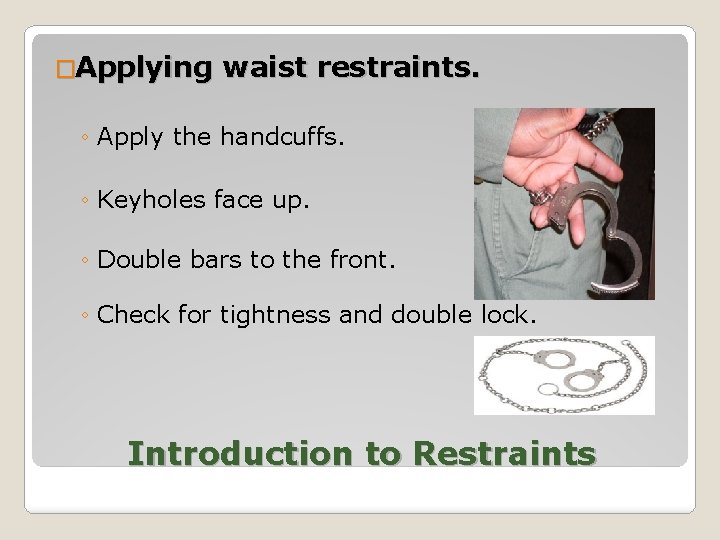
�Applying waist restraints. ◦ Apply the handcuffs. ◦ Keyholes face up. ◦ Double bars to the front. ◦ Check for tightness and double lock. Introduction to Restraints
�Removal of waist restraints. ◦ While the inmate is leaning against a wall or another solid surface. ◦ Unlock and remove the wrist restraints one at a time. �Remember to close the cuffs as you take them off. ◦ Ordering the inmates hands to the wall or on their head. Introduction to Restraints
�Removal of waist restraints. ◦ Remove the padlock, while controlling the long portion of the chain. ◦ Retain the long portion of the chain, and allow the short portion to drop and swing behind the inmate. Introduction to Restraints
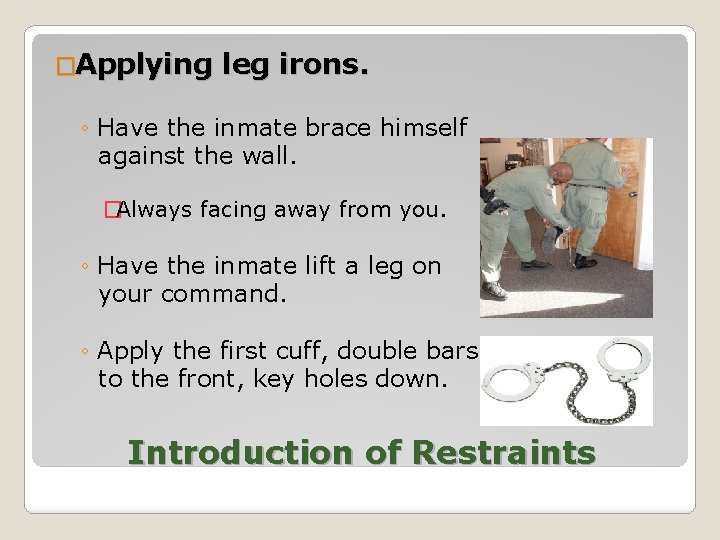
�Applying leg irons. ◦ Have the inmate brace himself against the wall. �Always facing away from you. ◦ Have the inmate lift a leg on your command. ◦ Apply the first cuff, double bars to the front, key holes down. Introduction of Restraints
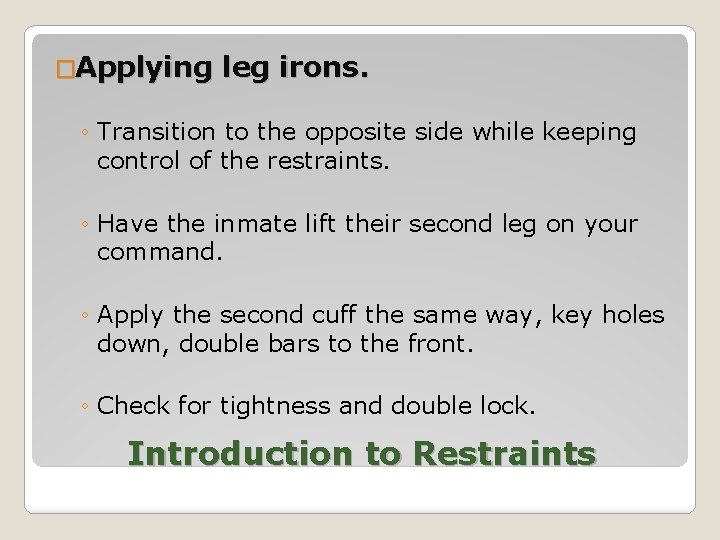
�Applying leg irons. ◦ Transition to the opposite side while keeping control of the restraints. ◦ Have the inmate lift their second leg on your command. ◦ Apply the second cuff the same way, key holes down, double bars to the front. ◦ Check for tightness and double lock. Introduction to Restraints
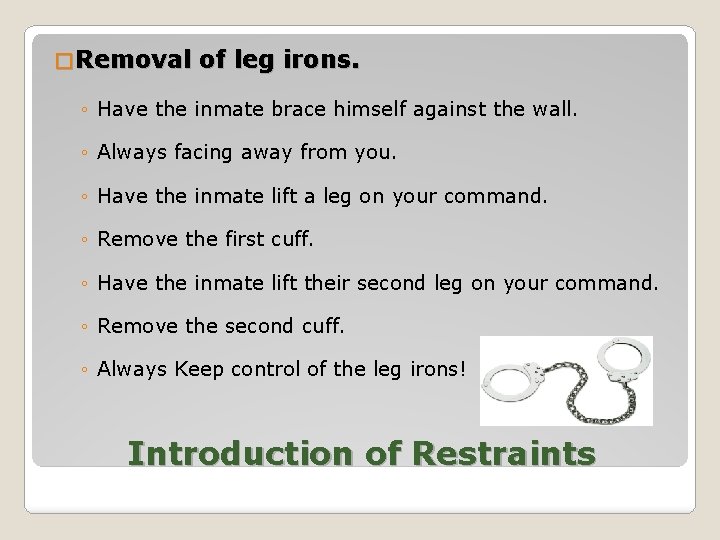
� Removal of leg irons. ◦ Have the inmate brace himself against the wall. ◦ Always facing away from you. ◦ Have the inmate lift a leg on your command. ◦ Remove the first cuff. ◦ Have the inmate lift their second leg on your command. ◦ Remove the second cuff. ◦ Always Keep control of the leg irons! Introduction of Restraints
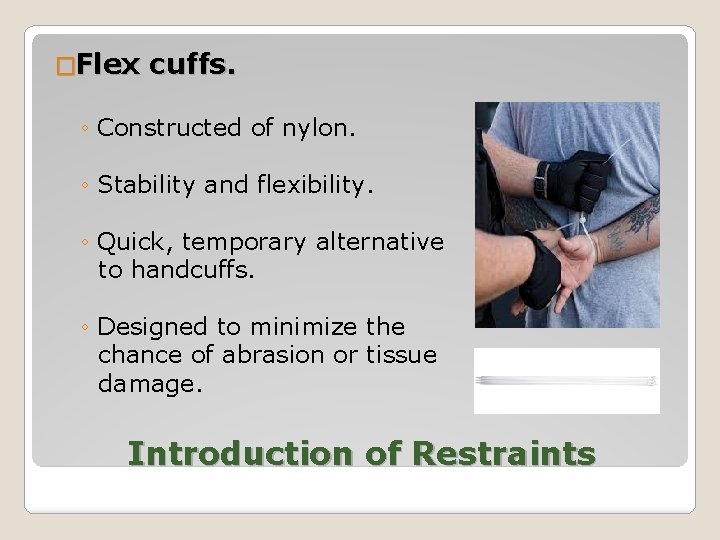
�Flex cuffs. ◦ Constructed of nylon. ◦ Stability and flexibility. ◦ Quick, temporary alternative to handcuffs. ◦ Designed to minimize the chance of abrasion or tissue damage. Introduction of Restraints
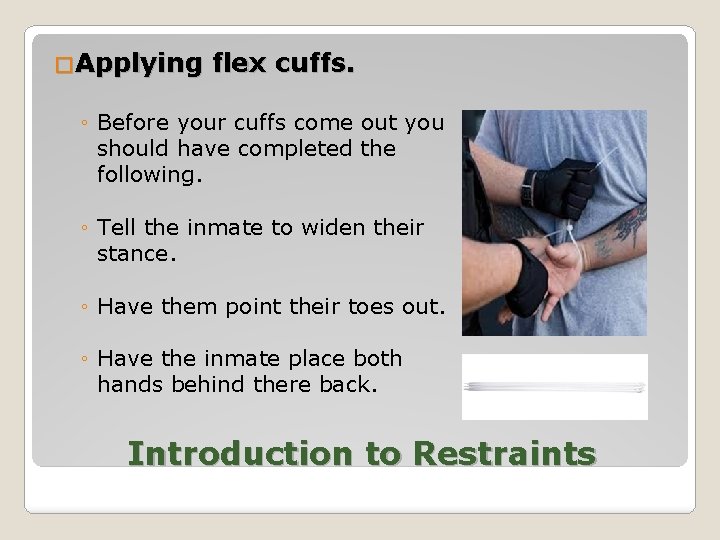
�Applying flex cuffs. ◦ Before your cuffs come out you should have completed the following. ◦ Tell the inmate to widen their stance. ◦ Have them point their toes out. ◦ Have the inmate place both hands behind there back. Introduction to Restraints
�Applying flex cuffs. ◦ Have the inmate bring the backs of their hands together and interlock their fingers. ◦ Using your free hand, grasp the inmates fingers. ◦ Pull the inmates hands slightly away from their body. ◦ Draw your flex cuff. ◦ Place the flex cuff over both wrist and tighten. Introduction to Restraints
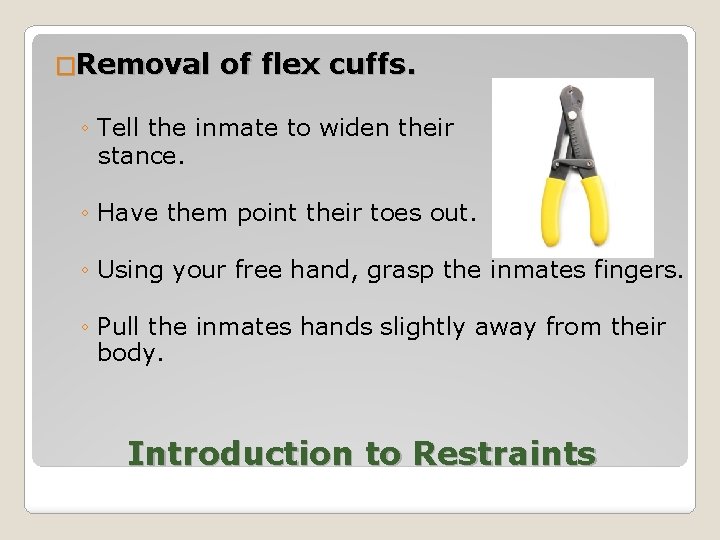
�Removal of flex cuffs. ◦ Tell the inmate to widen their stance. ◦ Have them point their toes out. ◦ Using your free hand, grasp the inmates fingers. ◦ Pull the inmates hands slightly away from their body. Introduction to Restraints
�Removal of flex cuffs. ◦ Allow space to reach in with the restraint cutters. ◦ Cut the flex cuffs and order the inmates hands to the wall or on their head. ◦ Take a step back, close the door…allow the inmate to relax once the possibility of threat is gone. Introduction to Restraints
Questions ? Hands on practical… Introduction to Restraints
- Slides: 34