
NEVADA DEPARTMENT OF CORRECTIONS INMATE GRIEVANCE PROCEDURE WHY


- Slides: 42
NEVADA DEPARTMENT OF CORRECTIONS INMATE GRIEVANCE PROCEDURE WHY WE HAVE A GRIEVANCE PROCESS…
Have you ever been involved in the Inmate Grievance Procedure? What do you believe the purpose of the Inmate Grievance Procedure is?
HISTORY OF INMATE GRIEVANCE PROCEDURES • Beginning in the mid 1960’s Federal Courts began to recognize prisoner’s rights such as habeas corpus, the Eighth Amendment, and other constitutional provisions • Civil Rights Act 1964 allowed judges to hold prison administrators responsible for unconstitutional actions taken under state law
Adoption of Internal Grievance Procedures served to benefit the Courts, the Prisons and the Inmates by: 1. Allowing prisons to identify institutional problems and handle disputes within the prison system before they reached the court’s thereby reducing inmate litigation and judicial intervention with respect of the management of prisons AND
2. Reduce inmate violence by giving inmates a fair and equitable forum to voice complaints and receive responses to their complaints Allowing prisons to identify institutional problems and handle disputes within the prison system before they reached the court’s thereby reducing inmate litigation and judicial intervention with respect of the management of prisons
Reduce inmate violence by giving inmates a fair and equitable forum to voice complaints and receive responses to their complaints
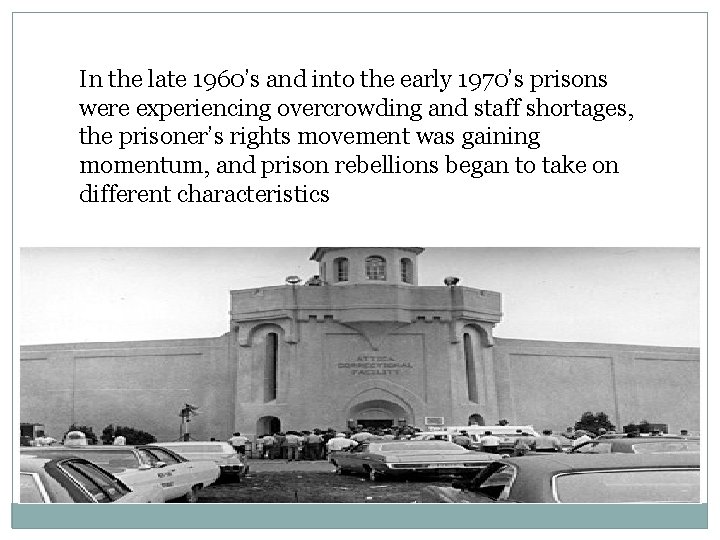
In the late 1960’s and into the early 1970’s prisons were experiencing overcrowding and staff shortages, the prisoner’s rights movement was gaining momentum, and prison rebellions began to take on different characteristics
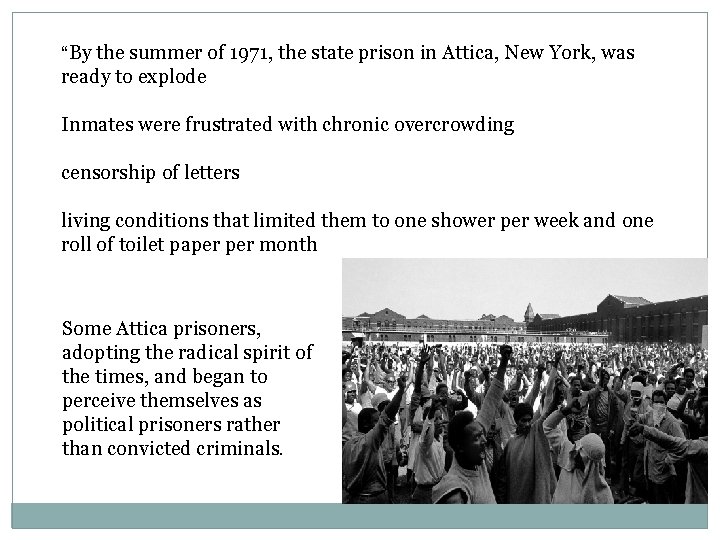
“By the summer of 1971, the state prison in Attica, New York, was ready to explode Inmates were frustrated with chronic overcrowding censorship of letters living conditions that limited them to one shower per week and one roll of toilet paper month Some Attica prisoners, adopting the radical spirit of the times, and began to perceive themselves as political prisoners rather than convicted criminals.
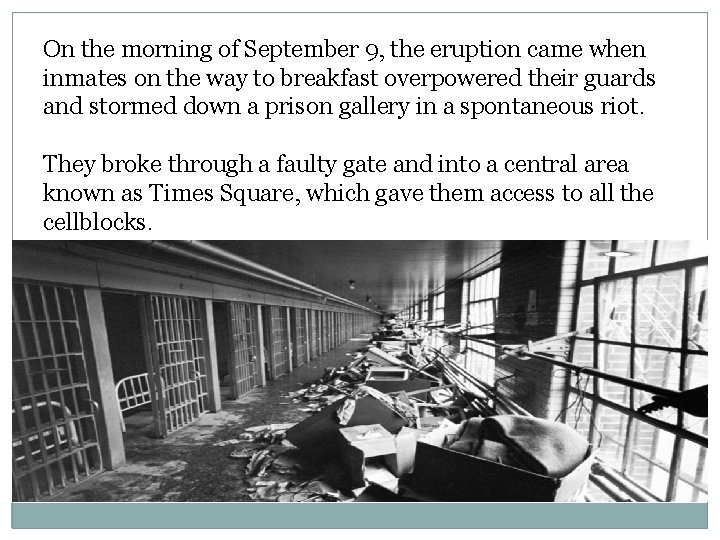
On the morning of September 9, the eruption came when inmates on the way to breakfast overpowered their guards and stormed down a prison gallery in a spontaneous riot. They broke through a faulty gate and into a central area known as Times Square, which gave them access to all the cellblocks.
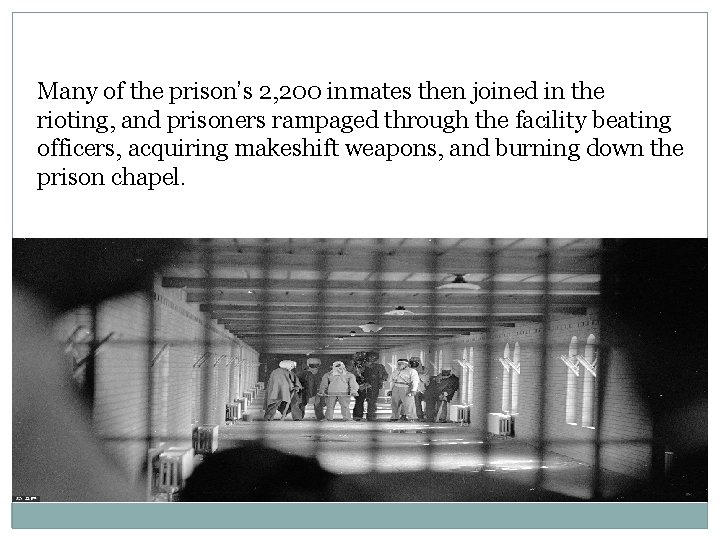
Many of the prison’s 2, 200 inmates then joined in the rioting, and prisoners rampaged through the facility beating officers, acquiring makeshift weapons, and burning down the prison chapel.
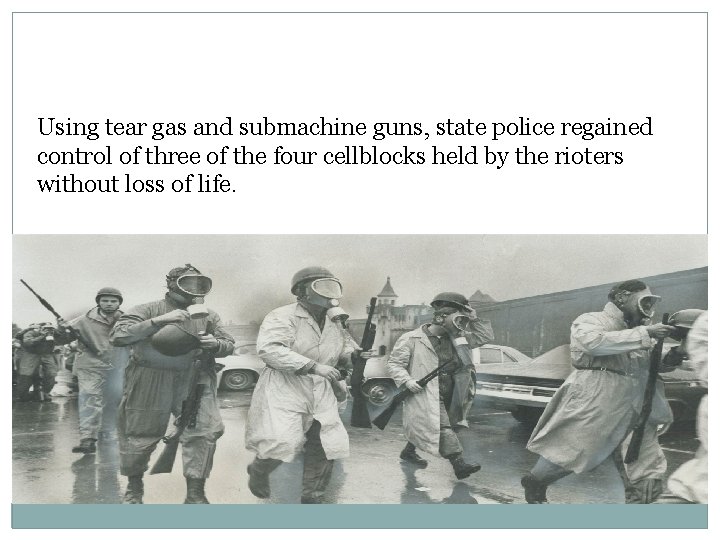
Using tear gas and submachine guns, state police regained control of three of the four cellblocks held by the rioters without loss of life.
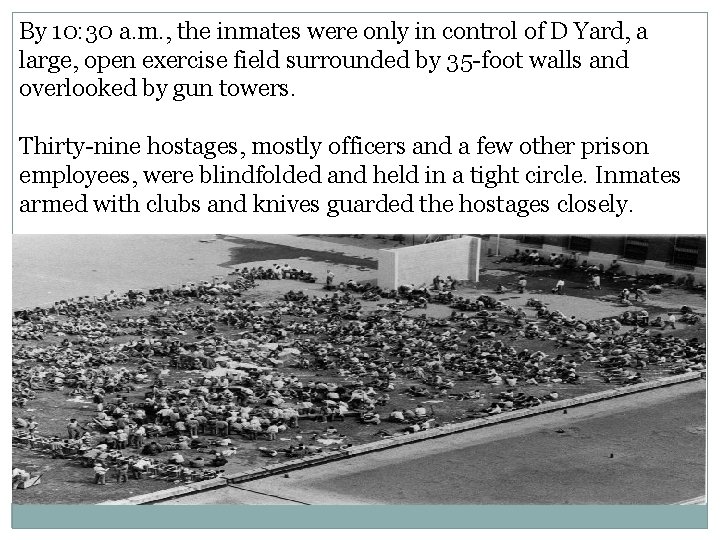
By 10: 30 a. m. , the inmates were only in control of D Yard, a large, open exercise field surrounded by 35 -foot walls and overlooked by gun towers. Thirty-nine hostages, mostly officers and a few other prison employees, were blindfolded and held in a tight circle. Inmates armed with clubs and knives guarded the hostages closely.
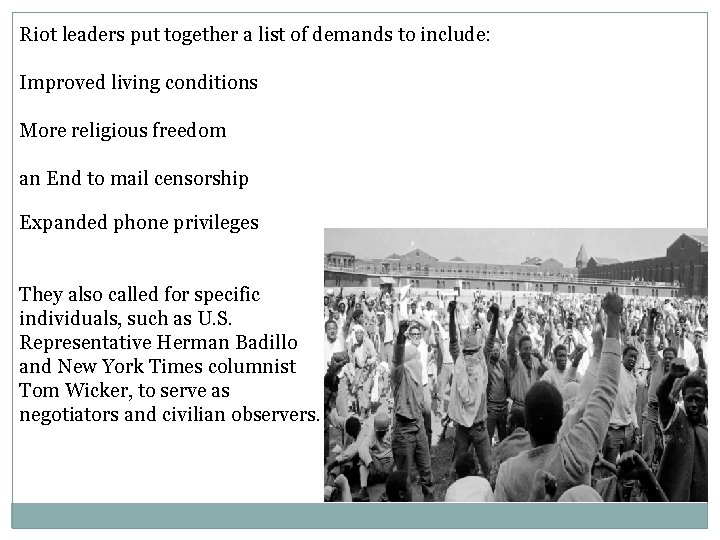
Riot leaders put together a list of demands to include: Improved living conditions More religious freedom an End to mail censorship Expanded phone privileges They also called for specific individuals, such as U. S. Representative Herman Badillo and New York Times columnist Tom Wicker, to serve as negotiators and civilian observers.
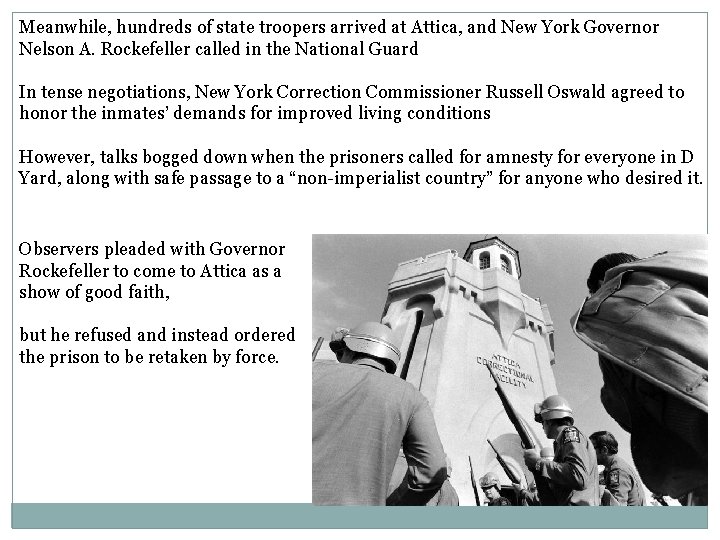
Meanwhile, hundreds of state troopers arrived at Attica, and New York Governor Nelson A. Rockefeller called in the National Guard In tense negotiations, New York Correction Commissioner Russell Oswald agreed to honor the inmates’ demands for improved living conditions However, talks bogged down when the prisoners called for amnesty for everyone in D Yard, along with safe passage to a “non-imperialist country” for anyone who desired it. Observers pleaded with Governor Rockefeller to come to Attica as a show of good faith, but he refused and instead ordered the prison to be retaken by force.
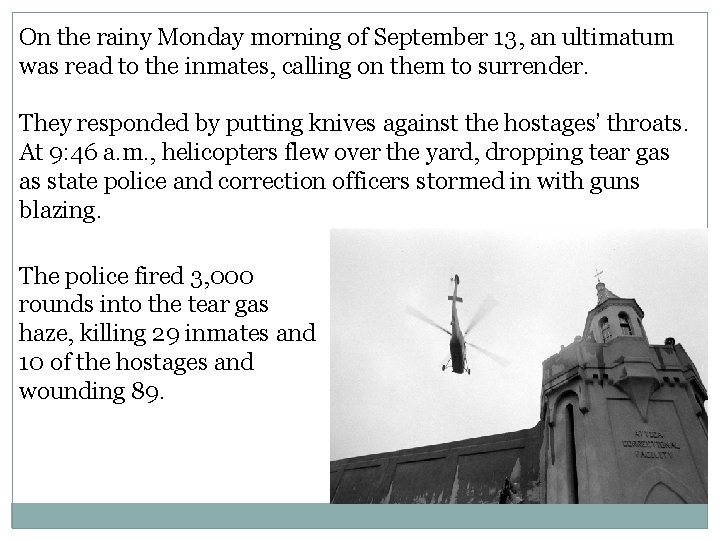
On the rainy Monday morning of September 13, an ultimatum was read to the inmates, calling on them to surrender. They responded by putting knives against the hostages’ throats. At 9: 46 a. m. , helicopters flew over the yard, dropping tear gas as state police and correction officers stormed in with guns blazing. The police fired 3, 000 rounds into the tear gas haze, killing 29 inmates and 10 of the hostages and wounding 89.
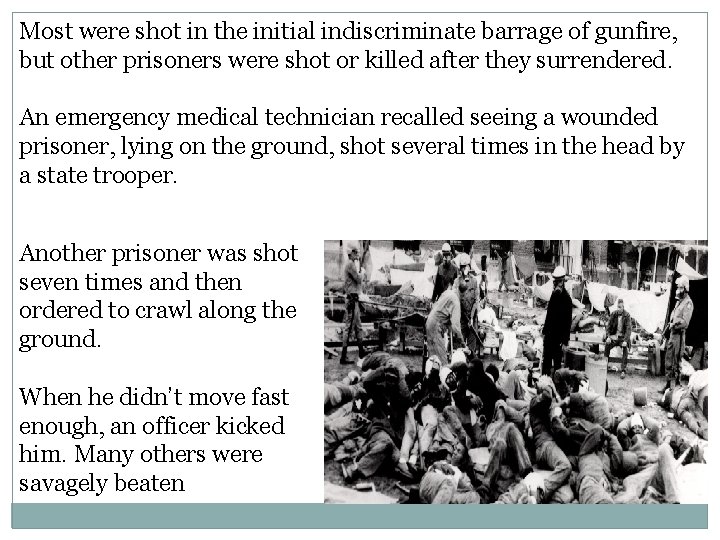
Most were shot in the initial indiscriminate barrage of gunfire, but other prisoners were shot or killed after they surrendered. An emergency medical technician recalled seeing a wounded prisoner, lying on the ground, shot several times in the head by a state trooper. Another prisoner was shot seven times and then ordered to crawl along the ground. When he didn’t move fast enough, an officer kicked him. Many others were savagely beaten
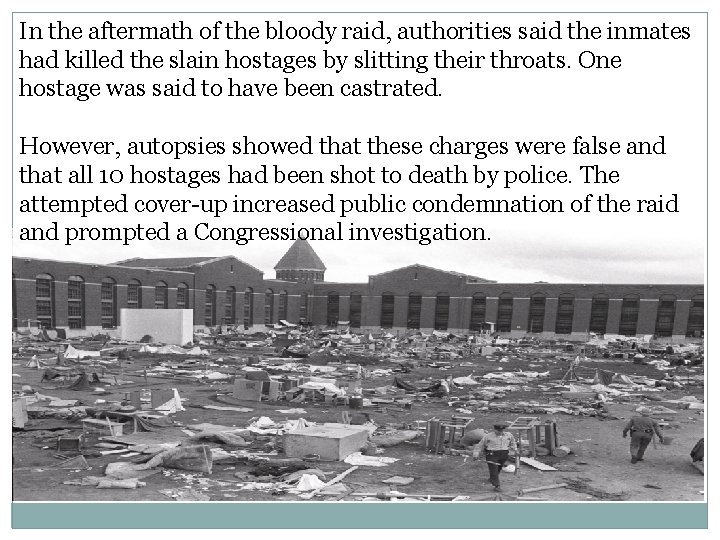
In the aftermath of the bloody raid, authorities said the inmates had killed the slain hostages by slitting their throats. One hostage was said to have been castrated. However, autopsies showed that these charges were false and that all 10 hostages had been shot to death by police. The attempted cover-up increased public condemnation of the raid and prompted a Congressional investigation.
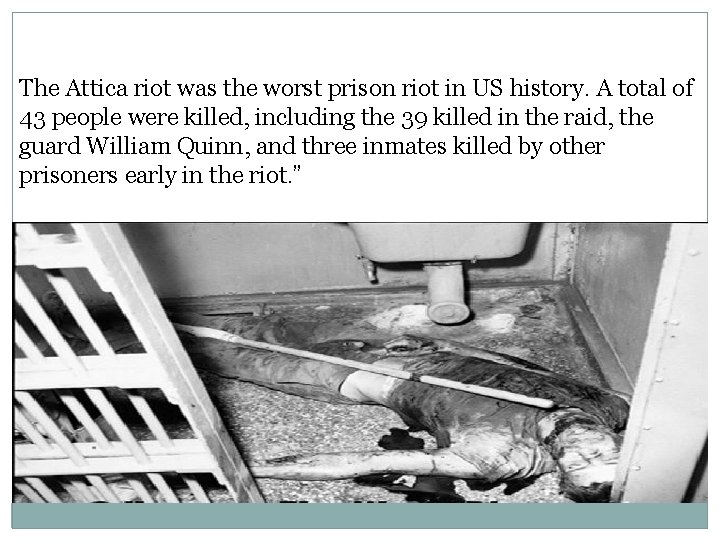
The Attica riot was the worst prison riot in US history. A total of 43 people were killed, including the 39 killed in the raid, the guard William Quinn, and three inmates killed by other prisoners early in the riot. ”
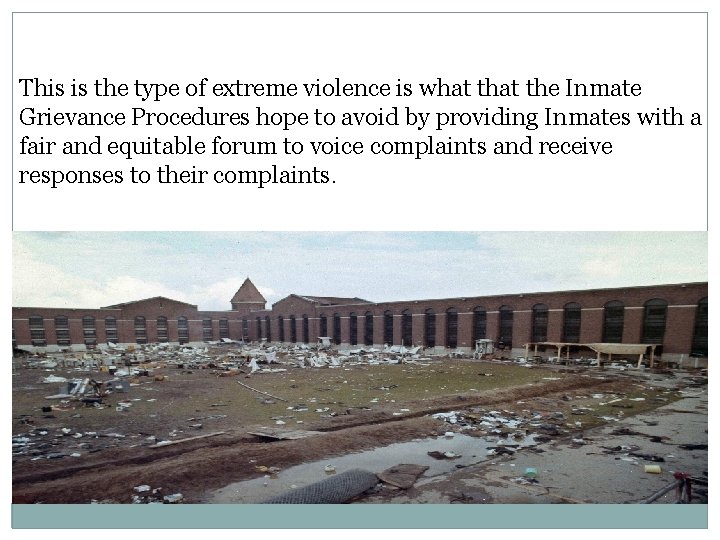
This is the type of extreme violence is what the Inmate Grievance Procedures hope to avoid by providing Inmates with a fair and equitable forum to voice complaints and receive responses to their complaints.
By 1983, each of the 50 states had adopted some form of grievance procedures for their adult prison systems
NDOC INMATE GRIEVANCE PROCEDURE ADMINISTRATIVE REGULATION 740
What is the purpose of AR 740 Inmate Grievance Procedure? “The purpose of this Administrative Regulation (“AR”) is to set forth the requirements and procedures of the administrative process that the Nevada Department of Corrections (“NDOC”) inmates must utilize to resolve addressable grievances and claims, including, but not limit to, claims for personal property, property damage, disciplinary appeals, personal injuries, and any other tort or civil rights claim relating to conditions of confinement. ”
INMATE GRIEVANCE PROCEDURE FLOW CHART
• Inmate has Issue/Complaint • Inmate Attempts to Informally Resolve at Lowest Level • Generally the inmate will address the issue and attempt informal resolution with their caseworker
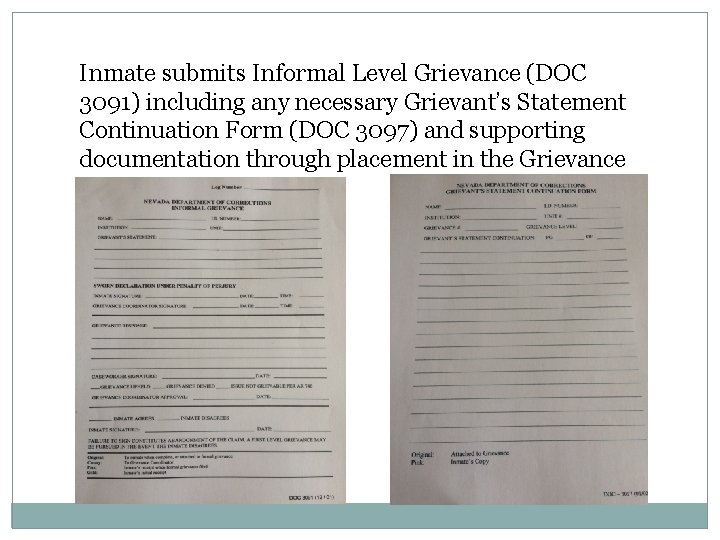
Inmate submits Informal Level Grievance (DOC 3091) including any necessary Grievant’s Statement Continuation Form (DOC 3097) and supporting documentation through placement in the Grievance Box
Informal Level Grievance is reviewed to determine if procedural and substantive requirements of AR 740 have been met • Grievances must have a remedy • Grievances must be submitted in within the proper time frames “Within six (6) months, in compliance with NRS 209. 243, if the issue involves personal property damage or loss, personal injury, medical claims or any other tort claims, including civil rights claims. ” “Within ten (10) calendar days if the issue involves any other issues within the authority and control of the Department including, but not limited to, classification, disciplinary, mail and correspondence, religious items, and food. ” These timeframes do NOT apply to PREA allegations of sexual abuse
• Grievances must factually demonstrate a loss or harm • Grievances issues must be within the authority and control of the NDOC • Grievances must only have one issue • Grievances cannot be a duplicate of previously filed grievance • Inmates may only file 1 grievance per week (Monday. Sunday) This excludes PREA allegations of Sexual Abuse and Emergency Grievances that involve Health or Safety Concerns
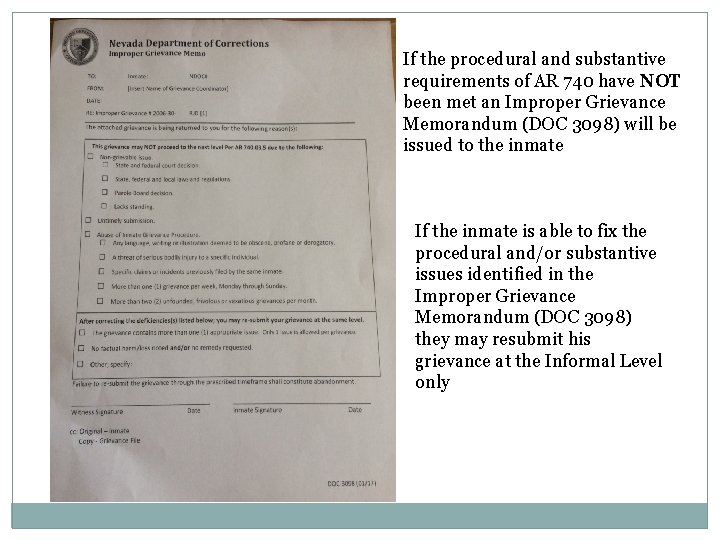
If the procedural and substantive requirements of AR 740 have NOT been met an Improper Grievance Memorandum (DOC 3098) will be issued to the inmate If the inmate is able to fix the procedural and/or substantive issues identified in the Improper Grievance Memorandum (DOC 3098) they may resubmit his grievance at the Informal Level only
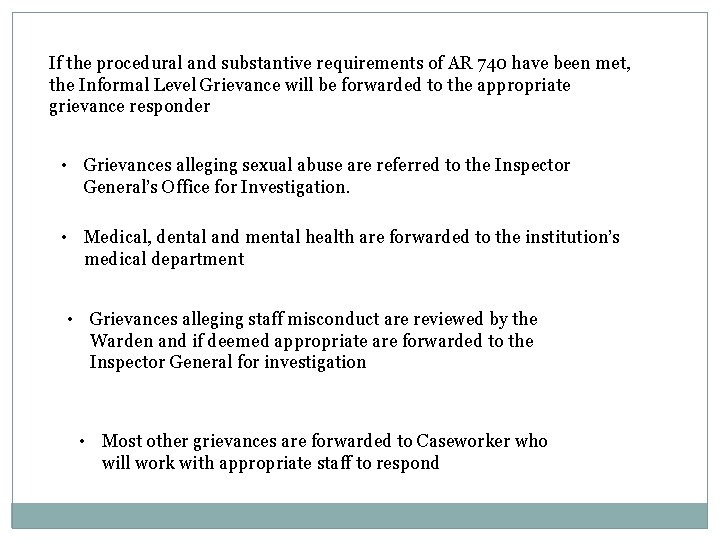
If the procedural and substantive requirements of AR 740 have been met, the Informal Level Grievance will be forwarded to the appropriate grievance responder • Grievances alleging sexual abuse are referred to the Inspector General’s Office for Investigation. • Medical, dental and mental health are forwarded to the institution’s medical department • Grievances alleging staff misconduct are reviewed by the Warden and if deemed appropriate are forwarded to the Inspector General for investigation • Most other grievances are forwarded to Caseworker who will work with appropriate staff to respond
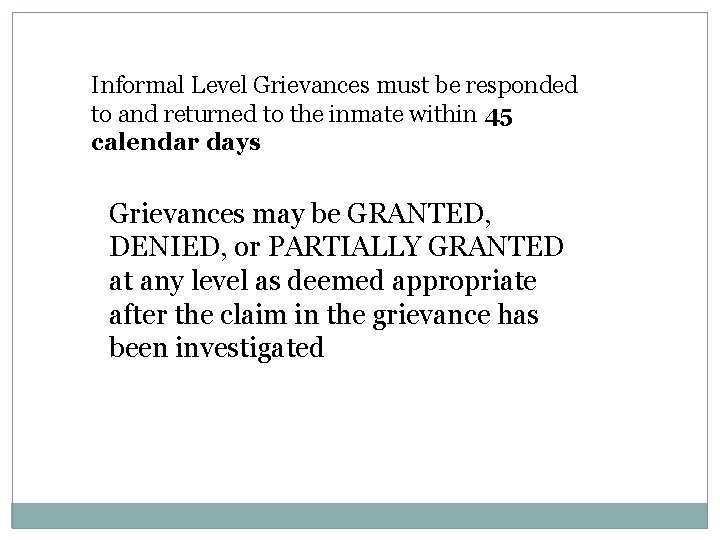
Informal Level Grievances must be responded to and returned to the inmate within 45 calendar days Grievances may be GRANTED, DENIED, or PARTIALLY GRANTED at any level as deemed appropriate after the claim in the grievance has been investigated
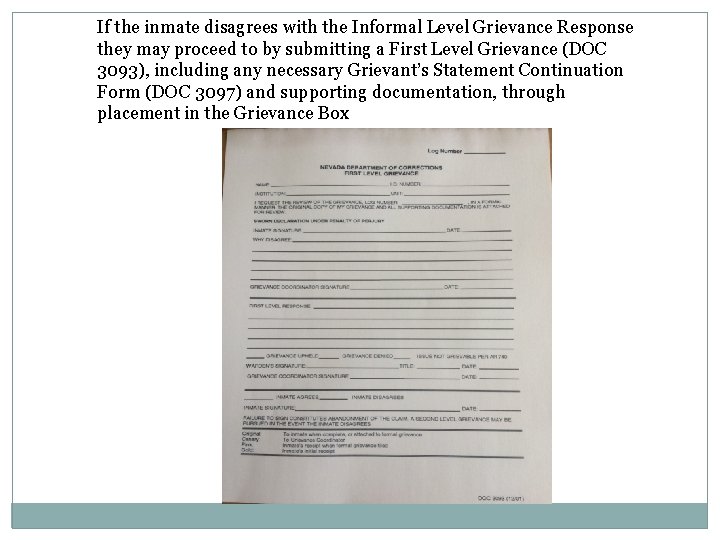
If the inmate disagrees with the Informal Level Grievance Response they may proceed to by submitting a First Level Grievance (DOC 3093), including any necessary Grievant’s Statement Continuation Form (DOC 3097) and supporting documentation, through placement in the Grievance Box
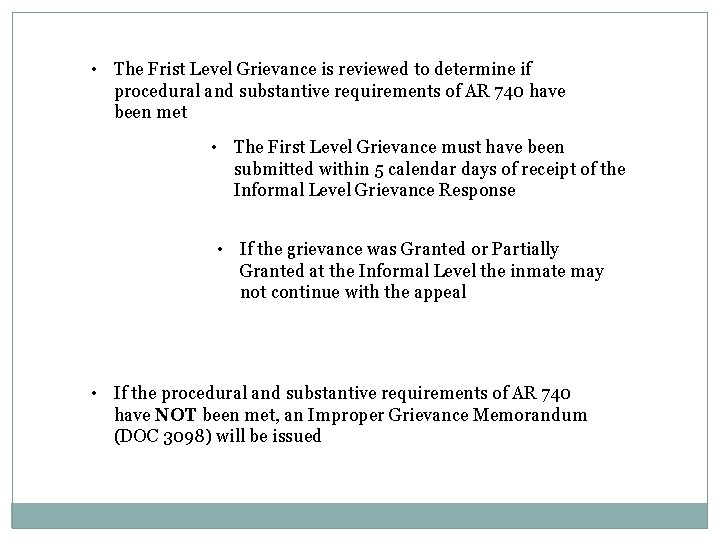
• The Frist Level Grievance is reviewed to determine if procedural and substantive requirements of AR 740 have been met • The First Level Grievance must have been submitted within 5 calendar days of receipt of the Informal Level Grievance Response • If the grievance was Granted or Partially Granted at the Informal Level the inmate may not continue with the appeal • If the procedural and substantive requirements of AR 740 have NOT been met, an Improper Grievance Memorandum (DOC 3098) will be issued
• If the procedural and substantive requirements have been met, the First Level Grievance will be forwarded to the appropriate grievance responder Medical, dental and mental health will be forwarded to the institution’s medical department for response by the Director of Nursing All other matters will be responded to by the Warden • The grievance responder will investigate and prepare a written response to the First Level Grievance
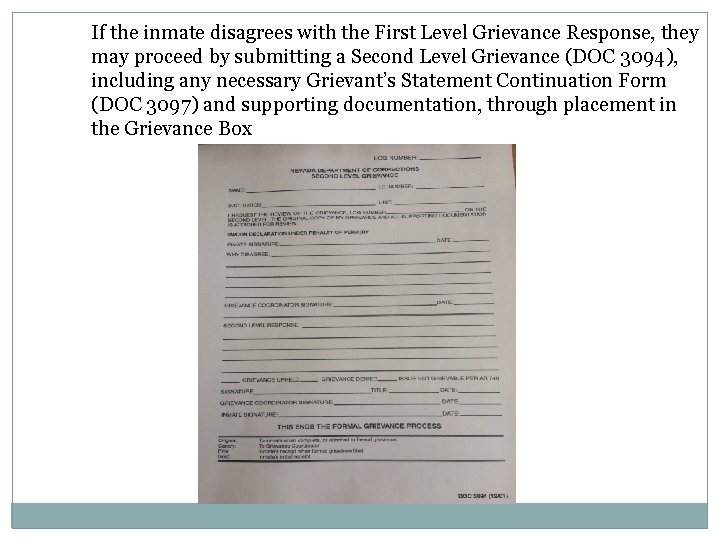
If the inmate disagrees with the First Level Grievance Response, they may proceed by submitting a Second Level Grievance (DOC 3094), including any necessary Grievant’s Statement Continuation Form (DOC 3097) and supporting documentation, through placement in the Grievance Box
• The Second Level Grievance is reviewed to determine if procedural and substantive requirements of AR 740 have been met • The Second Level Grievance must have been submitted within 5 calendar days of receipt of the First Level Grievance Response • If the grievance was Granted or Partially Granted at the Frist Level the inmate may not continue with the appeal
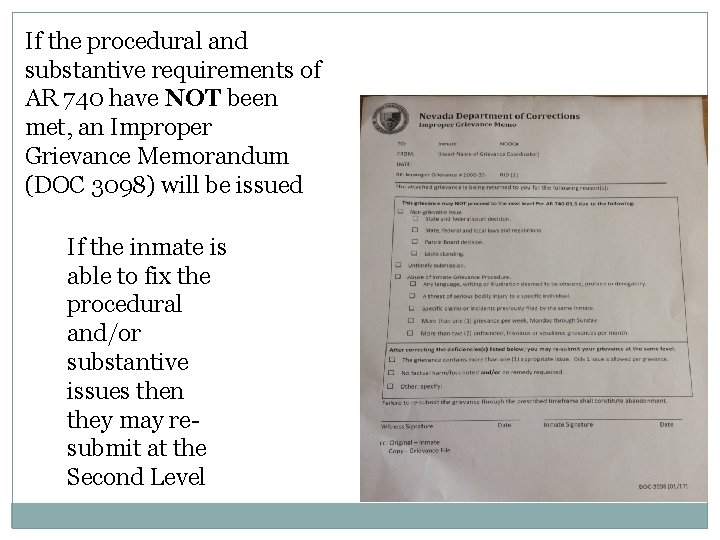
If the procedural and substantive requirements of AR 740 have NOT been met, an Improper Grievance Memorandum (DOC 3098) will be issued If the inmate is able to fix the procedural and/or substantive issues then they may resubmit at the Second Level
If the procedural and substantive requirements have been met, the Second Level Grievance will be forwarded to the appropriate grievance responder • The Deputy Director of Operations responds to facility custody or security operations that do not involve programs • The Deputy Director of Programs responds to all program issues such as education, visiting, or religious programming • The Deputy Director of Support services responds to fiscal, property and telephone issues • The Offender Management Administrator responds to classification and timekeeping issues • The Medical Director responds to medical/dental issues, including medical co-pays or charges • The Mental Health Administrator responds to mental health issues The grievance responder will investigate and prepare a written response to the Second Level Grievance
If the inmate disagrees with the Second Level Grievance Response they may proceed to litigation having most likely exhausted all available administrative remedies If an Informal or Frist Level Grievance is granted, under the current version of AR 740, the inmate’s administrative remedies were exhausted
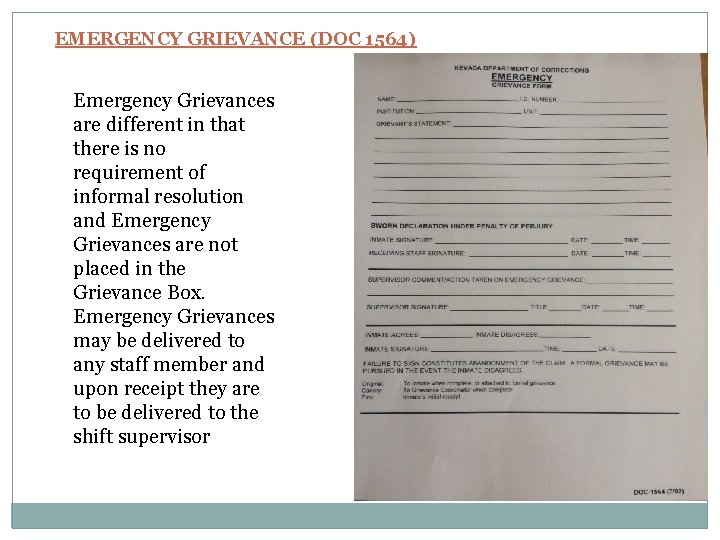
EMERGENCY GRIEVANCE (DOC 1564) Emergency Grievances are different in that there is no requirement of informal resolution and Emergency Grievances are not placed in the Grievance Box. Emergency Grievances may be delivered to any staff member and upon receipt they are to be delivered to the shift supervisor
Most NDOC staff will not be involved with drafting responses to inmate grievances, however, many may be involved in assisting other NDOC staff, such as Caseworkers, in preparing responses to Inmate Grievances If you are asked to prepare a report (028) or respond to an inquiry from a Caseworker or Admin Lieutenant regarding in incident which the inmate is grieving, what do you think would be helpful to include in your report or response?