
Neutrons expose Kitaev quantum spin liquid excitations in

- Slides: 6
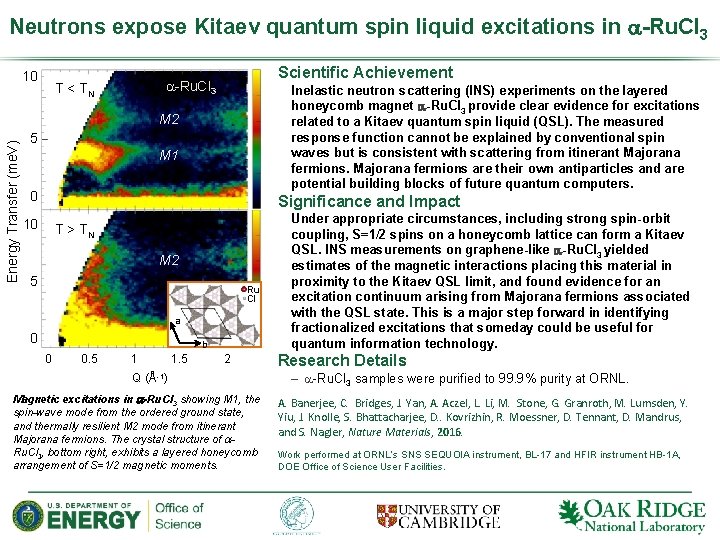
Neutrons expose Kitaev quantum spin liquid excitations in a-Ru. Cl 3 10 T < TN M 2 Energy Transfer (me. V) Scientific Achievement a-Ru. Cl 3 Inelastic neutron scattering (INS) experiments on the layered honeycomb magnet a-Ru. Cl 3 provide clear evidence for excitations related to a Kitaev quantum spin liquid (QSL). The measured response function cannot be explained by conventional spin waves but is consistent with scattering from itinerant Majorana fermions are their own antiparticles and are potential building blocks of future quantum computers. a 5 M 1 0 Significance and Impact 10 T > TN M 2 5 Ru Cl a 0 b 0 0. 5 1 Q 1. 5 2 (Å-1) Magnetic excitations in a-Ru. Cl 3 showing M 1, the spin-wave mode from the ordered ground state, and thermally resilient M 2 mode from itinerant Majorana fermions. The crystal structure of a. Ru. Cl 3, bottom right, exhibits a layered honeycomb arrangement of S=1/2 magnetic moments. Under appropriate circumstances, including strong spin-orbit coupling, S=1/2 spins on a honeycomb lattice can form a Kitaev QSL. INS measurements on graphene-like a-Ru. Cl 3 yielded estimates of the magnetic interactions placing this material in proximity to the Kitaev QSL limit, and found evidence for an excitation continuum arising from Majorana fermions associated with the QSL state. This is a major step forward in identifying fractionalized excitations that someday could be useful for quantum information technology. Research Details – a-Ru. Cl 3 samples were purified to 99. 9% purity at ORNL. A. Banerjee, C. Bridges, J. Yan, A. Aczel, L. Li, M. Stone, G. Granroth, M. Lumsden, Y. Yiu, J. Knolle, S. Bhattacharjee, D. . Kovrizhin, R. Moessner, D. Tennant, D. Mandrus, and S. Nagler, Nature Materials, 2016. Work performed at ORNL’s SNS SEQUOIA instrument, BL-17 and HFIR instrument HB-1 A, DOE Office of Science User Facilities.
Achieving High-Temperature Ferromagnetic Topological Insulators by Proximity Coupling Scientific Achievement Using polarized neutron reflectometry (PNR), researchers have discovered magnetic moments in hybrid topological insulator (TI) materials at room temperature, hundreds of degrees warmer than the sub-zero temperature where the properties are expected to occur. Significance and Impact TIs are insulating materials in bulk and display conducting surface states protected by time-reversal symmetry, wherein electron spins are locked to their momentum. Inducing ferromagnetic surface states in TIs are thought to enable the emergence of exotic phenomena such as interfacial magnetoelectric coupling, and Majorana fermions. This discovery promises new opportunities for next-generation electronic and spintronic devices such as improved transistors and quantum computing technologies. Research Details – The ferromagnetic state was directly observed in the top two quintuple layers (QL, where 1 QL ≈ 0. 96 nm) of Bi 2 Se 3 near the TI-FMI interface up to temperatures higher than 300 kelvins. – PNR provides characterization of the depth profiles of the elemental nuclear density, the magnetization density, and is also particularly element-sensitive to Eu via the absorption density profile. This affords a very precise disentanglement of the intrinsic ferromagnetism of Eu. S, from its interfacial magnetism and the induced magnetization in Bi 2 Se 3. Schematic of the PNR experimental set up for Bi 2 Se 3 Eu. S bilayer films and measured and fitted (solid lines) reflectivity curves for two neutron spin polarization. The inset is an expanded view of the reflectivity below its critical edge that is sensitive to the distribution of the Eu ions due to the absorption cross section and the magnetic moment. F. Katmis, V. Lauter, F. Nogueira, B. Assaf, M. Jamer, P. Wei, B. Satpati, J. Freeland, I. Eremin, D. Heiman, P. Jarillo-Herrero, and J. Moodera, Nature, 2016. Work was performed at ORNL’s SNS Magnetism Reflectometer instrument, BL-4 A, a DOE Office of Science User Facility.
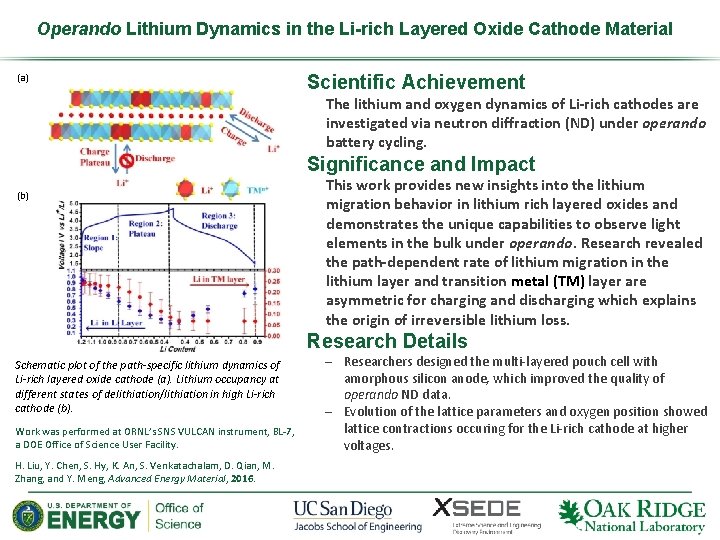
Operando Lithium Dynamics in the Li-rich Layered Oxide Cathode Material (a) Scientific Achievement The lithium and oxygen dynamics of Li-rich cathodes are investigated via neutron diffraction (ND) under operando battery cycling. Significance and Impact (b) This work provides new insights into the lithium migration behavior in lithium rich layered oxides and demonstrates the unique capabilities to observe light elements in the bulk under operando. Research revealed the path-dependent rate of lithium migration in the lithium layer and transition metal (TM) layer are asymmetric for charging and discharging which explains the origin of irreversible lithium loss. Research Details Schematic plot of the path specific lithium dynamics of Li rich layered oxide cathode (a). Lithium occupancy at different states of delithiation/lithiation in high Li rich cathode (b). Work was performed at ORNL’s SNS VULCAN instrument, BL-7, a DOE Office of Science User Facility. H. Liu, Y. Chen, S. Hy, K. An, S. Venkatachalam, D. Qian, M. Zhang, and Y. Meng, Advanced Energy Material, 2016. – Researchers designed the multi-layered pouch cell with amorphous silicon anode, which improved the quality of operando ND data. – Evolution of the lattice parameters and oxygen position showed lattice contractions occuring for the Li-rich cathode at higher voltages.
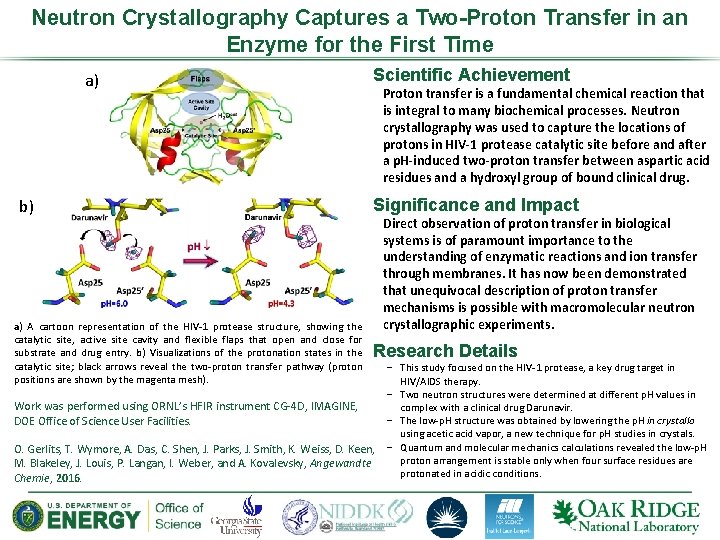
Neutron Crystallography Captures a Two-Proton Transfer in an Enzyme for the First Time a) b) a) A cartoon representation of the HIV-1 protease structure, showing the catalytic site, active site cavity and flexible flaps that open and close for substrate and drug entry. b) Visualizations of the protonation states in the catalytic site; black arrows reveal the two-proton transfer pathway (proton positions are shown by the magenta mesh). Scientific Achievement Proton transfer is a fundamental chemical reaction that is integral to many biochemical processes. Neutron crystallography was used to capture the locations of protons in HIV-1 protease catalytic site before and after a p. H-induced two-proton transfer between aspartic acid residues and a hydroxyl group of bound clinical drug. Significance and Impact Direct observation of proton transfer in biological systems is of paramount importance to the understanding of enzymatic reactions and ion transfer through membranes. It has now been demonstrated that unequivocal description of proton transfer mechanisms is possible with macromolecular neutron crystallographic experiments. Research Details Work was performed using ORNL’s HFIR instrument CG-4 D, IMAGINE, DOE Office of Science User Facilities. O. Gerlits, T. Wymore, A. Das, C. Shen, J. Parks, J. Smith, K. Weiss, D. Keen, M. Blakeley, J. Louis, P. Langan, I. Weber, and A. Kovalevsky, Angewandte Chemie, 2016. − This study focused on the HIV-1 protease, a key drug target in HIV/AIDS therapy. − Two neutron structures were determined at different p. H values in complex with a clinical drug Darunavir. − The low-p. H structure was obtained by lowering the p. H in crystallo using acetic acid vapor, a new technique for p. H studies in crystals. − Quantum and molecular mechanics calculations revealed the low-p. H proton arrangement is stable only when four surface residues are protonated in acidic conditions.
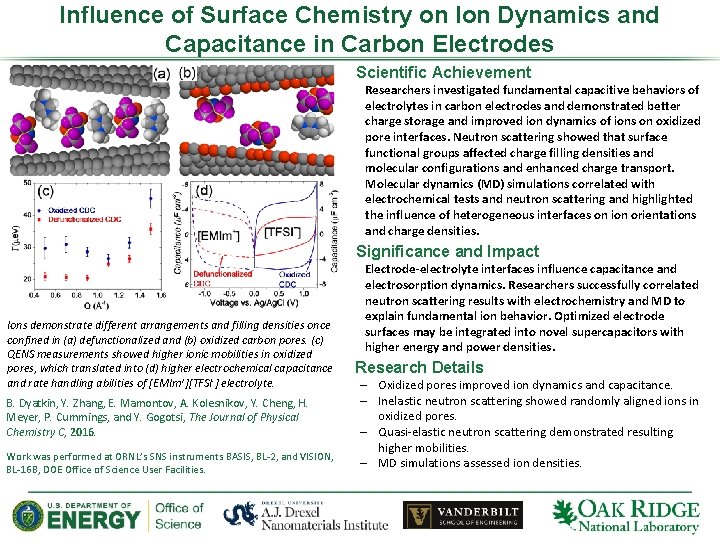
Influence of Surface Chemistry on Ion Dynamics and Capacitance in Carbon Electrodes Scientific Achievement Researchers investigated fundamental capacitive behaviors of electrolytes in carbon electrodes and demonstrated better charge storage and improved ion dynamics of ions on oxidized pore interfaces. Neutron scattering showed that surface functional groups affected charge filling densities and molecular configurations and enhanced charge transport. Molecular dynamics (MD) simulations correlated with electrochemical tests and neutron scattering and highlighted the influence of heterogeneous interfaces on ion orientations and charge densities. Significance and Impact Ions demonstrate different arrangements and filling densities once confined in (a) defunctionalized and (b) oxidized carbon pores. (c) QENS measurements showed higher ionic mobilities in oxidized pores, which translated into (d) higher electrochemical capacitance and rate handling abilities of [EMIm+][TFSI ] electrolyte. B. Dyatkin, Y. Zhang, E. Mamontov, A. Kolesnikov, Y. Cheng, H. Meyer, P. Cummings, and Y. Gogotsi, The Journal of Physical Chemistry C, 2016. Work was performed at ORNL’s SNS instruments BASIS, BL-2, and VISION, BL-16 B, DOE Office of Science User Facilities. Electrode-electrolyte interfaces influence capacitance and electrosorption dynamics. Researchers successfully correlated neutron scattering results with electrochemistry and MD to explain fundamental ion behavior. Optimized electrode surfaces may be integrated into novel supercapacitors with higher energy and power densities. Research Details – Oxidized pores improved ion dynamics and capacitance. – Inelastic neutron scattering showed randomly aligned ions in oxidized pores. – Quasi-elastic neutron scattering demonstrated resulting higher mobilities. – MD simulations assessed ion densities.
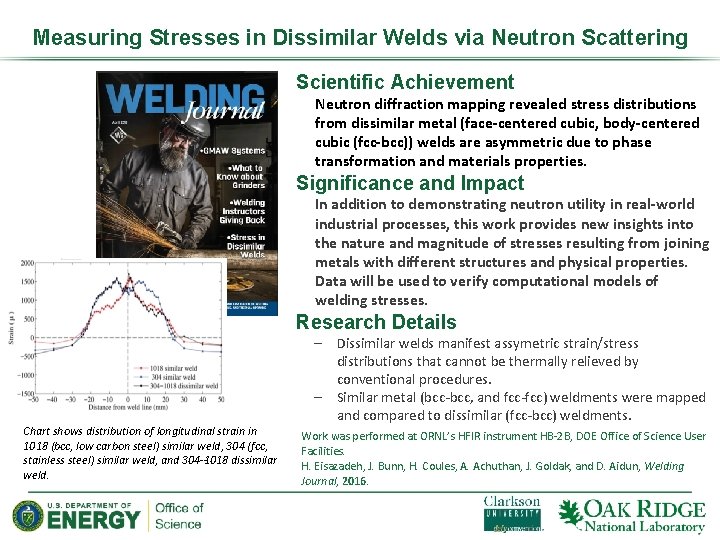
Measuring Stresses in Dissimilar Welds via Neutron Scattering Scientific Achievement Neutron diffraction mapping revealed stress distributions from dissimilar metal (face-centered cubic, body-centered cubic (fcc-bcc)) welds are asymmetric due to phase transformation and materials properties. Significance and Impact In addition to demonstrating neutron utility in real-world industrial processes, this work provides new insights into the nature and magnitude of stresses resulting from joining metals with different structures and physical properties. Data will be used to verify computational models of welding stresses. Research Details – Dissimilar welds manifest assymetric strain/stress distributions that cannot be thermally relieved by conventional procedures. – Similar metal (bcc-bcc, and fcc-fcc) weldments were mapped and compared to dissimilar (fcc-bcc) weldments. Chart shows distribution of longitudinal strain in 1018 (bcc, low carbon steel) similar weld, 304 (fcc, stainless steel) similar weld, and 304 1018 dissimilar weld. Work was performed at ORNL’s HFIR instrument HB-2 B, DOE Office of Science User Facilities. H. Eisazadeh, J. Bunn, H. Coules, A. Achuthan, J. Goldak, and D. Aidun, Welding Journal, 2016.