
Neutronics Fuel Cycle and Tritium Fuel SelfSufficiency One
- Slides: 67
Neutronics, Fuel Cycle, and Tritium Fuel Self-Sufficiency One of a number of lectures given at the Institute for Plasma Research (IPR) at Gandhinagar, India, January 2007 Mohamed Abdou (web: http: //www. fusion. ucla. edu/abdou/) Distinguished Professor of Engineering and Applied Science Director, Center for Energy Science and Technology (CESTAR) (http: //www. cestar. seas. ucla. edu/) Director, Fusion Science and Technology Center (http: //www. fusion. ucla. edu/) University of California, Los Angeles (UCLA) Abdou Lecture 5
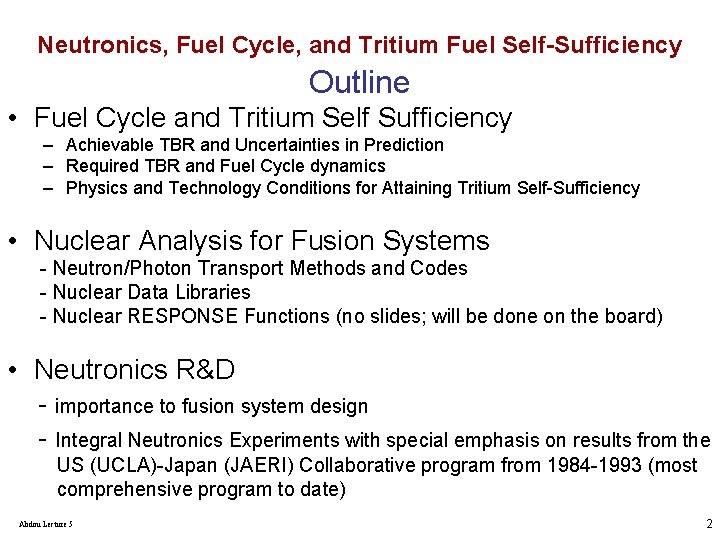
Neutronics, Fuel Cycle, and Tritium Fuel Self-Sufficiency Outline • Fuel Cycle and Tritium Self Sufficiency – Achievable TBR and Uncertainties in Prediction – Required TBR and Fuel Cycle dynamics – Physics and Technology Conditions for Attaining Tritium Self-Sufficiency • Nuclear Analysis for Fusion Systems - Neutron/Photon Transport Methods and Codes - Nuclear Data Libraries - Nuclear RESPONSE Functions (no slides; will be done on the board) • Neutronics R&D - importance to fusion system design - Integral Neutronics Experiments with special emphasis on results from the US (UCLA)-Japan (JAERI) Collaborative program from 1984 -1993 (most comprehensive program to date) Abdou Lecture 5 2
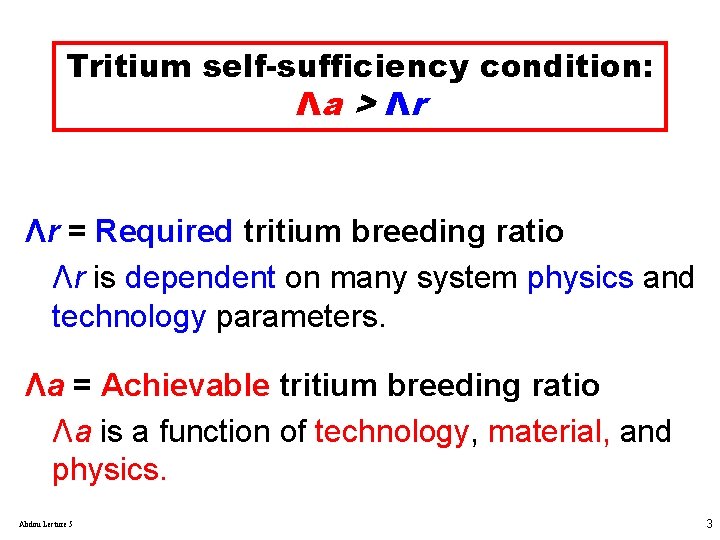
Tritium self-sufficiency condition: Λa > Λr Λr = Required tritium breeding ratio Λr is dependent on many system physics and technology parameters. Λa = Achievable tritium breeding ratio Λa is a function of technology, material, and physics. Abdou Lecture 5 3
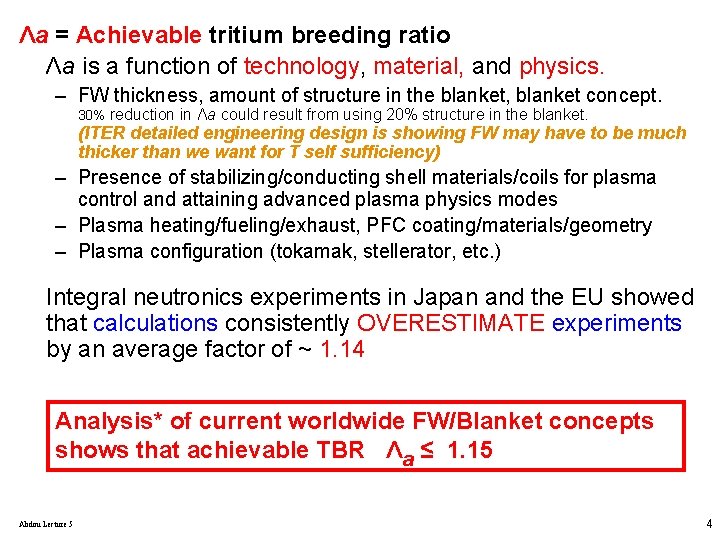
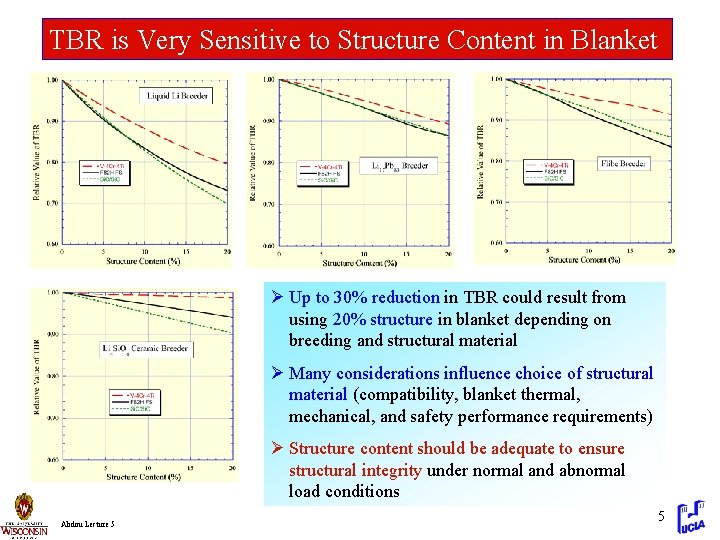
Λa = Achievable tritium breeding ratio Λa is a function of technology, material, and physics. – FW thickness, amount of structure in the blanket, blanket concept. 30% reduction in Λa could result from using 20% structure in the blanket. (ITER detailed engineering design is showing FW may have to be much thicker than we want for T self sufficiency) – Presence of stabilizing/conducting shell materials/coils for plasma control and attaining advanced plasma physics modes – Plasma heating/fueling/exhaust, PFC coating/materials/geometry – Plasma configuration (tokamak, stellerator, etc. ) Integral neutronics experiments in Japan and the EU showed that calculations consistently OVERESTIMATE experiments by an average factor of ~ 1. 14 Analysis* of current worldwide FW/Blanket concepts shows that achievable TBR Λa ≤ 1. 15 Abdou Lecture 5 4
TBR is Very Sensitive to Structure Content in Blanket Ø Up to 30% reduction in TBR could result from using 20% structure in blanket depending on breeding and structural material Ø Many considerations influence choice of structural material (compatibility, blanket thermal, mechanical, and safety performance requirements) Ø Structure content should be adequate to ensure structural integrity under normal and abnormal load conditions Abdou Lecture 5 5
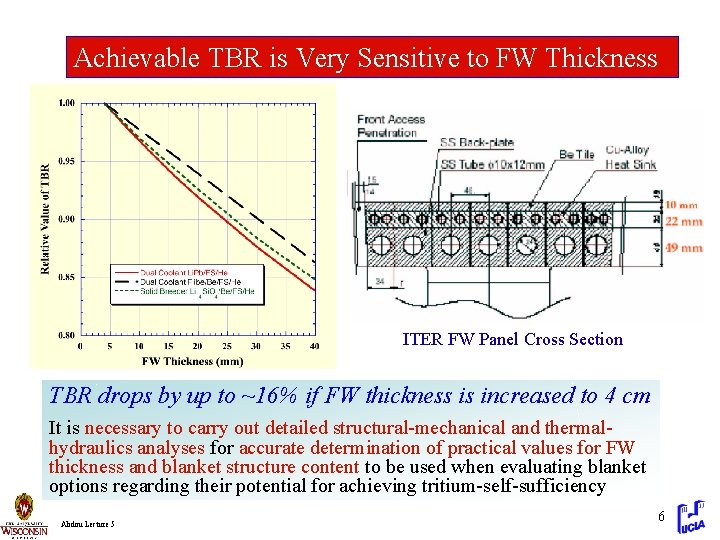
Achievable TBR is Very Sensitive to FW Thickness ITER FW Panel Cross Section TBR drops by up to ~16% if FW thickness is increased to 4 cm It is necessary to carry out detailed structural-mechanical and thermalhydraulics analyses for accurate determination of practical values for FW thickness and blanket structure content to be used when evaluating blanket options regarding their potential for achieving tritium-self-sufficiency Abdou Lecture 5 6
Uncertainties in the Achievable TBR Uncertainties in calculating the achievable TBR are due to: 1. System definition Achievable TBR depends on many system parameters and design considerations that are not yet well defined (amount and configuration of structure, required FW thickness, using separate coolant and/or neutron multiplier, need for electric insulator, chamber penetrations, absorbing materials in stabilizing shells, divertors, and plasma heating and CD systems) 2. Modeling and calculation method Calculation model (3 -D) should accurately reflect the detailed chamber configuration including all components with detailed design and material distribution and heterogeneity and accurate source profile 3. Nuclear data Uncertainties in measured cross section data and their processing lead in uncertainties in calculating TBR Abdou Lecture 5 7
The Required TBR The required TBR should exceed unity by a margin to: (a) compensate for losses and radioactive decay (5. 5%/year) of tritium between production and use (b) supply inventory for startup of other reactors (c) provide a “reserve” storage inventory necessary for continued reactor operation under certain conditions (e. g. , inventory kept in reserve to keep the power plant operating during a failure in a tritium processing line) Ø To accurately determine the required TBR, one has to consider the “dynamics” of the entire fuel cycle for the DT plant that involves many subsystems Ø Main subsystems of the power plant with significant tritium inventories are plasma exhaust and vacuum pumping, first wall, blanket, plasma-facing components, fuel clean-up, isotope separation, fuel management, storage, and fueling Abdou Lecture 5 8
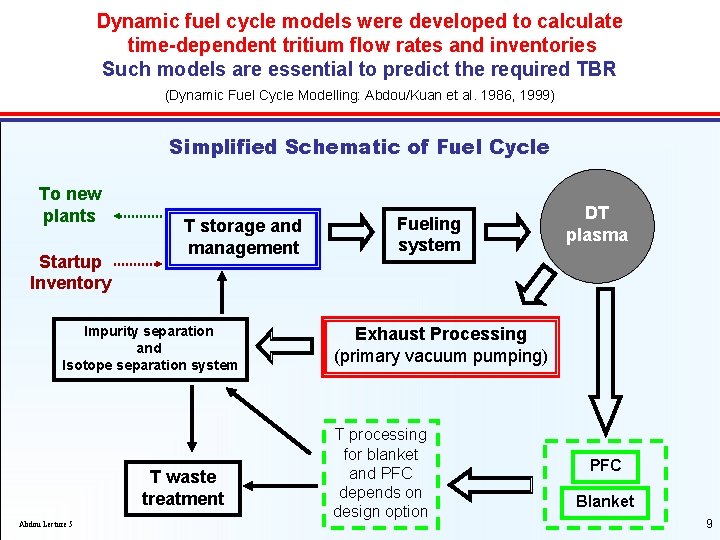
Dynamic fuel cycle models were developed to calculate time-dependent tritium flow rates and inventories Such models are essential to predict the required TBR (Dynamic Fuel Cycle Modelling: Abdou/Kuan et al. 1986, 1999) Simplified Schematic of Fuel Cycle To new plants Startup Inventory T storage and management Impurity separation and Isotope separation system T waste treatment Abdou Lecture 5 Fueling system DT plasma Exhaust Processing (primary vacuum pumping) T processing for blanket and PFC depends on design option PFC Blanket 9
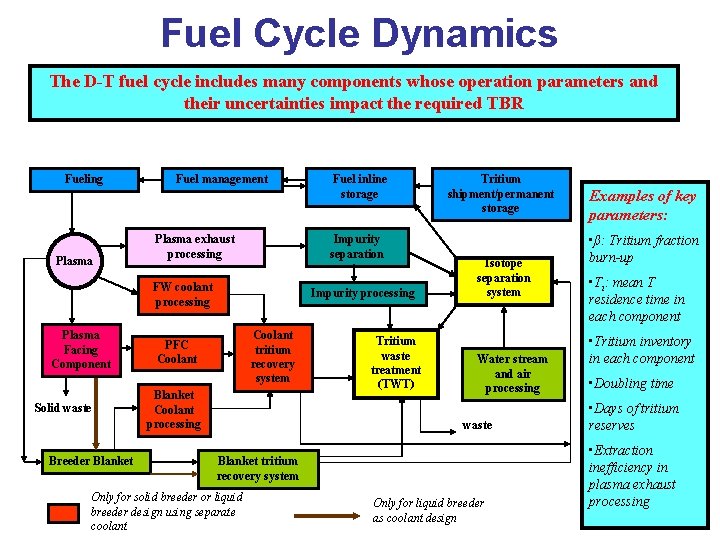
Fuel Cycle Dynamics The D-T fuel cycle includes many components whose operation parameters and their uncertainties impact the required TBR Fueling Plasma Fuel management Plasma exhaust processing Impurity separation FW coolant processing Plasma Facing Component Solid waste Breeder Blanket Fuel inline storage Impurity processing Coolant tritium recovery system PFC Coolant Blanket Coolant processing Tritium waste treatment (TWT) Tritium shipment/permanent storage Isotope separation system Water stream and air processing waste Blanket tritium recovery system Only for solid breeder or liquid breeder design using separate coolant Only for liquid breeder as coolant design Examples of key parameters: • ß: Tritium fraction burn-up • Ti: mean T residence time in each component • Tritium inventory in each component • Doubling time • Days of tritium reserves • Extraction inefficiency in plasma exhaust processing 10
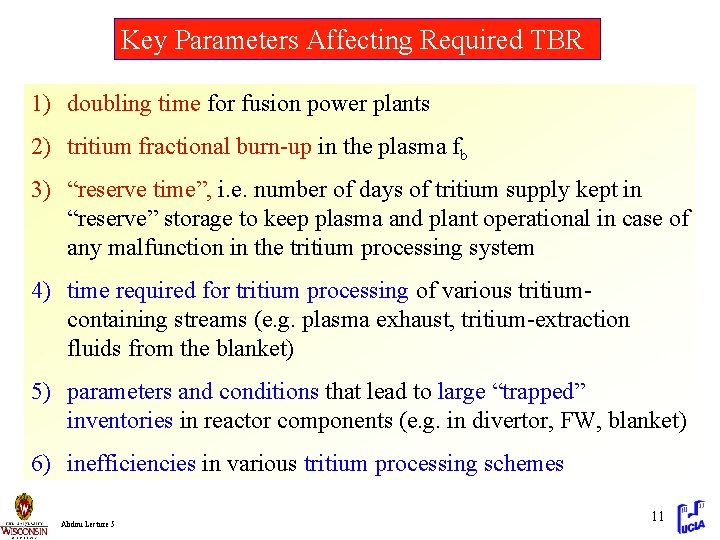
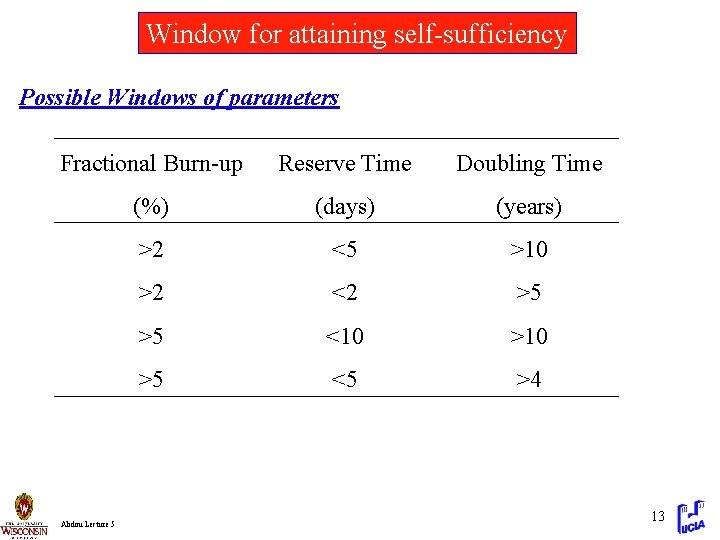
Key Parameters Affecting Required TBR 1) doubling time for fusion power plants 2) tritium fractional burn-up in the plasma fb 3) “reserve time”, i. e. number of days of tritium supply kept in “reserve” storage to keep plasma and plant operational in case of any malfunction in the tritium processing system 4) time required for tritium processing of various tritiumcontaining streams (e. g. plasma exhaust, tritium-extraction fluids from the blanket) 5) parameters and conditions that lead to large “trapped” inventories in reactor components (e. g. in divertor, FW, blanket) 6) inefficiencies in various tritium processing schemes Abdou Lecture 5 11
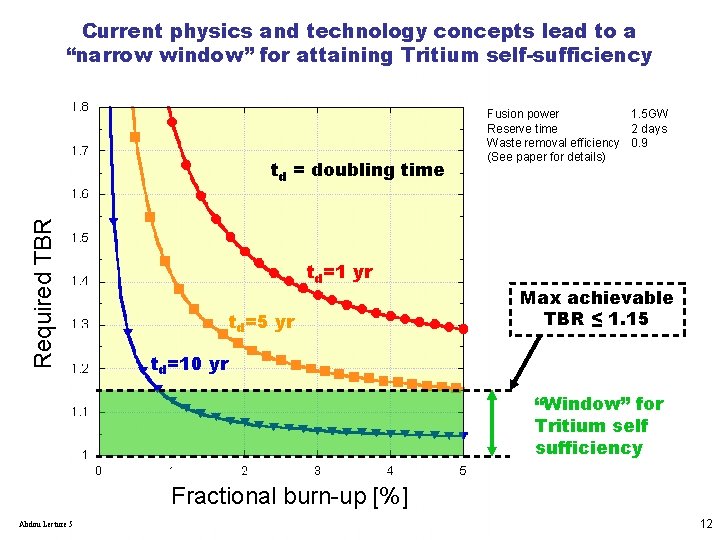
Current physics and technology concepts lead to a “narrow window” for attaining Tritium self-sufficiency Required TBR td = doubling time td=1 yr td=5 yr Fusion power 1. 5 GW Reserve time 2 days Waste removal efficiency 0. 9 (See paper for details) Max achievable TBR ≤ 1. 15 td=10 yr “Window” for Tritium self sufficiency Fractional burn-up [%] Abdou Lecture 5 12
Window for attaining self-sufficiency Possible Windows of parameters Fractional Burn-up Reserve Time Doubling Time (%) (days) (years) >2 <5 >10 >2 <2 >5 >5 <10 >5 <5 >4 Abdou Lecture 5 13
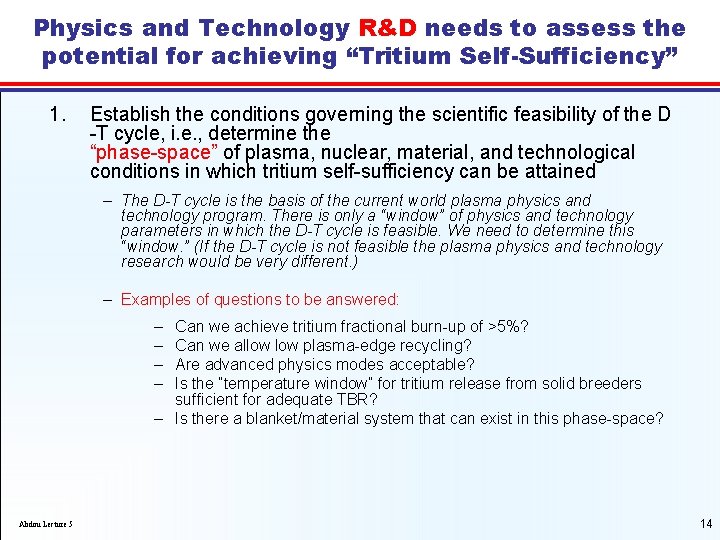
Physics and Technology R&D needs to assess the potential for achieving “Tritium Self-Sufficiency” 1. Establish the conditions governing the scientific feasibility of the D -T cycle, i. e. , determine the “phase-space” of plasma, nuclear, material, and technological conditions in which tritium self-sufficiency can be attained – The D-T cycle is the basis of the current world plasma physics and technology program. There is only a “window” of physics and technology parameters in which the D-T cycle is feasible. We need to determine this “window. ” (If the D-T cycle is not feasible the plasma physics and technology research would be very different. ) – Examples of questions to be answered: – – Can we achieve tritium fractional burn-up of >5%? Can we allow plasma-edge recycling? Are advanced physics modes acceptable? Is the “temperature window” for tritium release from solid breeders sufficient for adequate TBR? – Is there a blanket/material system that can exist in this phase-space? Abdou Lecture 5 14
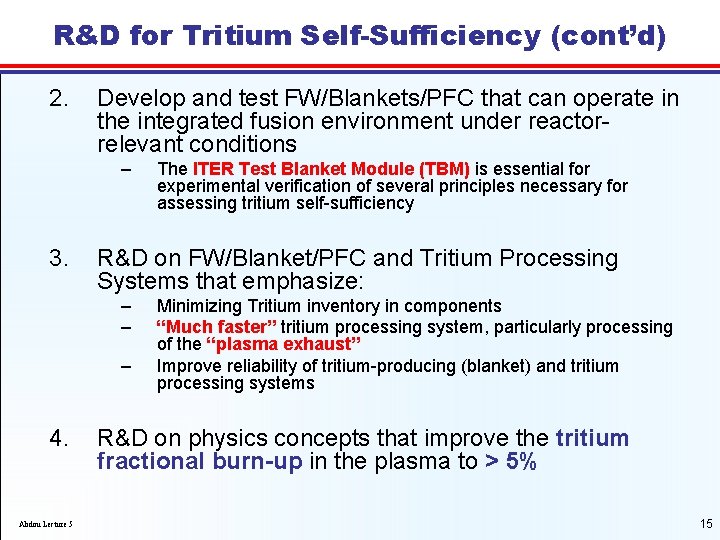
R&D for Tritium Self-Sufficiency (cont’d) 2. Develop and test FW/Blankets/PFC that can operate in the integrated fusion environment under reactorrelevant conditions – 3. R&D on FW/Blanket/PFC and Tritium Processing Systems that emphasize: – – – 4. Abdou Lecture 5 The ITER Test Blanket Module (TBM) is essential for experimental verification of several principles necessary for assessing tritium self-sufficiency Minimizing Tritium inventory in components “Much faster” tritium processing system, particularly processing of the “plasma exhaust” Improve reliability of tritium-producing (blanket) and tritium processing systems R&D on physics concepts that improve the tritium fractional burn-up in the plasma to > 5% 15
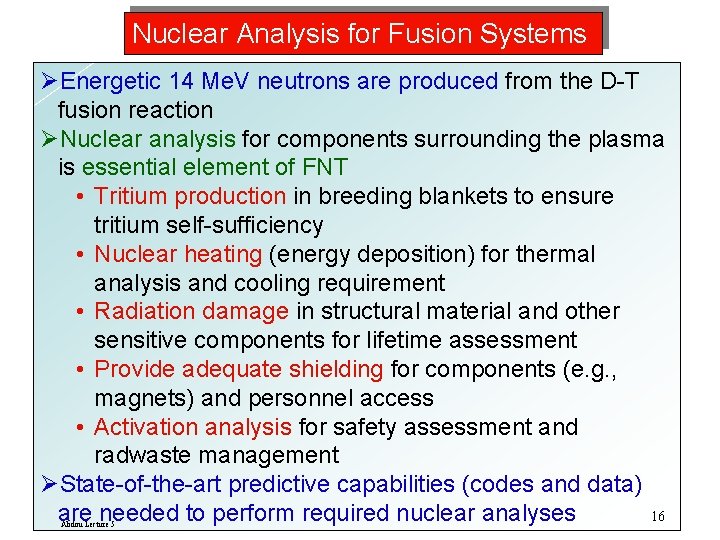
Nuclear Analysis for Fusion Systems ØEnergetic 14 Me. V neutrons are produced from the D-T fusion reaction ØNuclear analysis for components surrounding the plasma is essential element of FNT • Tritium production in breeding blankets to ensure tritium self-sufficiency • Nuclear heating (energy deposition) for thermal analysis and cooling requirement • Radiation damage in structural material and other sensitive components for lifetime assessment • Provide adequate shielding for components (e. g. , magnets) and personnel access • Activation analysis for safety assessment and radwaste management ØState-of-the-art predictive capabilities (codes and data) are needed to perform required nuclear analyses 16 Abdou Lecture 5
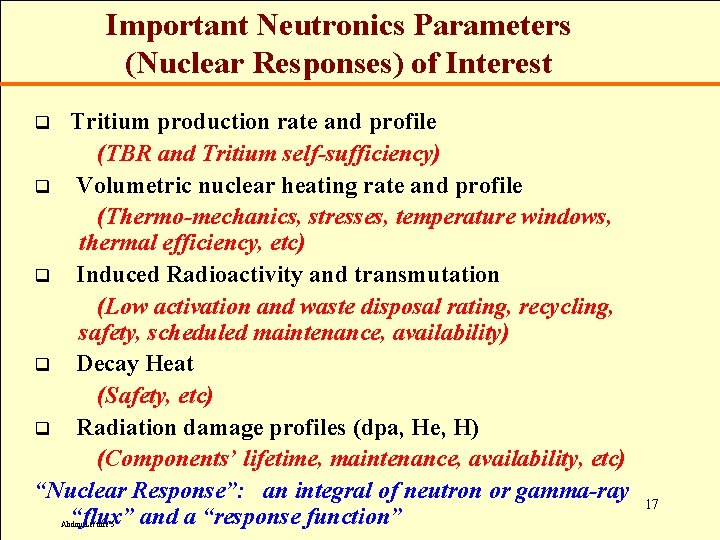
Important Neutronics Parameters (Nuclear Responses) of Interest Tritium production rate and profile (TBR and Tritium self-sufficiency) q Volumetric nuclear heating rate and profile (Thermo-mechanics, stresses, temperature windows, thermal efficiency, etc) q Induced Radioactivity and transmutation (Low activation and waste disposal rating, recycling, safety, scheduled maintenance, availability) q Decay Heat (Safety, etc) q Radiation damage profiles (dpa, He, H) (Components’ lifetime, maintenance, availability, etc) “Nuclear Response”: an integral of neutron or gamma-ray “flux” and a “response function” q Abdou Lecture 5 17
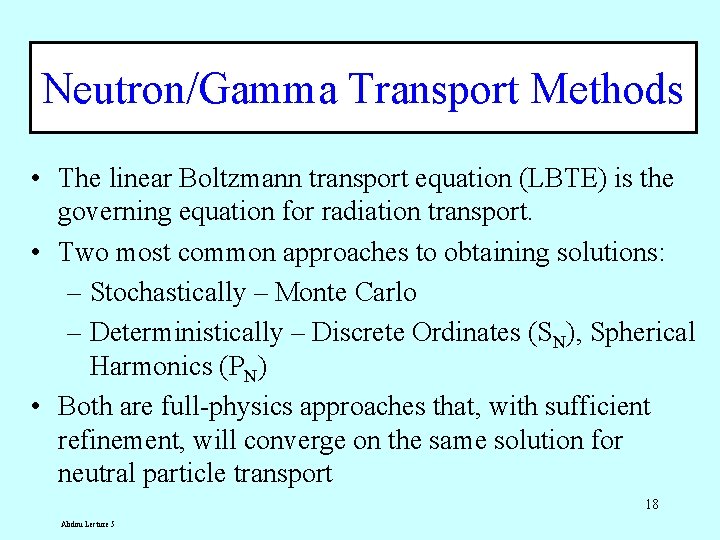
Neutron/Gamma Transport Methods • The linear Boltzmann transport equation (LBTE) is the governing equation for radiation transport. • Two most common approaches to obtaining solutions: – Stochastically – Monte Carlo – Deterministically – Discrete Ordinates (SN), Spherical Harmonics (PN) • Both are full-physics approaches that, with sufficient refinement, will converge on the same solution for neutral particle transport 18 Abdou Lecture 5
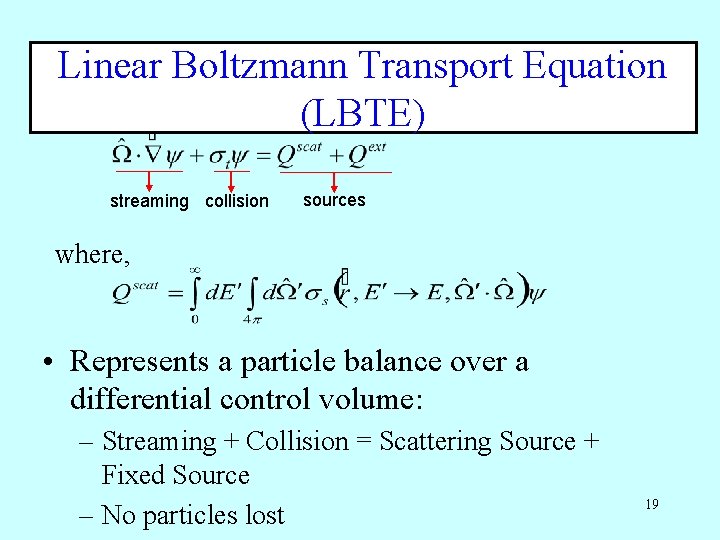
Linear Boltzmann Transport Equation (LBTE) streaming collision sources where, • Represents a particle balance over a differential control volume: – Streaming + Collision = Scattering Source + Fixed Source – No particles lost 19
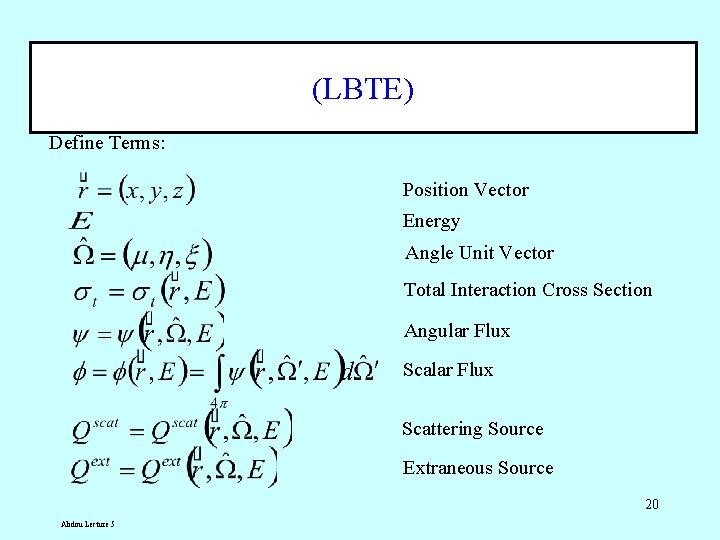
(LBTE) Define Terms: Position Vector Energy Angle Unit Vector Total Interaction Cross Section Angular Flux Scattering Source Extraneous Source 20 Abdou Lecture 5
Discrete Ordinates Method (Discretization) • Several Sn-Pn Codes solve the LBTE by discretizing in space, angle and energy: – Spatial – Computational Mesh – Angle – Discrete Ordinates (SN) and Scattering Order (PN) – Energy – Multi-Group Energy Formulation • What is Flux? – Particles per unit area, per unit time, per unit energy, per unit solid angle. Energy-dependent flux at a spatial point is obtained from integrating the angular flux at this point over all angles (directions) • What is a reaction rate in a region (or zone)? – Multiplication of the energy-dependent flux at a point by the appropriate reaction cross section, then integration over all energies and spatial point throughout the computational domain – E. g. tritium production rate is obtained by integrating the product of the flux over all angles and energies and the tritium production cross section for the reactions Li-6(n, t) and Li-7(n, n’)at
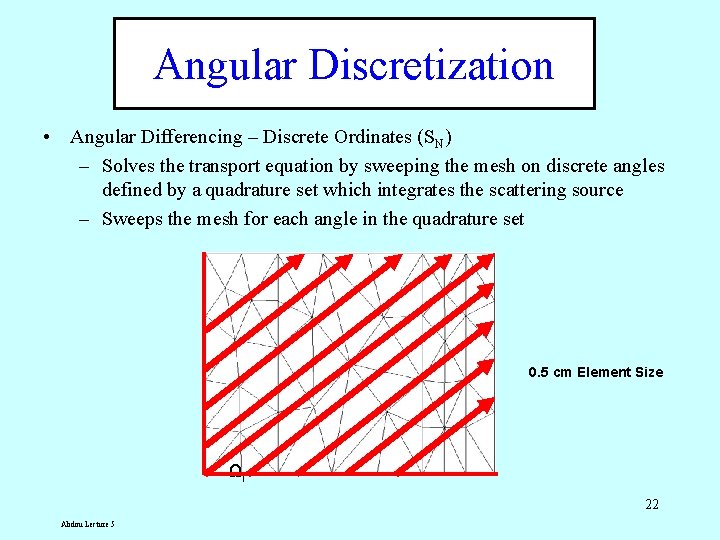
Angular Discretization • Angular Differencing – Discrete Ordinates (SN) – Solves the transport equation by sweeping the mesh on discrete angles defined by a quadrature set which integrates the scattering source – Sweeps the mesh for each angle in the quadrature set 0. 5 cm Element Size Ωi 22 Abdou Lecture 5
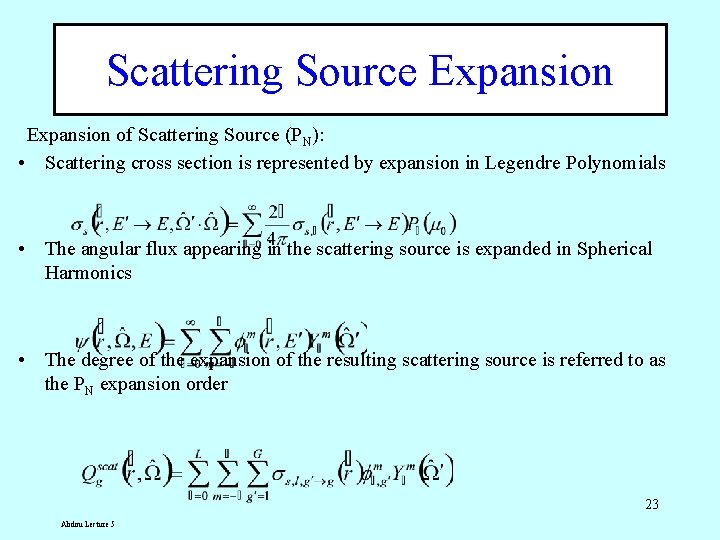
Scattering Source Expansion of Scattering Source (PN): • Scattering cross section is represented by expansion in Legendre Polynomials • The angular flux appearing in the scattering source is expanded in Spherical Harmonics • The degree of the expansion of the resulting scattering source is referred to as the PN expansion order 23 Abdou Lecture 5
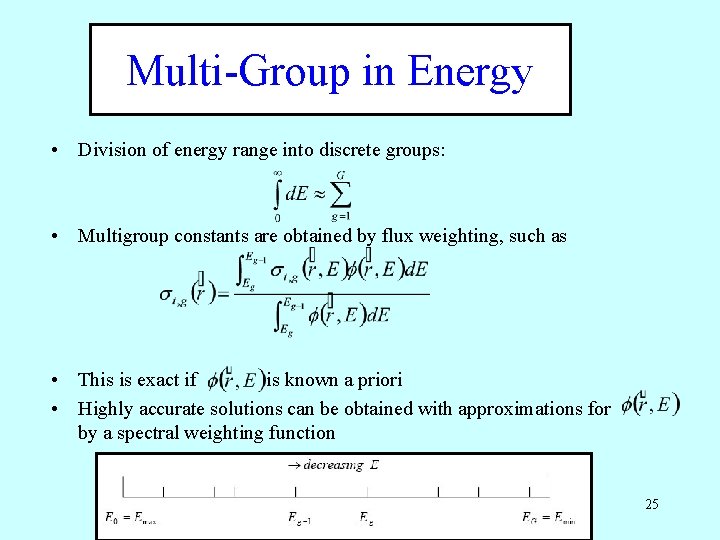
Multi-Group in Energy • The particle energy range of interest is divided into a finite number of intervals, or groups – Particle interaction data (cross sections) originate from same source as for Monte Carlo, but is processed into a multi-group format • Same phenomena modeled – Energy groups are ordered by decreasing energy – Effectively the cross sections (total and scattering) are constant within each group 24 Abdou Lecture 5
Multi-Group in Energy • Division of energy range into discrete groups: • Multigroup constants are obtained by flux weighting, such as • This is exact if is known a priori • Highly accurate solutions can be obtained with approximations for by a spectral weighting function 25
History of Deterministic Discrete Ordinates Codes Development of the deterministic methods for nuclear analysis goes back to the early 1960: Oak. Ridge National Laboratory (ORNL): W. Engle, ANISN, 1967 R. J. Rogers , W. W. Engle, F. R. Mynatt, W. A. Rhoades, D. B. Simpson, R. L. Childs: DOT (1965), DOT II (1967), DOT III (1969), DOT 3. 5 (1975), DOT IV (1976)……… DORT ………TORT……. DOORS Los Alamos National Laboratory (LANL): K. D. Lathrop, F. W. Brinkley, W. H. Reed, G. I. Bell, B. G. Carlson: TWOTRAN (1970), TWOTRAN II (1977) …. THREETRAN…… …TRIDENT-CTR……DANTSYS…PARTISN 26 Abdou Lecture 5
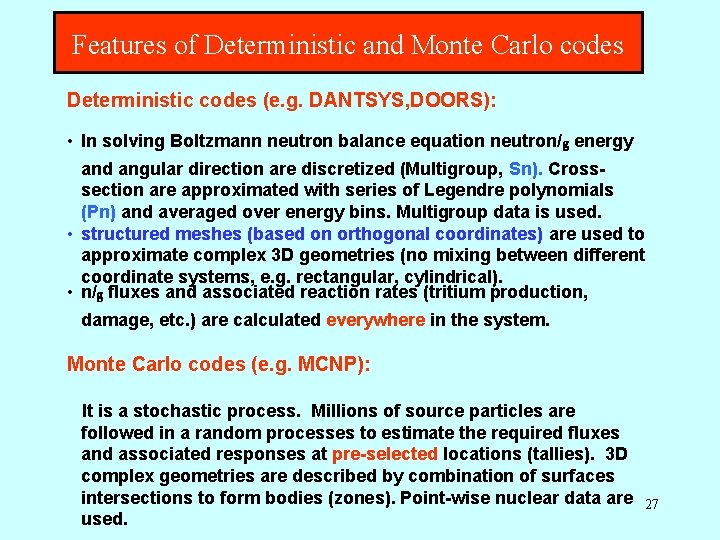
Features of Deterministic and Monte Carlo codes Deterministic codes (e. g. DANTSYS, DOORS): • In solving Boltzmann neutron balance equation neutron/g energy and angular direction are discretized (Multigroup, Sn). Crosssection are approximated with series of Legendre polynomials (Pn) and averaged over energy bins. Multigroup data is used. • structured meshes (based on orthogonal coordinates) are used to approximate complex 3 D geometries (no mixing between different coordinate systems, e. g. rectangular, cylindrical). • n/g fluxes and associated reaction rates (tritium production, damage, etc. ) are calculated everywhere in the system. Monte Carlo codes (e. g. MCNP): It is a stochastic process. Millions of source particles are followed in a random processes to estimate the required fluxes and associated responses at pre-selected locations (tallies). 3 D complex geometries are described by combination of surfaces intersections to form bodies (zones). Point-wise nuclear data are used. 27
Calculation Methods for Neutron and Photon Transport ØThere are several numerical methods and codes available to solve the Boltzmann transport equation for neutral particles ØThe methods can be broken down into two broad groups - Deterministic method: Directly solves the equation using numerical techniques for solving a system of ordinary and partial differential equations - Statistical based method: Solves the equation using probabilistic and statistical techniques ØEach method has its strengths and weaknesses Abdou Lecture 5 28
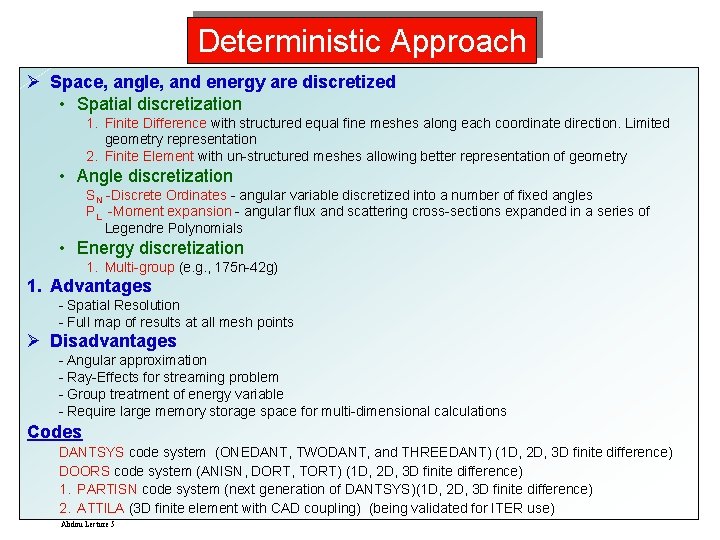
Deterministic Approach Ø Space, angle, and energy are discretized • Spatial discretization 1. Finite Difference with structured equal fine meshes along each coordinate direction. Limited geometry representation 2. Finite Element with un-structured meshes allowing better representation of geometry • Angle discretization SN -Discrete Ordinates - angular variable discretized into a number of fixed angles PL -Moment expansion - angular flux and scattering cross-sections expanded in a series of Legendre Polynomials • Energy discretization 1. Multi-group (e. g. , 175 n-42 g) 1. Advantages - Spatial Resolution - Full map of results at all mesh points Ø Disadvantages - Angular approximation - Ray-Effects for streaming problem - Group treatment of energy variable - Require large memory storage space for multi-dimensional calculations Codes DANTSYS code system (ONEDANT, TWODANT, and THREEDANT) (1 D, 2 D, 3 D finite difference) DOORS code system (ANISN, DORT, TORT) (1 D, 2 D, 3 D finite difference) 1. PARTISN code system (next generation of DANTSYS)(1 D, 2 D, 3 D finite difference) 2. ATTILA (3 D finite element with CAD coupling) (being validated for ITER use) Abdou Lecture 5
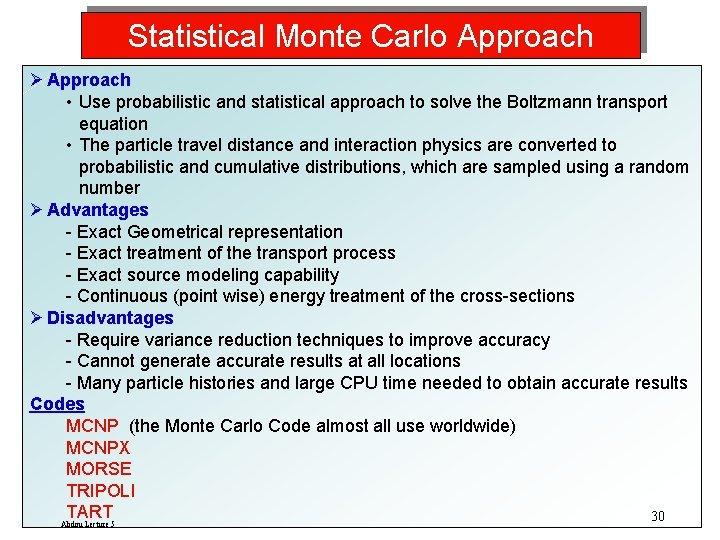
Statistical Monte Carlo Approach Ø Approach • Use probabilistic and statistical approach to solve the Boltzmann transport equation • The particle travel distance and interaction physics are converted to probabilistic and cumulative distributions, which are sampled using a random number Ø Advantages - Exact Geometrical representation - Exact treatment of the transport process - Exact source modeling capability - Continuous (point wise) energy treatment of the cross-sections Ø Disadvantages - Require variance reduction techniques to improve accuracy - Cannot generate accurate results at all locations - Many particle histories and large CPU time needed to obtain accurate results Codes MCNP (the Monte Carlo Code almost all use worldwide) MCNPX MORSE TRIPOLI TART 30 Abdou Lecture 5
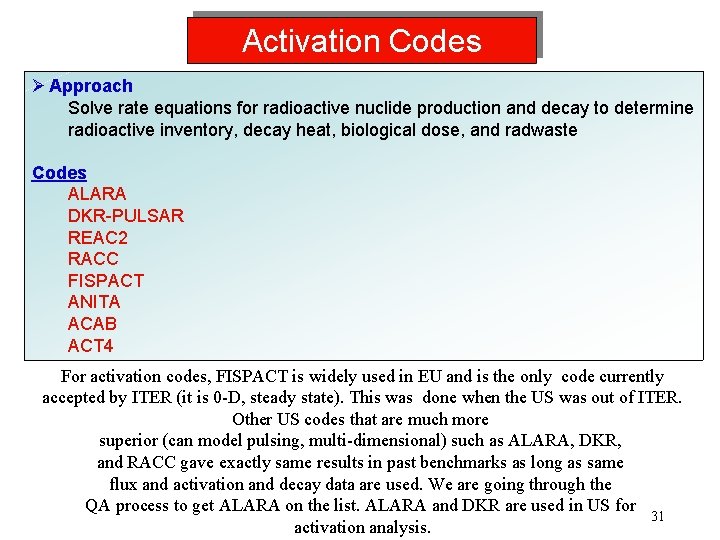
Activation Codes Ø Approach Solve rate equations for radioactive nuclide production and decay to determine radioactive inventory, decay heat, biological dose, and radwaste Codes ALARA DKR-PULSAR REAC 2 RACC FISPACT ANITA ACAB ACT 4 For activation codes, FISPACT is widely used in EU and is the only code currently accepted by ITER (it is 0 -D, steady state). This was done when the US was out of ITER. Other US codes that are much more superior (can model pulsing, multi-dimensional) such as ALARA, DKR, and RACC gave exactly same results in past benchmarks as long as same flux and activation and decay data are used. We are going through the QA process to get ALARA on the list. ALARA and DKR are used in US for 31 activation analysis.
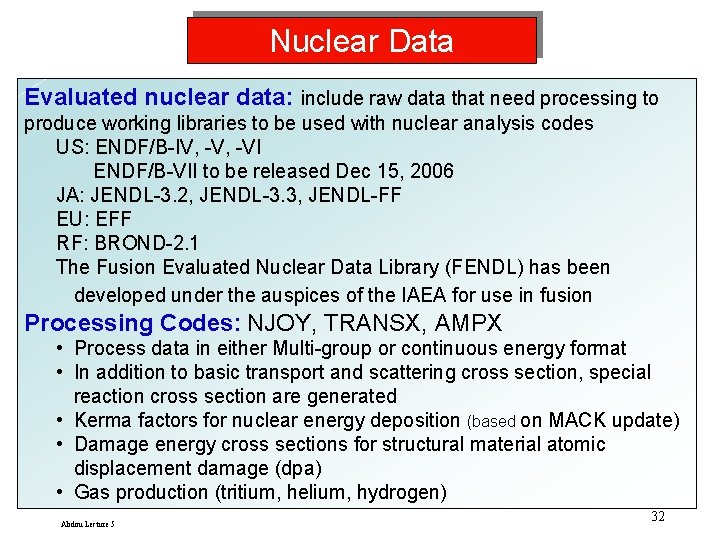
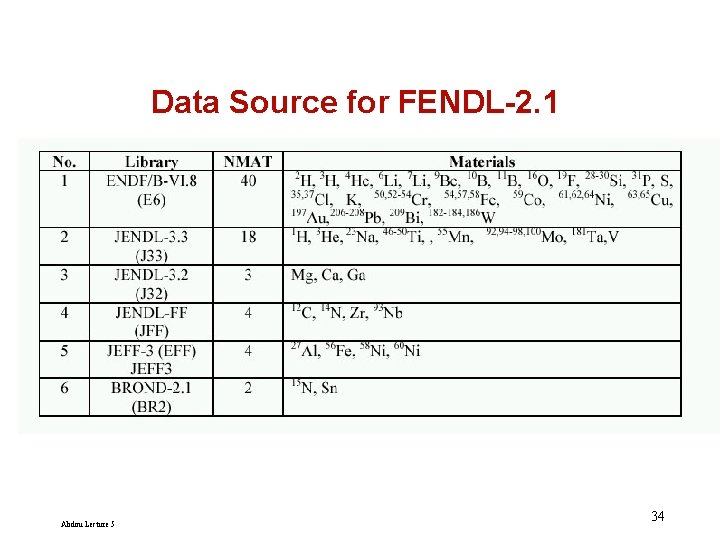
Nuclear Data Evaluated nuclear data: include raw data that need processing to produce working libraries to be used with nuclear analysis codes US: ENDF/B-IV, -VI ENDF/B-VII to be released Dec 15, 2006 JA: JENDL-3. 2, JENDL-3. 3, JENDL-FF EU: EFF RF: BROND-2. 1 The Fusion Evaluated Nuclear Data Library (FENDL) has been developed under the auspices of the IAEA for use in fusion Processing Codes: NJOY, TRANSX, AMPX • Process data in either Multi-group or continuous energy format • In addition to basic transport and scattering cross section, special reaction cross section are generated • Kerma factors for nuclear energy deposition (based on MACK update) • Damage energy cross sections for structural material atomic displacement damage (dpa) • Gas production (tritium, helium, hydrogen) Abdou Lecture 5 32
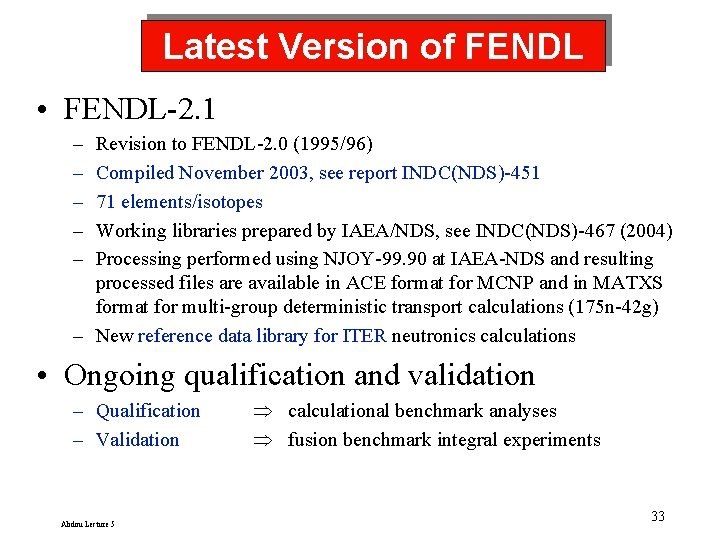
Latest Version of FENDL • FENDL-2. 1 – – – Revision to FENDL-2. 0 (1995/96) Compiled November 2003, see report INDC(NDS)-451 71 elements/isotopes Working libraries prepared by IAEA/NDS, see INDC(NDS)-467 (2004) Processing performed using NJOY-99. 90 at IAEA-NDS and resulting processed files are available in ACE format for MCNP and in MATXS format for multi-group deterministic transport calculations (175 n-42 g) – New reference data library for ITER neutronics calculations • Ongoing qualification and validation – Qualification – Validation Abdou Lecture 5 calculational benchmark analyses fusion benchmark integral experiments 33
Data Source for FENDL-2. 1 Abdou Lecture 5 34
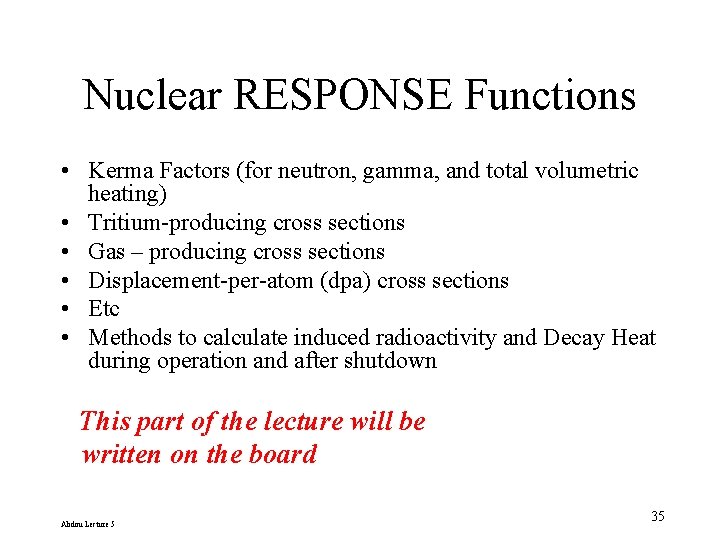
Nuclear RESPONSE Functions • Kerma Factors (for neutron, gamma, and total volumetric heating) • Tritium-producing cross sections • Gas – producing cross sections • Displacement-per-atom (dpa) cross sections • Etc • Methods to calculate induced radioactivity and Decay Heat during operation and after shutdown This part of the lecture will be written on the board Abdou Lecture 5 35
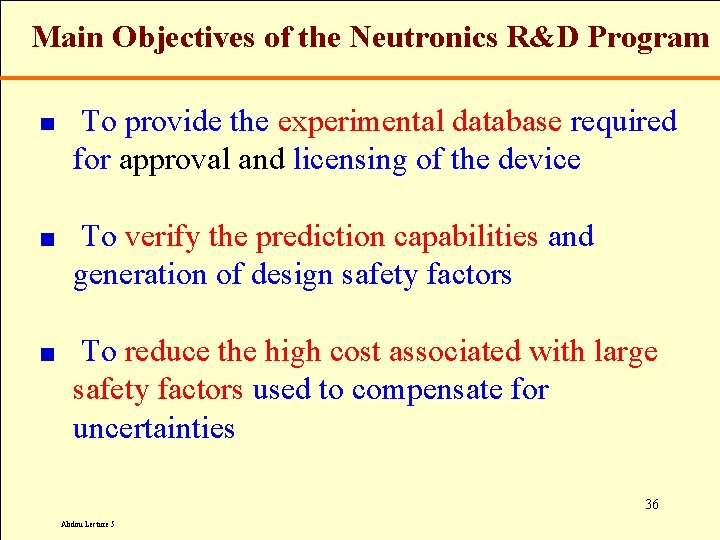
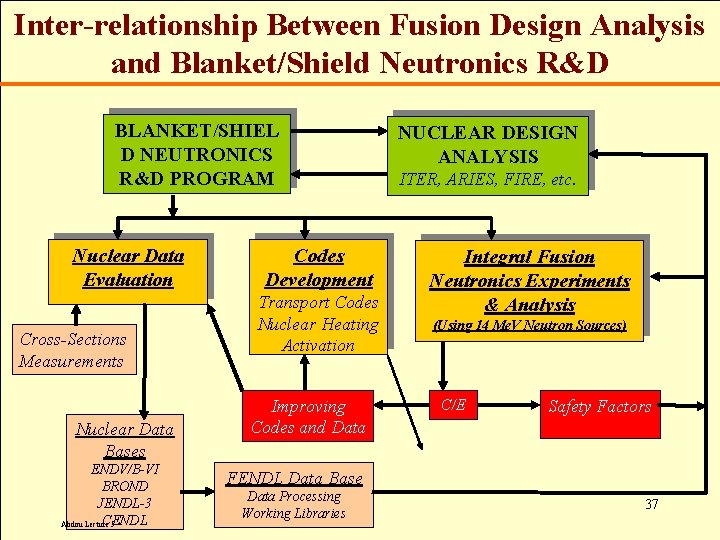
Main Objectives of the Neutronics R&D Program To provide the experimental database required for approval and licensing of the device To verify the prediction capabilities and generation of design safety factors To reduce the high cost associated with large safety factors used to compensate for uncertainties 36 Abdou Lecture 5
Inter-relationship Between Fusion Design Analysis and Blanket/Shield Neutronics R&D BLANKET/SHIEL D NEUTRONICS R&D PROGRAM Nuclear Data Evaluation Cross-Sections Measurements Nuclear Data Bases ENDV/B-VI BROND JENDL-3 CENDL Abdou Lecture 5 Codes Development Transport Codes Nuclear Heating Activation Improving Codes and Data NUCLEAR DESIGN ANALYSIS ITER, ARIES, FIRE, etc. Integral Fusion Neutronics Experiments & Analysis (Using 14 Me. V Neutron Sources) C/E Safety Factors FENDL Data Base Data Processing Working Libraries 37
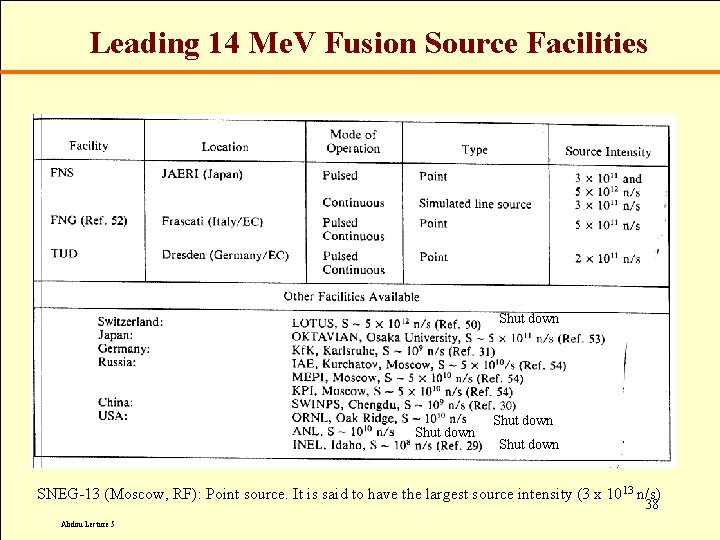
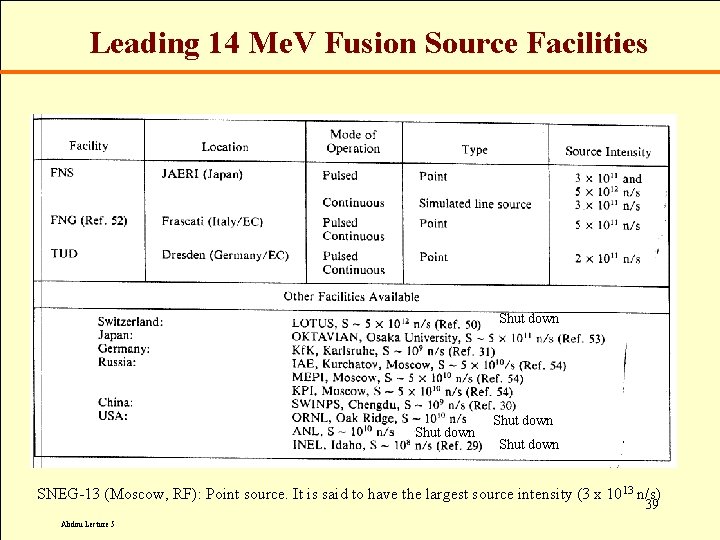
Vacuum Vessel (Cont’d) Leading 14 Me. V Fusion Source Facilities Shut down SNEG-13 (Moscow, RF): Point source. It is said to have the largest source intensity (3 x 10¹³ n/s) 38 Abdou Lecture 5
Vacuum Vessel (Cont’d) Leading 14 Me. V Fusion Source Facilities Shut down SNEG-13 (Moscow, RF): Point source. It is said to have the largest source intensity (3 x 10¹³ n/s) 39 Abdou Lecture 5
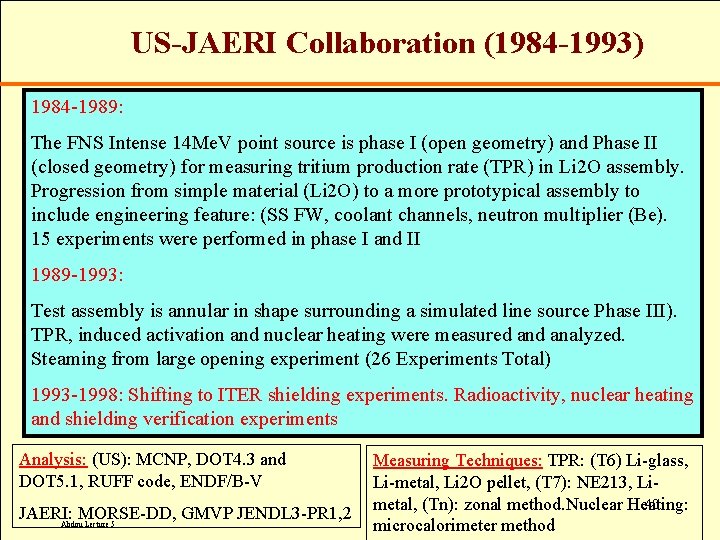
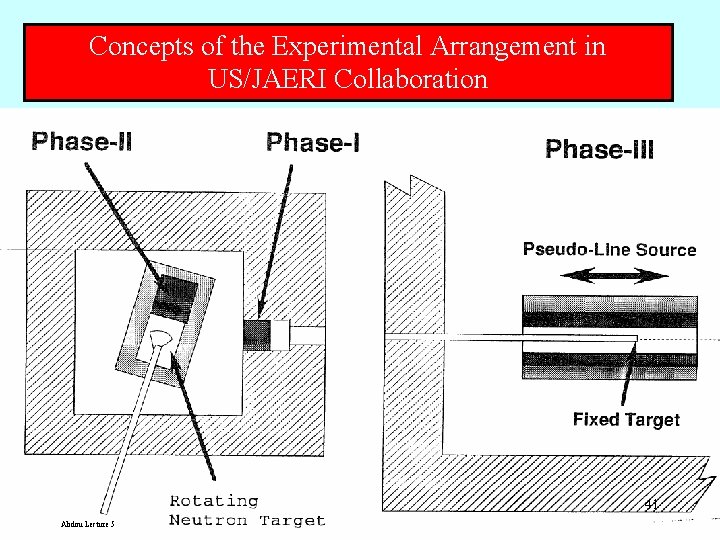
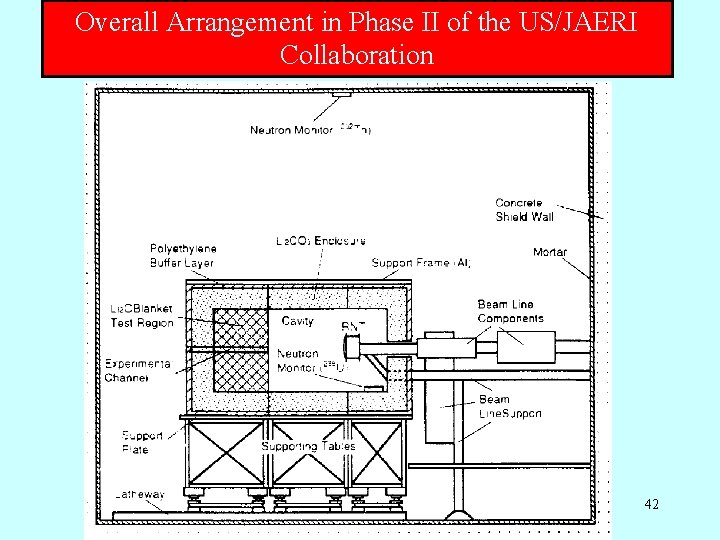
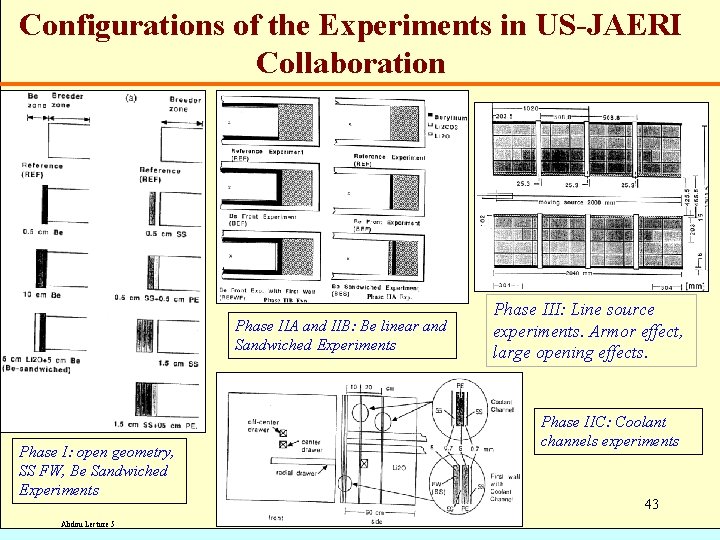
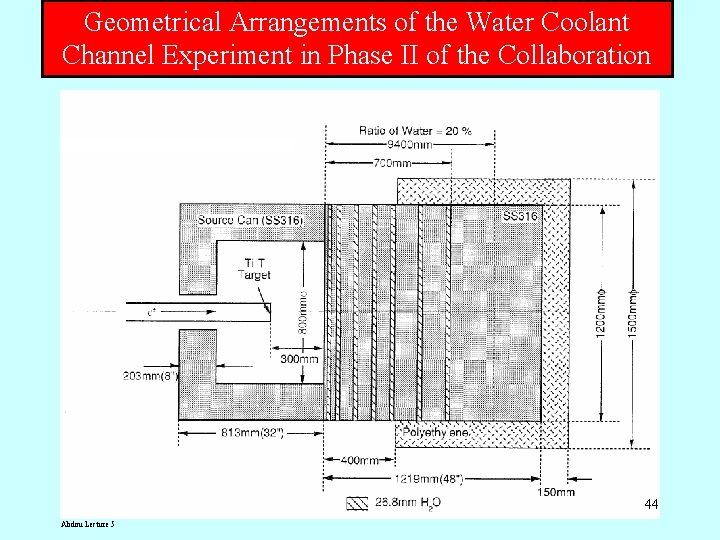
US-JAERI Collaboration (1984 -1993) 1984 -1989: The FNS Intense 14 Me. V point source is phase I (open geometry) and Phase II (closed geometry) for measuring tritium production rate (TPR) in Li 2 O assembly. Progression from simple material (Li 2 O) to a more prototypical assembly to include engineering feature: (SS FW, coolant channels, neutron multiplier (Be). 15 experiments were performed in phase I and II 1989 -1993: Test assembly is annular in shape surrounding a simulated line source Phase III). TPR, induced activation and nuclear heating were measured analyzed. Steaming from large opening experiment (26 Experiments Total) 1993 -1998: Shifting to ITER shielding experiments. Radioactivity, nuclear heating and shielding verification experiments Analysis: (US): MCNP, DOT 4. 3 and DOT 5. 1, RUFF code, ENDF/B-V JAERI: MORSE-DD, GMVP JENDL 3 -PR 1, 2 Abdou Lecture 5 Measuring Techniques: TPR: (T 6) Li-glass, Li-metal, Li 2 O pellet, (T 7): NE 213, Li 40 metal, (Tn): zonal method. Nuclear Heating: microcalorimeter method
Concepts of the Experimental Arrangement in US/JAERI Collaboration 41 Abdou Lecture 5
Overall Arrangement in Phase II of the US/JAERI Collaboration 42
Configurations of the Experiments in US-JAERI Collaboration Phase IIA and IIB: Be linear and Sandwiched Experiments Phase I: open geometry, SS FW, Be Sandwiched Experiments Abdou Lecture 5 Phase III: Line source experiments. Armor effect, large opening effects. Phase IIC: Coolant channels experiments 43
Geometrical Arrangements of the Water Coolant Channel Experiment in Phase II of the Collaboration 44 Abdou Lecture 5
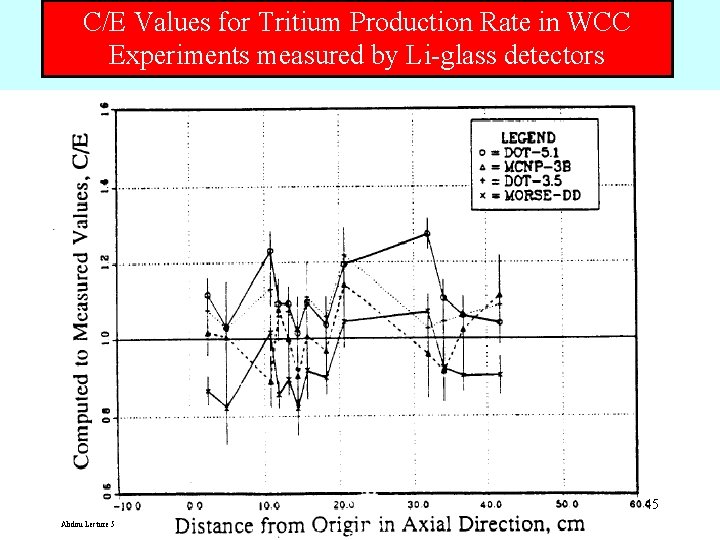
C/E Values for Tritium Production Rate in WCC Experiments measured by Li-glass detectors 45 Abdou Lecture 5
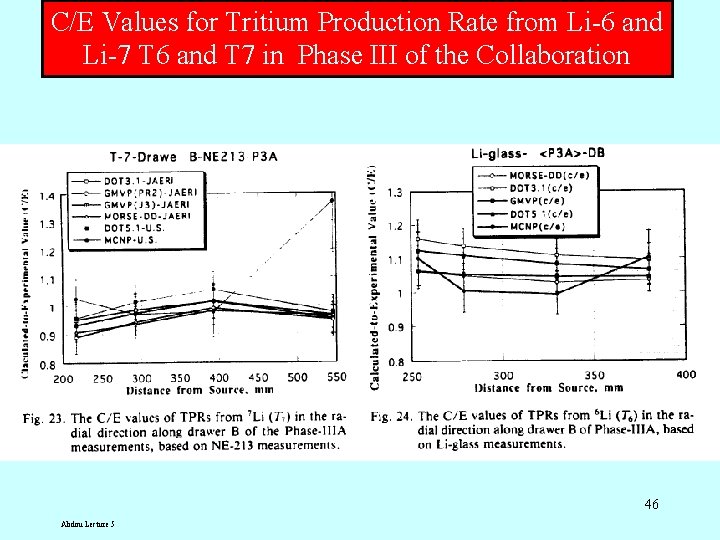
C/E Values for Tritium Production Rate from Li-6 and Li-7 T 6 and T 7 in Phase III of the Collaboration 46 Abdou Lecture 5
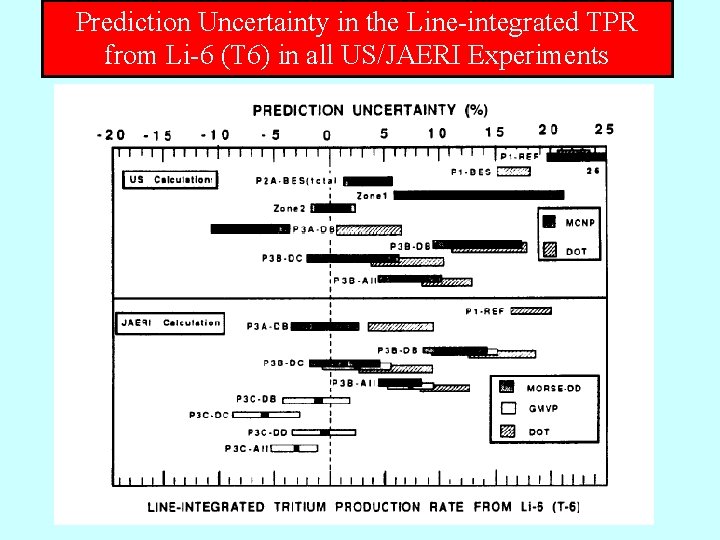
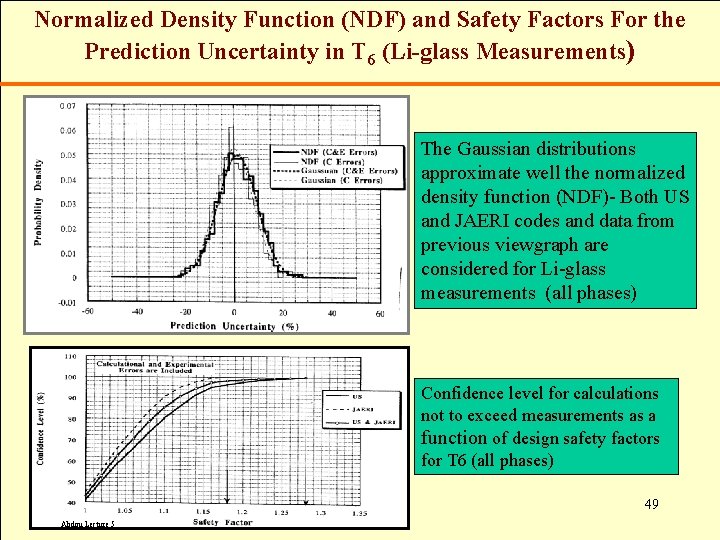
Prediction Uncertainty in the Line-integrated TPR from Li-6 (T 6) in all US/JAERI Experiments
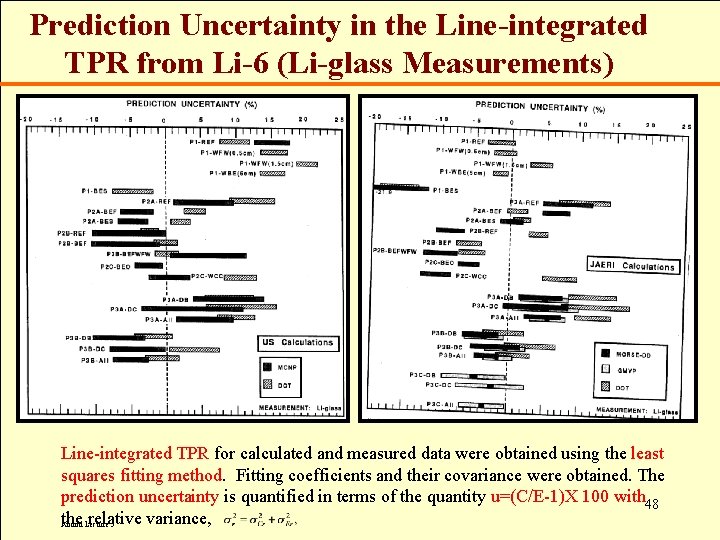
Prediction Uncertainty in the Line-integrated TPR from Li-6 (Li-glass Measurements) Line-integrated TPR for calculated and measured data were obtained using the least squares fitting method. Fitting coefficients and their covariance were obtained. The prediction uncertainty is quantified in terms of the quantity u=(C/E-1)X 100 with 48 the Lecture relative variance, Abdou 5
Normalized Density Function (NDF) and Safety Factors For the Prediction Uncertainty in T 6 (Li-glass Measurements) The Gaussian distributions approximate well the normalized density function (NDF)- Both US and JAERI codes and data from previous viewgraph are considered for Li-glass measurements (all phases) Confidence level for calculations not to exceed measurements as a function of design safety factors for T 6 (all phases) 49 Abdou Lecture 5
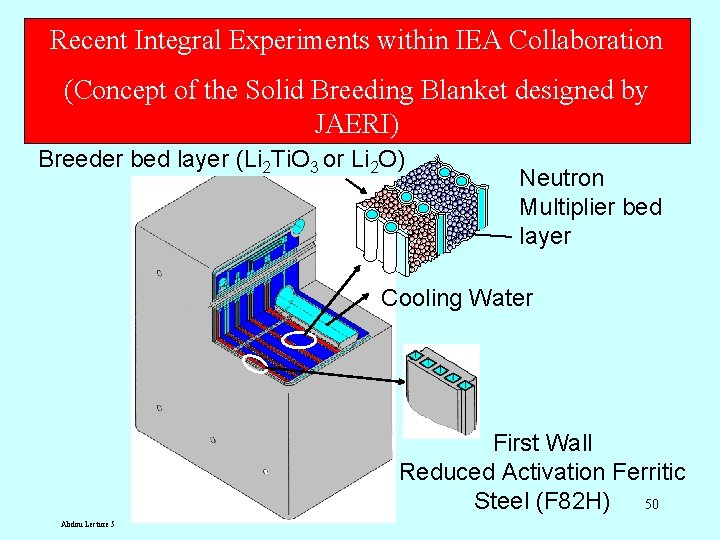
Recent Integral Experiments within IEA Collaboration (Concept of the Solid Breeding Blanket designed by JAERI) Breeder bed layer (Li 2 Ti. O 3 or Li 2 O) Neutron Multiplier bed layer Cooling Water First Wall Reduced Activation Ferritic Steel (F 82 H) 50 Abdou Lecture 5
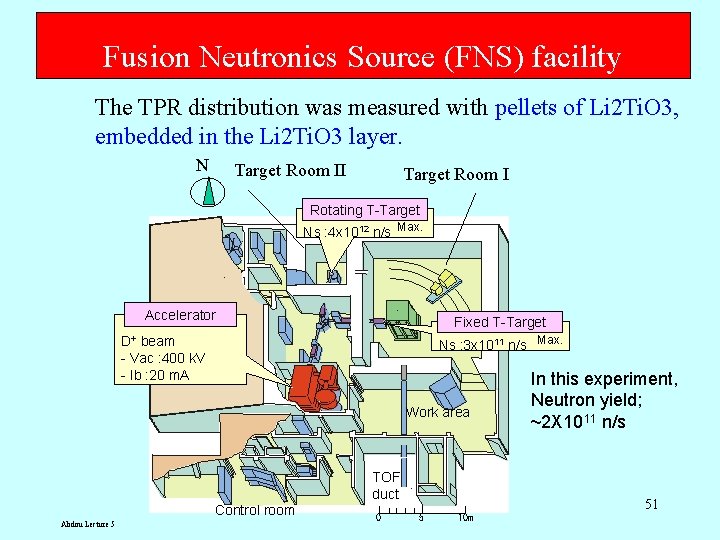
Fusion Neutronics Source (FNS) facility The TPR distribution was measured with pellets of Li 2 Ti. O 3, embedded in the Li 2 Ti. O 3 layer. N Target Room II Target Room I Rotating T-Target Ns : 4 x 10¹² n/s Max. Accelerator Fixed T-Target Ns : 3 x 10¹¹ n/s Max. D+ beam - Vac : 400 k. V - Ib : 20 m. A Work area TOF duct Control room Abdou Lecture 5 0 In this experiment, Neutron yield; ~2 X 10¹¹ n/s 51 5 10 m
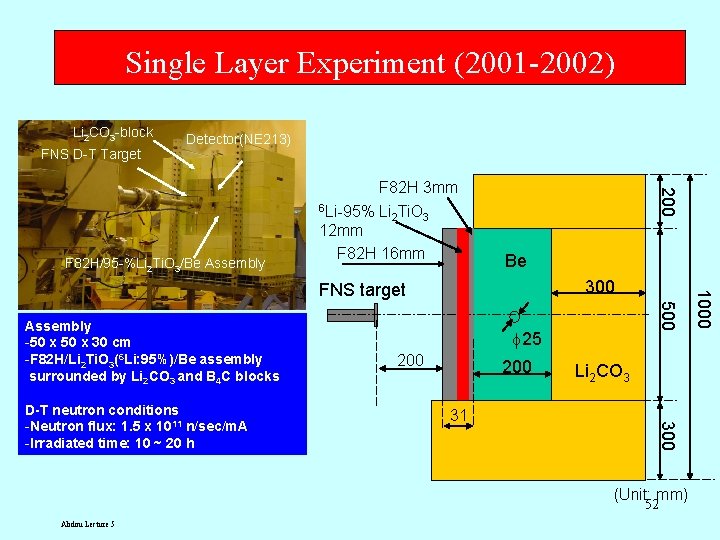
Single Layer Experiment (2001 -2002) Li 2 CO 3 -block Detector(NE 213) FNS D-T Target 200 F 82 H/95 -%Li 2 Ti. O 3/Be Assembly F 82 H 3 mm 6 Li-95% Li Ti. O 2 3 12 mm F 82 H 16 mm Be f 25 200 31 Li 2 CO 3 300 D-T neutron conditions -Neutron flux: 1. 5 x 10¹¹ n/sec/m. A -Irradiated time: 10 ~ 20 h 500 Assembly -50 x 30 cm -F 82 H/Li 2 Ti. O 3(6 Li: 95%)/Be assembly surrounded by Li 2 CO 3 and B 4 C blocks (Unit: mm) 52 Abdou Lecture 5 1000 300 FNS target
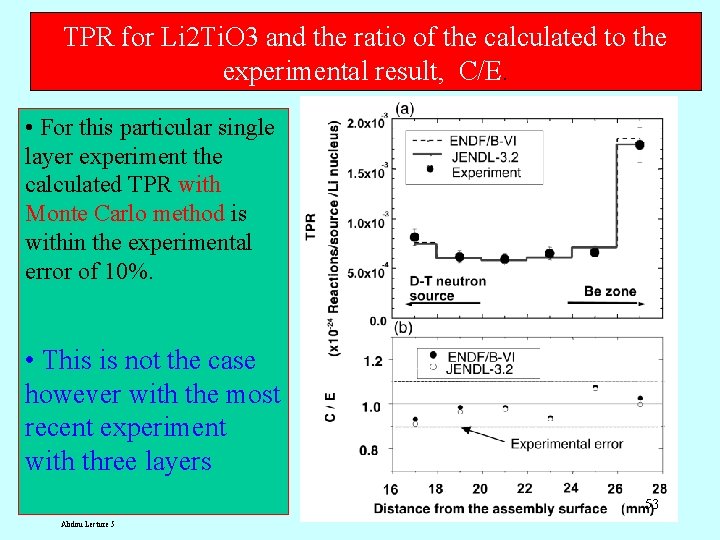
TPR for Li 2 Ti. O 3 and the ratio of the calculated to the experimental result, C/E. • For this particular single layer experiment the calculated TPR with Monte Carlo method is within the experimental error of 10%. • This is not the case however with the most recent experiment with three layers 53 Abdou Lecture 5
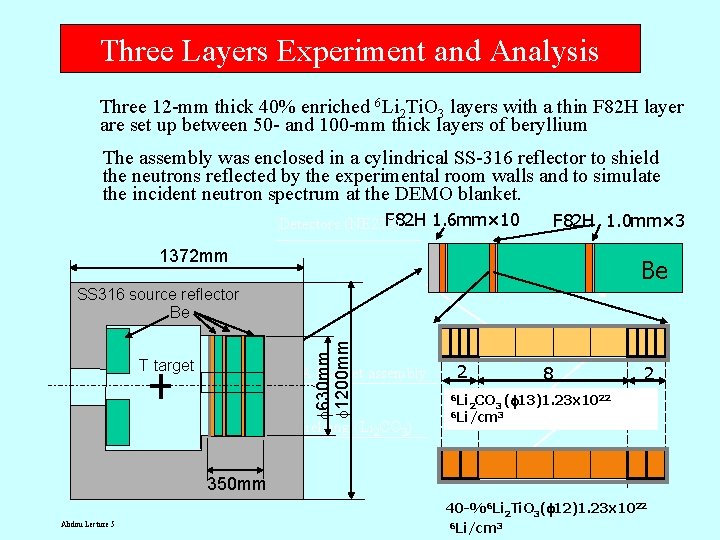
Three Layers Experiment and Analysis Three 12 -mm thick 40% enriched 6 Li 2 Ti. O 3 layers with a thin F 82 H layer are set up between 50 - and 100 -mm thick layers of beryllium The assembly was enclosed in a cylindrical SS-316 reflector to shield the neutrons reflected by the experimental room walls and to simulate the incident neutron spectrum at the DEMO blanket. F 82 H 1. 6 mm× 10 Detectors (NE 213) F 82 H 1. 0 mm× 3 1372 mm Be f 630 mm f 1200 mm SS 316 source reflector Be T target A blanket assembly Shielding (Li 2 CO 3) 2 6 Li 8 2 CO 3 (f 13)1. 23 x 10 6 Li/cm 3 2 22 350 mm Abdou Lecture 5 40 -%6 Li 2 Ti. O 3(f 12)1. 23 x 1022 6 Li/cm 3
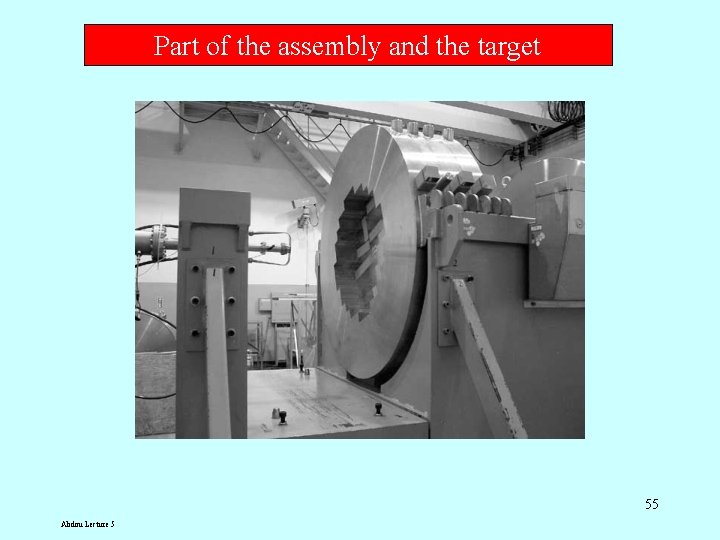
Part of the assembly and the target 55 Abdou Lecture 5
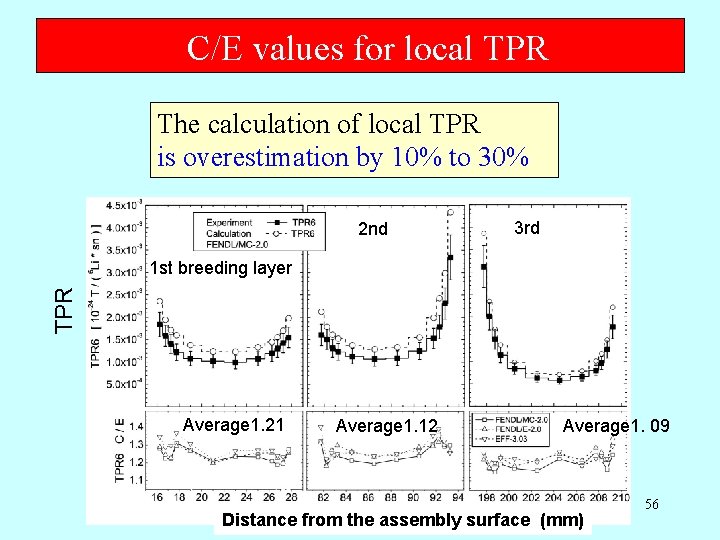
C/E values for local TPR The calculation of local TPR is overestimation by 10% to 30% 2 nd 3 rd TPR 1 st breeding layer Average 1. 21 Average 1. 12 Average 1. 09 Distance from the assembly surface (mm) 56
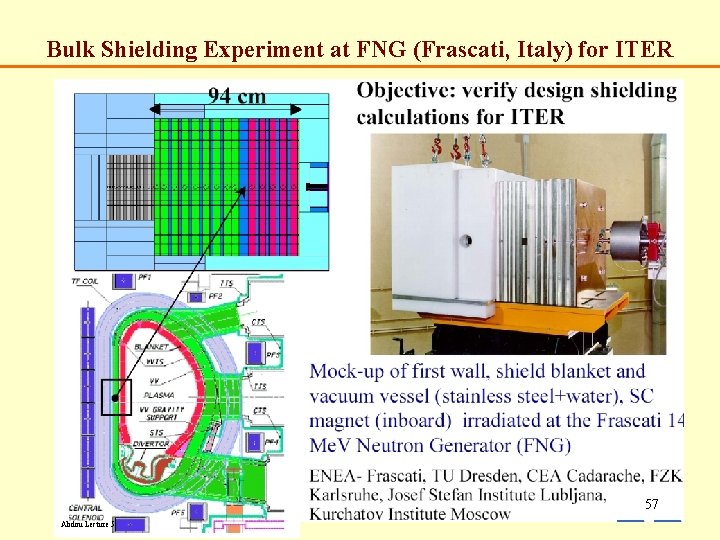
Bulk Shielding Experiment at FNGCarlo (Frascati, Italy) for ITER Monte Analysis The calculation of TPR is overestimation by 10% to 25% in this experiment. C/E of the integrated TPR for three layers was about 1. 15, which is a little bit larger than the design margin for the tritium breeding performance. 2 nd 3 rd TPR 1 st breeding layer Average 1. 21 Abdou Lecture 5 Average 1. 12 Average 1. 09 Distance from the assembly surface (mm) 57
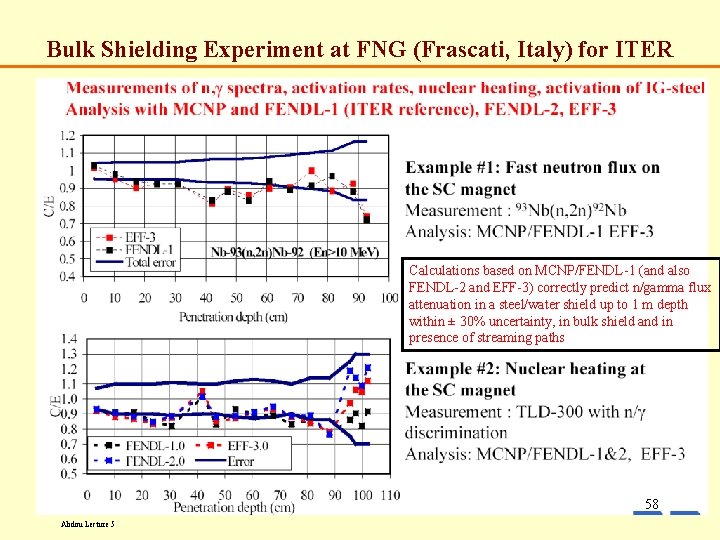
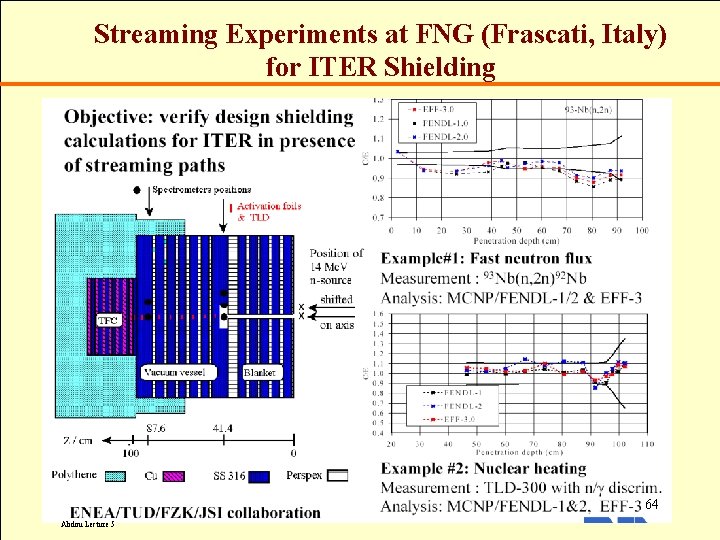
Bulk Shielding Experiment at FNGCarlo (Frascati, Italy) for ITER Monte Analysis The calculation of TPR is overestimation by 10% to 25% in this experiment. C/E of the integrated TPR for three layers was about 1. 15, which is a little bit larger than the design margin for the tritium breeding performance. 3 rd 2 nd TPR 1 st breeding layer Average 1. 21 Abdou Lecture 5 Calculations based on MCNP/FENDL-1 (and also FENDL-2 and EFF-3) correctly predict n/gamma flux attenuation in a steel/water shield up to 1 m depth within ± 30% uncertainty, in bulk shield and in presence of streaming paths Average 1. 12 Average 1. 09 Distance from the assembly surface (mm) 58
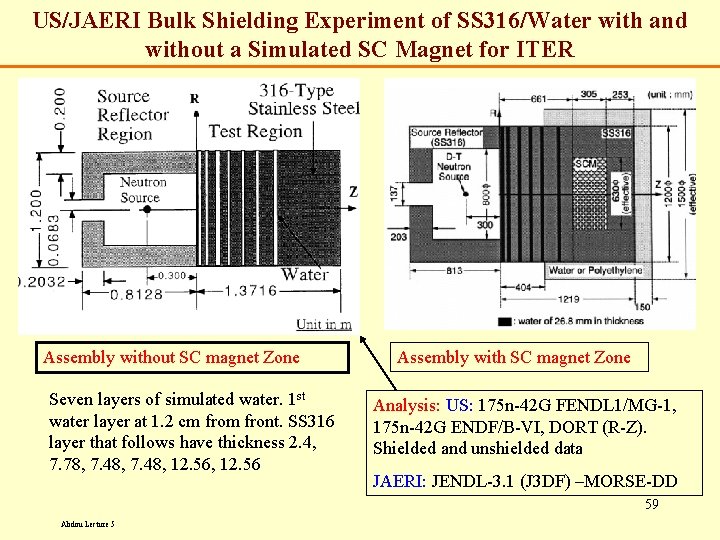
US/JAERI Bulk Shielding Experiment of SS 316/Water with and without a Simulated SC Magnet ITER Monte Carlo for Analysis The calculation of TPR is overestimation by 10% to 25% in this experiment. C/E of the integrated TPR for three layers was about 1. 15, which is a little bit larger than the design margin for the tritium breeding performance. 2 nd 3 rd TPR 1 st breeding layer Assembly without SC magnet Zone Assembly with SC magnet Zone Seven layers of simulated water. 1 st Analysis: US: 175 n-42 G FENDL 1/MG-1, water layer at 1. 2 cm front. SS 316 Average 1. 12 Average 1. 21 Average 1. 175 n-42 G ENDF/B-VI, DORT (R-Z). 09 layer that follows have thickness 2. 4, Shielded and unshielded data 7. 78, 7. 48, 12. 56 JAERI: JENDL-3. 1 (J 3 DF) –MORSE-DD Abdou Lecture 5 Distance from the assembly surface (mm) 59
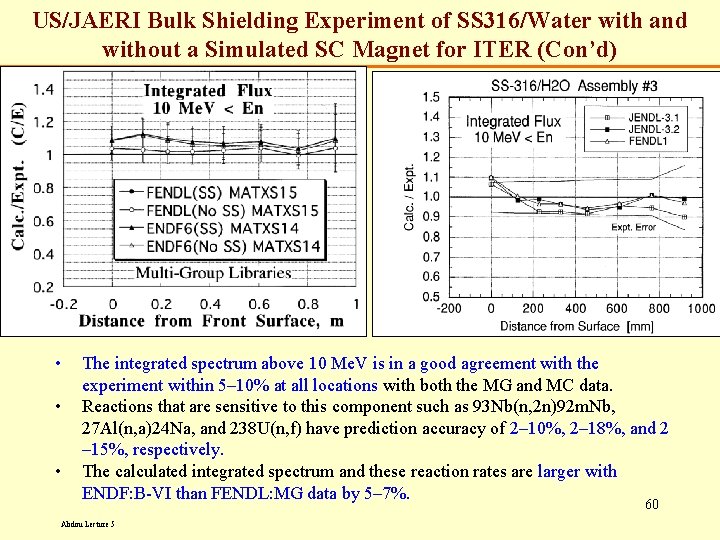
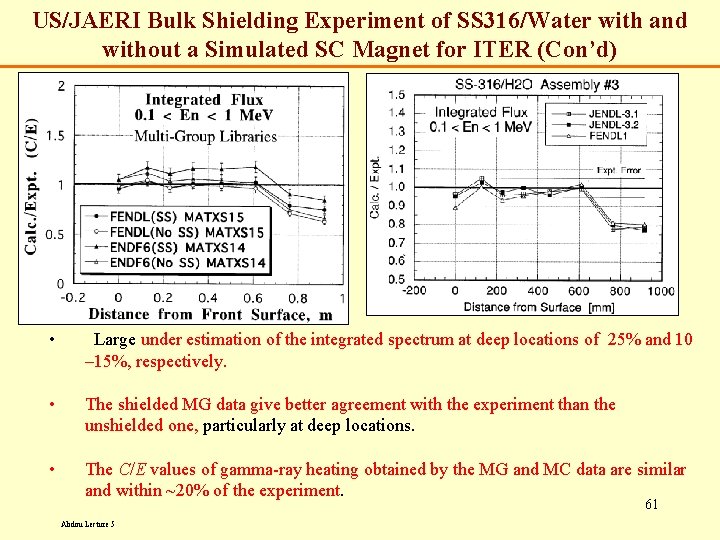
US/JAERI Bulk Shielding Experiment of SS 316/Water with and without a Simulated Monte SC Magnet for ITER (Con’d) Carlo Analysis The calculation of TPR is overestimation by 10% to 25% in this experiment. C/E of the integrated TPR for three layers was about 1. 15, which is a little bit larger than the design margin for the tritium breeding performance. 2 nd 3 rd TPR 1 st breeding layer • • • The integrated spectrum above 10 Me. V is in a good agreement with the experiment within 5– 10% at all locations with both the MG and MC data. Reactions that are sensitive to this component such as 93 Nb(n, 2 n)92 m. Nb, Average 1. 21 27 Al(n, a)24 Na, and 238 U(n, f) have. Average 1. 12 prediction accuracy of 2– 10%, Average 1. 2– 18%, and 09 2 – 15%, respectively. The calculated integrated spectrum and these reaction rates are larger with ENDF: B-VI than FENDL: MG data by 5– 7%. Abdou Lecture 5 Distance from the assembly surface (mm) 60
US/JAERI Bulk Shielding Experiment of SS 316/Water with and without a Simulated Monte SC Magnet for ITER (Con’d) Carlo Analysis The calculation of TPR is overestimation by 10% to 25% in this experiment. C/E of the integrated TPR for three layers was about 1. 15, which is a little bit larger than the design margin for the tritium breeding performance. 2 nd 3 rd TPR 1 st breeding layer • Large under estimation of the integrated spectrum at deep locations of 25% and 10 – 15%, respectively. • The shielded MG data give better agreement with the experiment than the Average 1. 21 unshielded one, particularly at deep. Average 1. 12 locations. Average 1. 09 • The C/E values of gamma-ray heating obtained by the MG and MC data are similar and within ~20% of the experiment. Abdou Lecture 5 Distance from the assembly surface (mm) 61
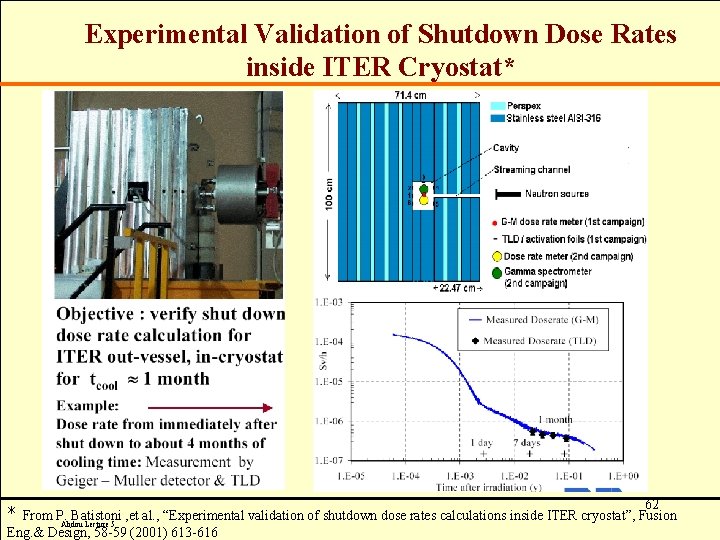
Experimental Validation of Shutdown Dose Rates inside ITER Cryostat* 62 From P. Batistoni , et al. , “Experimental validation of shutdown dose rates calculations inside ITER cryostat”, Fusion Abdou Lecture 5 Eng. & Design, 58 -59 (2001) 613 -616 *
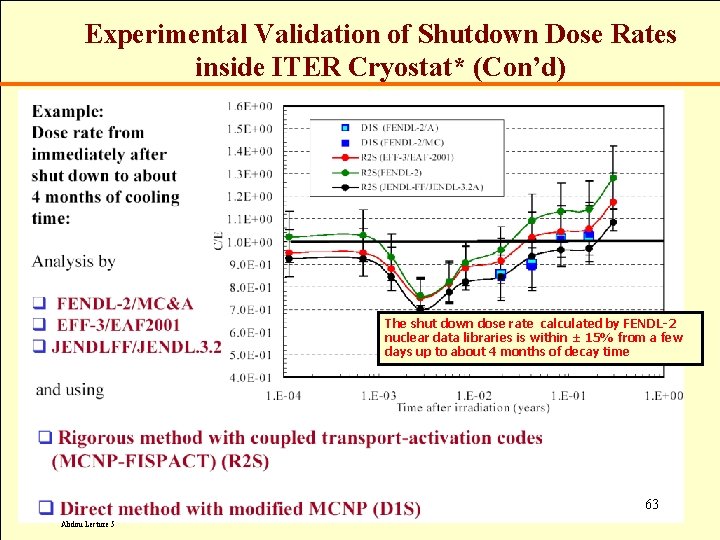
Experimental Validation of Shutdown Dose Rates inside ITER Cryostat* (Con’d) The shut down dose rate calculated by FENDL-2 nuclear data libraries is within ± 15% from a few days up to about 4 months of decay time 63 Abdou Lecture 5
Streaming Experiments at FNG (Frascati, Italy) for ITER Shielding 64 Abdou Lecture 5
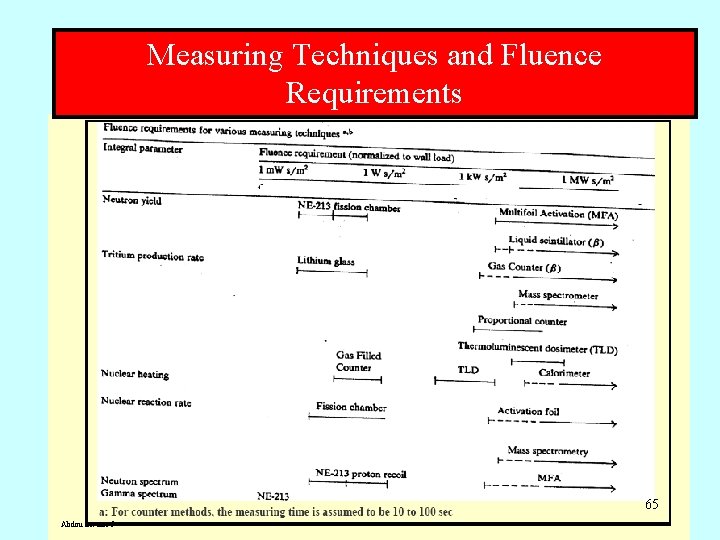
Measuring Techniques and Fluence Requirements 65 Abdou Lecture 5
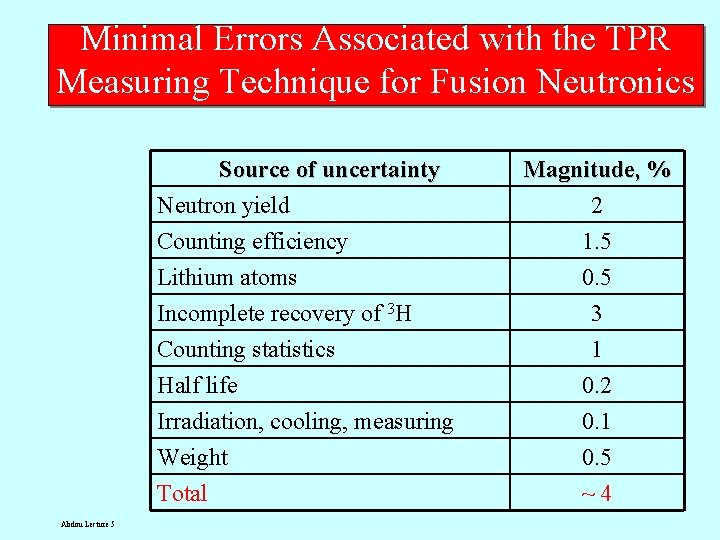
Minimal Errors Associated with the TPR Measuring Technique for Fusion Neutronics Source of uncertainty Neutron yield Counting efficiency Abdou Lecture 5 Magnitude, % 2 1. 5 Lithium atoms 0. 5 Incomplete recovery of 3 H Counting statistics Half life Irradiation, cooling, measuring Weight Total 3 1 0. 2 0. 1 0. 5 ~4
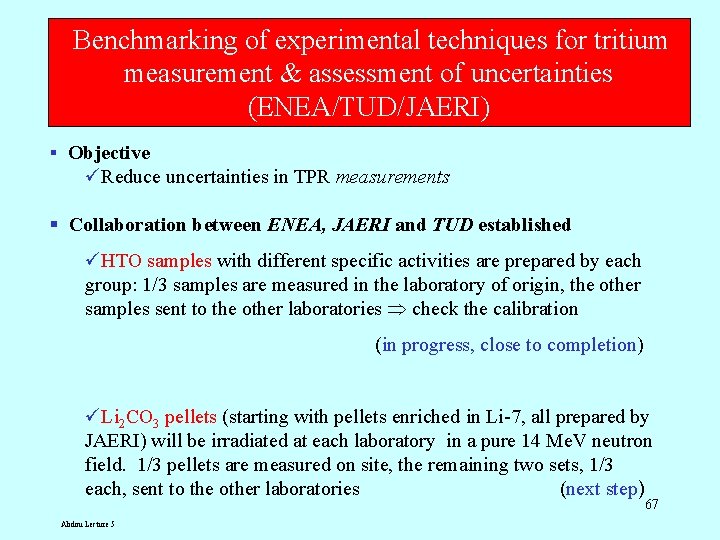
Benchmarking of experimental techniques for tritium measurement & assessment of uncertainties (ENEA/TUD/JAERI) § Objective üReduce uncertainties in TPR measurements § Collaboration between ENEA, JAERI and TUD established üHTO samples with different specific activities are prepared by each group: 1/3 samples are measured in the laboratory of origin, the other samples sent to the other laboratories check the calibration (in progress, close to completion) üLi 2 CO 3 pellets (starting with pellets enriched in Li-7, all prepared by JAERI) will be irradiated at each laboratory in a pure 14 Me. V neutron field. 1/3 pellets are measured on site, the remaining two sets, 1/3 each, sent to the other laboratories (next step) 67 Abdou Lecture 5