
Neutron Stars Adam Flanders Discovery of Neutron Stars
- Slides: 23
Neutron Stars Adam Flanders
Discovery of Neutron Stars • Walter Baade and Fritz Zwicky first proposed the existence of neutron stars, in December 1933, at a meeting with physicists • 1965, Antony Hewish and Samuel Okoye found a strange source of radio brightness in space • In 1967, Franco Pacini suggested the search for neutron stars should focus on discovering the electromagnetic waves caused by the rapid spinning of the star. Antony and Jocelyn Bell discovered the radio emissions of a pulsar from a neutron star • In 1974, Joseph Taylor and Russell Hulse discovered the first two orbiting neutron stars
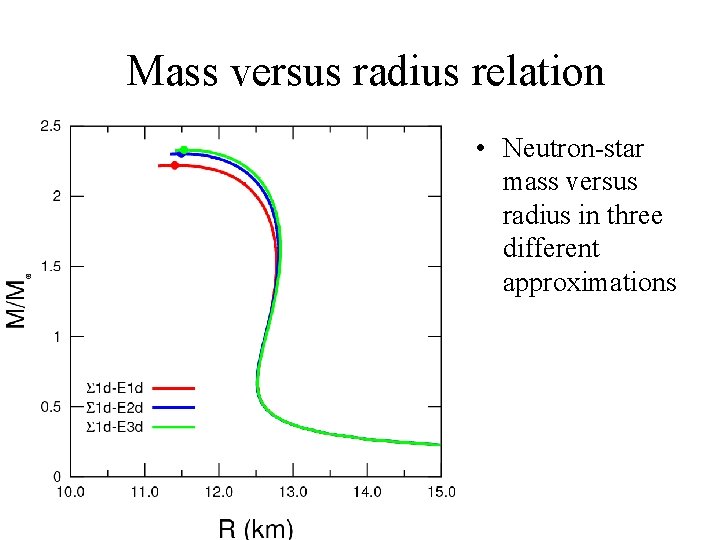
Mass versus radius relation • Neutron-star mass versus radius in three different approximations
Neutron Stars • Degenerate stars heavier than 1. 4 solar masses collapse to become neutron stars • Formed in supernova explosions • Electrons are not separate – Combine with nuclei to form neutrons • Neutron stars are degenerate gas of neutrons
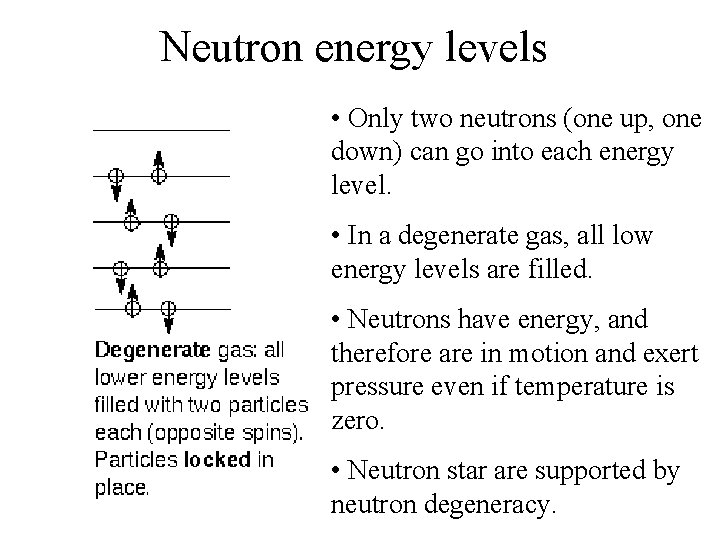
Neutron energy levels • Only two neutrons (one up, one down) can go into each energy level. • In a degenerate gas, all low energy levels are filled. • Neutrons have energy, and therefore are in motion and exert pressure even if temperature is zero. • Neutron star are supported by neutron degeneracy.
Neutron Stars • Very compact – about 10 km radius • Very dense – one teaspoon of neutron star material weighs as much as all the buildings in Manhattan • Spin rapidly – as fast as 600 times per second • High magnetic fields – compressed from magnetic field of progenitor star
Composition • A neutron star is predominantly composed of neutrons, with a few electrons and protons within some of the layers of the star • A range of particles such as pion condensates, delta isobars, and quark-gluon plasmas can be found within the inner layers of the star where temperatures are high enough.
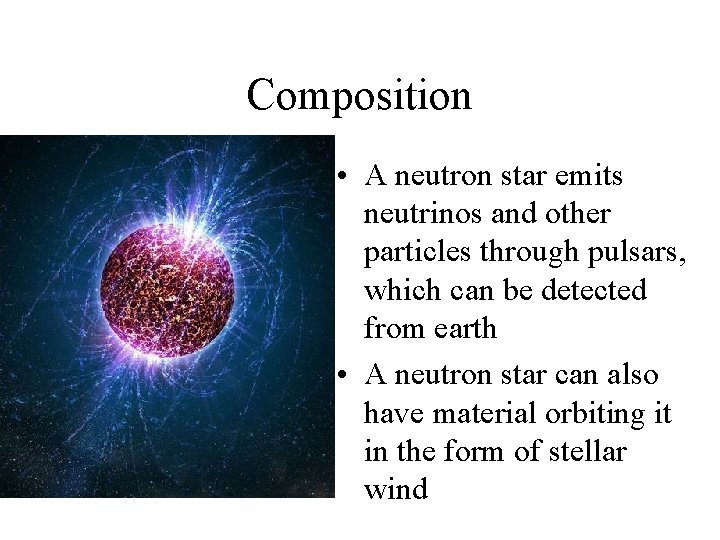
Composition • A neutron star emits neutrinos and other particles through pulsars, which can be detected from earth • A neutron star can also have material orbiting it in the form of stellar wind
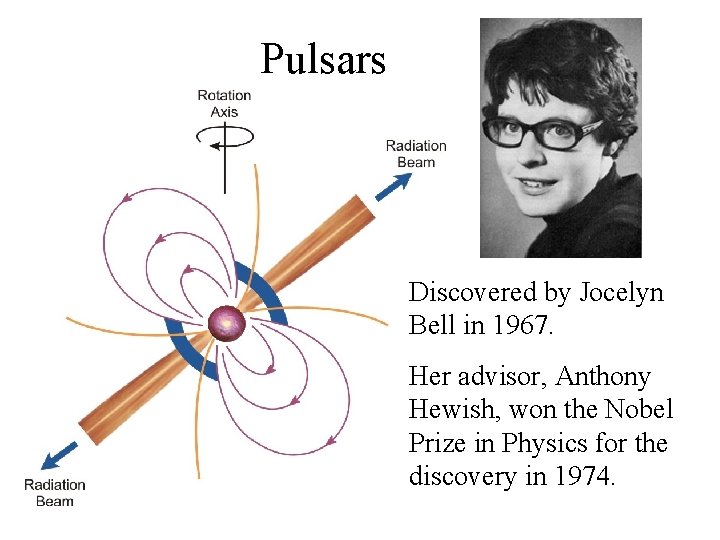
Pulsars Discovered by Jocelyn Bell in 1967. Her advisor, Anthony Hewish, won the Nobel Prize in Physics for the discovery in 1974.
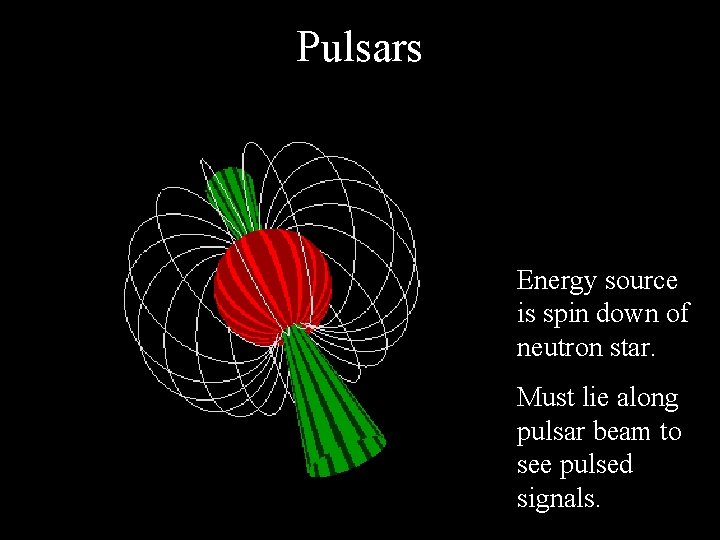
Pulsars Energy source is spin down of neutron star. Must lie along pulsar beam to see pulsed signals.
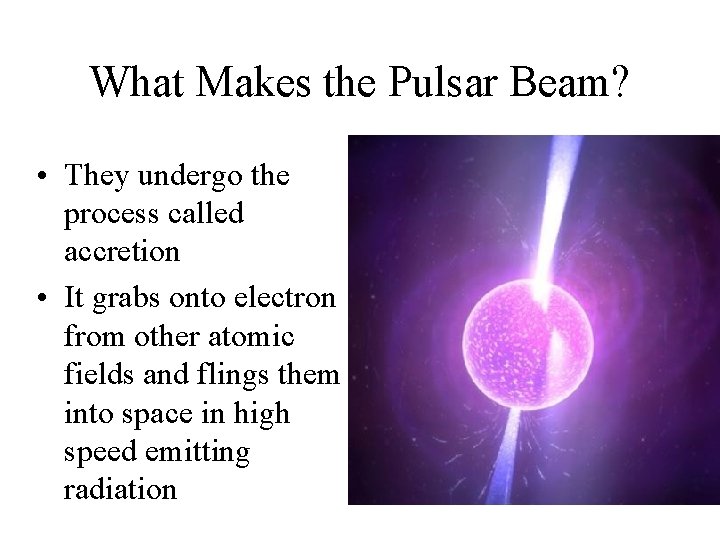
What Makes the Pulsar Beam? • They undergo the process called accretion • It grabs onto electron from other atomic fields and flings them into space in high speed emitting radiation
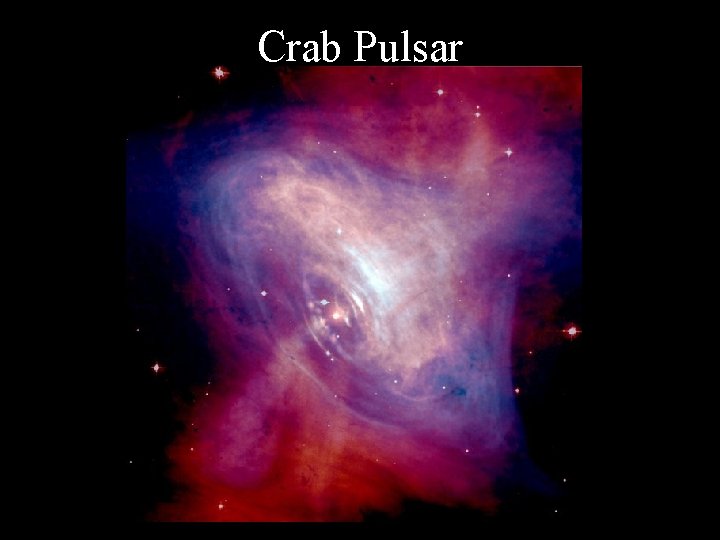
Crab Pulsar
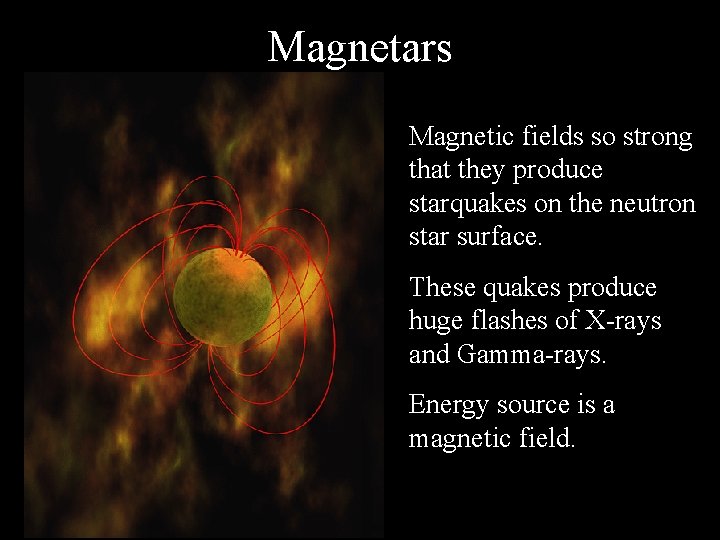
Magnetars Magnetic fields so strong that they produce starquakes on the neutron star surface. These quakes produce huge flashes of X-rays and Gamma-rays. Energy source is a magnetic field.
Magnetar Formation • When in a supernova, a star collapses to a neutron star, and its magnetic field increases dramatically in strength • Duncan and Thompson calculated that when the spin, temperature and magnetic field of a newly formed neutron star falls into the right ranges, a dynamo mechanism could act, converting heat and rotational energy into magnetic energy and increasing the magnetic field, normally an already enormous 108 teslas, to more than 1011 teslas • It is estimated that about one in ten supernova explosions results in a magnetar rather than a more standard neutron star or pulsar
Dynamo Mechanism • The dynamo theory proposes a mechanism by which a celestial body such as Earth or a star generates a magnetic field • The dynamo theory describes the process through which a rotating, convecting, and electrically conducting fluid can maintain a magnetic field over astronomical time scales • A dynamo is thought to be the source of the Earth's magnetic field and the magnetic fields of Mercury and the Jovian planets
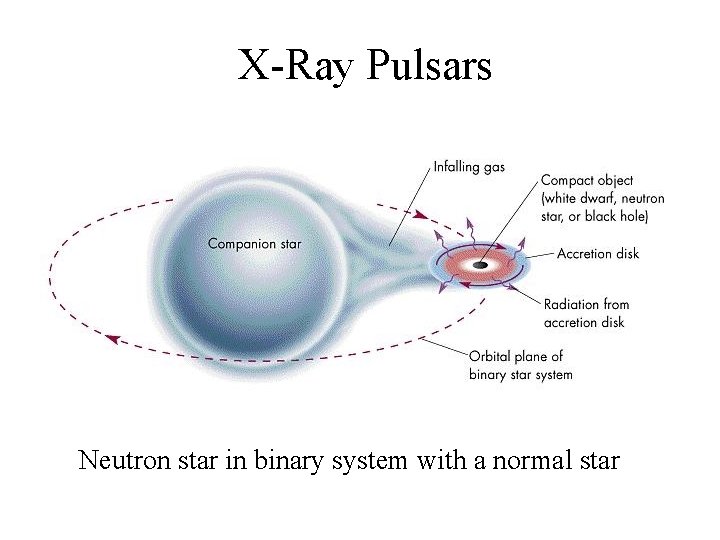
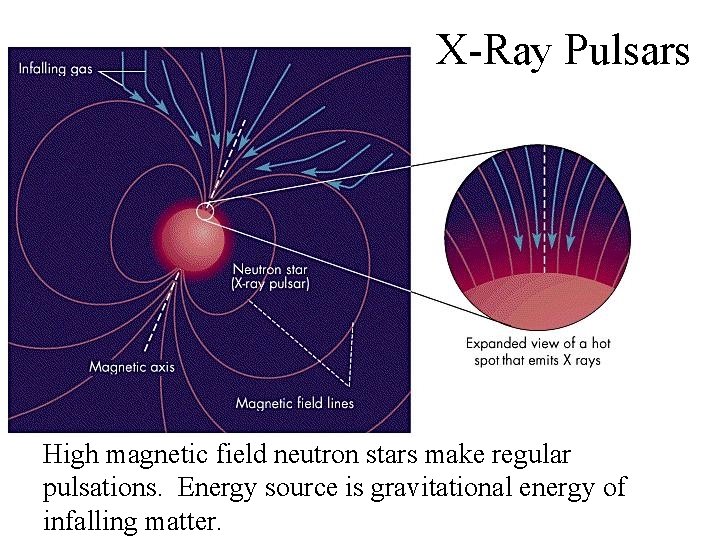
X-Ray Pulsars Neutron star in binary system with a normal star
X-Ray Pulsars High magnetic field neutron stars make regular pulsations. Energy source is gravitational energy of infalling matter.
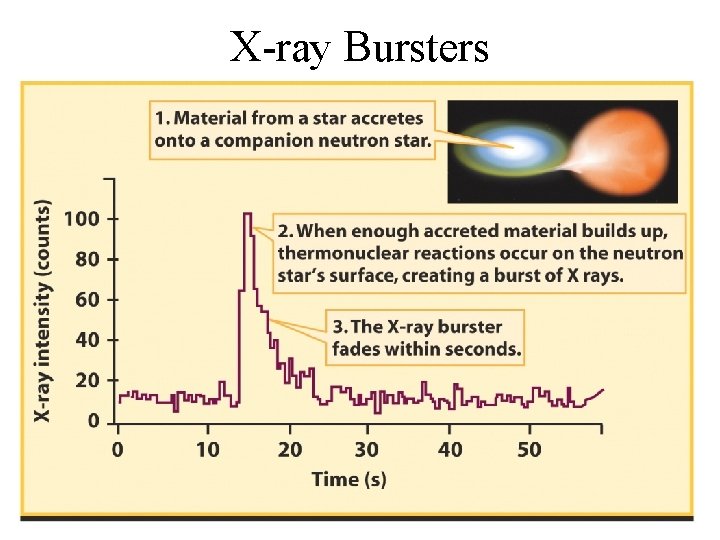
X-ray Bursters • X-ray bursts are some of the most energetic events observed in the cosmos • X-ray bursts are thermonuclear explosions occurring near the surface of accreting neutron stars • The material accreted from the companion star is funneled to the surface of the neutron stars • The extreme density found near the surface of the neutron star provides the environment for explosive Hydrogen and Helium burning
X-ray Bursters
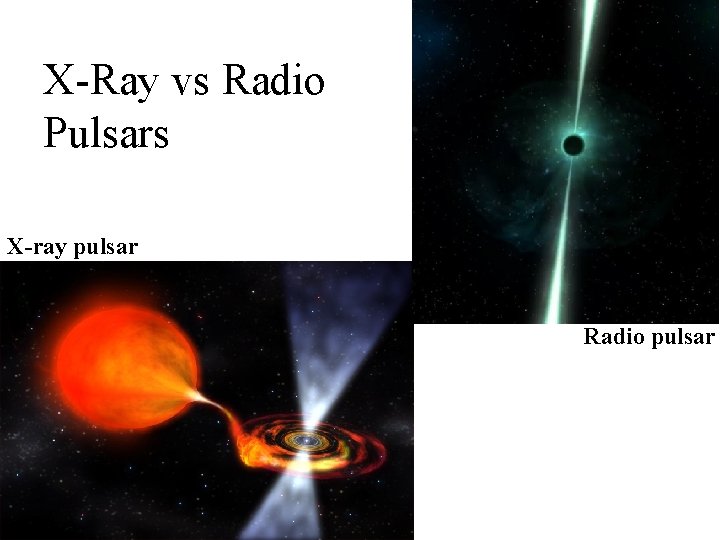
X-ray vs Radio Pulsars • Radio pulsars have periods on the order of milliseconds to seconds, and all radio pulsars are losing angular momentum and slowing down. In contrast, the X-ray pulsars exhibit a variety of spin behaviors • Some X-ray pulsars are observed to be continuously spinning faster and faster or slower and slower (with occasional reversals in these trends) while others show either little change in pulse period or display erratic spindown and spin-up behavior
X-Ray vs Radio Pulsars X-ray pulsar Radio pulsar
X-ray vs Radio Pulsars • Over 99% of radio pulsars are single objects that radiate away their rotational energy in the form of relativistic particles and magnetic dipole radiation, lighting up any nearby nebulae that surround them • In contrast, X-ray pulsars are members of binary star systems and accrete matter from either stellar winds or accretion disks • The accreted matter transfers angular momentum to the neutron star causing the spin rate to increase or decrease at rates that are often hundreds of times faster than the typical spin down rate in radio pulsars
Sources • • • https: //www. researchgate. net/publication/247152796_Properties_of_dense_asymmetric_nuclear_matt er_in_Dirac-Brueckner-Hartree-Fock_approach#pf 11 http: //www. physics. drexel. edu/~bob/Term_Reports/John_Timlin. pdf http: //archive. jinaweb. org/docs/nuggets_09/Spo_nugget. pdf https: //arxiv. org/abs/1506. 07881 https: //aasnova. org/2019/09/10/radio-pulsars-how-slow-do-they-go/ https: //www. nasa. gov/missions/deepspace/f_magnetars. html https: //www. ncbi. nlm. nih. gov/pmc/articles/PMC 33576/ https: //chandra. harvard. edu/xray_sources/neutron_stars. html https: //www. esa. int/Science_Exploration/Space_Science/Missing_link_found_between_Xray_and_radio_pulsars