
Neutron Sources for Materials Research Tenth National School






- Slides: 56
Neutron Sources for Materials Research Tenth National School on Neutron and X-ray Scattering 24 September-11 October, 2008 John M. Carpenter IPNS, SNS 26 September 2008
Neutrons and Neutron Sources n James Chadwick discovered the neutron in 1932. n In 1936 Mitchel & Powers and Halban & Preiswerk first demonstrated coherent neutron diffraction in (Bragg scattering by crystal lattice planes) as an exercise in wave mechanics. n The possibility of using the scattering of neutrons as a probe of materials developed after 1945 with the availability of copious quantities of slow neutrons from reactors. Fermi's group used Bragg scattering to measure nuclear crosssections at early Argonne reactors. 98 -6245 uc/vlb 2
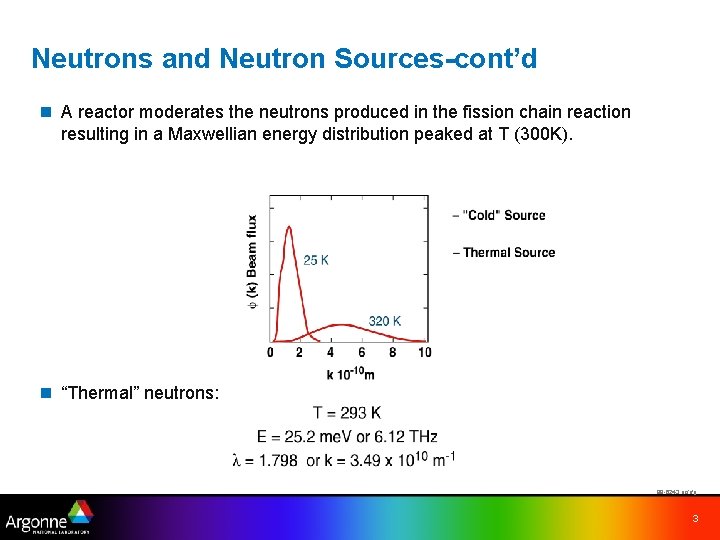
Neutrons and Neutron Sources-cont’d n A reactor moderates the neutrons produced in the fission chain reaction resulting in a Maxwellian energy distribution peaked at T (300 K). n “Thermal” neutrons: 98 -6243 uc/rfg 3
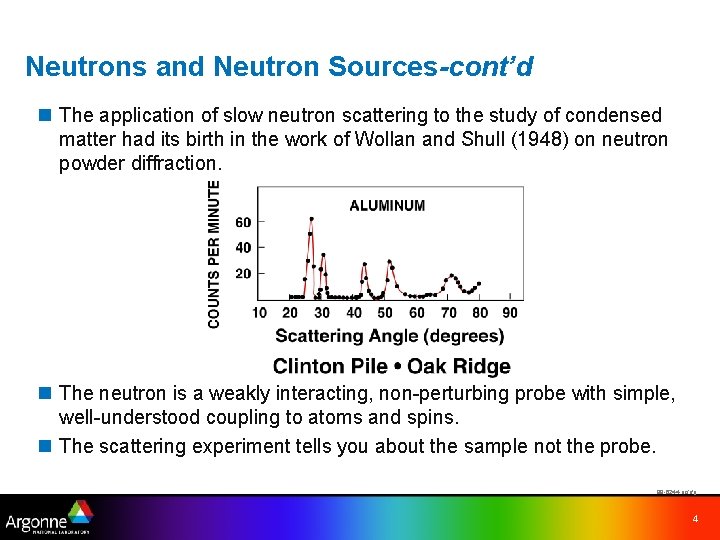
Neutrons and Neutron Sources-cont’d n The application of slow neutron scattering to the study of condensed matter had its birth in the work of Wollan and Shull (1948) on neutron powder diffraction. n The neutron is a weakly interacting, non-perturbing probe with simple, well-understood coupling to atoms and spins. n The scattering experiment tells you about the sample not the probe. 98 -6244 uc/rfg 4
Neutrons and Neutron Sources-cont’d n You can easily work in extreme sample environments H, T, P, . . . (e. g. 4 He cryostat) and penetrate into dense samples. n The magnetic and nuclear cross-sections are comparable; nuclear cross-sections are similar, but vary randomly across the periodic table. n Sensitivity to a wide a range of properties, both magnetic and atomic structural arrangements. 98 -6242 uc/rfg 5
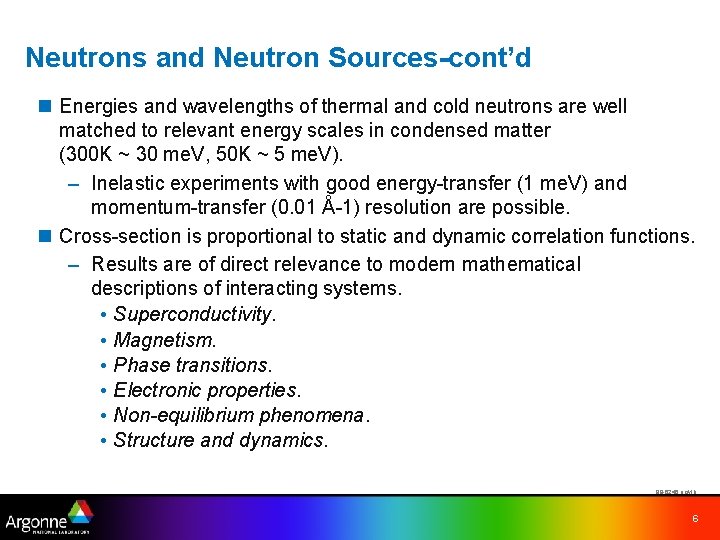
Neutrons and Neutron Sources-cont’d n Energies and wavelengths of thermal and cold neutrons are well matched to relevant energy scales in condensed matter (300 K ~ 30 me. V, 50 K ~ 5 me. V). – Inelastic experiments with good energy-transfer (1 me. V) and momentum-transfer (0. 01 Å-1) resolution are possible. n Cross-section is proportional to static and dynamic correlation functions. – Results are of direct relevance to modern mathematical descriptions of interacting systems. • Superconductivity. • Magnetism. • Phase transitions. • Electronic properties. • Non-equilibrium phenomena. • Structure and dynamics. 98 -6246 uc/vlb 6
Neutrons and Neutron Sources-cont’d n Scientists carried out work leading to the development of inelastic neutron scattering throughout the 1950 s. n The real breakthrough was the development of the “constant-Q” mode of operating the triple-axis spectrometer pioneered by Brockhouse and co-workers at Chalk River. – This permitted the systematic investigation of the dynamic response of the material – concentrating on the regions of interest. 98 -6241 uc/rra 7
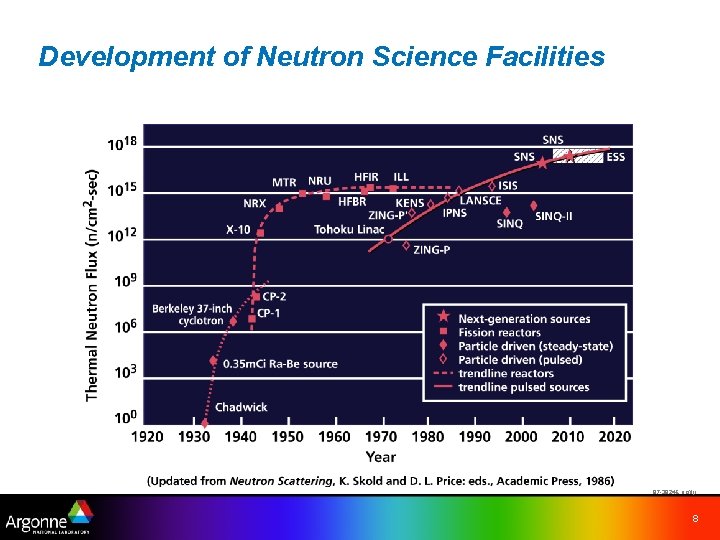
Development of Neutron Science Facilities 97 -3924 E uc/djr 8
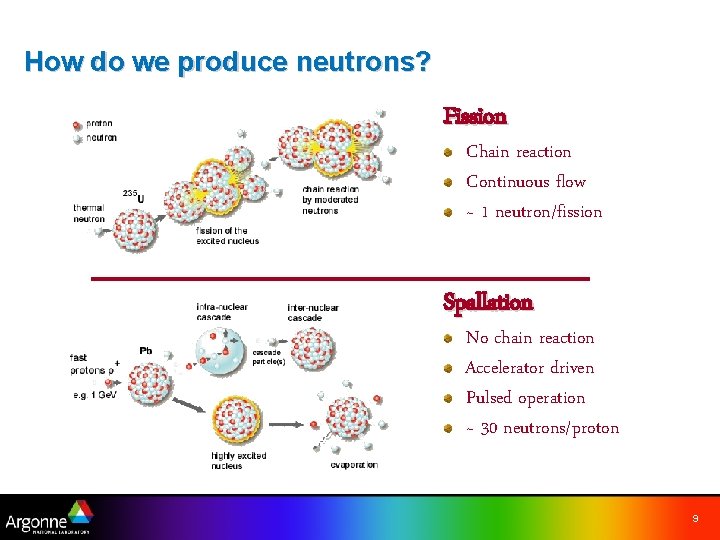
How do we produce neutrons? Fission Chain reaction Continuous flow ~ 1 neutron/fission Spallation No chain reaction Accelerator driven Pulsed operation ~ 30 neutrons/proton 9
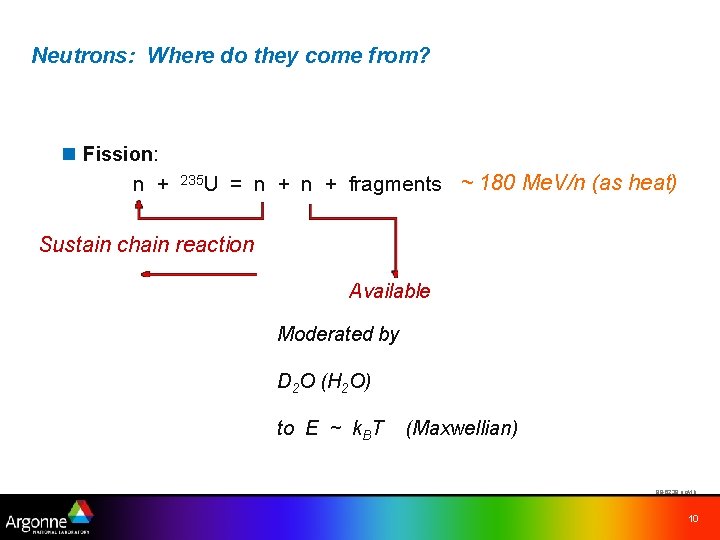
Neutrons: Where do they come from? n Fission: n + 235 U = n + fragments ~ 180 Me. V/n (as heat) Sustain chain reaction Available Moderated by D 2 O (H 2 O) to E ~ k. BT (Maxwellian) 98 -6239 uc/vlb 10
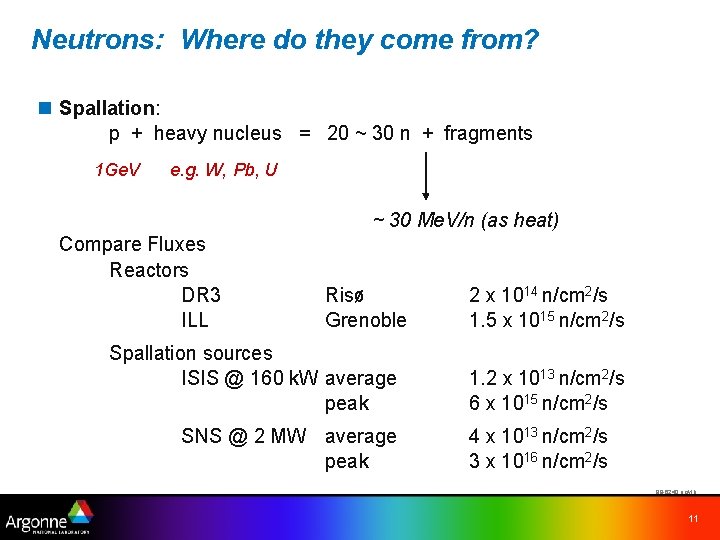
Neutrons: Where do they come from? n Spallation: p + heavy nucleus = 20 ~ 30 n + fragments 1 Ge. V e. g. W, Pb, U ~ 30 Me. V/n (as heat) Compare Fluxes Reactors DR 3 ILL Risø Grenoble Spallation sources ISIS @ 160 k. W average peak SNS @ 2 MW average peak 2 x 10¹⁴ n/cm 2/s 1. 5 x 10¹⁵ n/cm 2/s 1. 2 x 10¹³ n/cm 2/s 6 x 10¹⁵ n/cm 2/s 4 x 10¹³ n/cm 2/s 3 x 10¹⁶ n/cm 2/s 98 -6240 uc/vlb 11
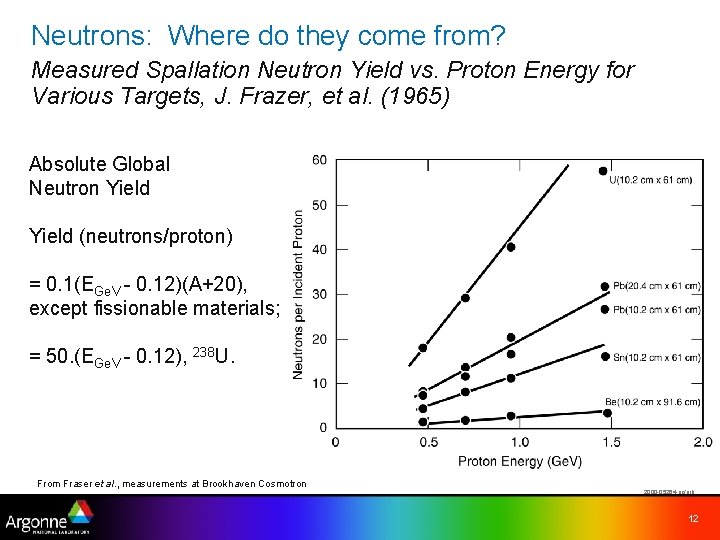
Neutrons: Where do they come from? Measured Spallation Neutron Yield vs. Proton Energy for Various Targets, J. Frazer, et al. (1965) Absolute Global Neutron Yield (neutrons/proton) = 0. 1(EGe. V - 0. 12)(A+20), except fissionable materials; = 50. (EGe. V - 0. 12), 238 U. From Fraser et al. , measurements at Brookhaven Cosmotron 2000 -05264 uc/arb 12
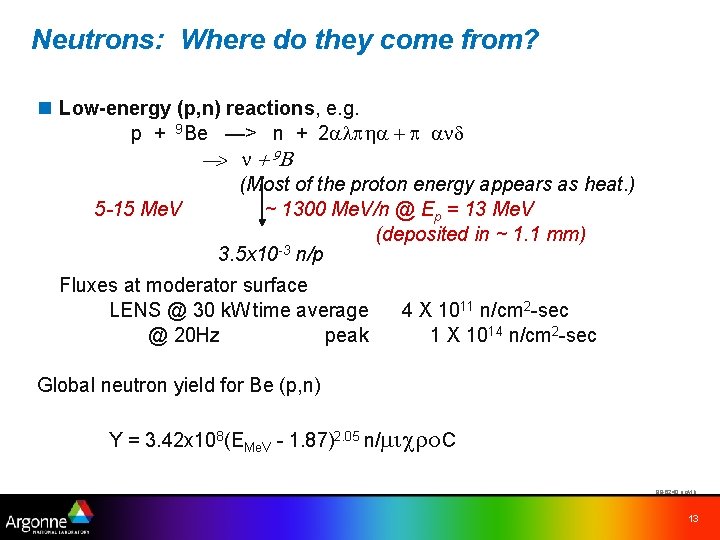
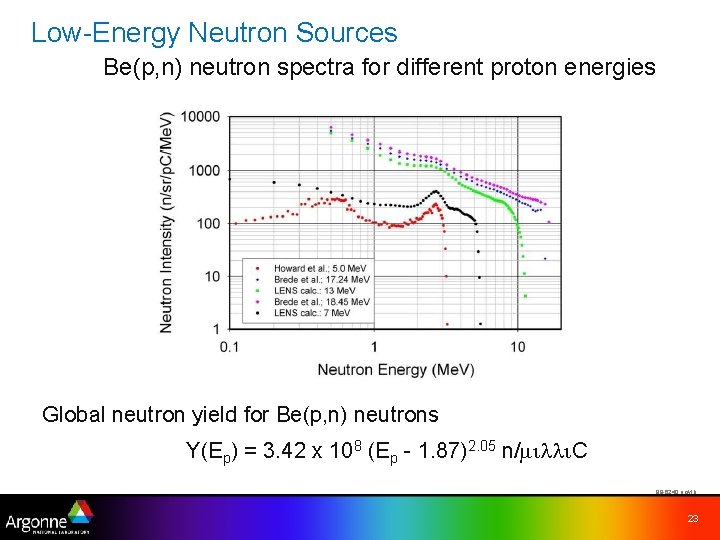
Neutrons: Where do they come from? n Low-energy (p, n) reactions, e. g. p + 9 Be —> n + 2 alpha + p and —> n + 9 B (Most of the proton energy appears as heat. ) 5 -15 Me. V ~ 1300 Me. V/n @ Ep = 13 Me. V (deposited in ~ 1. 1 mm) -3 3. 5 x 10 n/p Fluxes at moderator surface LENS @ 30 k. W time average @ 20 Hz peak 4 X 10¹¹ n/cm 2 -sec 1 X 10¹⁴ n/cm 2 -sec Global neutron yield for Be (p, n) Y = 3. 42 x 108(EMe. V - 1. 87)2. 05 n/micro. C 98 -6240 uc/vlb 13
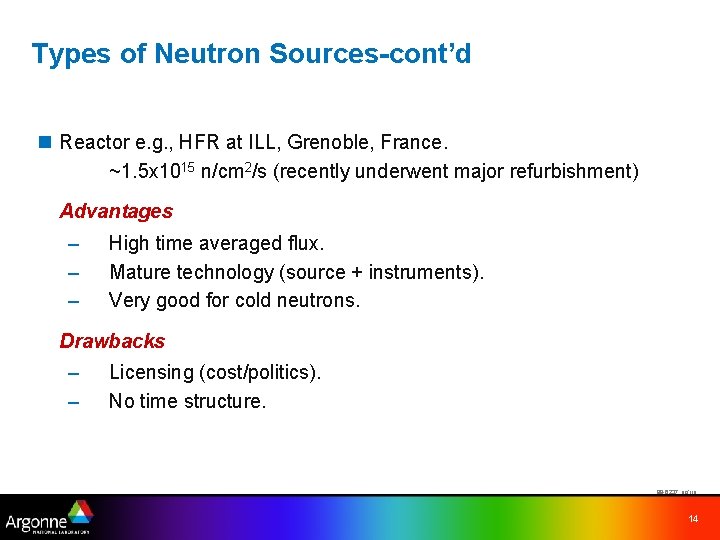
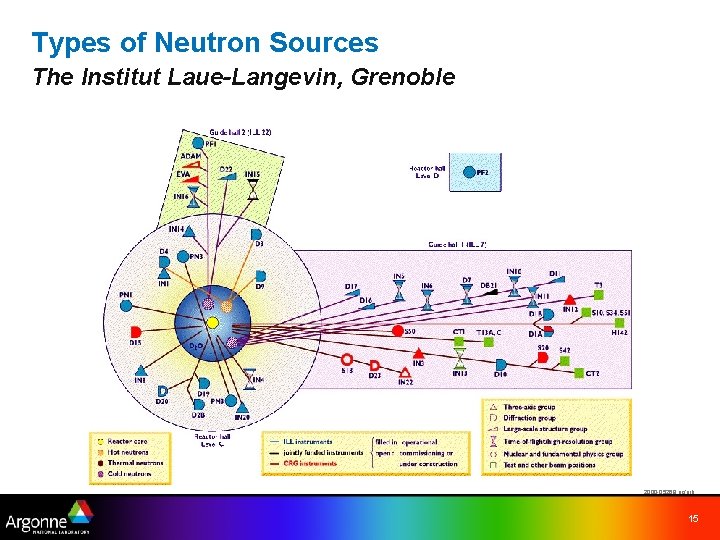
Types of Neutron Sources-cont’d n Reactor e. g. , HFR at ILL, Grenoble, France. ~1. 5 x 10¹⁵ n/cm 2/s (recently underwent major refurbishment) Advantages – – – High time averaged flux. Mature technology (source + instruments). Very good for cold neutrons. Drawbacks – – Licensing (cost/politics). No time structure. 98 -6237 uc/rra 14
Types of Neutron Sources The Institut Laue-Langevin, Grenoble 2000 -05269 uc/arb 15
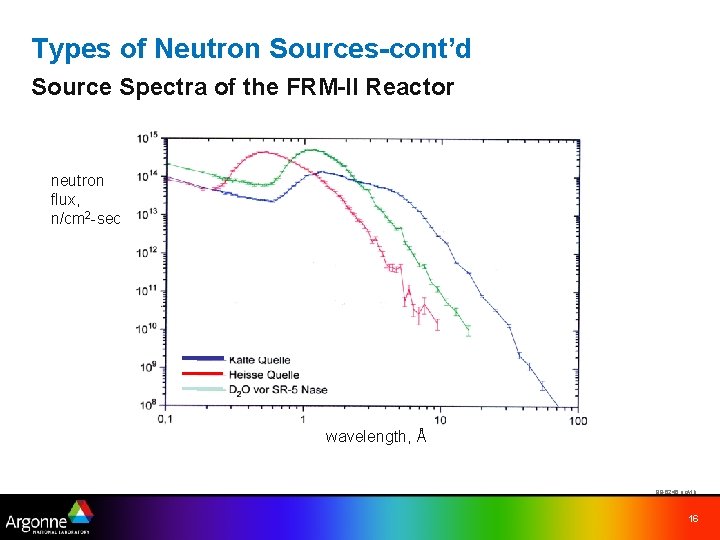
Types of Neutron Sources-cont’d Source Spectra of the FRM-II Reactor neutron flux, n/cm 2 -sec wavelength, Å 98 -6245 uc/vlb 16
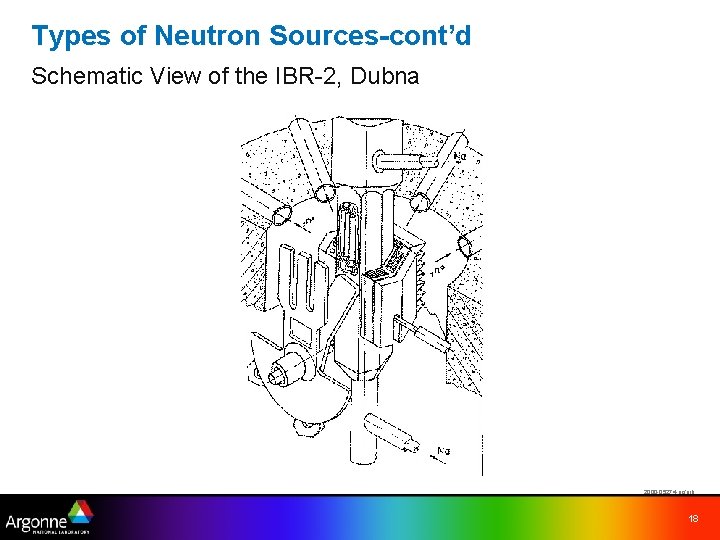
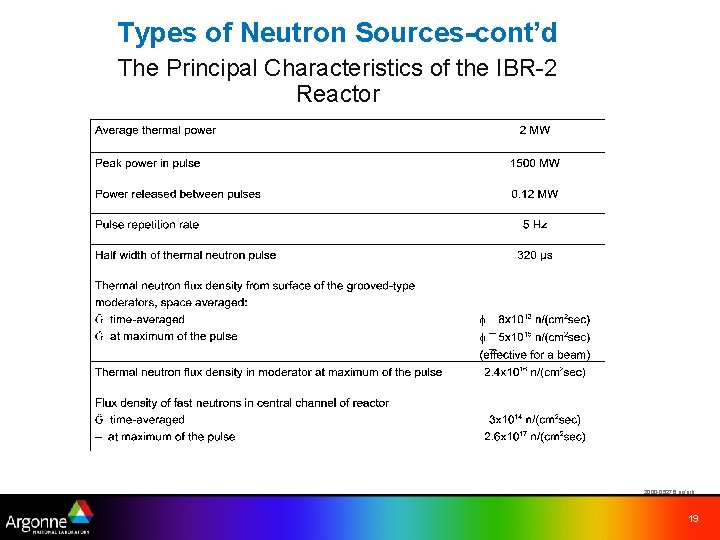
Types of Neutron Sources-cont’d n Pulsed reactor – Tried only in Russia. • IBR II Dubna. – 2 -5 Hz 1500 MW when on. Advantages – High peak flux. Drawbacks – – Time structure not optimal (frequency too low, pulses too long). Not licensable in the West. 98 -6238 uc/rra 17
Types of Neutron Sources-cont’d Schematic View of the IBR-2, Dubna 2000 -05274 uc/arb 18
Types of Neutron Sources-cont’d The Principal Characteristics of the IBR-2 Reactor 2000 -05276 uc/arb 19
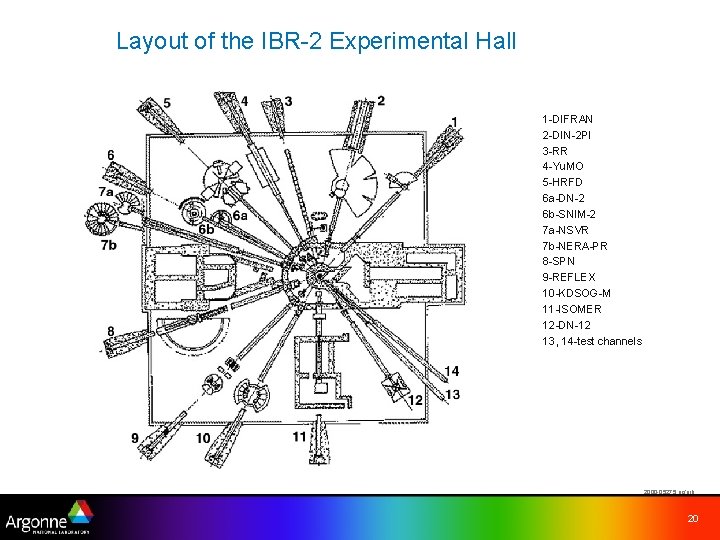
Layout of the IBR-2 Experimental Hall 1 -DIFRAN 2 -DIN-2 PI 3 -RR 4 -Yu. MO 5 -HRFD 6 a-DN-2 6 b-SNIM-2 7 a-NSVR 7 b-NERA-PR 8 -SPN 9 -REFLEX 10 -KDSOG-M 11 -ISOMER 12 -DN-12 13, 14 -test channels 2000 -05275 uc/arb 20
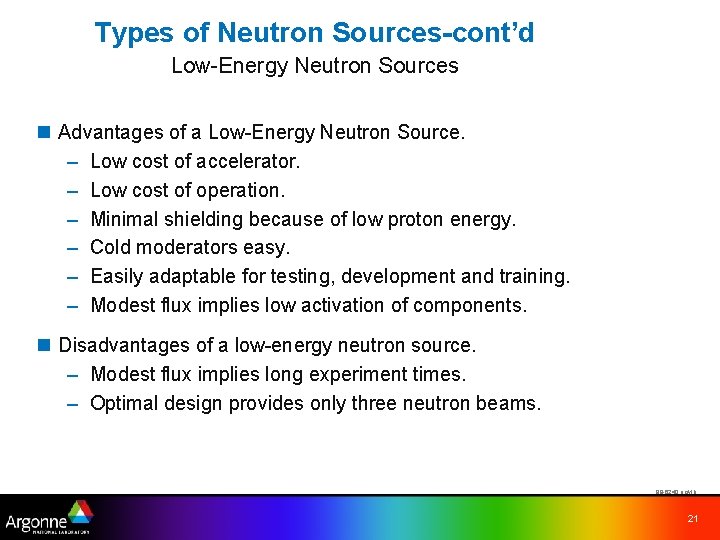
Types of Neutron Sources-cont’d Low-Energy Neutron Sources n Advantages of a Low-Energy Neutron Source. – Low cost of accelerator. – Low cost of operation. – Minimal shielding because of low proton energy. – Cold moderators easy. – Easily adaptable for testing, development and training. – Modest flux implies low activation of components. n Disadvantages of a low-energy neutron source. – Modest flux implies long experiment times. – Optimal design provides only three neutron beams. 98 -6240 uc/vlb 21
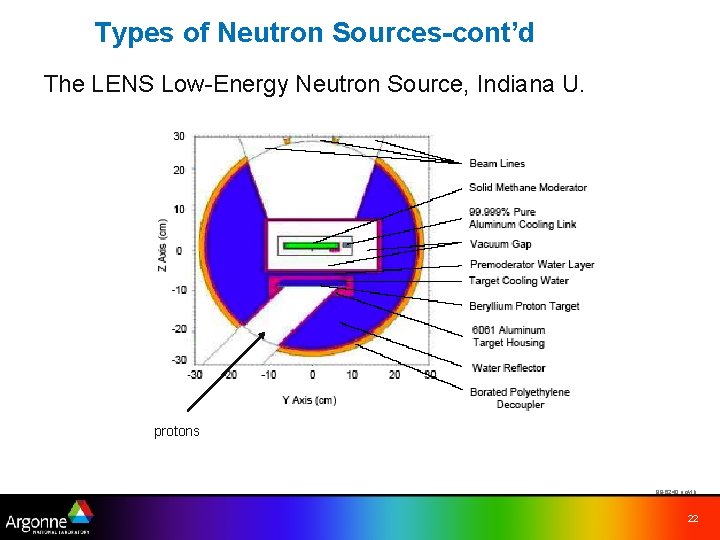
Types of Neutron Sources-cont’d The LENS Low-Energy Neutron Source, Indiana U. protons 98 -6240 uc/vlb 22
Low-Energy Neutron Sources Be(p, n) neutron spectra for different proton energies Global neutron yield for Be(p, n) neutrons Y(Ep) = 3. 42 x 108 (Ep - 1. 87)2. 05 n/milli. C 98 -6240 uc/vlb 23
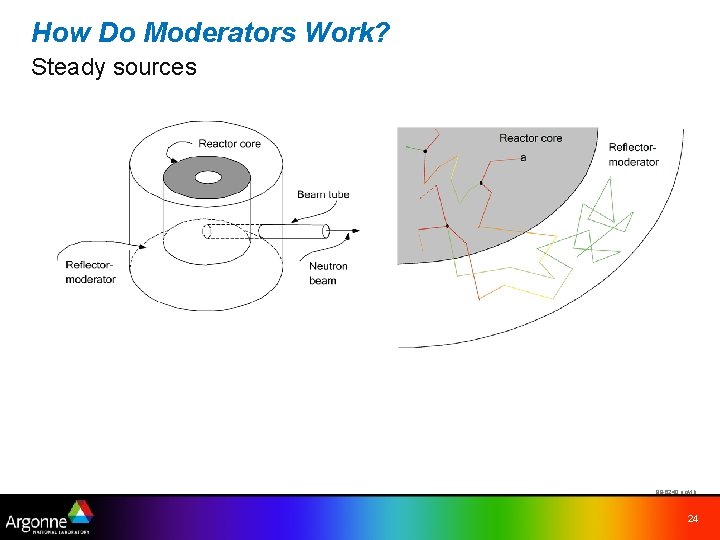
How Do Moderators Work? Steady sources 98 -6240 uc/vlb 24
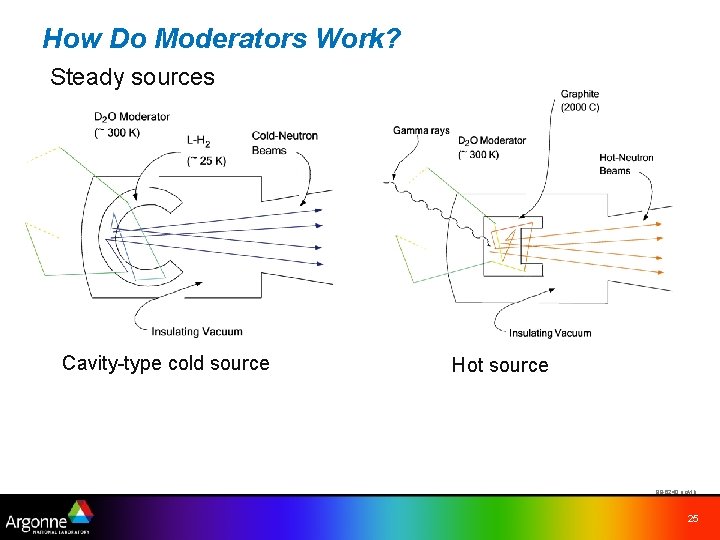
How Do Moderators Work? Steady sources Cavity-type cold source Hot source 98 -6240 uc/vlb 25
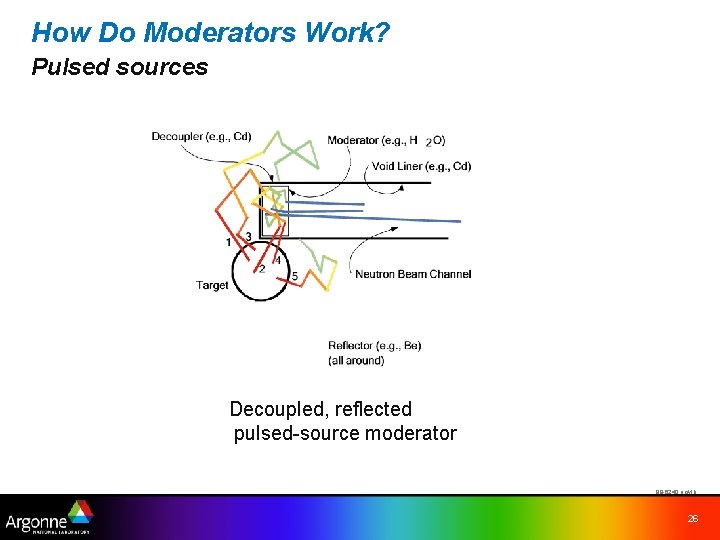
How Do Moderators Work? Pulsed sources Decoupled, reflected pulsed-source moderator 98 -6240 uc/vlb 26
Types of Neutron Sources-cont’d n Pulsed spallation sources e. g. , IPNS, ISIS, LANSCE, SNS. 200 µA, 0. 8 Ge. V, 160 k. W 1. 4 m. A, 1. 0 Ge. V, 1. 4 MW ISIS 2 x 10¹³ n/cm 2/s average flux SNS 8 x 10¹⁵ n/cm 2/s peak flux Advantages – High peak flux. – Advantageous time structure for many applications. – Accelerator based – politics simpler than reactors. – Technology rapidly evolving. Disadvantages – Low time averaged flux. – Not all applications exploit time structure. – Rapidly evolving technology. 98 -6235 uc/rra 27
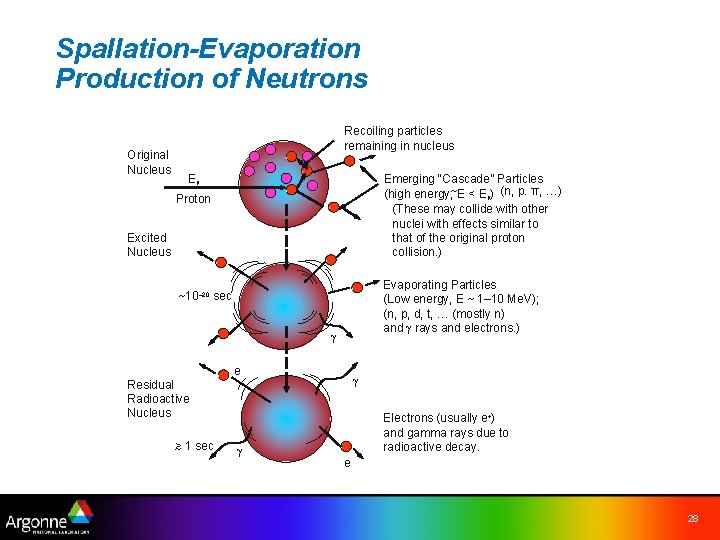
Spallation-Evaporation Production of Neutrons Original Nucleus Recoiling particles remaining in nucleus ‘ ‘ ‘ Ep Emerging “Cascade” Particles (high energy, ~E < Ep) (n, p. π, …) (These may collide with other nuclei with effects similar to that of the original proton collision. ) ‘ Proton ‘ Excited Nucleus ‘ ‘ ‘ ~10– 20 sec g ‘ Residual Radioactive Nucleus > 1 sec ~ ‘ e g Evaporating Particles (Low energy, E ~ 1– 10 Me. V); (n, p, d, t, … (mostly n) and g rays and electrons. ) g Electrons (usually e+) and gamma rays due to radioactive decay. ‘ e 28
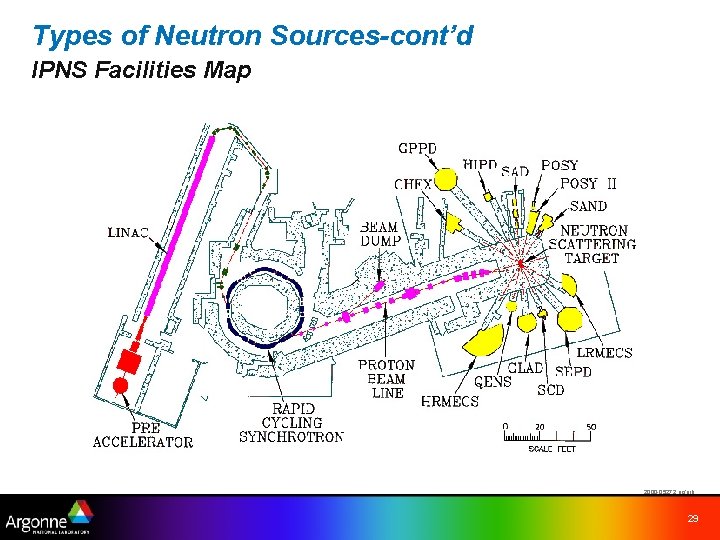
Types of Neutron Sources-cont’d IPNS Facilities Map 2000 -05272 uc/arb 29
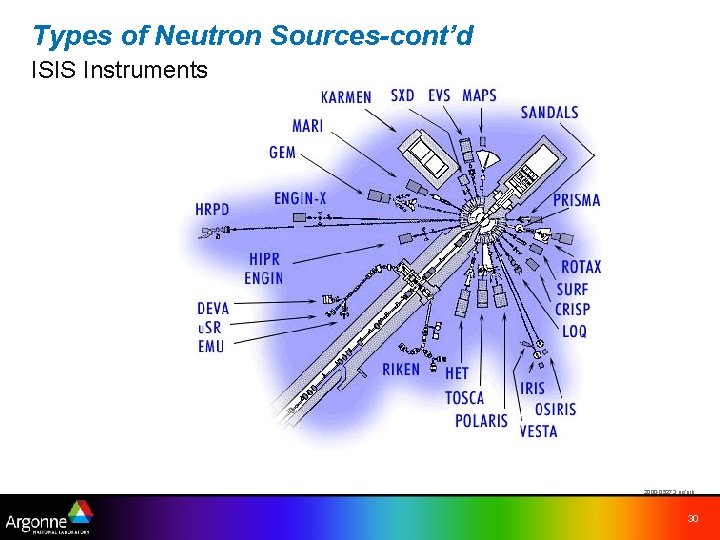
Types of Neutron Sources-cont’d ISIS Instruments 2000 -05273 uc/arb 30
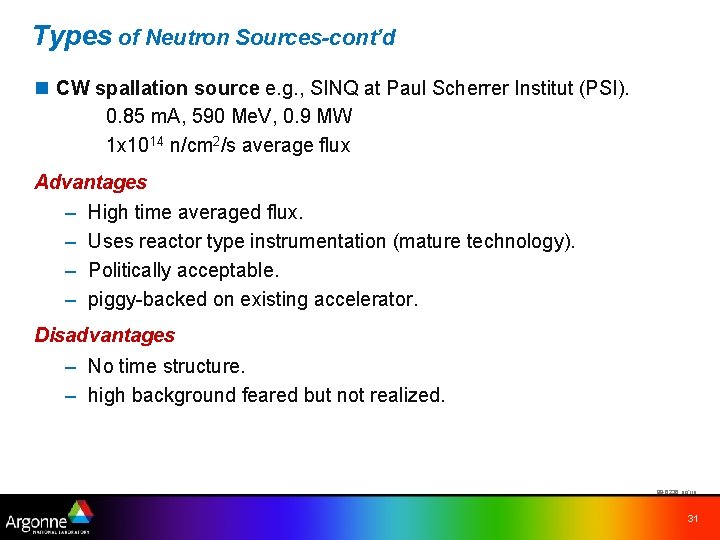
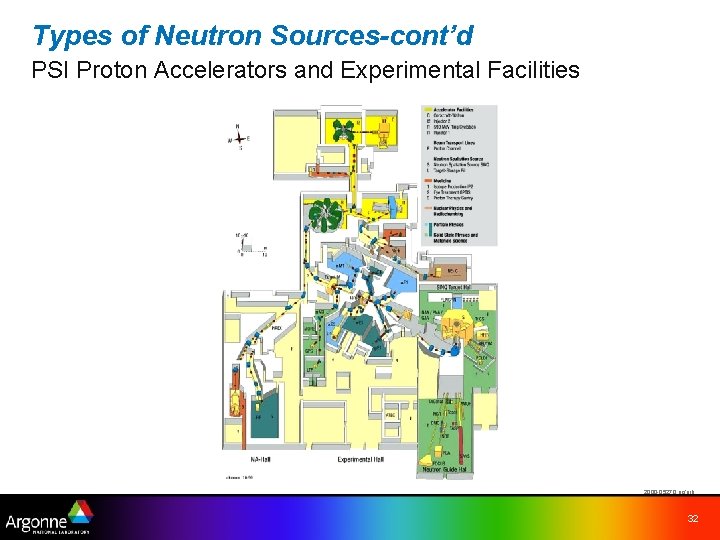
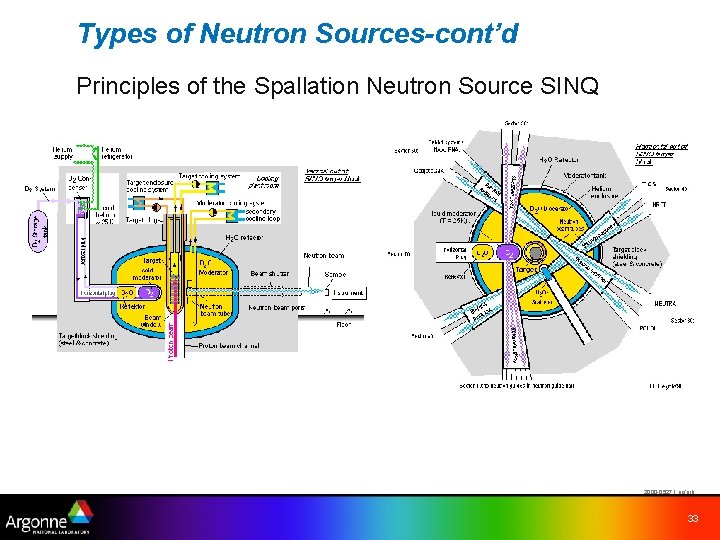
Types of Neutron Sources-cont’d n CW spallation source e. g. , SINQ at Paul Scherrer Institut (PSI). 0. 85 m. A, 590 Me. V, 0. 9 MW 1 x 10¹⁴ n/cm 2/s average flux Advantages – – High time averaged flux. Uses reactor type instrumentation (mature technology). Politically acceptable. piggy-backed on existing accelerator. Disadvantages – No time structure. – high background feared but not realized. 98 -6236 uc/rra 31
Types of Neutron Sources-cont’d PSI Proton Accelerators and Experimental Facilities 2000 -05270 uc/arb 32
Types of Neutron Sources-cont’d Principles of the Spallation Neutron Source SINQ 2000 -05271 uc/arb 33
Some History: The Materials Testing Accelerator n E. O. Lawrence conceived this project in the late 1940 s as a means to produce Pu-239 and tritium and, later, U-233. Despite its name, MTA was never intended for materials research. n Work went on at the site of the present Lawrence Livermore Laboratory, where scientists accomplished substantial high-power accelerator developments. Efforts continued until 1955 when intense exploration efforts revealed large uranium ore reserves in the U. S. and the project terminated. By that time the pre-accelerator had delivered CW proton currents of 100 m. A and 30 m. A of deuterons. The work was declassified in 1957. 2000 -05265 uc/arb 34
History The Materials Testing Accelerator: Machine Parameters n There was already by that time some information on the production of spallation neutrons by 190 -Me. V deuteron-induced spallation on Uranium, about 30% more than by protons of the same energy. This guided the choice of accelerated particle type and beam energy. With the anticipated required production rate, the parameters of the accelerator were set: – Deuterons. – Particle energy – 500 Me. V. – CW operation – 320 m. A (beam power 160 MW). 2000 -05266 uc/arb 35
The Materials Testing Accelerator: Target n Original ideas concerned a Uranium target. n Subsequent development led to target systems alternatives including moderated subcritical lattices (k < 0. 9). n Finally the chosen target system consisted of a Na. K-cooled Beryllium primary target, and depleted Uranium secondary target for neutron multiplication, within a water-cooled depleted Uranium lattice for breeding Plutonium. 2000 -05267 uc/arb 36
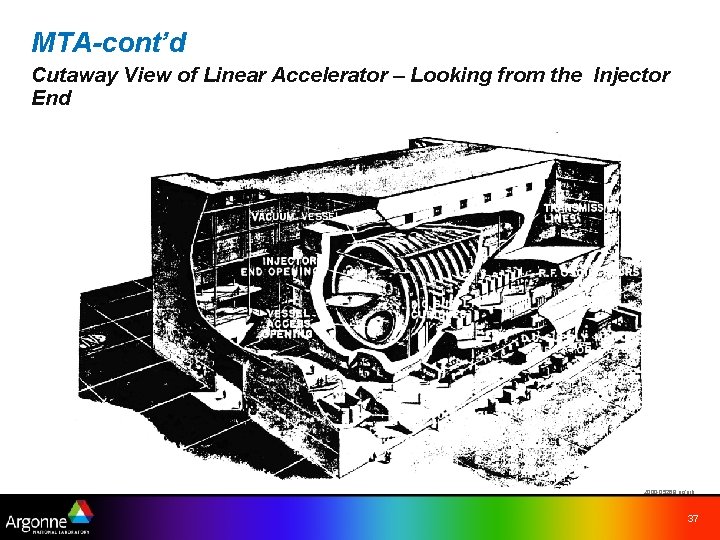
MTA-cont’d Cutaway View of Linear Accelerator – Looking from the Injector End 2000 -05268 uc/arb 37
More History: The Intense Neutron Generator (ING) n 1952—W. B. Lewis promotes spallation and accelerators for neutron production. n 1960 s at CRNL— 65 m. A CW protons to 1 Ge. V. – Accelerator development. – Pb-Bi loops. – Experimental facilities and design. – Cockcroft-Walton limitation – 35 m. A CW at 750 ke. V. n Led to Accelerator Breeder program in 1970 s. – ZEBRA in 1980 s. 2000 -05263 uc/arb 38
The ING Project n The Chalk River Laboratory of Atomic Energy of Canada Ltd launched the Intense Neutron Generator (ING) Project in 1964. The goal was a “versatile machine” providing a high neutron flux for isotope production and neutron beam experiments. Work continued until late 1968 when the project was cancelled due to the perceived high costs and insufficient political support in the Canadian scientific community. ING was estimated to cost about $150 M to build and about $20 M/yr to operate. n Technical developments that resulted from the ING project were significant, even seminal. 2000 -05257 uc/arb 39
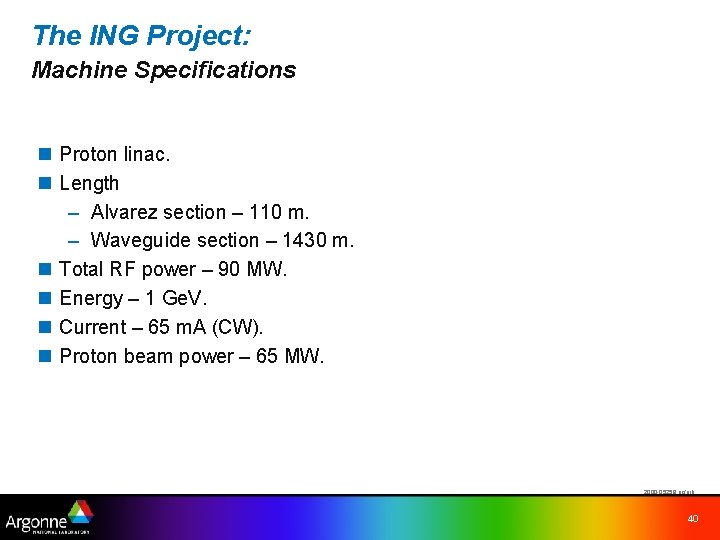
The ING Project: Machine Specifications n Proton linac. n Length – Alvarez section – 110 m. – Waveguide section – 1430 m. n Total RF power – 90 MW. n Energy – 1 Ge. V. n Current – 65 m. A (CW). n Proton beam power – 65 MW. 2000 -05258 uc/arb 40
ING: Perspective View 2000 -05259 uc/arb 41
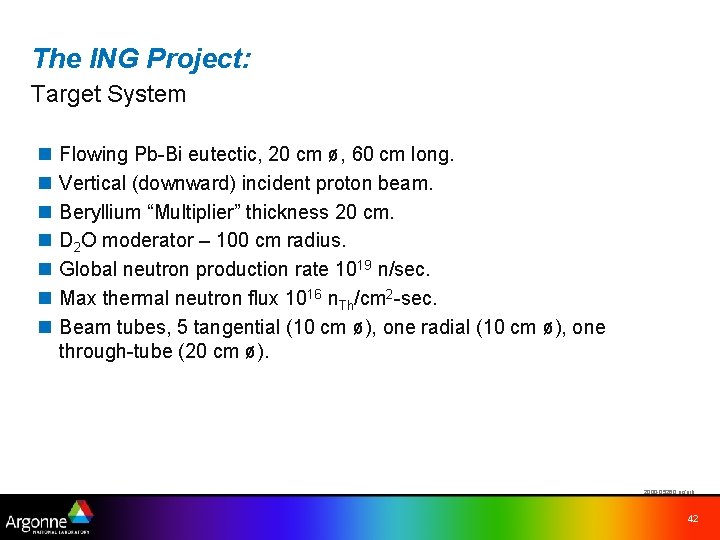
The ING Project: Target System n n n n Flowing Pb-Bi eutectic, 20 cm ø, 60 cm long. Vertical (downward) incident proton beam. Beryllium “Multiplier” thickness 20 cm. D 2 O moderator – 100 cm radius. Global neutron production rate 1019 n/sec. Max thermal neutron flux 1016 n. Th/cm 2 -sec. Beam tubes, 5 tangential (10 cm ø), one radial (10 cm ø), one through-tube (20 cm ø). 2000 -05260 uc/arb 42
ING: Lead-bismuth Eutectic Flow in the Target 2000 -05262 uc/arb 43
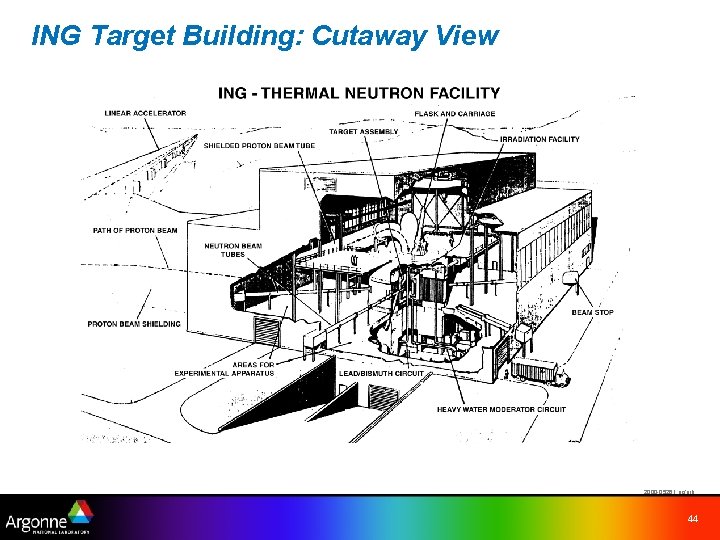
ING Target Building: Cutaway View 2000 -05261 uc/arb 44
Earliest Pulsed Spallation Neutron Sources Primary source pulse widths of all are less than 0. 5 µsec 2000 -05277 uc/arb 45
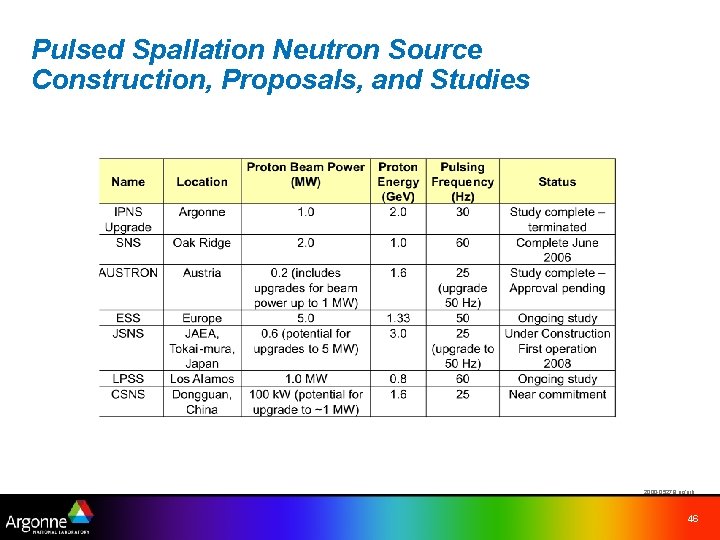
Pulsed Spallation Neutron Source Construction, Proposals, and Studies 2000 -05278 uc/arb 46
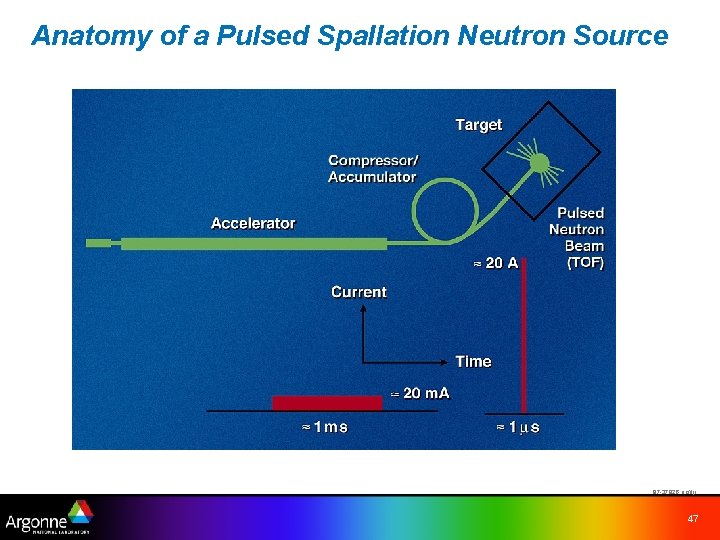
Anatomy of a Pulsed Spallation Neutron Source 97 -3792 B uc/djr 47
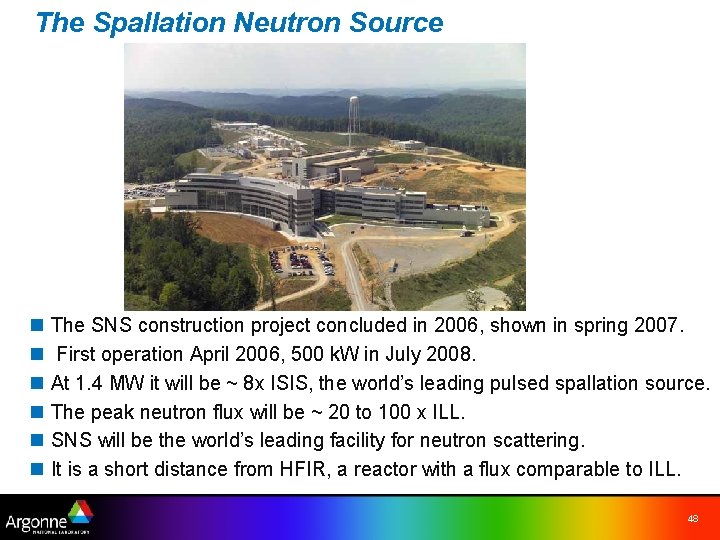
The Spallation Neutron Source n n n The SNS construction project concluded in 2006, shown in spring 2007. First operation April 2006, 500 k. W in July 2008. At 1. 4 MW it will be ~ 8 x ISIS, the world’s leading pulsed spallation source. The peak neutron flux will be ~ 20 to 100 x ILL. SNS will be the world’s leading facility for neutron scattering. It is a short distance from HFIR, a reactor with a flux comparable to ILL. 48
SNS - Guiding Principles n SNS will provide high-availability, high-reliability operation of the world’s most powerful pulsed neutron source. n It will operate as a User Facility to support peer reviewed research on a best-in -class suite of instruments. – Research conducted at SNS will be at the forefront of biology, chemistry, physics, materials science and engineering. n SNS will have the capability to advance the state of the art in spallation neutron source technology, including the following: – R&D in accelerators, target, and instruments to keep SNS at the forefront of neutron scattering facilities. – Planned enhancement of SNS performance through upgrades of the complex (accelerator power upgrade and second target station). – Ongoing instrument development as part of the normal operating life of the facility. 49
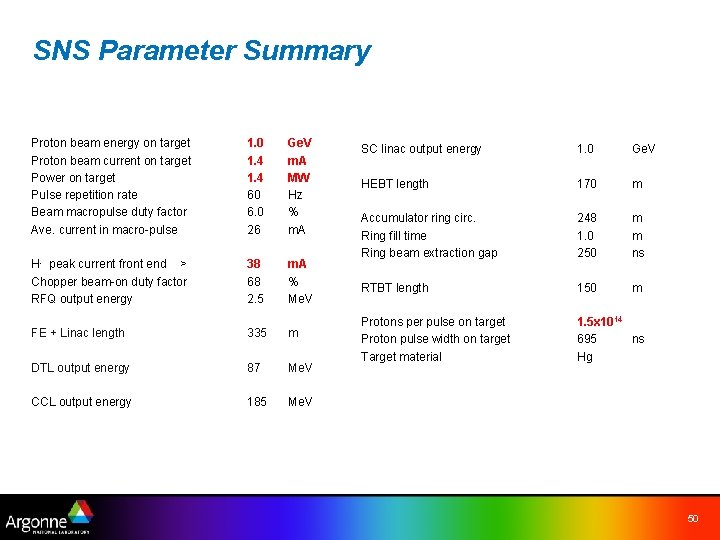
SNS Parameter Summary Proton beam energy on target Proton beam current on target Power on target Pulse repetition rate Beam macropulse duty factor Ave. current in macro-pulse 1. 0 1. 4 60 6. 0 26 Ge. V m. A MW Hz % m. A H- peak current front end > Chopper beam-on duty factor RFQ output energy 38 68 2. 5 m. A % Me. V FE + Linac length 335 m DTL output energy 87 Me. V CCL output energy 185 Me. V SC linac output energy 1. 0 Ge. V HEBT length 170 m Accumulator ring circ. Ring fill time Ring beam extraction gap 248 1. 0 250 m m ns RTBT length 150 m Protons per pulse on target Proton pulse width on target Target material 1. 5 x 10¹⁴ 695 ns Hg 50
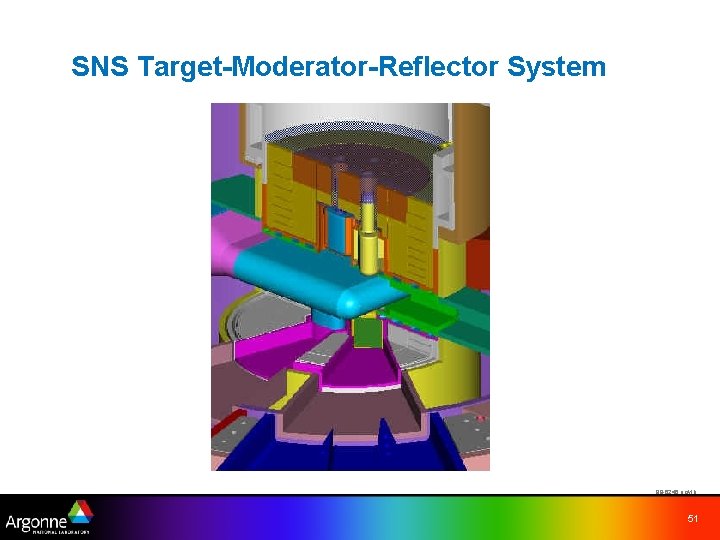
SNS Target-Moderator-Reflector System 98 -6245 uc/vlb 51
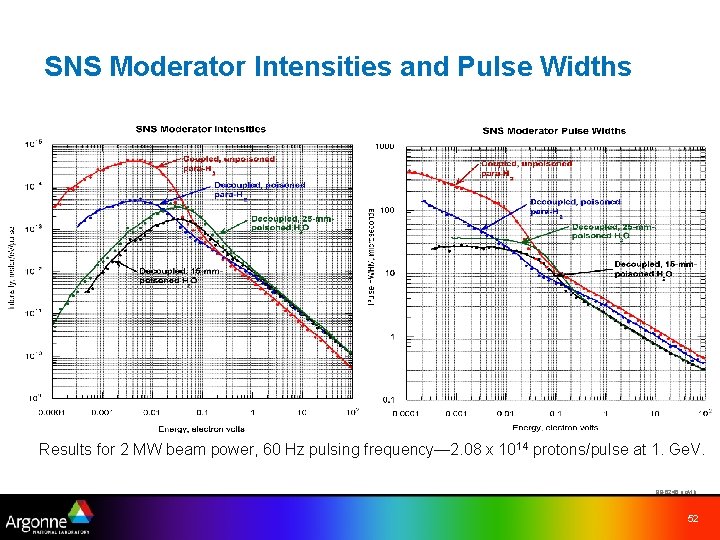
SNS Moderator Intensities and Pulse Widths Results for 2 MW beam power, 60 Hz pulsing frequency— 2. 08 x 1014 protons/pulse at 1. Ge. V. 98 -6245 uc/vlb 52
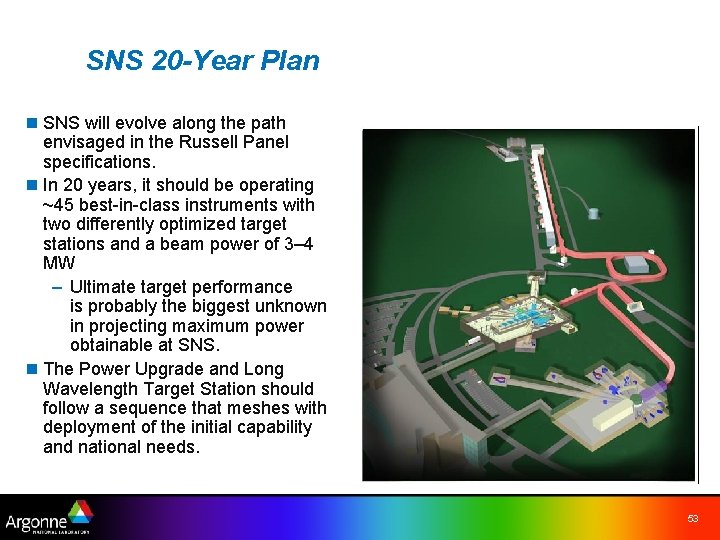
SNS 20 -Year Plan n SNS will evolve along the path envisaged in the Russell Panel specifications. n In 20 years, it should be operating ~45 best-in-class instruments with two differently optimized target stations and a beam power of 3– 4 MW – Ultimate target performance is probably the biggest unknown in projecting maximum power obtainable at SNS. n The Power Upgrade and Long Wavelength Target Station should follow a sequence that meshes with deployment of the initial capability and national needs. 53
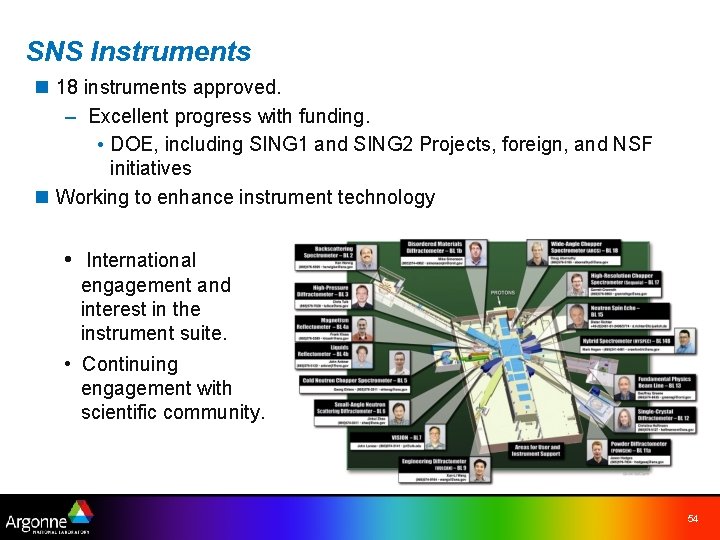
SNS Instruments n 18 instruments approved. – Excellent progress with funding. • DOE, including SING 1 and SING 2 Projects, foreign, and NSF initiatives n Working to enhance instrument technology • International engagement and interest in the instrument suite. • Continuing engagement with scientific community. 54
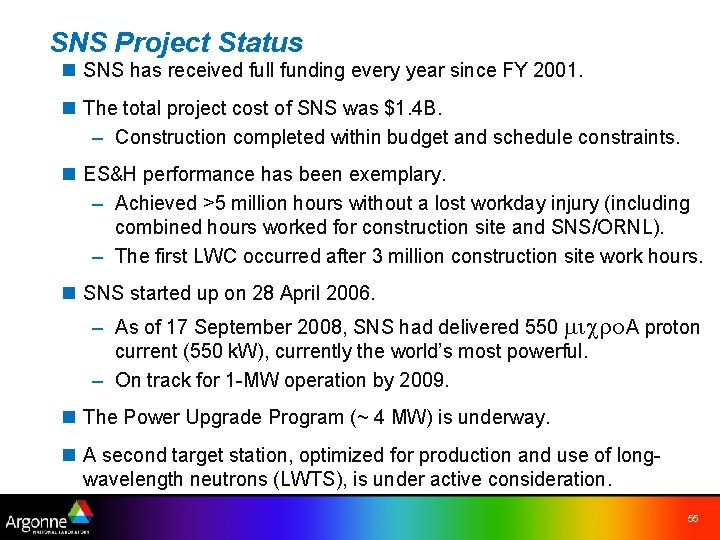
SNS Project Status n SNS has received full funding every year since FY 2001. n The total project cost of SNS was $1. 4 B. – Construction completed within budget and schedule constraints. n ES&H performance has been exemplary. – Achieved >5 million hours without a lost workday injury (including combined hours worked for construction site and SNS/ORNL). – The first LWC occurred after 3 million construction site work hours. n SNS started up on 28 April 2006. – As of 17 September 2008, SNS had delivered 550 micro. A proton current (550 k. W), currently the world’s most powerful. – On track for 1 -MW operation by 2009. n The Power Upgrade Program (~ 4 MW) is underway. n A second target station, optimized for production and use of longwavelength neutrons (LWTS), is under active consideration. 55
End of Presentation Thank you! 56