
Neutron scattering in condensed matter research 20 years
![Magnetic off-specular neutron scattering from (001) [Cr(12Å)/57 Fe(68Å)]x 12 /Al 2 O 3 multilayer](https://slidetodoc.com/presentation_image_h/13a74429c928612a9ed4a8be136408f2/image-15.jpg "Magnetic off-specular neutron scattering from (001) [Cr(12Å)/57 Fe(68Å)]x 12 /Al 2 O 3 multilayer")

- Slides: 42
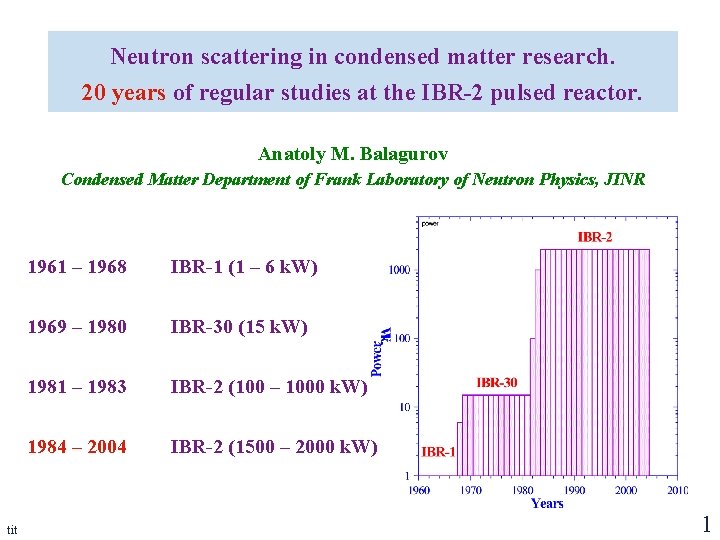
Neutron scattering in condensed matter research. 20 years of regular studies at the IBR-2 pulsed reactor. Anatoly M. Balagurov Condensed Matter Department of Frank Laboratory of Neutron Physics, JINR tit 1961 – 1968 IBR-1 (1 – 6 k. W) 1969 – 1980 IBR-30 (15 k. W) 1981 – 1983 IBR-2 (100 – 1000 k. W) 1984 – 2004 IBR-2 (1500 – 2000 k. W) 1
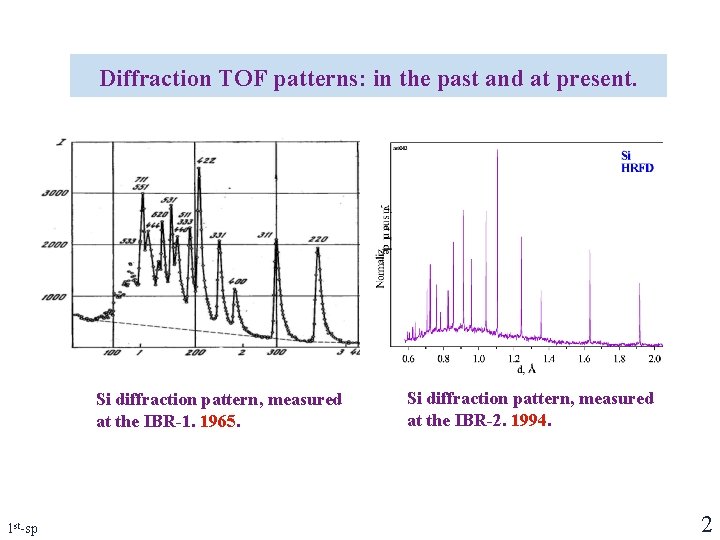
Diffraction TOF patterns: in the past and at present. Si diffraction pattern, measured at the IBR-1. 1965. 1 st-sp Si diffraction pattern, measured at the IBR-2. 1994. 2
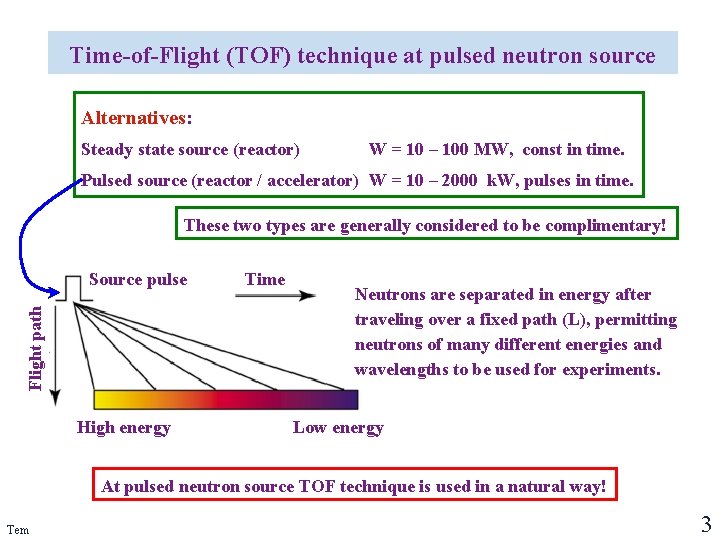
Time-of-Flight (TOF) technique at pulsed neutron source Alternatives: Steady state source (reactor) W = 10 – 100 MW, const in time. Pulsed source (reactor / accelerator) W = 10 – 2000 k. W, pulses in time. These two types are generally considered to be complimentary! Flight path Source pulse High energy Time Neutrons are separated in energy after traveling over a fixed path (L), permitting neutrons of many different energies and wavelengths to be used for experiments. Low energy At pulsed neutron source TOF technique is used in a natural way! Tem 3
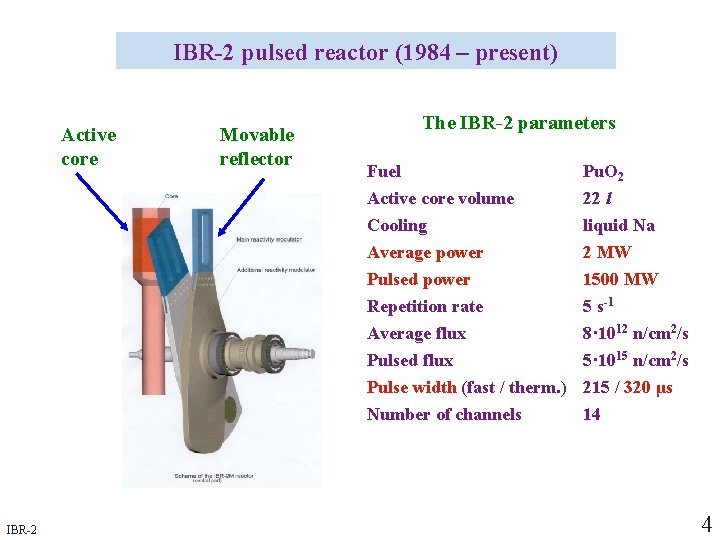
IBR-2 pulsed reactor (1984 – present) Active core IBR-2 Movable reflector The IBR-2 parameters Fuel Active core volume Cooling Average power Pu. O 2 22 l liquid Na 2 МW Pulsed power Repetition rate Average flux Pulsed flux Pulse width (fast / therm. ) Number of channels 1500 MW 5 s-1 8· 1012 n/cm 2/s 5· 1015 n/сm 2/s 215 / 320 μs 14 4
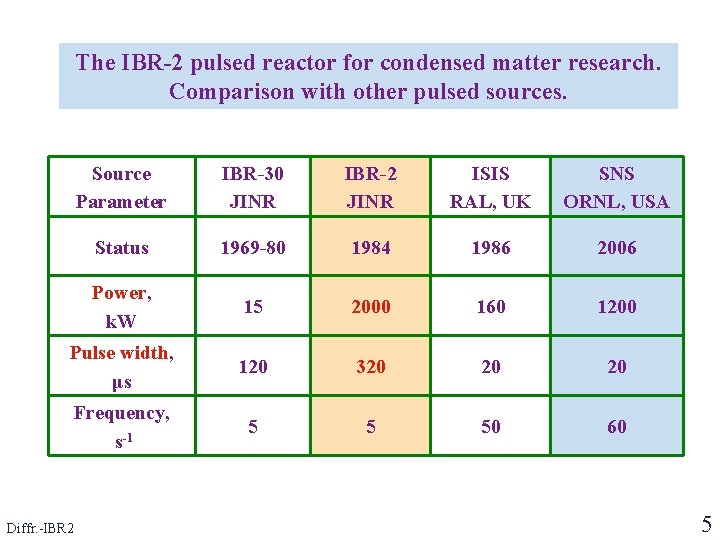
The IBR-2 pulsed reactor for condensed matter research. Comparison with other pulsed sources. Source Parameter IBR-30 JINR IBR-2 JINR ISIS RAL, UK SNS ORNL, USA Status 1969 -80 1984 1986 2006 Power, k. W 15 2000 160 1200 Pulse width, μs 120 320 20 20 Frequency, s-1 5 5 50 60 Diffr. -IBR 2 5
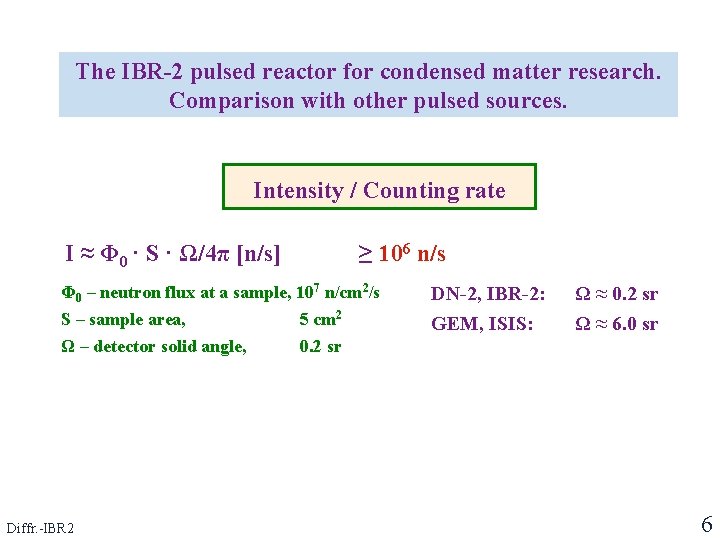
The IBR-2 pulsed reactor for condensed matter research. Comparison with other pulsed sources. Intensity / Counting rate I ≈ Φ 0 · S · Ω/4π [n/s] ≥ 106 n/s Φ 0 – neutron flux at a sample, 107 n/cm 2/s S – sample area, 5 cm 2 Ω – detector solid angle, 0. 2 sr Diffr. -IBR 2 DN-2, IBR-2: GEM, ISIS: Ω ≈ 0. 2 sr Ω ≈ 6. 0 sr 6
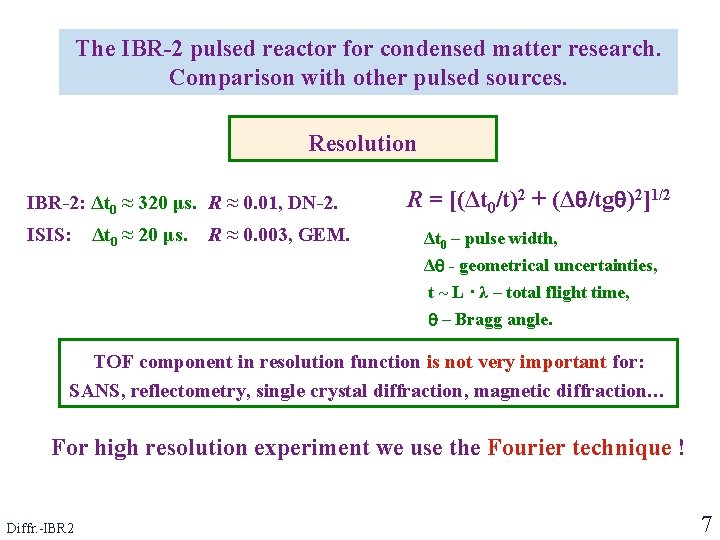
The IBR-2 pulsed reactor for condensed matter research. Comparison with other pulsed sources. Resolution IBR-2: Δt 0 ≈ 320 μs. R ≈ 0. 01, DN-2. ISIS: Δt 0 ≈ 20 μs. R ≈ 0. 003, GEM. R = [(Δt 0/t)2 + (Δ /tg )2]1/2 Δt 0 – pulse width, Δ - geometrical uncertainties, t ~ L · λ – total flight time, – Bragg angle. TOF component in resolution function is not very important for: SANS, reflectometry, single crystal diffraction, magnetic diffraction… For high resolution experiment we use the Fourier technique ! Diffr. -IBR 2 7
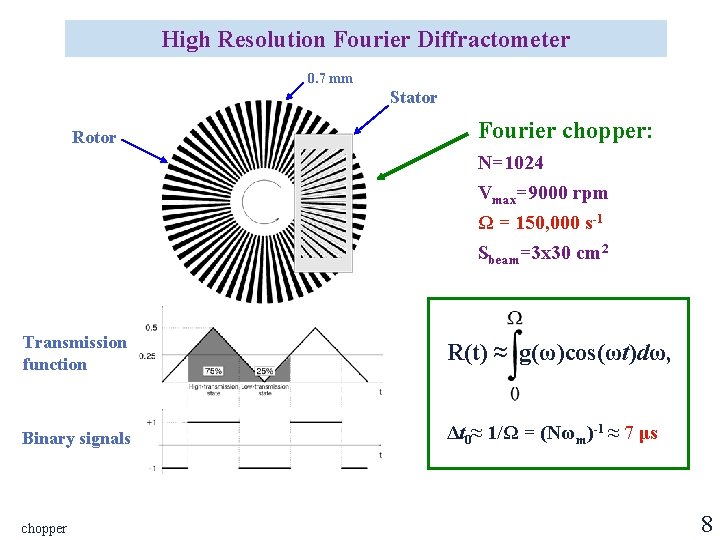
High Resolution Fourier Diffractometer 0. 7 mm Stator Rotor Fourier chopper: N=1024 Vmax=9000 rpm Ω = 150, 000 s-1 Sbeam=3 x 30 cm 2 Transmission function R(t) ≈ g(ω)cos(ωt)dω, ) Binary signals Δt 0≈ 1/Ω = (Nωm)-1 ≈ 7 μs chopper 8
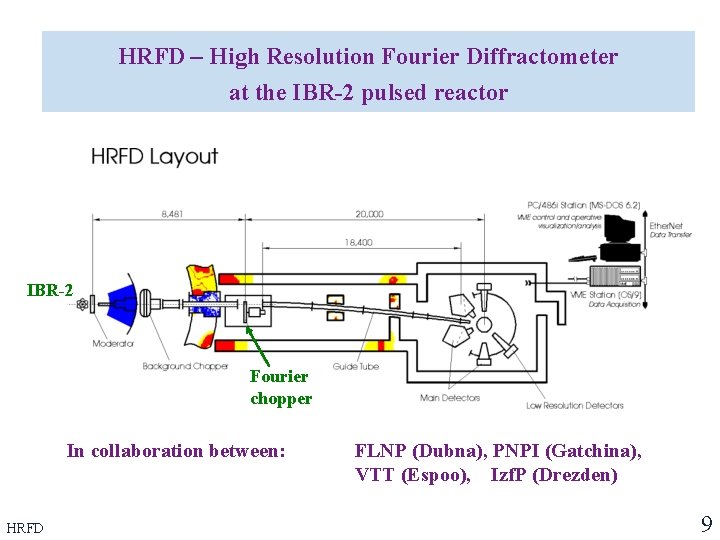
HRFD – High Resolution Fourier Diffractometer at the IBR-2 pulsed reactor IBR-2 Fourier chopper In collaboration between: HRFD FLNP (Dubna), PNPI (Gatchina), VTT (Espoo), Izf. P (Drezden) 9
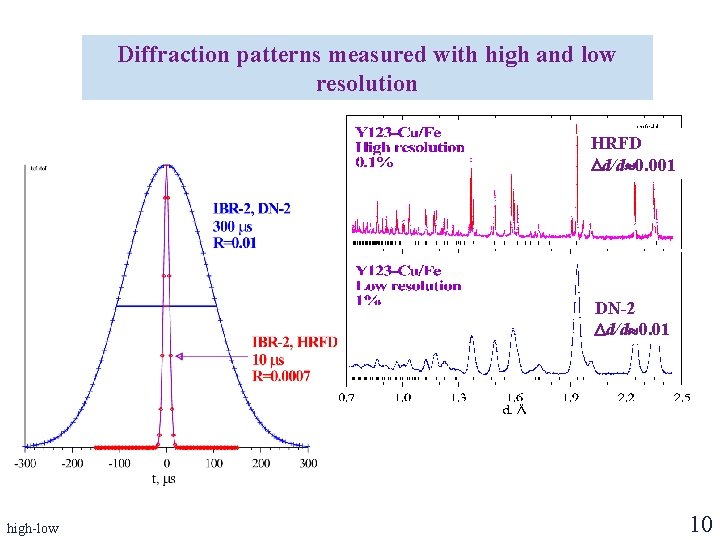
Diffraction patterns measured with high and low resolution HRFD d/d 0. 001 DN-2 d/d 0. 01 high-low 10
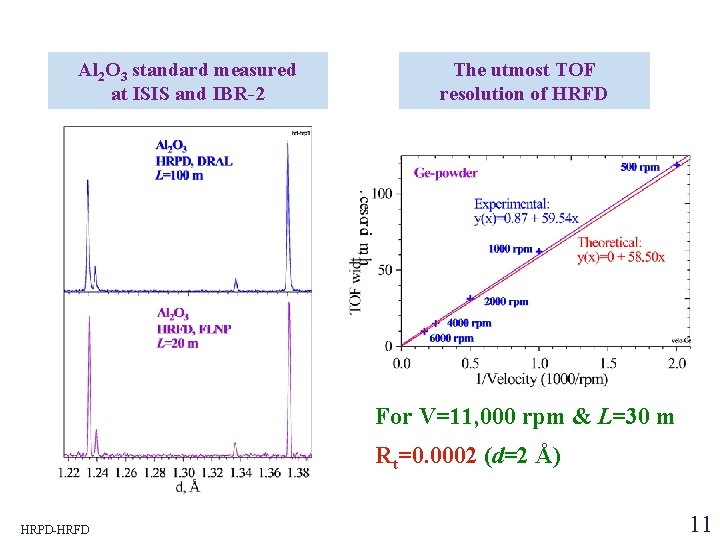
Al 2 O 3 standard measured at ISIS and IBR-2 The utmost TOF resolution of HRFD For V=11, 000 rpm & L=30 m Rt=0. 0002 (d=2 Å) HRPD-HRFD 11
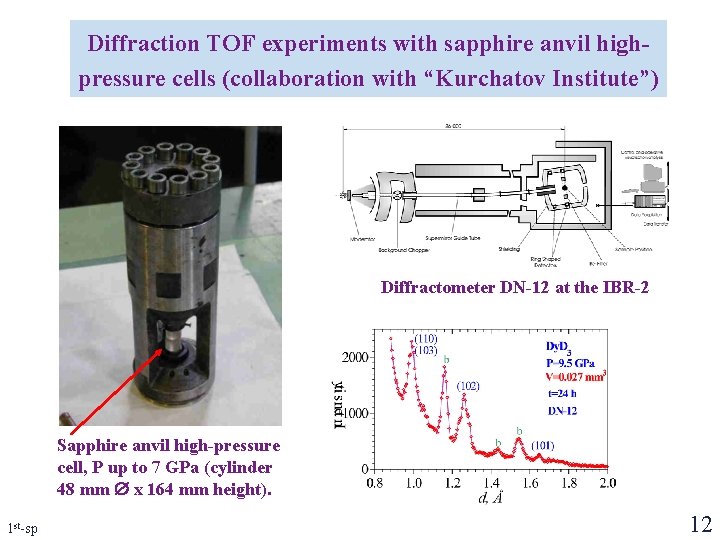
Diffraction TOF experiments with sapphire anvil highpressure cells (collaboration with “Kurchatov Institute”) Diffractometer DN-12 at the IBR-2 Sapphire anvil high-pressure cell, Р up to 7 GPa (cylinder 48 mm x 164 mm height). 1 st-sp 12
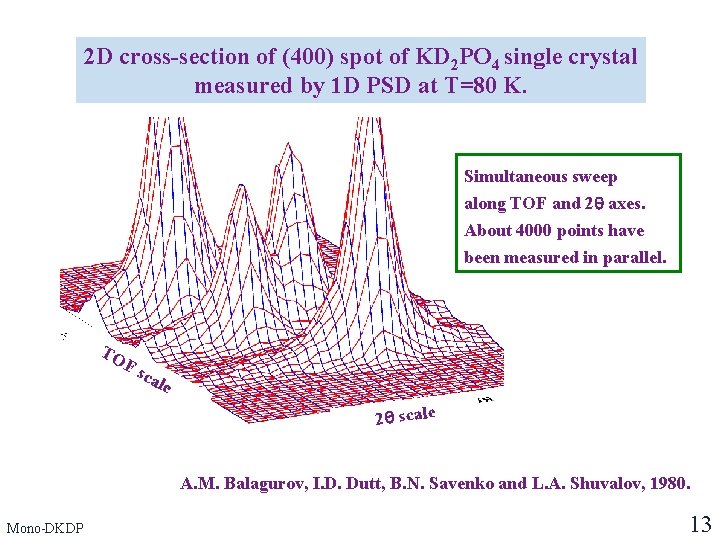
2 D cross-section of (400) spot of KD 2 PO 4 single crystal measured by 1 D PSD at T=80 K. Simultaneous sweep along TOF and 2 axes. About 4000 points have been measured in parallel. TO F s cal e 2 scale А. M. Balagurov, I. D. Dutt, B. N. Savenko and L. A. Shuvalov, 1980. Mono-DKDP 13
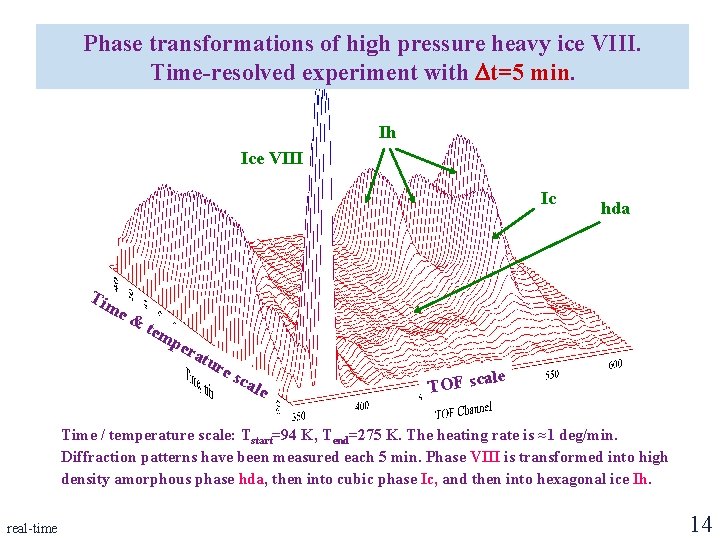
Phase transformations of high pressure heavy ice VIII. Time-resolved experiment with t=5 min. Ih Ice VIII Ic Tim hda e & tem per atu re s cal e le TOF sca Time / temperature scale: Tstart=94 K, Tend=275 K. The heating rate is ≈1 deg/min. Diffraction patterns have been measured each 5 min. Phase VIII is transformed into high density amorphous phase hda, then into cubic phase Ic, and then into hexagonal ice Ih. real-time 14
Magnetic off-specular neutron scattering from (001) [Cr(12Å)/57 Fe(68Å)]x 12 /Al 2 O 3 multilayer Intensity map of specular and offspecular scattered neutrons from the Fe/Cr multilayer (SPN data). Neutron wavelength, Å Result of the supermatrix calculations with the model of non-collinear domains. Neutron wavelength, Å V. Lauter-Pasyuk, H. Lauter, B. Toperverg et al. , 1999. spn 15
State Prize of the Russian Federation in 2000 Development and realization of new methods in time-of-flight neutron diffraction studies at pulsed and steady state nuclear reactors prem FLNP, JINR PNPI RAS, Gatchina RRC KI, Moscow Victor L. Aksenov Valery A. Kudryashev Victor P. Glazkov Anatoly M. Balagurov Vladimir V. Nietz Yuri M. Ostanevich Vitaly A. Trounov Victor A. Somenkov 16
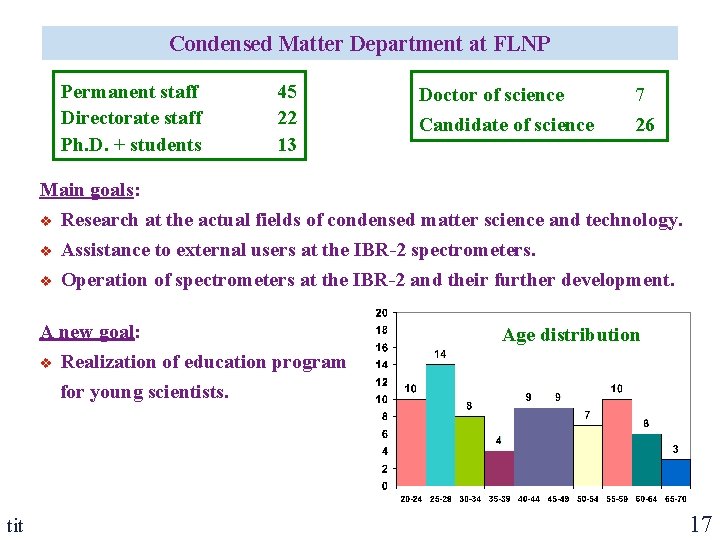
Condensed Matter Department at FLNP Permanent staff Directorate staff Ph. D. + students 45 22 13 Doctor of science Candidate of science 7 26 Main goals: v Research at the actual fields of condensed matter science and technology. v Assistance to external users at the IBR-2 spectrometers. v Operation of spectrometers at the IBR-2 and their further development. A new goal: v Realization of education program for young scientists. tit Age distribution 17
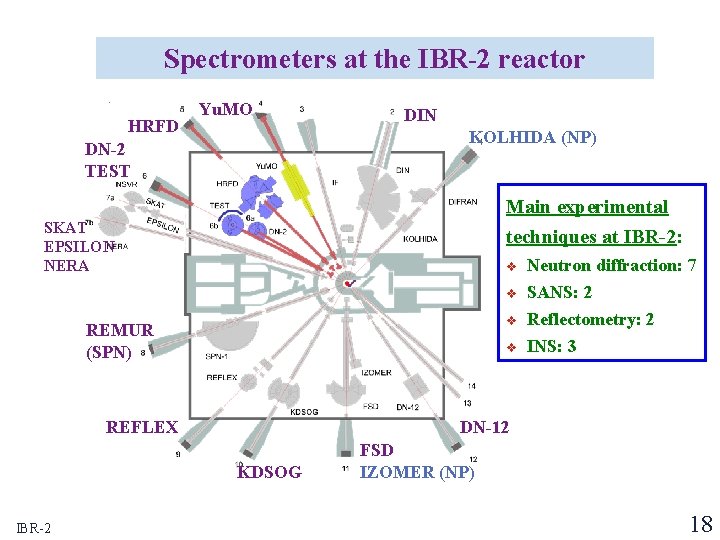
Spectrometers at the IBR-2 reactor HRFD Yu. MO DIN KOLHIDA (NP) DN-2 TEST Main experimental techniques at IBR-2: SKAT EPSILON NERA v v v REMUR (SPN) v REFLEX DN-12 KDSOG IBR-2 Neutron diffraction: 7 SANS: 2 Reflectometry: 2 INS: 3 FSD IZOMER (NP) 18
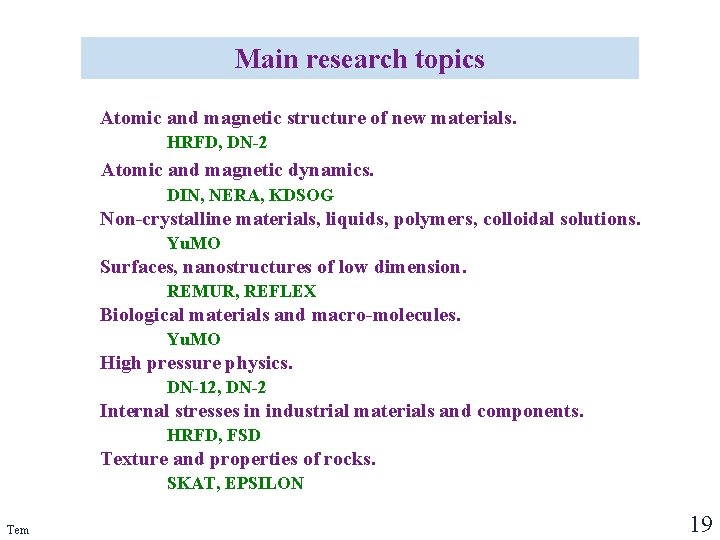
Main research topics Atomic and magnetic structure of new materials. HRFD, DN-2 Atomic and magnetic dynamics. DIN, NERA, KDSOG Non-crystalline materials, liquids, polymers, colloidal solutions. Yu. MO Surfaces, nanostructures of low dimension. REMUR, REFLEX Biological materials and macro-molecules. Yu. MO High pressure physics. DN-12, DN-2 Internal stresses in industrial materials and components. HRFD, FSD Texture and properties of rocks. SKAT, EPSILON Tem 19
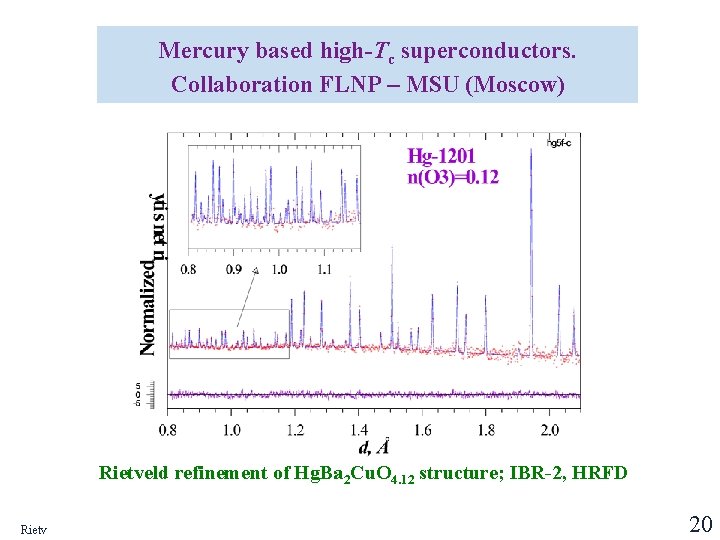
Mercury based high-Tc superconductors. Collaboration FLNP – MSU (Moscow) Rietveld refinement of Hg. Ba 2 Cu. O 4. 12 structure; IBR-2, HRFD Rietv 20
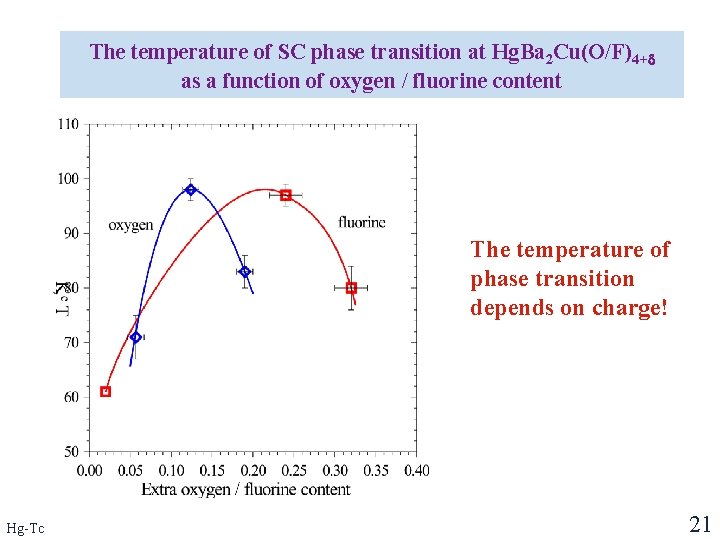
The temperature of SC phase transition at Hg. Ba 2 Cu(O/F)4+ as a function of oxygen / fluorine content Тhe temperature of phase transition depends on charge! Hg-Tc 21
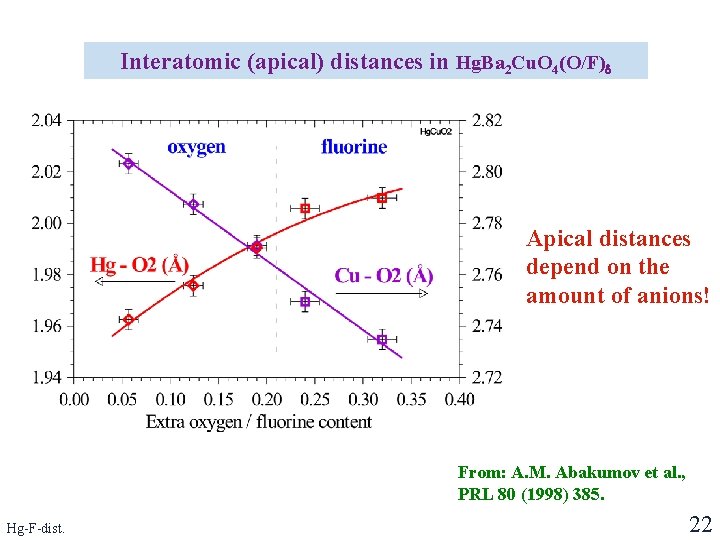
Interatomic (apical) distances in Hg. Ba 2 Cu. O 4(O/F) Apical distances depend on the amount of anions! From: A. M. Abakumov et al. , PRL 80 (1998) 385. Hg-F-dist. 22
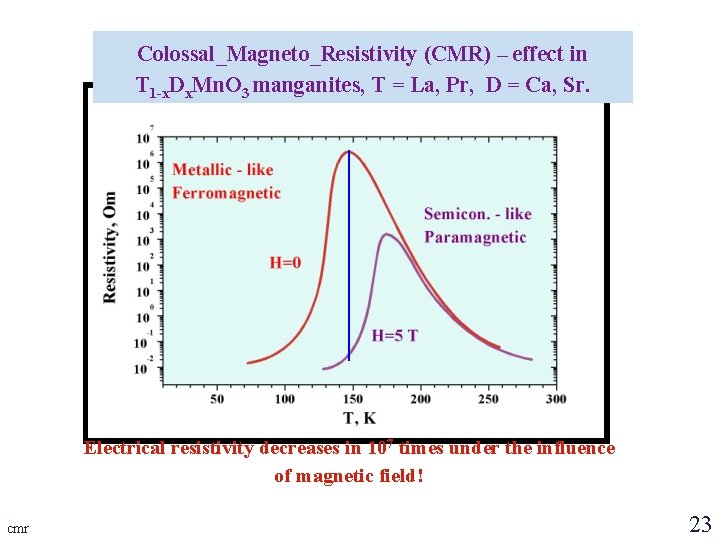
Colossal_Magneto_Resistivity (CMR) – effect in T 1 -x. Dx. Mn. O 3 manganites, T = La, Pr, D = Ca, Sr. Electrical resistivity decreases in 107 times under the influence of magnetic field! cmr 23
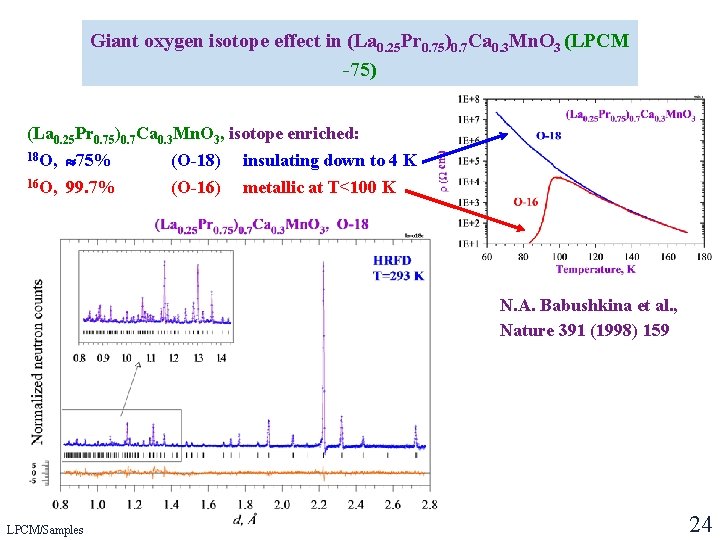
Giant oxygen isotope effect in (La 0. 25 Pr 0. 75)0. 7 Ca 0. 3 Mn. O 3 (LPCM -75) (La 0. 25 Pr 0. 75)0. 7 Ca 0. 3 Mn. O 3, isotope enriched: 18 O, 75% (O-18) insulating down to 4 K 16 O, 99. 7% (O-16) metallic at T<100 K N. A. Babushkina et al. , Nature 391 (1998) 159 LPCM/Samples 24
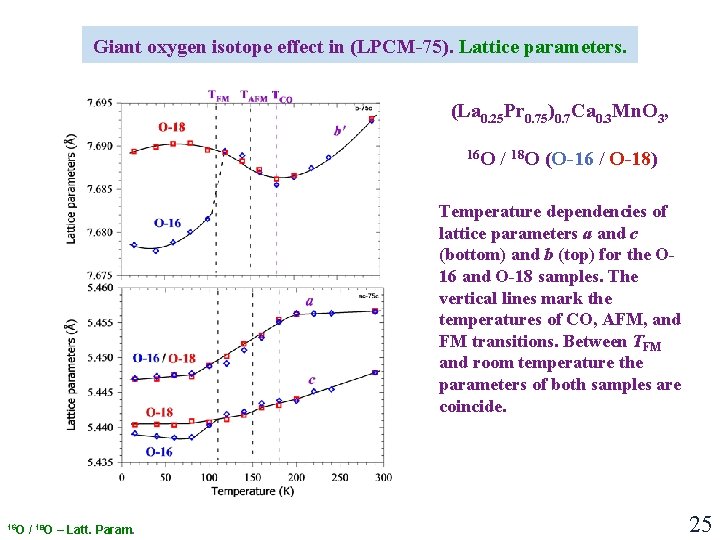
Giant oxygen isotope effect in (LPCM-75). Lattice parameters. (La 0. 25 Pr 0. 75)0. 7 Ca 0. 3 Mn. O 3, 16 O / 18 O (O-16 / O-18) Temperature dependencies of lattice parameters a and c (bottom) and b (top) for the O 16 and O-18 samples. The vertical lines mark the temperatures of CO, AFM, and FM transitions. Between TFM and room temperature the parameters of both samples are coincide. 16 O / 18 O – Latt. Param. 25
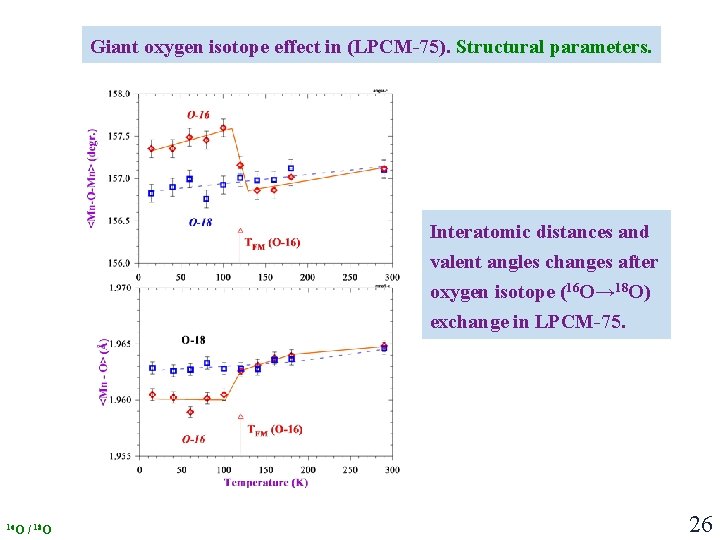
16 Giant oxygen isotope effect in (LPCM-75). Structural parameters. Interatomic distances and valent angles changes after oxygen isotope (16 O→ 18 O) exchange in LPCM-75. O / 18 O 26
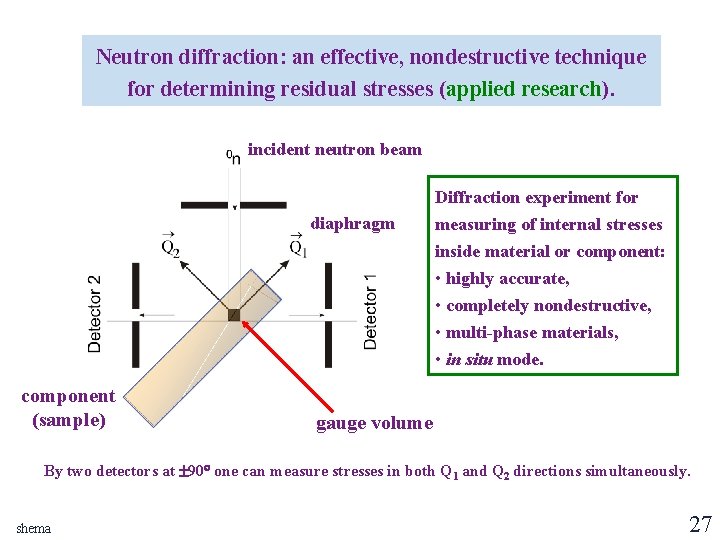
Neutron diffraction: an effective, nondestructive technique for determining residual stresses (applied research). incident neutron beam diaphragm Diffraction experiment for measuring of internal stresses inside material or component: • highly accurate, • completely nondestructive, • multi-phase materials, • in situ mode. component (sample) gauge volume By two detectors at 90 one can measure stresses in both Q detectors at 1 and Q 2 directions simultaneously. shema 27
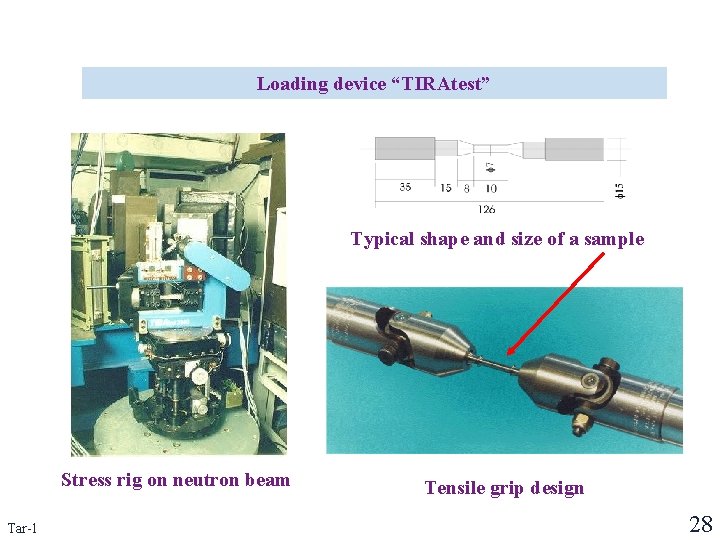
Loading device “TIRAtest” Typical shape and size of a sample Stress rig on neutron beam Tar-1 Tensile grip design 28
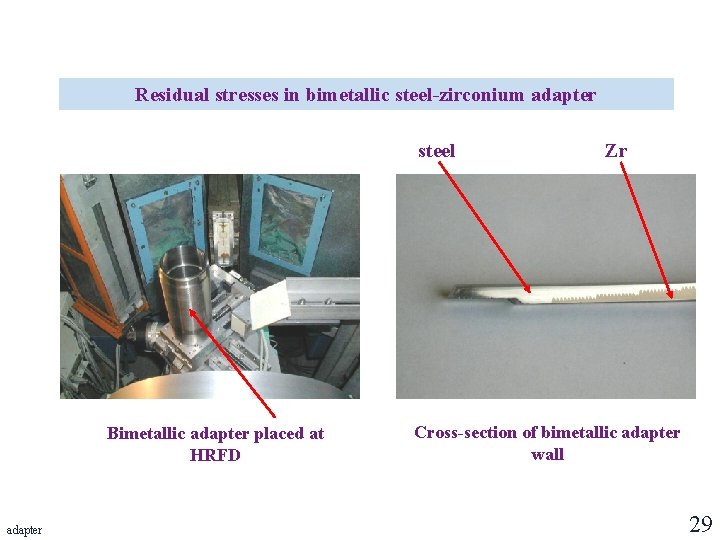
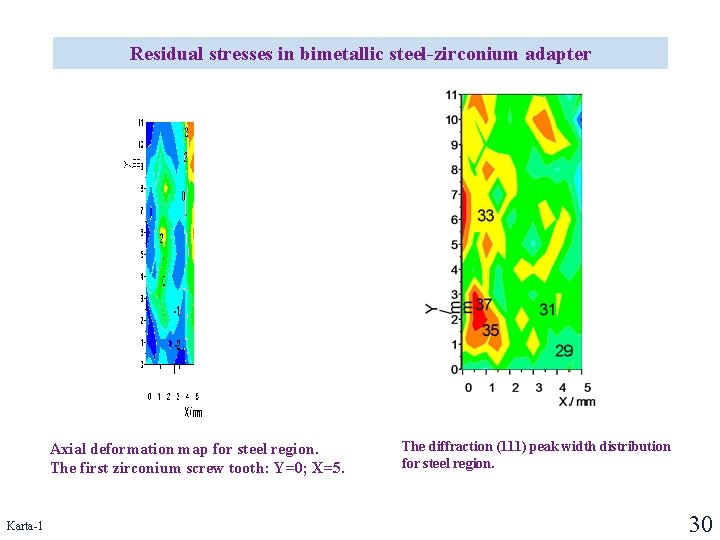
Residual stresses in bimetallic steel-zirconium adapter steel Bimetallic adapter placed at HRFD adapter Zr Cross-section of bimetallic adapter wall 29
Residual stresses in bimetallic steel-zirconium adapter Axial deformation map for steel region. The first zirconium screw tooth: Y=0; X=5. Karta-1 The diffraction (111) peak width distribution for steel region. 30
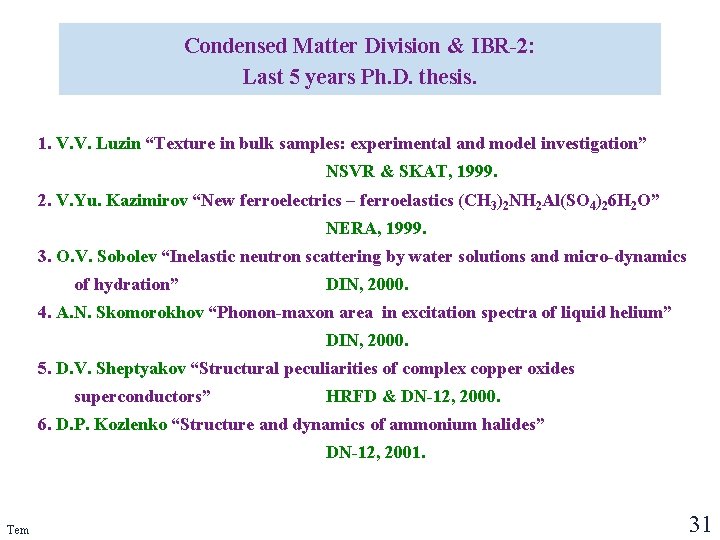
Condensed Matter Division & IBR-2: Last 5 years Ph. D. thesis. 1. V. V. Luzin “Texture in bulk samples: experimental and model investigation” NSVR & SKAT, 1999. 2. V. Yu. Kazimirov “New ferroelectrics – ferroelastics (CH 3)2 NH 2 Al(SO 4)26 H 2 O” NERA, 1999. 3. О. V. Sobolev “Inelastic neutron scattering by water solutions and micro-dynamics of hydration” DIN, 2000. 4. А. N. Skomorokhov “Phonon-maxon area in excitation spectra of liquid helium” DIN, 2000. 5. D. V. Sheptyakov “Structural peculiarities of complex copper oxides superconductors” HRFD & DN-12, 2000. 6. D. P. Kozlenko “Structure and dynamics of ammonium halides” Tem DN-12, 2001. 31
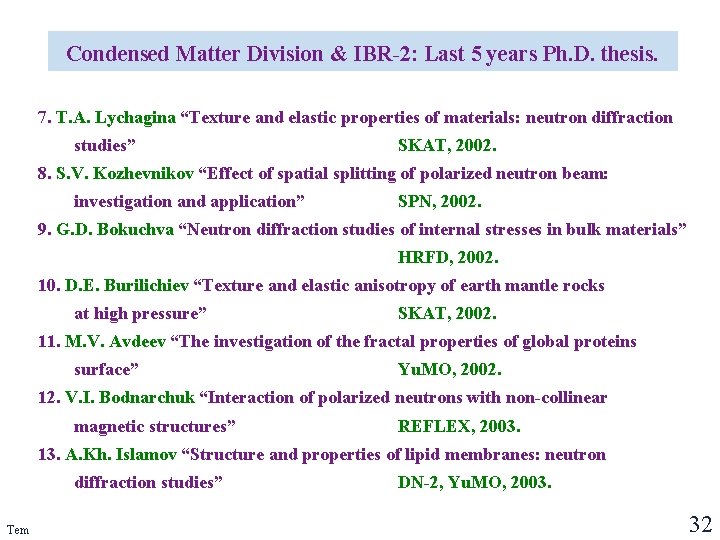
Condensed Matter Division & IBR-2: Last 5 years Ph. D. thesis. 7. Т. А. Lychagina “Texture and elastic properties of materials: neutron diffraction studies” SKAT, 2002. 8. S. V. Kozhevnikov “Effect of spatial splitting of polarized neutron beam: investigation and application” SPN, 2002. 9. G. D. Bokuchva “Neutron diffraction studies of internal stresses in bulk materials” HRFD, 2002. 10. D. Е. Burilichiev “Texture and elastic anisotropy of earth mantle rocks at high pressure” SKAT, 2002. 11. М. V. Avdeev “The investigation of the fractal properties of global proteins surface” Yu. MO, 2002. 12. V. I. Bodnarchuk “Interaction of polarized neutrons with non-collinear magnetic structures” REFLEX, 2003. 13. А. Kh. Islamov “Structure and properties of lipid membranes: neutron diffraction studies” Tem DN-2, Yu. MO, 2003. 32
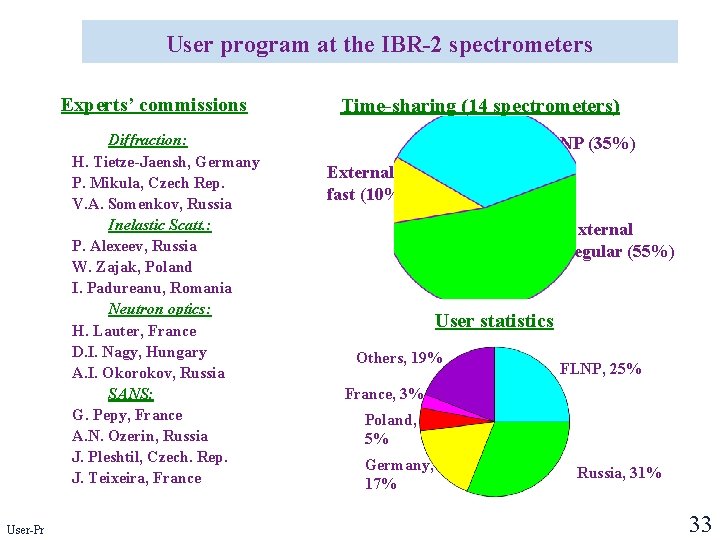
User program at the IBR-2 spectrometers Experts’ commissions Diffraction: H. Tietze-Jaensh, Germany P. Mikula, Czech Rep. V. A. Somenkov, Russia Inelastic Scatt. : P. Alexeev, Russia W. Zajak, Poland I. Padureanu, Romania Neutron optics: H. Lauter, France D. I. Nagy, Hungary A. I. Okorokov, Russia SANS: G. Pepy, France A. N. Ozerin, Russia J. Pleshtil, Czech. Rep. J. Teixeira, France User-Pr Time-sharing (14 spectrometers) FLNP (35%) External fast (10%) External regular (55%) User statistics Others, 19% FLNP, 25% France, 3% Poland, 5% Germany, 17% Russia, 31% 33
Conclusions Neutron scattering at the IBR-2 has the excellent present and good prospect for future because: v IBR-2 is one of the best neutron sources for condensed matter studies; v Parameters and performance of neutron spectrometers at the IBR-2 are at a world top level; v There exists a realistic program for development of spectrometers; v The staff is well experienced and there is a good balance between aged and young scientists; v Tem There exists a good collaboration with many Institutions. 34
END 35
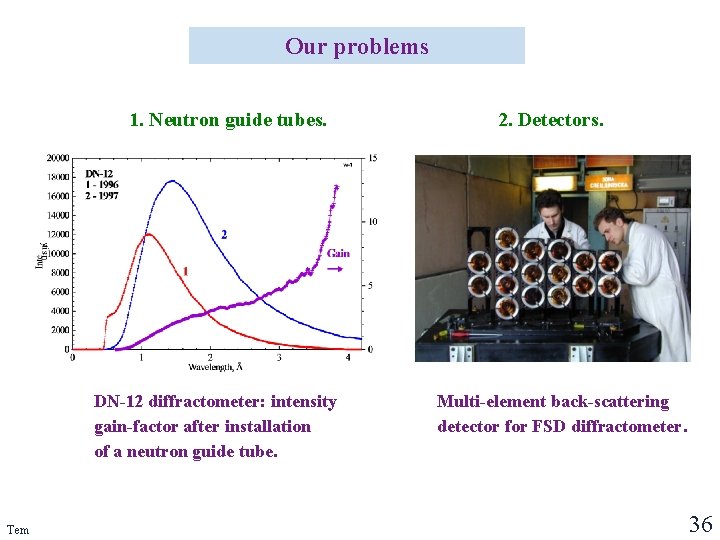
Our problems 1. Neutron guide tubes. DN-12 diffractometer: intensity gain-factor after installation of a neutron guide tube. Tem 2. Detectors. Multi-element back-scattering detector for FSD diffractometer. 36
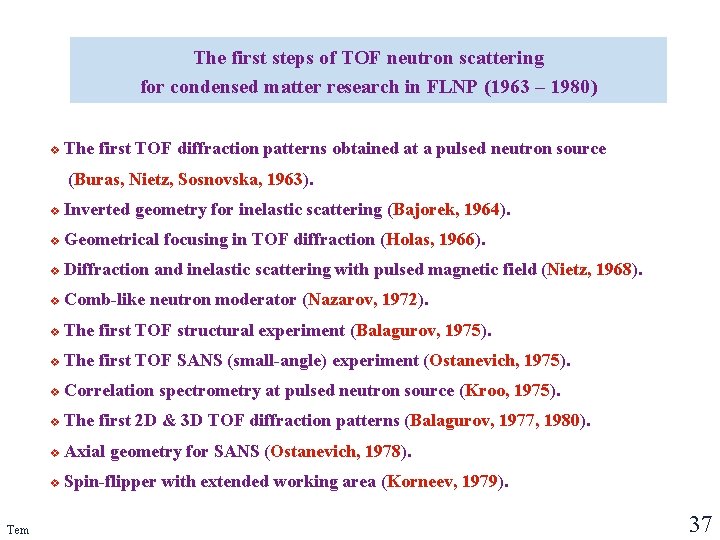
The first steps of TOF neutron scattering for condensed matter research in FLNP (1963 – 1980) v The first TOF diffraction patterns obtained at a pulsed neutron source (Buras, Nietz, Sosnovska, 1963). v Inverted geometry for inelastic scattering (Bajorek, 1964). v Geometrical focusing in TOF diffraction (Holas, 1966). v Diffraction and inelastic scattering with pulsed magnetic field (Nietz, 1968). v Comb-like neutron moderator (Nazarov, 1972). v The first TOF structural experiment (Balagurov, 1975). v The first TOF SANS (small-angle) experiment (Ostanevich, 1975). v Correlation spectrometry at pulsed neutron source (Kroo, 1975). v The first 2 D & 3 D TOF diffraction patterns (Balagurov, 1977, 1980). v Axial geometry for SANS (Ostanevich, 1978). v Spin-flipper with extended working area (Korneev, 1979). Tem 37
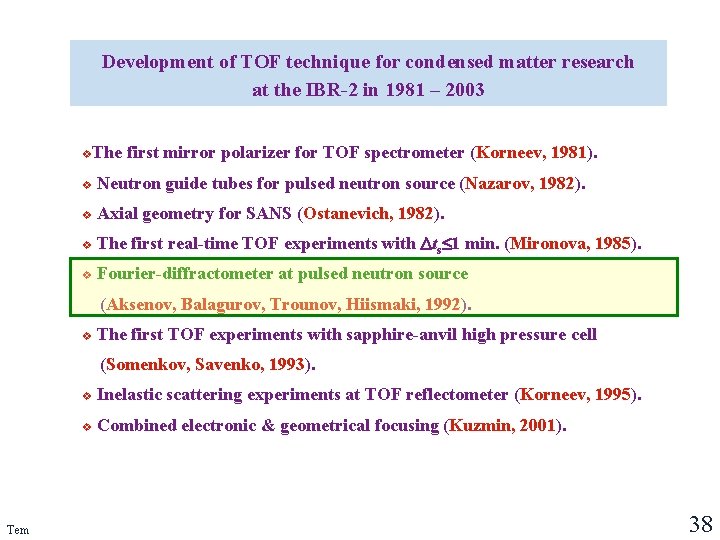
Development of TOF technique for condensed matter research at the IBR-2 in 1981 – 2003 v. The first mirror polarizer for TOF spectrometer (Korneev, 1981). v Neutron guide tubes for pulsed neutron source (Nazarov, 1982). v Axial geometry for SANS (Ostanevich, 1982). v The first real-time TOF experiments with ts 1 min. (Mironova, 1985). v Fourier-diffractometer at pulsed neutron source (Aksenov, Balagurov, Trounov, Hiismaki, 1992). v The first TOF experiments with sapphire-anvil high pressure cell (Somenkov, Savenko, 1993). v Inelastic scattering experiments at TOF reflectometer (Korneev, 1995). v Combined electronic & geometrical focusing (Kuzmin, 2001). Tem 38
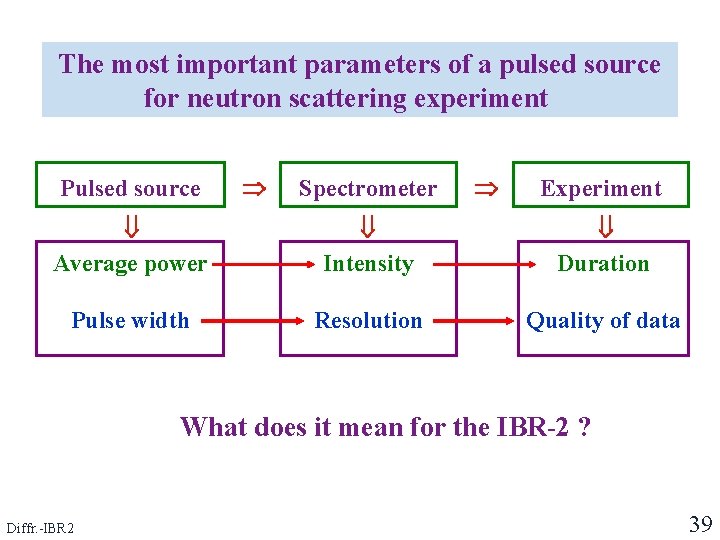
The most important parameters of a pulsed source for neutron scattering experiment Pulsed source Spectrometer Experiment Average power Intensity Duration Pulse width Resolution Quality of data What does it mean for the IBR-2 ? Diffr. -IBR 2 39
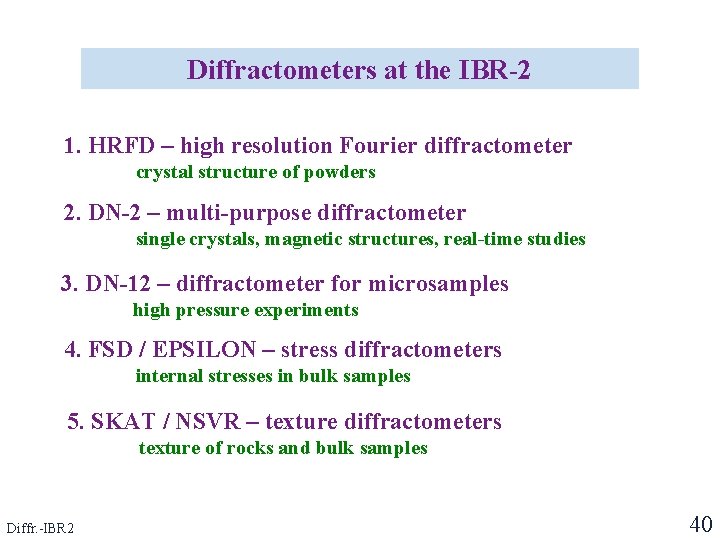
Diffractometers at the IBR-2 1. HRFD – high resolution Fourier diffractometer crystal structure of powders 2. DN-2 – multi-purpose diffractometer single crystals, magnetic structures, real-time studies 3. DN-12 – diffractometer for microsamples high pressure experiments 4. FSD / EPSILON – stress diffractometers internal stresses in bulk samples 5. SKAT / NSVR – texture diffractometers texture of rocks and bulk samples Diffr. -IBR 2 40
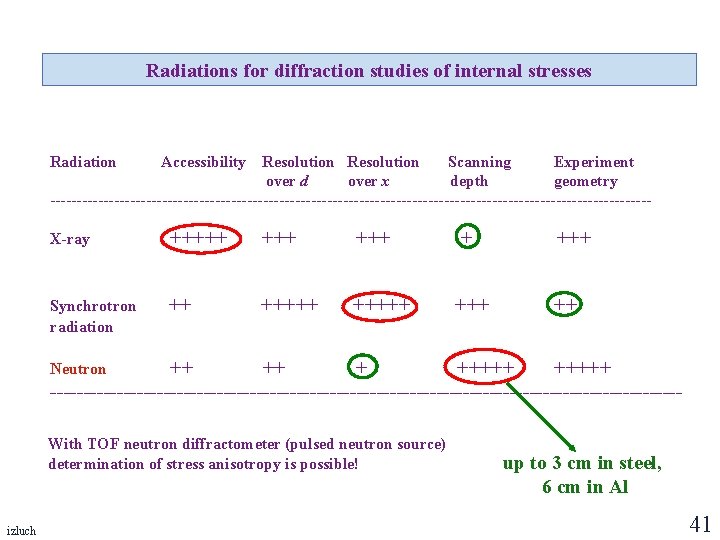
Radiations for diffraction studies of internal stresses Radiation Accessibility Resolution Scanning Experiment over d over x depth geometry --------------------------------------------------------X-ray +++++ +++ Synchrotron +++++ ++ radiation Neutron +++++ +++++ -----------------------------------------------With TOF neutron diffractometer (pulsed neutron source) determination of stress anisotropy is possible! izluch up to 3 cm in steel, 6 cm in Al 41
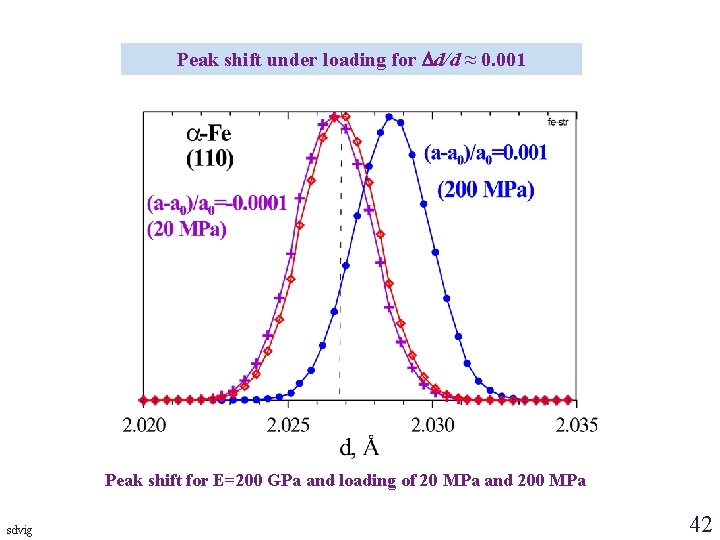
Peak shift under loading for d/d ≈ 0. 001 Peak shift for E=200 GPa and loading of 20 MPa and 200 MPa sdvig 42