
NEUTRON DIFFUSION THE CONTINUITY EQUATION Consider the number
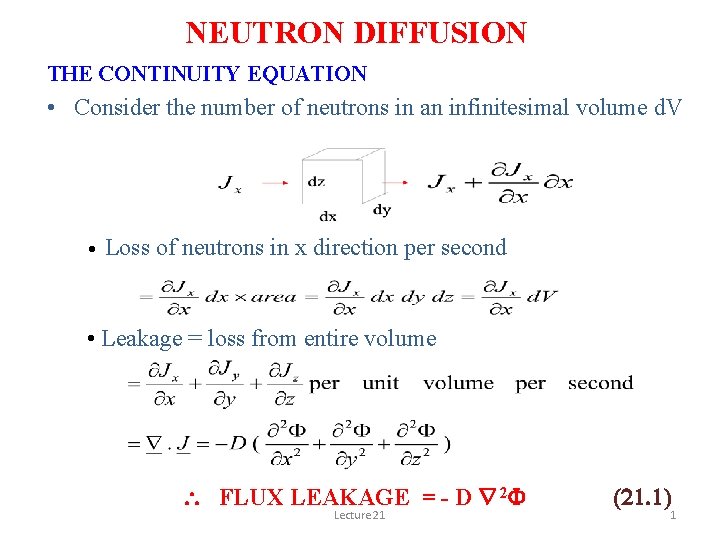
NEUTRON DIFFUSION THE CONTINUITY EQUATION • Consider the number of neutrons in an infinitesimal volume d. V • Loss of neutrons in x direction per second • Leakage = loss from entire volume FLUX LEAKAGE = - D 2 F Lecture 21 (21. 1) 1
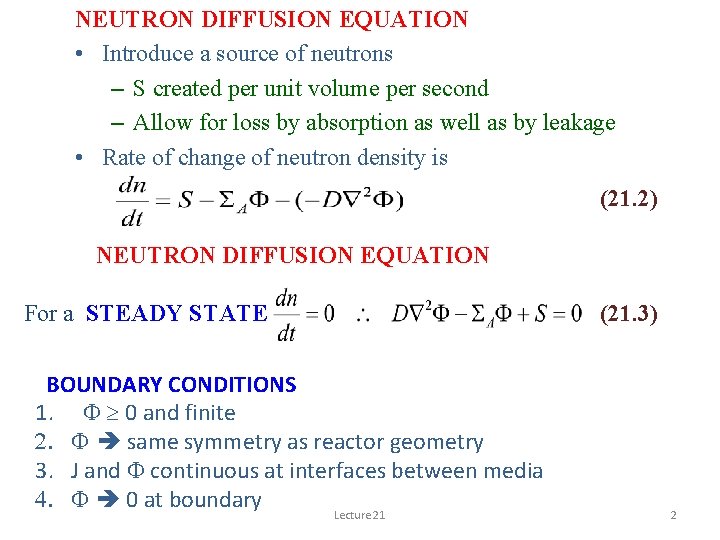
NEUTRON DIFFUSION EQUATION • Introduce a source of neutrons – S created per unit volume per second – Allow for loss by absorption as well as by leakage • Rate of change of neutron density is (21. 2) NEUTRON DIFFUSION EQUATION For a STEADY STATE (21. 3) BOUNDARY CONDITIONS 1. F 0 and finite 2. F same symmetry as reactor geometry 3. J and F continuous at interfaces between media 4. F 0 at boundary Lecture 21 2
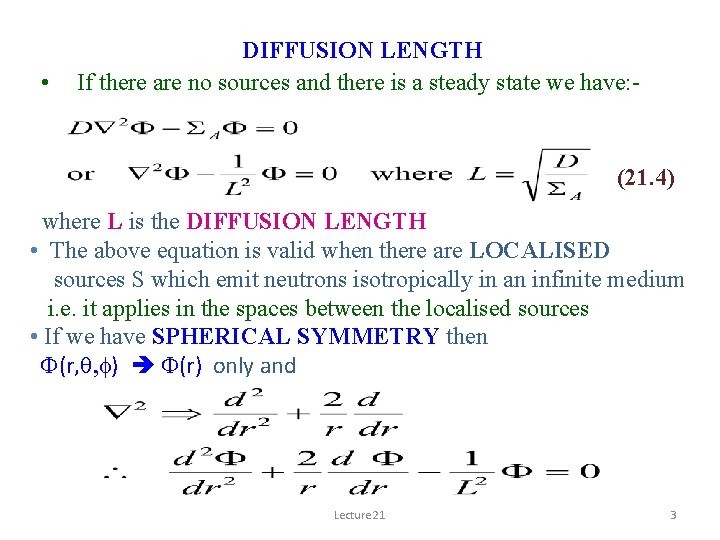
• DIFFUSION LENGTH If there are no sources and there is a steady state we have: - (21. 4) where L is the DIFFUSION LENGTH • The above equation is valid when there are LOCALISED sources S which emit neutrons isotropically in an infinite medium i. e. it applies in the spaces between the localised sources • If we have SPHERICAL SYMMETRY then F(r, q, f) F(r) only and Lecture 21 3
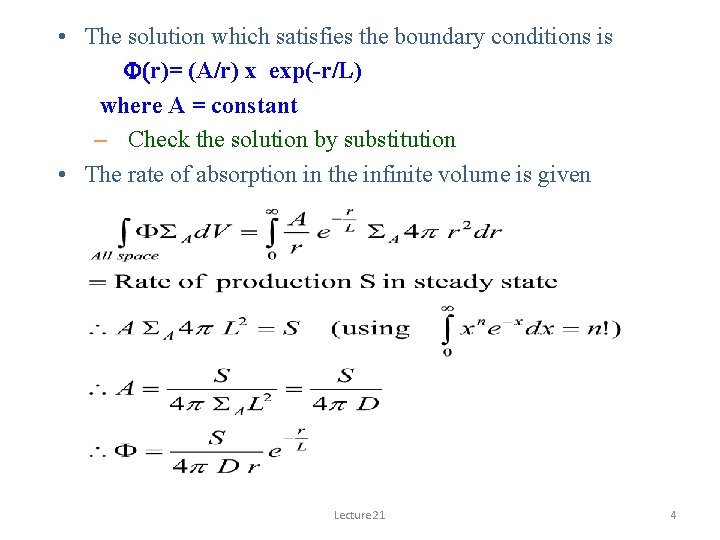
• The solution which satisfies the boundary conditions is F(r)= (A/r) x exp(-r/L) where A = constant – Check the solution by substitution • The rate of absorption in the infinite volume is given Lecture 21 4
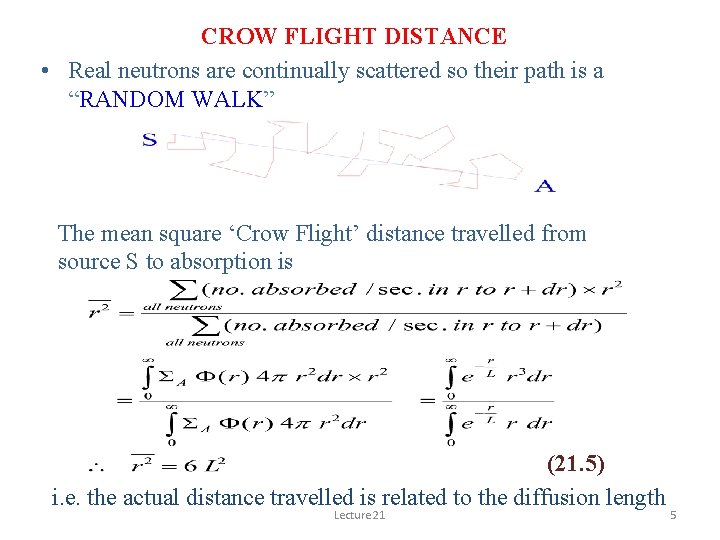
CROW FLIGHT DISTANCE • Real neutrons are continually scattered so their path is a “RANDOM WALK” The mean square ‘Crow Flight’ distance travelled from source S to absorption is (21. 5) i. e. the actual distance travelled is related to the diffusion length Lecture 21 5
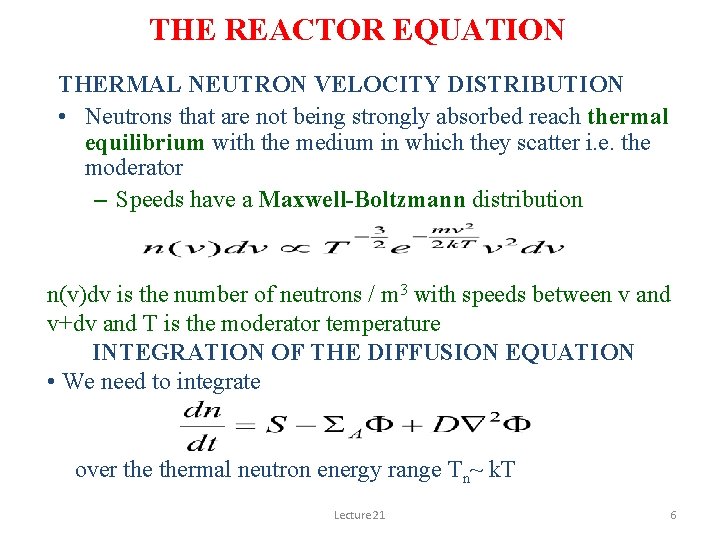
THE REACTOR EQUATION THERMAL NEUTRON VELOCITY DISTRIBUTION • Neutrons that are not being strongly absorbed reach thermal equilibrium with the medium in which they scatter i. e. the moderator – Speeds have a Maxwell-Boltzmann distribution n(v)dv is the number of neutrons / m 3 with speeds between v and v+dv and T is the moderator temperature INTEGRATION OF THE DIFFUSION EQUATION • We need to integrate over thermal neutron energy range Tn~ k. T Lecture 21 6
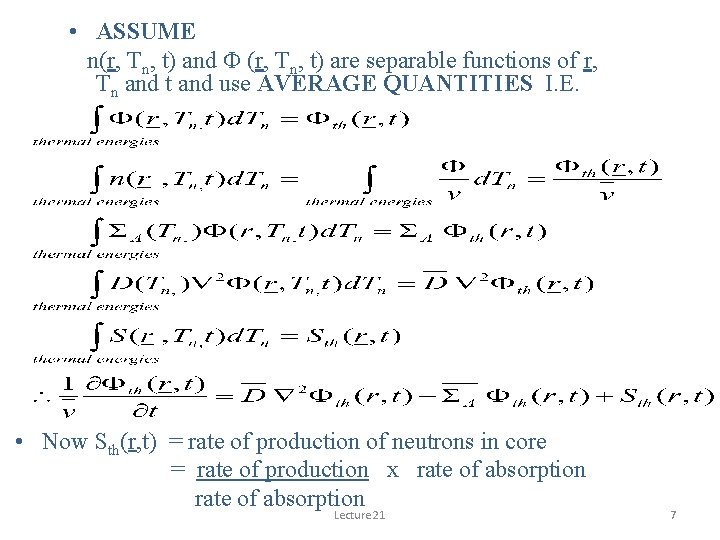
• ASSUME n(r, Tn, t) and F (r, Tn, t) are separable functions of r, Tn and t and use AVERAGE QUANTITIES I. E. • Now Sth(r, t) = rate of production of neutrons in core = rate of production x rate of absorption Lecture 21 7
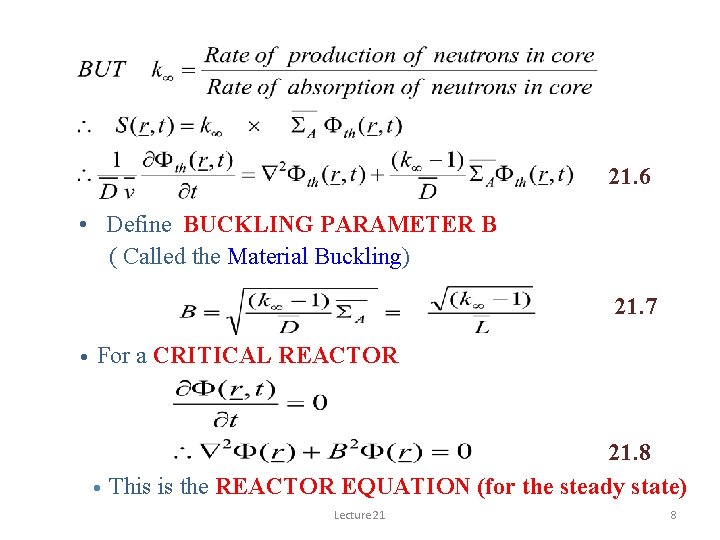
21. 6 • Define BUCKLING PARAMETER B ( Called the Material Buckling) 21. 7 • For a CRITICAL REACTOR • 21. 8 This is the REACTOR EQUATION (for the steady state) Lecture 21 8
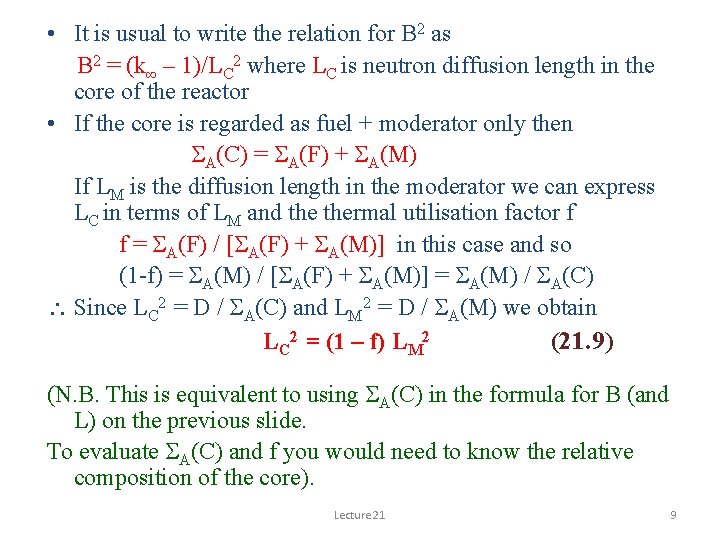
• It is usual to write the relation for B 2 as B 2 = (k∞ – 1)/LC 2 where LC is neutron diffusion length in the core of the reactor • If the core is regarded as fuel + moderator only then SA(C) = SA(F) + SA(M) If LM is the diffusion length in the moderator we can express LC in terms of LM and thermal utilisation factor f f = SA(F) / [SA(F) + SA(M)] in this case and so (1 -f) = SA(M) / [SA(F) + SA(M)] = SA(M) / SA(C) Since LC 2 = D / SA(C) and LM 2 = D / SA(M) we obtain LC 2 = (1 – f) LM 2 (21. 9) (N. B. This is equivalent to using SA(C) in the formula for B (and L) on the previous slide. To evaluate SA(C) and f you would need to know the relative composition of the core). Lecture 21 9
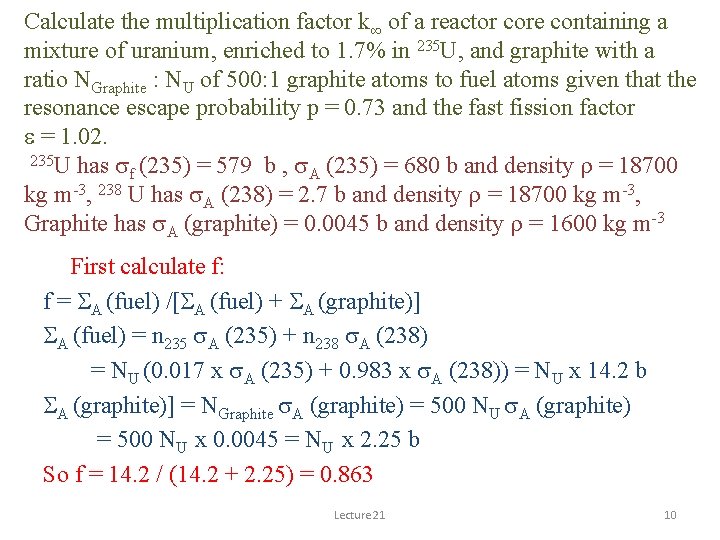
Calculate the multiplication factor k∞ of a reactor core containing a mixture of uranium, enriched to 1. 7% in 235 U, and graphite with a ratio NGraphite : NU of 500: 1 graphite atoms to fuel atoms given that the resonance escape probability p = 0. 73 and the fast fission factor e = 1. 02. 235 U has s (235) = 579 b , s (235) = 680 b and density r = 18700 f A kg m-3, 238 U has s. A (238) = 2. 7 b and density r = 18700 kg m-3, Graphite has s. A (graphite) = 0. 0045 b and density r = 1600 kg m-3 First calculate f: f = SA (fuel) /[SA (fuel) + SA (graphite)] SA (fuel) = n 235 s. A (235) + n 238 s. A (238) = NU (0. 017 x s. A (235) + 0. 983 x s. A (238)) = NU x 14. 2 b SA (graphite)] = NGraphite s. A (graphite) = 500 NU x 0. 0045 = NU x 2. 25 b So f = 14. 2 / (14. 2 + 2. 25) = 0. 863 Lecture 21 10
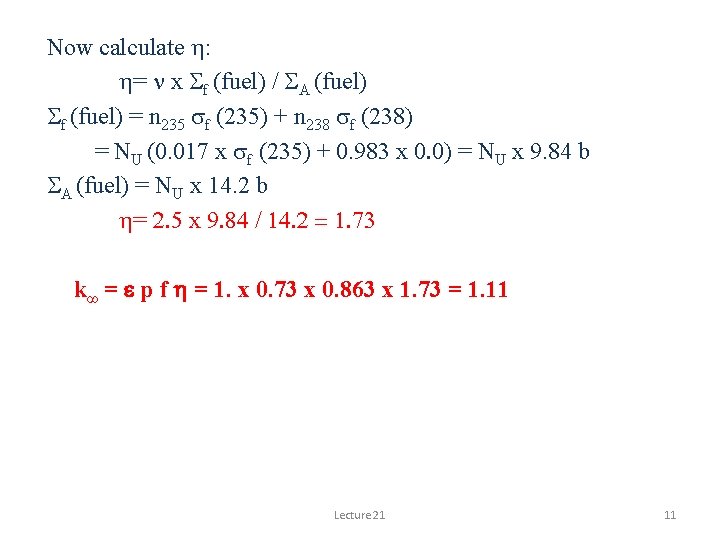
Now calculate h: h= n x Sf (fuel) / SA (fuel) Sf (fuel) = n 235 sf (235) + n 238 sf (238) = NU (0. 017 x sf (235) + 0. 983 x 0. 0) = NU x 9. 84 b SA (fuel) = NU x 14. 2 b h= 2. 5 x 9. 84 / 14. 2 = 1. 73 k∞ = e p f h = 1. x 0. 73 x 0. 863 x 1. 73 = 1. 11 Lecture 21 11
- Slides: 11