
Neutron Beam Simulations WBS 1 08 D Borissenko
Neutron Beam Simulations (WBS 1. 08) D. Borissenko University of Kiel & University of Virginia E. M. Scott & G. L. Greene University of Tennessee Nab Annual Review Germantown, MD 04 Aug, 2015
Outline • Critical Parameters – Decay Rate – Background – Beam Profile Uniformity • Beamline Geometries – Baseline Collimation – Tapered Guide – Refined Collimation • Results • Future Work
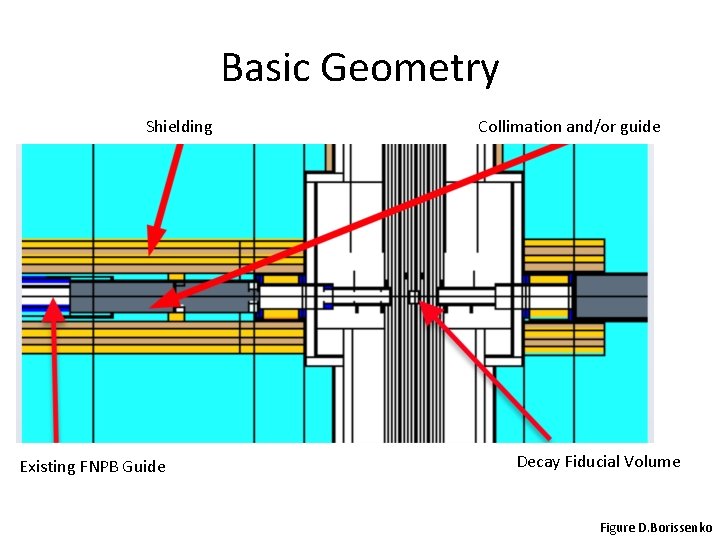
Basic Geometry Shielding Existing FNPB Guide Collimation and/or guide Decay Fiducial Volume Figure D. Borissenko

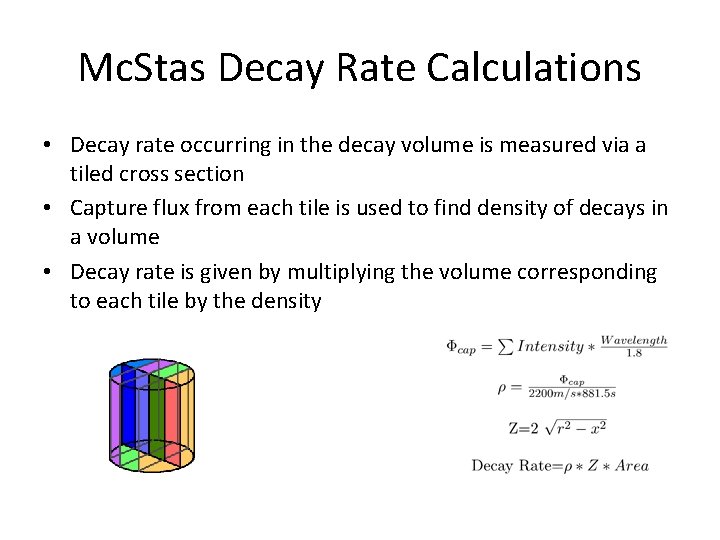
Mc. Stas Decay Rate Calculations • Decay rate occurring in the decay volume is measured via a tiled cross section • Capture flux from each tile is used to find density of decays in a volume • Decay rate is given by multiplying the volume corresponding to each tile by the density
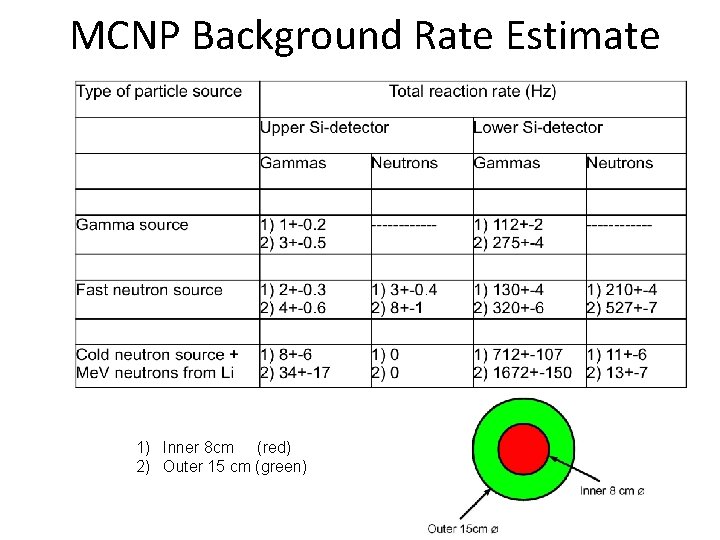
MCNP Background Rate Estimate 1) Inner 8 cm (red) 2) Outer 15 cm (green)
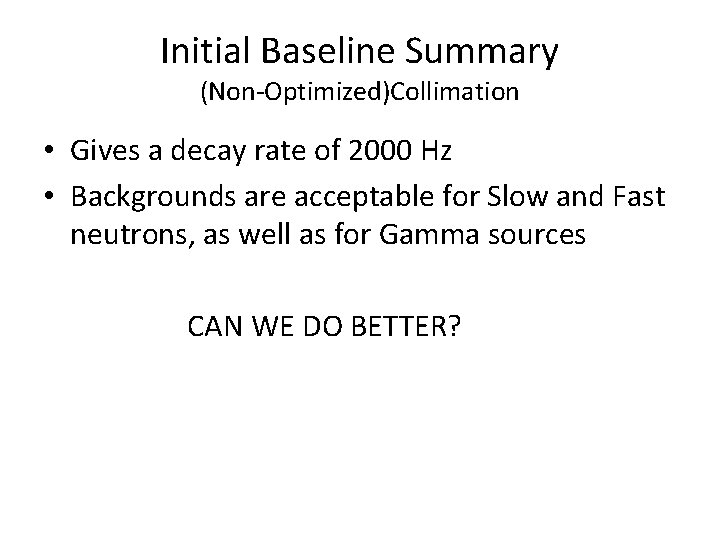
Initial Baseline Summary (Non-Optimized)Collimation • Gives a decay rate of 2000 Hz • Backgrounds are acceptable for Slow and Fast neutrons, as well as for Gamma sources CAN WE DO BETTER?
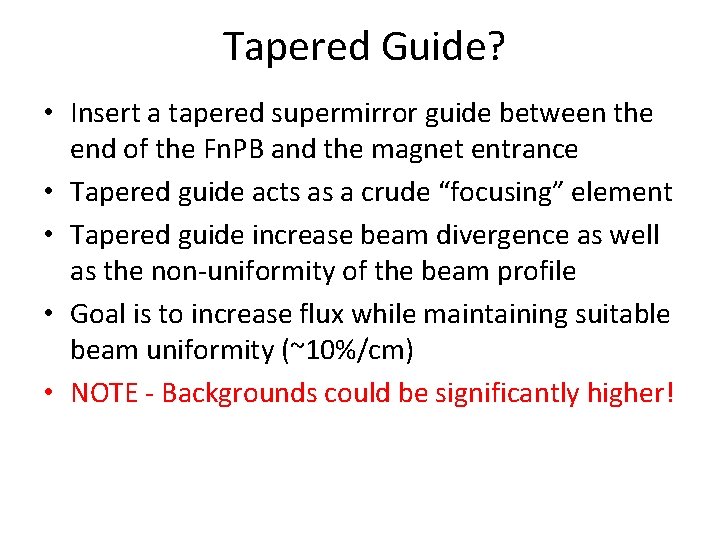
Tapered Guide? • Insert a tapered supermirror guide between the end of the Fn. PB and the magnet entrance • Tapered guide acts as a crude “focusing” element • Tapered guide increase beam divergence as well as the non-uniformity of the beam profile • Goal is to increase flux while maintaining suitable beam uniformity (~10%/cm) • NOTE - Backgrounds could be significantly higher!
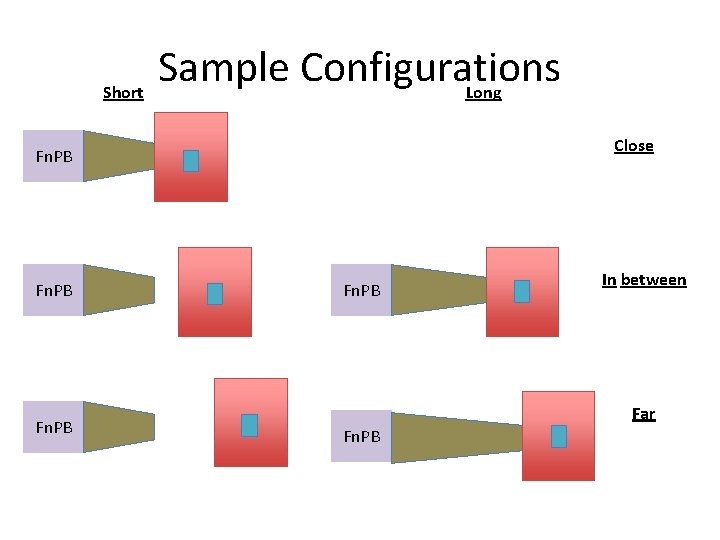
Short Sample Configurations Long Close Fn. PB In between Far Fn. PB
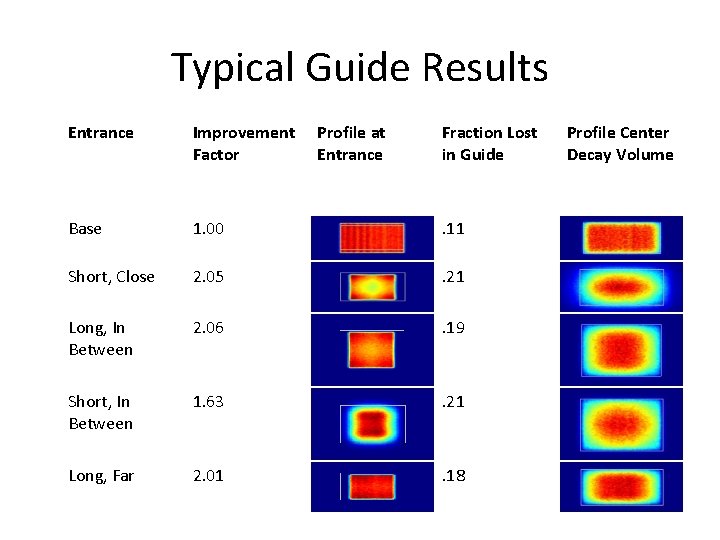
Typical Guide Results Entrance Improvement Factor Profile at Entrance Fraction Lost in Guide Base 1. 00 . 11 Short, Close 2. 05 . 21 Long, In Between 2. 06 . 19 Short, In Between 1. 63 . 21 Long, Far 2. 01 . 18 Profile Center Decay Volume
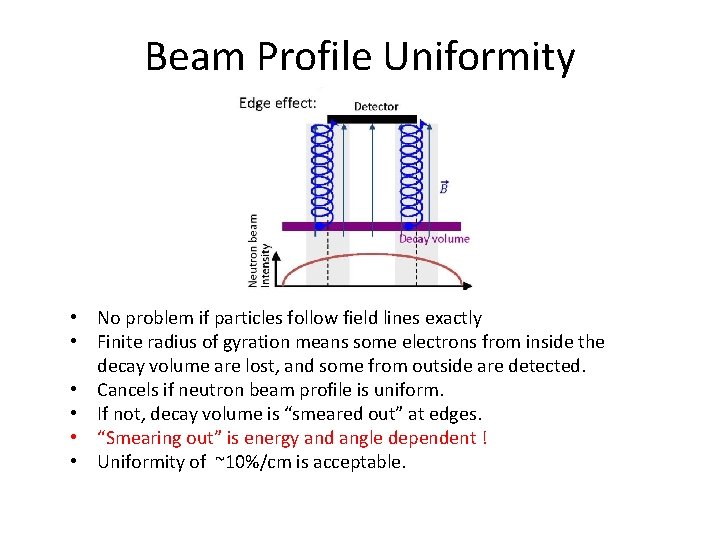
Beam Profile Uniformity • No problem if particles follow field lines exactly • Finite radius of gyration means some electrons from inside the decay volume are lost, and some from outside are detected. • Cancels if neutron beam profile is uniform. • If not, decay volume is “smeared out” at edges. • “Smearing out” is energy and angle dependent ! • Uniformity of ~10%/cm is acceptable.
Tapered Guide Beam Profile
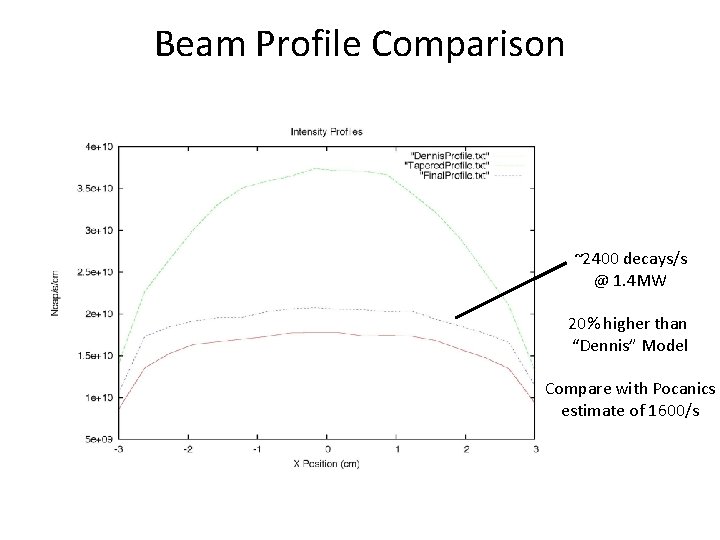
Beam Profile Comparison (Optimized) ~2400 decays/s @ 1. 4 MW 20% higher than “Dennis” Model Compare with Pocanics estimate of 1600/s
Cost /Schedule Without the focusing neutron guide, no major cost/schedule concerns. • Schedule - High Level Milestone due FY 16 Q 1 “Neutronics Report” • Cost - $67 k – No charges to date • ES&H - No substantive issue as this work package does not include biological shielding
Conclusions • Tapered guides improve flux by x 2 but with poor beam uniformity • Optimization of the collimation leads to retaining about 98% of possible decays while reducing possible background and beam profile issues • Approximately 30% of incident beam is absorbed by 6 Li collimators. Fast neutrons from secondary α, n reactions and capture on Al windows are main source of background in lower detector • MCNP simulation must be refined to account for refined beamline model and actual background spectrum.
- Slides: 15