
Neutrinoless Double Beta Decay in Liquid Scintillator Mark
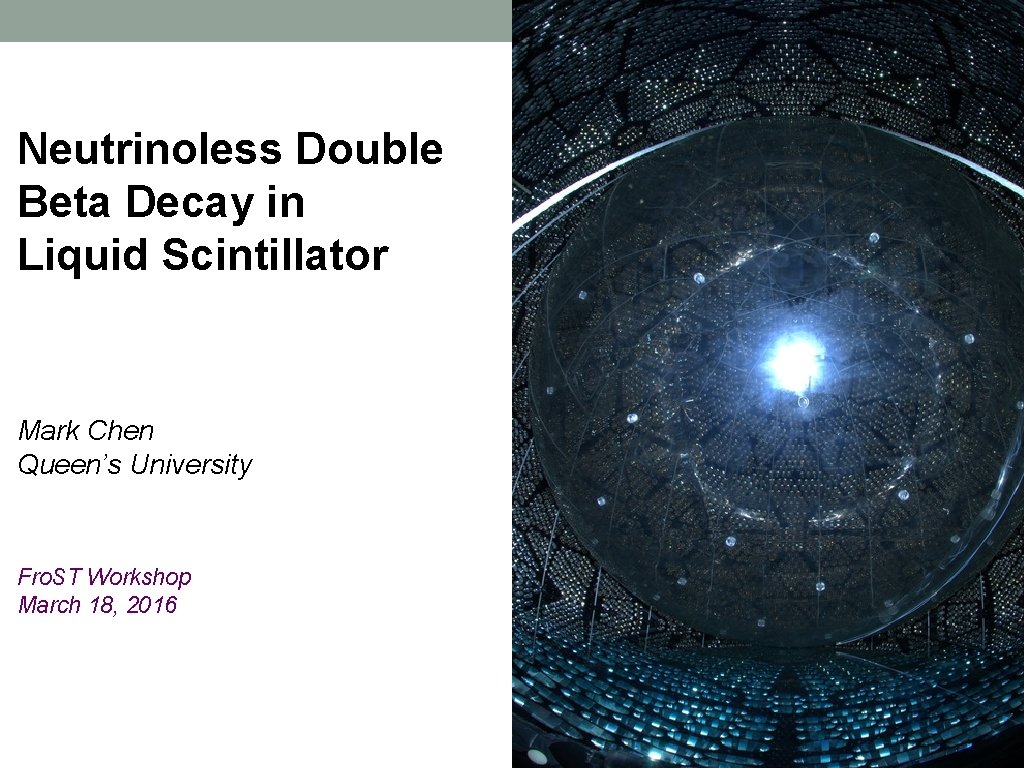
Neutrinoless Double Beta Decay in Liquid Scintillator Mark Chen Queen’s University Fro. ST Workshop March 18, 2016
Talk Outline • double beta decay • favorable isotopes • brief history of double beta decay in liquid scintillator • liquid scintillator NLDBD approach • advantages • requirements
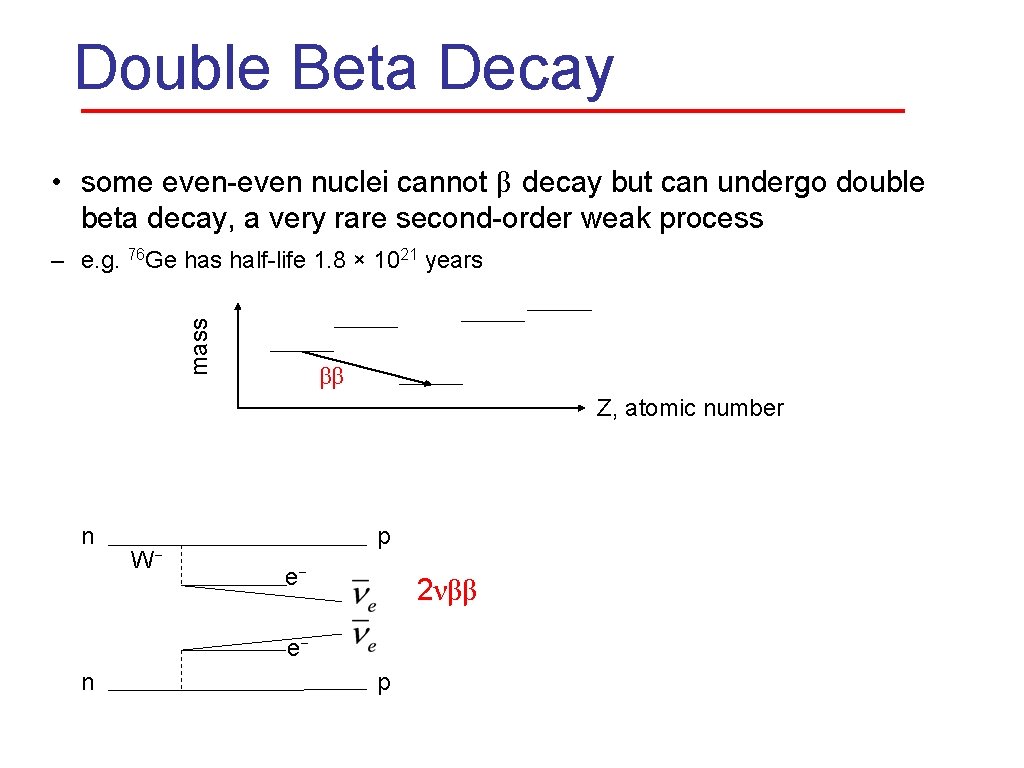
Double Beta Decay • some even-even nuclei cannot β decay but can undergo double beta decay, a very rare second-order weak process mass – e. g. 76 Ge has half-life 1. 8 × 10²¹ years ββ Z, atomic number n W− p e− 2νββ e− n p
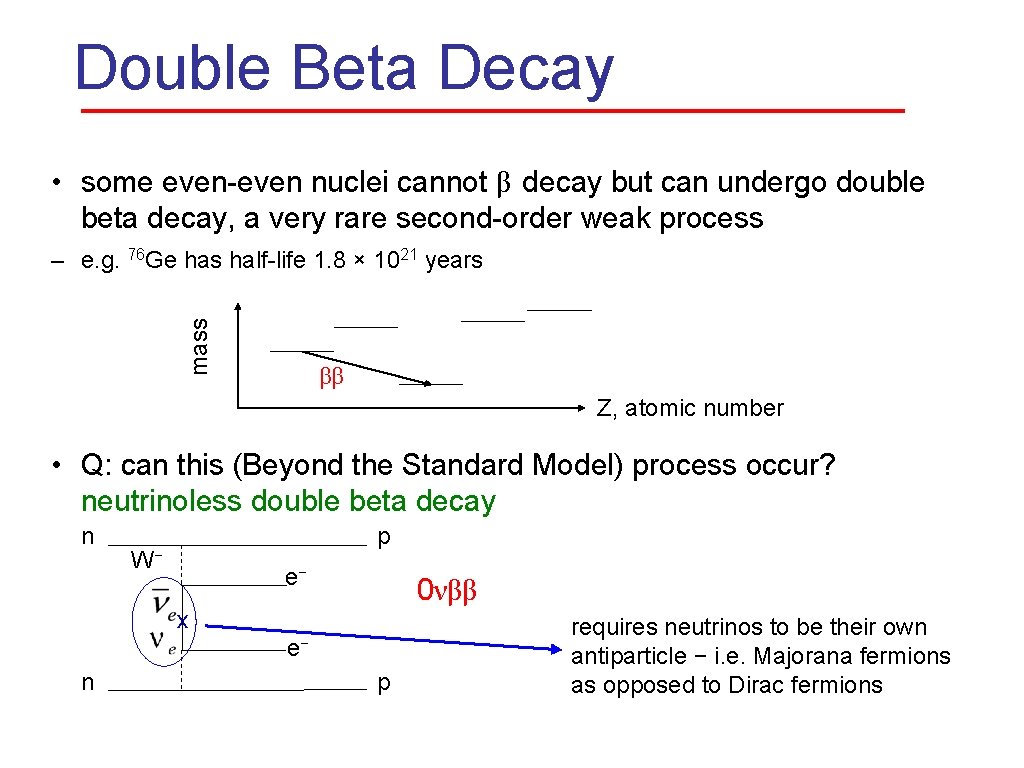
Double Beta Decay • some even-even nuclei cannot β decay but can undergo double beta decay, a very rare second-order weak process mass – e. g. 76 Ge has half-life 1. 8 × 10²¹ years ββ Z, atomic number • Q: can this (Beyond the Standard Model) process occur? neutrinoless double beta decay n p W− e− 0νββ x e− n p requires neutrinos to be their own antiparticle − i. e. Majorana fermions as opposed to Dirac fermions
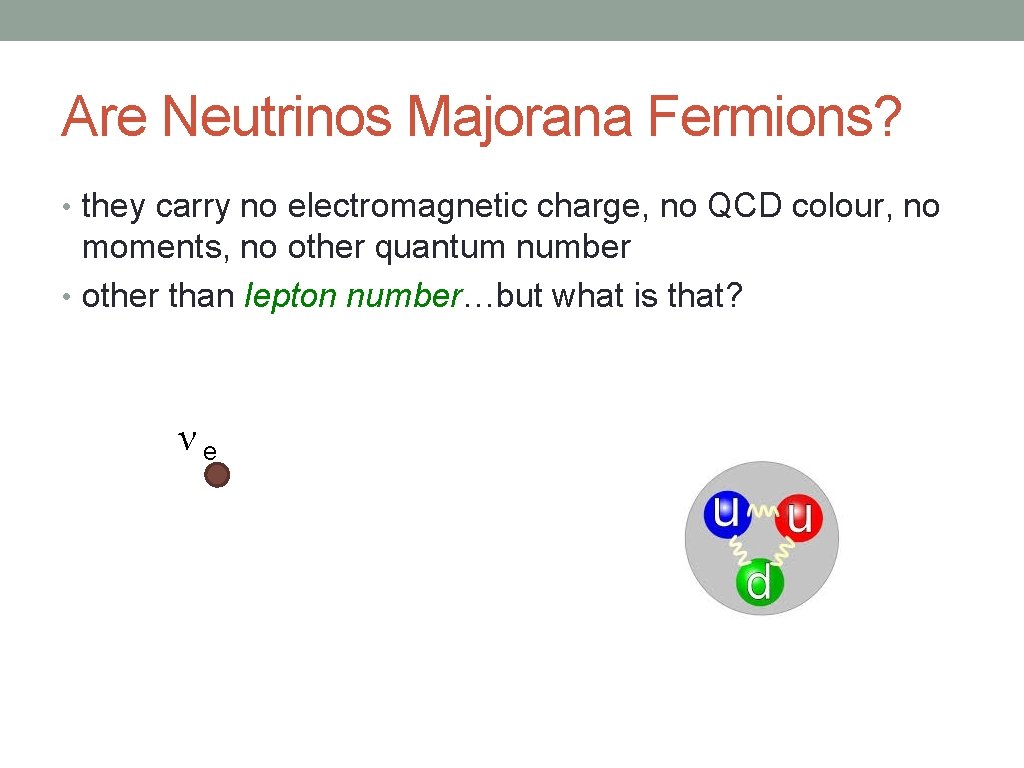
Are Neutrinos Majorana Fermions? • they carry no electromagnetic charge, no QCD colour, no moments, no other quantum number • other than lepton number…but what is that? νe
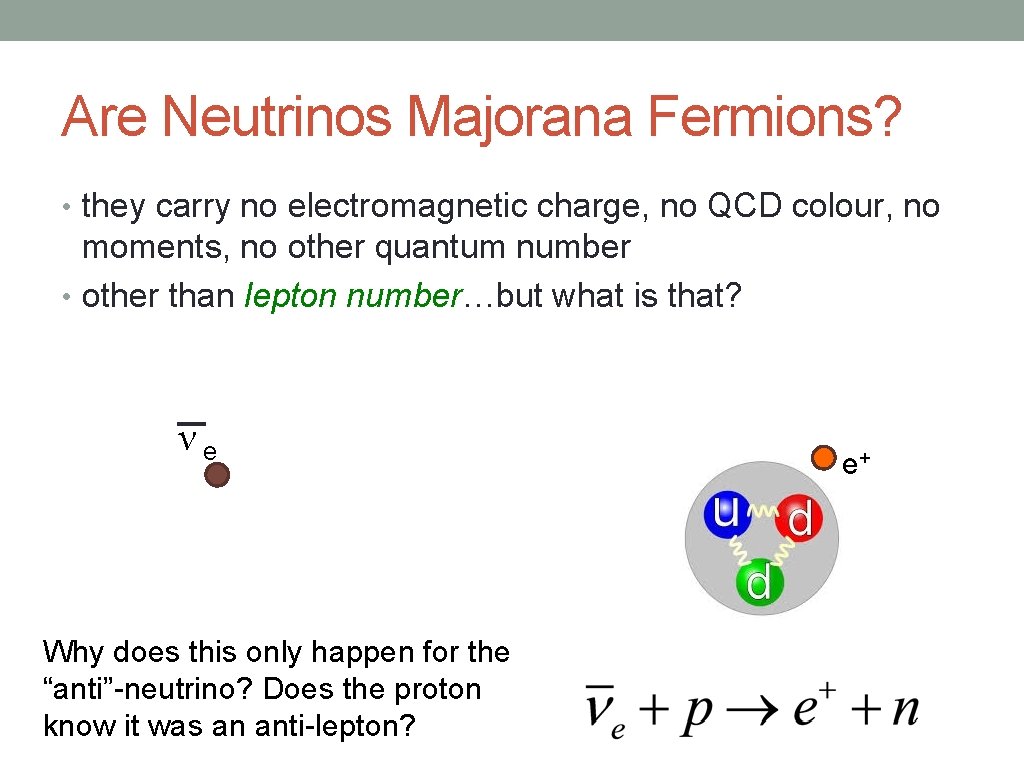
Are Neutrinos Majorana Fermions? • they carry no electromagnetic charge, no QCD colour, no moments, no other quantum number • other than lepton number…but what is that? νe Why does this only happen for the “anti”-neutrino? Does the proton know it was an anti-lepton? e+
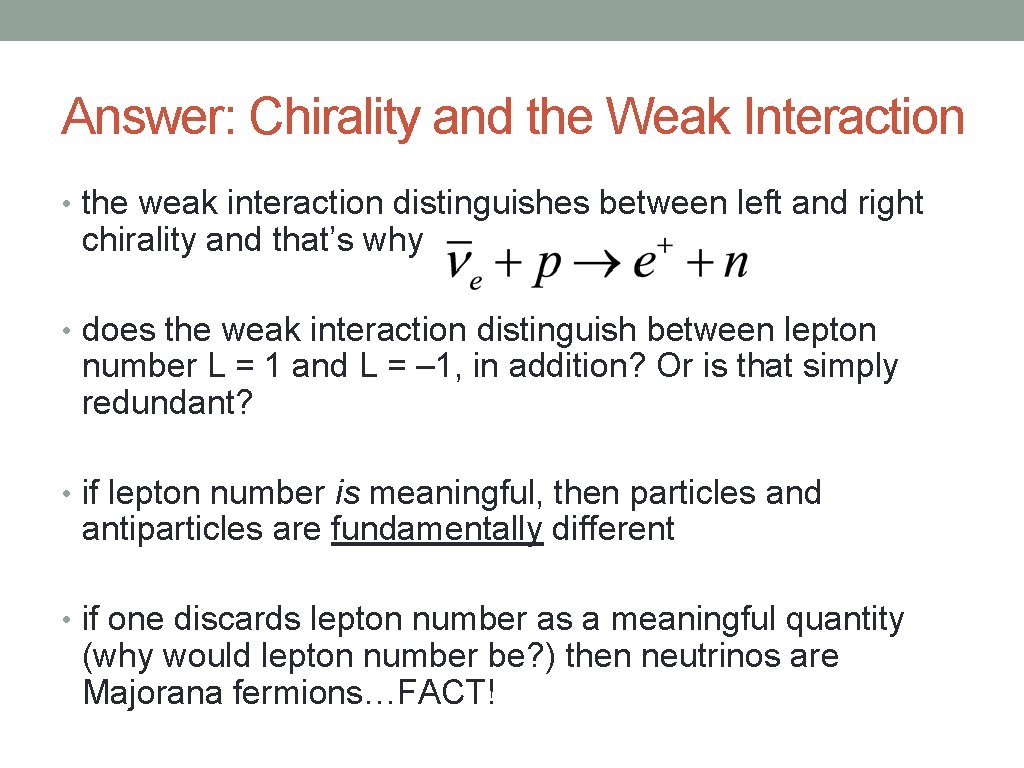
Answer: Chirality and the Weak Interaction • the weak interaction distinguishes between left and right chirality and that’s why • does the weak interaction distinguish between lepton number L = 1 and L = – 1, in addition? Or is that simply redundant? • if lepton number is meaningful, then particles and antiparticles are fundamentally different • if one discards lepton number as a meaningful quantity (why would lepton number be? ) then neutrinos are Majorana fermions…FACT!
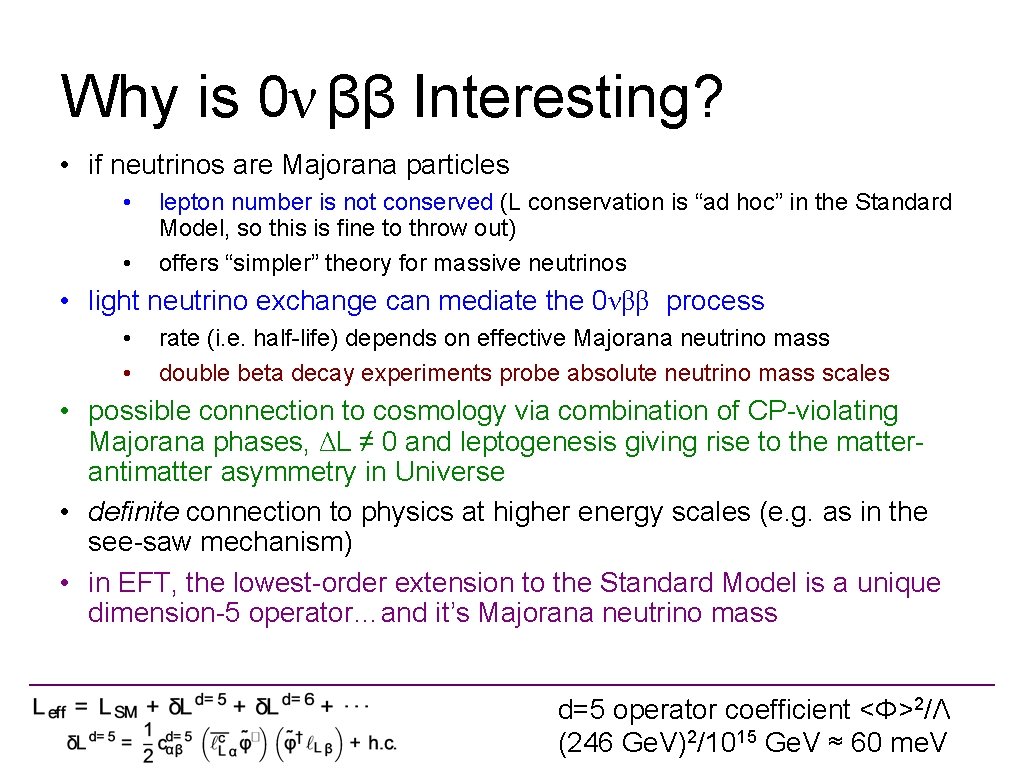
Why is 0ν ββ Interesting? • if neutrinos are Majorana particles • • lepton number is not conserved (L conservation is “ad hoc” in the Standard Model, so this is fine to throw out) offers “simpler” theory for massive neutrinos • light neutrino exchange can mediate the 0νββ process • • rate (i. e. half-life) depends on effective Majorana neutrino mass double beta decay experiments probe absolute neutrino mass scales • possible connection to cosmology via combination of CP-violating Majorana phases, ΔL ≠ 0 and leptogenesis giving rise to the matterantimatter asymmetry in Universe • definite connection to physics at higher energy scales (e. g. as in the see-saw mechanism) • in EFT, the lowest-order extension to the Standard Model is a unique dimension-5 operator…and it’s Majorana neutrino mass d=5 operator coefficient <Φ>2/Λ (246 Ge. V)2/1015 Ge. V ≈ 60 me. V
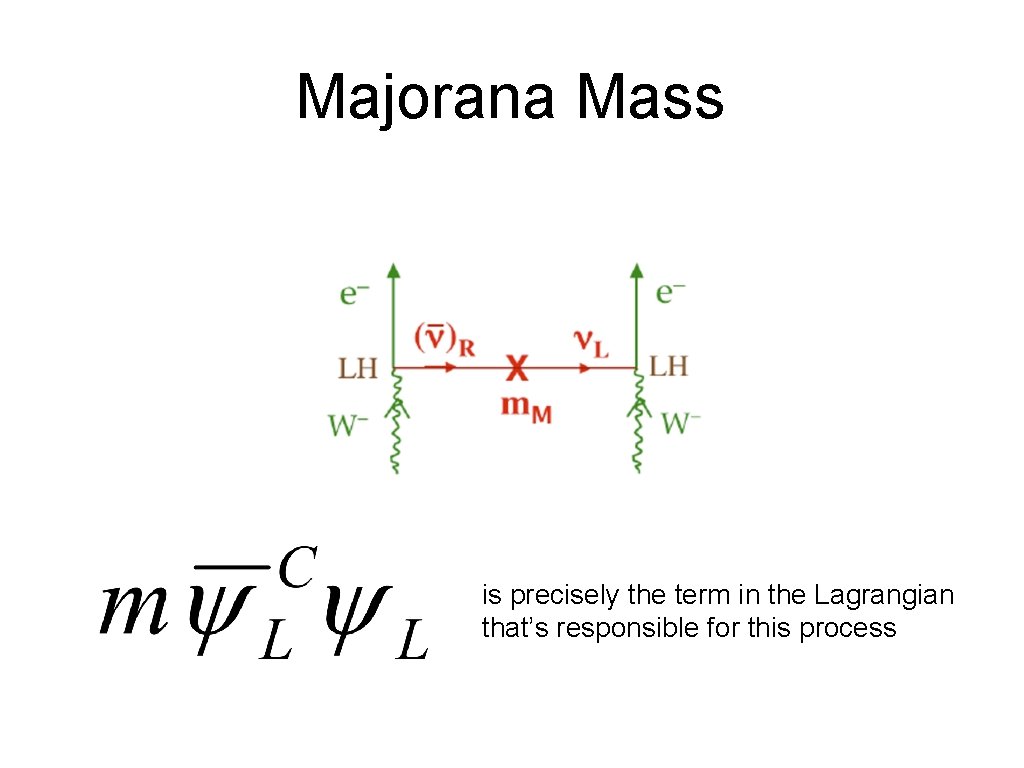
Majorana Mass is precisely the term in the Lagrangian that’s responsible for this process
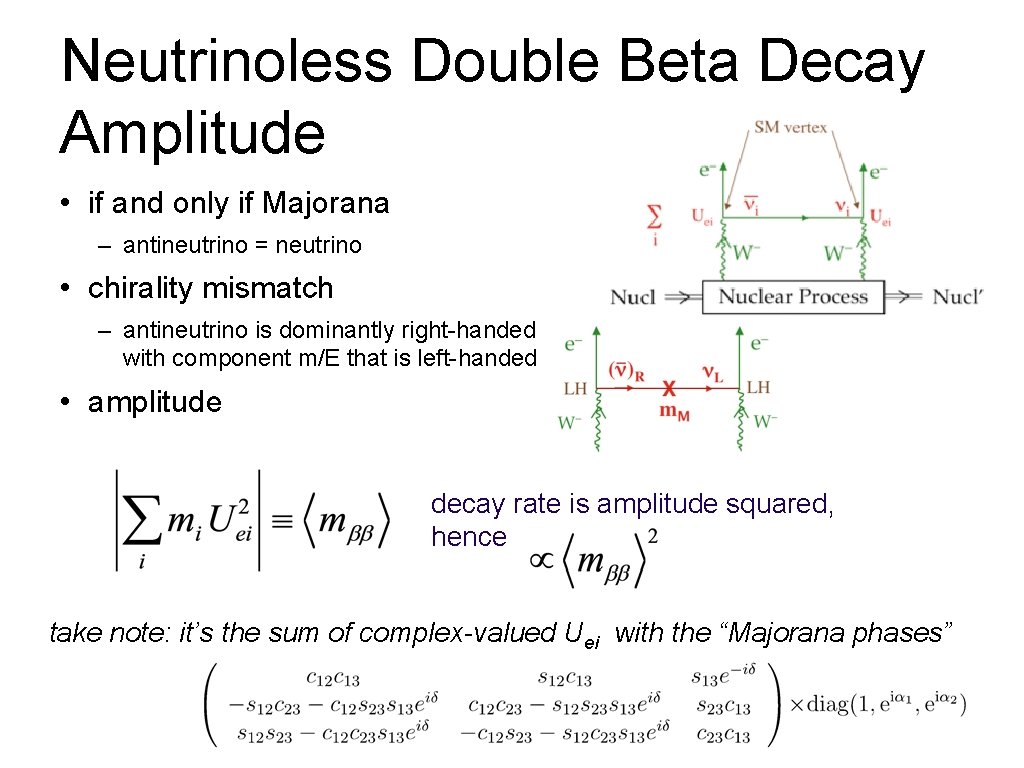
Neutrinoless Double Beta Decay Amplitude • if and only if Majorana – antineutrino = neutrino • chirality mismatch – antineutrino is dominantly right-handed with component m/E that is left-handed • amplitude decay rate is amplitude squared, hence take note: it’s the sum of complex-valued Uei with the “Majorana phases”
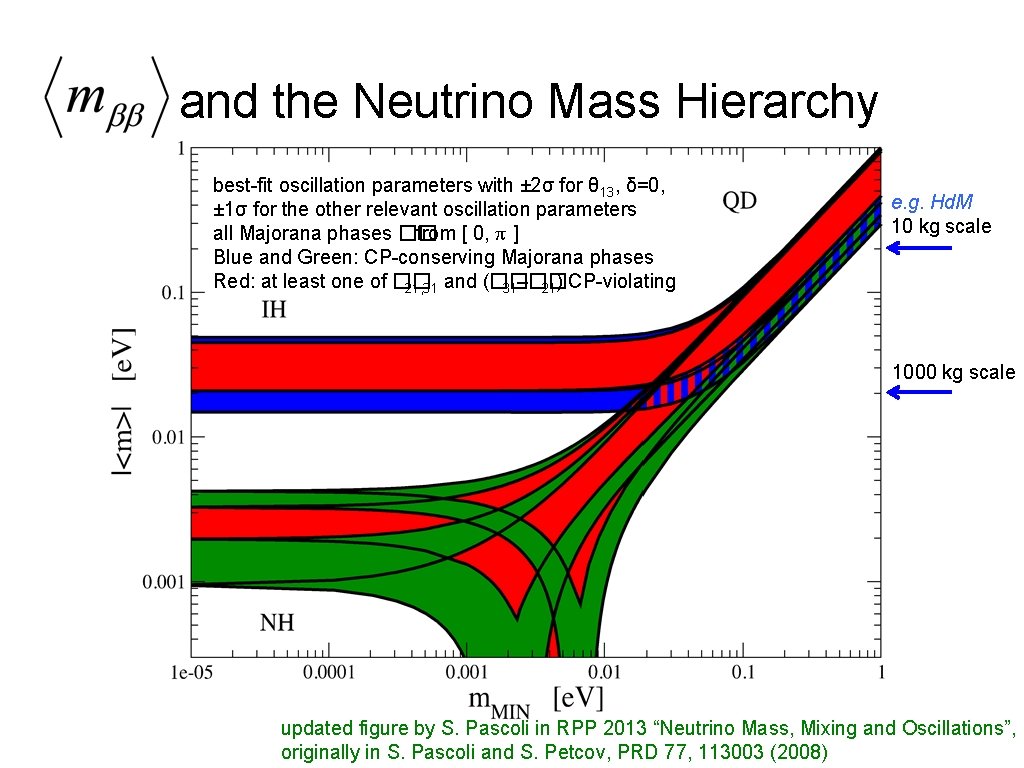
and the Neutrino Mass Hierarchy best-fit oscillation parameters with ± 2σ for θ 13, δ=0, ± 1σ for the other relevant oscillation parameters all Majorana phases �� from [ 0, π ] Blue and Green: CP-conserving Majorana phases Red: at least one of �� 21, 31 and (�� 31–�� 21) CP-violating e. g. Hd. M 10 kg scale 1000 kg scale updated figure by S. Pascoli in RPP 2013 “Neutrino Mass, Mixing and Oscillations”, originally in S. Pascoli and S. Petcov, PRD 77, 113003 (2008)

Which Isotope? • 35 naturally-occurring isotopes can double beta decay • double beta isotopes with Q > 2 Me. V listed below isotope Q-value [Me. V] natural abundance 48 Ca 4. 27 0. 187% CANDLES, AMo. RE 150 Nd 3. 37 5. 6% SNO+, DCBA 96 Zr 3. 35 2. 8% 100 Mo 3. 03 9. 8% MOON, AMo. RE, LUMINEU 82 Se 3. 00 8. 7% Super. NEMO, LUCIFER 116 Cd 2. 80 2. 53 2. 48 2. 29 2. 04 2. 01 7. 5% 34. 1% 8. 86% 5. 8% 7. 73% 11. 7% C 0 BRA 130 Te 136 Xe 124 Sn 76 Ge 110 Pd CUORE, SNO+ Kam. LAND-Zen, EXO, NEXT Sn-loaded scintillator GERDA, MAJORANA • 34 naturally-occurring isotopes can EC/EC, EC/β+, β+/β+ • only six of them have high enough Q to emit double positron
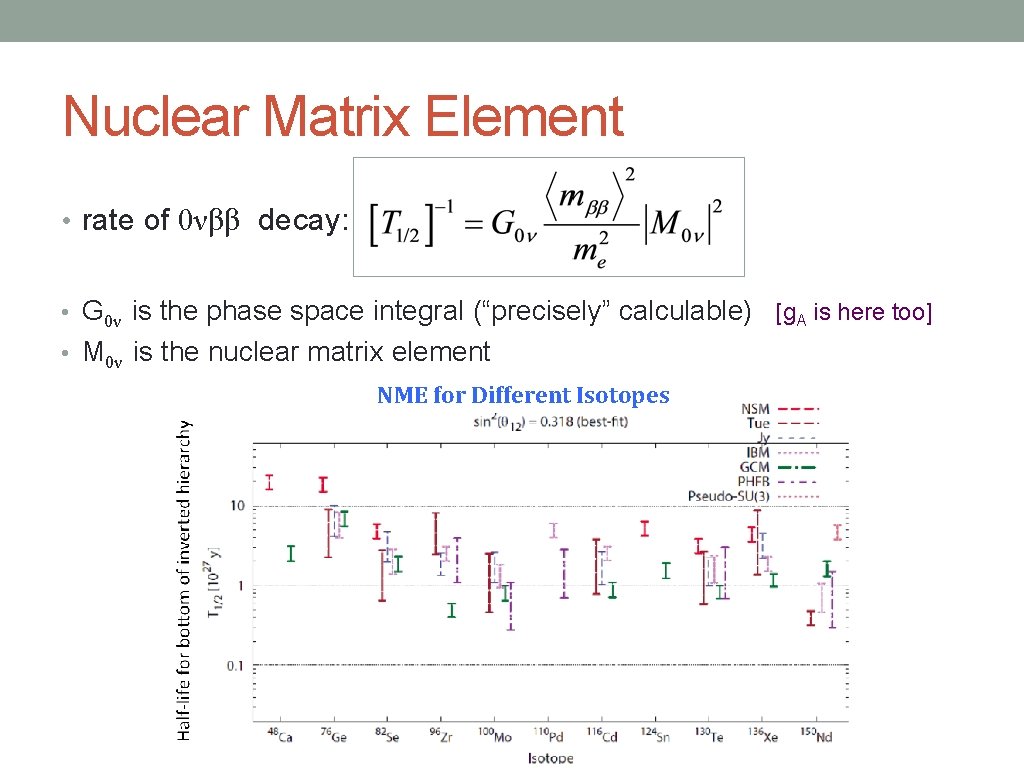
Nuclear Matrix Element • rate of 0νββ decay: • G 0ν is the phase space integral (“precisely” calculable) [g. A is here too] • M 0ν is the nuclear matrix element NME for Different Isotopes
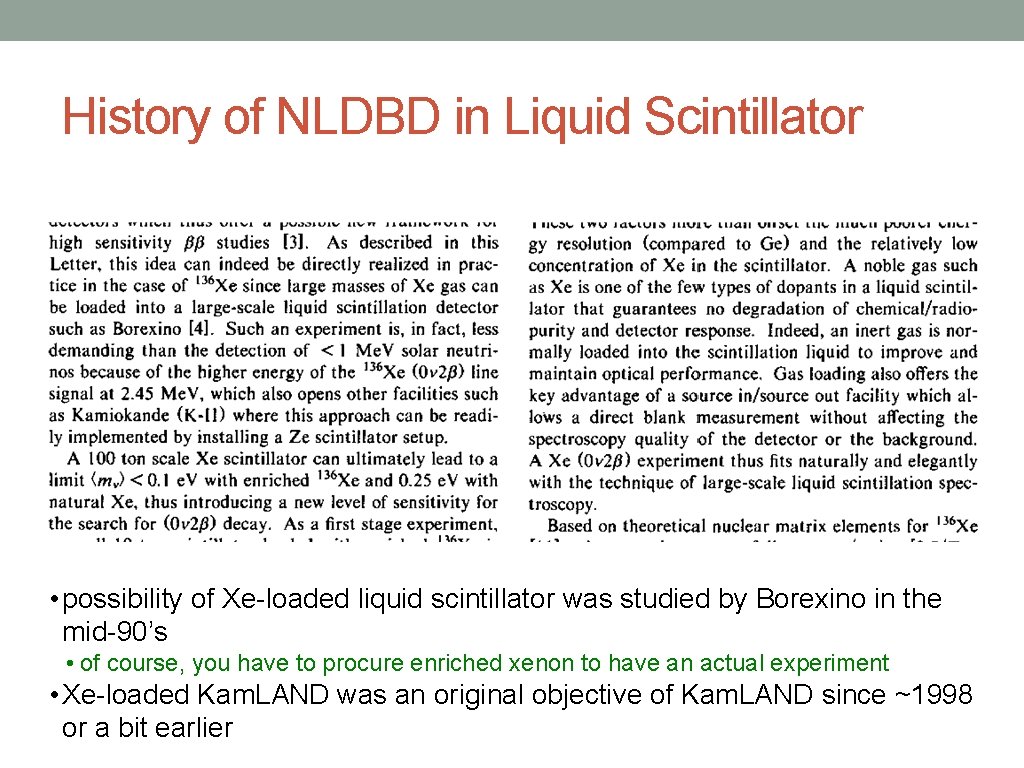
History of NLDBD in Liquid Scintillator • possibility of Xe-loaded liquid scintillator was studied by Borexino in the mid-90’s • of course, you have to procure enriched xenon to have an actual experiment • Xe-loaded Kam. LAND was an original objective of Kam. LAND since ~1998 or a bit earlier
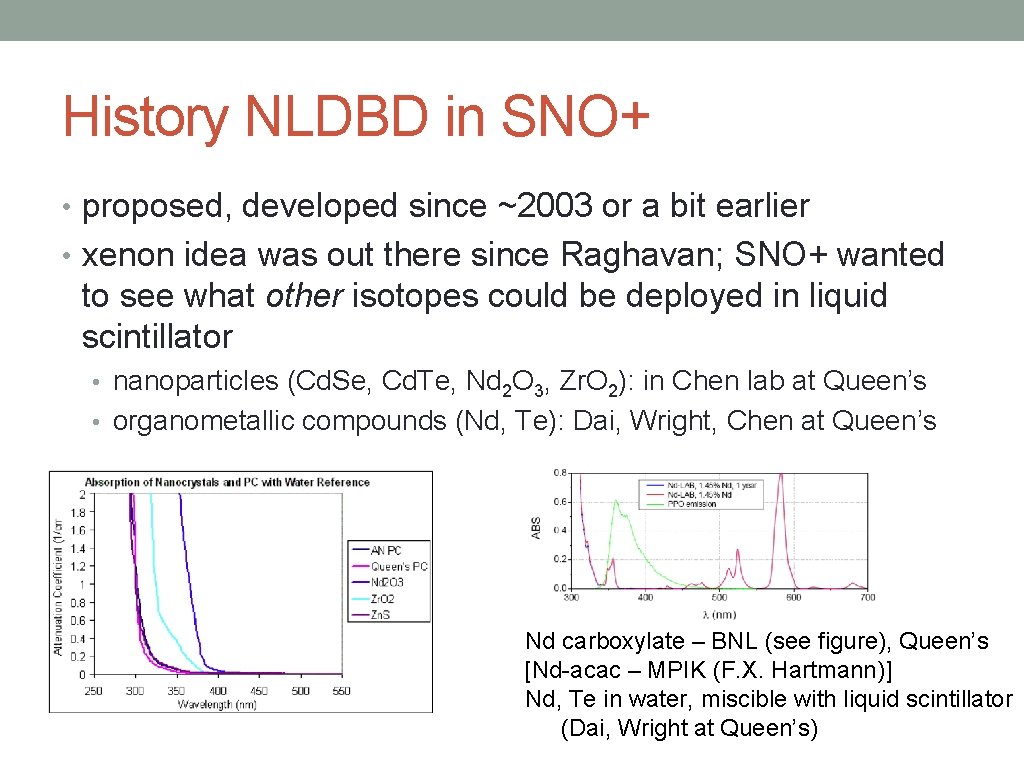
History NLDBD in SNO+ • proposed, developed since ~2003 or a bit earlier • xenon idea was out there since Raghavan; SNO+ wanted to see what other isotopes could be deployed in liquid scintillator • nanoparticles (Cd. Se, Cd. Te, Nd 2 O 3, Zr. O 2): in Chen lab at Queen’s • organometallic compounds (Nd, Te): Dai, Wright, Chen at Queen’s Nd carboxylate – BNL (see figure), Queen’s [Nd-acac – MPIK (F. X. Hartmann)] Nd, Te in water, miscible with liquid scintillator (Dai, Wright at Queen’s)
History NLDBD – Kam. LAND-Zen • Kam. LAND was funded to procure enriched • and became Kam. LAND-Zen 136 Xe in ~2009 • built mini-balloon, Xe handling and loading systems • deployed balloon filled with enriched scintillator • first results in 2012! [see talk by Itaru Shimizu] 136 Xe liquid
![SNO+ was funded in late 2010 SNO+ Nd [see talk by Szymon Manecki] SNO+](http://slidetodoc.com/presentation_image_h/273ed737946ac3c6d7e97c33066784fa/image-17.jpg "SNO+ was funded in late 2010 SNO+ Nd [see talk by Szymon Manecki] SNO+")
SNO+ was funded in late 2010 SNO+ Nd [see talk by Szymon Manecki] SNO+ Te • Nd has some advantages for NLDBD • enrichment of Nd using AVLIS facility in France brought to our attention at Neutrino 2006 as a possibility • and remained a remote possibility until ~2011 or a bit earlier • in late 2011 -early 2012, BNL surfactant approach (developed from Wb. LS R&D) successful at loading tellurium
Tellurium NLDBD Advantages especially important for loaded liquid scintillator approach to tonne-scale NLDBD • natural isotopic abundance 34. 1% • slow 2ν ββ background (Xe and Te are the slowest) • 2ν /0ν ratio is smallest • in the 0νββ ROI, backgrounds from U and Th can be rejected with high efficiency (214 Bi-Po)
Xenon NLDBD Advantages especially important for loaded liquid scintillator approach to tonne-scale NLDBD • 136 Xe argubly easiest and cheapest isotope to enrich • slow 2ν ββ background (Xe and Te are the slowest) • 2ν /0ν ratio is smallest • in the 0νββ ROI, backgrounds from U and Th can be rejected with high efficiency (214 Bi-Po)
![Ideal NLDBD Experiment Capabilities from NSAC Town Meeting in September 2014 [in Chicago] •](http://slidetodoc.com/presentation_image_h/273ed737946ac3c6d7e97c33066784fa/image-20.jpg "Ideal NLDBD Experiment Capabilities from NSAC Town Meeting in September 2014 [in Chicago] •")
Ideal NLDBD Experiment Capabilities from NSAC Town Meeting in September 2014 [in Chicago] • very low backgrounds: internal and external • good energy resolution (and calibration) • scalability – acceptable cost • tracking of betas to identify ββ event topology • large Q-value (ROI above U and Th backgrounds, larger phase space) – what SNO+ Nd was about • ability to remove or replace isotope to demonstrate possible signal The loaded liquid scintillator approach does these ones (in blue) very well.
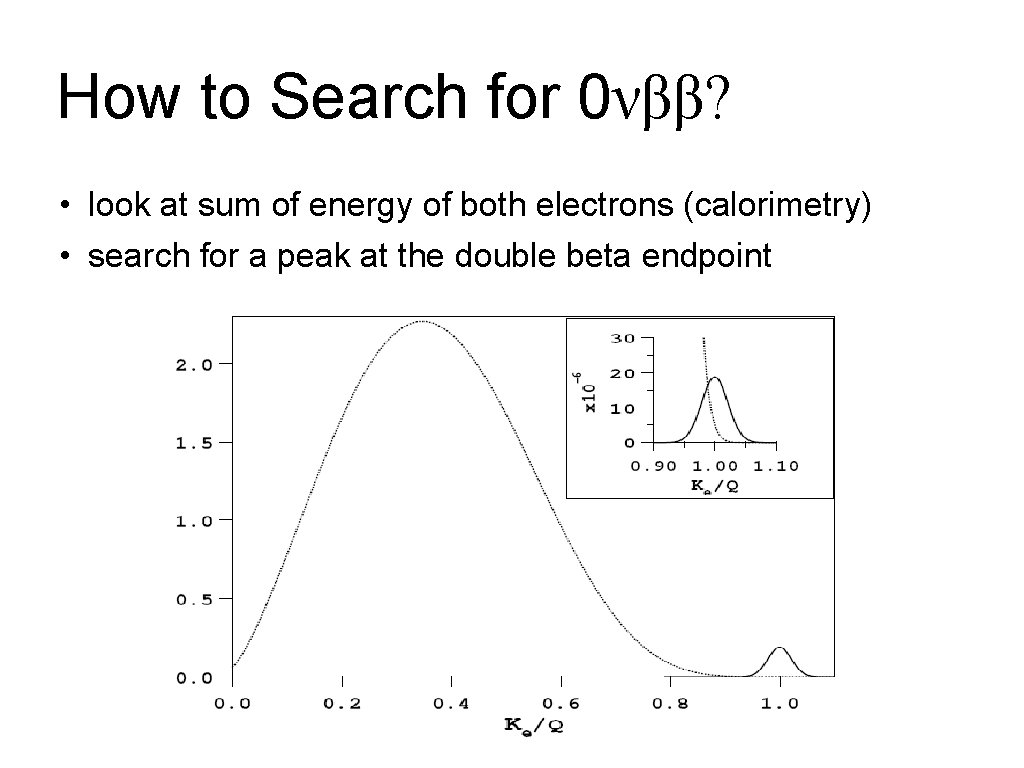
How to Search for 0νββ? • look at sum of energy of both electrons (calorimetry) • search for a peak at the double beta endpoint
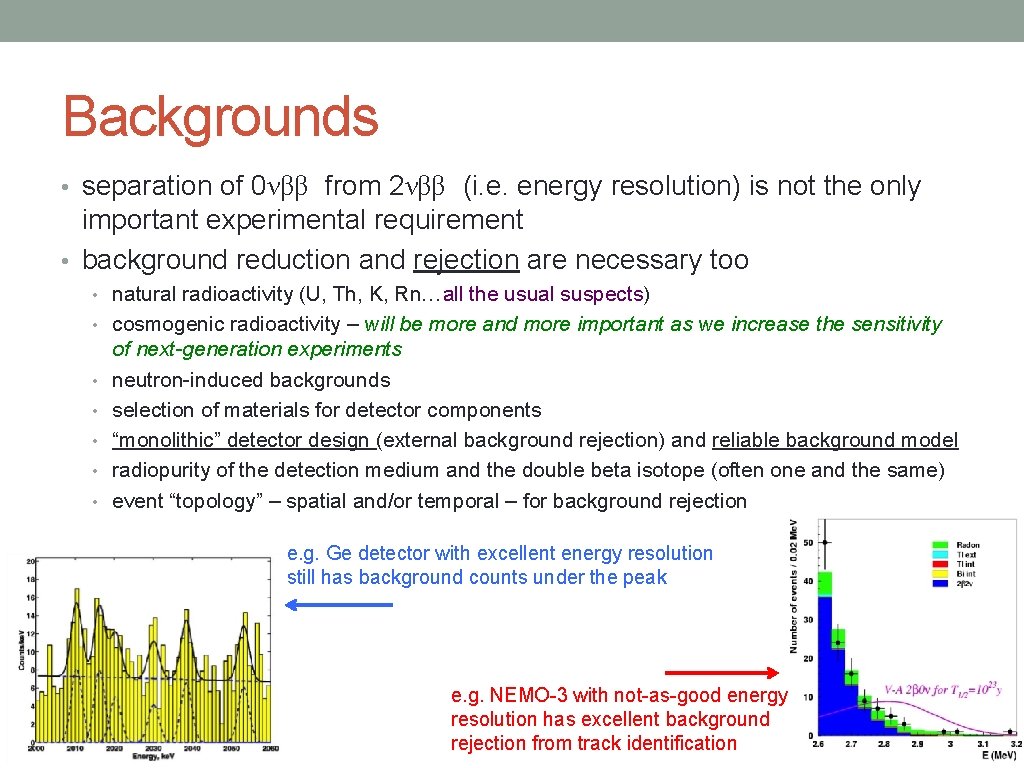
Backgrounds • separation of 0νββ from 2νββ (i. e. energy resolution) is not the only important experimental requirement • background reduction and rejection are necessary too • natural radioactivity (U, Th, K, Rn…all the usual suspects) • cosmogenic radioactivity – will be more and more important as we increase the sensitivity • • • of next-generation experiments neutron-induced backgrounds selection of materials for detector components “monolithic” detector design (external background rejection) and reliable background model radiopurity of the detection medium and the double beta isotope (often one and the same) event “topology” – spatial and/or temporal – for background rejection e. g. Ge detector with excellent energy resolution still has background counts under the peak e. g. NEMO-3 with not-as-good energy resolution has excellent background rejection from track identification
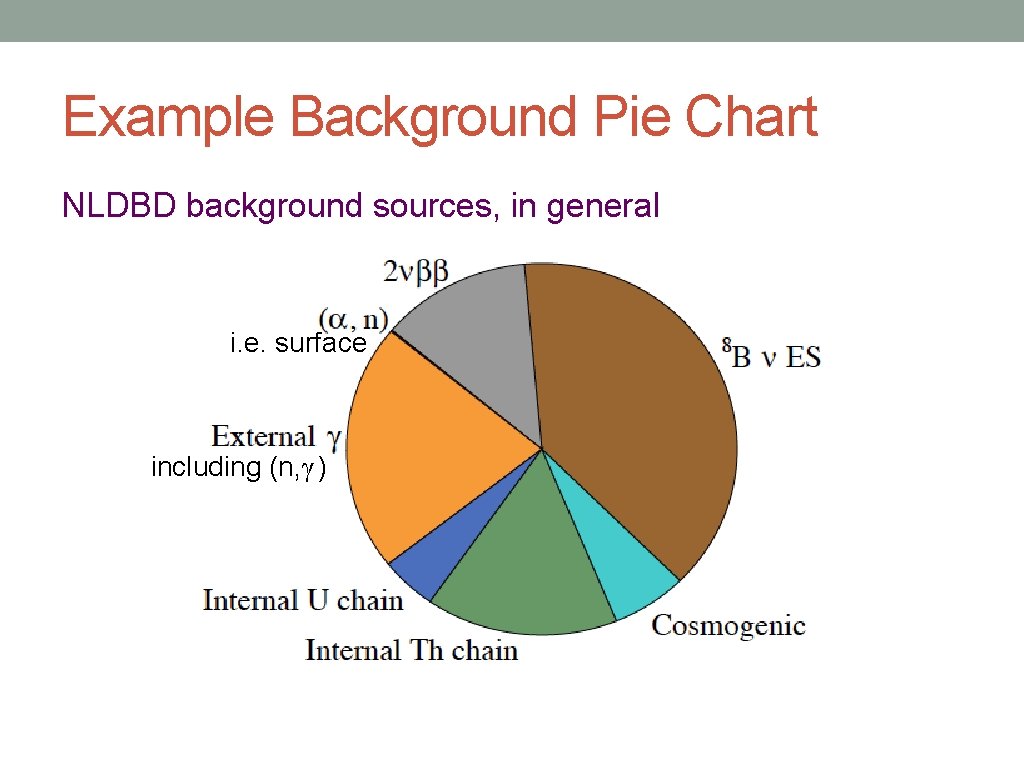
Example Background Pie Chart NLDBD background sources, in general i. e. surface including (n, γ )
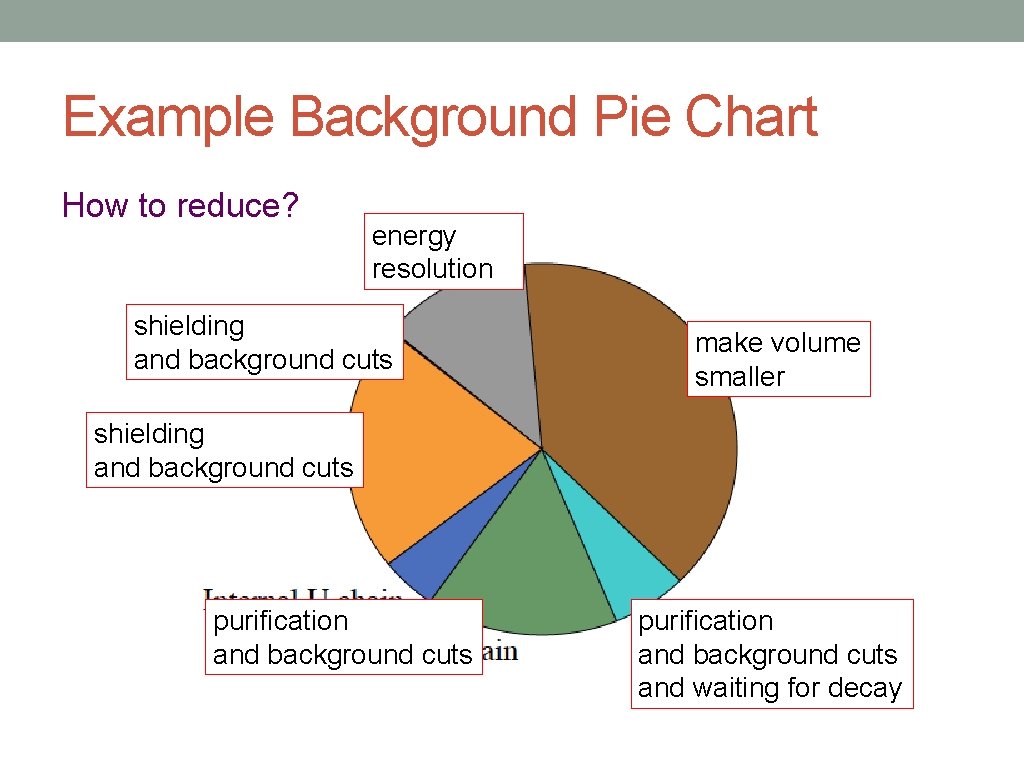
Example Background Pie Chart How to reduce? energy resolution shielding i. e. surface and background cuts make volume smaller shielding including (n, γcuts ) and background purification and background cuts and waiting for decay
Liquid Scintillator Requirements for NLDBD • Q: What is more important, energy resolution or low backgrounds? • A: both, of course… 1) liquid scintillator formulation must be amenable to purification to achieve ultra-low background 2) good energy resolution: intrinsic light yield, long attenuation length also important • transparency gives rise to better uniformity of energy response across large detector; smaller energy resolution systematics
Other Desirable Features for NLDBD in Liquid Scintillator • dense loading (maintaining suitable optical properties) • concentrate isotope in smaller volume – only way to reduce 8 B solar neutrino background • optimize light collection for the smaller volume (e. g. Winston cones) • scintillation fast timing • position reconstruction (resolution) to reject external backgrounds • coincidence background rejection • coupled with fine granularity light collection gives possibility of β/γ event topology “figure of merit” (i. e. single-site/multi-site discrimination)
More Desirable Features • pulse-shape discrimination • alphas not really direct background in ROI • PSD can help alpha ID in coincidence tagging, in the presence of other larger background rates • Cherenkov-scintillation separation • the only other way to reduce 8 B solar neutrino background
Summary In general, next-gen double beta decay experiments: 1. NEED TO BE BIG 2. HAVE GOOD ENERGY RESOLUTION 3. AND HAVE ULTRA-LOW BACKGROUND These are the most important requirements for tonne-scale NLDBD. Loaded liquid scintillator approach excels at #1 and #3.

Backup Slides
Sn-Loaded Liquid Scintillator • for NLDBD
- Slides: 30