
Neutrino Processes in Neutron Stars Evgeni E Kolomeitsev
- Slides: 42
Neutrino Processes in Neutron Stars Evgeni E. Kolomeitsev (Matej Bel University, Banska Bystrica, Slovakia)
What can we learn from neutron stars about processes in dense matter? Data: star temperatures and ages Interpretation: star cooling Theory: ns cooling in a nutshell luminosity of basic reactions Problems: one scenario for all data points How to calculate nuclear reactions in dense medium? Green’s function method Fermi liquid approach quasiparticles and effective charges Fermi liquid approach for superfluid medium anomalous Green’s functions conservation laws and Ward Identity
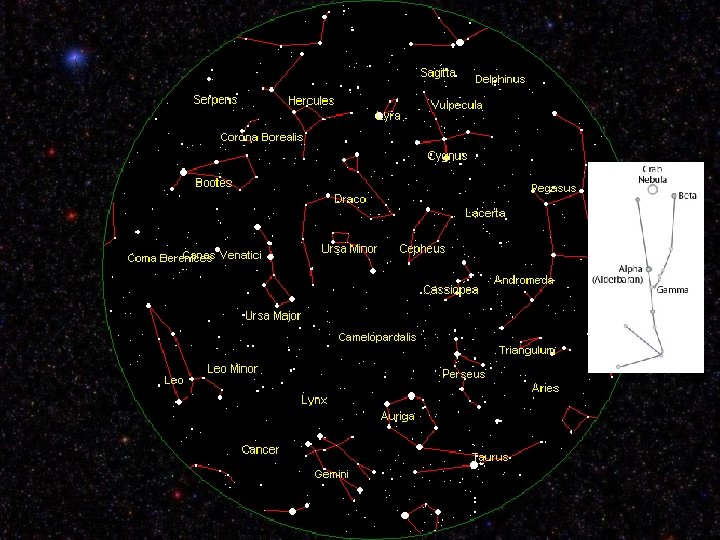
Northern hemisphere
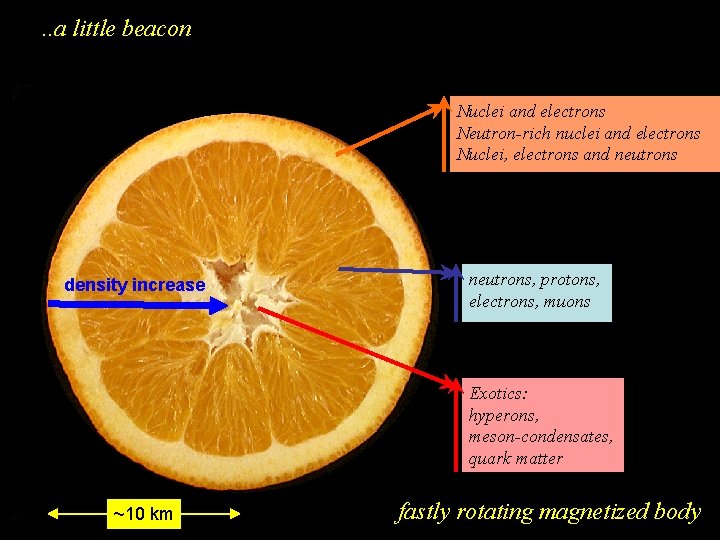
. . a little beacon Nuclei and electrons Neutron-rich nuclei and electrons Nuclei, electrons and neutrons density increase neutrons, protons, electrons, muons Exotics: hyperons, meson-condensates, quark matter ~10 km fastly rotating magnetized body
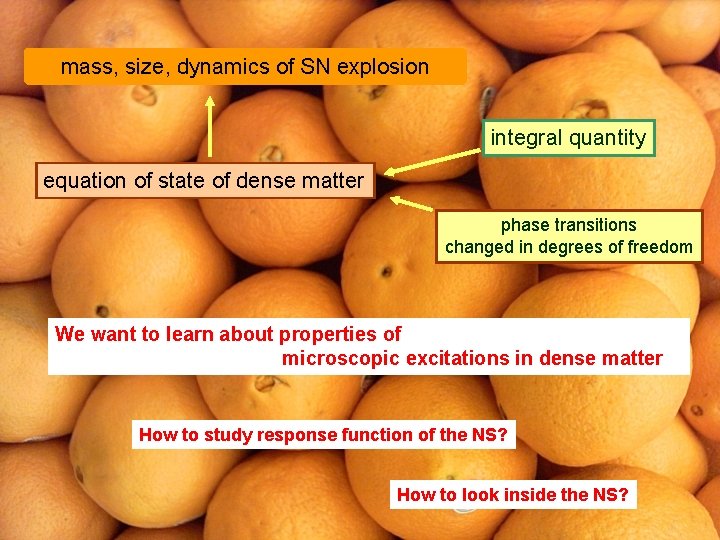
mass, size, dynamics of SN explosion integral quantity equation of state of dense matter phase transitions changed in degrees of freedom We want to learn about properties of microscopic excitations in dense matter How to study response function of the NS? How to look inside the NS?
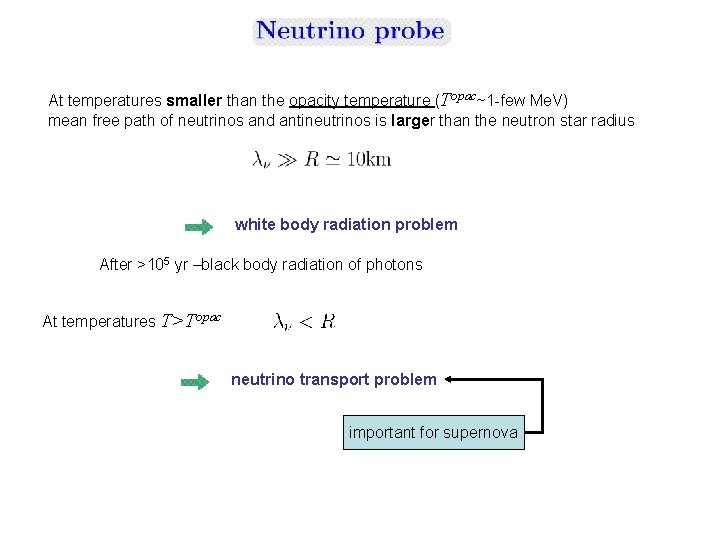
At temperatures smaller than the opacity temperature (Topac~1 -few Me. V) mean free path of neutrinos and antineutrinos is larger than the neutron star radius white body radiation problem After >105 yr –black body radiation of photons At temperatures T>Topac neutrino transport problem important for supernova
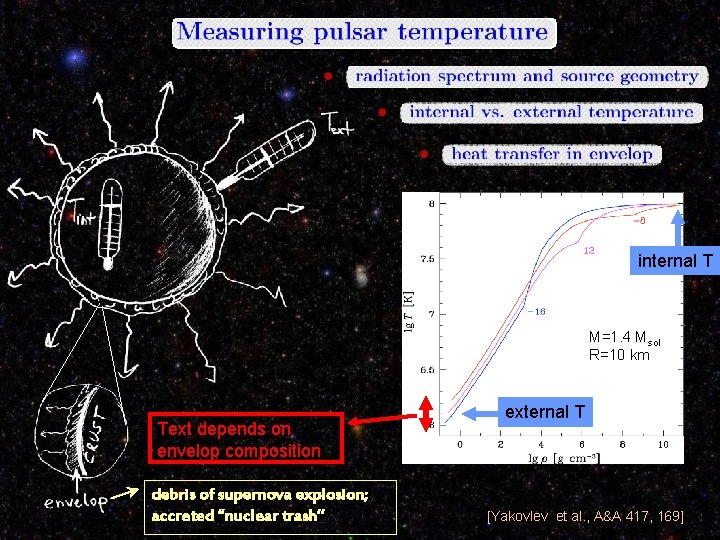
internal T M=1. 4 Msol R=10 km Text depends on envelop composition debris of supernova explosion; accreted “nuclear trash” external T [Yakovlev et al. , A&A 417, 169]
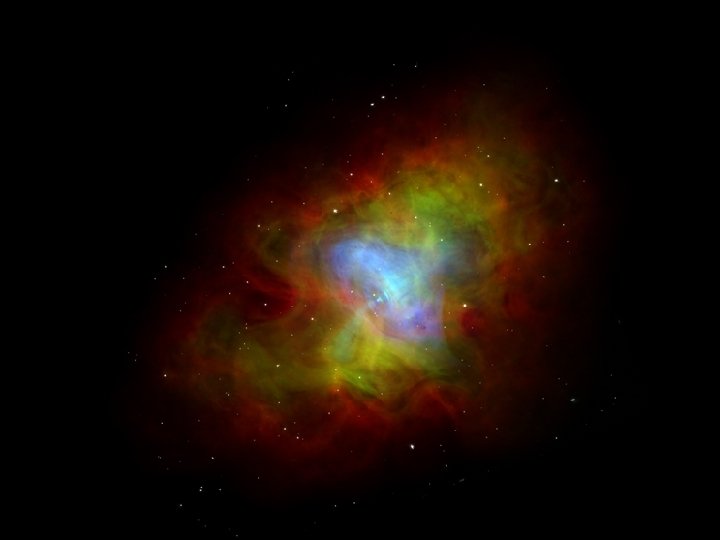
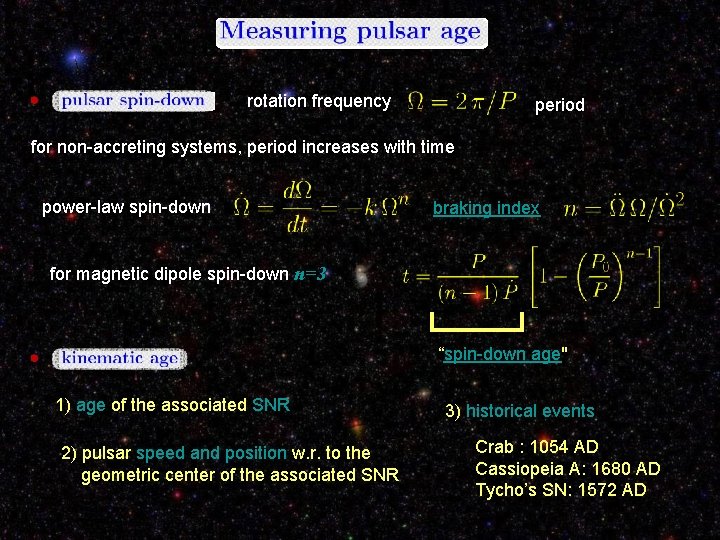
rotation frequency period for non-accreting systems, period increases with time power-law spin-down braking index for magnetic dipole spin-down n=3 “spin-down age" 1) age of the associated SNR 2) pulsar speed and position w. r. to the geometric center of the associated SNR 3) historical events Crab : 1054 AD Cassiopeia A: 1680 AD Tycho’s SN: 1572 AD
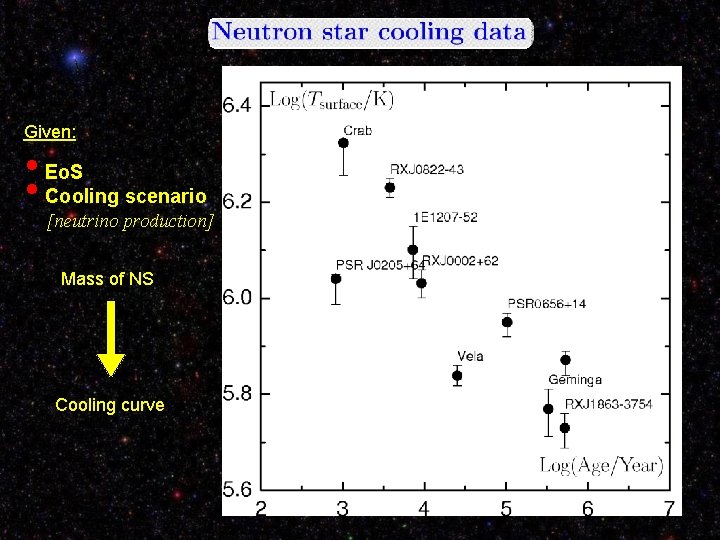
Given: • Eo. S • Cooling scenario [neutrino production] Mass of NS Cooling curve
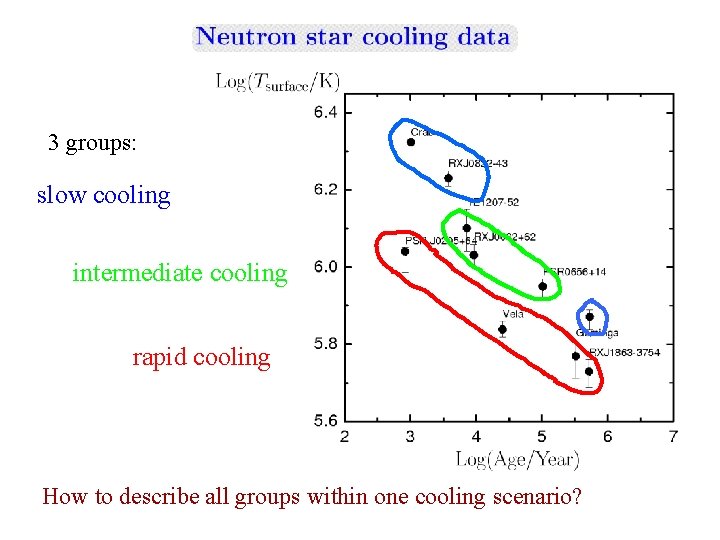
3 groups: slow cooling intermediate cooling rapid cooling How to describe all groups within one cooling scenario?
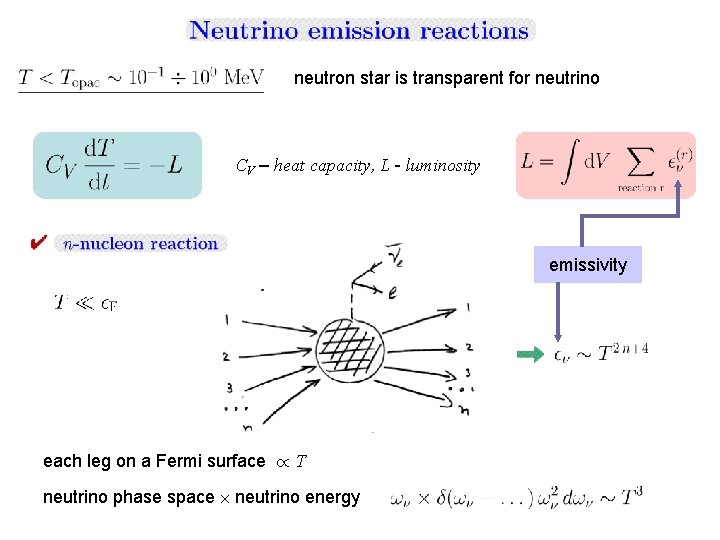
neutron star is transparent for neutrino CV – heat capacity, L - luminosity emissivity each leg on a Fermi surface / T neutrino phase space ´ neutrino energy
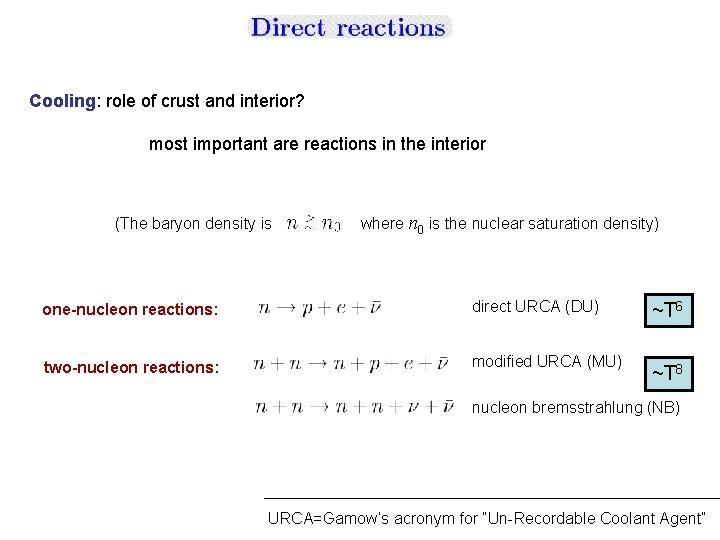
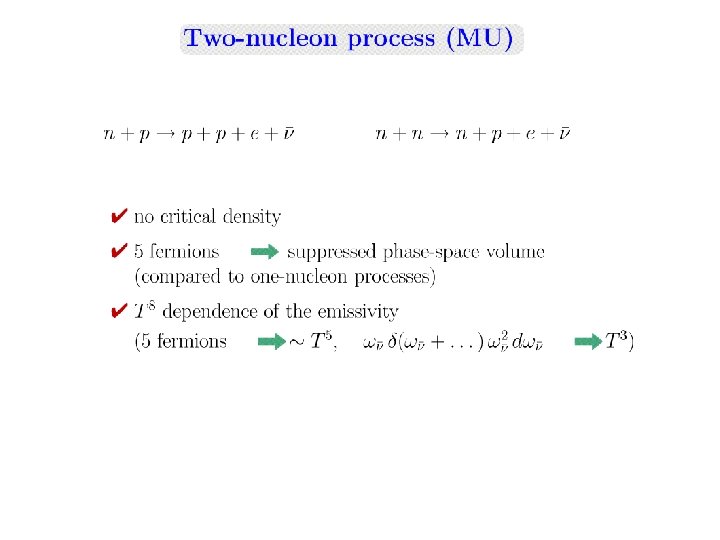
Cooling: role of crust and interior? most important are reactions in the interior (The baryon density is where n 0 is the nuclear saturation density) one-nucleon reactions: direct URCA (DU) two-nucleon reactions: modified URCA (MU) ~T 6 ~T 8 nucleon bremsstrahlung (NB) URCA=Gamow’s acronym for “Un-Recordable Coolant Agent”
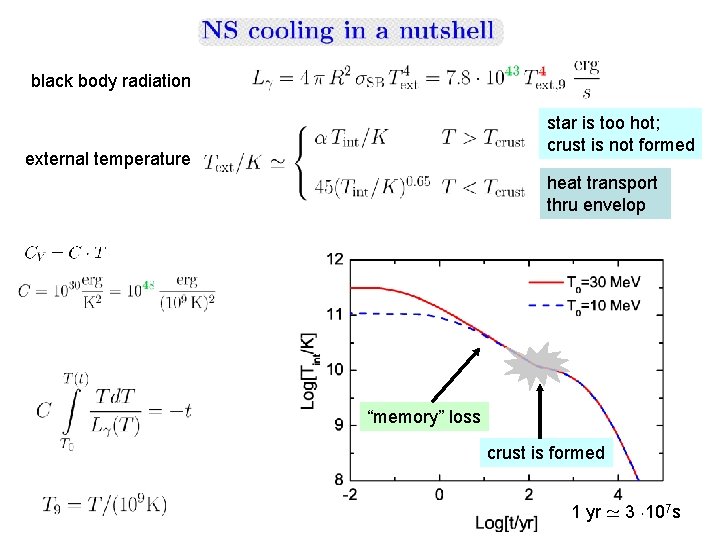
black body radiation star is too hot; crust is not formed external temperature heat transport thru envelop “memory” loss crust is formed 1 yr ' 3 ¢ 107 s
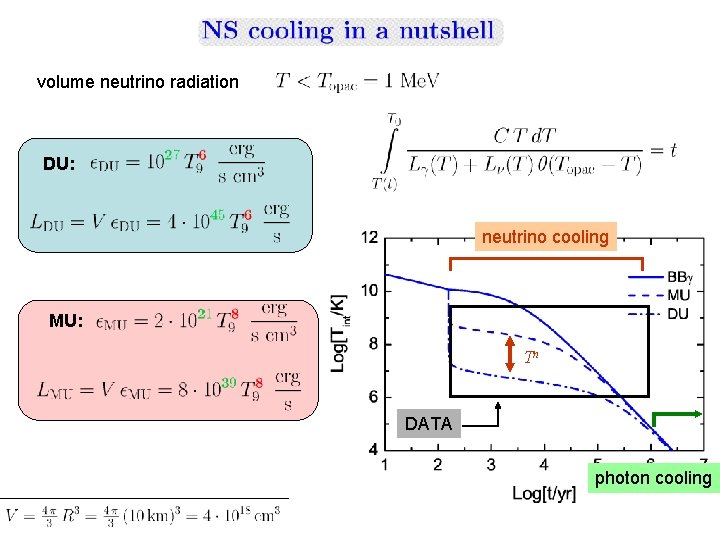
volume neutrino radiation DU: neutrino cooling MU: Tn DATA photon cooling
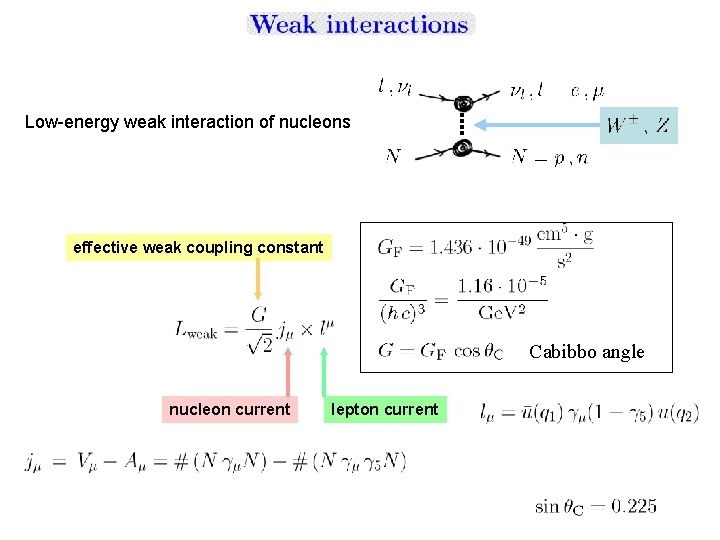
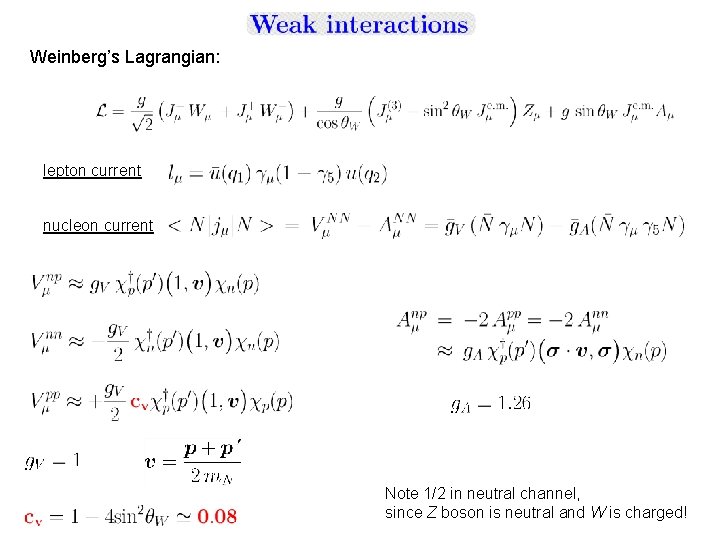
Low-energy weak interaction of nucleons effective weak coupling constant Cabibbo angle nucleon current lepton current
Weinberg’s Lagrangian: lepton current nucleon current Note 1/2 in neutral channel, since Z boson is neutral and W is charged!
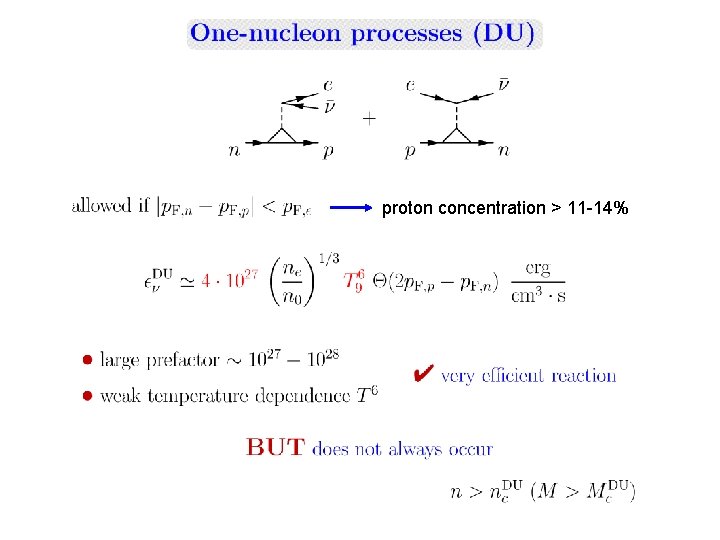
ONE-NUCLEON PROCESS DIRECT URCA
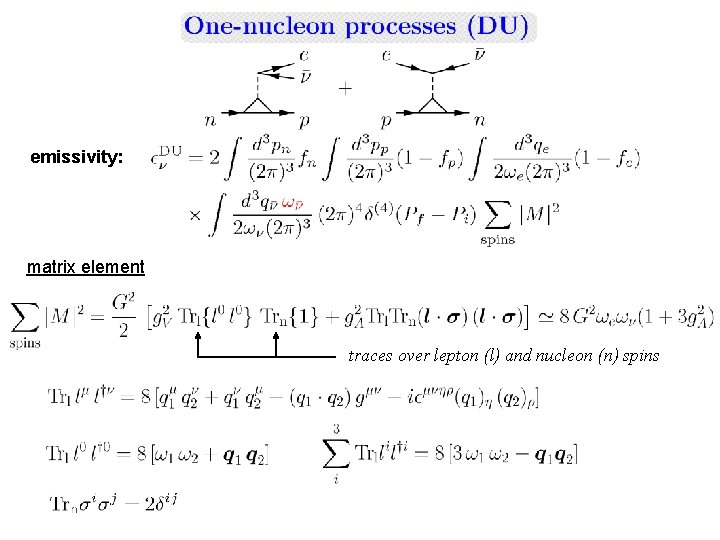
emissivity: matrix element traces over lepton (l) and nucleon (n) spins
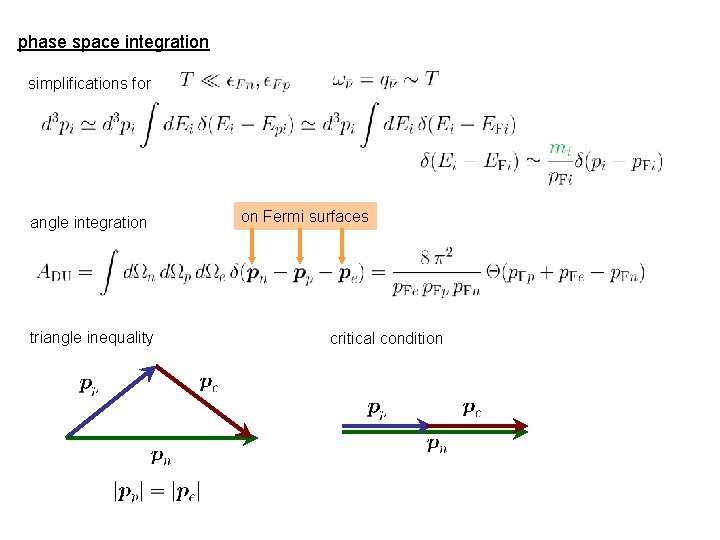
phase space integration simplifications for angle integration triangle inequality on Fermi surfaces critical condition
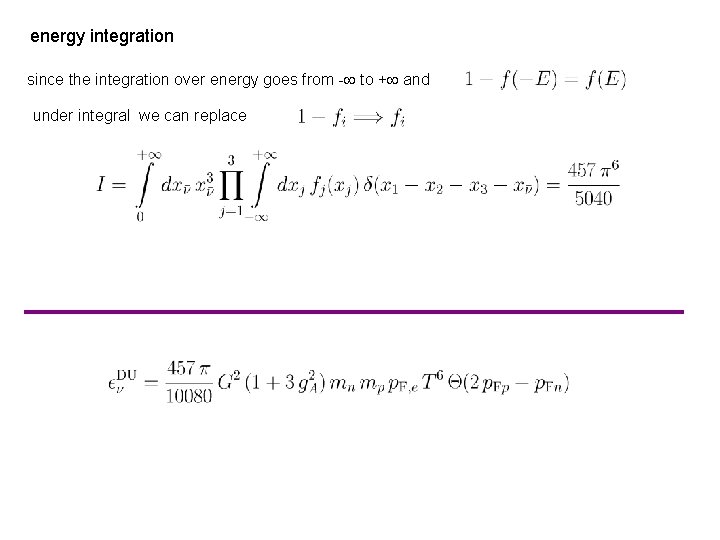
energy integration since the integration over energy goes from -¥ to +¥ and under integral we can replace
proton concentration > 11 -14%
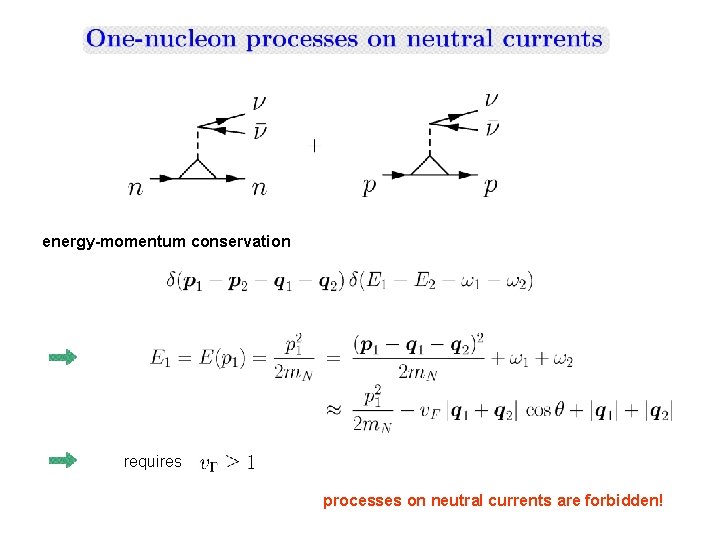
energy-momentum conservation requires processes on neutral currents are forbidden!
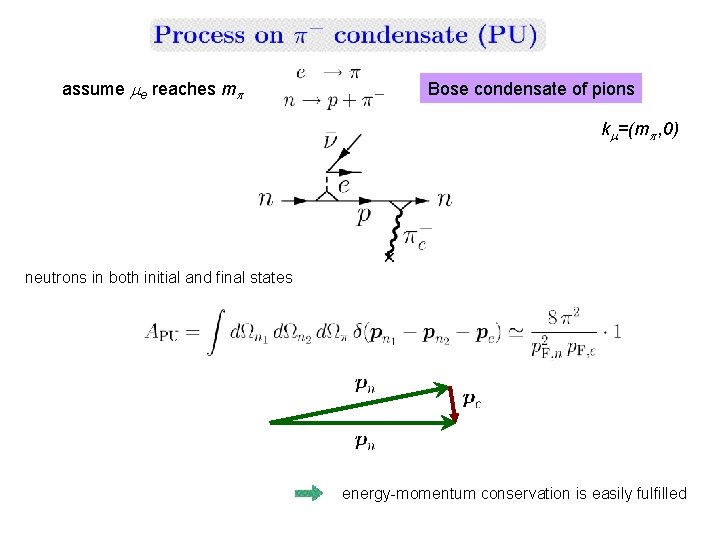
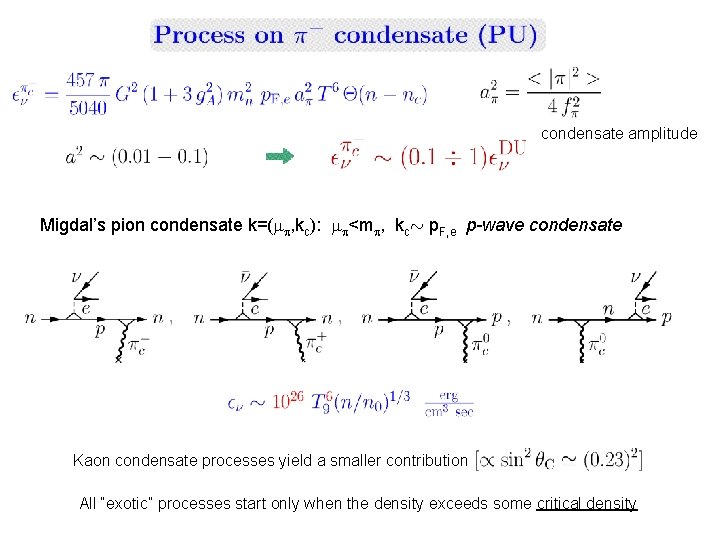
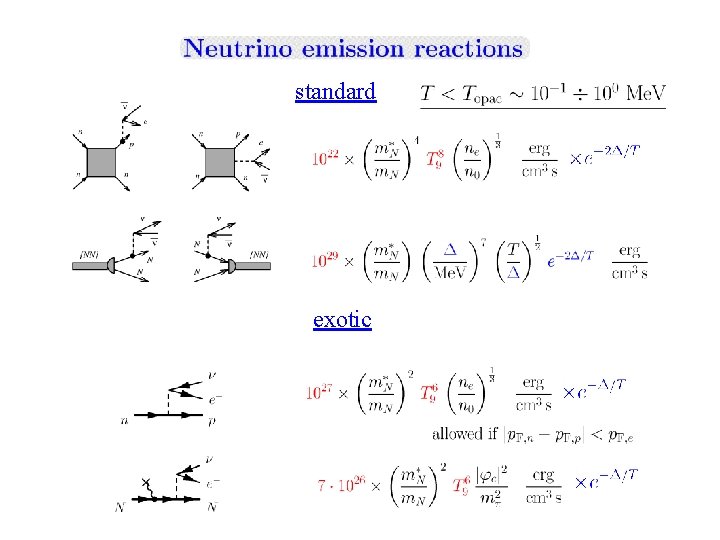
assume e reaches m Bose condensate of pions k =(m , 0) neutrons in both initial and final states energy-momentum conservation is easily fulfilled
condensate amplitude Migdal’s pion condensate k=( , kc): <m , kc» p. F, e p-wave condensate Kaon condensate processes yield a smaller contribution All “exotic” processes start only when the density exceeds some critical density
TWO-NUCLEON PROCESSES MODIFIED URCA
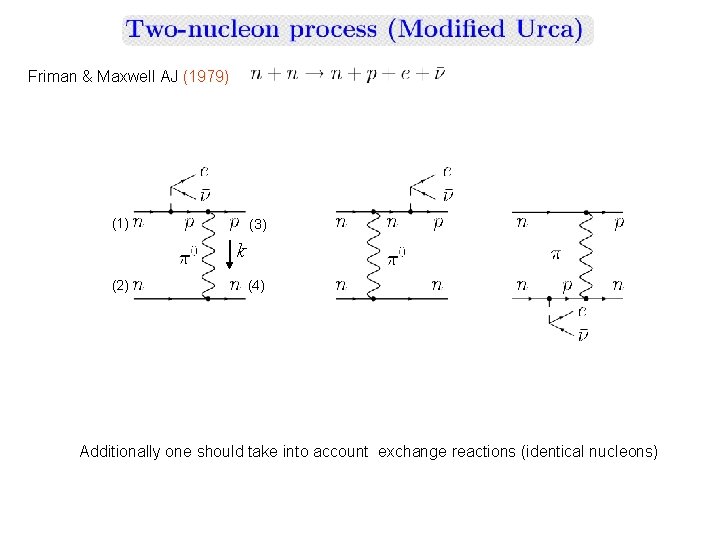
Friman & Maxwell AJ (1979) (1) (3) k (2) (4) Additionally one should take into account exchange reactions (identical nucleons)
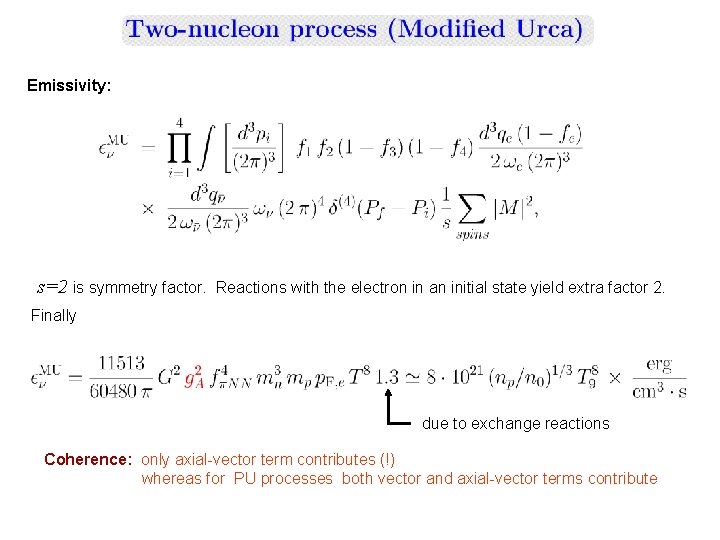
Emissivity: s=2 is symmetry factor. Reactions with the electron in an initial state yield extra factor 2. Finally due to exchange reactions Coherence: only axial-vector term contributes (!) whereas for PU processes both vector and axial-vector terms contribute
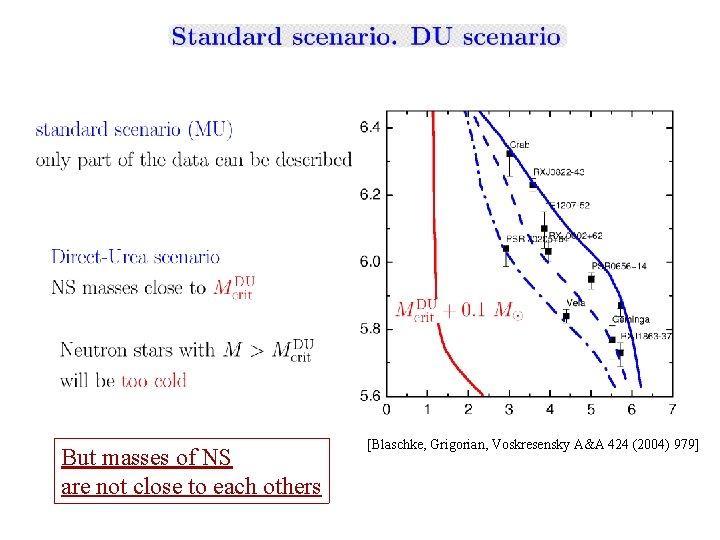
But masses of NS are not close to each others [Blaschke, Grigorian, Voskresensky A&A 424 (2004) 979]
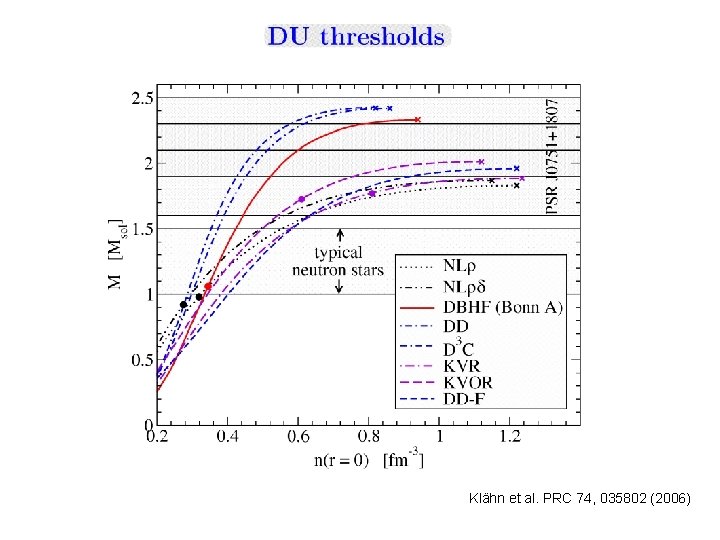
Klähn et al. PRC 74, 035802 (2006)
SUPERFLUID MATTER
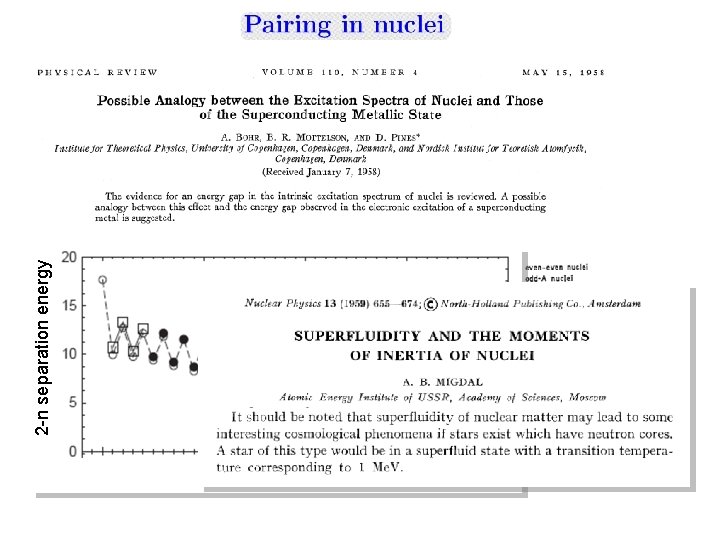
A 2 -n separation energy
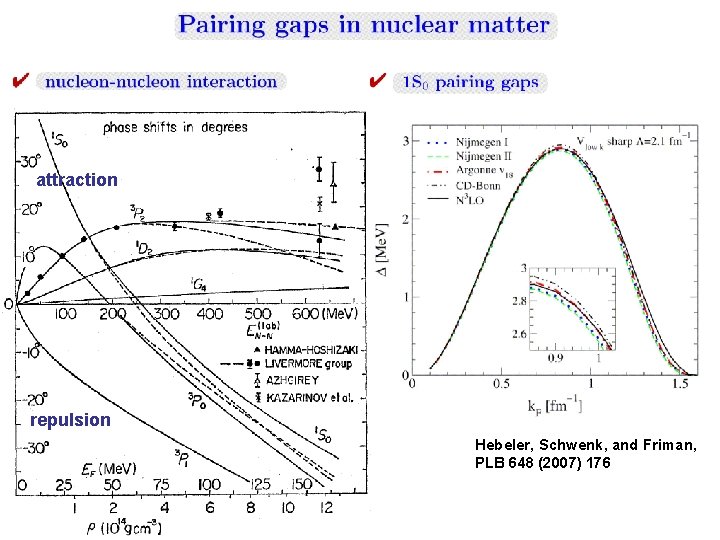
attraction repulsion Hebeler, Schwenk, and Friman, PLB 648 (2007) 176
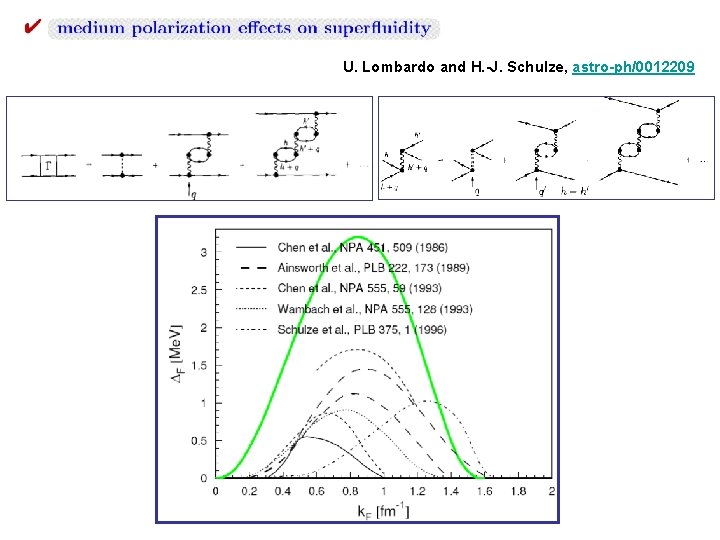
U. Lombardo and H. -J. Schulze, astro-ph/0012209
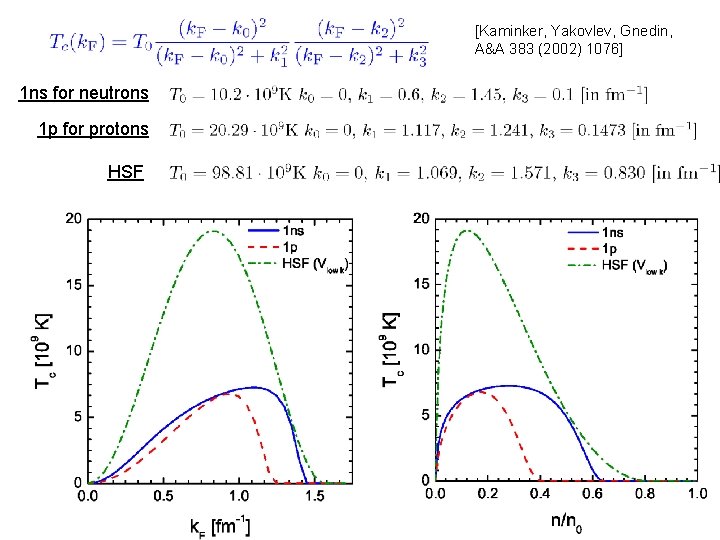
[Kaminker, Yakovlev, Gnedin, A&A 383 (2002) 1076] 1 ns for neutrons 1 p for protons HSF
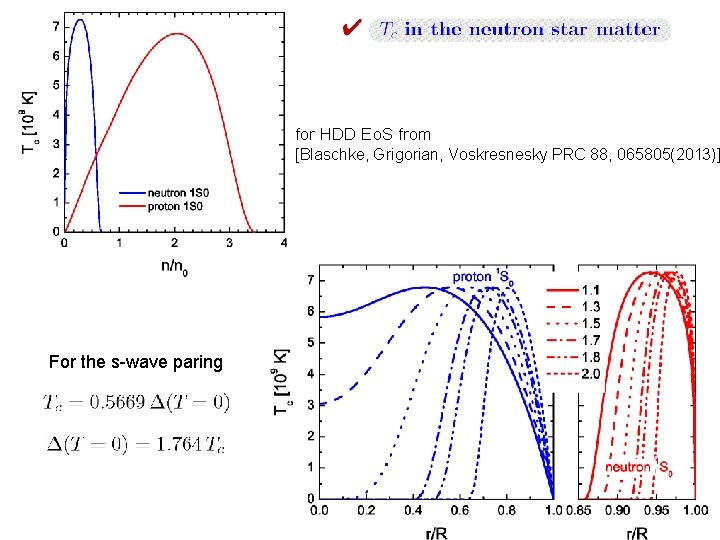
for HDD Eo. S from [Blaschke, Grigorian, Voskresnesky PRC 88, 065805(2013)] For the s-wave paring
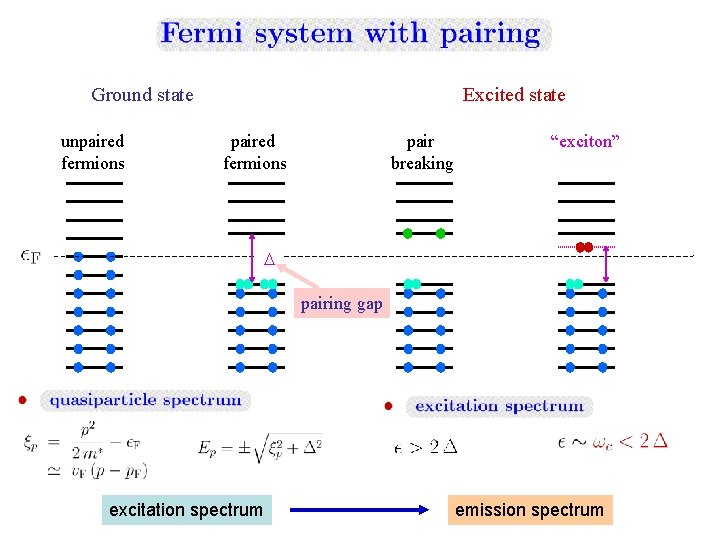
Ground state unpaired fermions Excited state paired fermions pair breaking “exciton” pairing gap excitation spectrum emission spectrum
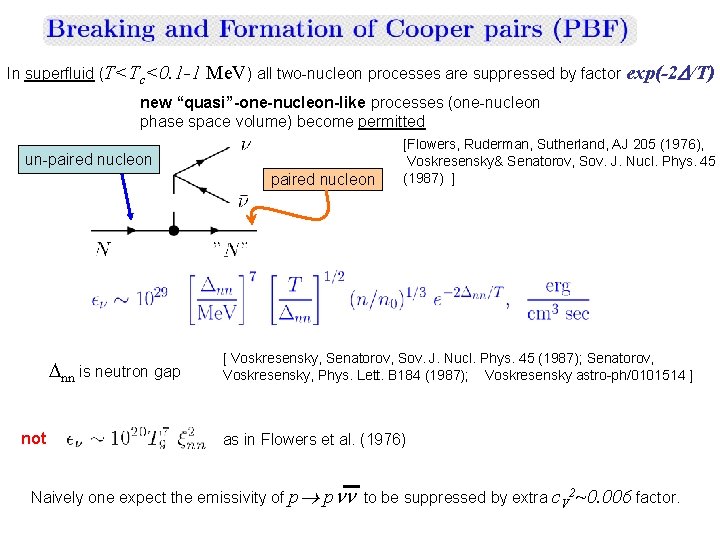
In superfluid (T<Tc<0. 1 -1 Me. V) all two-nucleon processes are suppressed by factor exp(-2 /T) new “quasi”-one-nucleon-like processes (one-nucleon phase space volume) become permitted un-paired nucleon nn is neutron gap not [Flowers, Ruderman, Sutherland, AJ 205 (1976), Voskresensky& Senatorov, Sov. J. Nucl. Phys. 45 (1987) ] [ Voskresensky, Senatorov, Sov. J. Nucl. Phys. 45 (1987); Senatorov, Voskresensky, Phys. Lett. B 184 (1987); Voskresensky astro-ph/0101514 ] as in Flowers et al. (1976) Naively one expect the emissivity of p p to be suppressed by extra c. V 2~0. 006 factor.
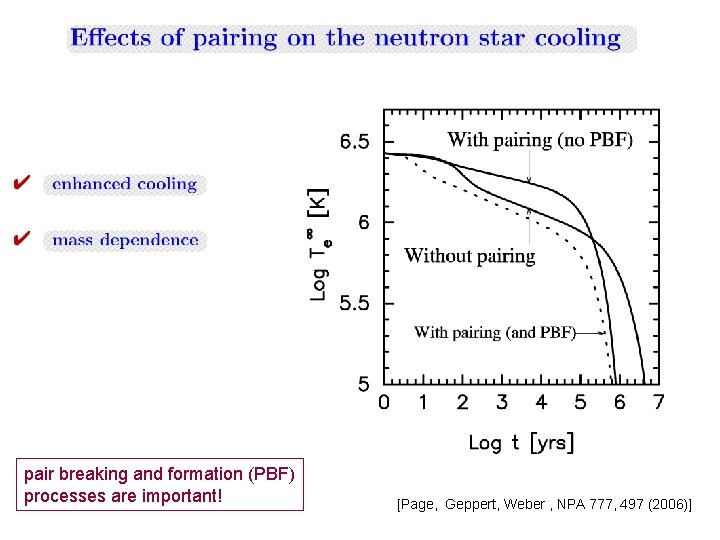
pair breaking and formation (PBF) processes are important! [Page, Geppert, Weber , NPA 777, 497 (2006)]
standard exotic
How to calculate nuclear reactions in dense medium? Green’s function method Fermi liquid approach quasiparticles and effective charges