
Neutrino oscillations and astrophysical fluxes solar CHOOZ reactor
- Slides: 24
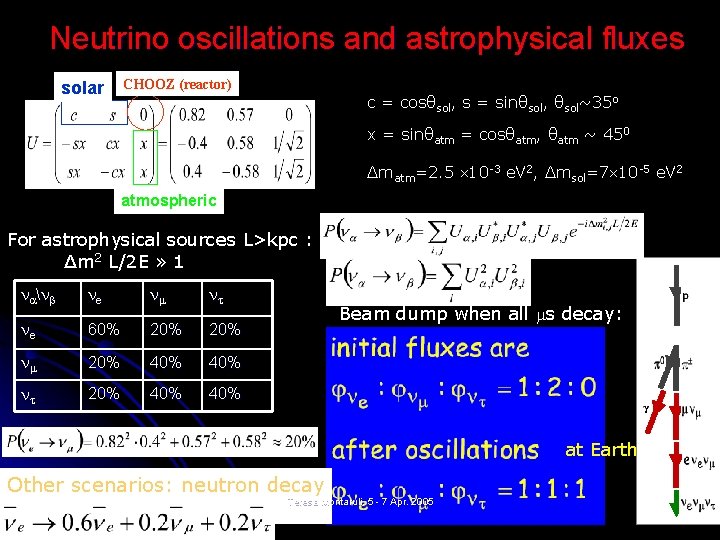
Neutrino oscillations and astrophysical fluxes solar CHOOZ (reactor) c = cosθsol, s = sinθsol, θsol~35 o x = sinθatm = cosθatm, θatm ~ 450 Δmatm=2. 5 10 -3 e. V 2, Δmsol=7 10 -5 e. V 2 atmospheric For astrophysical sources L>kpc : Δm 2 L/2 E » 1 e e 60% 20% 20% 40% 40% Beam dump when all s decay: at Earth Other scenarios: neutron decay Teresa Montaruli, 5 - 7 Apr. 2005
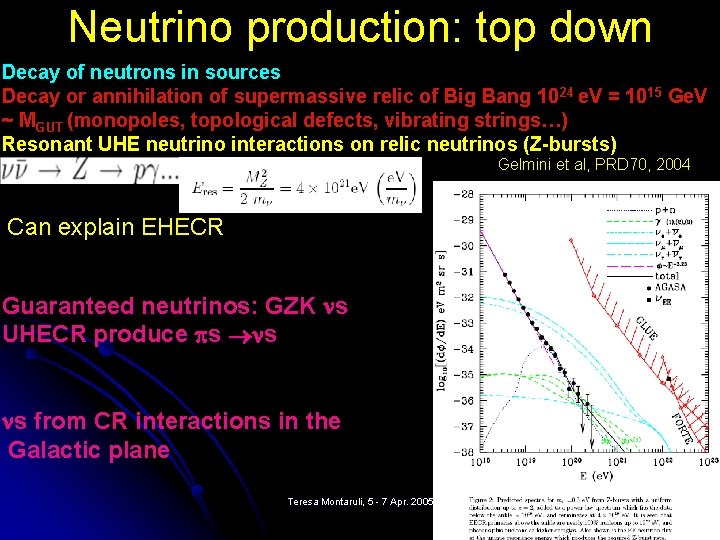
Neutrino production: top down Decay of neutrons in sources Decay or annihilation of supermassive relic of Big Bang 1024 e. V = 1015 Ge. V ~ MGUT (monopoles, topological defects, vibrating strings…) Resonant UHE neutrino interactions on relic neutrinos (Z-bursts) Gelmini et al, PRD 70, 2004 Can explain EHECR Guaranteed neutrinos: GZK s UHECR produce s s s from CR interactions in the Galactic plane Teresa Montaruli, 5 - 7 Apr. 2005
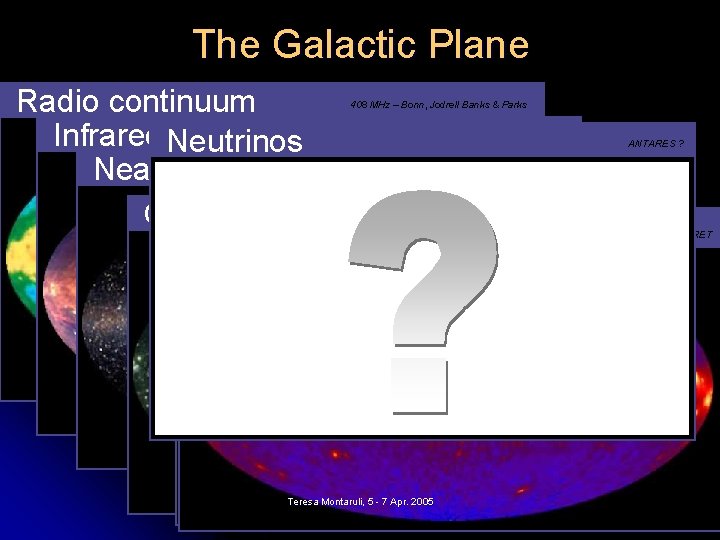
The Galactic Plane Radio continuum Infrared Neutrinos Near Infrared Optical X-Ray Gamma Ray 408 MHz – Bonn, Jodrell Banks & Parks Teresa Montaruli, 5 - 7 Apr. 2005 COBE / DIRBE ANTARES ? COBE / DIRBE Photomosaic - Lausten et al. 0. 25, 0. 75, 1. 5 ke. V – ROSAT / PSPC >100 Me. V – CGRO / EGRET
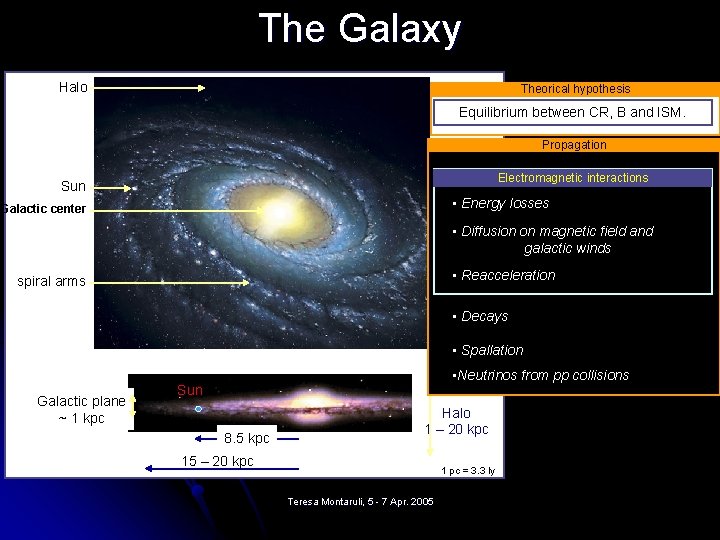
The Galaxy Halo Theorical hypothesis Equilibrium between CR, B and ISM. Propagation Electromagnetic interactions Sun Ring + bar • Energy losses Bulge • Diffusion on magnetic field and galactic winds Galactic center • Reacceleration spiral arms • Decays • Spallation Galactic plane ~ 1 kpc • Neutrinos from pp collisions Sun 8. 5 kpc Halo 1 – 20 kpc 15 – 20 kpc 1 pc = 3. 3 ly Teresa Montaruli, 5 - 7 Apr. 2005
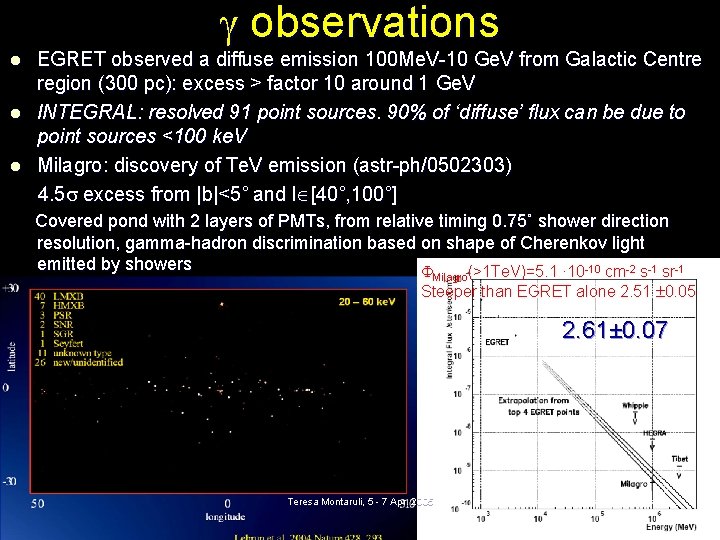
observations l l l EGRET observed a diffuse emission 100 Me. V-10 Ge. V from Galactic Centre region (300 pc): excess > factor 10 around 1 Ge. V INTEGRAL: resolved 91 point sources. 90% of ‘diffuse’ flux can be due to point sources <100 ke. V Milagro: discovery of Te. V emission (astr-ph/0502303) 4. 5 s excess from |b|<5˚ and l [40˚, 100˚] Covered pond with 2 layers of PMTs, from relative timing 0. 75˚ shower direction resolution, gamma-hadron discrimination based on shape of Cherenkov light emitted by showers F (>1 Te. V)=5. 1 · 10 -10 cm-2 s-1 sr-1 Milagro Steeper than EGRET alone 2. 51 0. 05 2. 61± 0. 07 Teresa Montaruli, 5 - 7 Apr. 2005
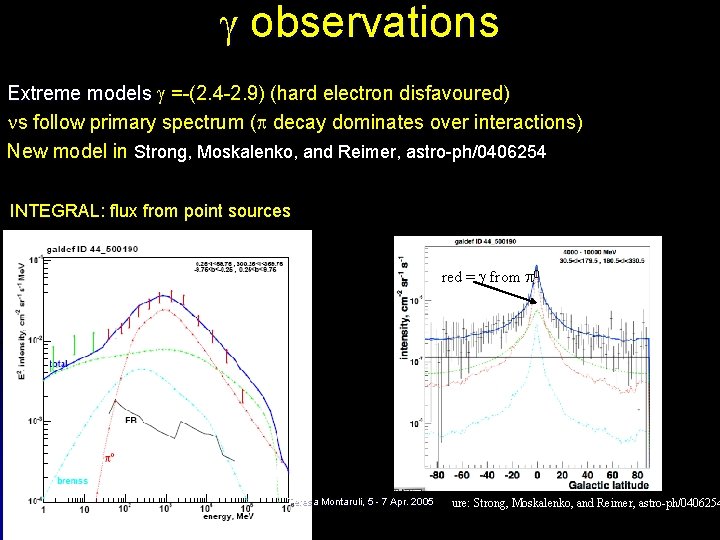
observations Extreme models =-(2. 4 -2. 9) (hard electron disfavoured) s follow primary spectrum ( decay dominates over interactions) New model in Strong, Moskalenko, and Reimer, astro-ph/0406254 INTEGRAL: flux from point sources red = from 0 Teresa Montaruli, 5 - 7 Apr. 2005 Figure: Strong, Moskalenko, and Reimer, astro-ph/0406254
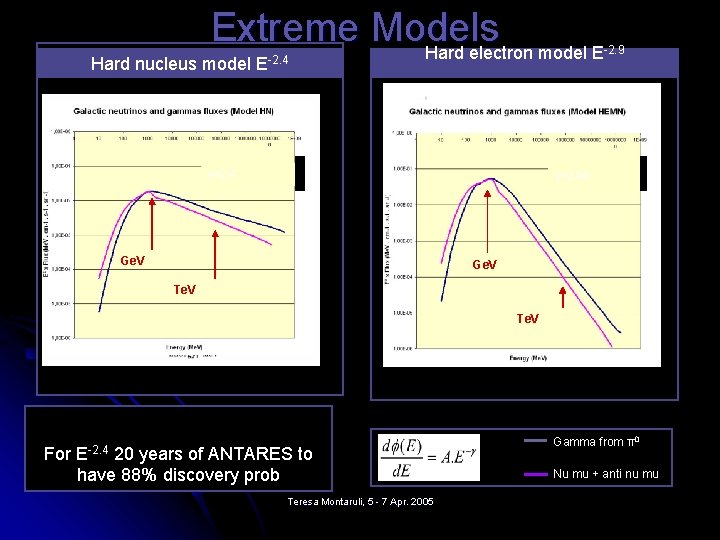
Extreme Models Hard electron model E Hard nucleus model E-2. 4 γ=2. 4 -2. 9 γ=2. 94 Ge. V Te. V Model HEMN Te. V Model HN For E-2. 4 20 years of ANTARES to have 88% discovery prob Teresa Montaruli, 5 - 7 Apr. 2005 Gamma from π0 Nu mu + anti nu mu
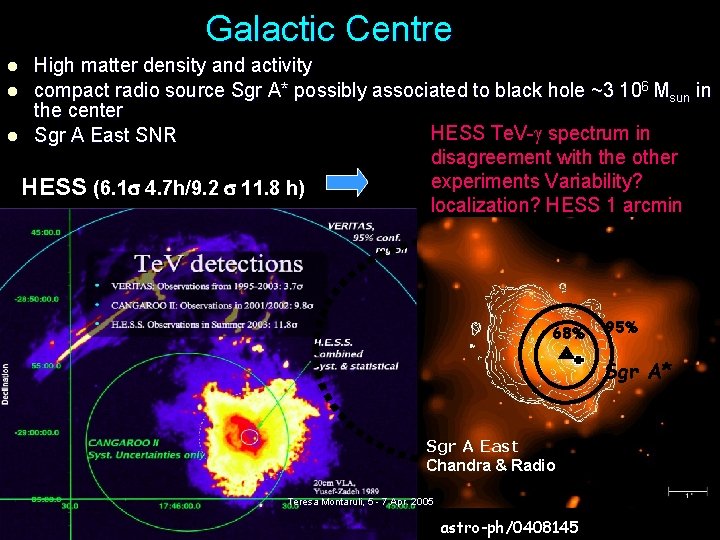
Galactic Centre High matter density and activity l compact radio source Sgr A* possibly associated to black hole ~3 106 Msun in the center HESS Te. V- spectrum in l Sgr A East SNR disagreement with the other experiments Variability? HESS (6. 1 s 4. 7 h/9. 2 s 11. 8 h) localization? HESS 1 arcmin around Sgr A* l 68% 95% Sgr A* Sgr A East Chandra & Radio Teresa Montaruli, 5 - 7 Apr. 2005 astro-ph/0408145
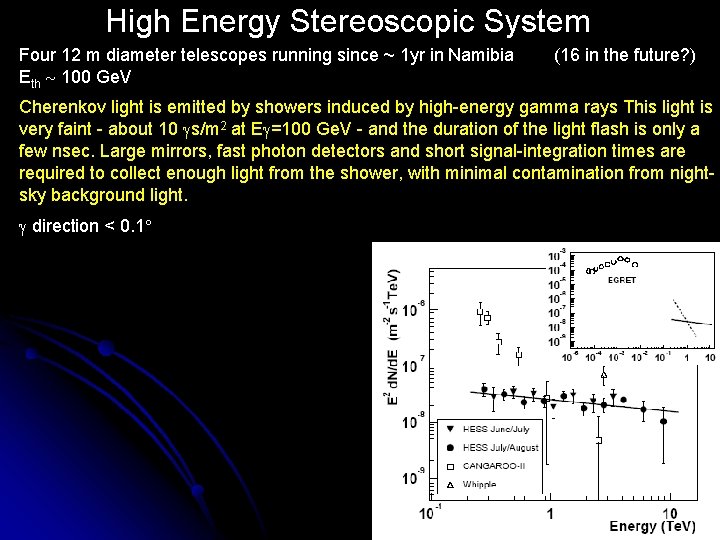
High Energy Stereoscopic System Four 12 m diameter telescopes running since ~ 1 yr in Namibia Eth 100 Ge. V (16 in the future? ) Cherenkov light is emitted by showers induced by high-energy gamma rays This light is very faint - about 10 s/m 2 at E =100 Ge. V - and the duration of the light flash is only a few nsec. Large mirrors, fast photon detectors and short signal-integration times are required to collect enough light from the shower, with minimal contamination from nightsky background light. direction < 0. 1
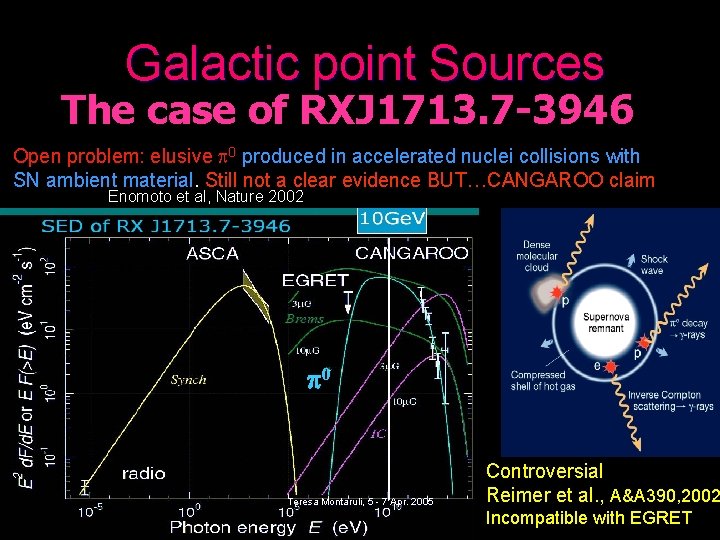
Galactic point Sources The case of RXJ 1713. 7 -3946 Open problem: elusive 0 produced in accelerated nuclei collisions with SN ambient material. Still not a clear evidence BUT…CANGAROO claim Enomoto et al, Nature 2002 0 Teresa Montaruli, 5 - 7 Apr. 2005 Controversial Reimer et al. , A&A 390, 2002 Incompatible with EGRET
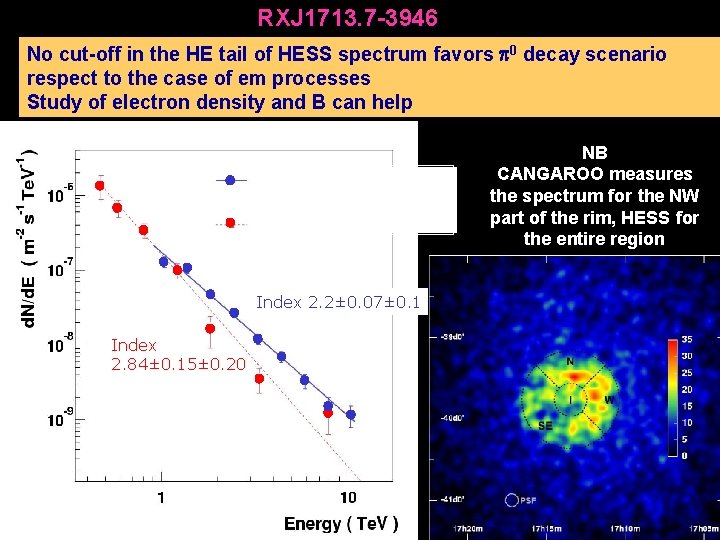
RXJ 1713. 7 -3946 No cut-off in the HE tail of HESS spectrum favors 0 decay scenario respect to the case of em processes Study of electron density and B can help H. E. S. S. : full remnant CANGAROO: hotspot Index 2. 2± 0. 07± 0. 1 Index 2. 84± 0. 15± 0. 20 preliminary NB CANGAROO measures the spectrum for the NW part of the rim, HESS for the entire region RXJ 1713. 7 -3946 Seen by HESS
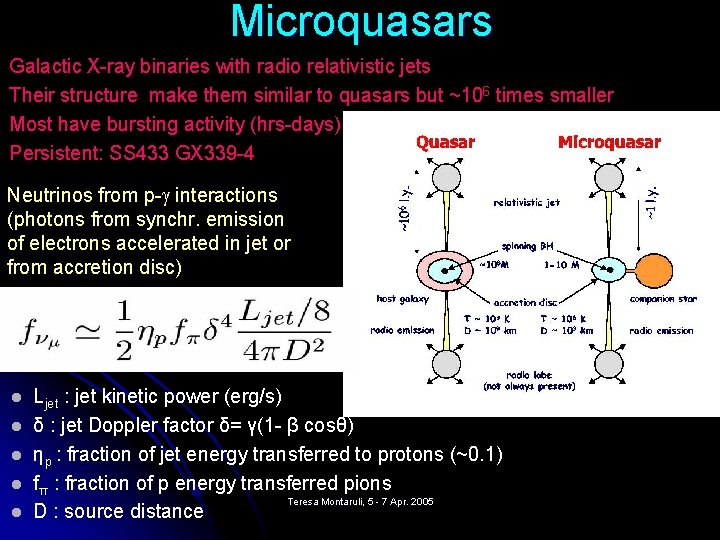
Microquasars Galactic X-ray binaries with radio relativistic jets Their structure make them similar to quasars but ~106 times smaller Most have bursting activity (hrs-days) Persistent: SS 433 GX 339 -4 Neutrinos from p- interactions (photons from synchr. emission of electrons accelerated in jet or from accretion disc) l l l Ljet : jet kinetic power (erg/s) δ : jet Doppler factor δ= γ(1 - β cosθ) ηp : fraction of jet energy transferred to protons (~0. 1) fπ : fraction of p energy transferred pions Teresa Montaruli, 5 - 7 Apr. 2005 D : source distance
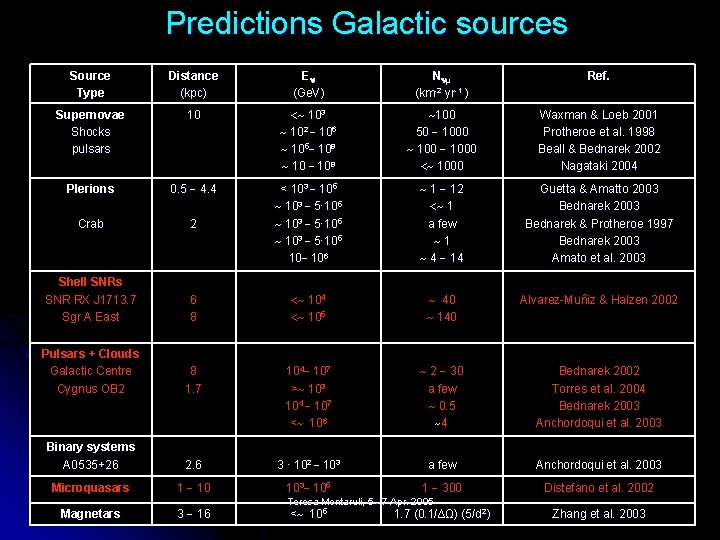
Predictions Galactic sources Source Type Distance (kpc) E (Ge. V) N μ (km-2 yr-1 ) Ref. Supernovae Shocks pulsars 10 103 102 106 105 108 100 50 1000 Waxman & Loeb 2001 Protheroe et al. 1998 Beall & Bednarek 2002 Nagataki 2004 Plerions 0. 5 4. 4 Crab 2 < 103 105 103 5· 105 10 106 1 12 1 a few 1 4 14 Guetta & Amatto 2003 Bednarek & Protheroe 1997 Bednarek 2003 Amato et al. 2003 Shell SNRs SNR RX J 1713. 7 Sgr A East 6 8 104 105 40 140 Alvarez-Muñiz & Halzen 2002 Pulsars + Clouds Galactic Centre Cygnus OB 2 8 1. 7 104 107 > 103 104 107 < 106 2 30 a few 0. 5 4 Bednarek 2002 Torres et al. 2004 Bednarek 2003 Anchordoqui et al. 2003 Binary systems A 0535+26 2. 6 3 · 102 103 a few Anchordoqui et al. 2003 Microquasars 1 10 103 105 1 300 Distefano et al. 2002 Magnetars 3 16 Teresa Montaruli, 5 - 7 Apr. 2005 < 105 1. 7 (0. 1/∆Ω) (5/d 2) Zhang et al. 2003
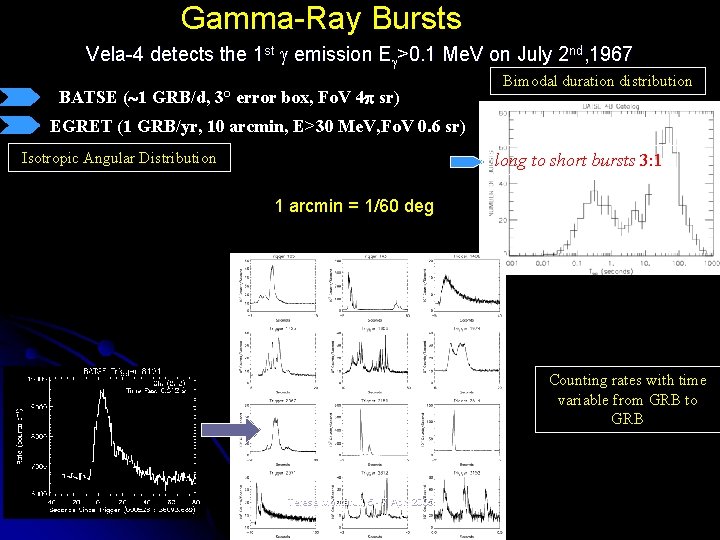
Gamma-Ray Bursts Vela-4 detects the 1 st emission E >0. 1 Me. V on July 2 nd, 1967 BATSE ( 1 GRB/d, 3° error box, Fo. V 4 sr) Bimodal duration distribution EGRET (1 GRB/yr, 10 arcmin, E>30 Me. V, Fo. V 0. 6 sr) Isotropic Angular Distribution long to short bursts 3: 1 1 arcmin = 1/60 deg Counting rates with time variable from GRB to GRB Teresa Montaruli, 5 - 7 Apr. 2005
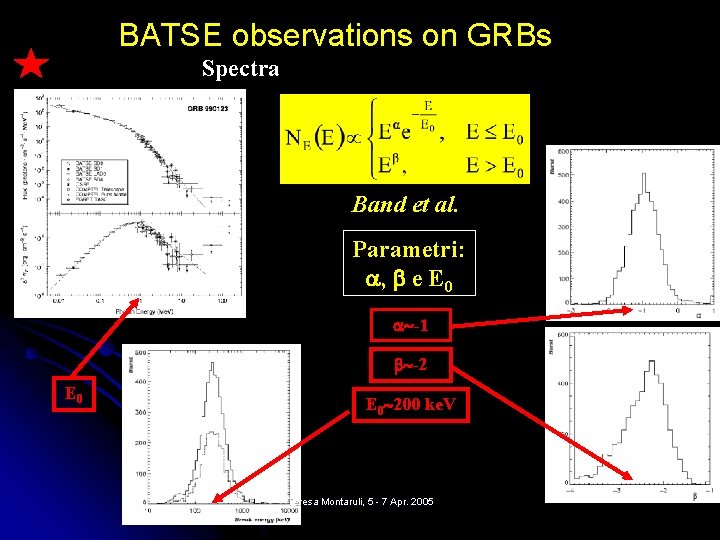
BATSE observations on GRBs Spectra Band et al. Parametri: , e E 0 -1 -2 E 0 200 ke. V Teresa Montaruli, 5 - 7 Apr. 2005
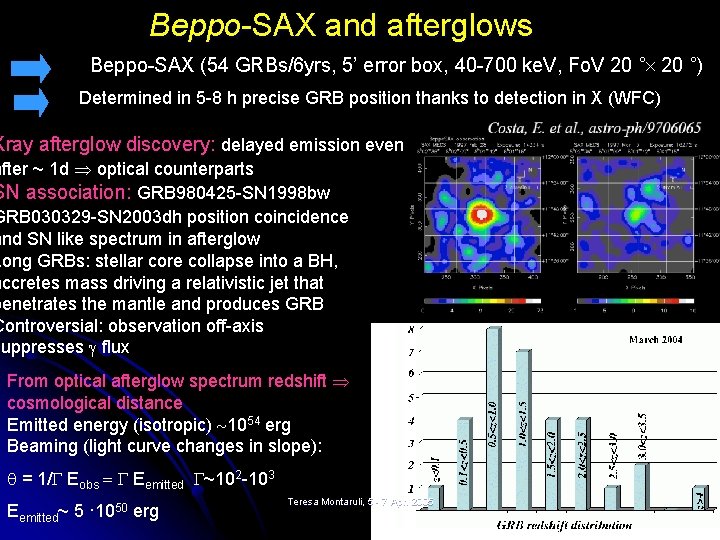
Beppo-SAX and afterglows Beppo-SAX (54 GRBs/6 yrs, 5’ error box, 40 -700 ke. V, Fo. V 20 ˚) Determined in 5 -8 h precise GRB position thanks to detection in X (WFC) Xray afterglow discovery: delayed emission even after ~ 1 d optical counterparts SN association: GRB 980425 -SN 1998 bw GRB 030329 -SN 2003 dh position coincidence and SN like spectrum in afterglow Long GRBs: stellar core collapse into a BH, accretes mass driving a relativistic jet that penetrates the mantle and produces GRB Controversial: observation off-axis suppresses flux From optical afterglow spectrum redshift cosmological distance Emitted energy (isotropic) 1054 erg Beaming (light curve changes in slope): q = 1/G Eobs = G Eemitted G~102 -103 Eemitted~ 5 · 1050 erg Teresa Montaruli, 5 - 7 Apr. 2005
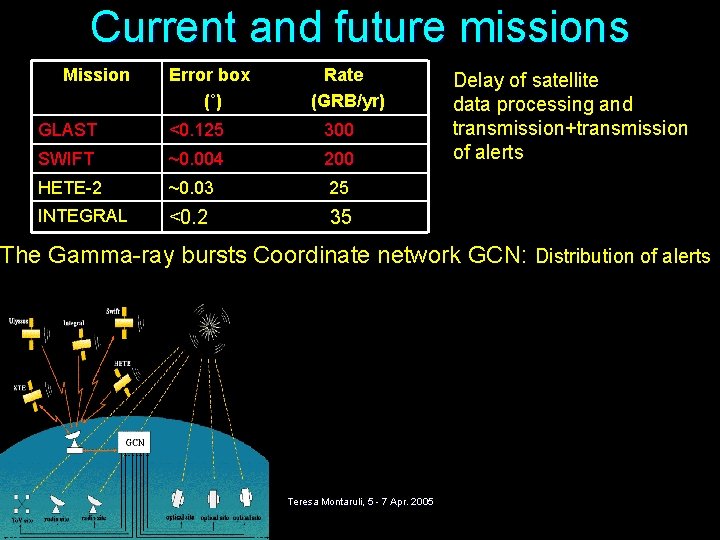
Current and future missions Mission Error box (˚) Rate (GRB/yr) GLAST <0. 125 300 SWIFT ~0. 004 200 HETE-2 ~0. 03 25 INTEGRAL <0. 2 35 Delay of satellite data processing and transmission+transmission of alerts The Gamma-ray bursts Coordinate network GCN: Distribution of alerts Teresa Montaruli, 5 - 7 Apr. 2005
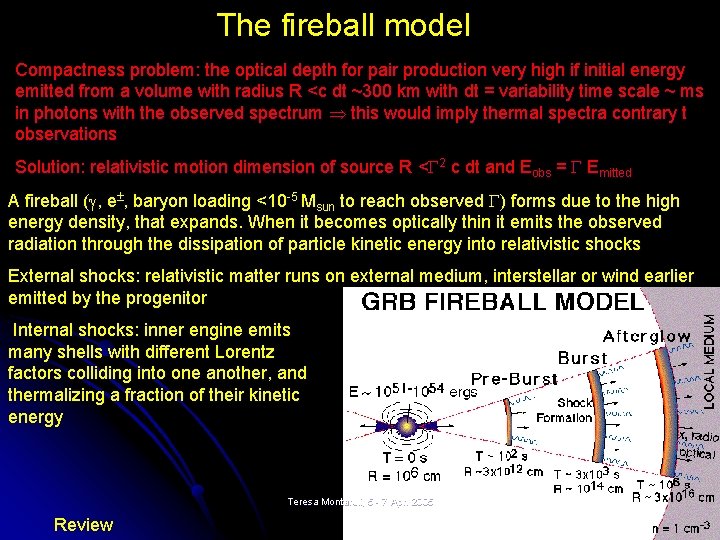
The fireball model Compactness problem: the optical depth for pair production very high if initial energy emitted from a volume with radius R <c dt ~300 km with dt = variability time scale ~ ms in photons with the observed spectrum this would imply thermal spectra contrary t observations Solution: relativistic motion dimension of source R <G 2 c dt and Eobs = G Emitted A fireball ( , e , baryon loading <10 -5 Msun to reach observed G) forms due to the high energy density, that expands. When it becomes optically thin it emits the observed radiation through the dissipation of particle kinetic energy into relativistic shocks External shocks: relativistic matter runs on external medium, interstellar or wind earlier emitted by the progenitor Internal shocks: inner engine emits many shells with different Lorentz factors colliding into one another, and thermalizing a fraction of their kinetic energy Teresa Montaruli, 5 - 7 Apr. 2005 Review
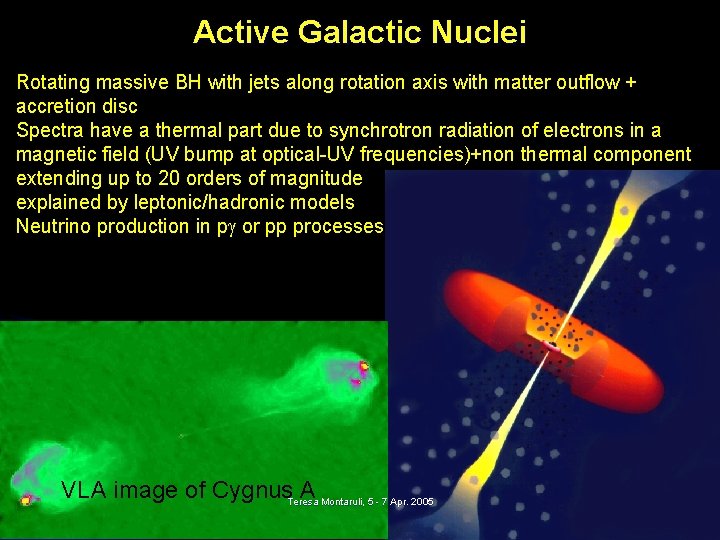
Active Galactic Nuclei Rotating massive BH with jets along rotation axis with matter outflow + accretion disc Spectra have a thermal part due to synchrotron radiation of electrons in a magnetic field (UV bump at optical-UV frequencies)+non thermal component extending up to 20 orders of magnitude explained by leptonic/hadronic models Neutrino production in p or pp processes VLA image of Cygnus. Teresa A Montaruli, 5 - 7 Apr. 2005
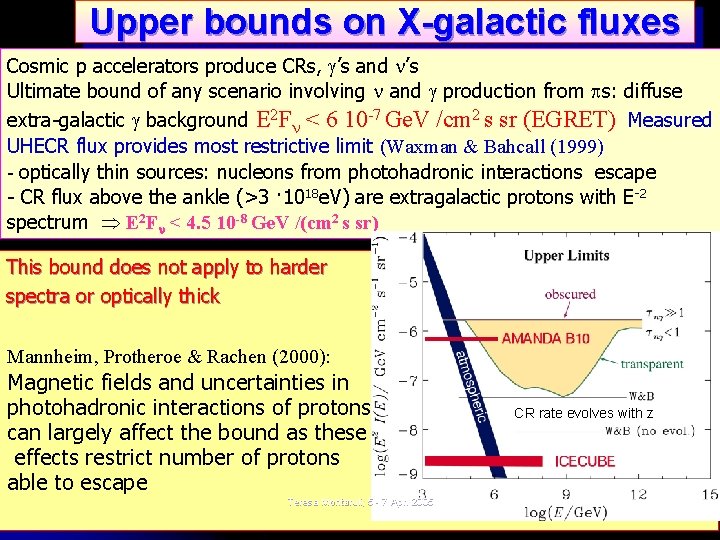
Upper bounds on X-galactic fluxes Cosmic p accelerators produce CRs, ’s and ’s Ultimate bound of any scenario involving and production from s: diffuse extra-galactic background E 2 F < 6 10 -7 Ge. V /cm 2 s sr (EGRET) Measured UHECR flux provides most restrictive limit (Waxman & Bahcall (1999) - optically thin sources: nucleons from photohadronic interactions escape - CR flux above the ankle (>3 · 1018 e. V) are extragalactic protons with E-2 spectrum E 2 F < 4. 5 10 -8 Ge. V /(cm 2 s sr) This bound does not apply to harder spectra or optically thick Mannheim, Protheroe & Rachen (2000): Magnetic fields and uncertainties in photohadronic interactions of protons can largely affect the bound as these effects restrict number of protons able to escape Teresa Montaruli, 5 - 7 Apr. 2005 CR rate evolves with z
Suggested references Halzen and Hooper, Rept. Prog. Phys. 65: 1025 -1078, 2002 l Learned and Mannheim, Ann. Rev. Nucl. Part. Sci. 50: 679 -749, 2000 l Burgio, Bednarek, TM, New Astron. Rev. 49, 2005 (galactic point sources) l http: //arxiv. org/PS_cache/astro-ph/pdf/0405503. pdf (GRBs) l Books: Longair, High Energy Astrophysics Berezinski, Neutrino Astrophysics 1995 l These transparencies: l http: //www. icecube. wisc. edu/~tmontaruli/ Teresa Montaruli, 5 - 7 Apr. 2005
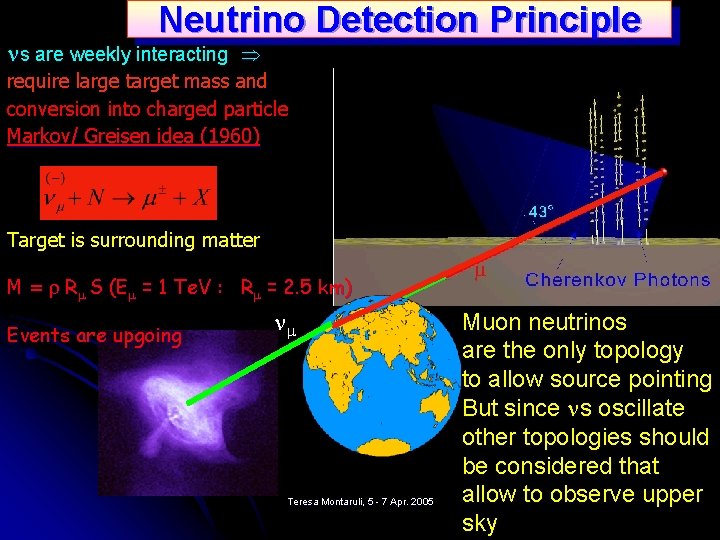
Neutrino Detection Principle s are weekly interacting require large target mass and conversion into charged particle Markov/ Greisen idea (1960) Target is surrounding matter M = r R S (E = 1 Te. V : R = 2. 5 km) Events are upgoing Teresa Montaruli, 5 - 7 Apr. 2005 Muon neutrinos are the only topology to allow source pointing But since s oscillate other topologies should be considered that allow to observe upper sky
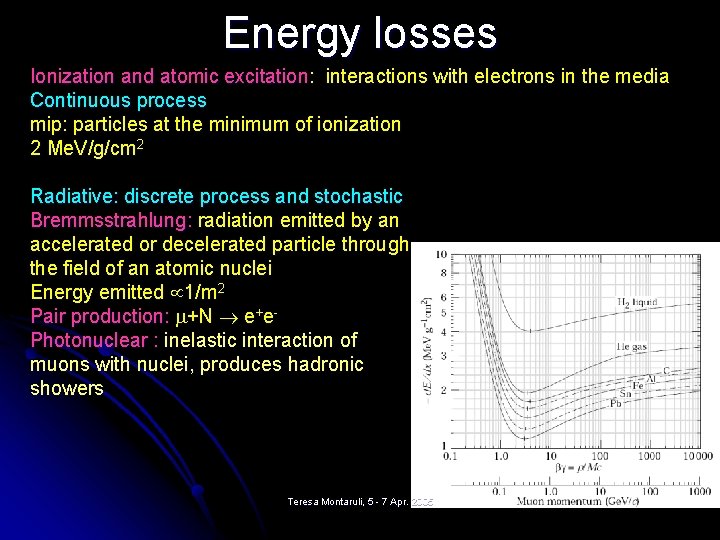
Energy losses Ionization and atomic excitation: interactions with electrons in the media Continuous process mip: particles at the minimum of ionization 2 Me. V/g/cm 2 Radiative: discrete process and stochastic Bremmsstrahlung: radiation emitted by an accelerated or decelerated particle through the field of an atomic nuclei Energy emitted 1/m 2 Pair production: +N e+e. Photonuclear : inelastic interaction of muons with nuclei, produces hadronic showers Teresa Montaruli, 5 - 7 Apr. 2005
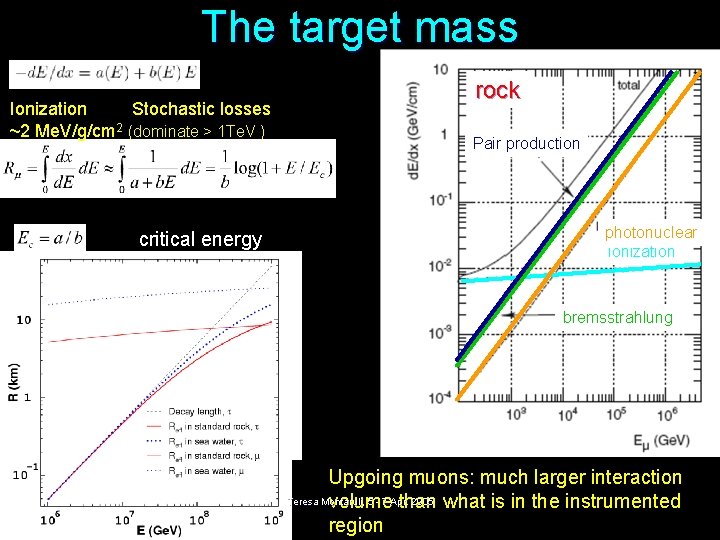
The target mass Ionization Stochastic losses ~2 Me. V/g/cm 2 (dominate > 1 Te. V ) critical energy rock Pair production photonuclear ionization bremsstrahlung Upgoing muons: much larger interaction Teresa Montaruli, 5 - 7 Apr. 2005 what is in the instrumented volume than region