
Neutrino Oscillation Studies with the Fermilab Nu MI
Neutrino Oscillation Studies with the Fermilab Nu. MI beam: Episode III • Historical Introduction: Pre-history, Episodes I and II • Physics Motivation • Off-axis Beams • Backgrounds and Detector Issues • Sensitivity of Nu. MI Off-axis Experiments June 11, 2003 1 st Yamada Symposium, NDM 2003 Adam Para, Fermilab
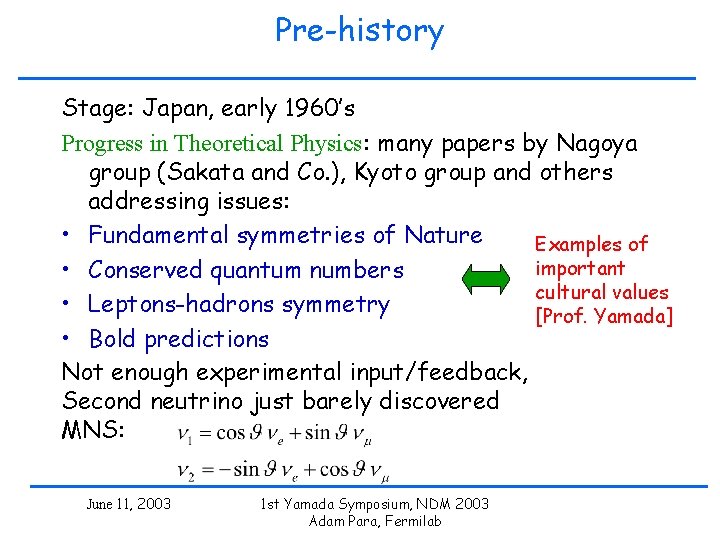
Pre-history Stage: Japan, early 1960’s Progress in Theoretical Physics: many papers by Nagoya group (Sakata and Co. ), Kyoto group and others addressing issues: • Fundamental symmetries of Nature Examples of important • Conserved quantum numbers cultural values • Leptons-hadrons symmetry [Prof. Yamada] • Bold predictions Not enough experimental input/feedback, Second neutrino just barely discovered MNS: June 11, 2003 1 st Yamada Symposium, NDM 2003 Adam Para, Fermilab
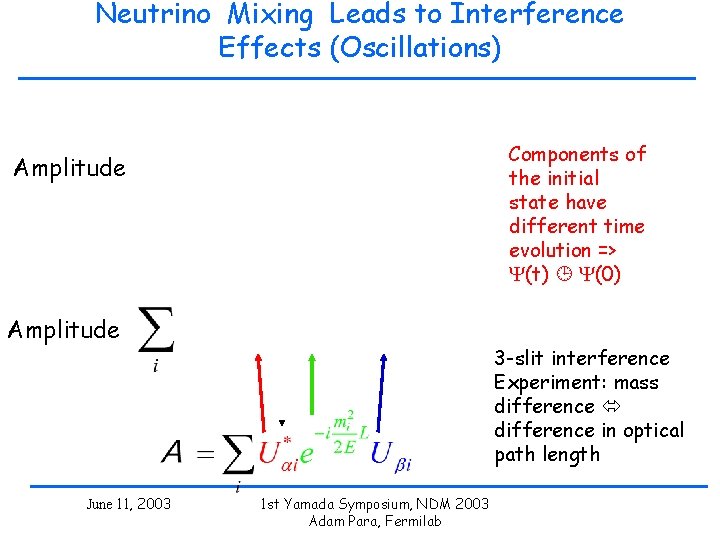
Neutrino Mixing Leads to Interference Effects (Oscillations) Components of the initial state have different time evolution => Y(t) Y(0) Amplitude June 11, 2003 3 -slit interference Experiment: mass difference in optical path length 1 st Yamada Symposium, NDM 2003 Adam Para, Fermilab
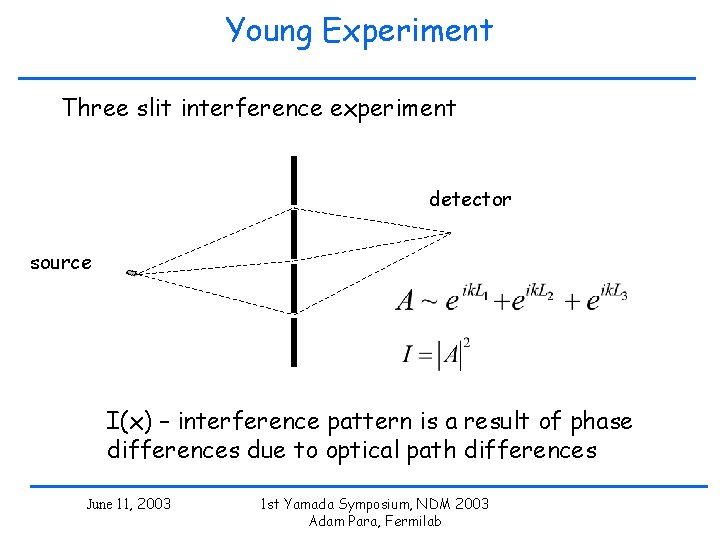
Young Experiment Three slit interference experiment detector source I(x) – interference pattern is a result of phase differences due to optical path differences June 11, 2003 1 st Yamada Symposium, NDM 2003 Adam Para, Fermilab
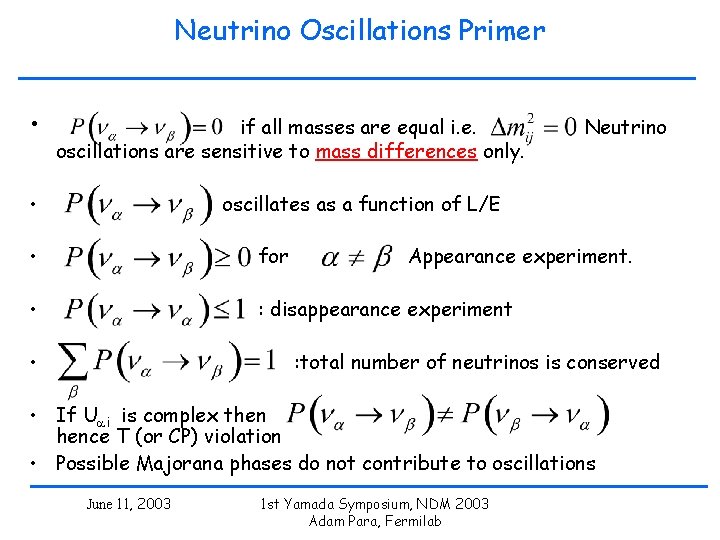
Neutrino Oscillations Primer • if all masses are equal i. e. oscillations are sensitive to mass differences only. • Neutrino oscillates as a function of L/E • for • : disappearance experiment • Appearance experiment. : total number of neutrinos is conserved • If Uai is complex then hence T (or CP) violation • Possible Majorana phases do not contribute to oscillations June 11, 2003 1 st Yamada Symposium, NDM 2003 Adam Para, Fermilab
Episode I: Before the “New Era” Theory: • Neutrino mass differences 1 -100 e. V 2 • Neutrino mixing matrix similar to quarks (small or very small mixing angles) Experiment: • No evidence for neutrino oscillations in accelerator (BEBC, CDHS, CHARM, CCFR) or reactor (Bugey, Gosgen) experiments • Confusing ‘solar neutrino problem’ New Era started by “Super. K revolution”: • Neutrinos have mass, mass differences are very small • Neutrino mixing angles are very large June 11, 2003 1 st Yamada Symposium, NDM 2003 Adam Para, Fermilab
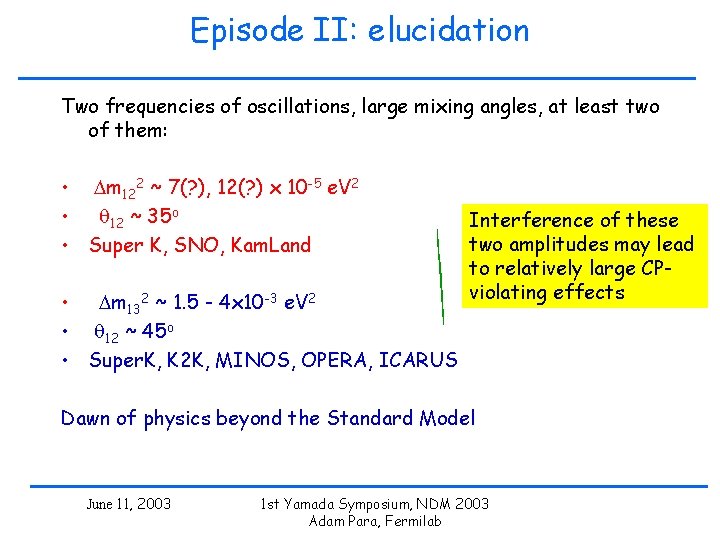
Episode II: elucidation Two frequencies of oscillations, large mixing angles, at least two of them: • Dm 122 ~ 7(? ), 12(? ) x 10 -5 e. V 2 • q 12 ~ 35 o • Super K, SNO, Kam. Land • Dm 132 ~ 1. 5 - 4 x 10 -3 e. V 2 • q 12 ~ 45 o • Super. K, K 2 K, MINOS, OPERA, ICARUS Interference of these two amplitudes may lead to relatively large CPviolating effects Dawn of physics beyond the Standard Model June 11, 2003 1 st Yamada Symposium, NDM 2003 Adam Para, Fermilab

Neutrinos vs Standard Model Whereas • There is a major effort to complete the Standard Model (Higgs search) • There is a broad front of experiments looking for possible deviations from the Standard Model (SUSY searches, Bphysics experiments, g-2, EDM, …) The first evidence for physics beyond the standard model is here: • Neutrino mass and oscillations Where does it lead us? • Just an extension (additional 9? 7? Parameters) ? • First glimpse at physics at the unification scale ? (see-saw? ? ) • Extra dimensions? • Unexpected? (CPT violation ? ? ? ) June 11, 2003 1 st Yamada Symposium, NDM 2003 Adam Para, Fermilab
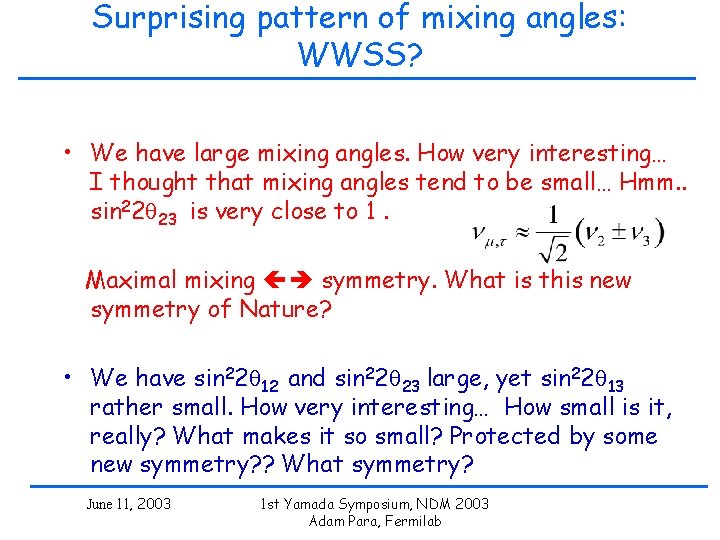
Surprising pattern of mixing angles: WWSS? • We have large mixing angles. How very interesting… I thought that mixing angles tend to be small… Hmm. . sin 22 q 23 is very close to 1. Maximal mixing symmetry. What is this new symmetry of Nature? • We have sin 22 q 12 and sin 22 q 23 large, yet sin 22 q 13 rather small. How very interesting… How small is it, really? What makes it so small? Protected by some new symmetry? ? What symmetry? June 11, 2003 1 st Yamada Symposium, NDM 2003 Adam Para, Fermilab
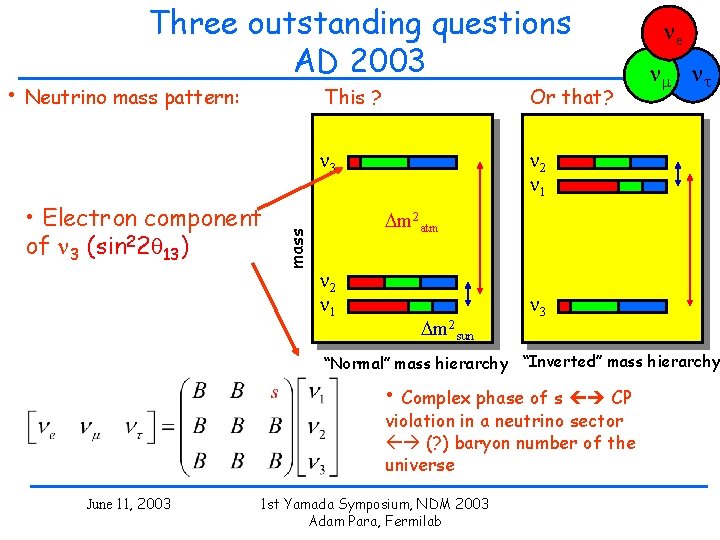
Three outstanding questions AD 2003 • Electron component of n 3 (sin 22 q 13) mass • Neutrino mass pattern: This ? Or that? n 3 n 2 n 1 ne nm nt Dm 2 atm n 2 n 1 Dm 2 sun n 3 “Normal” mass hierarchy “Inverted” mass hierarchy • Complex phase of s CP violation in a neutrino sector (? ) baryon number of the universe June 11, 2003 1 st Yamada Symposium, NDM 2003 Adam Para, Fermilab
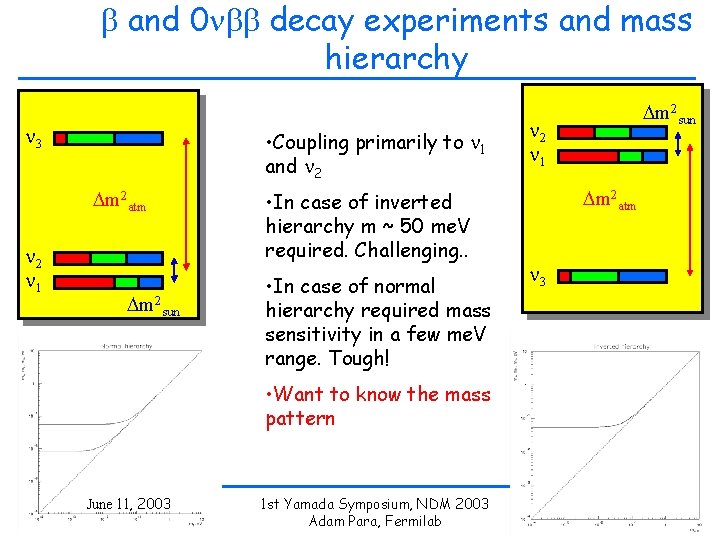
b and 0 nbb decay experiments and mass hierarchy n 3 • Coupling primarily to n 1 and n 2 Dm 2 atm n 2 n 1 Dm 2 sun • In case of inverted hierarchy m ~ 50 me. V required. Challenging. . • In case of normal hierarchy required mass sensitivity in a few me. V range. Tough! • Want to know the mass pattern June 11, 2003 1 st Yamada Symposium, NDM 2003 Adam Para, Fermilab Dm 2 sun n 2 n 1 Dm 2 atm n 3
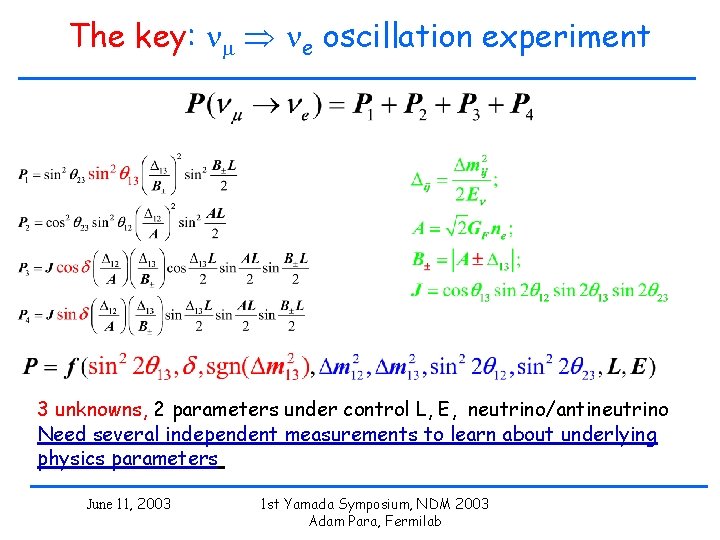
The key: nm ne oscillation experiment 3 unknowns, 2 parameters under control L, E, neutrino/antineutrino Need several independent measurements to learn about underlying physics parameters June 11, 2003 1 st Yamada Symposium, NDM 2003 Adam Para, Fermilab
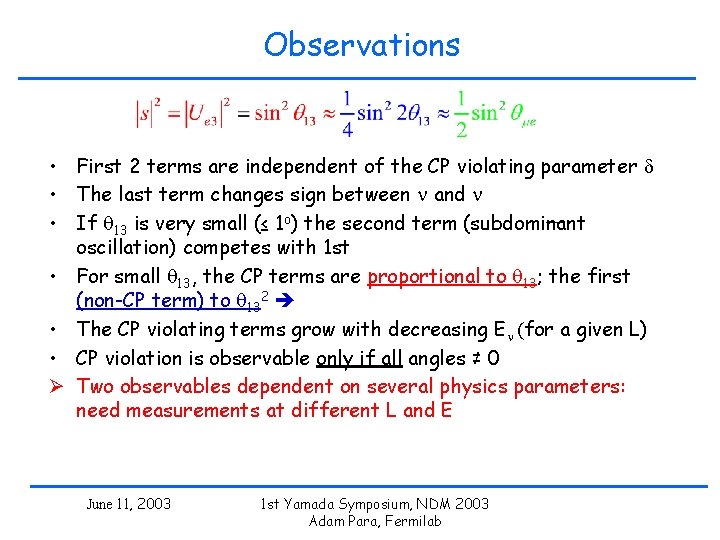
Observations • First 2 terms are independent of the CP violating parameter d • The last term changes sign between n and n • If q 13 is very small (≤ 1 o) the second term (subdominant oscillation) competes with 1 st • For small q 13, the CP terms are proportional to q 13; the first (non-CP term) to q 132 • The CP violating terms grow with decreasing En (for a given L) • CP violation is observable only if all angles ≠ 0 Ø Two observables dependent on several physics parameters: need measurements at different L and E June 11, 2003 1 st Yamada Symposium, NDM 2003 Adam Para, Fermilab
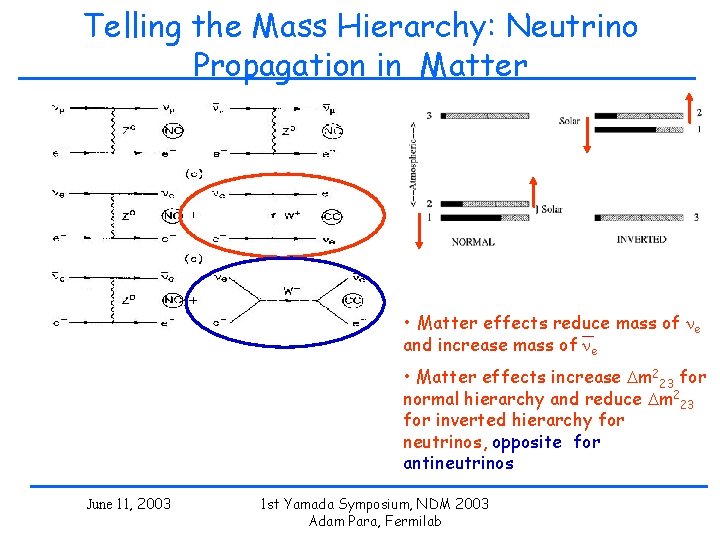
Telling the Mass Hierarchy: Neutrino Propagation in Matter • Matter effects reduce mass of ne and increase mass of ne • Matter effects increase Dm 223 for normal hierarchy and reduce Dm 223 for inverted hierarchy for neutrinos, opposite for antineutrinos June 11, 2003 1 st Yamada Symposium, NDM 2003 Adam Para, Fermilab
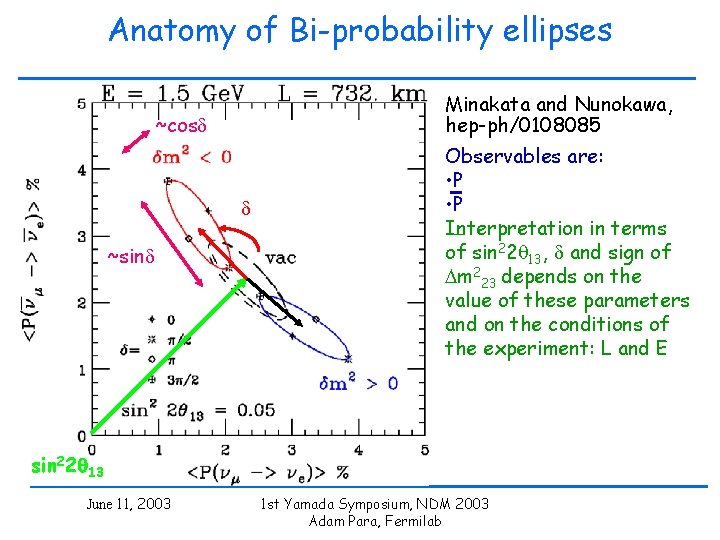
Anatomy of Bi-probability ellipses Minakata and Nunokawa, hep-ph/0108085 ~cosd d ~sind Observables are: • P Interpretation in terms of sin 22 q 13, d and sign of Dm 223 depends on the value of these parameters and on the conditions of the experiment: L and E sin 22 q 13 June 11, 2003 1 st Yamada Symposium, NDM 2003 Adam Para, Fermilab
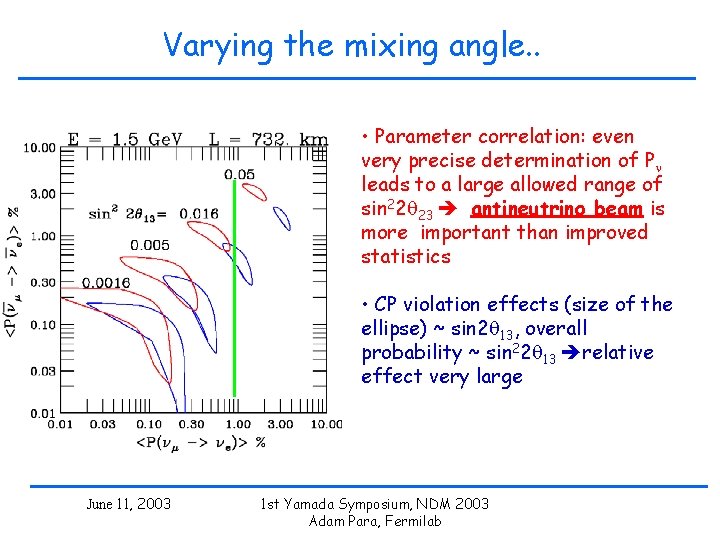
Varying the mixing angle. . • Parameter correlation: even very precise determination of Pn leads to a large allowed range of sin 22 q 23 antineutrino beam is more important than improved statistics • CP violation effects (size of the ellipse) ~ sin 2 q 13, overall probability ~ sin 22 q 13 relative effect very large June 11, 2003 1 st Yamada Symposium, NDM 2003 Adam Para, Fermilab
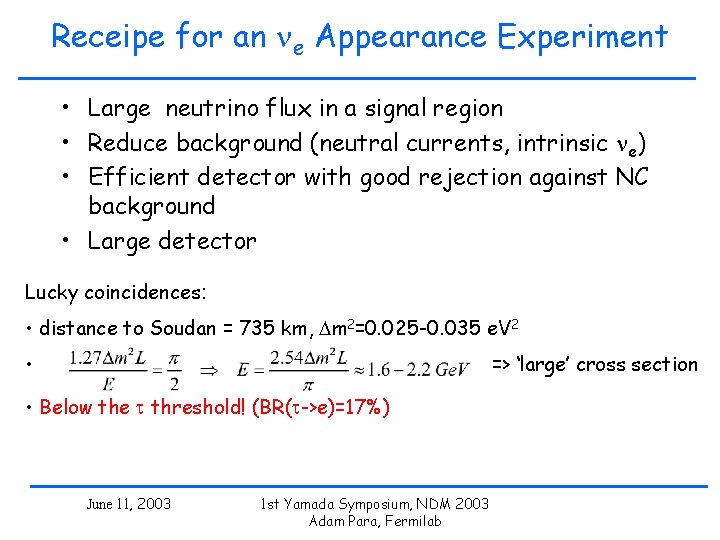
Receipe for an ne Appearance Experiment • Large neutrino flux in a signal region • Reduce background (neutral currents, intrinsic ne) • Efficient detector with good rejection against NC background • Large detector Lucky coincidences: • distance to Soudan = 735 km, Dm 2=0. 025 -0. 035 e. V 2 • => ‘large’ cross section • Below the t threshold! (BR(t->e)=17%) June 11, 2003 1 st Yamada Symposium, NDM 2003 Adam Para, Fermilab
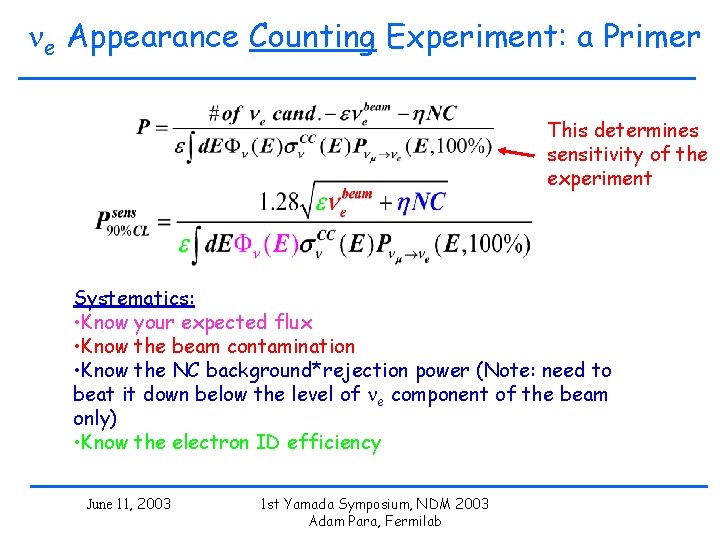
ne Appearance Counting Experiment: a Primer This determines sensitivity of the experiment Systematics: • Know your expected flux • Know the beam contamination • Know the NC background*rejection power (Note: need to beat it down below the level of ne component of the beam only) • Know the electron ID efficiency June 11, 2003 1 st Yamada Symposium, NDM 2003 Adam Para, Fermilab
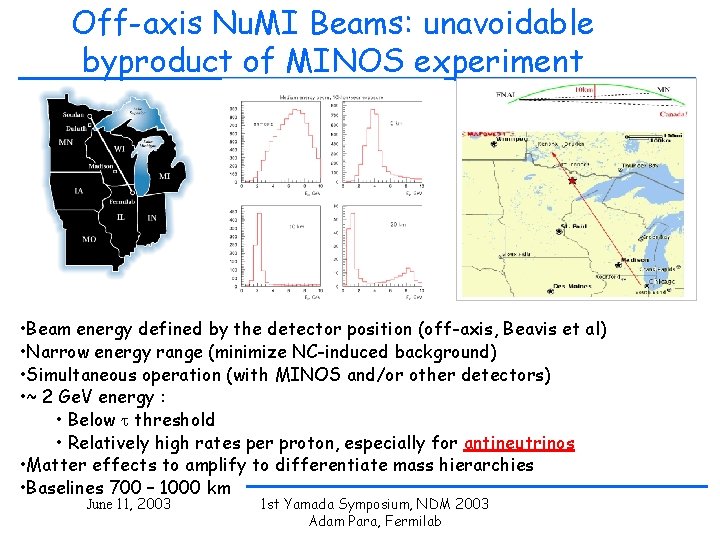
Off-axis Nu. MI Beams: unavoidable byproduct of MINOS experiment " • Beam energy defined by the detector position (off-axis, Beavis et al) • Narrow energy range (minimize NC-induced background) • Simultaneous operation (with MINOS and/or other detectors) • ~ 2 Ge. V energy : • Below t threshold • Relatively high rates per proton, especially for antineutrinos • Matter effects to amplify to differentiate mass hierarchies • Baselines 700 – 1000 km June 11, 2003 1 st Yamada Symposium, NDM 2003 Adam Para, Fermilab
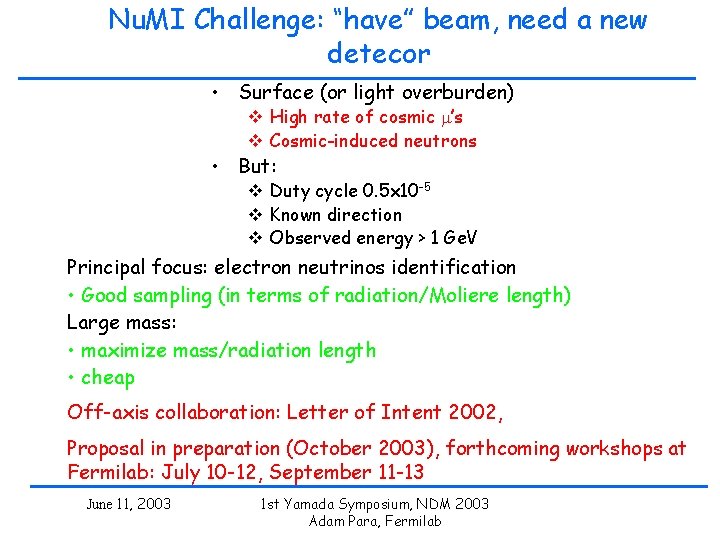
Nu. MI Challenge: “have” beam, need a new detecor • Surface (or light overburden) v High rate of cosmic m’s v Cosmic-induced neutrons • But: v Duty cycle 0. 5 x 10 -5 v Known direction v Observed energy > 1 Ge. V Principal focus: electron neutrinos identification • Good sampling (in terms of radiation/Moliere length) Large mass: • maximize mass/radiation length • cheap Off-axis collaboration: Letter of Intent 2002, Proposal in preparation (October 2003), forthcoming workshops at Fermilab: July 10 -12, September 11 -13 June 11, 2003 1 st Yamada Symposium, NDM 2003 Adam Para, Fermilab
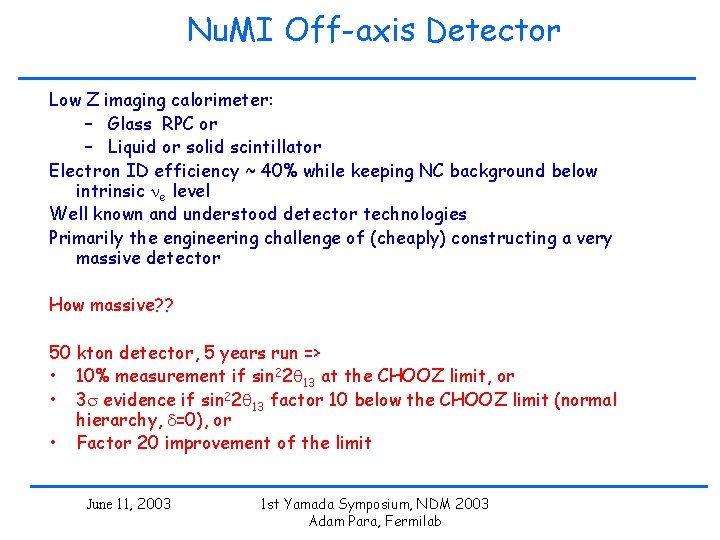
Nu. MI Off-axis Detector Low Z imaging calorimeter: – Glass RPC or – Liquid or solid scintillator Electron ID efficiency ~ 40% while keeping NC background below intrinsic ne level Well known and understood detector technologies Primarily the engineering challenge of (cheaply) constructing a very massive detector How massive? ? 50 kton detector, 5 years run => • 10% measurement if sin 22 q 13 at the CHOOZ limit, or • 3 s evidence if sin 22 q 13 factor 10 below the CHOOZ limit (normal hierarchy, d=0), or • Factor 20 improvement of the limit June 11, 2003 1 st Yamada Symposium, NDM 2003 Adam Para, Fermilab
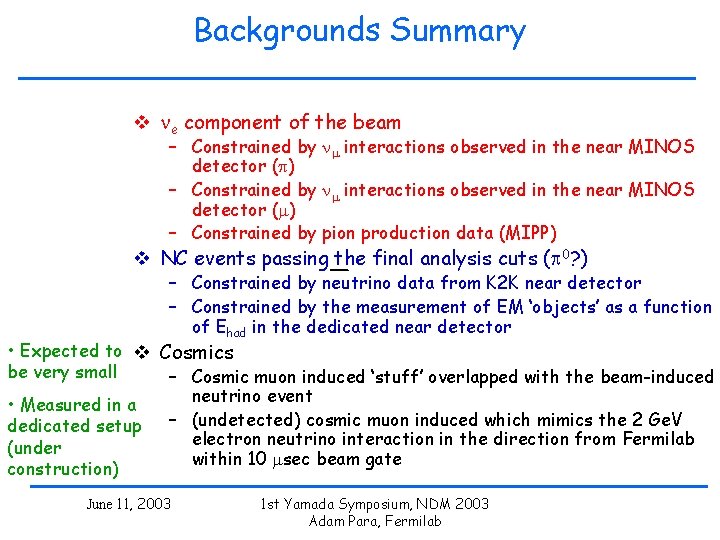
Backgrounds Summary v ne component of the beam – Constrained by nm interactions observed in the near MINOS detector (p) – Constrained by nm interactions observed in the near MINOS detector (m) – Constrained by pion production data (MIPP) v NC events passing the final analysis cuts (p 0? ) – Constrained by neutrino data from K 2 K near detector – Constrained by the measurement of EM ‘objects’ as a function of Ehad in the dedicated near detector • Expected to v Cosmics be very small – Cosmic muon induced ‘stuff’ overlapped with the beam-induced neutrino event • Measured in a – (undetected) cosmic muon induced which mimics the 2 Ge. V dedicated setup electron neutrino interaction in the direction from Fermilab (under within 10 msec beam gate construction) June 11, 2003 1 st Yamada Symposium, NDM 2003 Adam Para, Fermilab
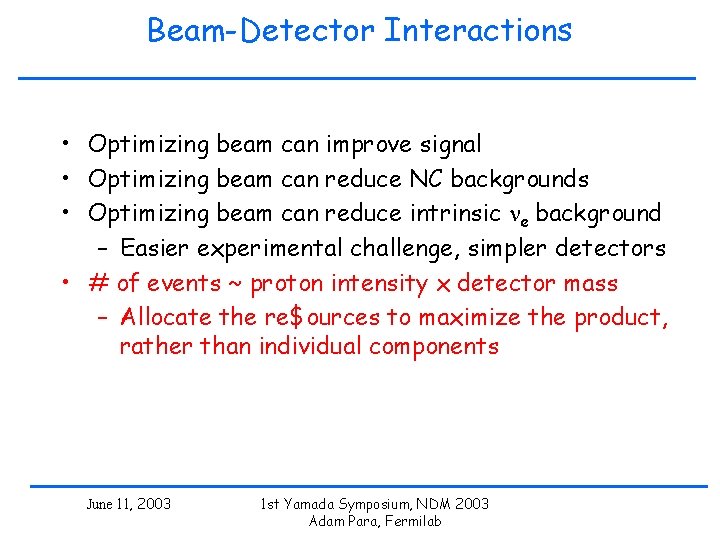
Beam-Detector Interactions • Optimizing beam can improve signal • Optimizing beam can reduce NC backgrounds • Optimizing beam can reduce intrinsic ne background – Easier experimental challenge, simpler detectors • # of events ~ proton intensity x detector mass – Allocate the re$ources to maximize the product, rather than individual components June 11, 2003 1 st Yamada Symposium, NDM 2003 Adam Para, Fermilab
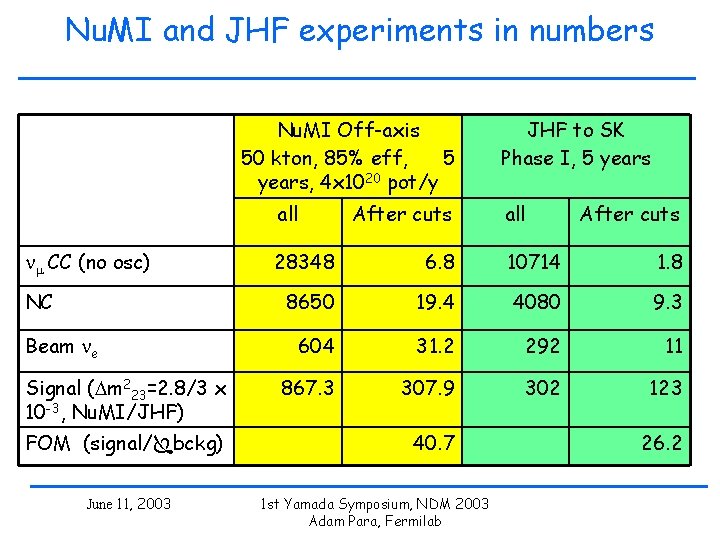
Nu. MI and JHF experiments in numbers Nu. MI Off-axis 50 kton, 85% eff, 5 years, 4 x 10²⁰ pot/y all nm CC (no osc) NC Beam ne Signal (Dm 223=2. 8/3 x 10 -3, Nu. MI/JHF) FOM (signal/ bckg) June 11, 2003 After cuts JHF to SK Phase I, 5 years all After cuts 28348 6. 8 10714 1. 8 8650 19. 4 4080 9. 3 604 31. 2 292 11 867. 3 307. 9 302 123 40. 7 1 st Yamada Symposium, NDM 2003 Adam Para, Fermilab 26. 2
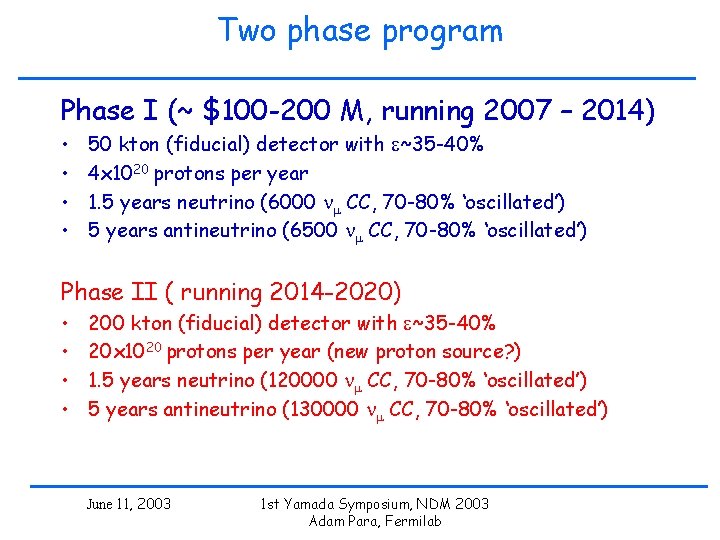
Two phase program Phase I (~ $100 -200 M, running 2007 – 2014) • • 50 kton (fiducial) detector with e~35 -40% 4 x 10²⁰ protons per year 1. 5 years neutrino (6000 nm CC, 70 -80% ‘oscillated’) 5 years antineutrino (6500 nm CC, 70 -80% ‘oscillated’) Phase II ( running 2014 -2020) • • 200 kton (fiducial) detector with e~35 -40% 20 x 1020 protons per year (new proton source? ) 1. 5 years neutrino (120000 nm CC, 70 -80% ‘oscillated’) 5 years antineutrino (130000 nm CC, 70 -80% ‘oscillated’) June 11, 2003 1 st Yamada Symposium, NDM 2003 Adam Para, Fermilab
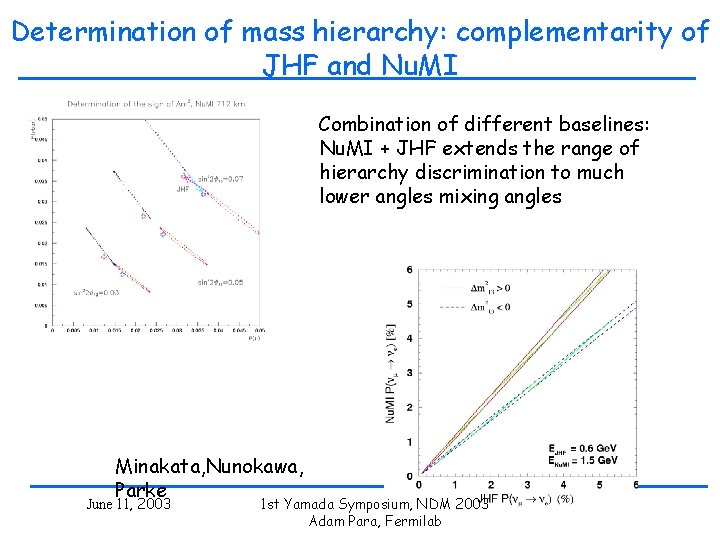
Determination of mass hierarchy: complementarity of JHF and Nu. MI Combination of different baselines: Nu. MI + JHF extends the range of hierarchy discrimination to much lower angles mixing angles Minakata, Nunokawa, Parke June 11, 2003 1 st Yamada Symposium, NDM 2003 Adam Para, Fermilab
Physics related to neutrino masses A quest for a neutrino mass spectrum mass generation mechanisms: • Neutrinos have non-zero mass • 0. 05 < m 3< 0. 23 e. V • Mass differences too small to be detectable by direct measurements interference experiments [ remember Dm. K=m(K 0 S)-m(KOL) ] A • • • search for fundamental symmetries: Conserved ‘family lepton’ number Conserved lepton number CP conservation in a lepton sector leptogenesis baryon number of the Universe our existence • CPT conservation • New, hereto unknown symmetries of Nature? June 11, 2003 1 st Yamada Symposium, NDM 2003 Adam Para, Fermilab
Conclusions v Neutrino Physics is an exciting field for many years to come v Most likely several experiments with different running conditions will be required to unravel the underlying physics. Healthy complementary program is shaping up (see Ichikawa-san). v Fermilab/Nu. MI beam is uniquely matched to this physics in terms of beam intensity, flexibility, beam energy, and potential source-to-detector distances that could be available v Important element of the HEP program in the US for the next 20 years June 11, 2003 1 st Yamada Symposium, NDM 2003 Adam Para, Fermilab
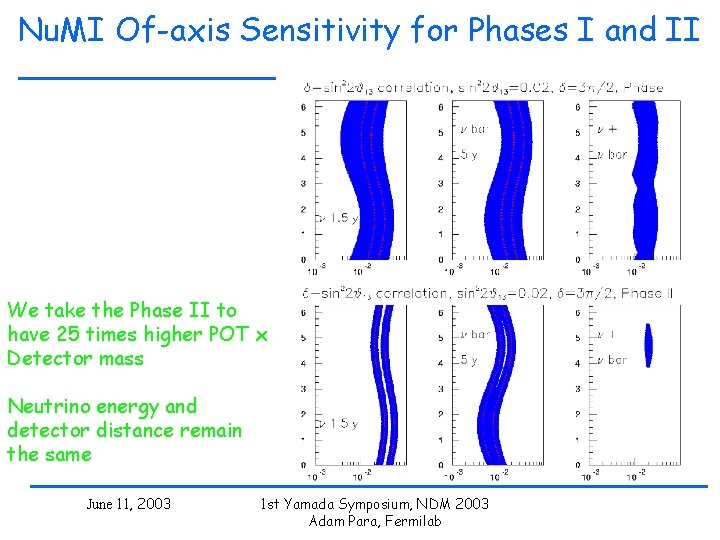
Nu. MI Of-axis Sensitivity for Phases I and II We take the Phase II to have 25 times higher POT x Detector mass Neutrino energy and detector distance remain the same June 11, 2003 1 st Yamada Symposium, NDM 2003 Adam Para, Fermilab
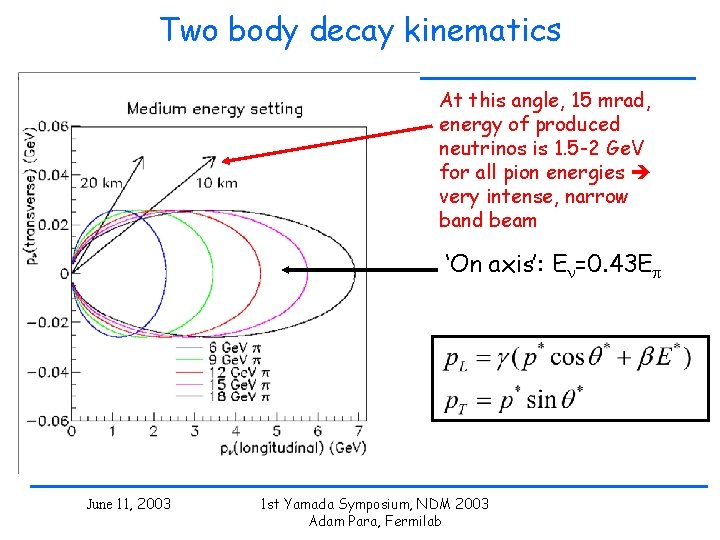
Two body decay kinematics At this angle, 15 mrad, energy of produced neutrinos is 1. 5 -2 Ge. V for all pion energies very intense, narrow band beam ‘On axis’: En=0. 43 Ep June 11, 2003 1 st Yamada Symposium, NDM 2003 Adam Para, Fermilab
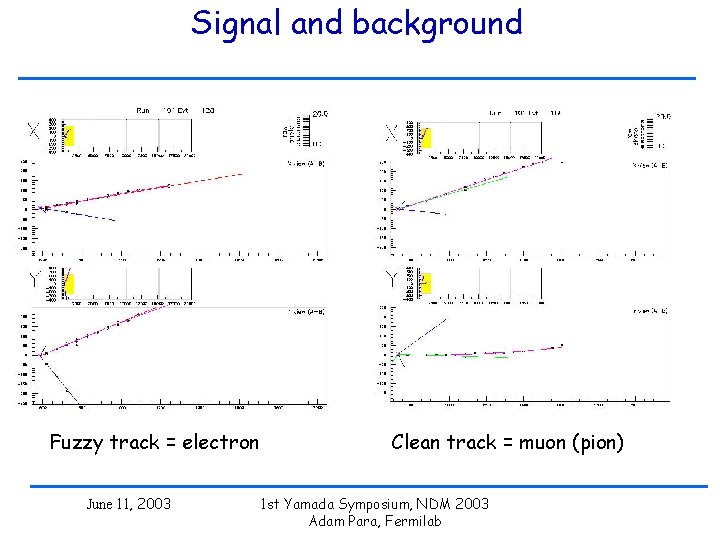
Signal and background Fuzzy track = electron June 11, 2003 Clean track = muon (pion) 1 st Yamada Symposium, NDM 2003 Adam Para, Fermilab
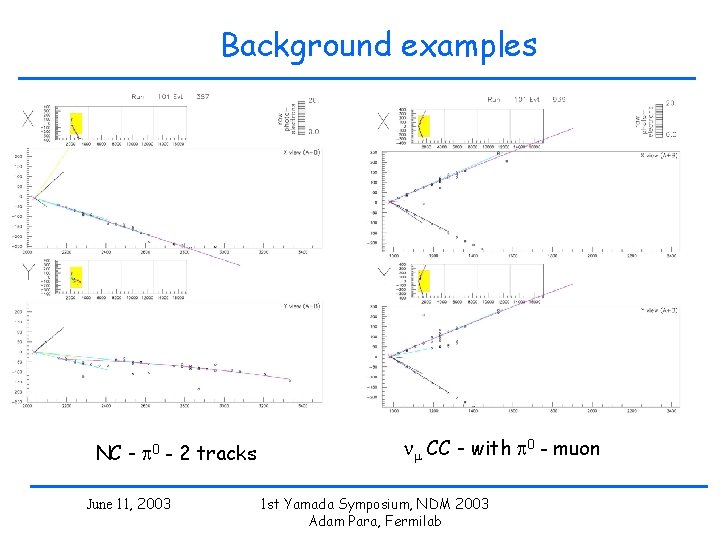
Background examples NC - p 0 - 2 tracks June 11, 2003 nm CC - with p 0 - muon 1 st Yamada Symposium, NDM 2003 Adam Para, Fermilab
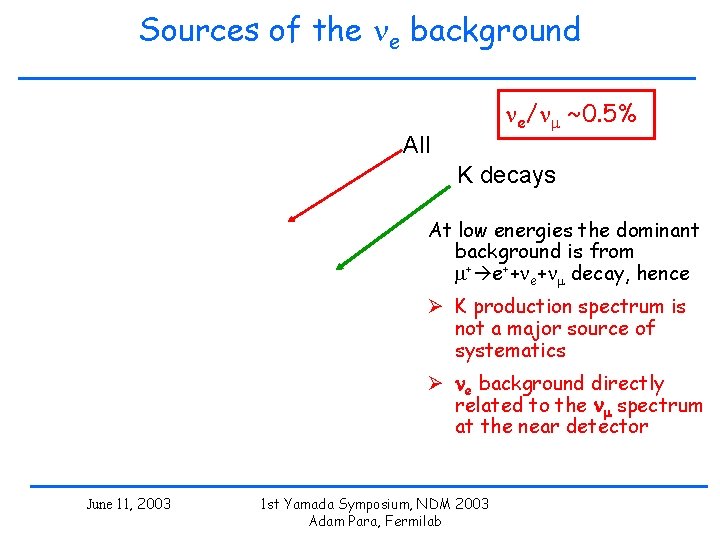
Sources of the ne background ne/nm ~0. 5% All K decays At low energies the dominant background is from m+ e++ne+nm decay, hence Ø K production spectrum is not a major source of systematics Ø ne background directly related to the nm spectrum at the near detector June 11, 2003 1 st Yamada Symposium, NDM 2003 Adam Para, Fermilab
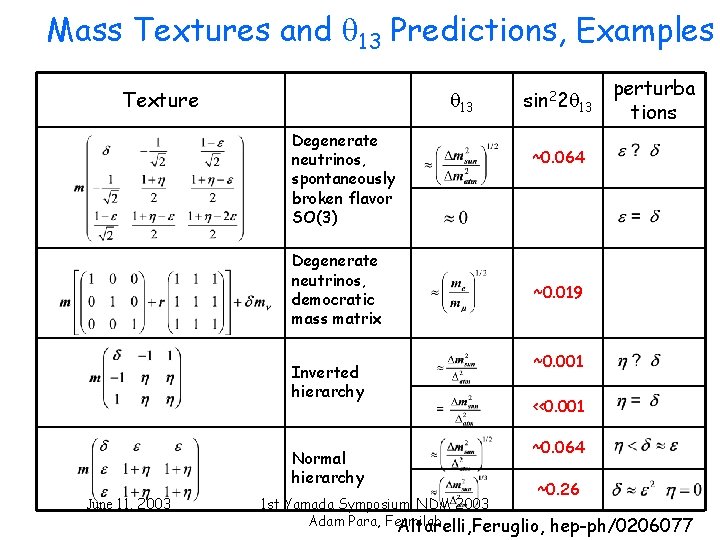
Mass Textures and q 13 Predictions, Examples Texture q 13 Degenerate neutrinos, spontaneously broken flavor SO(3) Degenerate neutrinos, democratic mass matrix Inverted hierarchy Normal hierarchy June 11, 2003 sin 22 q 13 perturba tions ~0. 064 ~0. 019 ~0. 001 <<0. 001 ~0. 064 ~0. 26 1 st Yamada Symposium, NDM 2003 Adam Para, Fermilab Altarelli, Feruglio, hep-ph/0206077
- Slides: 34