
Neutrino Flavor Oscillations at the Neutrino News from


- Slides: 74
Neutrino Flavor Oscillations at the Neutrino News from Fermilab Main Injector Sacha E. Kopp University of Texas at Austin SMU Physics Department Seminar 22 October 2007
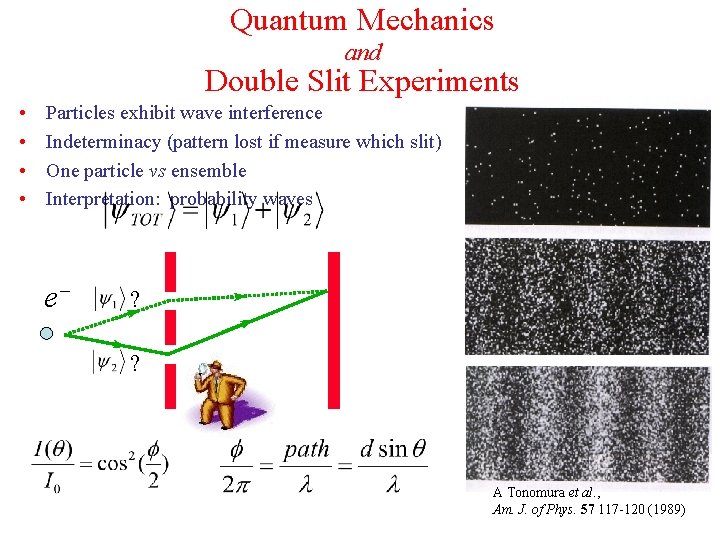
Quantum Mechanics and Double Slit Experiments • • Particles exhibit wave interference Indeterminacy (pattern lost if measure which slit) One particle vs ensemble Interpretation: probability waves e- ? ? A Tonomura et al. , Am. J. of Phys. 57 117 -120 (1989)
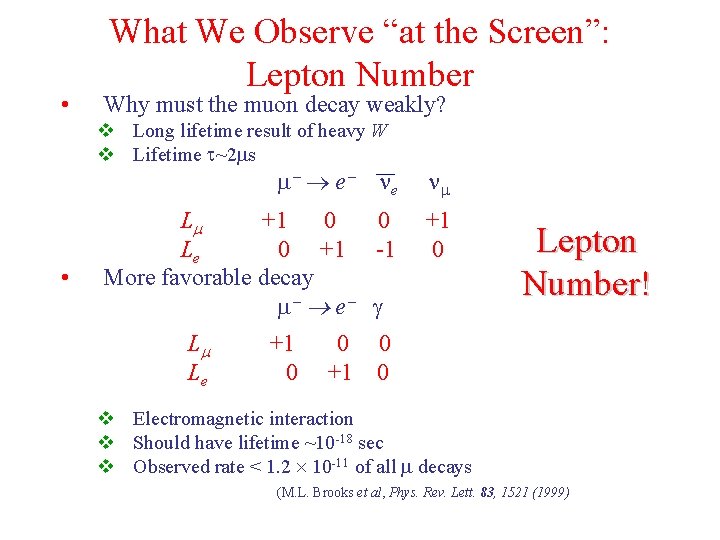
• What We Observe “at the Screen”: Lepton Number Why must the muon decay weakly? v Long lifetime result of heavy W v Lifetime t~2 ms m- e - • ne nm Lm +1 0 0 +1 Le 0 +1 -1 0 More favorable decay m- e - g Lepton Number! Lm +1 0 0 Le 0 +1 0 v Electromagnetic interaction v Should have lifetime ~10 -18 sec v Observed rate < 1. 2 10 -11 of all m decays (M. L. Brooks et al, Phys. Rev. Lett. 83, 1521 (1999)
n’s Have Lepton Number • Nuclear b decay has e, reactors produce ne • Reines & Cowen exp’t to observe free ne ne + p e+ + n Reines & Cowan, Science 124, 103 (1956), Phys. Rev. 113, 273 (1959) • Contrast to “failed” experiment by R. Davis ne + 37 Cl e- + 37 Ar R. Davis, Phys. Rev. 97, 766 (1955) NOT OBSERVED
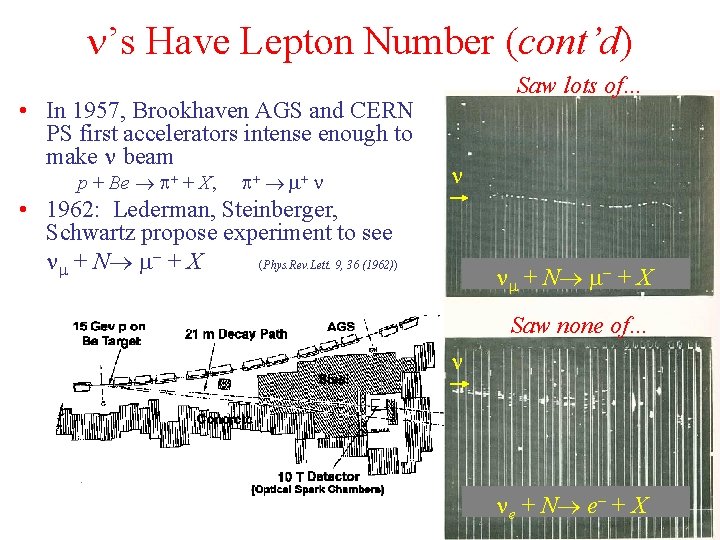
n’s Have Lepton Number (cont’d) • In 1957, Brookhaven AGS and CERN PS first accelerators intense enough to make n beam p + Be p+ + X, p+ m+ n Saw lots of… n • 1962: Lederman, Steinberger, Schwartz propose experiment to see nm + N m- + X (Phys. Rev. Lett. 9, 36 (1962)) nm + N m- + X Saw none of… n ne + N e- + X
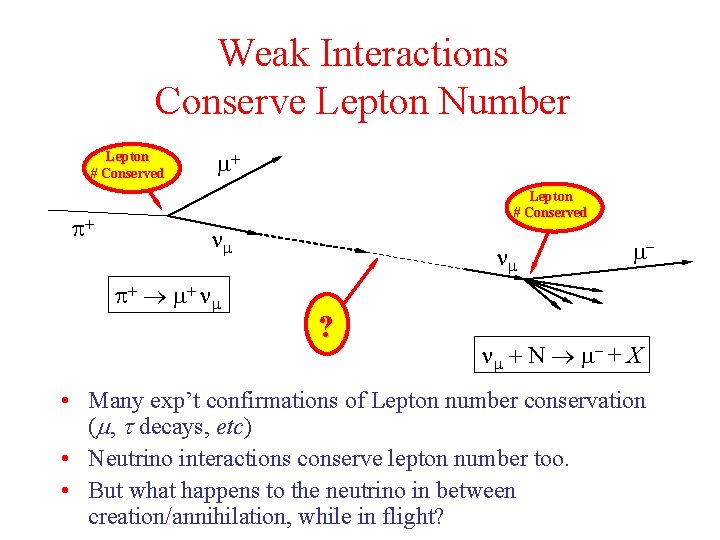
Weak Interactions Conserve Lepton Number Lepton # Conserved p+ m+ Lepton # Conserved nm p + m+ n m nm ? m- nm + N m- + X • Many exp’t confirmations of Lepton number conservation (m, t decays, etc) • Neutrino interactions conserve lepton number too. • But what happens to the neutrino in between creation/annihilation, while in flight?
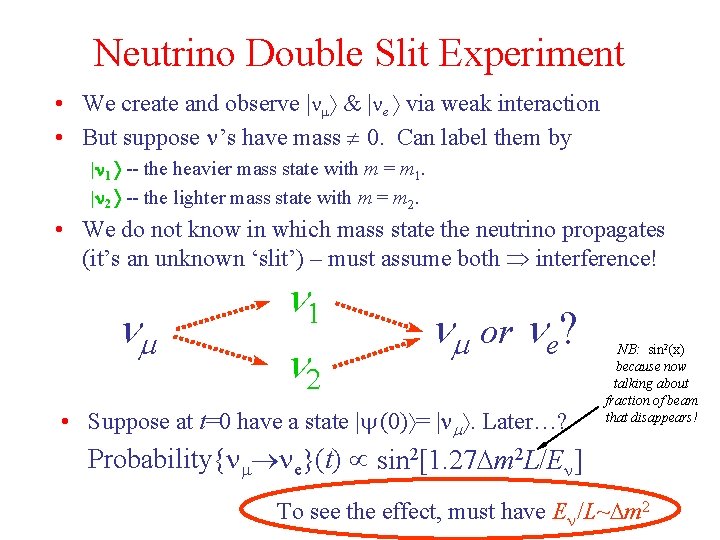
Neutrino Double Slit Experiment • We create and observe |nm & |ne via weak interaction • But suppose n’s have mass 0. Can label them by |n 1 -- the heavier mass state with m = m 1. |n 2 -- the lighter mass state with m = m 2. • We do not know in which mass state the neutrino propagates (it’s an unknown ‘slit’) – must assume both interference! nm n 1 n 2 nm or ne? • Suppose at t=0 have a state |y (0) = |nm. Later…? NB: sin 2(x) because now talking about fraction of beam that disappears! 2 t/4 p] 2 L/E ] Probability{nm ne}(t) sin 2[Dm [1. 27 Dm n To see the effect, must have En/L~Dm 2
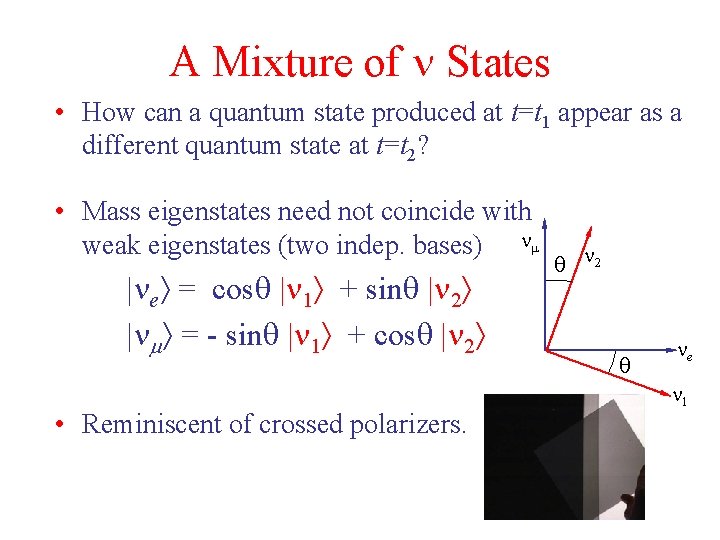
A Mixture of n States • How can a quantum state produced at t=t 1 appear as a different quantum state at t=t 2? • Mass eigenstates need not coincide with weak eigenstates (two indep. bases) nm n 2 |ne = cosq |n 1 + sinq |n 2 |nm = - sinq |n 1 + cosq |n 2 • Reminiscent of crossed polarizers. q q ne n 1
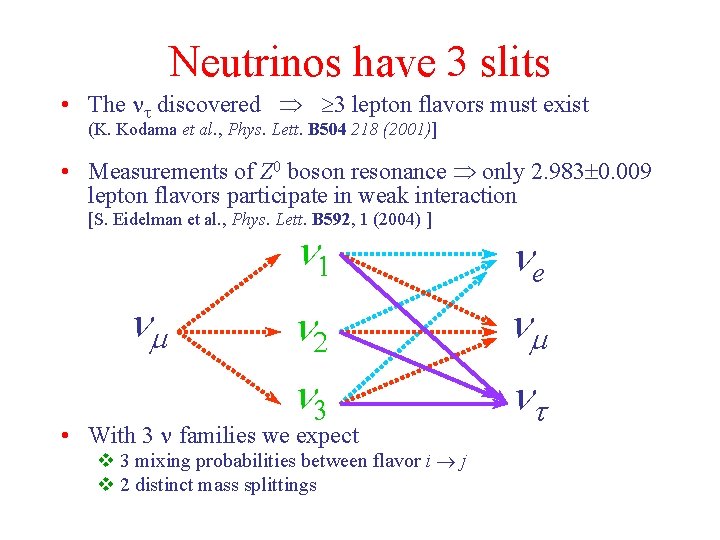
Neutrinos have 3 slits • The nt discovered 3 lepton flavors must exist (K. Kodama et al. , Phys. Lett. B 504 218 (2001)] • Measurements of Z 0 boson resonance only 2. 983 0. 009 lepton flavors participate in weak interaction [S. Eidelman et al. , Phys. Lett. B 592, 1 (2004) ] n 1 nm n 2 n 3 • With 3 n families we expect v 3 mixing probabilities between flavor i j v 2 distinct mass splittings ne nm nt
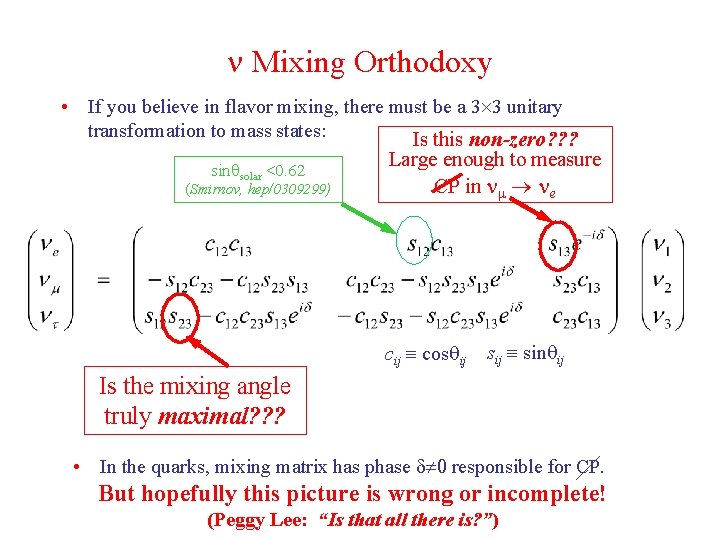
n Mixing Orthodoxy • If you believe in flavor mixing, there must be a 3 3 unitary transformation to mass states: Is this non-zero? ? ? CHOOZ 90%C. L. sinq 13<0. 22 Large enough to measure @ Dm 2=2 10 -3 e. V 2 sinqsolar <0. 62 Phys. Lett. B 466, 415 (1999) CP in nm ne (Smirnov, hep/0309299) cij cosqij sij sinqij Super-K 90%C. L. sinq 23>0. 58 Is the mixing angle @ Dm 2=2 10 -3 e. V 2 truly maximal? ? ? (hep-ex/0404034) • In the quarks, mixing matrix has phase d 0 responsible for CP. But hopefully this picture is wrong or incomplete! (Peggy Lee: “Is that all there is? ”)
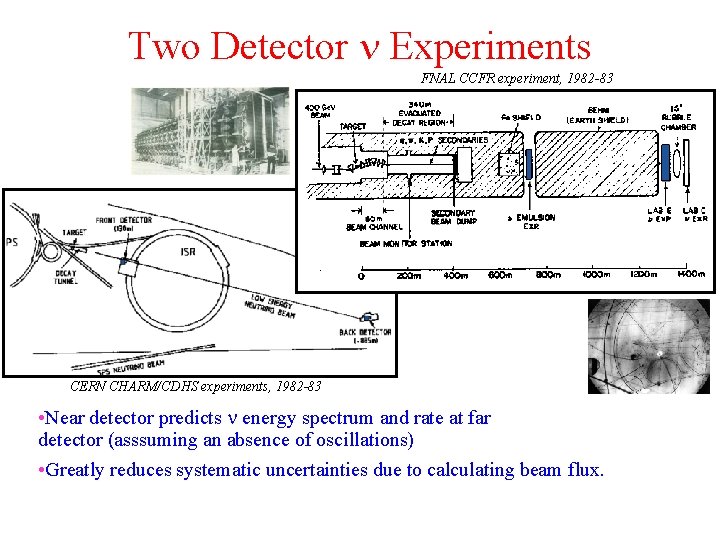
Two Detector n Experiments FNAL CCFR experiment, 1982 -83 CERN CHARM/CDHS experiments, 1982 -83 • Near detector predicts n energy spectrum and rate at far detector (asssuming an absence of oscillations) • Greatly reduces systematic uncertainties due to calculating beam flux.
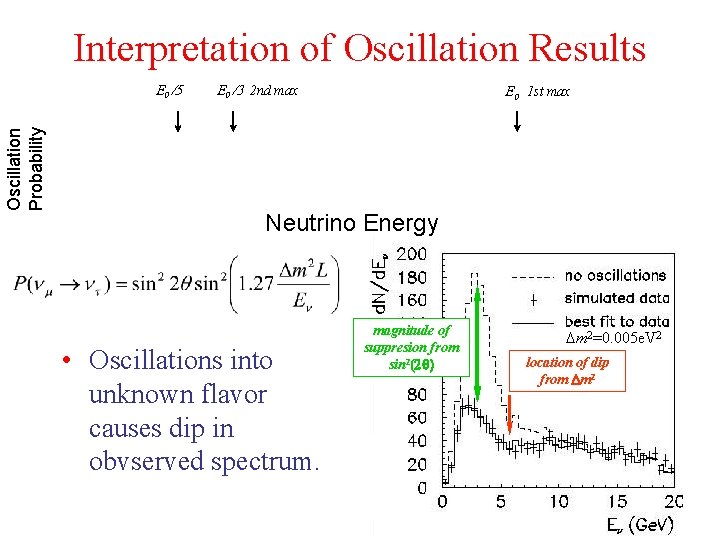
Interpretation of Oscillation Results Oscillation Probability E 0 /5 E 0 /3 2 nd max E 0 1 st max Neutrino Energy • Oscillations into unknown flavor causes dip in obvserved spectrum. magnitude of suppresion from sin 2(2 q) Dm 2=0. 005 e. V 2 location of dip from Dm 2
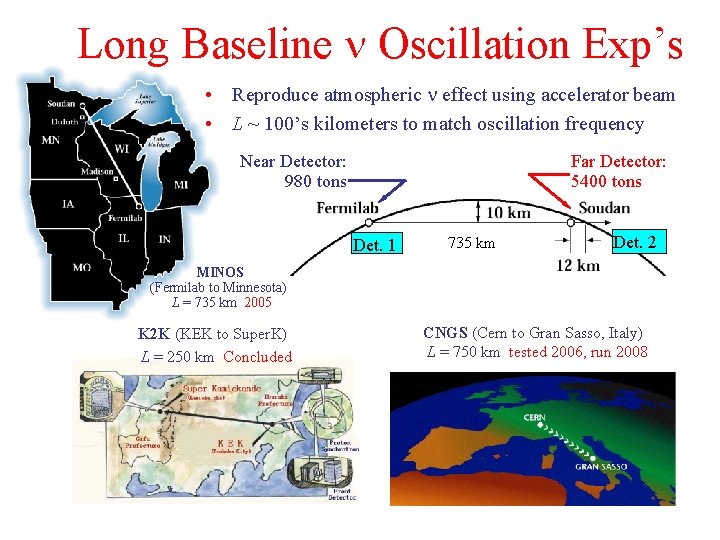
Long Baseline n Oscillation Exp’s • Reproduce atmospheric n effect using accelerator beam • L ~ 100’s kilometers to match oscillation frequency Near Detector: 980 tons Far Detector: 5400 tons Det. 1 735 km Det. 2 MINOS (Fermilab to Minnesota) L = 735 km 2005 K 2 K (KEK to Super. K) L = 250 km Concluded CNGS (Cern to Gran Sasso, Italy) L = 750 km tested 2006, run 2008
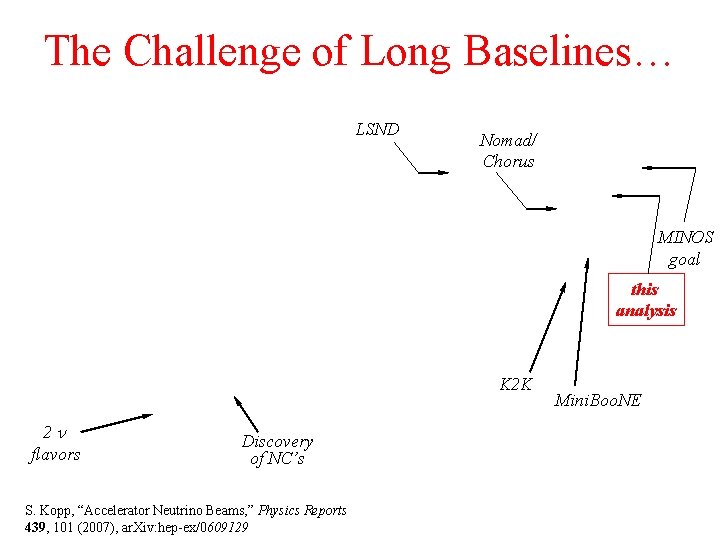
The Challenge of Long Baselines… LSND Nomad/ Chorus MINOS goal this analysis K 2 K 2 n flavors Discovery of NC’s S. Kopp, “Accelerator Neutrino Beams, ” Physics Reports 439, 101 (2007), ar. Xiv: hep-ex/0609129 Mini. Boo. NE
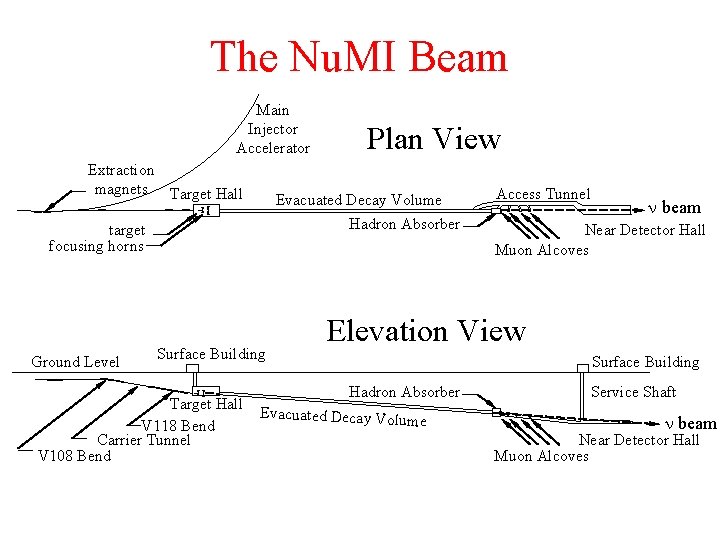
The Nu. MI Beam Main Injector Accelerator Extraction magnets Target Hall Evacuated Decay Volume Hadron Absorber target focusing horns Ground Level Surface Building Target Hall V 118 Bend Carrier Tunnel V 108 Bend Plan View Access Tunnel n beam Near Detector Hall Muon Alcoves Elevation View Surface Building Hadron Absorber Evacuated Decay Volum e Service Shaft n beam Near Detector Hall Muon Alcoves
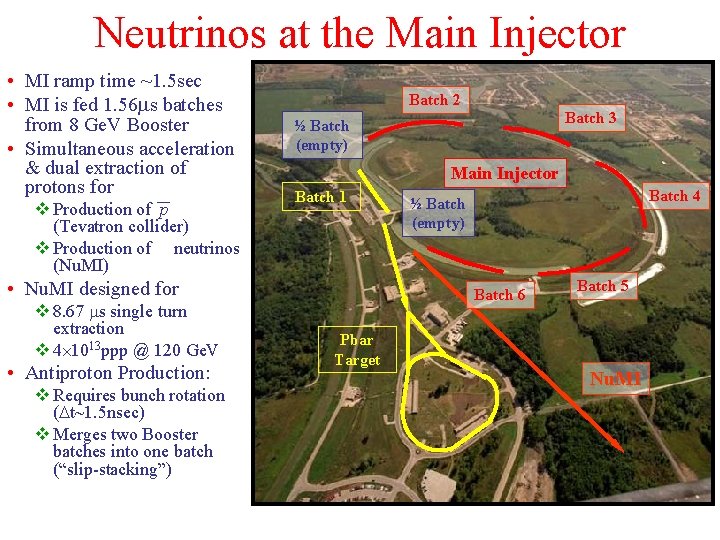
Neutrinos at the Main Injector • MI ramp time ~1. 5 sec • MI is fed 1. 56 ms batches from 8 Ge. V Booster • Simultaneous acceleration & dual extraction of protons for v Production of p (Tevatron collider) v Production of neutrinos (Nu. MI) Batch 2 Main Injector Batch 1 • Nu. MI designed for v 8. 67 ms single turn extraction v 4 1013 ppp @ 120 Ge. V • Antiproton Production: v Requires bunch rotation (Dt~1. 5 nsec) v Merges two Booster batches into one batch (“slip-stacking”) Batch 3 ½ Batch (empty) Batch 4 ½ Batch (empty) Batch 6 Pbar Target Batch 5 Nu. MI
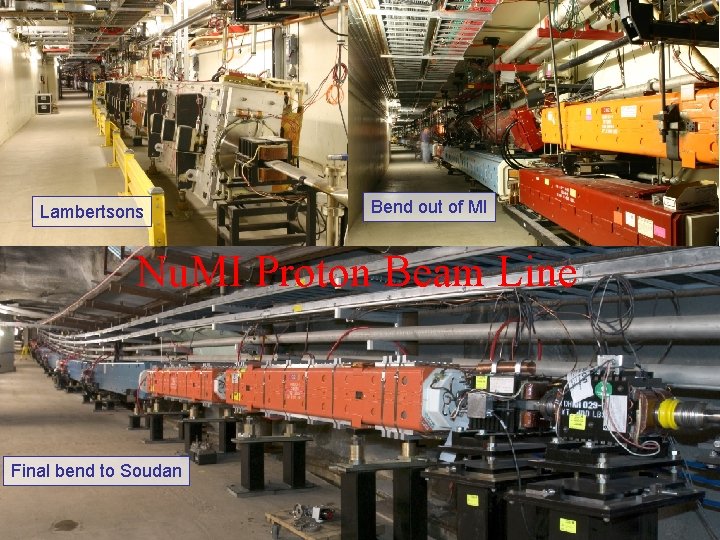
Lambertsons Bend out of MI Nu. MI Proton Beam Line Final bend to Soudan
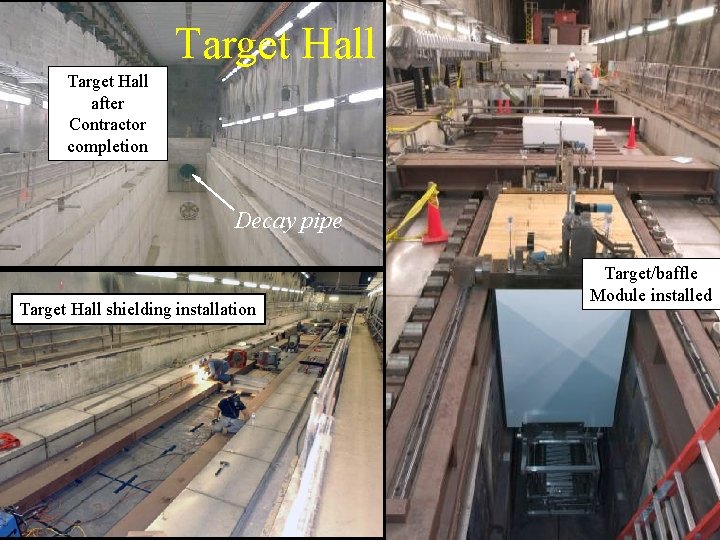
Target Hall after Contractor completion Decay pipe Target Hall shielding installation Target/baffle Module installed
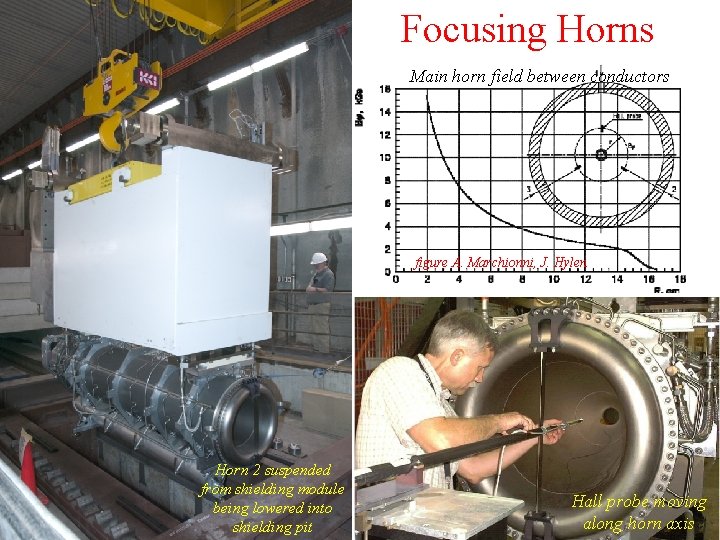
Focusing Horns Main horn field between conductors figure A. Marchionni, J. Hylen Horn 2 suspended from shielding module being lowered into shielding pit Hall probe moving along horn axis
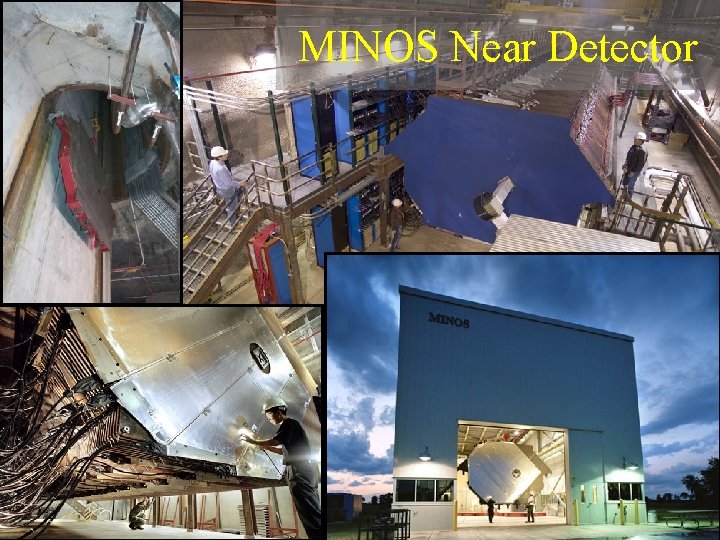
MINOS Near Detector
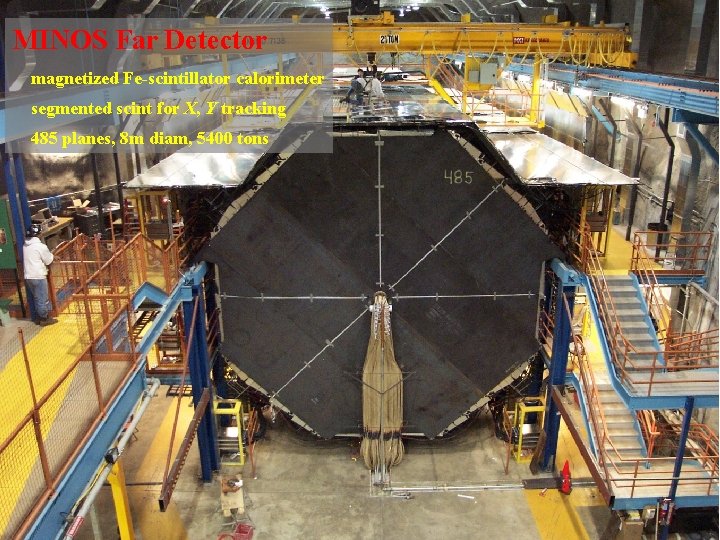
MINOS Far Detector magnetized Fe-scintillator calorimeter MINOS Far Detector segmented scint for X, Y tracking 485 planes, 8 m diam, 5400 tons
Raison d’Être for a Northern Minnesota Experiment! Austin American-Statesman Newspaper Sunday, April 18, 2004
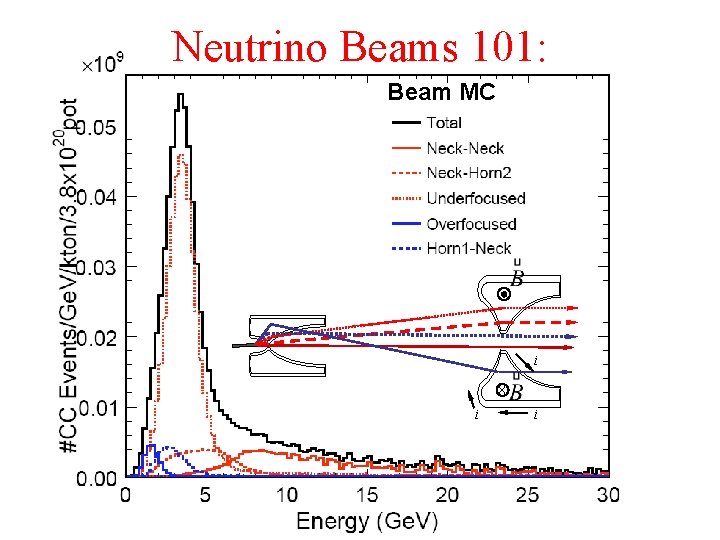
Neutrino Beams 101: Beam MC i X i i
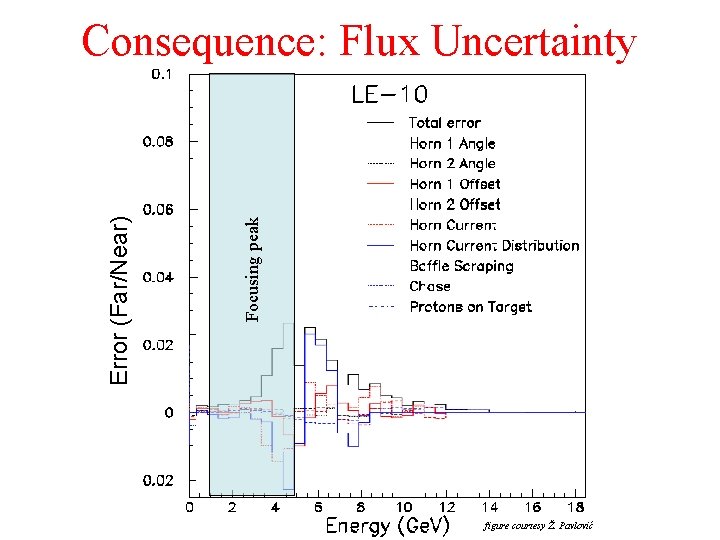
Focusing peak Error (Far/Near) Consequence: Flux Uncertainty figure courtesy Ž. Pavlović
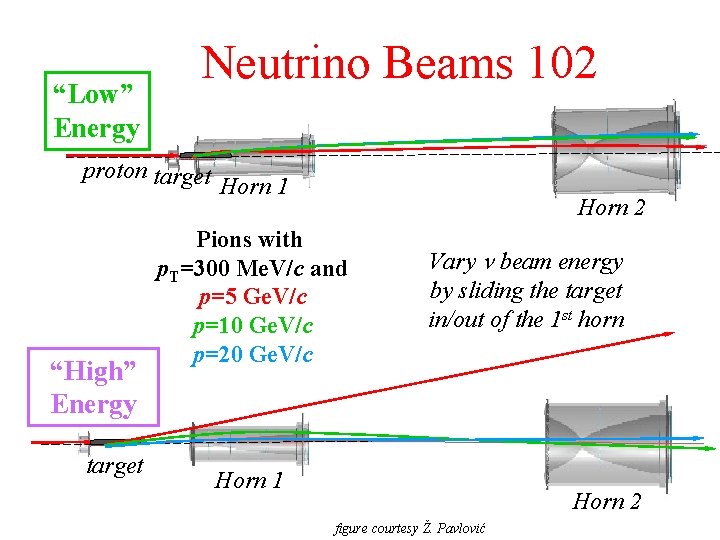
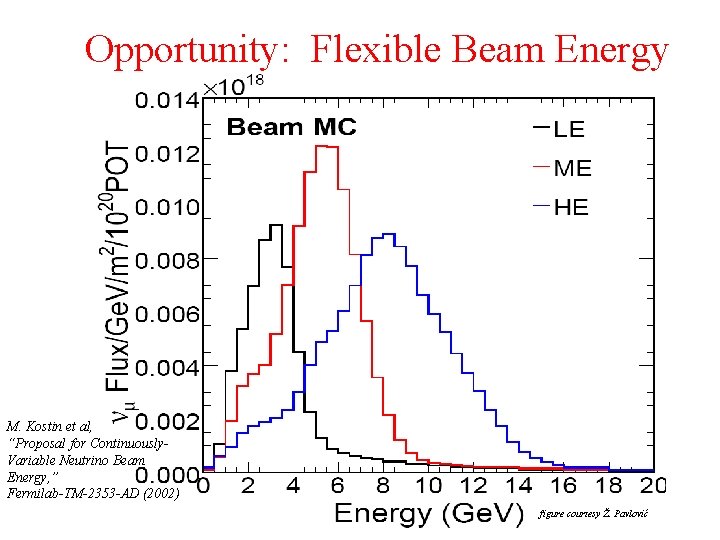
“Low” Energy Neutrino Beams 102 proton target “High” Energy target Horn 1 Horn 2 Pions with p. T=300 Me. V/c and p=5 Ge. V/c p=10 Ge. V/c p=20 Ge. V/c Vary n beam energy by sliding the target in/out of the 1 st horn Horn 1 Horn 2 figure courtesy Ž. Pavlović
Opportunity: Flexible Beam Energy M. Kostin et al, “Proposal for Continuously. Variable Neutrino Beam Energy, ” Fermilab-TM-2353 -AD (2002) figure courtesy Ž. Pavlović
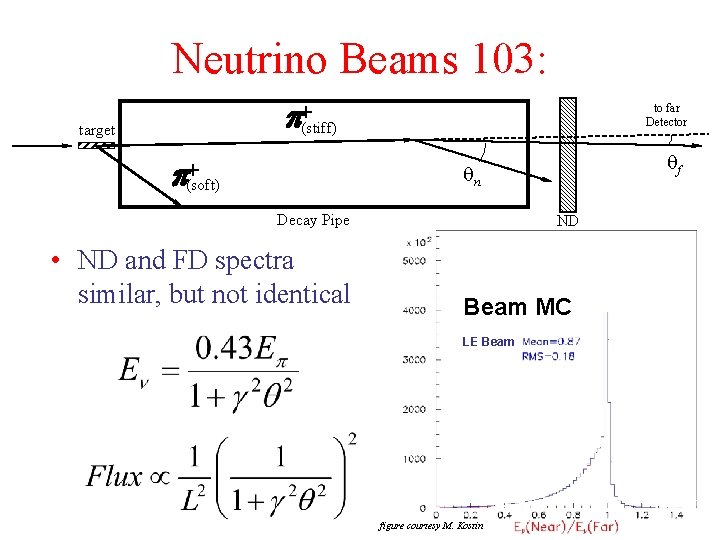
Neutrino Beams 103: p(stiff) + target p(soft) + to far Detector qf qn Decay Pipe • ND and FD spectra similar, but not identical ND Beam MC LE Beam figure courtesy M. Kostin Near Detector
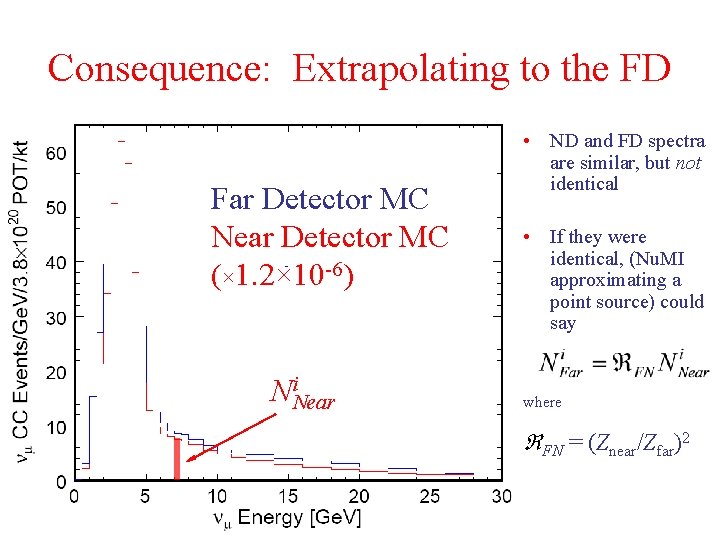
Consequence: Extrapolating to the FD Far Detector MC Near Detector MC (× 1. 2× 10 -6) Ni. Near • ND and FD spectra are similar, but not identical • If they were identical, (Nu. MI approximating a point source) could say where FN = (Znear/Zfar)2
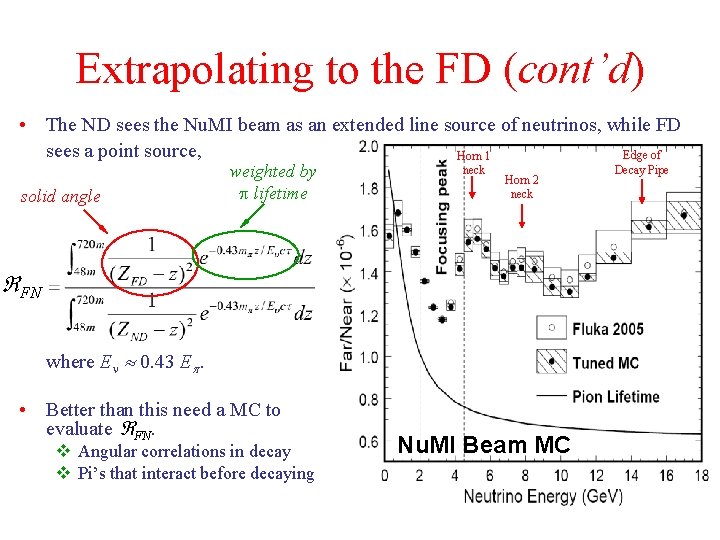
Extrapolating to the FD (cont’d) • The ND sees the Nu. MI beam as an extended line source of neutrinos, while FD sees a point source, Edge of Horn 1 solid angle weighted by p lifetime neck Horn 2 neck FN where En 0. 43 Ep. • Better than this need a MC to evaluate FN. v Angular correlations in decay v Pi’s that interact before decaying Nu. MI Beam MC Decay Pipe
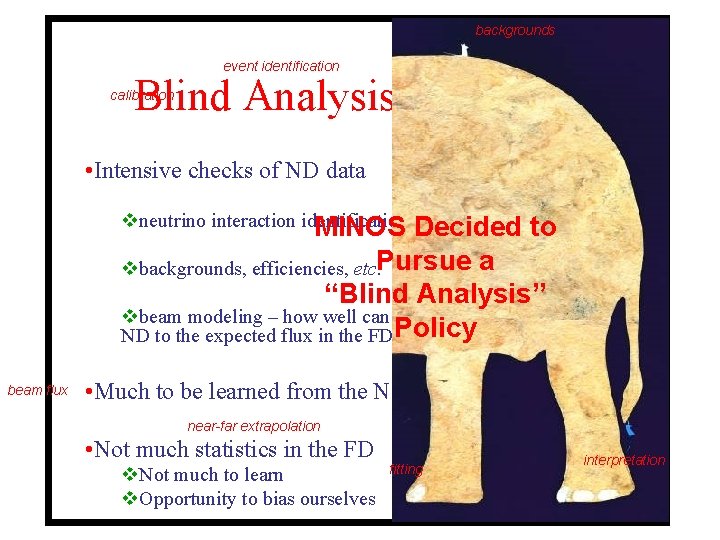
backgrounds event identification Blind Analysis Procedure calibration • Intensive checks of ND data vneutrino interaction identification in ND & FD MINOS Decided to vbackgrounds, efficiencies, etc. Pursue a “Blind Analysis” vbeam modeling – how well can we extrapolate flux measured in Policy ND to the expected flux in the FD? ? beam flux • Much to be learned from the ND Data near-far extrapolation • Not much statistics in the FD v. Not much to learn v. Opportunity to bias ourselves fitting interpretation
Step 1: Look at ND Data • Hope no gross disagreements with beam MC • See if neutrino identification is OK
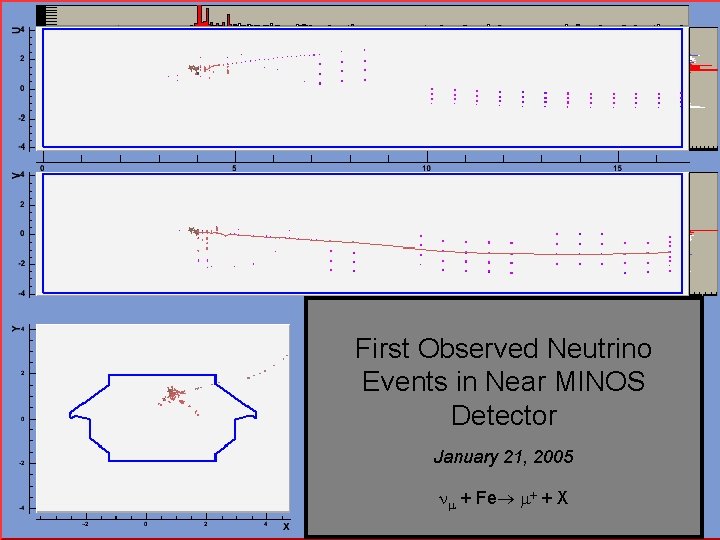
ND Events Observed First Observed Neutrino Events in Near MINOS Detector January 21, 2005 nm + Fe m+ + X
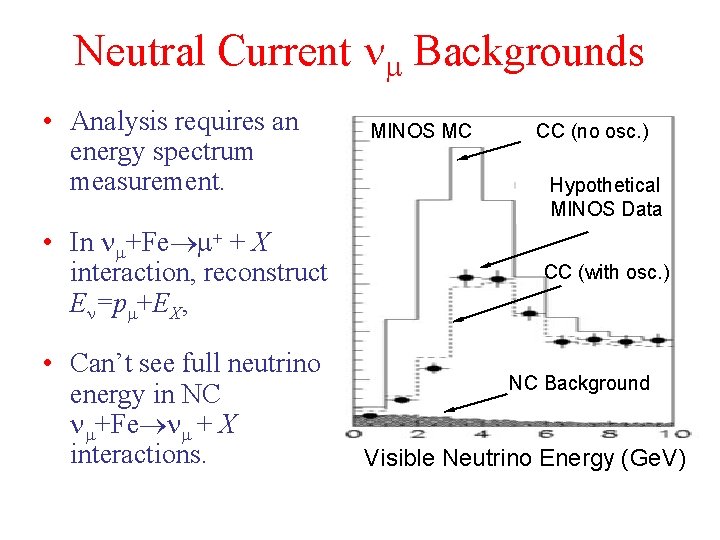
Neutral Current nm Backgrounds • Analysis requires an energy spectrum measurement. • In nm+Fe m+ + X interaction, reconstruct En=pm+EX, • Can’t see full neutrino energy in NC nm+Fe nm + X interactions. MINOS MC CC (no osc. ) Hypothetical MINOS Data CC (with osc. ) NC Background Visible Neutrino Energy (Ge. V)
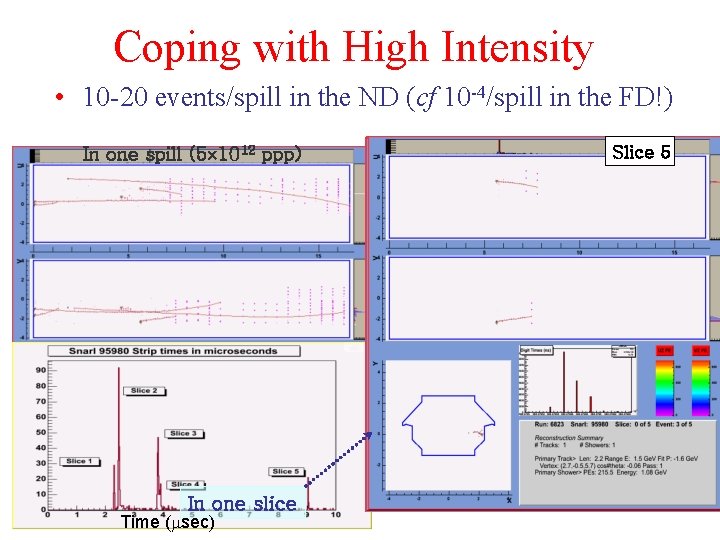
Coping with High Intensity • 10 -20 events/spill in the ND (cf 10 -4/spill in the FD!) In one spill (5 1012 ppp) In one slice Time (msec) Slice 3 2 5 1 4
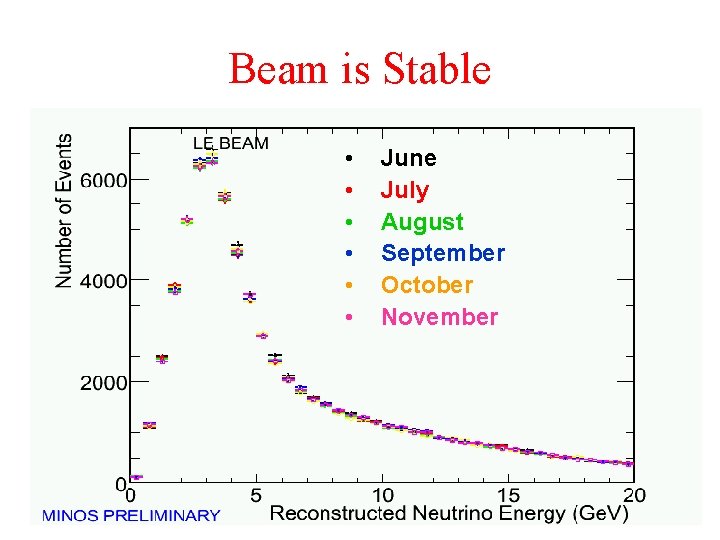
Beam is Stable • • • June July August September October November
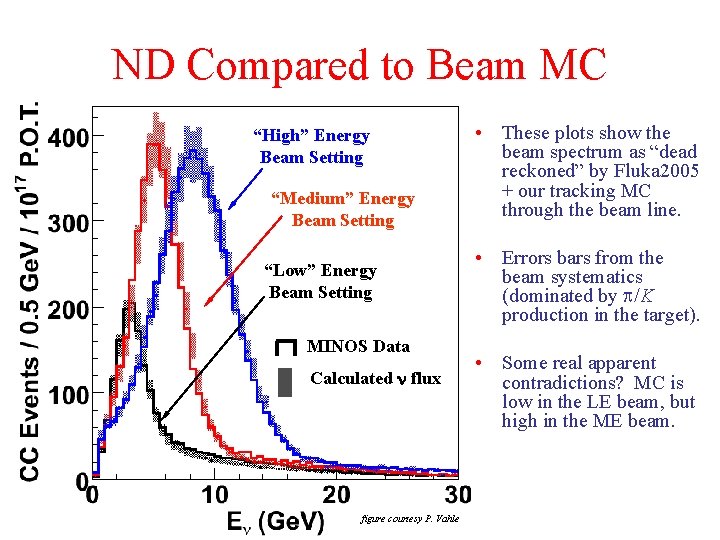
ND Compared to Beam MC “High” Energy Beam Setting “Medium” Energy Beam Setting “Low” Energy Beam Setting MINOS Data Calculated n flux figure courtesy P. Vahle • These plots show the beam spectrum as “dead reckoned” by Fluka 2005 + our tracking MC through the beam line. • Errors bars from the beam systematics (dominated by p/K production in the target). • Some real apparent contradictions? MC is low in the LE beam, but high in the ME beam.
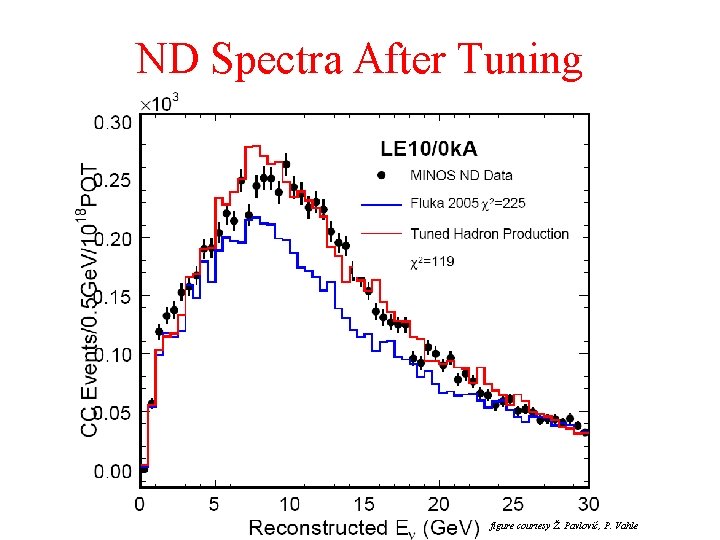
ND Spectra After Tuning figure courtesy Ž. Pavlović, P. Vahle
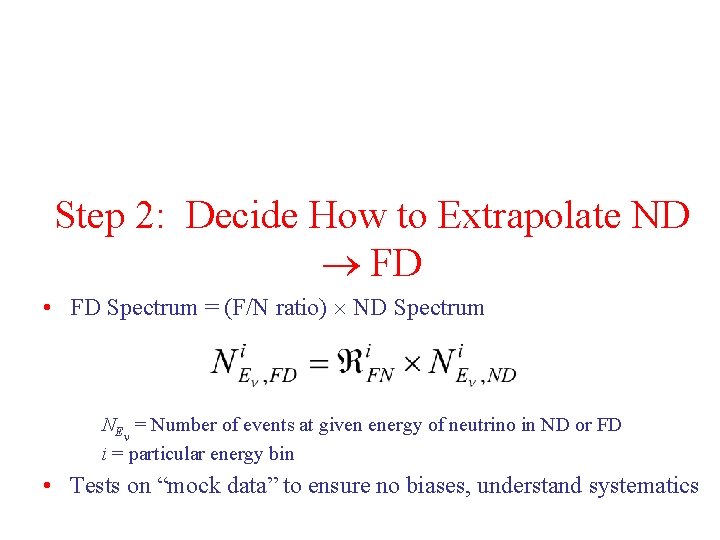
Step 2: Decide How to Extrapolate ND FD • FD Spectrum = (F/N ratio) ND Spectrum NEn = Number of events at given energy of neutrino in ND or FD i = particular energy bin • Tests on “mock data” to ensure no biases, understand systematics
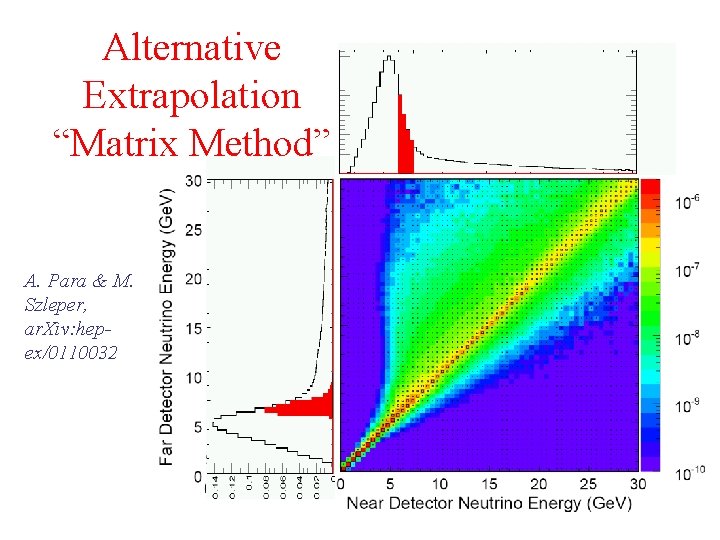
Alternative Extrapolation “Matrix Method” A. Para & M. Szleper, ar. Xiv: hepex/0110032
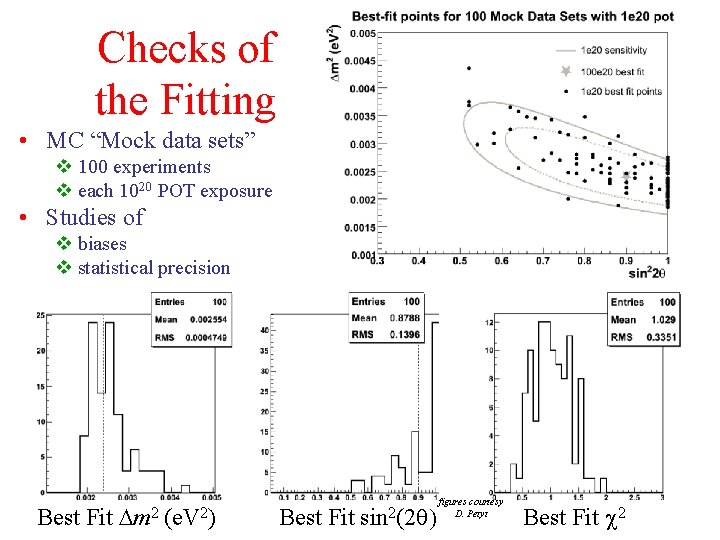
Checks of the Fitting • MC “Mock data sets” v 100 experiments v each 1020 POT exposure • Studies of v biases v statistical precision Best Fit Dm 2 (e. V 2) Best Fit sin 2(2 q) figures courtesy D. Petyt Best Fit c 2
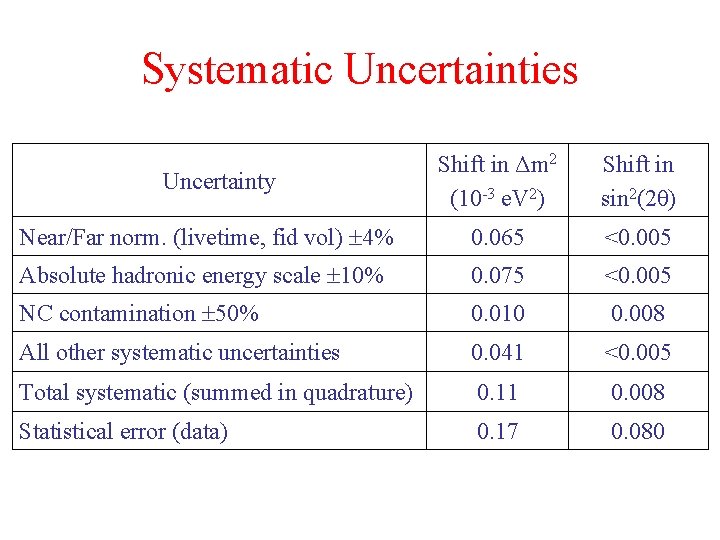
Systematic Uncertainties Shift in Δm 2 (10 -3 e. V 2) Shift in sin 2(2θ) Near/Far norm. (livetime, fid vol) 4% 0. 065 <0. 005 Absolute hadronic energy scale 10% 0. 075 <0. 005 NC contamination 50% 0. 010 0. 008 All other systematic uncertainties 0. 041 <0. 005 Total systematic (summed in quadrature) 0. 11 0. 008 Statistical error (data) 0. 17 0. 080 Uncertainty
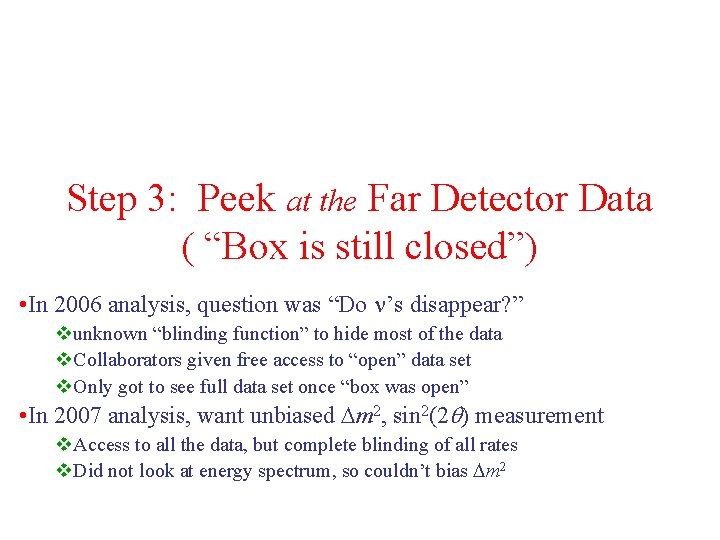
Step 3: Peek at the Far Detector Data ( “Box is still closed”) • In 2006 analysis, question was “Do n’s disappear? ” vunknown “blinding function” to hide most of the data v. Collaborators given free access to “open” data set v. Only got to see full data set once “box was open” • In 2007 analysis, want unbiased Dm 2, sin 2(2 q) measurement v. Access to all the data, but complete blinding of all rates v. Did not look at energy spectrum, so couldn’t bias Dm 2
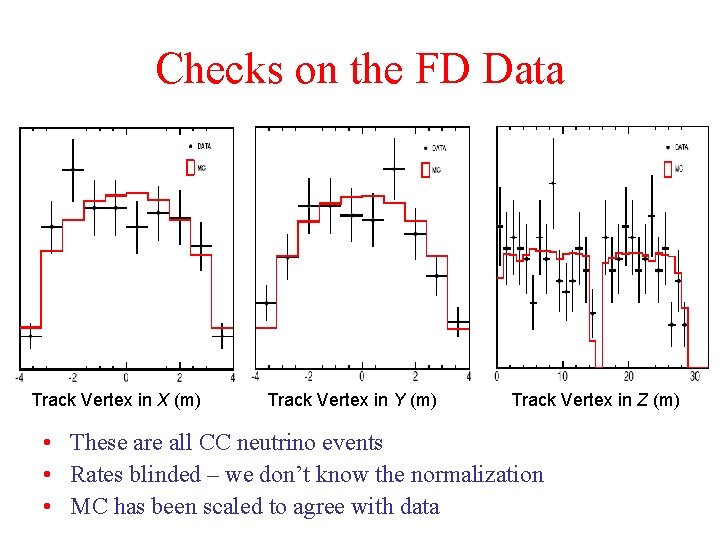
Checks on the FD Data Track Vertex in X (m) Track Vertex in Y (m) Track Vertex in Z (m) • These are all CC neutrino events • Rates blinded – we don’t know the normalization • MC has been scaled to agree with data
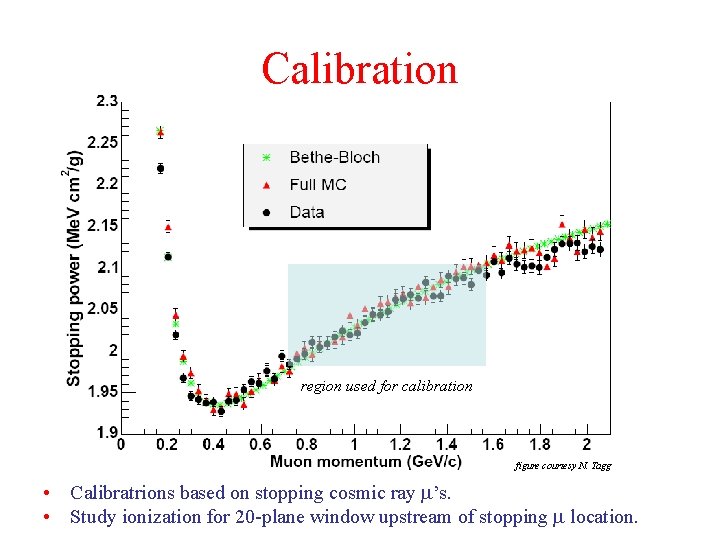
Calibration region used for calibration figure courtesy N. Tagg • Calibratrions based on stopping cosmic ray m’s. • Study ionization for 20 -plane window upstream of stopping m location.
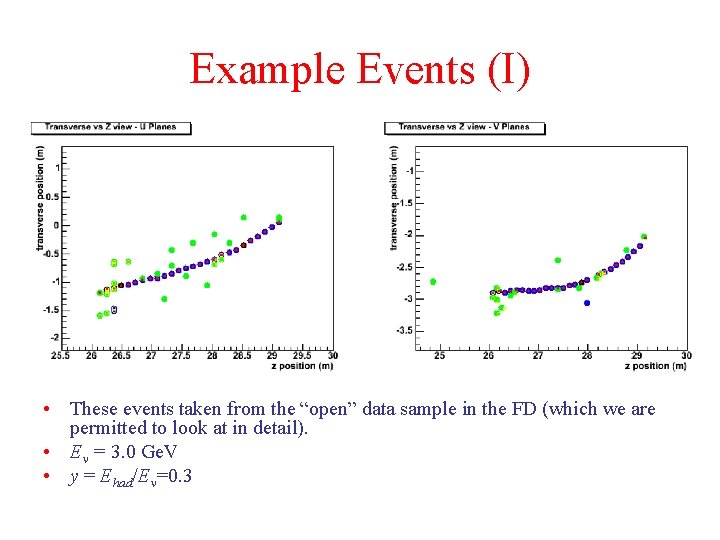
Example Events (I) • These events taken from the “open” data sample in the FD (which we are permitted to look at in detail). • En = 3. 0 Ge. V • y = Ehad/En=0. 3
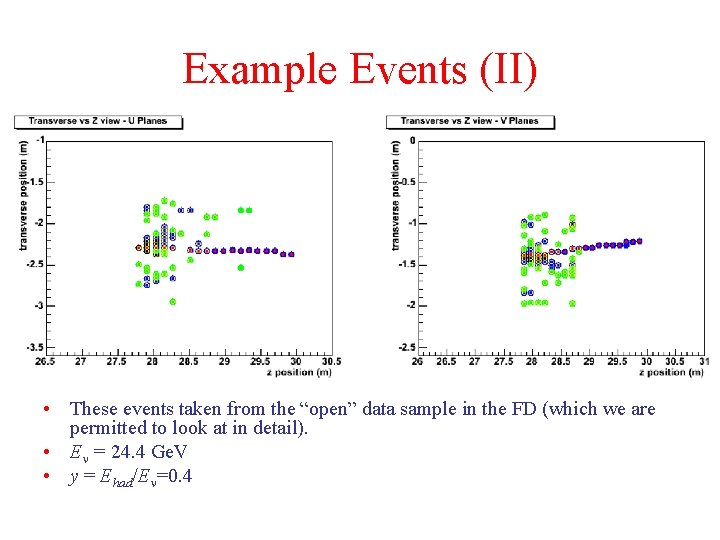
Example Events (II) • These events taken from the “open” data sample in the FD (which we are permitted to look at in detail). • En = 24. 4 Ge. V • y = Ehad/En=0. 4
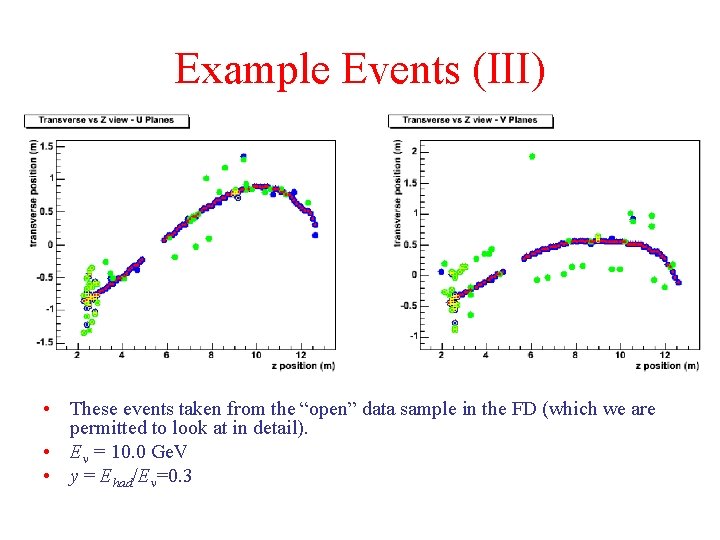
Example Events (III) • These events taken from the “open” data sample in the FD (which we are permitted to look at in detail). • En = 10. 0 Ge. V • y = Ehad/En=0. 3
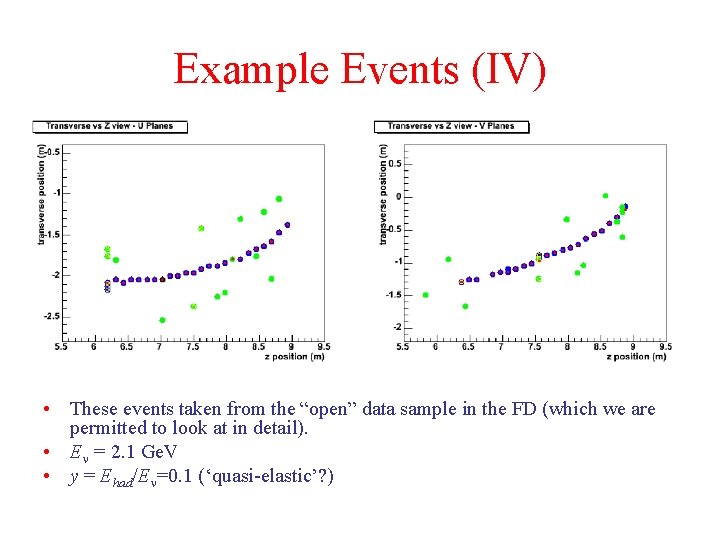
Example Events (IV) • These events taken from the “open” data sample in the FD (which we are permitted to look at in detail). • En = 2. 1 Ge. V • y = Ehad/En=0. 1 (‘quasi-elastic’? )
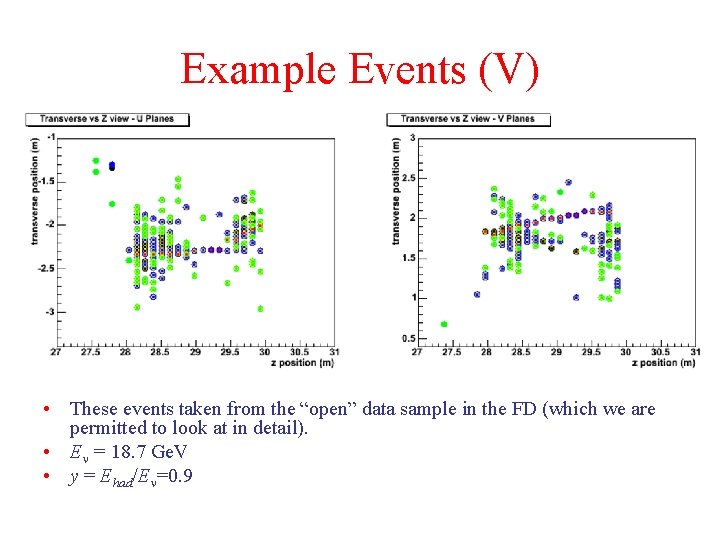
Example Events (V) • These events taken from the “open” data sample in the FD (which we are permitted to look at in detail). • En = 18. 7 Ge. V • y = Ehad/En=0. 9
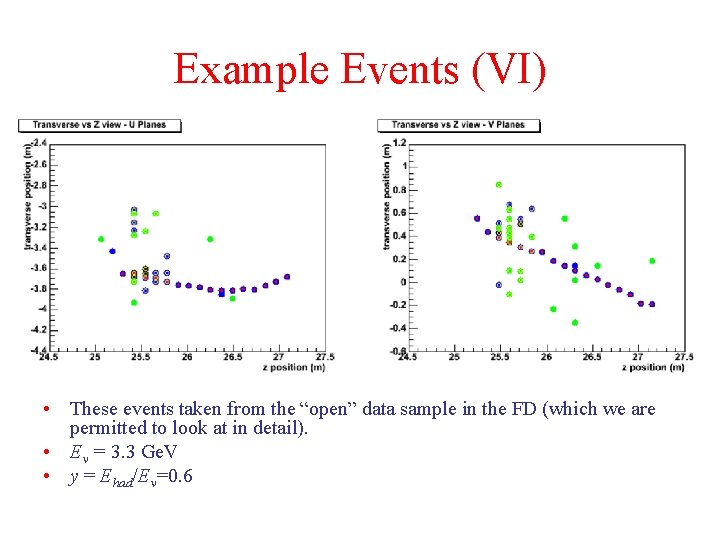
Example Events (VI) • These events taken from the “open” data sample in the FD (which we are permitted to look at in detail). • En = 3. 3 Ge. V • y = Ehad/En=0. 6
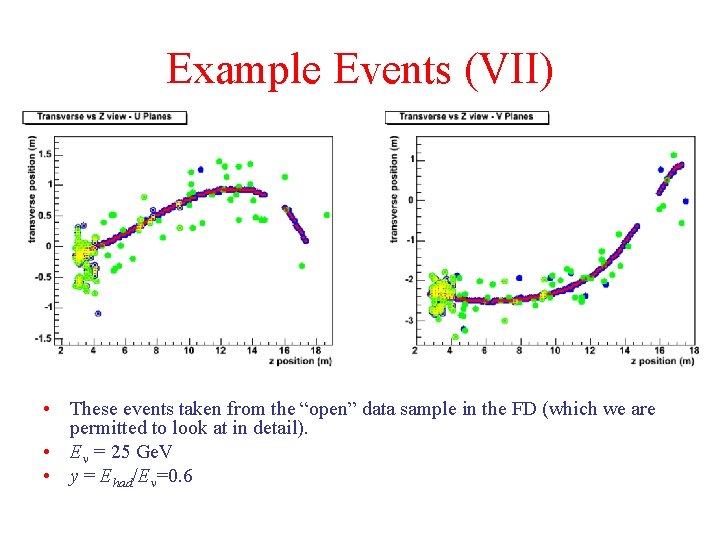
Example Events (VII) • These events taken from the “open” data sample in the FD (which we are permitted to look at in detail). • En = 25 Ge. V • y = Ehad/En=0. 6
Step 4: Look at All Events “Open the Box”
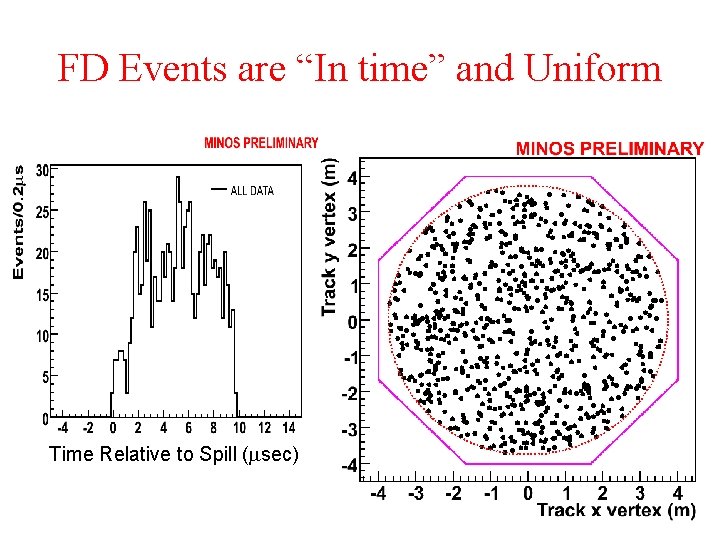
FD Events are “In time” and Uniform Time Relative to Spill (msec)
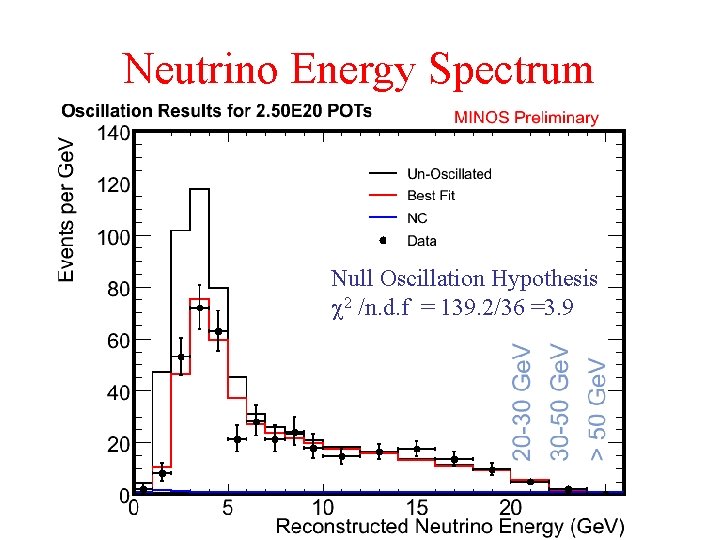
Neutrino Energy Spectrum Null Oscillation Hypothesis c 2 /n. d. f = 139. 2/36 =3. 9
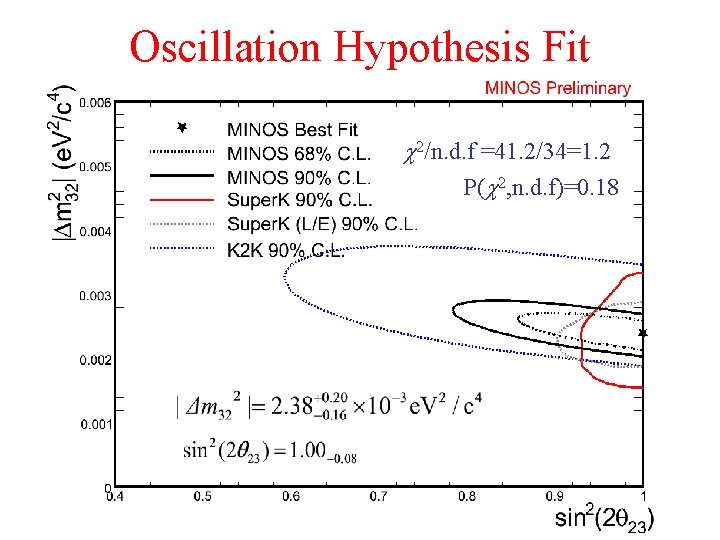
Oscillation Hypothesis Fit c 2/n. d. f =41. 2/34=1. 2 P(c 2, n. d. f)=0. 18
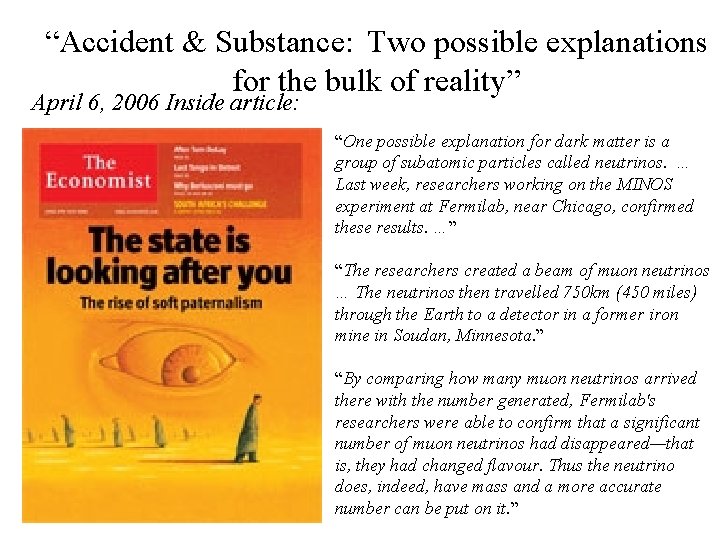
“Accident & Substance: Two possible explanations “Fair and Balanced” for the bulk of reality” April 6, 2006 Inside article: “One possible explanation for dark matter is a group of subatomic particles called neutrinos. … Last week, researchers working on the MINOS experiment at Fermilab, near Chicago, confirmed these results. …” “The researchers created a beam of muon neutrinos … The neutrinos then travelled 750 km (450 miles) through the Earth to a detector in a former iron mine in Soudan, Minnesota. ” “By comparing how many muon neutrinos arrived there with the number generated, Fermilab's researchers were able to confirm that a significant number of muon neutrinos had disappeared—that is, they had changed flavour. Thus the neutrino does, indeed, have mass and a more accurate number can be put on it. ”
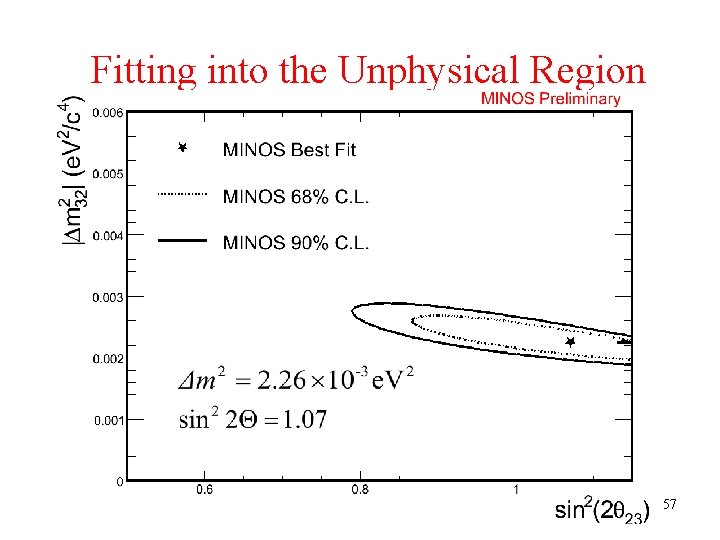
Fitting into the Unphysical Region 57
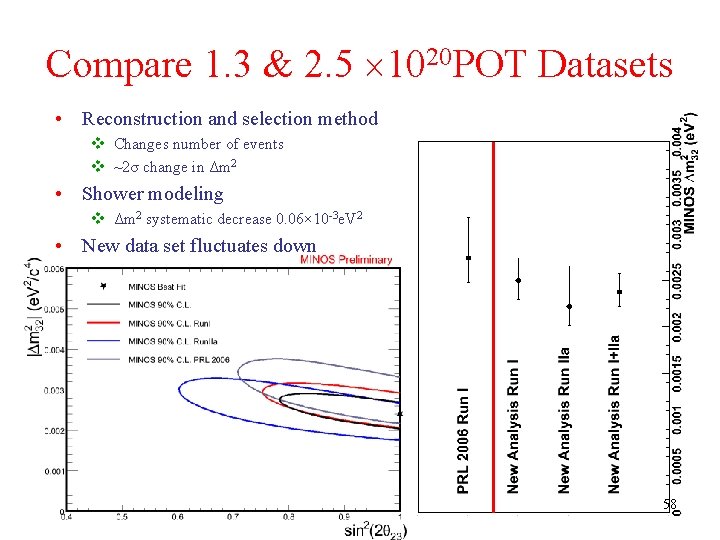
Compare 1. 3 & 2. 5 1020 POT Datasets • Reconstruction and selection method v Changes number of events v ~2σ change in Δm 2 • Shower modeling v Δm 2 systematic decrease 0. 06× 10 -3 e. V 2 • New data set fluctuates down 58
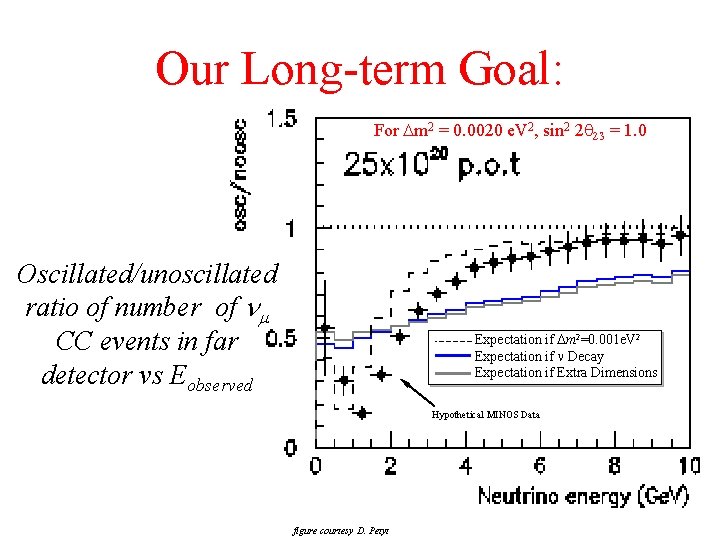
Our Long-term Goal: For Dm 2 = 0. 0020 e. V 2, sin 2 2 q 23 = 1. 0 Oscillated/unoscillated ratio of number of nm CC events in far detector vs Eobserved Expectation if Dm 2=0. 001 e. V 2 Expectation if n Decay Expectation if Extra Dimensions Hypothetical MINOS Data figure courtesy D. Petyt .
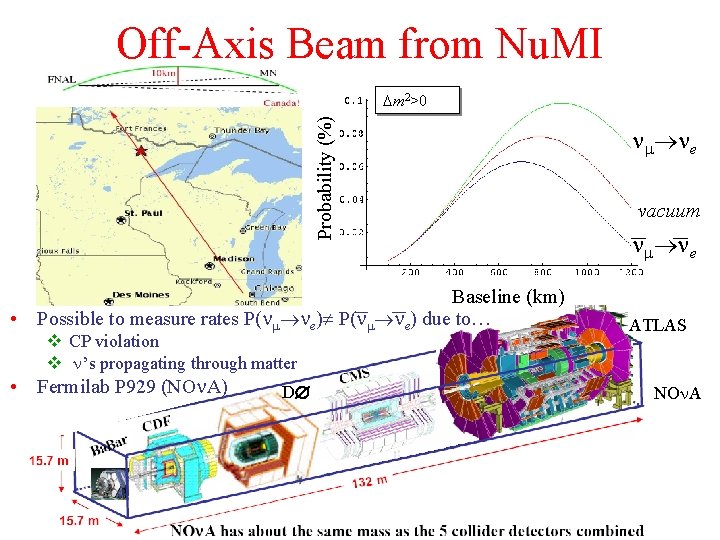
Off-Axis Beam from Nu. MI Probability (%) Dm 2>0 Baseline (km) • Possible to measure rates P(nm ne) due to… v CP violation v n’s propagating through matter • Fermilab P 929 (NOn. A) D nm ne vacuum nm ne ATLAS NOn. A
Competition in Japan
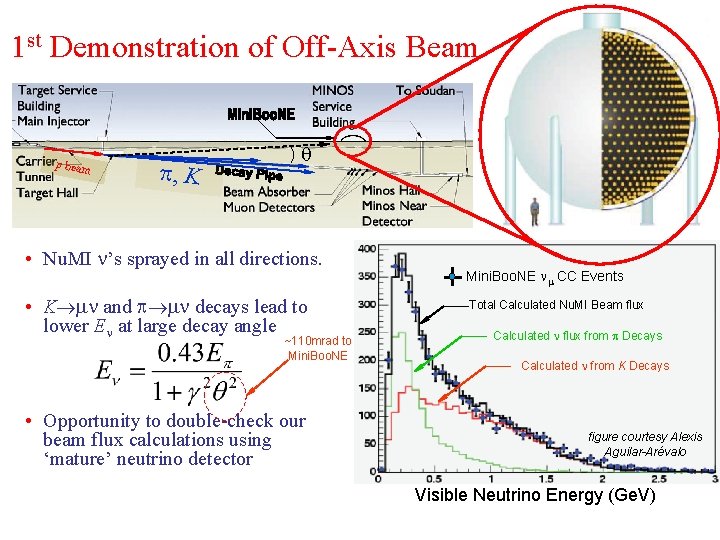
1 st Demonstration of Off-Axis Beam p beam p, K q • Nu. MI n’s sprayed in all directions. • K mn and p mn decays lead to lower En at large decay angle ~110 mrad to Mini. Boo. NE • Opportunity to double-check our beam flux calculations using ‘mature’ neutrino detector Mini. Boo. NE nm CC Events Total Calculated Nu. MI Beam flux Calculated n flux from p Decays Calculated n from K Decays figure courtesy Alexis Aguilar-Arévalo Visible Neutrino Energy (Ge. V)
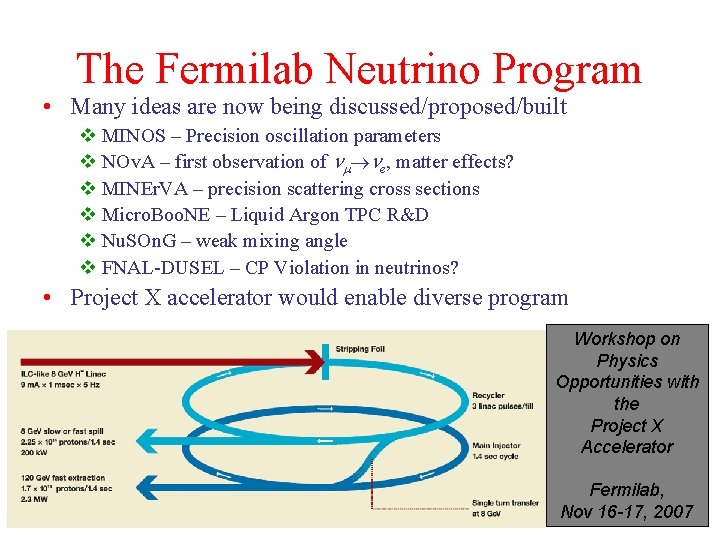
The Fermilab Neutrino Program • Many ideas are now being discussed/proposed/built v MINOS – Precision oscillation parameters v NOv. A – first observation of nm ne, matter effects? v MINEr. VA – precision scattering cross sections v Micro. Boo. NE – Liquid Argon TPC R&D v Nu. SOn. G – weak mixing angle v FNAL-DUSEL – CP Violation in neutrinos? • Project X accelerator would enable diverse program Workshop on Physics Opportunities with the Project X Accelerator Fermilab, Nov 16 -17, 2007
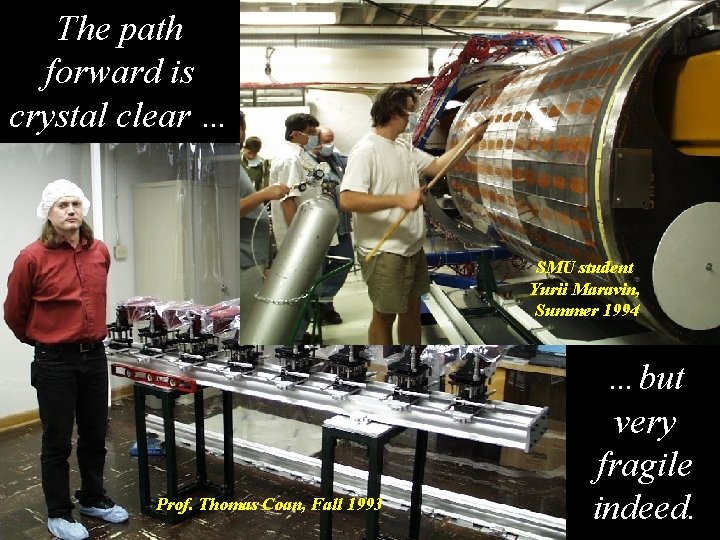
The path forward is crystal clear … SMU student Yurii Maravin, Summer 1994 Prof. Thomas Coan, Fall 1993 …but very fragile indeed.
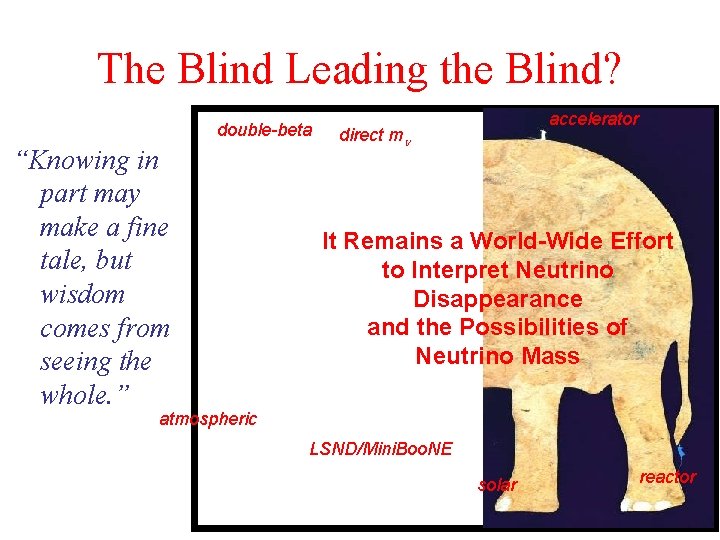
The Blind Leading the Blind? double-beta “Knowing in part may make a fine tale, but wisdom comes from seeing the whole. ” accelerator direct mn It Remains a World-Wide Effort to Interpret Neutrino Disappearance and the Possibilities of Neutrino Mass atmospheric LSND/Mini. Boo. NE solar reactor
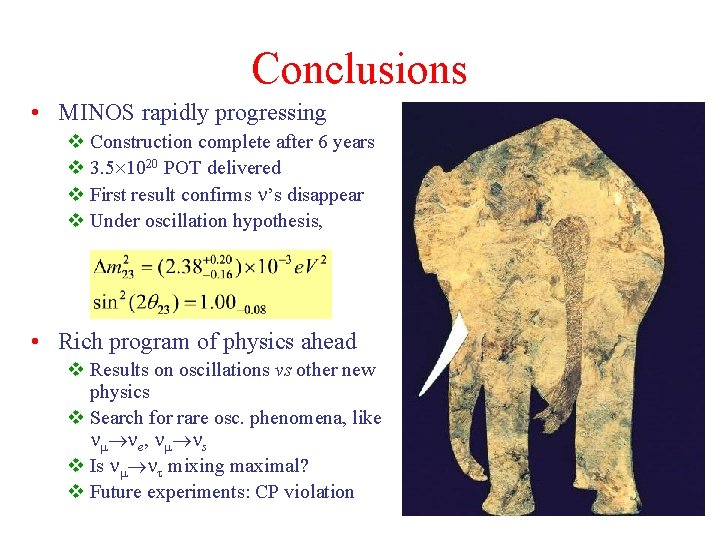
Conclusions • MINOS rapidly progressing v Construction complete after 6 years v 3. 5 1020 POT delivered v First result confirms n’s disappear v Under oscillation hypothesis, • Rich program of physics ahead v Results on oscillations vs other new physics v Search for rare osc. phenomena, like nm ne, nm ns v Is nm nt mixing maximal? v Future experiments: CP violation
Backup Slides
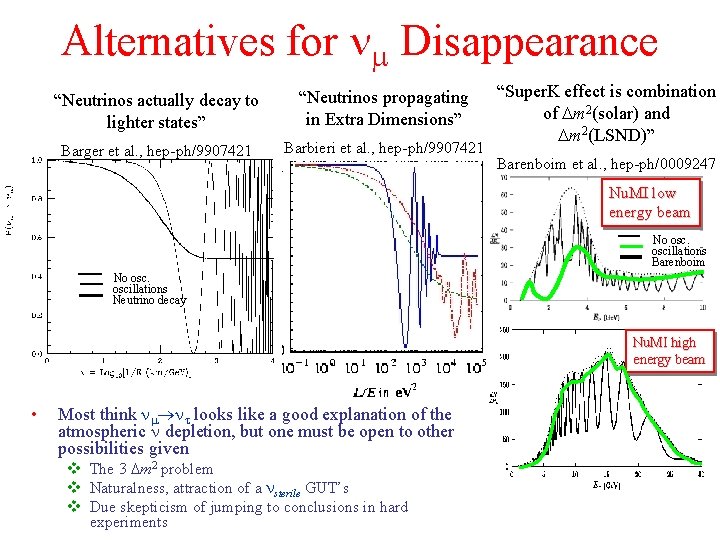
Alternatives for nm Disappearance “Neutrinos actually decay to lighter states” Barger et al. , hep-ph/9907421 “Super. K effect is combination “Neutrinos propagating of Dm 2(solar) and in Extra Dimensions” Dm 2(LSND)” Barbieri et al. , hep-ph/9907421 Barenboim et al. , hep-ph/0009247 Nu. MI low energy beam No oscillations Barenboim No oscillations Neutrino decay Nu. MI high energy beam • Most think nm nt looks like a good explanation of the atmospheric n depletion, but one must be open to other possibilities given v The 3 Dm 2 problem v Naturalness, attraction of a nsterile GUT’s v Due skepticism of jumping to conclusions in hard experiments
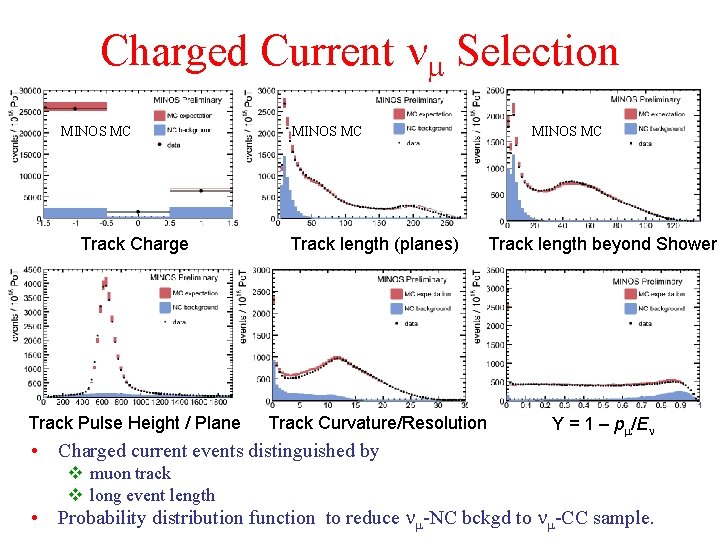
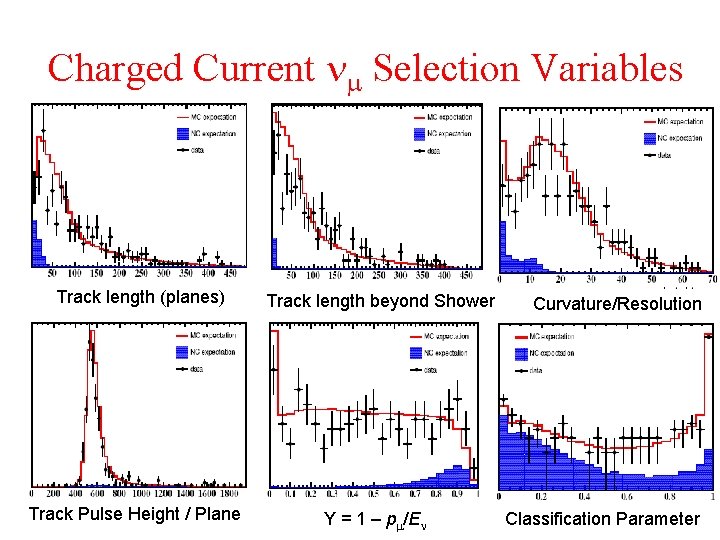
Charged Current nm Selection MINOS MC Track Charge Track length (planes) Track length beyond Shower Track Pulse Height / Plane Track Curvature/Resolution Y = 1 – pm/En • Charged current events distinguished by v muon track v long event length • Probability distribution function to reduce nm-NC bckgd to nm-CC sample.
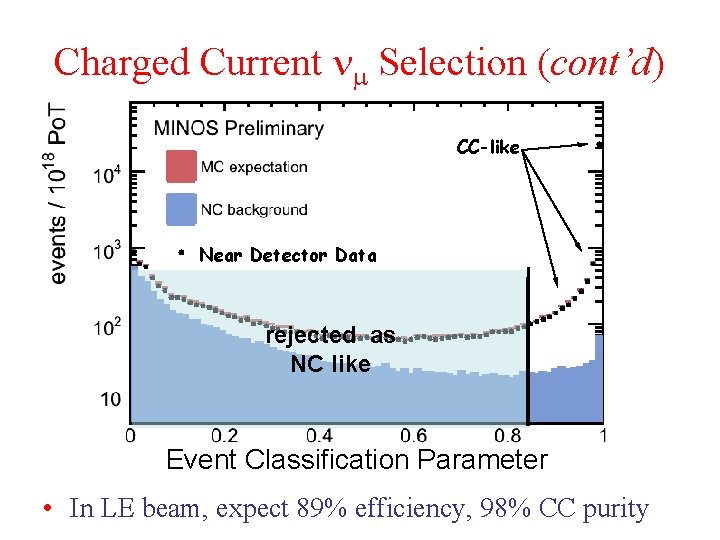
Charged Current nm Selection (cont’d) CC-like Near Detector Data rejected as NC like Event Classification Parameter • In LE beam, expect 89% efficiency, 98% CC purity
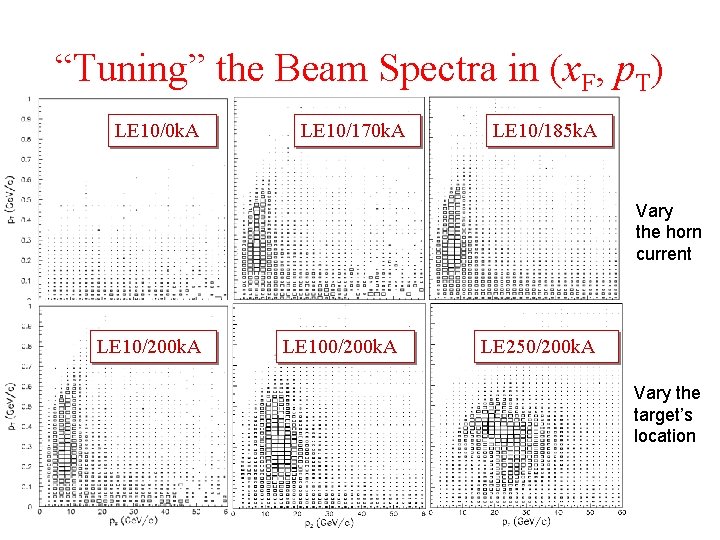
“Tuning” the Beam Spectra in (x. F, p. T) LE 10/0 k. A LE 10/170 k. A LE 10/185 k. A Vary the horn current LE 10/200 k. A LE 100/200 k. A LE 250/200 k. A Vary the target’s location
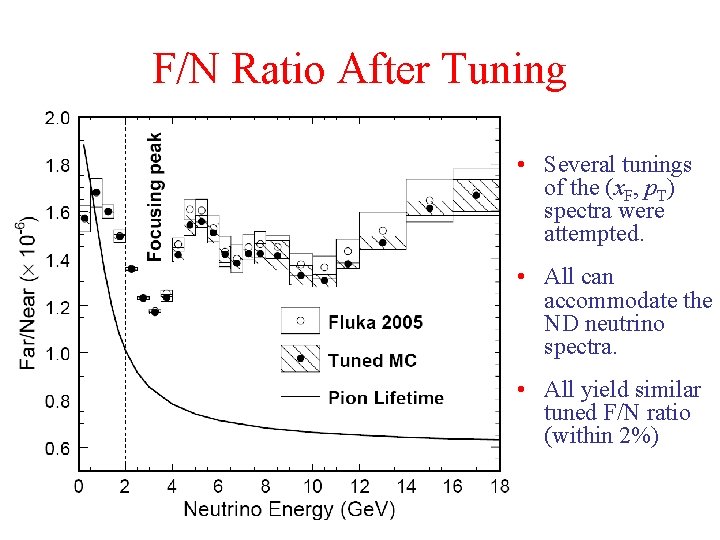
F/N Ratio After Tuning • Several tunings of the (x. F, p. T) spectra were attempted. • All can accommodate the ND neutrino spectra. • All yield similar tuned F/N ratio (within 2%)
Charged Current nm Selection Variables Track length (planes) Track Pulse Height / Plane Track length beyond Shower Y = 1 – pm/En Curvature/Resolution Classification Parameter
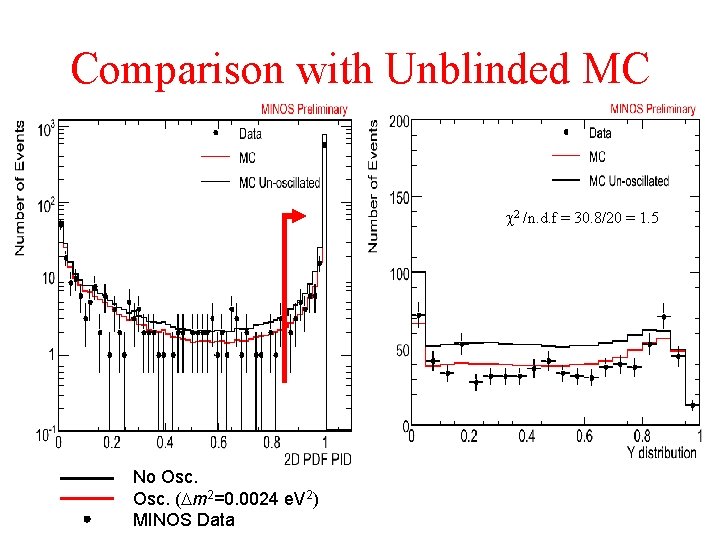
Comparison with Unblinded MC c 2 /n. d. f = 30. 8/20 = 1. 5 Reconstructed y Ehad/En No Osc. (Dm 2=0. 0024 e. V 2) MINOS Data