
Neutrino experiments Review of Recent Results Junpei Shirai


![Neutrino Oscillation Experiments: Long history (40~50 years!) of challenging mass! [Source] Flavor eigenstates L](https://slidetodoc.com/presentation_image/3be713f19a55ae59d958d70ec89d3b30/image-3.jpg "Neutrino Oscillation Experiments: Long history (40~50 years!) of challenging mass! [Source] Flavor eigenstates L")

![Neutrino generation & spectrum [SSM] pp de pe p d pp (. 909) pep](https://slidetodoc.com/presentation_image/3be713f19a55ae59d958d70ec89d3b30/image-5.jpg "Neutrino generation & spectrum [SSM] pp de pe p d pp (. 909) pep")
![Solar experiments ‘ 68~ Homestake e+37 Cl 37 Ar+e [C 2 Cl 4] ‘](https://slidetodoc.com/presentation_image/3be713f19a55ae59d958d70ec89d3b30/image-6.jpg "Solar experiments ‘ 68~ Homestake e+37 Cl 37 Ar+e [C 2 Cl 4] ‘")


![analysis region Results Observed e : 258 [>2. 6 Me. V] Expected for non-oscillation](https://slidetodoc.com/presentation_image/3be713f19a55ae59d958d70ec89d3b30/image-17.jpg "analysis region Results Observed e : 258 [>2. 6 Me. V] Expected for non-oscillation")
![No-oscillation Results Observed e : 258 [>2. 6 Me. V] Expected for non-oscillation :](https://slidetodoc.com/presentation_image/3be713f19a55ae59d958d70ec89d3b30/image-18.jpg "No-oscillation Results Observed e : 258 [>2. 6 Me. V] Expected for non-oscillation :")




![Direct mass measurement d. N/d. Ee=KF(Ee, Z)pe. Etot(E 0 -Ee)[(E 0 Ee)2 m 2)]2](https://slidetodoc.com/presentation_image/3be713f19a55ae59d958d70ec89d3b30/image-32.jpg "Direct mass measurement d. N/d. Ee=KF(Ee, Z)pe. Etot(E 0 -Ee)[(E 0 Ee)2 m 2)]2")


- Slides: 38
Neutrino experiments: Review of Recent Results Junpei Shirai Research Center for Neutrino Science Tohoku University (for the Kam. LAND Collaboration) Tau 04, 8 th International Workshop on Tau-Lepton Physics, Nara, Sept. 16, 2004.
Contents: Neutrino Oscillation Experiments Solar and Reactor Neutrino Results Atmospheric Neutrino Experiments Coming experiments Double beta decay & Search for neutrino mass Summary
Neutrino Oscillation Experiments: Long history (40~50 years!) of challenging mass! [Source] Flavor eigenstates L [Detector] cos sin = sin cos Survival probability of : P( )=1 P( ) 2 L M 2 2 1 sin 2 sin ( 4 Eij ) <1 ? Mij 2=Mi 2 -Mj 2) i j Oscillation parameters determined by Mass eigenstates Clear evidence of -flavor change; Solar : SNO Reactor : Kam. LAND Atmospheric : Super. K Accelerator : K 2 K �F F d. E � * Tiny , M =0 (SM) Flavor change of ��occurs dominantly by Oscillation. does have a Mass!
Solar Neutrino Problem (SNP) e 4 p+2 e 4 He+2 e+26. 73 Me. V E (Pure e flux is generated by thermo-nuclear fusion in the center of the sun!) e ? [Sun] [Earth] flux: Observation < Prediction [Experiments] [SSM]
Neutrino generation & spectrum [SSM] pp de pe p d pp (. 909) pep ( ) pd He H� He 2 p He e+ He H� Be e Li Be p 2 He ( ) Be p B 7 Be ( ) Li hep B Be* 8 B ( ) e+ 24 He Flux@1 AU(/cm 2/s/Me. V), (/cm 2/s for lines) pp-chain(98. 4%) +CNOcycle(1. 4%) 8 B pp & above 7 Be & above only Kamiokande, Super. K SNO J. N. Bahcall
Solar experiments ‘ 68~ Homestake e+37 Cl 37 Ar+e [C 2 Cl 4] ‘ 80 ‘ 90 ‘ 00 Fobs/F[SSM] 0. 3 0. 4 0. 5 0. 6 Radiochemical Real time ‘ 60 ‘ 70 (PDG’ 04) ‘ 83~’ 96 First observation of solar [H 2 O] really comes Kamiokande +e from the sun ‘ 91~’ 97 ‘ 90~’ 01 Establish Solar- deficit Gallex/ SAGE e+71 Ga 71 Ge+e GNO Detection of pp ‘ 96~ Super. K +e [H O] High Precision 2 measurement SNO ‘ 99~ e only e+d p+p+e ����� +d n+p+ ��N�� e+ + t +e ���� [D 2 O] Active Non- e Components !
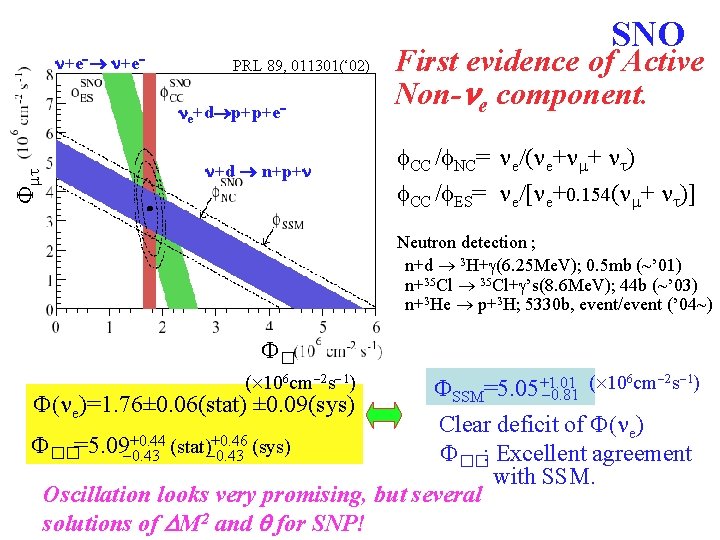
+e SNO PRL 89, 011301(‘ 02) F e+d p+p+e +d n+p+ First evidence of Active Non- e component. CC / NC= e ( e+ + ) CC / ES= e [ e+0. 154( + )] Neutron detection ; n+d H+ (6. 25 Me. V); 0. 5 mb (~’ 01) n+ Cl Cl+ ’s(8. 6 Me. V); 44 b (~’ 03) n+ He p+ H; 5330 b, event/event (’ 04~) F� ( 106 cm 2 s ) 2 ( 10 cm s ) FSSM=5. 05+1. 01 0. 81 F e)=1. 76± 0. 06(stat) ± 0. 09(sys) Clear deficit of F e) +0. 44 (stat)+0. 46 (sys) F��=5. 09 0. 43 F��: Excellent agreement 0. 43 with SSM. Oscillation looks very promising, but several solutions of DM 2 and for SNP! 6
-Oscillation parameters Allowed region(95%) H. Murayama Four solutions to SNP VAC(just so) SMA, LOW by Matter effect (MSW effect) P( e e)=1 sin 22 ���sin 2( M 2 L/4 E e only] sin 22 2 2 EGFNe cos 2 M 2 Seasonal variation, D/N asymmetry, Energy Spectrum ; LMA looks very promising, but no single experiment uniquely determined the solution. Needs decisive experiment ! Man-made provided by Reactor.
Reactor neutrino experiments Long history since the first detection of neutrino by F. Reines and C. L. Cowan using a reactor in 1950 s. Power reactors as a source. n n X A 235 U, 239 Pu, 241 Pu, 238 U Y Neutron rich nuclei to decay. e emission + ~200 Me. V /fission Typical reactor : 3 GW(thermal energy) �� ��� Pure and intense � flux which is known < 2% ! Measure P( e e) with a distant detector.
e flux, and interaction energies Previous reactor results e interactions No oscillation was found! e flux ( ep e+n) 3 4 5 Threshold (1. 8 Me. V) 6 7 8 E (Me. V) E������ d DM 2>10 -3 e. V 2 M 2~10 5 e. V 2 to check LMA, Loscil= 2 p. E ~O(100)km 2 M Intense e source & Large Detector Kam. LAND is experimentally known or calculated (~2%). are crucial! e spectrum of each fuel element
Kam. LAND Experimental Area 1000 m Detector Super. K 2. 2 km Control Room Kamioka mine Nitrogen Gas System Water Supply System Oil Purification System
Kam. LAND Detector (Kamioka Liquid scintillator Anti-Neutrino Detector) 52 power reactors in Japan 2700 m w. e. ~0. 3 m’s/sec 1000 ton Ultra pure LS in a 13 mf Balloon Kam. LAND 20 m PMTs (in 2. 5 m thick mineral oil; 1325 17”( t~1. 5 ns) +554 20” ( % p) Water Cherenkov counter(225 20”PMTs) E/E~7. 3%/ E[Me. V] ~70 GW(thermal) within 175± 35 km from Kam. LAND. 7% of the total reactor power in the world ! ~106 e/cm 2/sec @Kam. LAND (E >1. 8 Me. V)
Typical reactor operation Thermal Power Reactor Neutrino flux at Kam. LAND 1 106 e/cm 2/sec (E >1. 8 Me. V) Burnup Total Fission Rates Wakasa Bay 235 U Others Kashiwazaki 239 Pu 238 U 241 Pu Mar’ 02 Korea Shika Hamaoka Jan’ 0 F is precisely estimated within ± 3. 4% Fission rates are calculated by thermal power and initial fuel composition. Reactor power 2. 1%, Fuel comp. 1. 0% -spectra 2. 5%
e ep e+n Detection: Traditional method since F. Reines used Liquid Scintillator as an active target ! + e e e p [E 1. 8 Me. V] (0. 51) n Correlated signals; (Energy, Position, Time) (0. 51) [Prompt e+ signal] Ee+(=E 0. 8 Me. V) ~200 ms p d (2. 2) [Delayed by neutron capture] Greatly removes backgrounds! e; ID, E , time, position ee ee ��� recisely known ( 0. 2%)
Z--deviation(cm) Kam. LAND: Vertex and Energy Calibration 12 B/12 N(4~15 Me. V) ± 5 cm Fiducial Fid vol. (R<5. 5 m) (R/6. 5 m)3 Z-position DE/E -ray sources along Off axis by the central z-axis -spallation ± 2% np 68 Ge, 60 Co, 65 Zn n 12 C 12 B/12 N (Nfid/Ntot)/(Vfid/Vtot) Total vol. Energy dependence Fiducial vol. Error = 4. 7% Energy threshold(2. 6 Me. V Prompt signal) = 2. 3%
Kam. LAND: Event Selection Prompt event New Analysis! * Data sample: 766. 3 ton yr (Mar. 9, ‘ 02~Jan. 11, ‘ 04) 4. 7 times larger statistics than the 1 st results Correlated events : Time, Distance & 0. 5 s<DT<1 ms Energy of DR<2 m Delayed events Edelay=1. 8~2. 6 Me. V Eprompt-e+=2. 6~8. 5 Me. V Reject geo- Fiducial cut: R[prompt], R[delayed]<5. 5 m Reject -spallation (9 Li/8 He rejection): 3 m cylinder from the Whole detector [showering [nonshowering ] 9 Li/8 He bkg: 4. 8± 0. 9 events RFid=5. 5 m Delayed event RBalloon=6. 5 m
analysis region Results Observed e : 258 [>2. 6 Me. V] Expected for non-oscillation : 365± 24 Background : 7. 5± 1. 3 9 Li/8 He: 4. 8± 0. 9 Fast neutrons: <0. 89 Accidental: 2. 69± 0. 02 2. 6 Me. V (Nobs-Nbkg) = 0. 686± 0. 044± 0. 045 NExpected (stat) (sys) Clear disappearance at 99. 995%CL Best-fit oscillation parameters sin 22 = 0. 83 m 2 = 8. 3× 10 -5 e. V 2
No-oscillation Results Observed e : 258 [>2. 6 Me. V] Expected for non-oscillation : 365± 24 Background : 7. 5± 1. 3 9 Li/8 He: 4. 8± 0. 9 Fast neutrons: <0. 89 Accidental: 2. 69± 0. 02 2. 6 Me. V (Nobs-Nbkg) = 0. 686± 0. 044± 0. 045 NExpected (stat) (sys) Clear disappearance at 99. 995%CL Scaled No-oscillation Excluded at 99. 9%CL Null Oscillation Hypothesis disfavored Combined : 99. 99996%
L/E plot to check Oscillation or other hypotheses Best Fit Oscillation Barger et al. , PRL 82, (‘ 99) 2640 E. Lisi et al. , PRL 85, (‘ 00) 1166 Decay : exp[ m. L/(2 E)] Decoherence : 1 (1/2)sin 2 2 exp[ L/E] cos 2 +sin 2 Neutrino Oscillation is the best to fit the data!! Excluded at 96. 5% Excluded at 98. 3%
1 st results Oscillation Analysis with 2 flavors LMA 2: excluded at 99. 6%CL New results Excluded (95%) LMA Solar LMA Best fit (in LMA 1) sin 22 =0. 83 m 2=8. 3 10 5 Best fit sin 22 =1. 0 m 2=6. 9 10 5 LMA 0: excluded PRL 90, 021802(2003) at 94%CL Possible background sources; ( , n), spontaneous fission of 238 U, NC reaction by atmospheric , NC reaction by solar on deuterons delayed prompt A New Background source ( , n) ! 222 Rn 5. 4 Me. V 210 Pb 210 Bi 210 Po +13 C n+16 O*(6. 13, 6. 05) 3. 8 d 22. 3 y 5 d 138 d 206 Pb (stable) n+12 C 12 C*(4. 4) +n np d
Global Analysis of Kam. LAND+ Solar Mixing angle New 13 C( , n)16 O Background ~10 events 2004) Mass difference Preliminary +0. 09 tan 2 =0. 40 . +0. 6 2 e. V 2 Dm 2=8. 2 . Kam. LAND has shown decisively oscillation of LMA and DM 2 has been measured very precisely!!
SK Atmospheric neutrino oscillation SK-I (1496 days; 1996 -2001): Zenith angle distribution e-like Best-fit & Contours E. Kearns ( 2004) Up-going stopping through cos Up Down cos Oscillation explains quite w�l�! Strongly disfavored null oscillation!�
Super. K L/E Analysis Select events with best L/E resolution To observe oscillation pattern! 2726 events by a cut of 70% resolution Further constraint on m 2 Dm 2=(1. 9~3. 0) 10 3 e. V 2 sin 22 q>0. 90 at 90%CL Best fit: (sin 22 q Dm 2)= (1. 02, 2. 4 10 3 e. V 2 ), c 2=37. 7/40 dof SK-1 L/E Analysis decay decoherence K 2 K SK-1 All Data oscillation, dip at ~500 km/Ge. V Decay rejected at 3. 4 Decoherence rejected at 3. 8 Dip: checked by Other L/E resolution Different binning of L/E Change of the direction vector E-like event
������ 13 and CP in lepton sector e 3 mixing angles; 12, 23, 13 Three Mass differences; M 213~ M 223>> M 212 CP-violating phase d e 1 0 0 = 0 c 23 s 23 0 s 23 c 23 Atmospheric K 2 K PMNS-matrix c 13 0 s 13 e-i c 12 s 12 0 0 s 12 c 12 0 1 0 s 13 ei 0 c 13 0 0 1 Reactor Solar 1 cij=cos ij sij=sin ij New challenge !! * Present limit: sin 22 13<0. 12(CHOOZ) Reactor and LBL-Accelerator approaches are complementary!
Reactor & LBL-accelerator experiments. Reactor : P( e e) c 134 sin 22 12 sin 2 12 s 122 sin 22 13 sin 2 32 c 122 sin 22 13 sin 2 31 Reactor � ������� , L~O(1)km to make sin 2 32 , P( e e)=1 sin 22 13 cij=cos ij , sij=sin ij (Mi 2 Mj 2)L ij 4 E [Pure 13 measurement !] Accelerator : P( e) ~1 (taking L~2 p. E / M 322) = sin 22 13 sin 2 23 sin 2 32 2 M 12 cos 13 sin 2 12 sin 2 23 sin 2 13 sin 2 p 2 M 23 ~0. 04
LBL & Reactor LBL-Accelerator. Measurement P( e) 0. 61 0. 39 sin 2 23={1± 1 -sin 22 23}/2 ex) sin 22 q 23 =0. 95 (Lower lim. SK) sin 2 q 23 =0. 61, 0. 39 Reactor Measurement sin 22 13 sin 2 13 sin LBL-accelerator experiment alone; Intrinsic uncertainty from sin 2 23 and sin ambiguity to determine sin 22 13 Reactor 13 measurement solves them. ����� sin 22 13 provides the observability of the .
Kaska: Reactor 13 measurement 2 Near detector Kashiwazaki Nuclear Power Plant (Japan); 24. 3 GW(World’s. Largest thermal power!) [Detector] ~400 m Depth: 200 m(far), 70 m(near) Far detector 1300~1800 m Gd-LS ep e+n 7 reactors ’s~8 Me. V (Gd) 40, 000 events/2 yr (Far det. ) Sys. Error 0. 5~1%(<1%(det)+ 0. 2%(flux)) Sensitivity: sin 22 13~0. 017 -0. 026 Delayed (~30 s) prompt Non-Gd LS 6 m Buffer oil
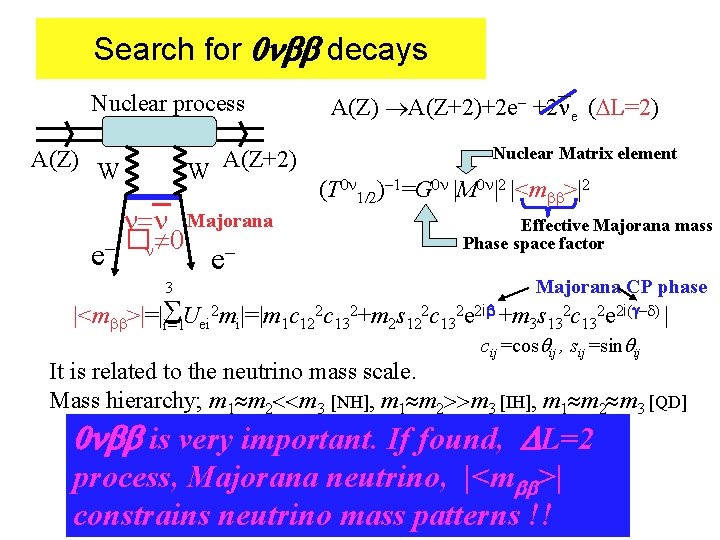
Search for 0 decays Nuclear process A(Z) W e W A(Z+2) Majorana � e 3 A(Z) A(Z+2)+2 e +2 e (DL=2) Nuclear Matrix element (T ) =G |M |2 |<m >|2 Effective Majorana mass Phase space factor Majorana CP phase 2 m |=|m c 2 c 2+m s 2 c 2 e 2 i | |<m >|=|S U i 1 12 13 2 12 13 3 13 13 i=1 ei cij =cos ij , sij =sin ij It is related to the neutrino mass scale. Mass hierarchy; m 1 m 2 m 3 [NH], m 1 m 2 m 3 [IH], m 1 m 2 m 3 [QD] 0 is very important. If found, DL=2 process, Majorana neutrino, |<m >| constrains neutrino mass patterns !!
|<m >| & mass hierarchy PDG’ 04 |<m >|=|m 1 c 122+m 2 s 122 e 2 i + m s 2 c 2 e 2 i | 3 13 13 Effective mass |<m >| (e. V) 1. 00 Degenerate m 1~m 2~m 3 0 0. 10 Dm 2 atm~50 me. V Inverted Hierarchy m 1~m 2>m 3 sin 2 qsol Dm 2 sol~5 me. V 0. 01 Normal Hierarchy m 1~m 2<m 3 |<m >| > a few 10 me. V Inverted hierarchy Sensitivity of � ���� 1�� 0. 001 would make a breakthrough ! 0. 001 0. 010 0. 10 Minimum neutrino mass (e. V) 1. 00 Mass pattern and minimum mass
Key for 0 Search appears as a sharp peak at the highest energy of the 2 spectrum in decays. 1 [T 1/2 G 0 |M 0 |2]1/2 Q 5 Sensitivity (Lower limit of T 1/2[y]) |<m >|= [Signal] # of nuclei=(M/A)NAa running time; y Detection efficiency A; atomic weight, a; Abundance M; Total mass [kg] Nte [BG] � BM t E (T 1/2 /ln 2) Energy resolution; Ke. V Background rate; counts/kg/Ke. V/y ae T 0 1/2 � 6 A M t BDE
Lots of Challenges to 0 Cryogenics CUORE/CUORETINO 113 Cd, 123 Te COBRA GEM Bolometory 76 Ge GENIUS Majorana Ionization (LN 2) 116 Cd MPI Making large figure of merit M ae , Q BDE to reach |<m >|~100 -10 me. V in several years operation! Tracking DCBA 150 Nd MOON 100 Mo NEMO 82 Se 136 Xe EXO Foils in wire chamber, TPC, Mag. field Scintillation CAMEO CANDLES 48 Ca CARVEL 116 Cd 160 Gd GSO Xe 136 Xe Crystals in Liq. Scint.
Direct mass measurement d. N/d. Ee=KF(Ee, Z)pe. Etot(E 0 -Ee)[(E 0 Ee)2 m 2)]2 Use only kinematics of decay particles to measure missing mass. (cf. -oscillation, , astrophysics) The fact of large flavor-mixing of Properties of ’s (incl. mass) might be the same. Mass degeneracy can be checked with a sensitivity of sub-e. V. d. N/d. E Tritium -decay has been tried : Small endpoint energy (18. 6 ke. V) Super-allowed transition m =0 Final state spectrum of daughter molecules are well known. m 0 Troitsk m <2. 05 e. V(@ 95%CL) PLB 350(‘ 95)263. E 0 -Ee Mainz m <2. 2 e. V (@ 95%CL) PLB 460(‘ 99)219. Both uses magnetic-bottle spectrometer and gaseous 3 H target. E 0
KATRIN (Karlsruhe Tritium Neutrino. Experiment) Electrostatic spectrometer with Adiabatic magnetic collimation Windowless gaseous tritium source Large acceptance, High resolution =Etrans/B : conserved in adiabatic B field DE/E=Banal/Bmax : Energy resolution (Banal ~a few m. T, Bmax~6 T) -mass sensitivity: 0. 2 e. V ine, ~ aml e b m 70 oids n e l o s. 40 s. c ss Stainle 10 m sel( s e v l e ste � � �
A claim for discovery of 0 Highest Sensitivity, Select single site events by PSA Degenerate! Can be found by direct measurement with sub-e. V sensitivity and planned 0 experiments! (H. V. Klapdor-Kleingrothaus, 2004) Needs confirmation by coming experiments!
Summary Recent experiments have established oscillation by observing the flux deficit, flavor change and spectral distortion; Solar (SK/SNO)/Reactor (Kam. LAND) for e ( e), Atmospheric (SK)/Accelerator (K 2 K) for Oscillation parameters, 12, 23, M 122, M 232 are being determined precisely by ongoing experiments. Reactor 13 measurement is very important to the coming LBL ������ experiment aiming to measure CP-violating pha �experiment is crucial not only to know whether ������ , but constrain or determine mass pattern, if |<m >| sens to ~0. 01 e. V is attained. ��re�� mass search with a mass sensitivity of sub-e. V can have a discovery potential.
Backup slides
Solar problem Atmospheric anomaly oscillation ! M 0 Precise measurement of oscillation parameters. Planned , LBL experiments Absolute mass? Mass pattern? CP & Mixing mechanism?
Sudbury Neutrino Observatory Deep underground 6010 m w. e. 1000 ton D 2 O in 12 mf acrylic vessel 9600 PMTs (60%of 4 p) H 2 O (1700 ton inner shield +5300 ton outer shield) Urylon Liner and Radon Seal