
Neutralization Reactions Ex HCl Na OH Na Cl
- Slides: 28
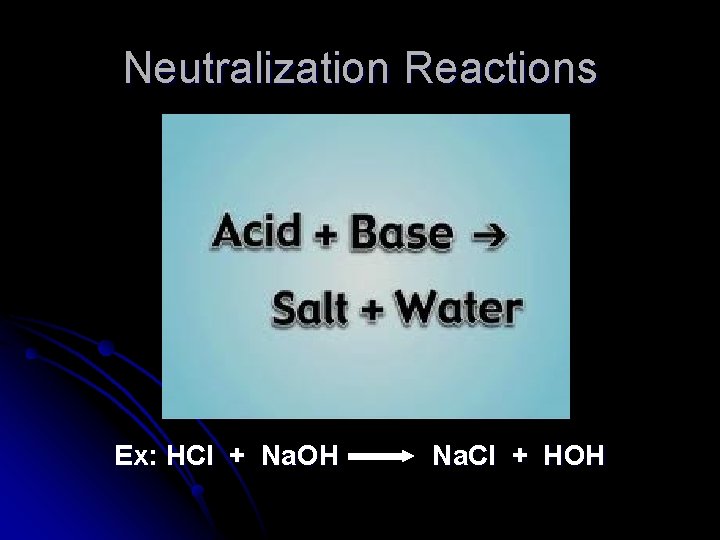
Neutralization Reactions Ex: HCl + Na. OH Na. Cl + HOH
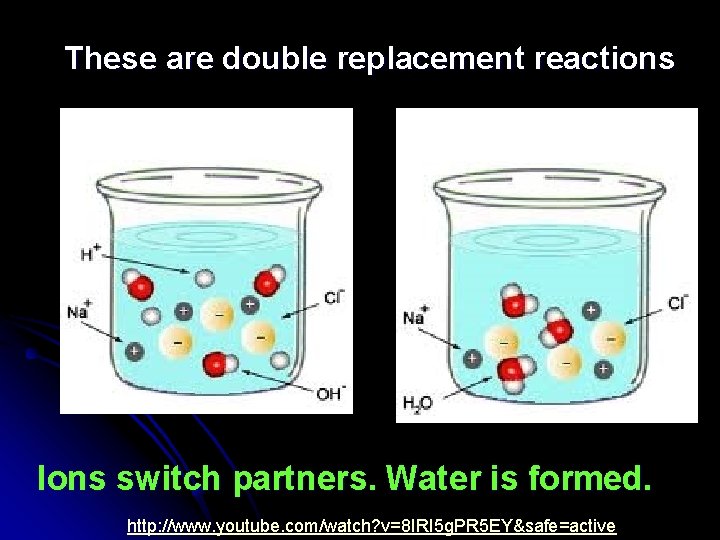
These are double replacement reactions Ions switch partners. Water is formed. http: //www. youtube. com/watch? v=8 IRI 5 g. PR 5 EY&safe=active
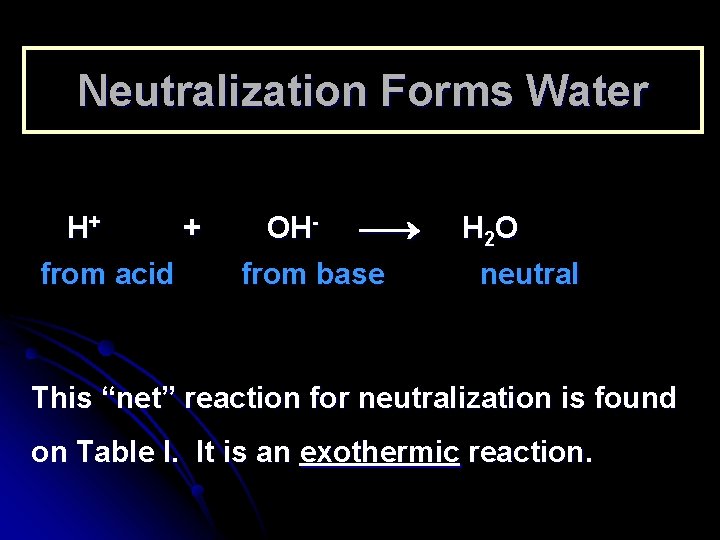
Neutralization Forms Water H+ + from acid OH- from base H 2 O neutral This “net” reaction for neutralization is found on Table I. It is an exothermic reaction.
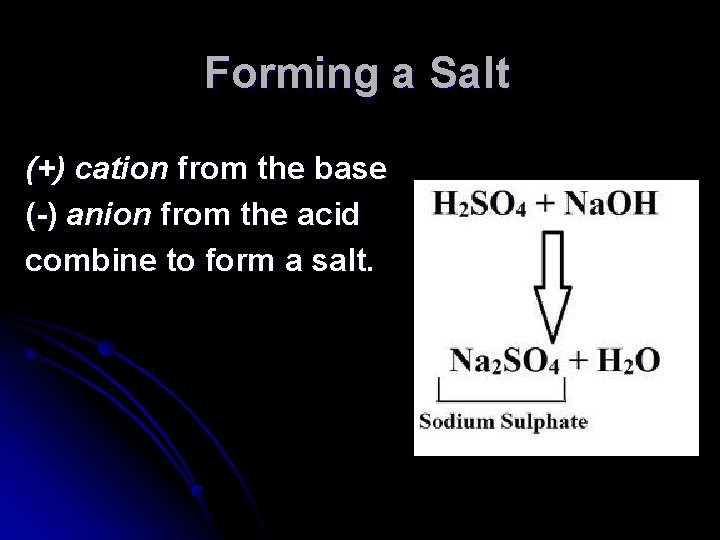
Forming a Salt (+) cation from the base (-) anion from the acid combine to form a salt.
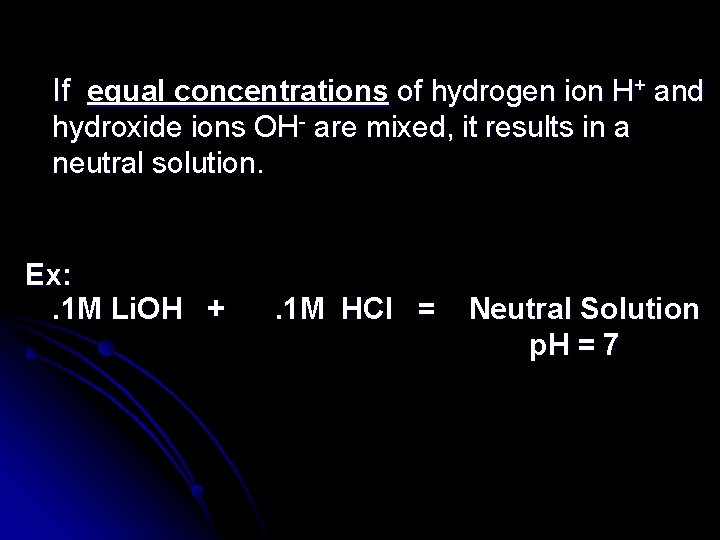
If equal concentrations of hydrogen ion H+ and hydroxide ions OH- are mixed, it results in a neutral solution. Ex: . 1 M Li. OH + . 1 M HCl = Neutral Solution p. H = 7
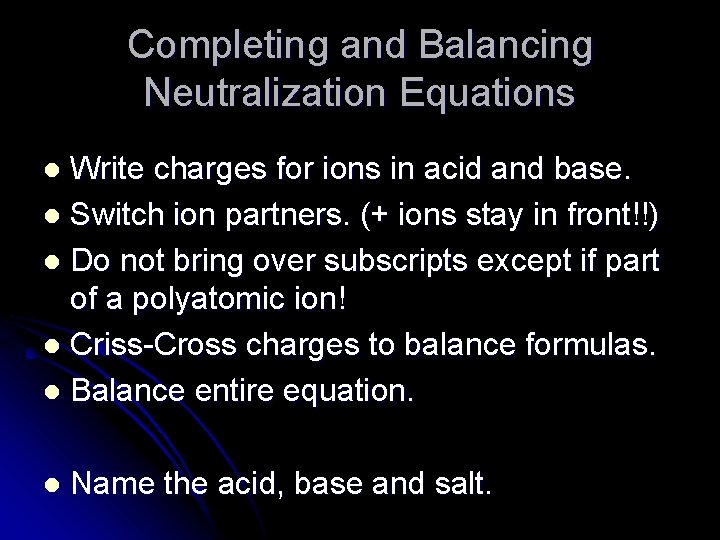
Completing and Balancing Neutralization Equations Write charges for ions in acid and base. l Switch ion partners. (+ ions stay in front!!) l Do not bring over subscripts except if part of a polyatomic ion! l Criss-Cross charges to balance formulas. l Balance entire equation. l l Name the acid, base and salt.
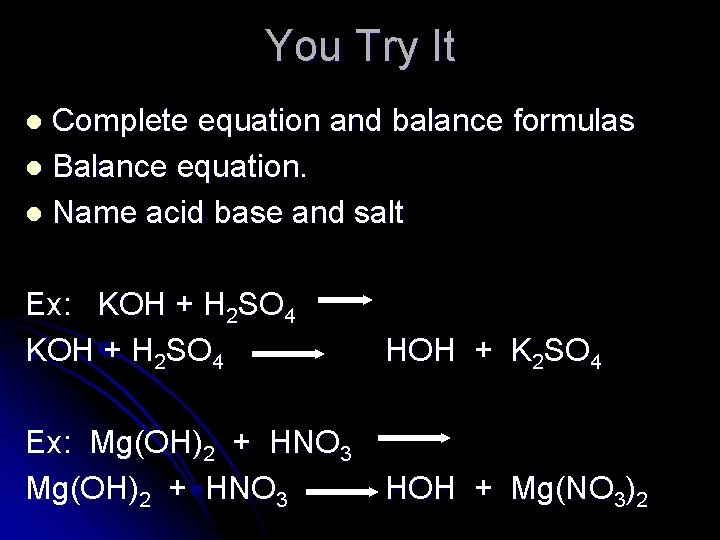
You Try It Complete equation and balance formulas l Balance equation. l Name acid base and salt l Ex: KOH + H 2 SO 4 HOH + K 2 SO 4 Ex: Mg(OH)2 + HNO 3 HOH + Mg(NO 3)2
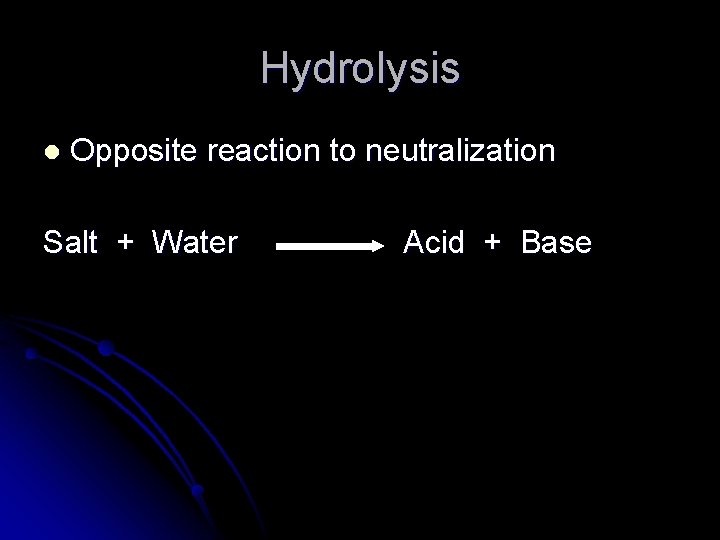
Hydrolysis l Opposite reaction to neutralization Salt + Water Acid + Base
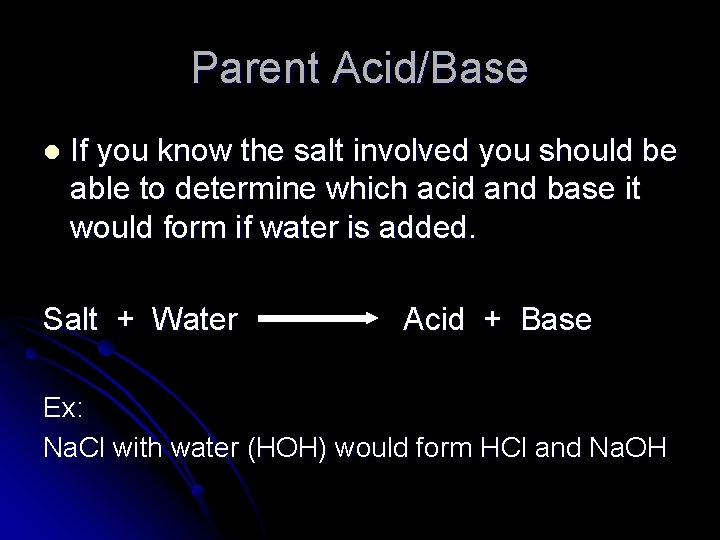
Parent Acid/Base l If you know the salt involved you should be able to determine which acid and base it would form if water is added. Salt + Water Acid + Base Ex: Na. Cl with water (HOH) would form HCl and Na. OH
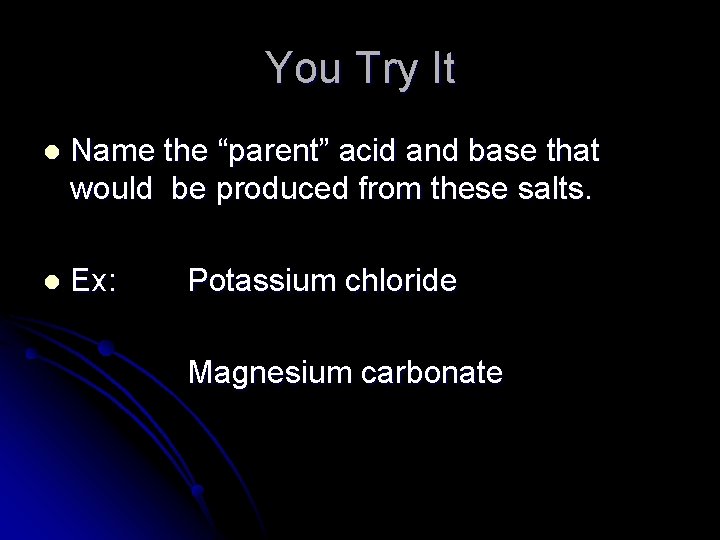
You Try It l Name the “parent” acid and base that would be produced from these salts. l Ex: Potassium chloride Magnesium carbonate
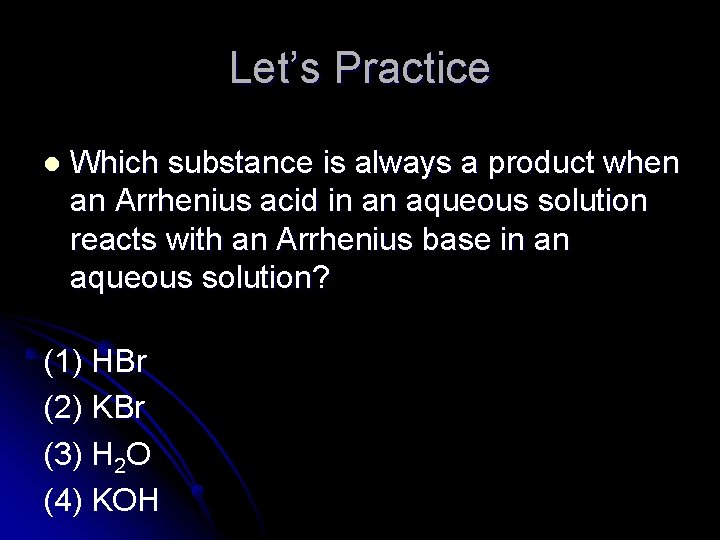
Let’s Practice l Which substance is always a product when an Arrhenius acid in an aqueous solution reacts with an Arrhenius base in an aqueous solution? (1) HBr (2) KBr (3) H 2 O (4) KOH
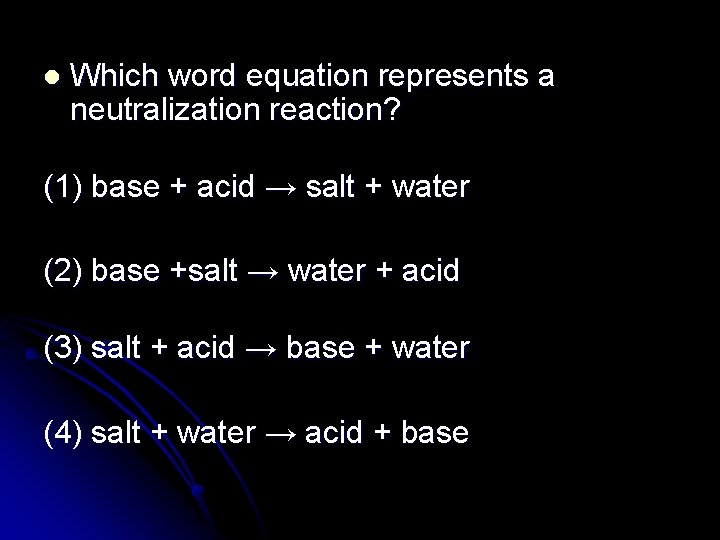
l Which word equation represents a neutralization reaction? (1) base + acid → salt + water (2) base +salt → water + acid (3) salt + acid → base + water (4) salt + water → acid + base
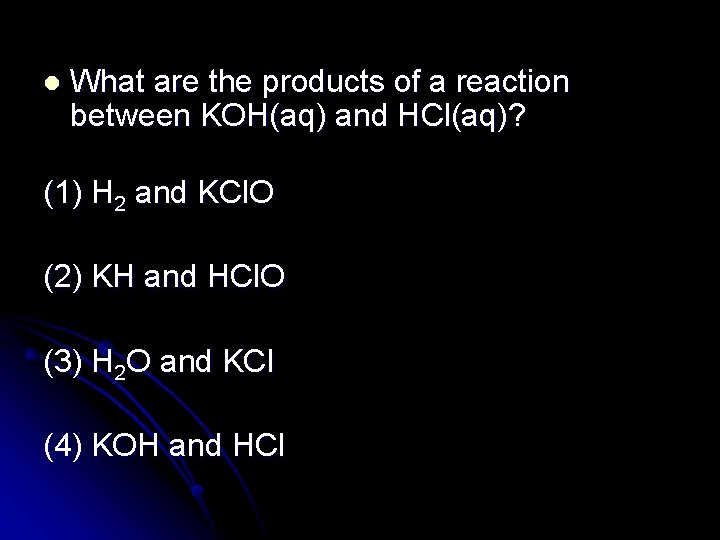
l What are the products of a reaction between KOH(aq) and HCl(aq)? (1) H 2 and KCl. O (2) KH and HCl. O (3) H 2 O and KCl (4) KOH and HCl
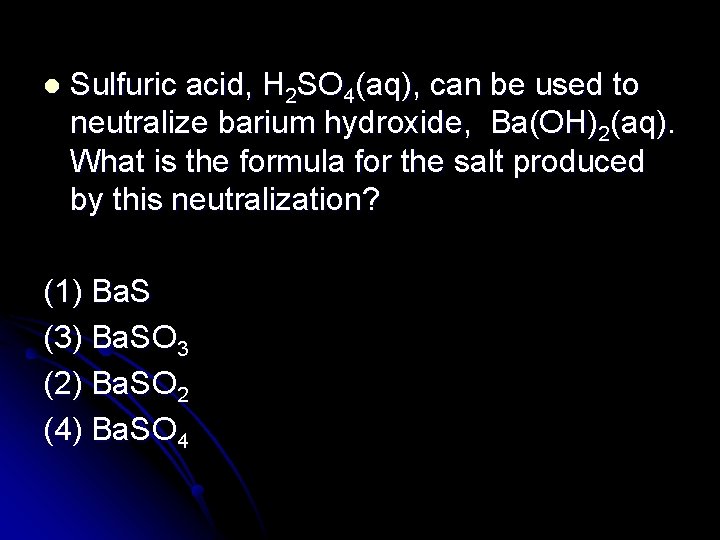
l Sulfuric acid, H 2 SO 4(aq), can be used to neutralize barium hydroxide, Ba(OH)2(aq). What is the formula for the salt produced by this neutralization? (1) Ba. S (3) Ba. SO 3 (2) Ba. SO 2 (4) Ba. SO 4
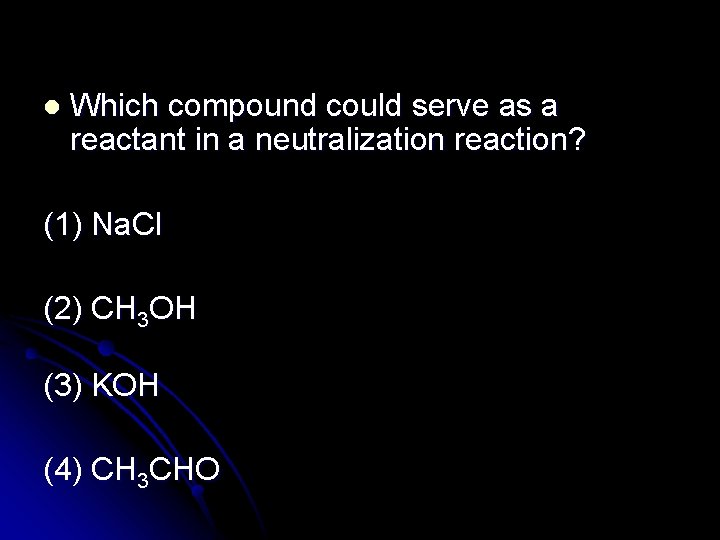
l Which compound could serve as a reactant in a neutralization reaction? (1) Na. Cl (2) CH 3 OH (3) KOH (4) CH 3 CHO
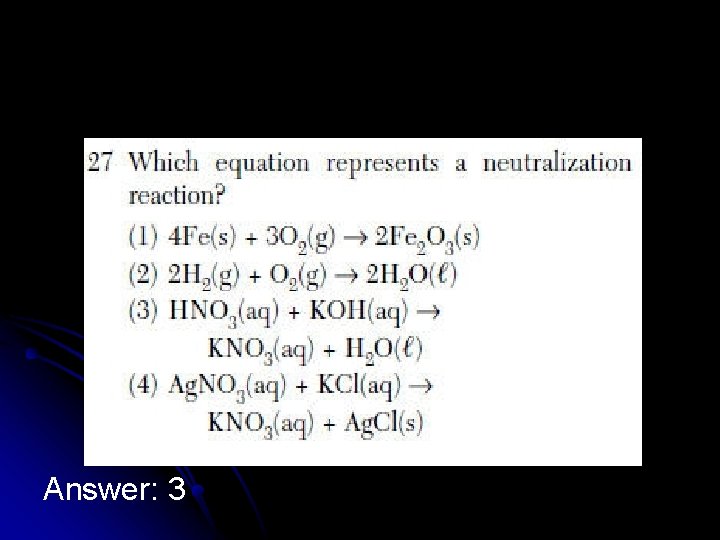
Answer: 3
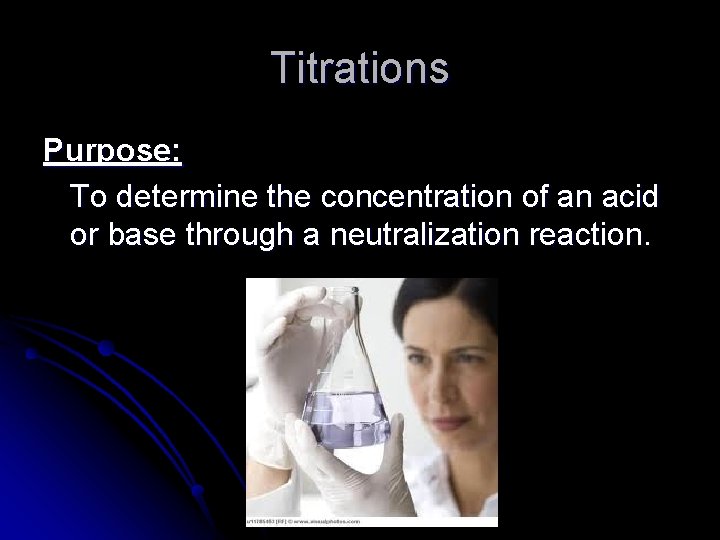
Titrations Purpose: To determine the concentration of an acid or base through a neutralization reaction.
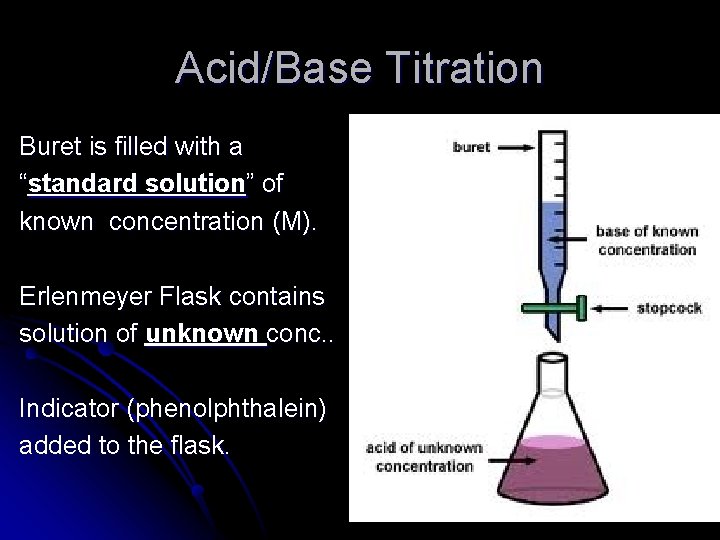
Acid/Base Titration Buret is filled with a “standard solution” of known concentration (M). Erlenmeyer Flask contains solution of unknown conc. . Indicator (phenolphthalein) added to the flask.
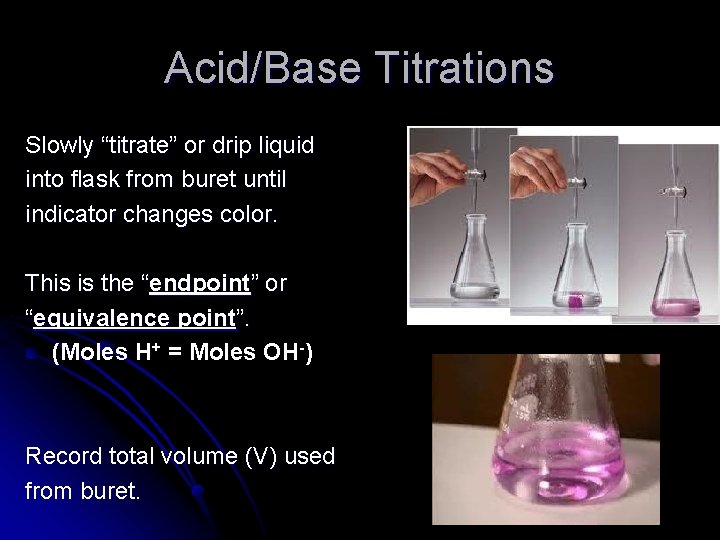
Acid/Base Titrations Slowly “titrate” or drip liquid into flask from buret until indicator changes color. This is the “endpoint” or “equivalence point”. (Moles H+ = Moles OH-) Record total volume (V) used from buret.
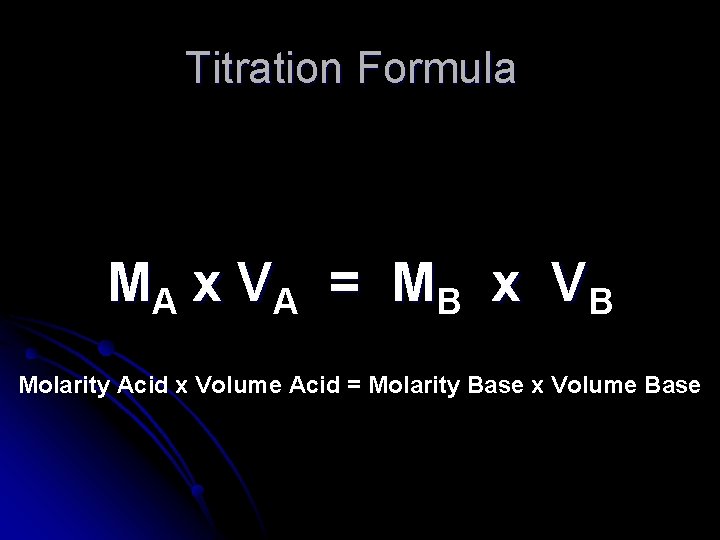
Titration Formula MA x V A = M B x V B Molarity Acid x Volume Acid = Molarity Base x Volume Base
Titration Applet http: //group. chem. iastate. edu/Greenbowe/se ctions/projectfolder/flashfiles/stoichiometry /acid_base. html
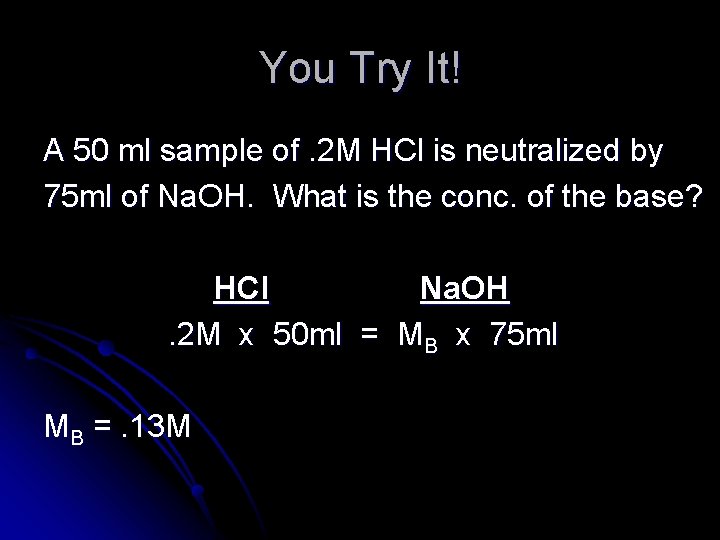
You Try It! A 50 ml sample of. 2 M HCl is neutralized by 75 ml of Na. OH. What is the conc. of the base? HCl Na. OH . 2 M x 50 ml = MB x 75 ml MB =. 13 M
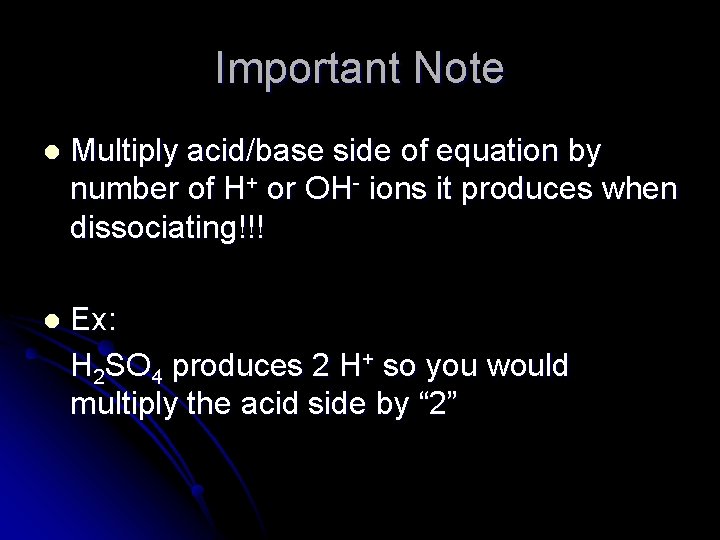
Important Note l Multiply acid/base side of equation by number of H+ or OH- ions it produces when dissociating!!! l Ex: H 2 SO 4 produces 2 H+ so you would multiply the acid side by “ 2”
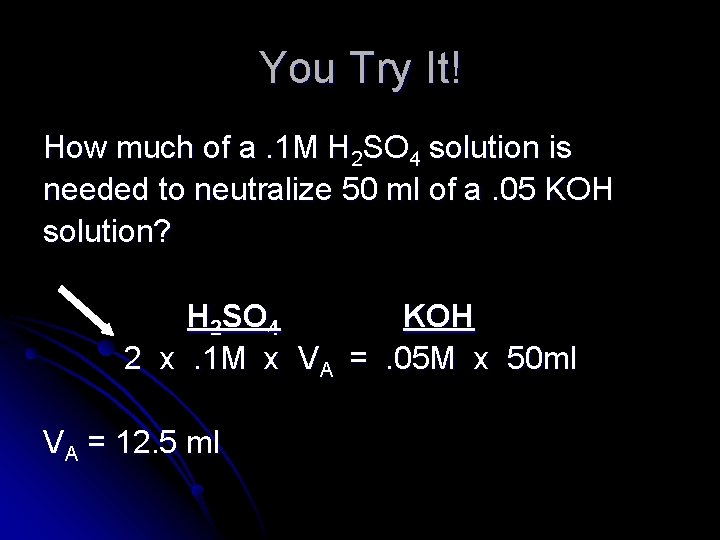
You Try It! How much of a. 1 M H 2 SO 4 solution is needed to neutralize 50 ml of a. 05 KOH solution? H 2 SO 4 KOH 2 x . 1 M x VA = . 05 M x 50 ml VA = 12. 5 ml
Titration Demonstration http: //www. youtube. com/watch? v=5 BZ 0 MPI ge. EE&safe=active
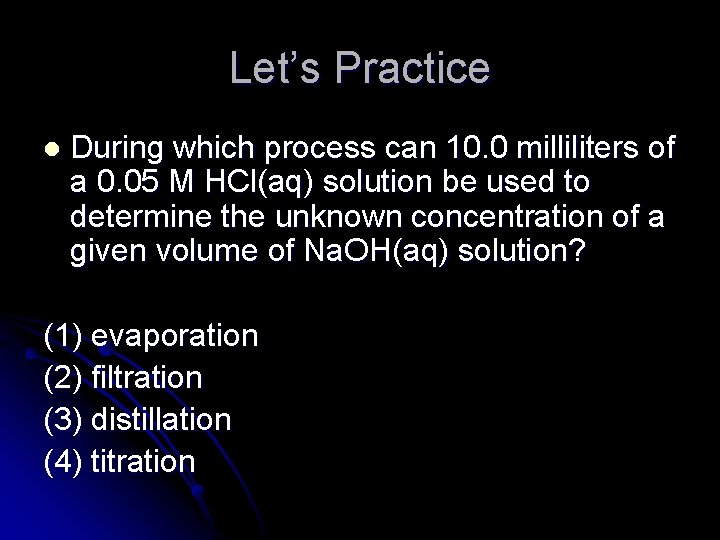
Let’s Practice l During which process can 10. 0 milliliters of a 0. 05 M HCl(aq) solution be used to determine the unknown concentration of a given volume of Na. OH(aq) solution? (1) evaporation (2) filtration (3) distillation (4) titration
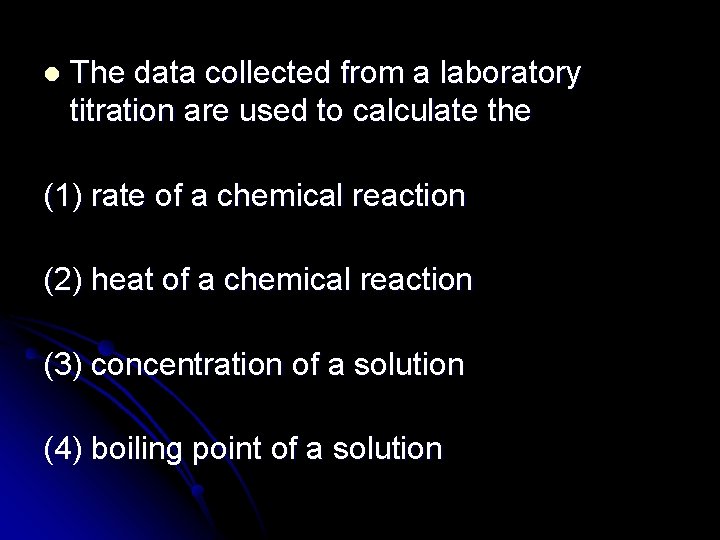
l The data collected from a laboratory titration are used to calculate the (1) rate of a chemical reaction (2) heat of a chemical reaction (3) concentration of a solution (4) boiling point of a solution
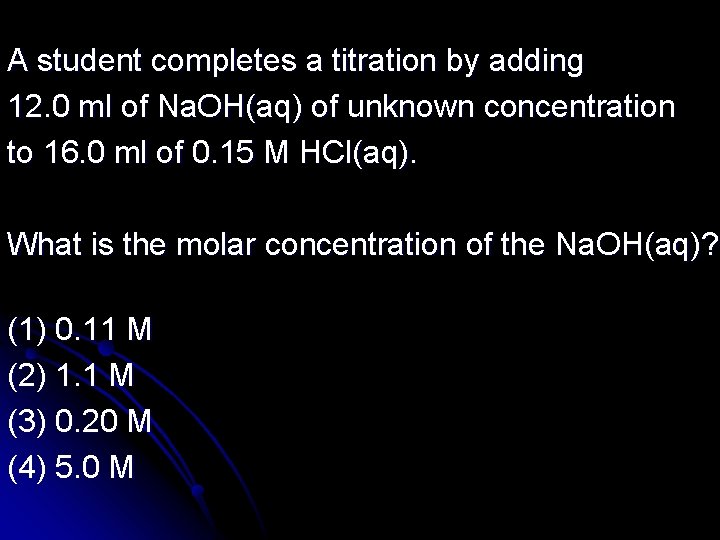
A student completes a titration by adding 12. 0 ml of Na. OH(aq) of unknown concentration to 16. 0 ml of 0. 15 M HCl(aq). What is the molar concentration of the Na. OH(aq)? (1) 0. 11 M (2) 1. 1 M (3) 0. 20 M (4) 5. 0 M