
NEUTRAL BLOCKING OF TRANSFORMER GMDGIC WHY A SURGE
NEUTRAL BLOCKING OF TRANSFORMER GMD/GIC: WHY A SURGE ARRESTER Alberto Ramirez Orquin Vanessa Ramirez August 2016 Audio presentation 1
General Introducing a simple, cost-effective means to deal with this major hazard by means of an innovative surge-arrester GIC-blocking principle Essential discussion regarding the impact upon transformer grounding of devices based on neutral GIC blocking 2

General Key application to a typical Autotransformer Significant invariance of the grounding ratios after a proposed arrester device deployment Important revealed features set plausible benchmarking with alternative capacitive blocking devices 3
The Surge Arrester Protective Functionality In addition to transformer and line protection surge arresters/(MOV) have been extensively utilized for series capacitor protection Transformer neutral-blocking devices use surge arresters for overvoltage protection 4
The Surge-arrester Protective Functionality: its Application to Neutral-Blocking Devices Exhaustive testing series performed at major highpower Labs Full-scale testing series performed at major highvoltage Labs Comprehensive simulations at both academic and industrial levels 5
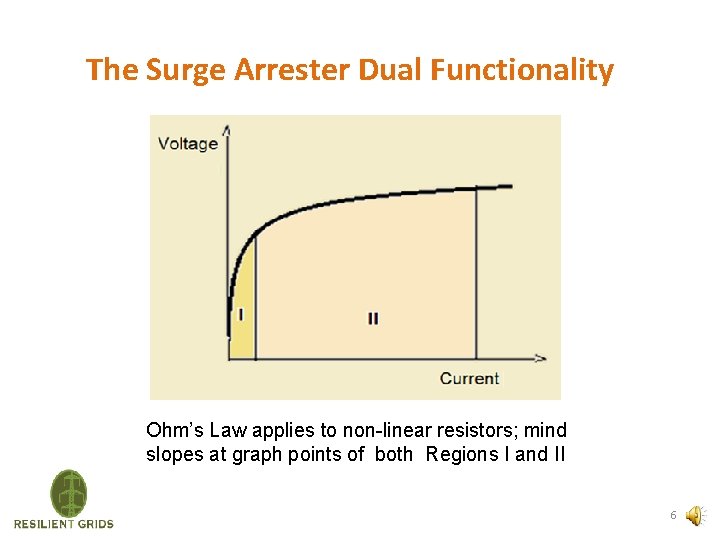
The Surge Arrester Dual Functionality Ohm’s Law applies to non-linear resistors; mind slopes at graph points of both Regions I and II 6
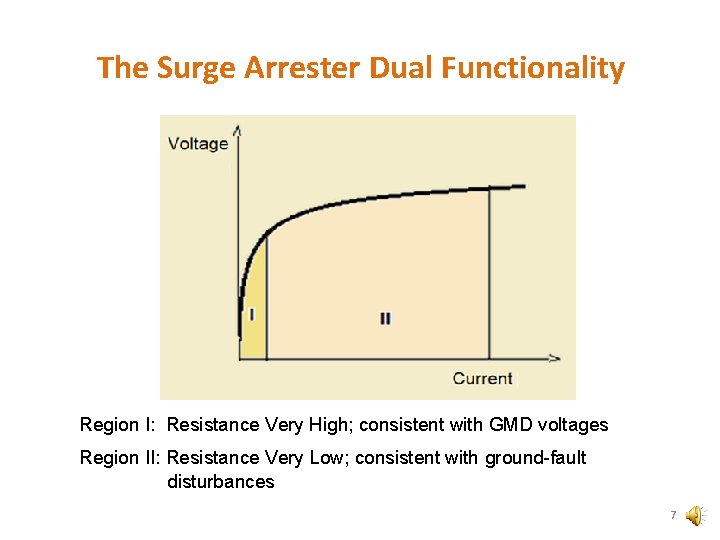
The Surge Arrester Dual Functionality Region I: Resistance Very High; consistent with GMD voltages Region II: Resistance Very Low; consistent with ground-fault disturbances 7
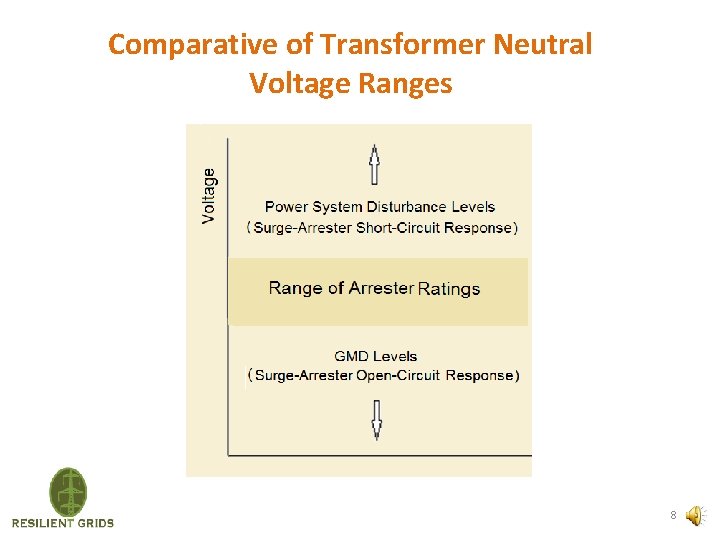
Comparative of Transformer Neutral Voltage Ranges 8
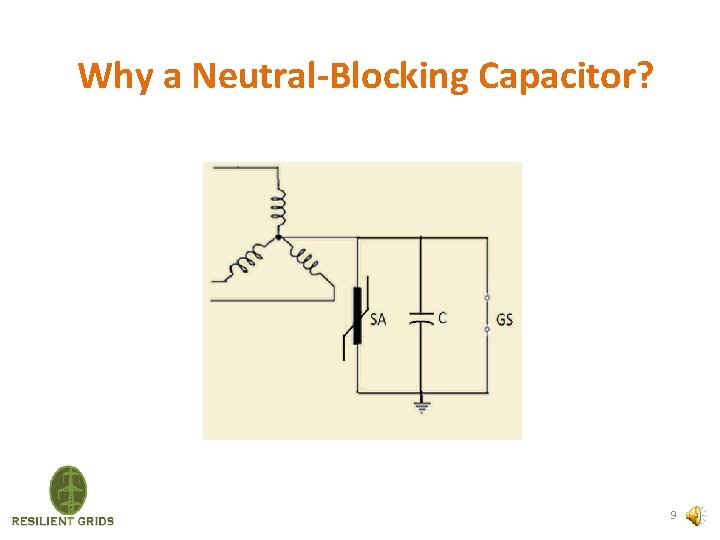
Why a Neutral-Blocking Capacitor? 9
Why a Neutral-Blocking Capacitor? Industry reluctance to this approach due to costs, size, complexity and perceived operational risks * Understanding this problem, and its solution, starts with consideration of three power-system design states * Failure modes for the most part unknown 10
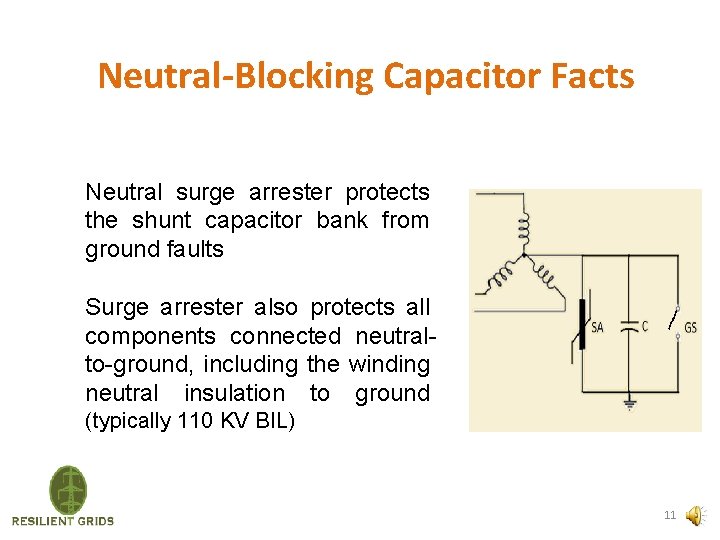
Neutral-Blocking Capacitor Facts Neutral surge arrester protects the shunt capacitor bank from ground faults Surge arrester also protects all components connected neutralto-ground, including the winding neutral insulation to ground (typically 110 KV BIL) 11
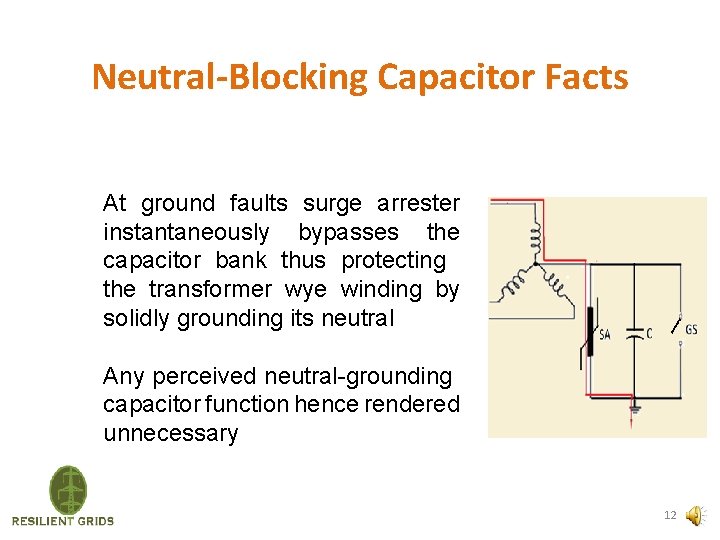
Neutral-Blocking Capacitor Facts At ground faults surge arrester instantaneously bypasses the capacitor bank thus protecting the transformer wye winding by solidly grounding its neutral Any perceived neutral-grounding capacitor function hence rendered unnecessary 12
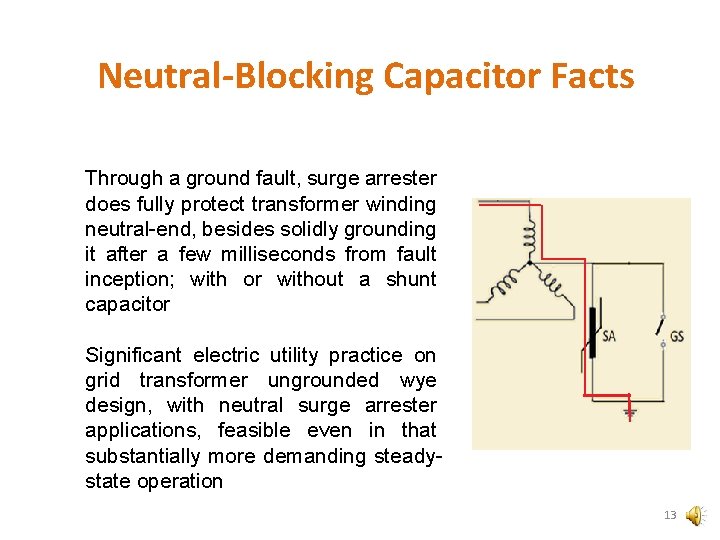
Neutral-Blocking Capacitor Facts Through a ground fault, surge arrester does fully protect transformer winding neutral-end, besides solidly grounding it after a few milliseconds from fault inception; with or without a shunt capacitor Significant electric utility practice on grid transformer ungrounded wye design, with neutral surge arrester applications, feasible even in that substantially more demanding steadystate operation 13
Why a Neutral-Blocking Capacitor? Three basic power-system device design states to consider, possibly in combination: a) Ground-Fault Disturbances b) GMD/GIC c) Steady State 14
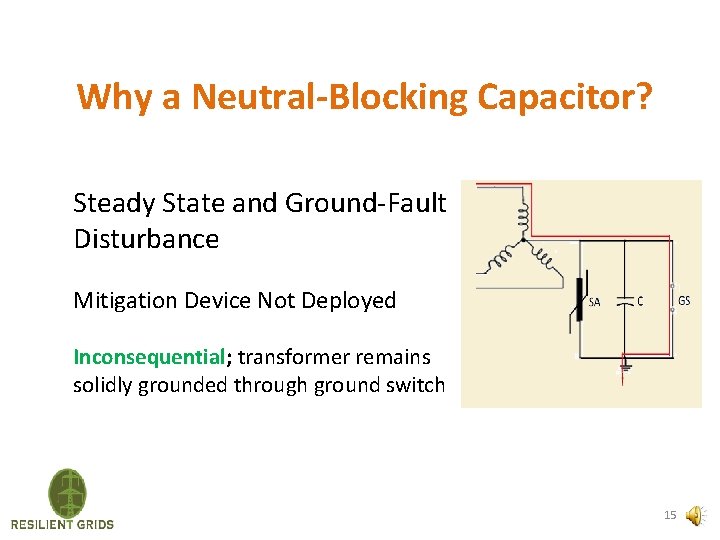
Why a Neutral-Blocking Capacitor? Steady State and Ground-Fault Disturbance Mitigation Device Not Deployed Inconsequential; transformer remains solidly grounded through ground switch 15
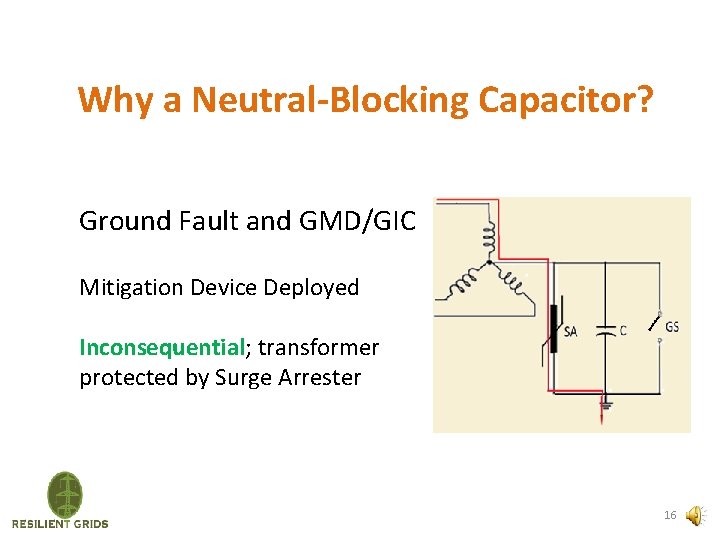
Why a Neutral-Blocking Capacitor? Ground Fault and GMD/GIC Mitigation Device Deployed Inconsequential; transformer protected by Surge Arrester 16
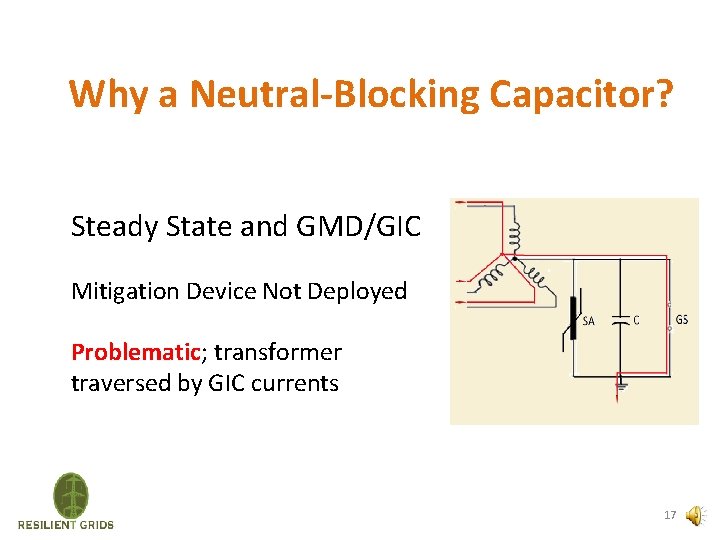
Why a Neutral-Blocking Capacitor? Steady State and GMD/GIC Mitigation Device Not Deployed Problematic; transformer traversed by GIC currents 17
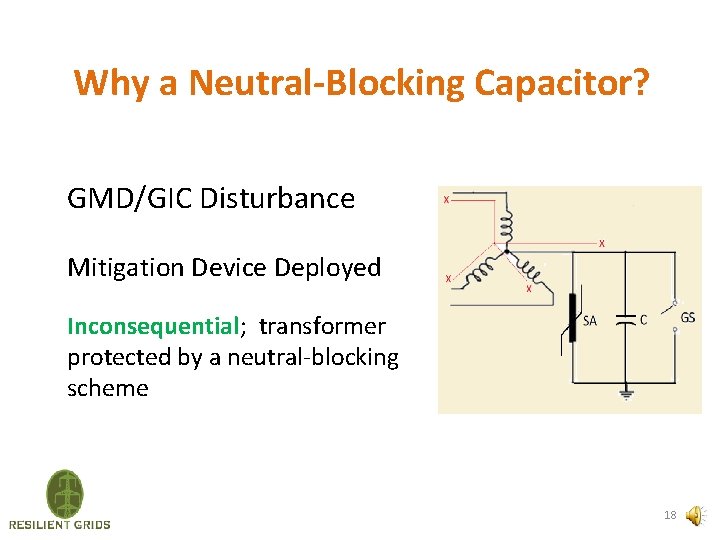
Why a Neutral-Blocking Capacitor? GMD/GIC Disturbance Mitigation Device Deployed Inconsequential; transformer protected by a neutral-blocking scheme 18
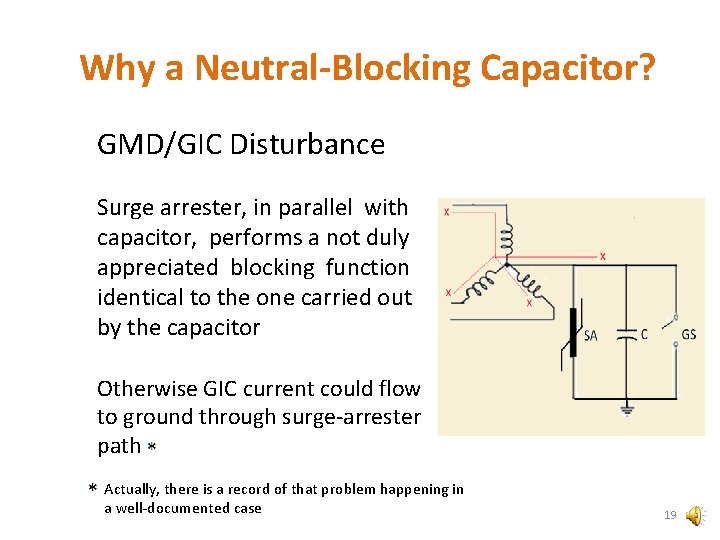
Why a Neutral-Blocking Capacitor? GMD/GIC Disturbance Surge arrester, in parallel with capacitor, performs a not duly appreciated blocking function identical to the one carried out by the capacitor Otherwise GIC current could flow to ground through surge-arrester path Actually, there is a record of that problem happening in a well-documented case 19
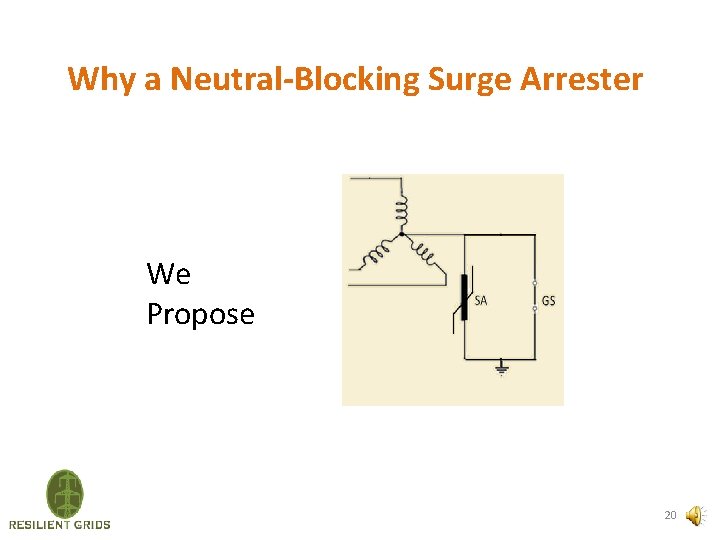
Why a Neutral-Blocking Surge Arrester We Propose 20
Why a Neutral-Blocking Surge Arrester It must therefore be concluded, based on state-design criteria, the inclusion of a capacitor bank in a neutralblocking scheme can not be justified from an engineering standpoint 21
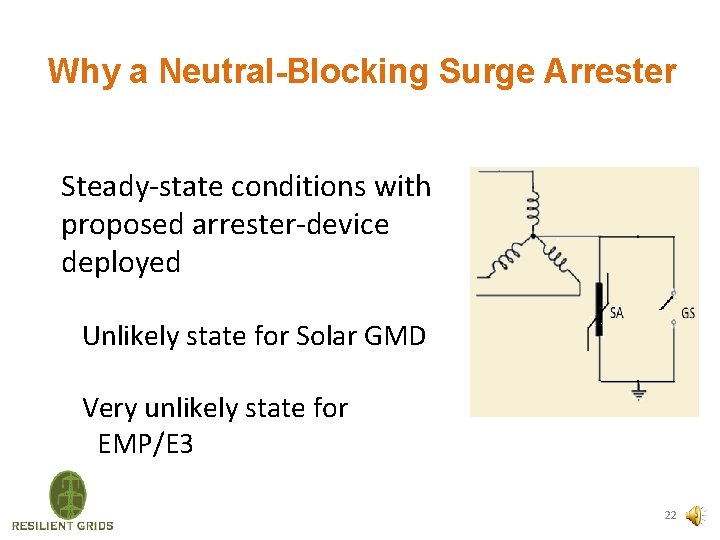
Why a Neutral-Blocking Surge Arrester Steady-state conditions with proposed arrester-device deployed Unlikely state for Solar GMD Very unlikely state for EMP/E 3 22
Steady-state Conditions: Arrester. Device Deployment Analysis Impact on all AC steady-state variables Impact on grounding ratio X 0/X 1 Impact on zero-sequence current flow Surge-arrester specs 23
Steady-state Conditions: Arrester. Device Deployment Analysis Typical Transformer apparatus: • Three-winding grounded Wye-Delta Autotransformer • Two-winding Delta-Wye (grounded) GSU 24
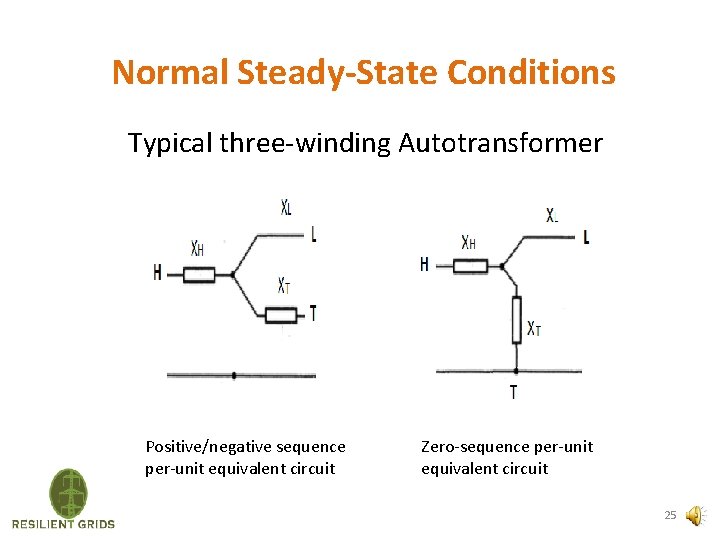
Normal Steady-State Conditions Typical three-winding Autotransformer Positive/negative sequence per-unit equivalent circuit Zero-sequence per-unit equivalent circuit 25
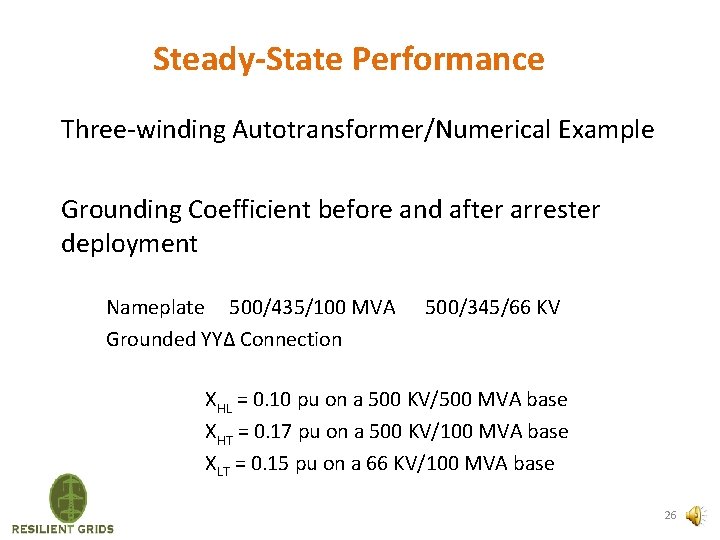
Steady-State Performance Three-winding Autotransformer/Numerical Example Grounding Coefficient before and after arrester deployment Nameplate 500/435/100 MVA Grounded YY∆ Connection 500/345/66 KV XHL = 0. 10 pu on a 500 KV/500 MVA base XHT = 0. 17 pu on a 500 KV/100 MVA base XLT = 0. 15 pu on a 66 KV/100 MVA base 26
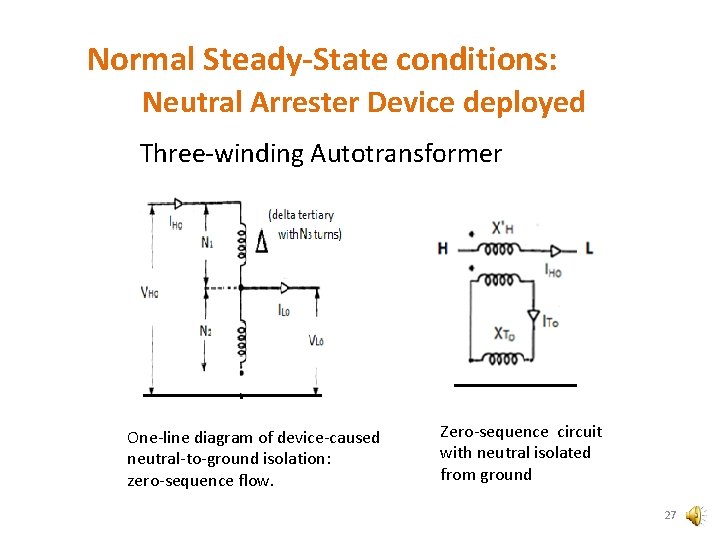
Normal Steady-State conditions: Neutral Arrester Device deployed Three-winding Autotransformer One-line diagram of device-caused neutral-to-ground isolation: zero-sequence flow. Zero-sequence circuit with neutral isolated from ground 27
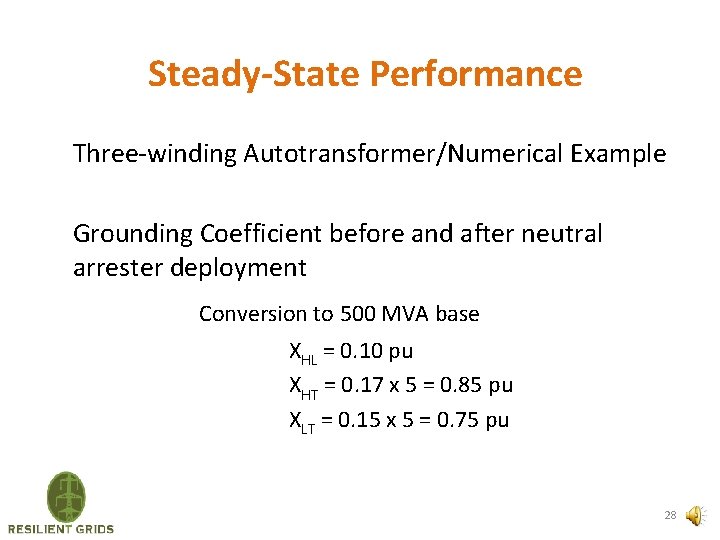
Steady-State Performance Three-winding Autotransformer/Numerical Example Grounding Coefficient before and after neutral arrester deployment Conversion to 500 MVA base XHL = 0. 10 pu XHT = 0. 17 x 5 = 0. 85 pu XLT = 0. 15 x 5 = 0. 75 pu 28
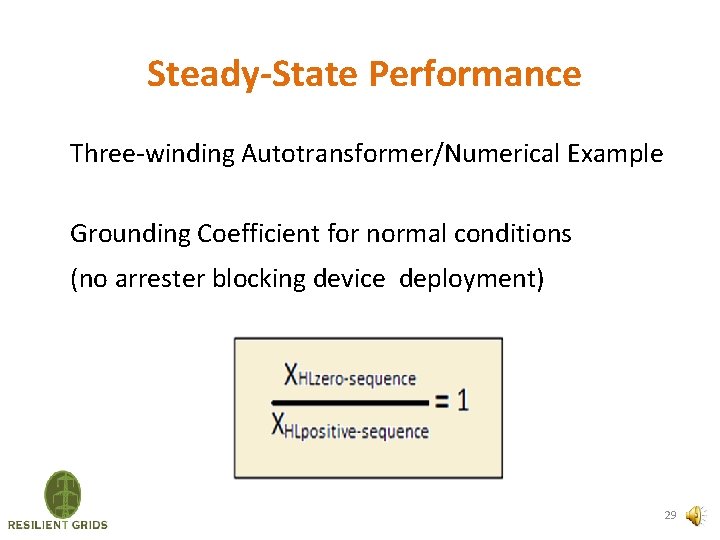
Steady-State Performance Three-winding Autotransformer/Numerical Example Grounding Coefficient for normal conditions (no arrester blocking device deployment) 29
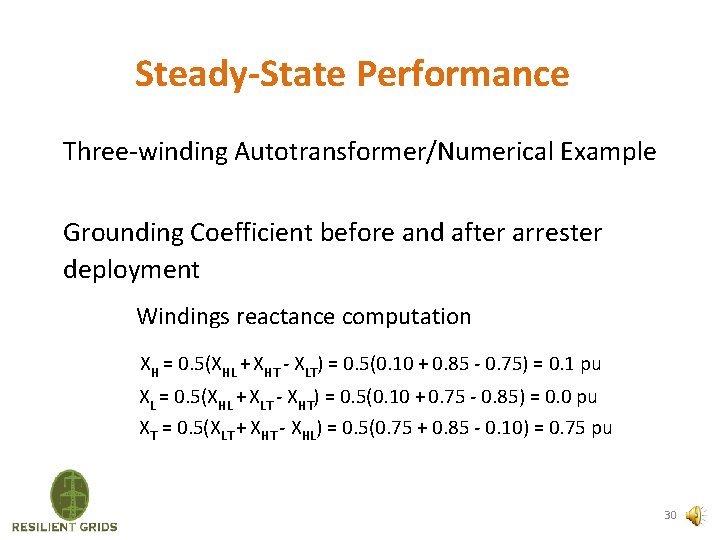
Steady-State Performance Three-winding Autotransformer/Numerical Example Grounding Coefficient before and after arrester deployment Windings reactance computation XH = 0. 5(XHL + XHT - XLT) = 0. 5(0. 10 + 0. 85 - 0. 75) = 0. 1 pu XL = 0. 5(XHL + XLT - XHT) = 0. 5(0. 10 + 0. 75 - 0. 85) = 0. 0 pu XT = 0. 5(XLT + XHT - XHL) = 0. 5(0. 75 + 0. 85 - 0. 10) = 0. 75 pu 30
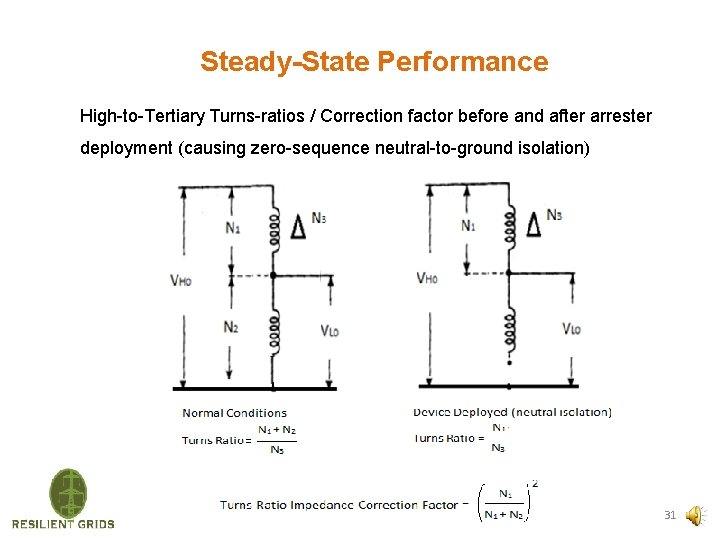
Steady-State Performance High-to-Tertiary Turns-ratios / Correction factor before and after arrester deployment (causing zero-sequence neutral-to-ground isolation) 31
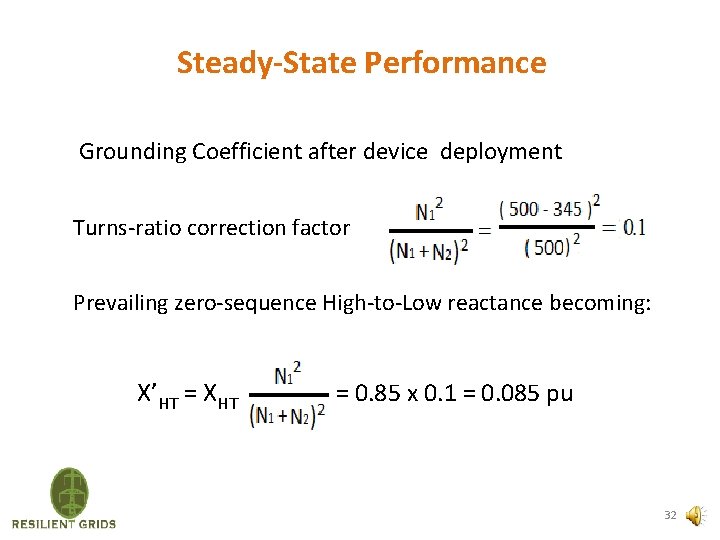
Steady-State Performance Grounding Coefficient after device deployment Turns-ratio correction factor Prevailing zero-sequence High-to-Low reactance becoming: X’HT = XHT = 0. 85 x 0. 1 = 0. 085 pu 32
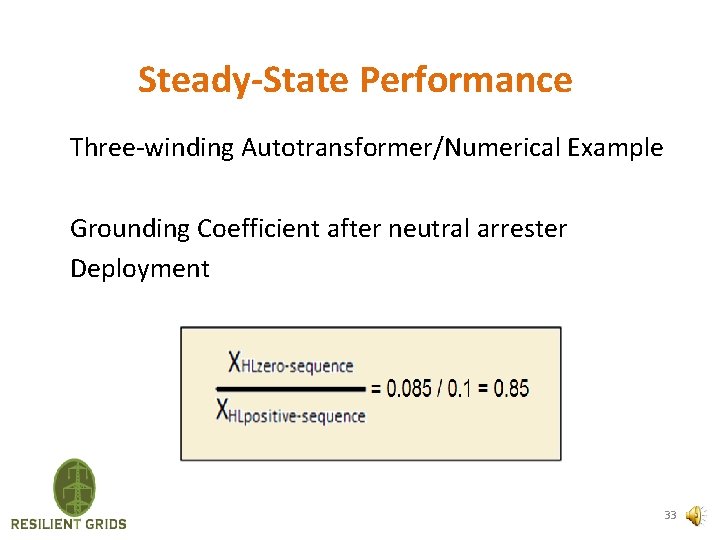
Steady-State Performance Three-winding Autotransformer/Numerical Example Grounding Coefficient after neutral arrester Deployment 33
Steady-State Performance Three-winding Autotransformer: Grounding Coefficient Summary No neutral arrester deployment = 1. 0 Neutral arrester deployment = 0. 85 Note: grounding coefficient of 1. 0 corresponds to a solidly-grounded equipment (IEEE Standard) 34
Steady-State Performance It can be then securely asserted, from the steady-state consideration, a capacitor bank application could not be justified from an engineering standpoint to protect a grid autotransformer 35
Steady-state Performance GSU Transformer No zero-sequence flow may come from the generation side Zero-sequence unbalance flow may develop from the transmission line side due to load or from line-parameter dissymmetry 36
Steady-state Performance GSU Transformer Zero-sequence components typically negligible Neutral shift would be limited to a Ferranti-rise in the zero-sequence network Zero-sequence flow through GSU immaterial as it refers to a line-end apparatus Arrester device lends itself to a straight-forward specification from the unbalance examination 37
Conclusions From: Steady-state performance, parametrical invariance, GIC blocking, ground-faults, zero-sequence current residuals, etc, the standalone surge-arrester device compares favorably with the one based on a capacitor bank, yet without any of its undeniable inherent risks The difference can only be found at the blockingfunction means: one performed by a capacitor bank and another by a common surge arrester 38
Conclusions Proposed Technology: Enables a drastic cost and footprint reduction of mitigation devices as well as a foremost simplicity It turns implementing capacitor banks for GIC neutral-blocking purposes into an unnecessary both a risky and costly redundancy 39
Conclusions The surge arrester, typically used for protection of power equipment, in addition to being a component actually present within all known GMD mitigation devices, and performing a full GIC-blocking function already, should then be upgraded to be the very sole element designed to carry out such an essential function, all things considered 40
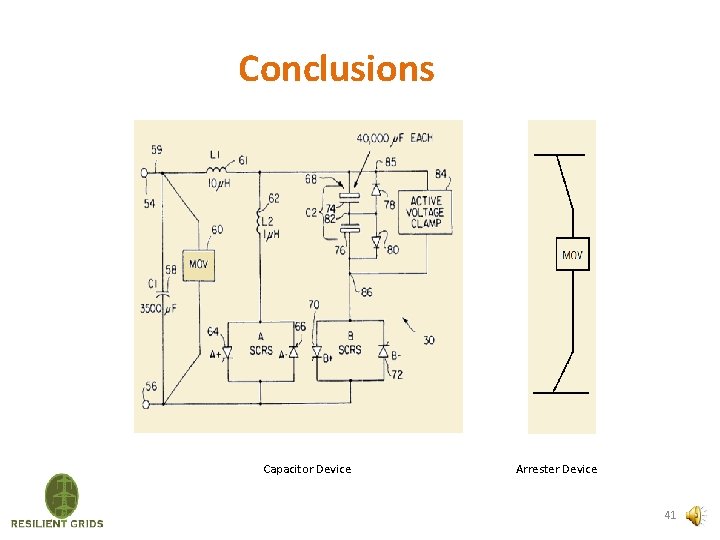
Conclusions Capacitor Device Arrester Device 41
Conclusions: Final Thoughts Legitimate reservations regarding the incremental cost/benefit of adding massive capacitor bank assemblies, with convoluted ancillaries, merely to secure the flow of inconsequential, quasi-parasitic, ground currents associated to a few transformers at limited and short steady-state situations Legitimate questions regarding such an incremental cost/benefit evaluation minding neutral-blocking units might operate infrequently and able to reduce basically around fifty percent of GIC upon some autotransformers * *Drastic GIC suppression achievable by grid strategic device placing 42
Future/Ongoing Work R&D on actionable early sensing of EMP shock waves (presently in advanced testing state) R&D to favorably address the challenging issue of GIC current interruption 43

Questions ? Feel free to contact us and/or also to request a personal presentation of this material for an in-depth discussion www. resilientgrids. com 44
- Slides: 44