
Neurons neurotransmitters and other stuff we did last
- Slides: 20
Neurons, neurotransmitters and other stuff we did last term… Psychology 2617
Introduction This is mostly review for those of you that took 2606 l The nervous system is made up, basically, of two types of cells l l Neurons l Do l Glial the communicating Cells l Support functions
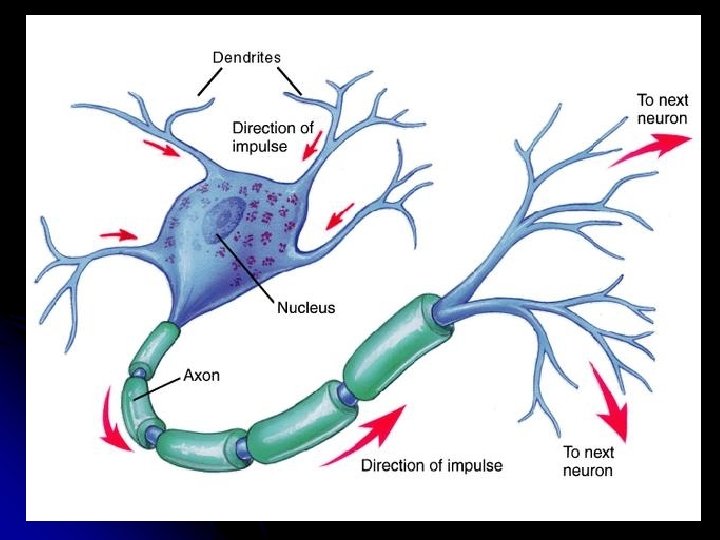
Some key neuron facts One axon, many dendrites (usually, multipolar neurons have more than one axon) l Dendrite -> cell body -> axon l Axons transmit information l Dendrites receive information l Dendrites can grow and change l l Make connections to more axons l Might be the basis of learning
Electrical activity of the neuron l Resting potential l About -70 m. V l Selectively allowing certain ions in l With stimulation Na+ is allowed in l Action potential l Changes in one area lead to changes in another l Chemical to electrical, very cool
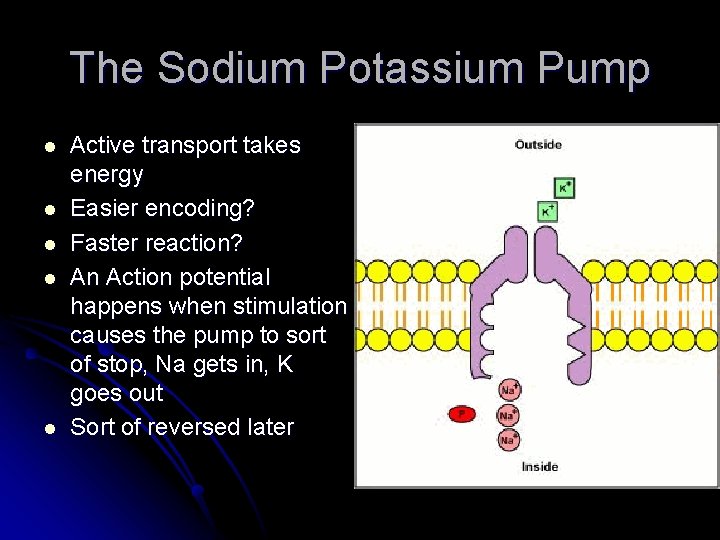
The action potential Resistance and myelin affect transmission rate l Less resistance with a big axon l Normally you have a resting potential because a process called Active Transport pump ouf NA+ and pulls K+ in (3: 2) so you get a negative charge across the cell membrane l
The Sodium Potassium Pump l l l Active transport takes energy Easier encoding? Faster reaction? An Action potential happens when stimulation causes the pump to sort of stop, Na gets in, K goes out Sort of reversed later
Biochemical Activity Otto Loewi did a cool experiment in 1921 l Simulated the vagus nerve is a frog’s heart l Slowed the heart down l Washed heart with solution, collected solution l Poured solution on a second heart l It slowed!!!! l
Loewi and his frogs Called the substance vagusstoff l Acetylcholine l Later stimulated heart rate, similar method l Ended up with a sped up heart l Epinephrine l
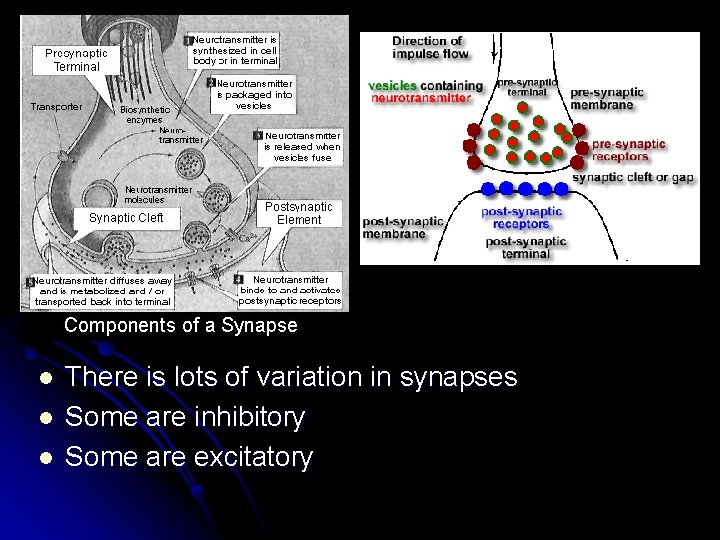
The Synapse Gap between the axon and the dendrite l Neurotransmitters are released across this gap l Sometimes, if all of the transmitter isn’t absorbed it is taken back up, this is known as reuptake l
l l l There is lots of variation in synapses Some are inhibitory Some are excitatory
More about synapses Is the excitatory vs. inhibitory nature of a synapse due to shape? l Probably l GABA synapses are inhibitory, have less post synaptic thickening l Glutamate synapses have more thickening, more vesicles l There are 7 types of synapses l
The Seven Steps in Neurotransmission Synthesis l Storage l Release l Receptor interaction l Inactivation l Reuptake l Degradation l
The Neurotransmitters l Basically, five conditions must be met before we call something a neurotransmitter l Present in terminal l Released on firing l Placing substance or organ emulates firing l Uptake for inactivation l Inactivation blocks stimulation
The Neurotransmitters Acetylcholine (Ach) l Monoamines l l Catecholamines l Norepinephrine (NE) l Epinephrine (E) l Dopamine (DA) l Indoleamine l Seretonin (5 -Ht) l Others l Histamine (H)
More neurotransmitters l Amino Acids l Glutamate (universally excitatory) l GABA (universally inhibitory) l Glycine l Proline l Peptides l Substance P
Finally…. l Morphine like substances l Endorphins l Enkephalins l Other peptides l Insulin l Prolactin l HGH l Vasopressin
distribution l l l Ach is all over the place, cortex, RAS, muscular system etc 5 Ht is also all over the place but originates in the nuclei of the raphe which project to the cerebellum NE mostly in lucus ceruleus DA substantia nigra and reward system GABA and glutamate are all over the place, maybe 1/3 of all synapses are GABA Opiates in VTA
Receptors Transmitters bind to receptors l Sort of like a lock and a key l Binding site l Ion channel l One neuron (usually) has only one type of receptor l Great place for drug interaction l
The Nervous system l Central Nervous system (CNS) l Brain, spinal column, cerebellum l Communication is neural l Peripheral Nervous system (PNS) l Nerves that make you move basically l Communication is neural l Autonomic nervous system