
NEUROMUSCULAR COORDINATION Dr Atif Malik CO ORDINATED MOVEMENT


- Slides: 21
NEUROMUSCULAR COORDINATION Dr Atif Malik
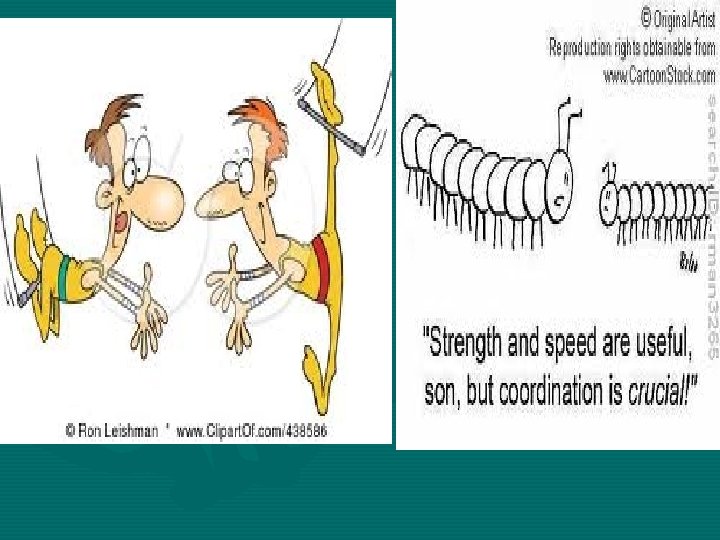
CO ORDINATED MOVEMENT Smooth, accurate and purposeful movement brought about by the integrated action of many muscles, superimposed upon the basis of efficient postural activity. The muscle are grouped together as I. Prime movers II. Antagonists III. Synergists IV. Fixators
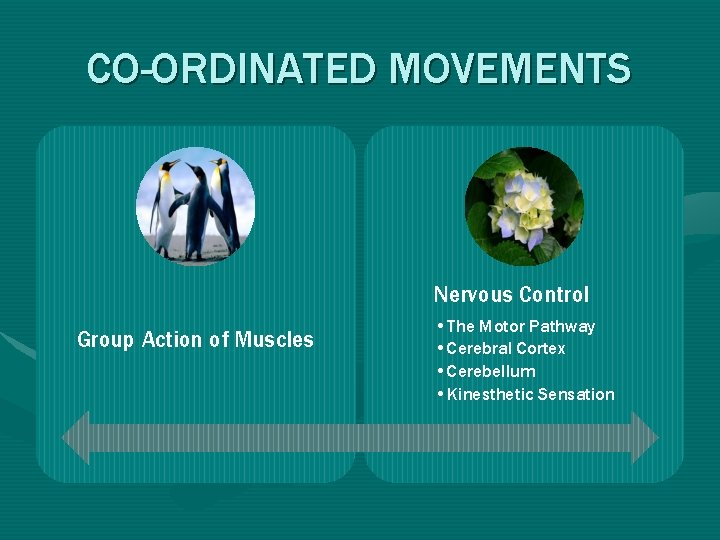
CO-ORDINATED MOVEMENTS Nervous Control Group Action of Muscles • The Motor Pathway • Cerebral Cortex • Cerebellum • Kinesthetic Sensation
GROUP ACTION OF THE MUSCLE Ø A single muscle can work alone to produce a particular movement or to secure stability Ø Functionally, muscles work together in groups Ø Each muscle has some specific part to play Ø Integrated activity of many groups is required to produce efficient functional movement
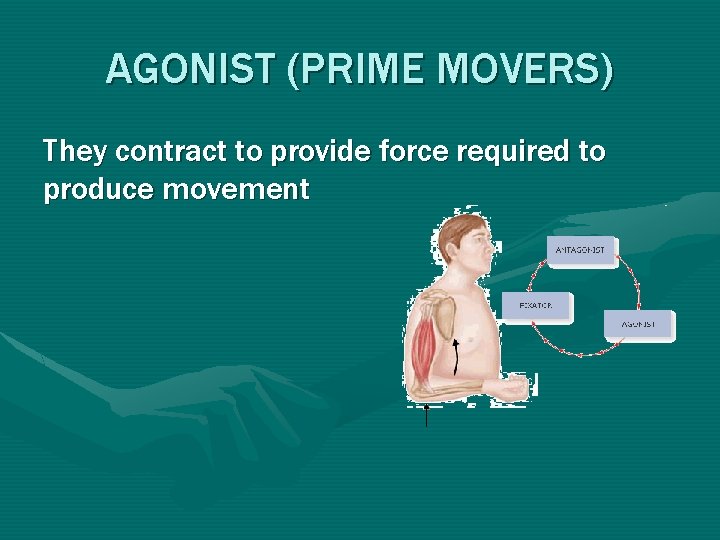
AGONIST (PRIME MOVERS) They contract to provide force required to produce movement
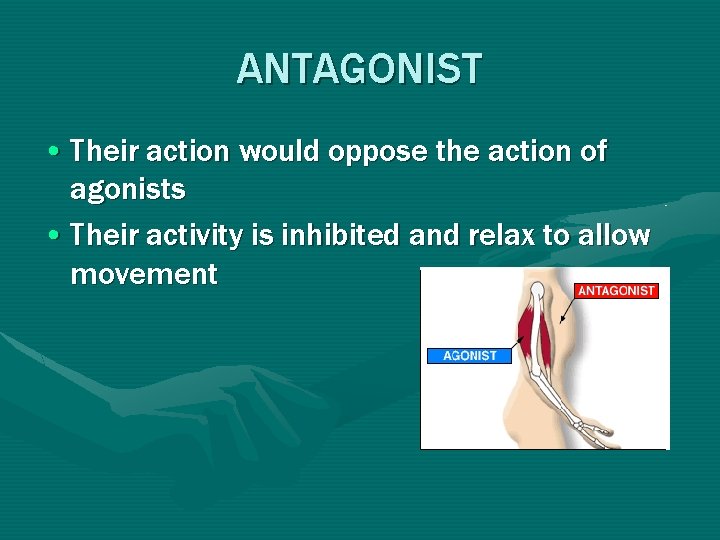
ANTAGONIST • Their action would oppose the action of agonists • Their activity is inhibited and relax to allow movement
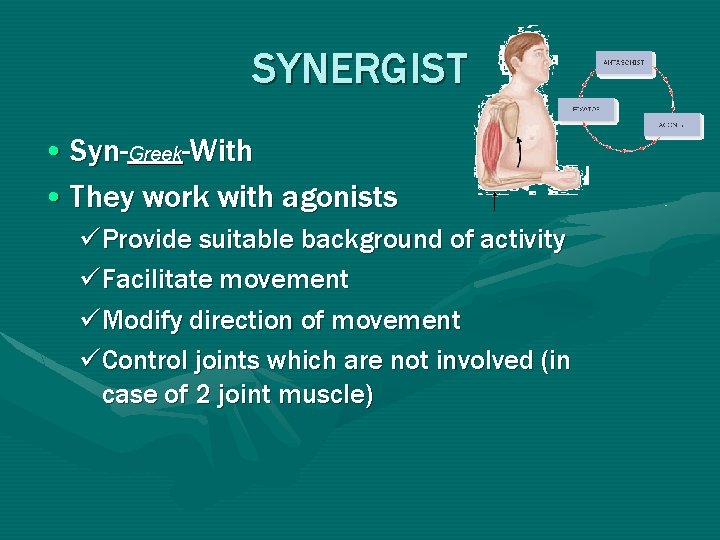
SYNERGIST • Syn-Greek-With • They work with agonists üProvide suitable background of activity üFacilitate movement üModify direction of movement üControl joints which are not involved (in case of 2 joint muscle)
FIXATORS Stabilize the bone of origin ü Increase the efficiency of agonist üStabilize the body as a whole
NERVOUS CONTROL This involves the following I. The motor pathway II. Cerebral cortex III. Cerebellum IV. Kinesthetic sensation
NERVOUS CONTROL q. THE MOTOR PATHWAY: action of muscle is determined by the afferent impulses reaching to it. q. CEREBRAL CORTEX: voluntary movement is initiated in response to sensory stimulus. Initiation centers exist in the brain stem that alert the cerebral cortex that is responsible for planning the pattern of movement.
q. CEREBELLUM: It is receiving station of information. It delicately adjust all the information and result in harmonious interaction of muscles and conveys the pattern to the AHC by either extra pyramidal tracts or other pathway of the spinal cord q. KINESTHETIC SENSATION: Afferent impulses arise from the proprioceptors situated in the muscle, tendons and joints. They record the position of limb. Some of the impulses reach the conscious level other end in spinal cord and cerebellum.
INCOORDINATION q. Interference in the coordination process lead to the jerky, arrhythmic or inaccurate movement. q. The exercises designed to overcome the problem are different according to the location of the lesion which is causing it.
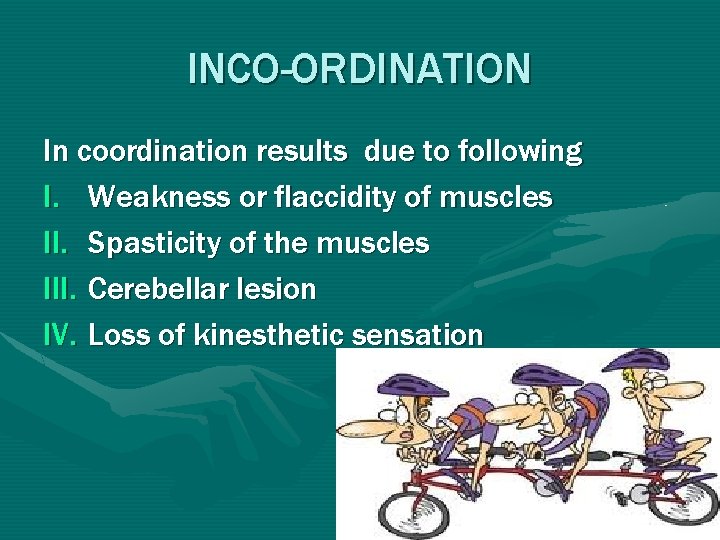
INCO-ORDINATION In coordination results due to following I. Weakness or flaccidity of muscles II. Spasticity of the muscles III. Cerebellar lesion IV. Loss of kinesthetic sensation
WEAKNESS OR FLACCIDITY OF MUSCLES In this case lesion of the Lower motor neurons prevents the appropriate impulses from reaching the muscle
SPASTICITY OF THE MUSCLES Lesion affecting the area of the cerebral cortex, or the upper motor neurons result in spasticity of the muscle so the response is abnormal.
CEREBELLAR LESION ü This is known as the ‘CEREBELLAR ATAXIA’ it means ‘without order’. ü There is marked hypotonicity of the muscle, tire easily, inadequate fixator action. ü Movement is irregular, swaying and with intention tremors.
LOSS OF KINESTHETIC SENSATION Ø This is ‘SENSORY ATAXIA’ or in case of TABES DORSALIS, TEBATIC ATAXIA. Ø In this case patient is unaware of his body in space or position of joint. Ø The muscle are hypotonic and tire easily, they are unaware with sensation of fatigue.