
NEUROLOGY THE EXTRAPYRAMIDAL SYSTEM DEFINITION It includes all


- Slides: 24
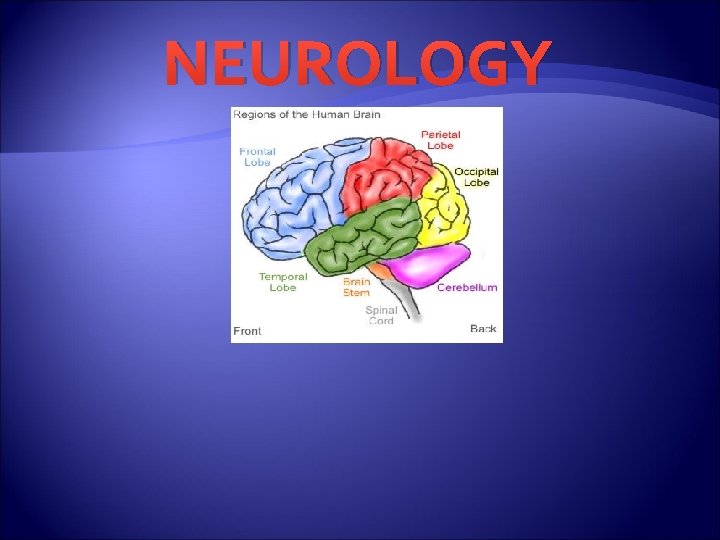
NEUROLOGY
THE EXTRAPYRAMIDAL SYSTEM DEFINITION: It includes all fibers that can influence the motor end plate activity and do not pass in the pyramidal tract.
Functions of the Extrapyramidal system: 1 -Regulation and integration of voluntary motor activity. 2 -Regulation and maintenance of the muscle tone. 3 -Regulation and maintenance of emotional and associative movements.
Disturbance of the functions of the extra- pyramidal system leads to:
II-Disturbance in the regulation and maintenance of normal muscle tone resulting in: III-Disturbance in the regulation and maintenance of emotional and associated movements resulting in:
PARKINSONISM It is due to deficiency of dopamine in the basal ganglia and substantia nigra.
*- Causes : I- Idiopathic: Parkinson's disease (paralysis agitans). The cause is unknown.
II- Symptomatic: There is a known cause which leads to deficiency of dopamine in the brain, but without structural changes in the substantia nigra or basal ganglia.
1 - Inflammatory: 2 - Vascular: 3 - Toxic: 4 - Neoplastic: 5 - Traumatic:
CLINICAL PICTURE I-Tremors: -
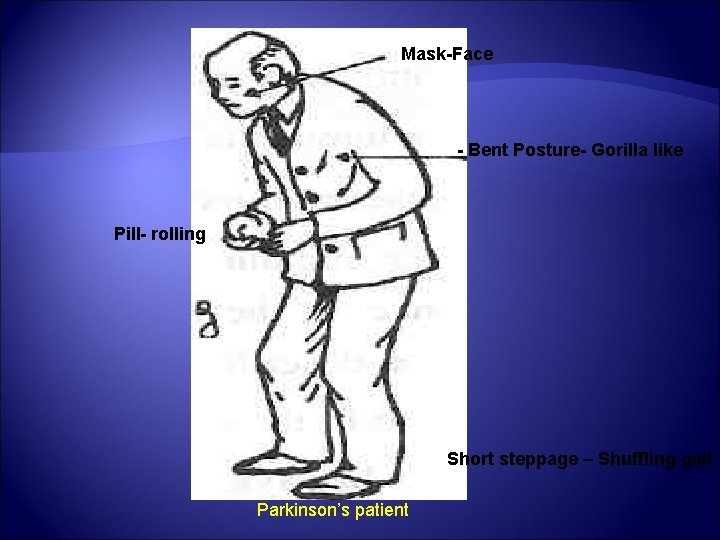
Mask-Face - Bent Posture- Gorilla like Pill- rolling Short steppage – Shuffling gait Parkinson’s patient
II- Rigidity : -
III- Loss of emotional and associative movements: - - IV-Other clinical manifestations may be found in some cases (mainly post-encephalitic):
* By far the commonest causes of Parkinsonism are: 1) Paralysis agitans. 2) Post-encephalitic. 3) Atherosclerosis.
Treatment of Parkinsonism The manifestations of Parkinsonism are due to an imbalance between the levels of acetylcholine and dopamine in the basal ganglia and substantia nigra.
I- Anticholinergic drugs: .
II- Levo-Dopa: (Dopamine precursor):
III_ Levo-Dopa + Carbi-Dopa: (Sinemet)
* On and off phenomenon: After long term treatment with L-dopa the patient may show signs a Parkinsonism (under treatment) alternating rapidly with signs of drug overdosage, mainly Chorea (over treatment), as if being turned "on and off. " The dose of L-dopa should be reduced and other drugs as Bromocriptine are given.
III- Dopamine agonist- IV-Amantadine hydrochloride (Symmetrel): V- Surgical : 1) Pallidectomy or 2) Thalamotomy
CHOREA DEFINITION: Chorea is involuntary, static, irregular, dysrhythmic, sudden, jerky, pseudopurposive movements of any part of the body, including the face, trunk and/or limbs.
Athetosis This a condition where there are: Involuntary, irregular, static, slow, snake-like movements. They involve the extremities (especially the hands & fingers) and the face on each side. *
Dystonia * This is a condition where there are: * Involuntary, static, very slow, torsion or twisting like movements. * They involve the neck, trunk & the proximal muscles of the extremities
Thank you