
NEUROLOGICAL SYSTEM ANATOMY AND PHYSIOLOGY PYRAMID POINTS Areas



- Slides: 41
NEUROLOGICAL SYSTEM ANATOMY AND PHYSIOLOGY
PYRAMID POINTS • Areas of the brain and control over functions • Functions of the cranial nerves • Effects of a dysfunction in the brain or spinal cord • Nursing interventions related to a specific dysfunction in the brain or spinal cord
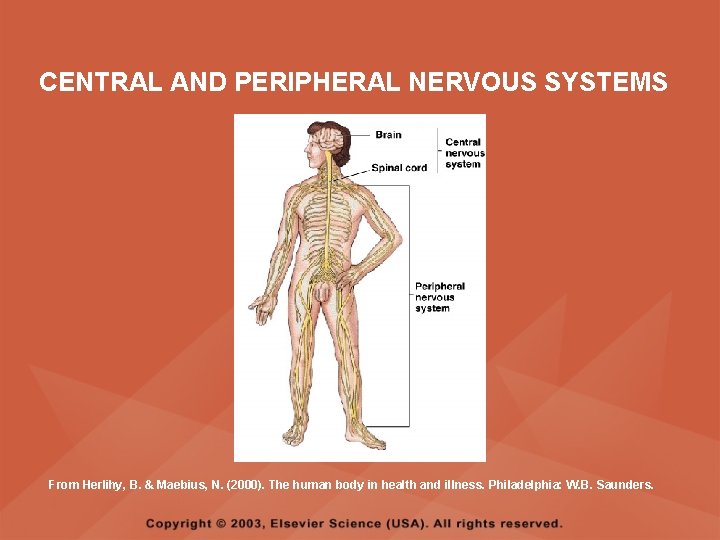
CENTRAL AND PERIPHERAL NERVOUS SYSTEMS From Herlihy, B. & Maebius, N. (2000). The human body in health and illness. Philadelphia: W. B. Saunders.
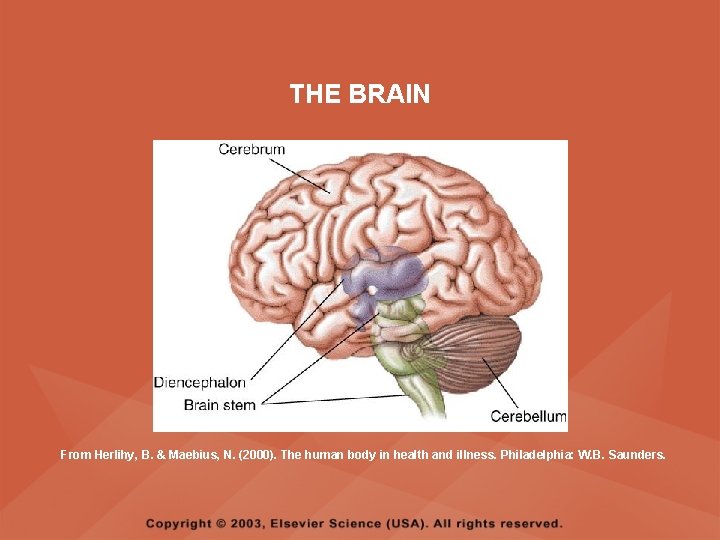
THE BRAIN From Herlihy, B. & Maebius, N. (2000). The human body in health and illness. Philadelphia: W. B. Saunders.
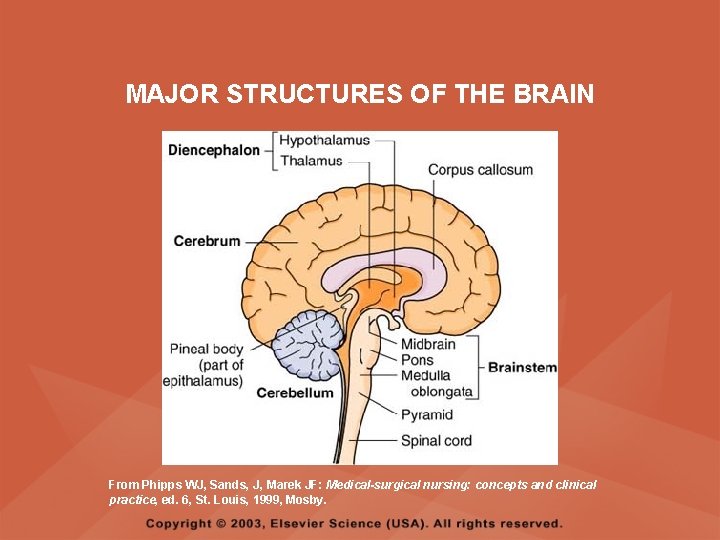
MAJOR STRUCTURES OF THE BRAIN From Phipps WJ, Sands, J, Marek JF: Medical-surgical nursing: concepts and clinical practice, ed. 6, St. Louis, 1999, Mosby.
CEREBRUM • Consists of the right and left hemispheres • Each hemisphere receives sensory information from the opposite side of the body and controls the skeletal muscles of the opposite side • Governs sensory and motor activity • Governs thought and learning
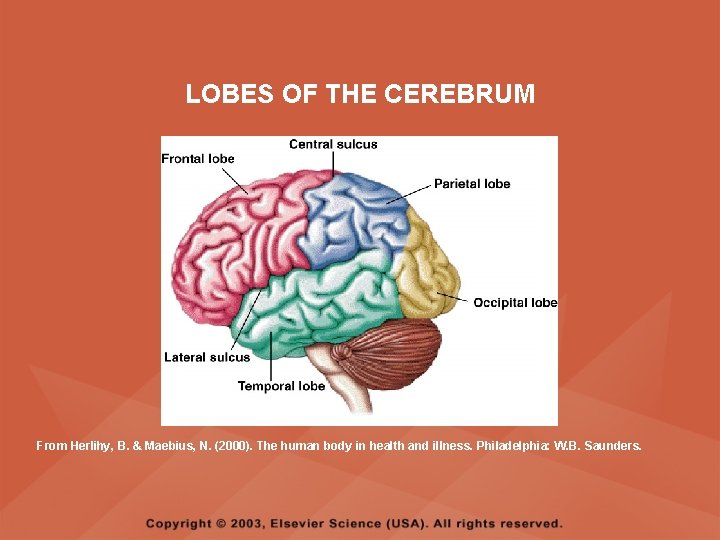
CEREBRAL CORTEX • Outer gray layer • Divided into four lobes • Responsible for the conscious activities of the cerebrum • Frontal lobe • Parietal lobe • Temporal lobe • Occipital lobe
LOBES OF THE CEREBRUM From Herlihy, B. & Maebius, N. (2000). The human body in health and illness. Philadelphia: W. B. Saunders.
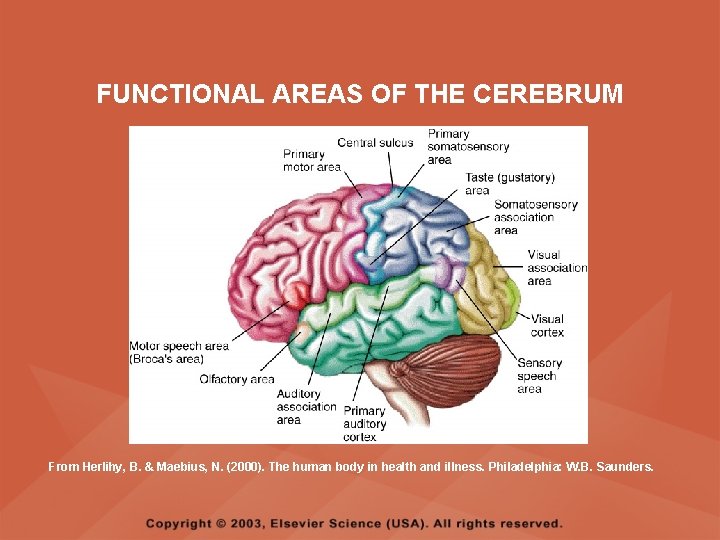
CEREBRAL CORTEX • FRONTAL LOBE – Broca's area for speech – Prefontal lobe controls morals, emotions, and judgments • PARIETAL LOBE – Interprets pain, touch, temperature, and pressure • TEMPORAL LOBE – Auditory center – Wenicke's area for sensory and speech • OCCIPITAL LOBE – Visual area
FUNCTIONAL AREAS OF THE CEREBRUM From Herlihy, B. & Maebius, N. (2000). The human body in health and illness. Philadelphia: W. B. Saunders.
BASAL GANGLIA • Cell bodies in white matter • Assists cerebral cortex in producing smooth voluntary movements
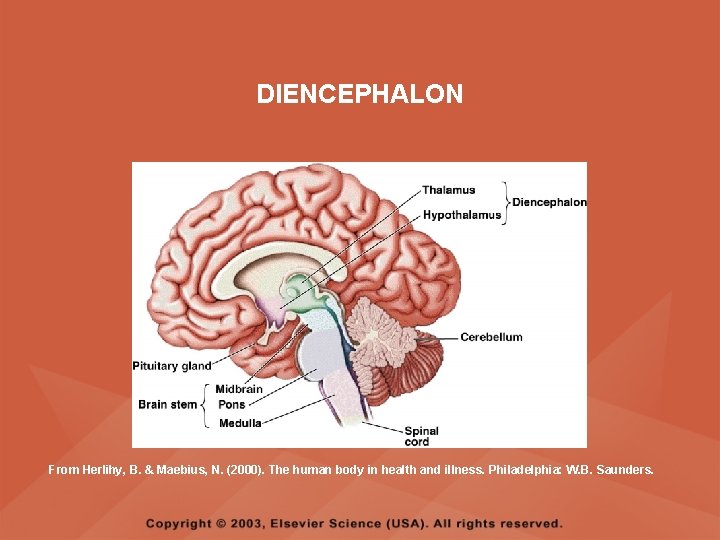
DIENCEPHALON • Thalamus • Hypothalamus
DIENCEPHALON From Herlihy, B. & Maebius, N. (2000). The human body in health and illness. Philadelphia: W. B. Saunders.
DIENCEPHALON • THALAMUS – Relays sensory impulses to the cortex – Provides a thalamic pain gate – Part of the reticular activating system
DIENCEPHALON • HYPOTHALAMUS – Regulates autonomic responses of the sympathetic and parasympathetic nervous systems – Regulates stress response, sleep, appetite, body temperature, fluid balance, and emotions – Responsible for the production of hormones secreted by the pituitary gland hypothalamus
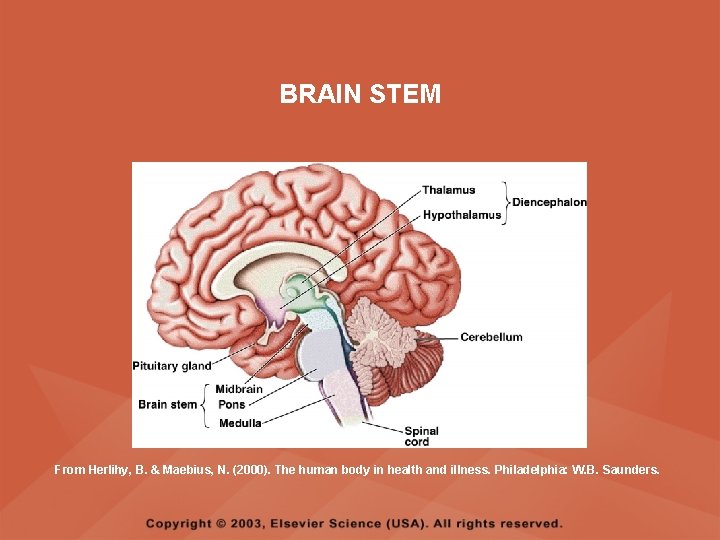
BRAIN STEM • Midbrain • Pons • Medulla oblongata
BRAIN STEM From Herlihy, B. & Maebius, N. (2000). The human body in health and illness. Philadelphia: W. B. Saunders.
BRAIN STEM • MIDBRAIN – Responsible for motor coordination – Visual reflex and auditory relay centers • PONS – Contains respiratory centers – Regulates breathing
BRAIN STEM • MEDULLA OBLONGATA – Contains all afferent and efferent tracts – Contains cardiac, respiratory, vomiting, and vasomotor centers – Controls heart rate, respiration, blood vessel diameter, sneezing, swallowing, vomiting, and coughing
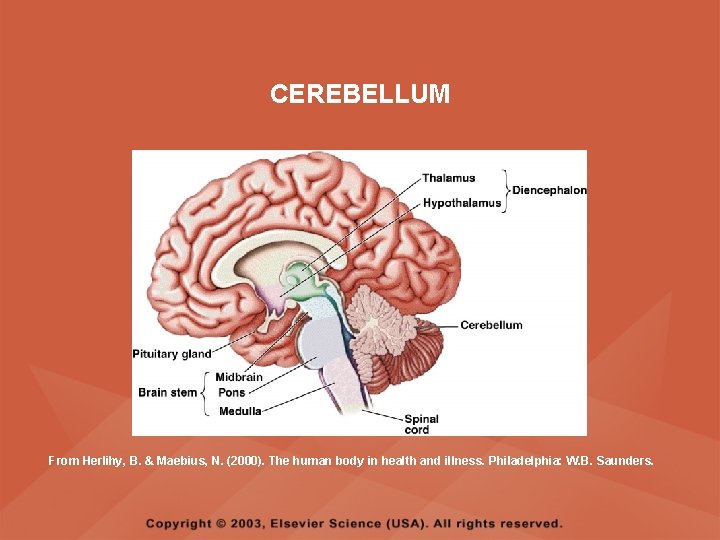
CEREBELLUM • Coordinates smooth muscle movement • Coordinates posture, equilibrium, and muscle tone
CEREBELLUM From Herlihy, B. & Maebius, N. (2000). The human body in health and illness. Philadelphia: W. B. Saunders.
SPINAL CORD • Provides neuron and synapse networks to produce involuntary responses to sensory stimulation • Allows for control of the number of pain impulses that pass through the spinal cord on their way to the brain • Carries sensory information to, and motor information from, the brain • Extends from the first cervical to the second lumbar vertebra • Protected by the meninges, cerebrospinal fluid, and adipose tissue
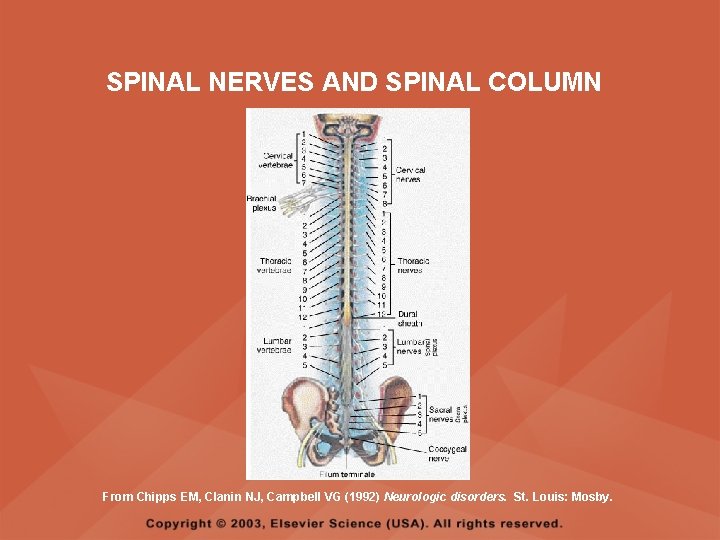
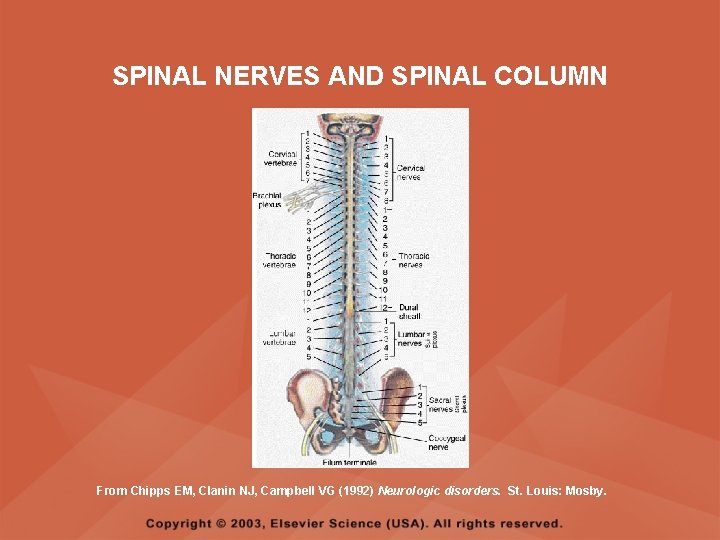
SPINAL NERVES AND SPINAL COLUMN From Chipps EM, Clanin NJ, Campbell VG (1992) Neurologic disorders. St. Louis: Mosby.
SPINAL CORD • HORNS – Inner column of gray matter contains two anterior and two posterior horns – Posterior horns connect with afferent (sensory) nerve fibers – Anterior horns contain efferent (motor) nerve fibers • NERVE TRACTS – White matter contains the nerve tract – Ascending tracts (sensory pathway) – Descending tract (motor pathway)
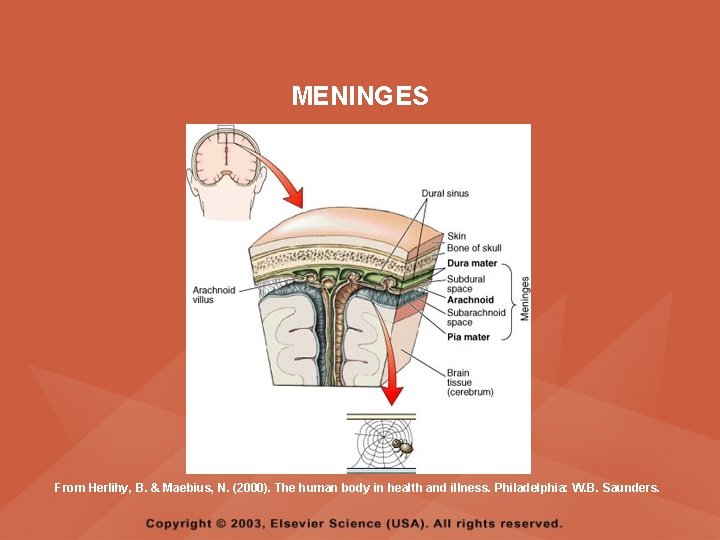
MENINGES • Dura mater is the tough and fibrous membrane • Arachnoid membrane is the delicate membrane and contains subarachnoid fluid • Pia mater is the vascular membrane • Subarachnoid space is formed by the arachnoid membrane and the pia mater
MENINGES From Herlihy, B. & Maebius, N. (2000). The human body in health and illness. Philadelphia: W. B. Saunders.
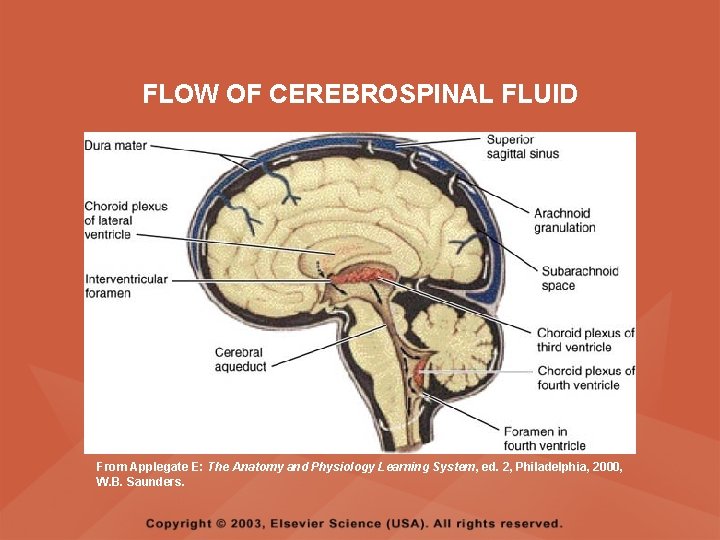
CEREBROSPINAL FLUID • Secreted in the ventricles and circulates through the ventricles to the subarachnoid layer of the meninges where it is reabsorbed • Circulates in the subarachnoid space • Normal pressure is 50 to 175 mm H 2 O • Normal volume is 125 to 150 ml • Acts as a protective cushion • Aids in the exchange of nutrients and wastes
FLOW OF CEREBROSPINAL FLUID From Applegate E: The Anatomy and Physiology Learning System, ed. 2, Philadelphia, 2000, W. B. Saunders.
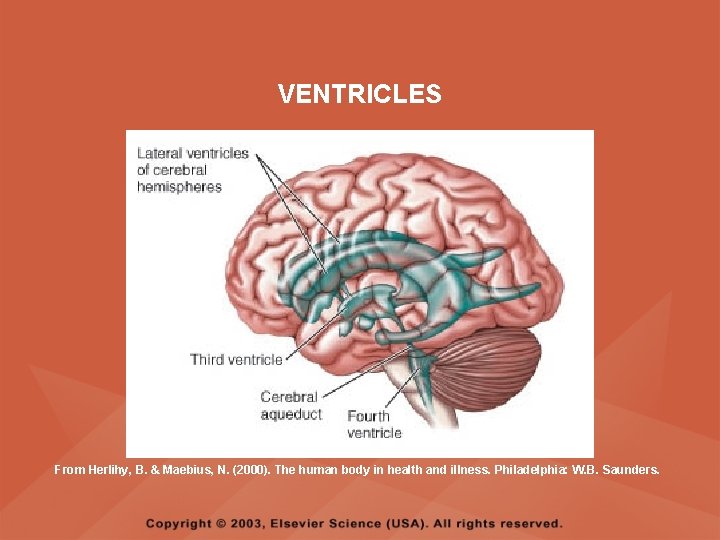
VENTRICLES • Four ventricles • Communicate between the subarachnoid spaces • Produce and circulate cerebrospinal fluid
VENTRICLES From Herlihy, B. & Maebius, N. (2000). The human body in health and illness. Philadelphia: W. B. Saunders.
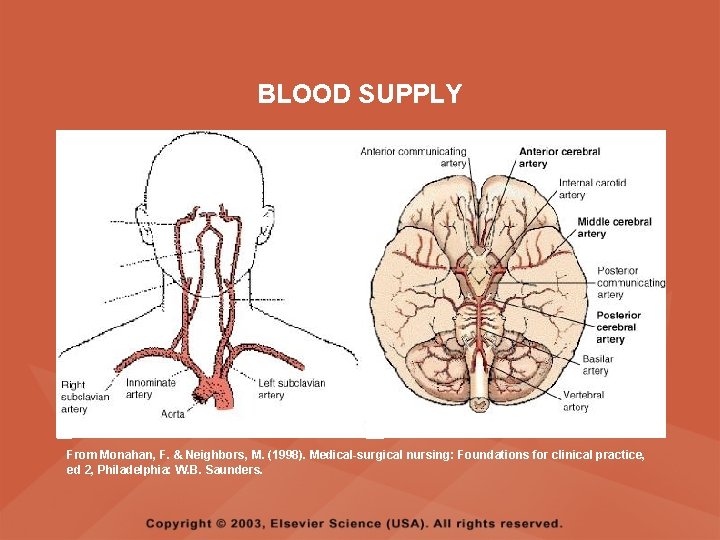
BLOOD SUPPLY • Right and left internal carotids • Right and left vertebral arteries • These arteries supply the brain via an anastamosis at the base of the brain called the circle of Willis
BLOOD SUPPLY From Monahan, F. & Neighbors, M. (1998). Medical-surgical nursing: Foundations for clinical practice, ed 2, Philadelphia: W. B. Saunders.
NEUROTRANSMITTERS • • • Acetylcholine Norepinephrine Dopamine Serotonin Amino acids Polypeptides
NEURONS • The cell body • Contains the axons and dendrites • Neurons carrying impulses to the central nervous system (CNS) are called sensory neurons • Neurons carrying impulses away from the CNS are called motor neurons • Synapse is the chemical transmission of impulses from one neuron to another
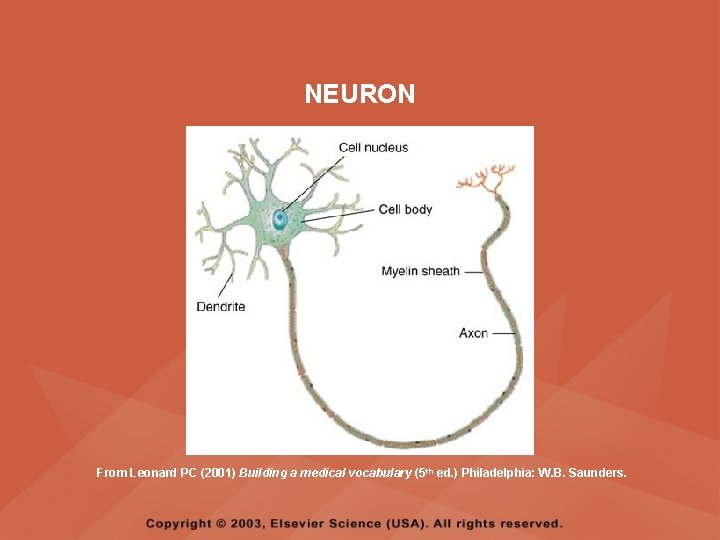
NEURON From Leonard PC (2001) Building a medical vocabulary (5 th ed. ) Philadelphia: W. B. Saunders.
AXONS AND DENDRITES • The axon conducts impulses from the cell body • The dendrites receive stimuli from the body and transmit them to the axon • Protected and insulated by Schwann’s cells • The Schwann’s cell sheath is called the neurolemma • Neurons do not reproduce after the neonatal period • If an axon or dendrite is damaged, it will die and be slowly replaced only if the neurolemma is intact and the cell body has not died
AXON AND DENDRITE From Herlihy, B. & Maebius, N. (2000). The human body in health and illness. Philadelphia: W. B. Saunders.
SPINAL NERVES • Thirty-one pairs of spinal nerves • Mixed nerve fibers are formed by the joining of the anterior motor and posterior sensory roots • Posterior roots contain with afferent (sensory) nerve fibers • Anterior roots contain efferent (motor) nerve fibers
SPINAL NERVES AND SPINAL COLUMN From Chipps EM, Clanin NJ, Campbell VG (1992) Neurologic disorders. St. Louis: Mosby.
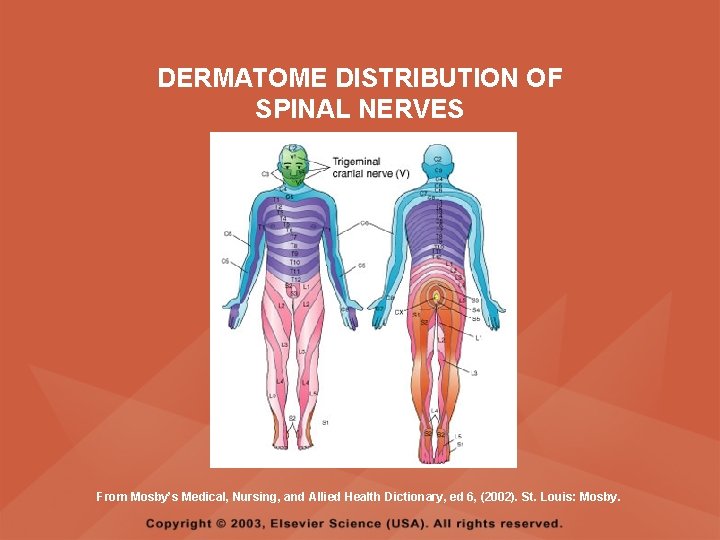
DERMATOME DISTRIBUTION OF SPINAL NERVES From Mosby’s Medical, Nursing, and Allied Health Dictionary, ed 6, (2002). St. Louis: Mosby.
AUTONOMIC NERVOUS SYSTEM • Sympathetic (adrenergic) fibers dilate pupils, increase heart rate and rhythm, contract blood vessels, and relax smooth muscles of the bronchi • Parasympathetic (cholinergic) fibers produce the opposite effect