
Neurological Control of Movement The Structure and Function
- Slides: 17
Neurological Control of Movement The Structure and Function of the Nervous System
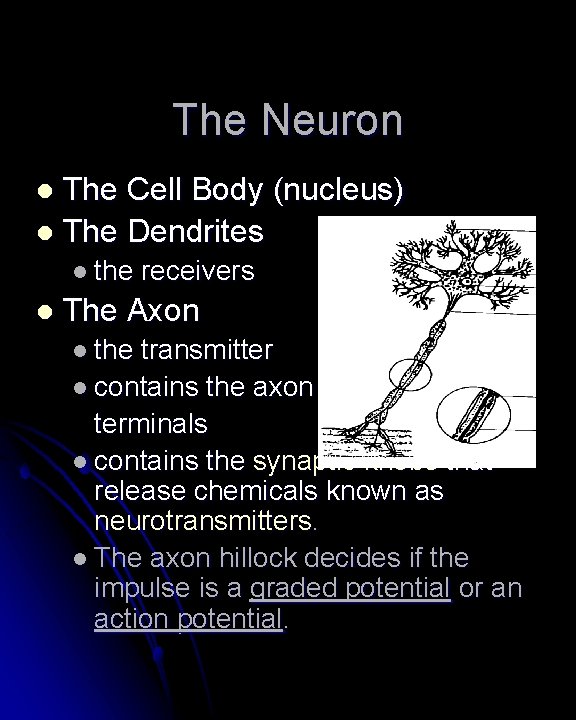
The Neuron The Cell Body (nucleus) l The Dendrites l l the l receivers The Axon l the transmitter l contains the axon terminals l contains the synaptic knobs that release chemicals known as neurotransmitters. l The axon hillock decides if the impulse is a graded potential or an action potential.
The Neuron l Node of ranvier l Myelin sheath l Saltitory conduction: the impulse skips from node to node and is a faster method of impulse travel.
The Nerve Impulse l Nerve Impulse: an electrical charge that passes from one neuron to the next neuron or muscle fiber. l Resting Membrane Potential: the separation of charges across the membrane (polarized). l l a constant RMP of -70 m. V is the function of the sodium-potassium pump. Depolarization: when the charge difference decreases (< -70 m. V), moving closer to zero (ie -20 m. V). l Hyperpolarization: when the charge difference increases (> -70 m. V), moving farther from zero (ie -120 m. V).
The Nerve Impulse l Graded Potentials: local changes in the neuron membrane to cause an inefficient charge difference. l Action Potentials: a rapid and substantial depolarization (excitation) of the neurons membrane. l axon hillock- measures the summation of impulses and determines the threshold for an action potential l All-Or-None Principle l Sequence of events [3. 2]
The Synapse l Synapse: is the site of impulse transmission from one neuron to another neuron or muscle fiber. l axon terminals- release acetylcholine l synaptic cleft l receptors- of a neuromuscular junction at the sarcolemma of a muscle fiber. [3. 4]
The Synapse l Excitatory Postsynaptic Potential (EPSP’s) can be either depolarizations (excites) or hyperpolarizations (inhibits) l Inhibitory Postsynaptic Potentials (IPSP’s) are only hyperpolarizations (inhibits)
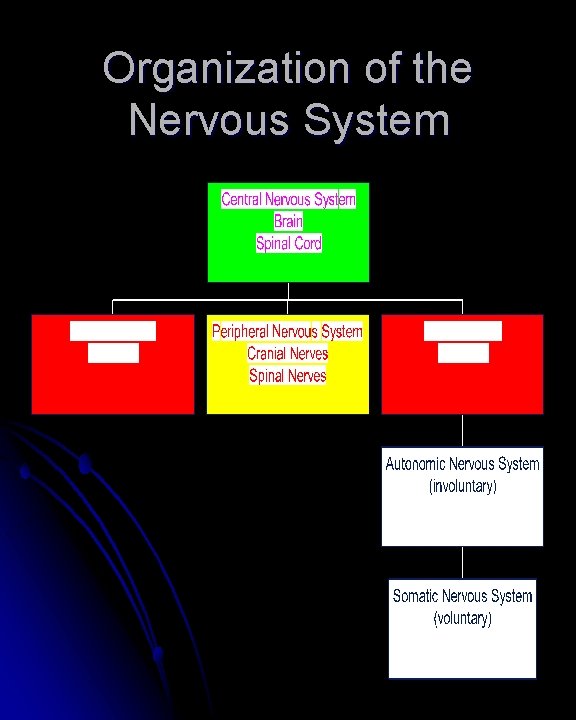
Organization of the Nervous System
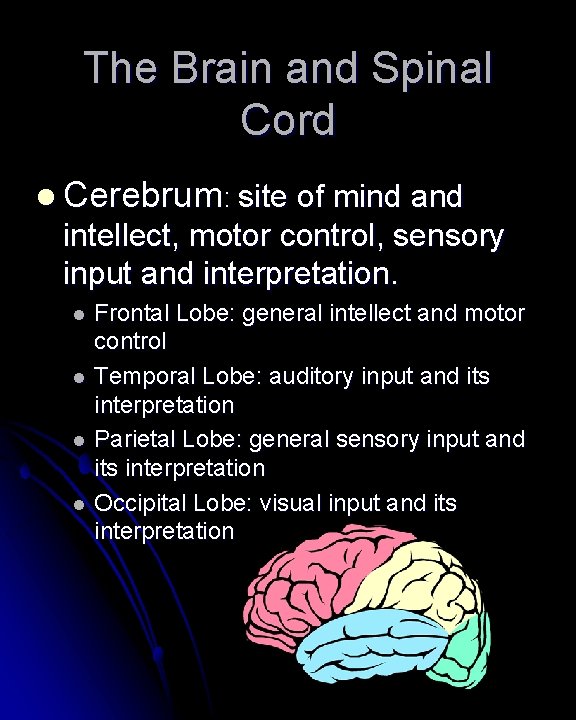
The Brain and Spinal Cord l Cerebrum: site of mind and intellect, motor control, sensory input and interpretation. l l Frontal Lobe: general intellect and motor control Temporal Lobe: auditory input and its interpretation Parietal Lobe: general sensory input and its interpretation Occipital Lobe: visual input and its interpretation
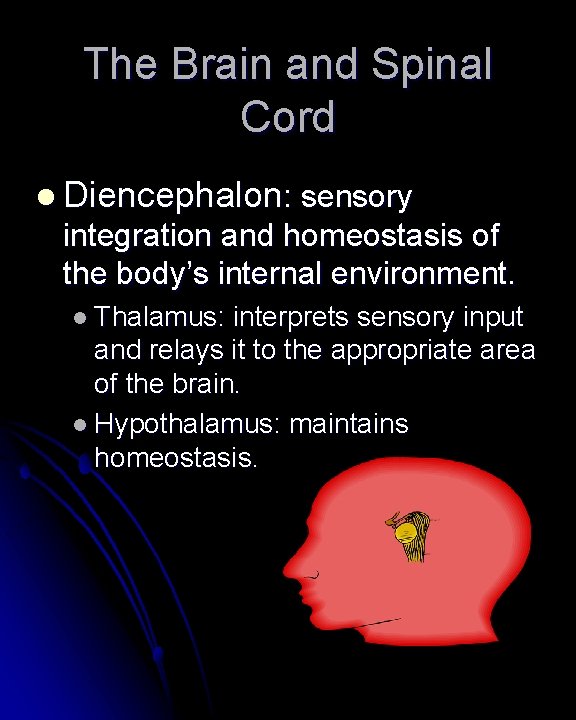
The Brain and Spinal Cord l Diencephalon: sensory integration and homeostasis of the body’s internal environment. l Thalamus: interprets sensory input and relays it to the appropriate area of the brain. l Hypothalamus: maintains homeostasis.
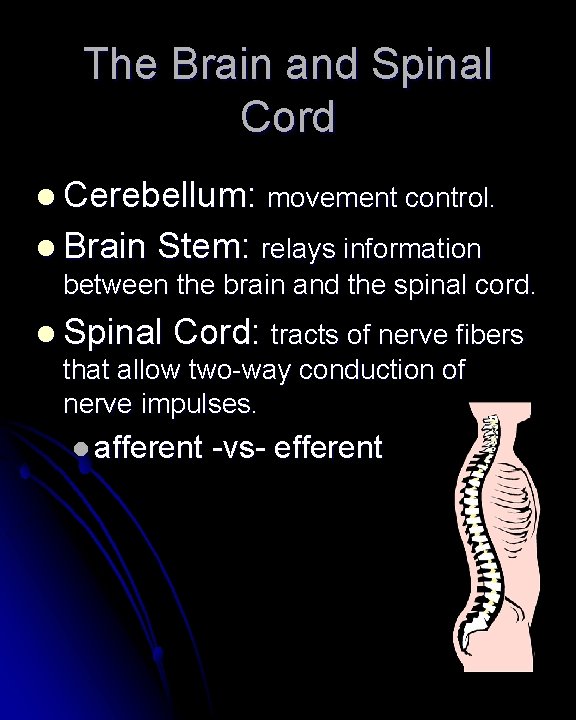
The Brain and Spinal Cord l Cerebellum: movement control. l Brain Stem: relays information between the brain and the spinal cord. l Spinal Cord: tracts of nerve fibers that allow two-way conduction of nerve impulses. l afferent -vs- efferent
The Peripheral Nervous System The PNS contains 12 pairs of cranial nerves and 31 pairs of spinal nerves. l Sensory neurons enter the spinal cord through the dorsal root. l l l mechanoreceptors (touch) thermoreceptors (temperature) nociceptors (pain) chemoreceptors (oxygen, glucose, electrolytes, etc. ) kinesthetic receptors (movement in joints, balance, etc. ) ie. golgi tendon organs
The Peripheral Nervous System l Motor neurons leave the spinal cord through the ventral root. l l Create muscle contraction Create muscle inhibition
The Autonomic Nervous System l The ANS controls your body’s involuntary internal functions. l Sympathetic Nervous System (fight or flight mechanism) l inc. H. R. and cardiac contraction l coronary vessels dilate increasing B. P. & blood flow l bronchodilation, inc. metabolic rate & mental capabilities l glucose is released from the liver into the blood
The Autonomic Nervous System l Parasympathetic Nervous System (housekeeping system) l carry’s out digestion, urination, & life support l conserves energy l decreases blood flow l decreases breathing rate
Sensory Motor Integration l l l Sensory Motor Integration: is the communication of the sensory and motor nerve pathways. [3. 1] Reflex: when sensory impulses terminate at the spinal cord and are integrated there. Motor Control: controlled by impulses conducted by motor (efferent) neurons from the brain. Muscle Spindles: create reflexive muscle contractions of the agonist muscle to resist further stretching. Golgi Tendon Organs: are sensitive to tension which excite the antagonist muscles to contract.
Muscle Fiber Recruitment l l Each muscle fiber is innervated by only one motor neuron, but each motor neuron innervates up to several thousand muscle fibers. Principle of Orderly Recruitment l l Motor units with smaller motor neurons (ST) will be recruited first, larger motor neurons (FTb) last. Motor units with a smaller number of muscle fibers will be recruited first.