
Neurological Assessment Glasgow Coma Scale Objectives Observe Glasgow
Neurological Assessment Glasgow Coma Scale

Objectives Observe Glasgow Coma Scale Video and understand how to undertake a GCS assessment Complete Quiz Who would you undertake a Glasgow Coma Scale for? Who might have a baseline GCS of less than 15 Frequency of GCS assessment Recognise and have a clear understanding of the importance in observations and communicating trends in patients condition at appropriate level Recognise and be able to adhere to Interim Acute Stroke Pathway for Patients in PAH Catchment Area Jan 2016

Neurological Assessment This E-Learning Module concentrates specifically on a neurological assessment in compliance with the Glasgow Coma Scale 40 years on

Who do we use the Glasgow Coma Scale for? Spontaneous Subarachnoid Haemorrhage Spontaneous Intracerebral Haemorrhage Ischaemic Stroke Intracranial Infection and Brain Haemorrhage General Trauma Non Traumatic Coma Poisoning Sepsis Anyone who deteriorates from their baseline on NEWS AVPU
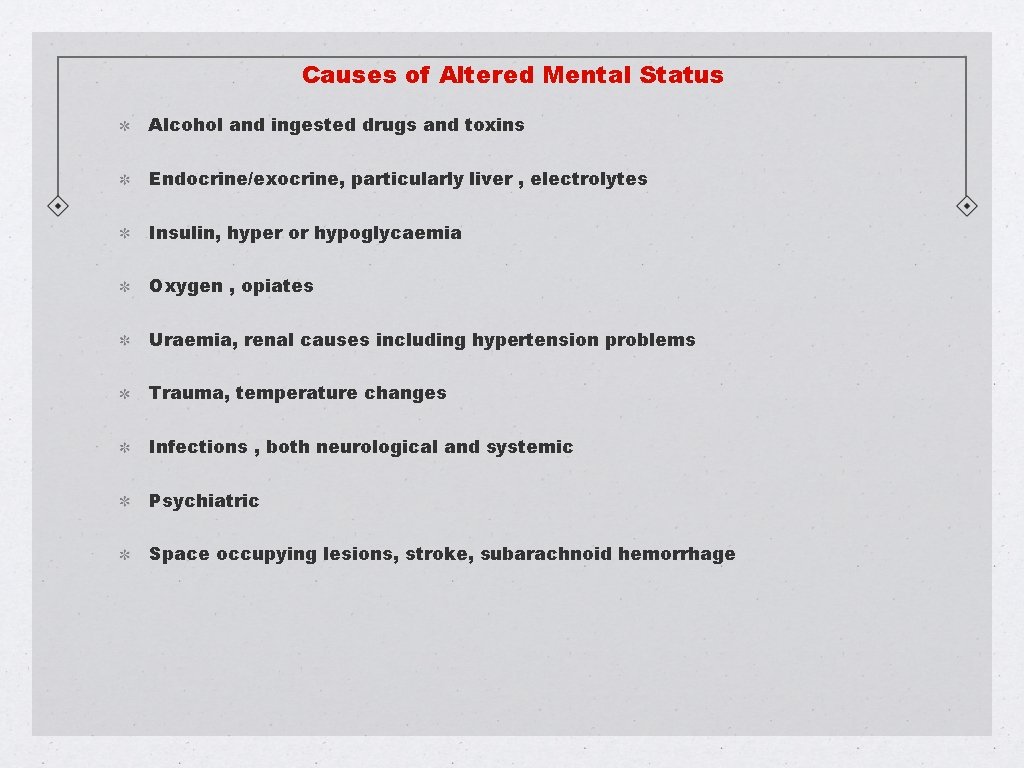
Causes of Altered Mental Status Alcohol and ingested drugs and toxins Endocrine/exocrine, particularly liver , electrolytes Insulin, hyper or hypoglycaemia Oxygen , opiates Uraemia, renal causes including hypertension problems Trauma, temperature changes Infections , both neurological and systemic Psychiatric Space occupying lesions, stroke, subarachnoid hemorrhage
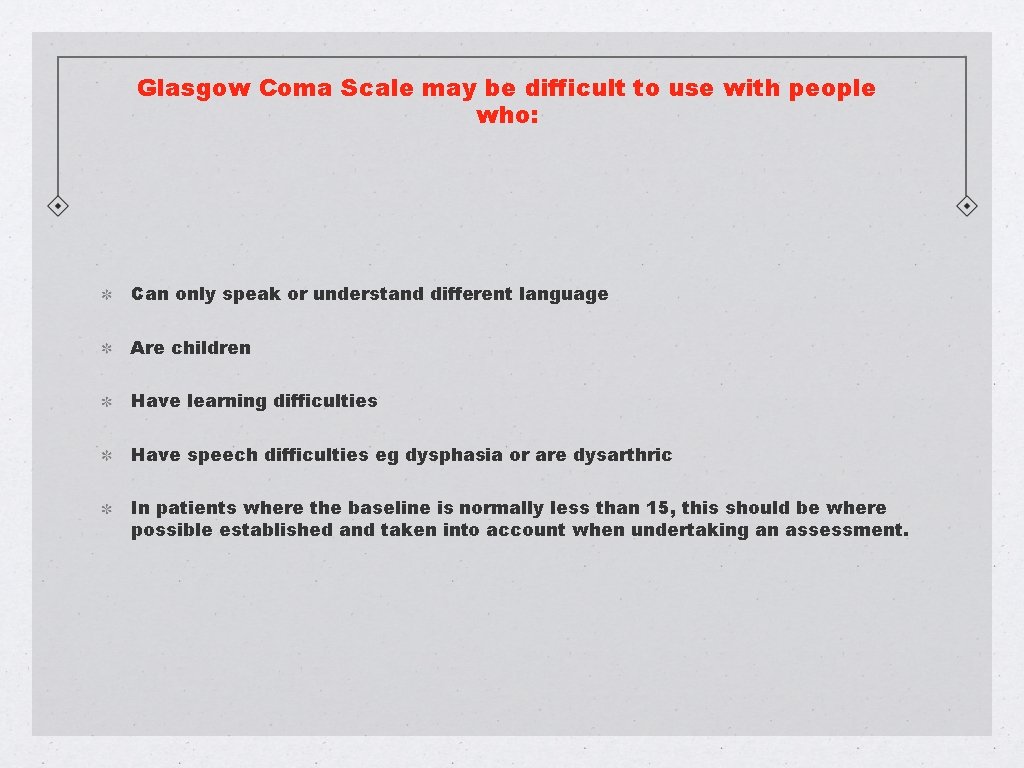
Glasgow Coma Scale may be difficult to use with people who: Can only speak or understand different language Are children Have learning difficulties Have speech difficulties eg dysphasia or are dysarthric In patients where the baseline is normally less than 15, this should be where possible established and taken into account when undertaking an assessment.

Frequency of neurological observations In hospital observation of patients with a head injury should only be conducted and frequency determined by professionals competent in GCS assessment. For patients admitted with head injury observation. The minimum acceptable documented neurological observations are GCS; pupil size and reactivity, limb movements, respiratory rate, heart rate, blood pressure, temperature, blood oxygen saturation. Perform and record observations half hourly until GCS of 15 has been achieved. The minimum frequency of observation for patients with GCS equal to 15 should be as follows, starting after the initial assessment in A&E

Frequency of Neurological Observations Half Hourly for 2 hours Then 1 hourly for 4 hours Then 2 hourly thereafter Should their GCS equal to 15 regress at any time after initial 2 hour period; observations should resume to half-hourly and follow original frequency schedule
Urgent reappraisal by supervising doctor in the following Signs of agitation or abnormal behaviour A constant drop (at least 30 mins) drop of 1 point in GCS (greater weight to be given to drop in motor response score of GCS) A deterioration of 3 or more points in the eye opening or verbal response scores of the GCS, or 2 or more points deterioration in the motor response score Onset of severe or increasing headache or continuous vomiting New or changing neurological symptoms or signs such as pupil inequality or asymmetry of limb or facial movement (2003, amended 2007)
Where possible, a second competent staff member should reassess prior to escalating a deterioration in condition, if this isn’t possible, escalate to Doctor If the above deteriorations occur, an urgent CT head should be considered and patient reassessed and managed appropriately In the case of a patient who has a normal CT scan but who has not achieved a GCS on 15 after 24 hours observation, a further CT scan or MRI scanning should be considered
Criteria for Performing CT head scan within 1 hour Adults with head injury and have any of the following should have a CT Head within 1 hour of the risk being identified GCS less than 13 on initial assessment in A&E GCS less than 15 at 2 hours after injury on assessment in A&E Suspected open or depressed skull fracture Any sign of basal skull fracture(panda eyes, cerebrospinal fluid leakage from ear or nose, Battle’s signs, haemotympanum)
Risk factors indicating cervical spine scan within 1 hour GCS less than 13 on initial assessment The patient is intubated Plain X-rays are technically inadequate Plain X-rays are suspicious or definitely abnormal A definitive diagnosis of cervical spine injury is needed urgently(prior to surgery) The patient is having other body areas scanned for head injury or multiregion truama The patient is having other body areas scanned for head injury or multiregion trauma
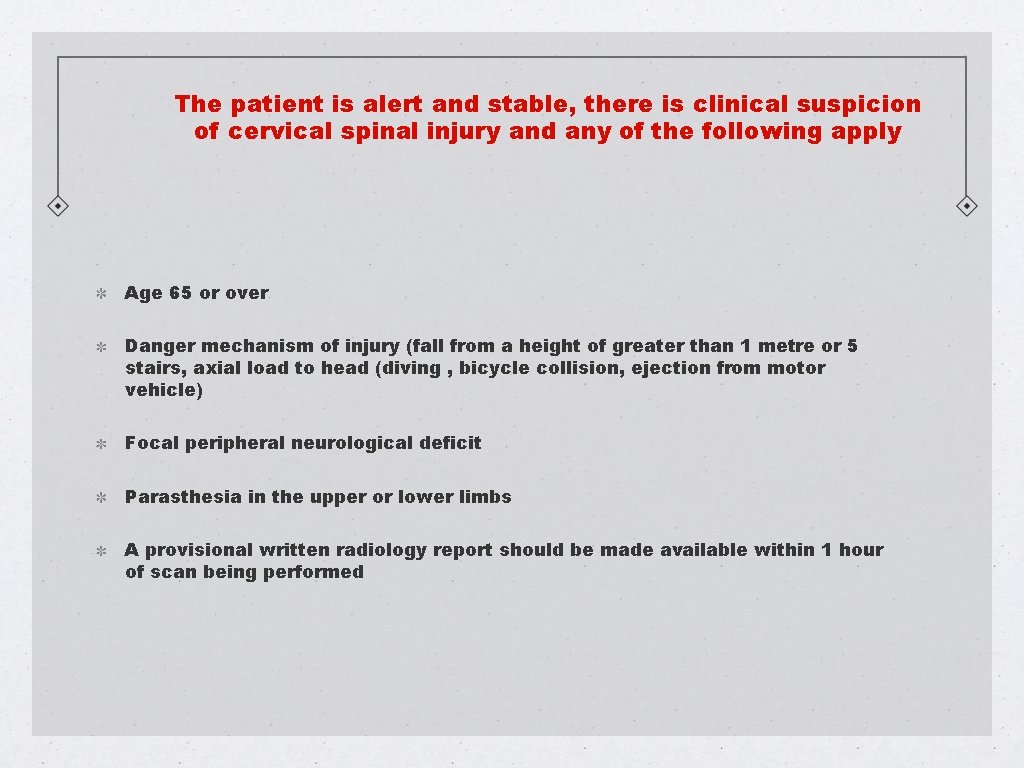
The patient is alert and stable, there is clinical suspicion of cervical spinal injury and any of the following apply Age 65 or over Danger mechanism of injury (fall from a height of greater than 1 metre or 5 stairs, axial load to head (diving , bicycle collision, ejection from motor vehicle) Focal peripheral neurological deficit Parasthesia in the upper or lower limbs A provisional written radiology report should be made available within 1 hour of scan being performed
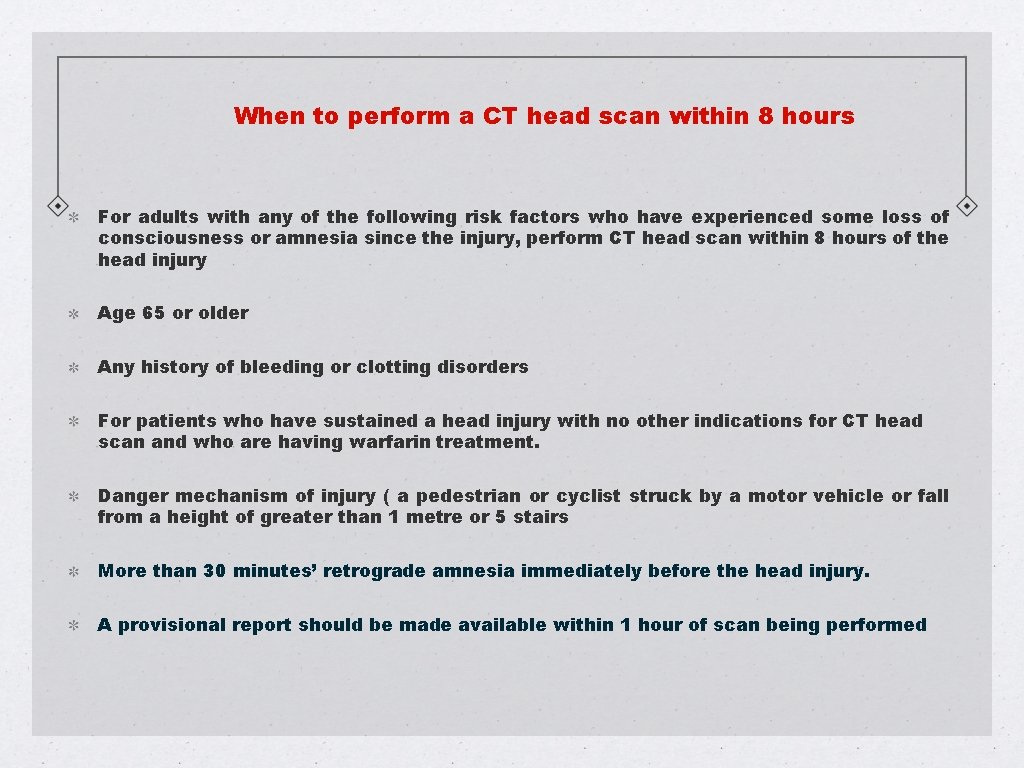
When to perform a CT head scan within 8 hours For adults with any of the following risk factors who have experienced some loss of consciousness or amnesia since the injury, perform CT head scan within 8 hours of the head injury Age 65 or older Any history of bleeding or clotting disorders For patients who have sustained a head injury with no other indications for CT head scan and who are having warfarin treatment. Danger mechanism of injury ( a pedestrian or cyclist struck by a motor vehicle or fall from a height of greater than 1 metre or 5 stairs More than 30 minutes’ retrograde amnesia immediately before the head injury. A provisional report should be made available within 1 hour of scan being performed
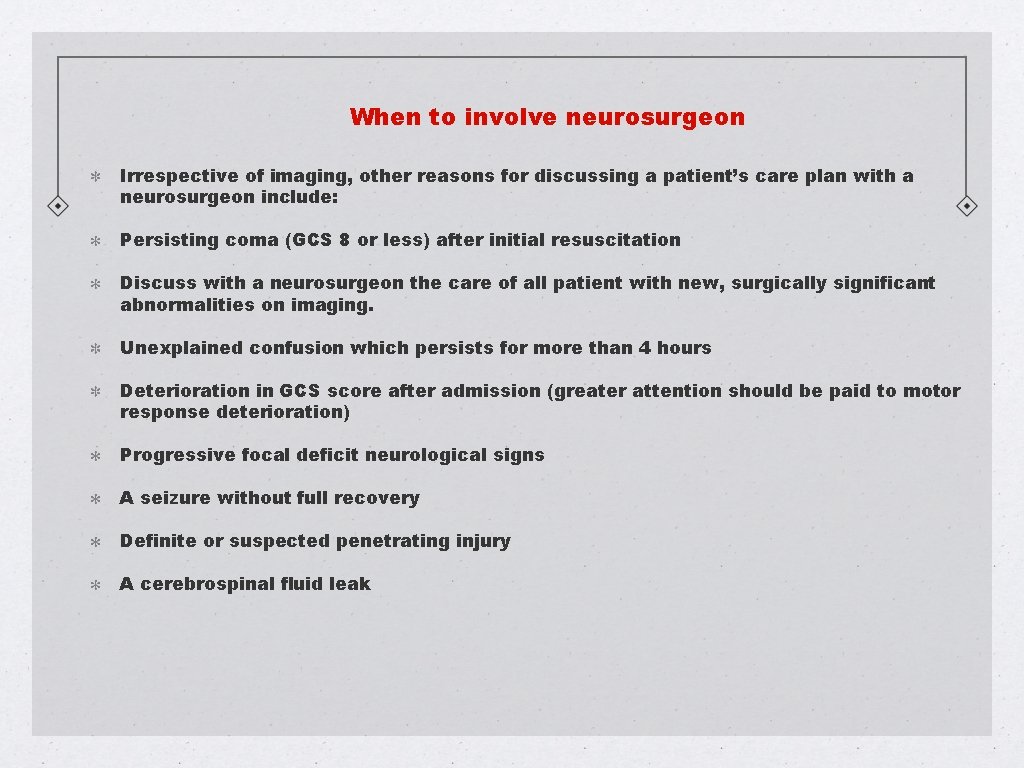
When to involve neurosurgeon Irrespective of imaging, other reasons for discussing a patient’s care plan with a neurosurgeon include: Persisting coma (GCS 8 or less) after initial resuscitation Discuss with a neurosurgeon the care of all patient with new, surgically significant abnormalities on imaging. Unexplained confusion which persists for more than 4 hours Deterioration in GCS score after admission (greater attention should be paid to motor response deterioration) Progressive focal deficit neurological signs A seizure without full recovery Definite or suspected penetrating injury A cerebrospinal fluid leak
• A provisional written radiology report should be made available within one hour of the scan being performed
PAH INTERIM ACUTE STROKE PATHWAY JAN 2016 TRANSFER TO QUEENS HOSPITAL WITH QUERY STROKE SHOULD BE URGENTLY CONSIDERED IN Patients who present less than 4. 5 hours since symptom onset or are an inpatient and develop symptoms Patients who present outside thrombolysis time, but within 72 hours of onset of symptoms
NO IMAGING SHOULD BE TAKEN AS THIS WILL DELAY TRANSFER Full patient history should be taken by a clinician Copy of notes if immediately available Escort required of airway compromise or seizure or essential infusions or monitoring Immediate telephone call to Queens Thrombolysis Nurse 01708 435000 should also occur informing them of planned transfer Patient should be transferred urgently by Blue light Transfer using EEAST (999). The patient should be rapidly assesses by the clinician and declared fit for transfer
- Slides: 19