
NeuroFuzzy and Soft Computing Fuzzy Sets Ch 2

- Slides: 31
Neuro-Fuzzy and Soft Computing: Fuzzy Sets Ch. 2 Fuzzy Sets Original: J. -S. Roger Jang (張智星) Edited and Extended by 陳琨太
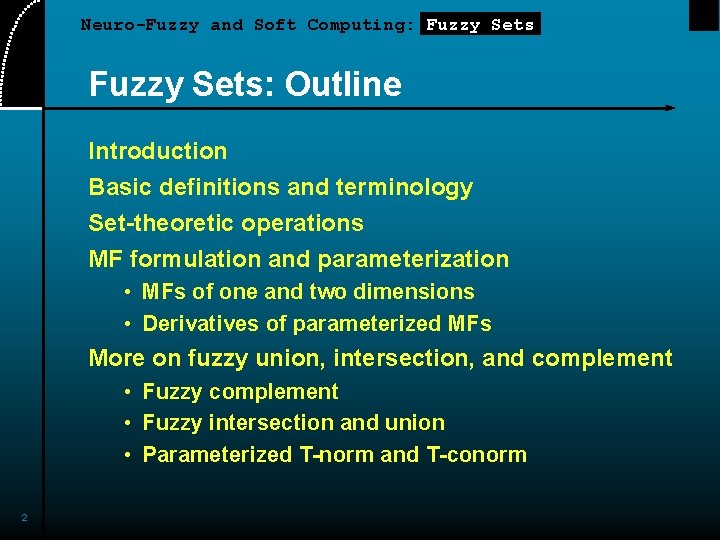
Neuro-Fuzzy and Soft Computing: Fuzzy Sets: Outline Introduction Basic definitions and terminology Set-theoretic operations MF formulation and parameterization • MFs of one and two dimensions • Derivatives of parameterized MFs More on fuzzy union, intersection, and complement • Fuzzy intersection and union • Parameterized T-norm and T-conorm 2
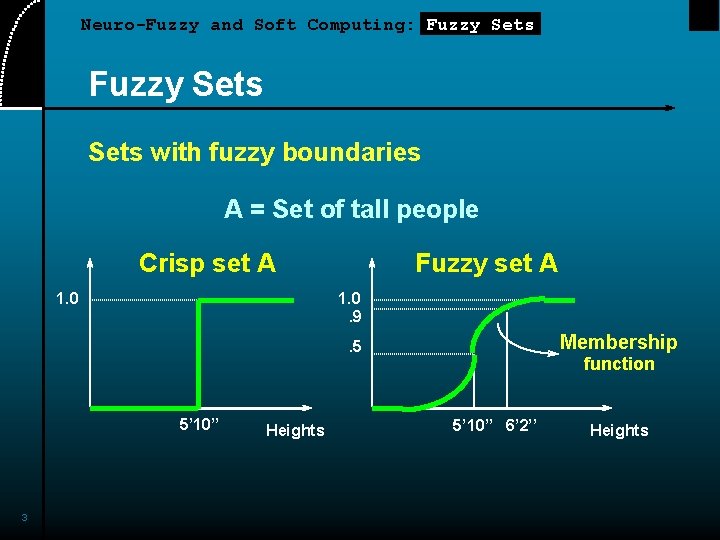
Neuro-Fuzzy and Soft Computing: Fuzzy Sets with fuzzy boundaries A = Set of tall people Crisp set A 1. 0 Fuzzy set A 1. 0. 9 Membership . 5 5’ 10’’ 3 Heights function 5’ 10’’ 6’ 2’’ Heights
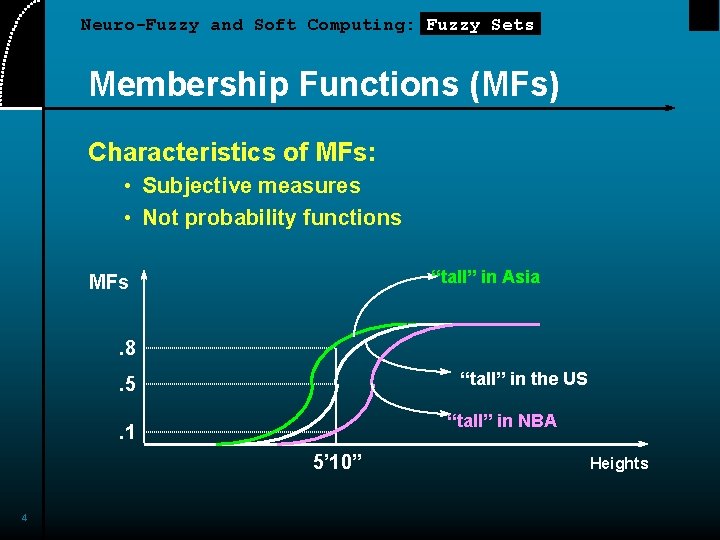
Neuro-Fuzzy and Soft Computing: Fuzzy Sets Membership Functions (MFs) Characteristics of MFs: • Subjective measures • Not probability functions “tall” in Asia MFs. 8 “tall” in the US . 5 “tall” in NBA . 1 5’ 10’’ 4 Heights
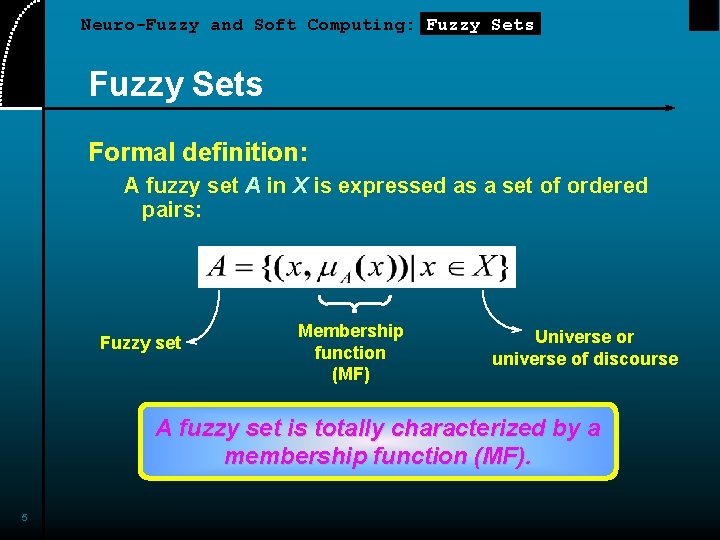
Neuro-Fuzzy and Soft Computing: Fuzzy Sets Formal definition: A fuzzy set A in X is expressed as a set of ordered pairs: Fuzzy set Membership function (MF) Universe or universe of discourse A fuzzy set is totally characterized by a membership function (MF). 5
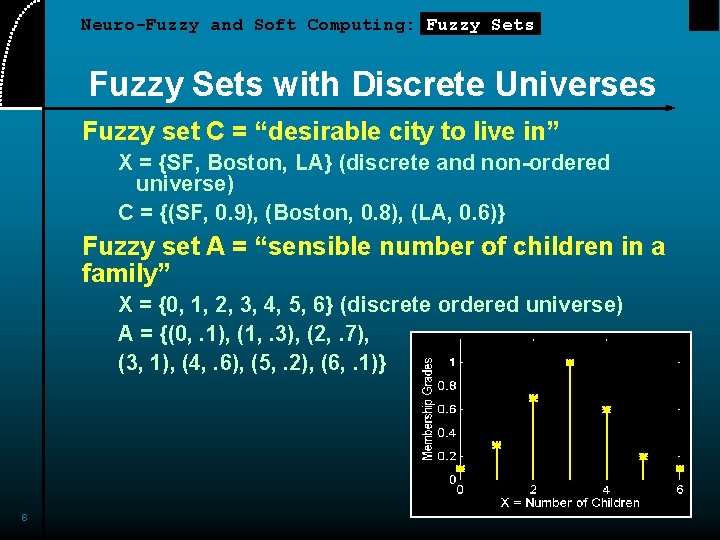
Neuro-Fuzzy and Soft Computing: Fuzzy Sets with Discrete Universes Fuzzy set C = “desirable city to live in” X = {SF, Boston, LA} (discrete and non-ordered universe) C = {(SF, 0. 9), (Boston, 0. 8), (LA, 0. 6)} Fuzzy set A = “sensible number of children in a family” X = {0, 1, 2, 3, 4, 5, 6} (discrete ordered universe) A = {(0, . 1), (1, . 3), (2, . 7), (3, 1), (4, . 6), (5, . 2), (6, . 1)} 6
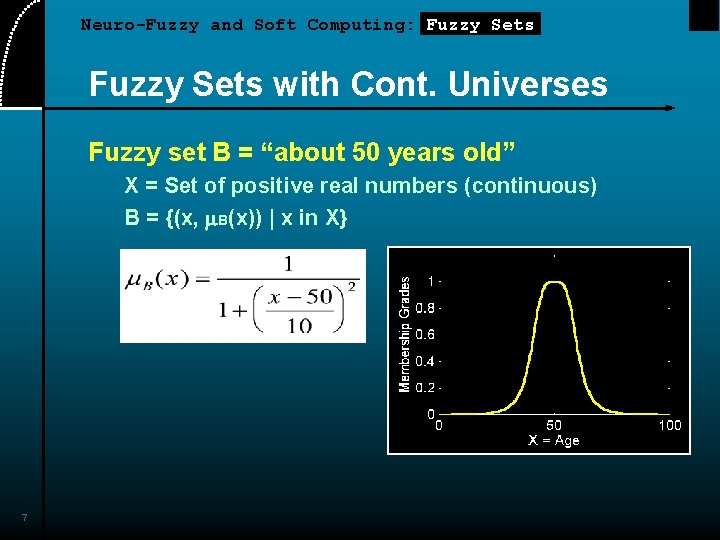
Neuro-Fuzzy and Soft Computing: Fuzzy Sets with Cont. Universes Fuzzy set B = “about 50 years old” X = Set of positive real numbers (continuous) B = {(x, m. B(x)) | x in X} 7
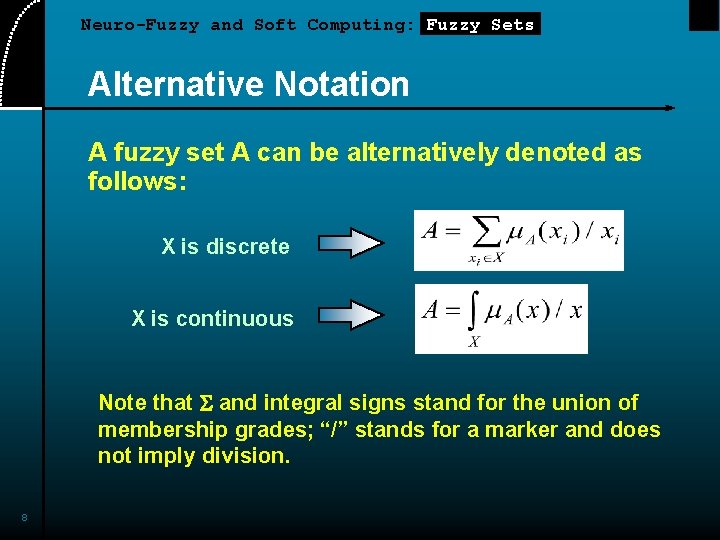
Neuro-Fuzzy and Soft Computing: Fuzzy Sets Alternative Notation A fuzzy set A can be alternatively denoted as follows: X is discrete X is continuous Note that S and integral signs stand for the union of membership grades; “/” stands for a marker and does not imply division. 8
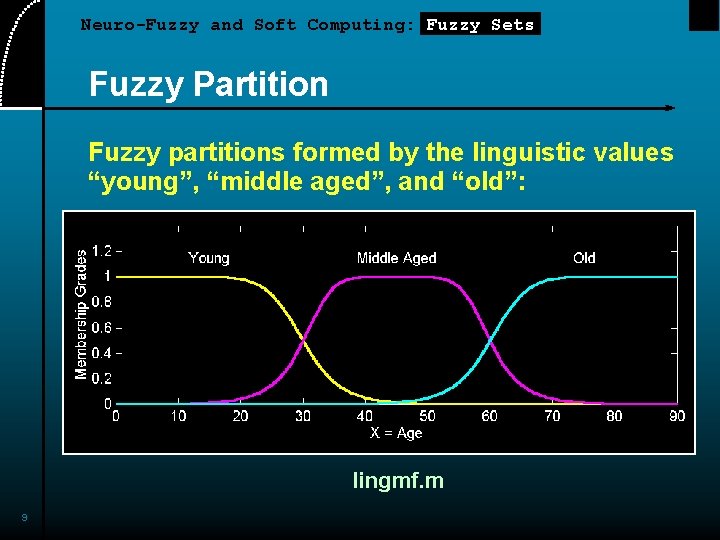
Neuro-Fuzzy and Soft Computing: Fuzzy Sets Fuzzy Partition Fuzzy partitions formed by the linguistic values “young”, “middle aged”, and “old”: lingmf. m 9
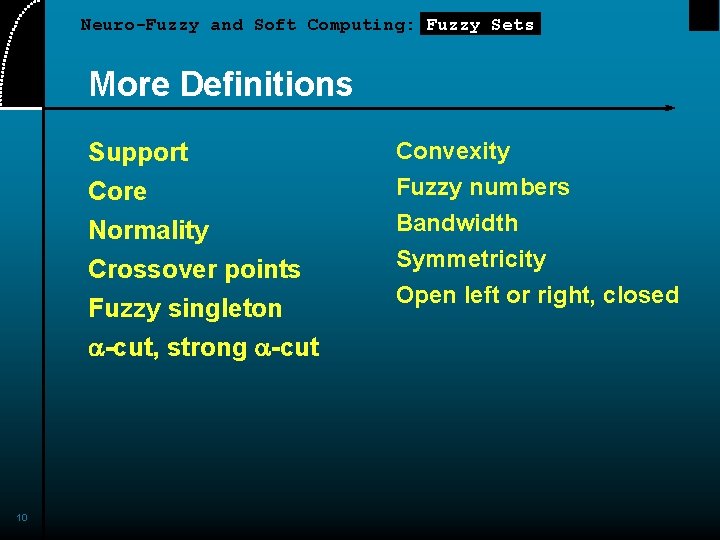
Neuro-Fuzzy and Soft Computing: Fuzzy Sets More Definitions Support Convexity Core Fuzzy numbers Bandwidth Symmetricity Open left or right, closed Normality Crossover points Fuzzy singleton a-cut, strong a-cut 10
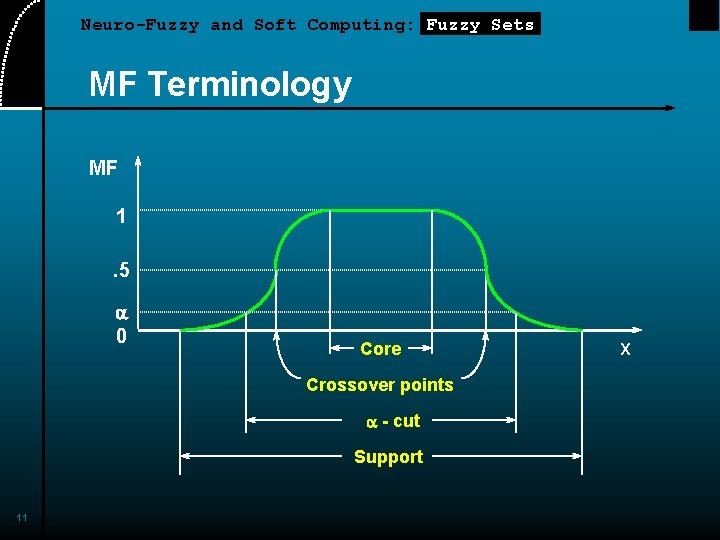
Neuro-Fuzzy and Soft Computing: Fuzzy Sets MF Terminology MF 1. 5 a 0 Core Crossover points a - cut Support 11 X
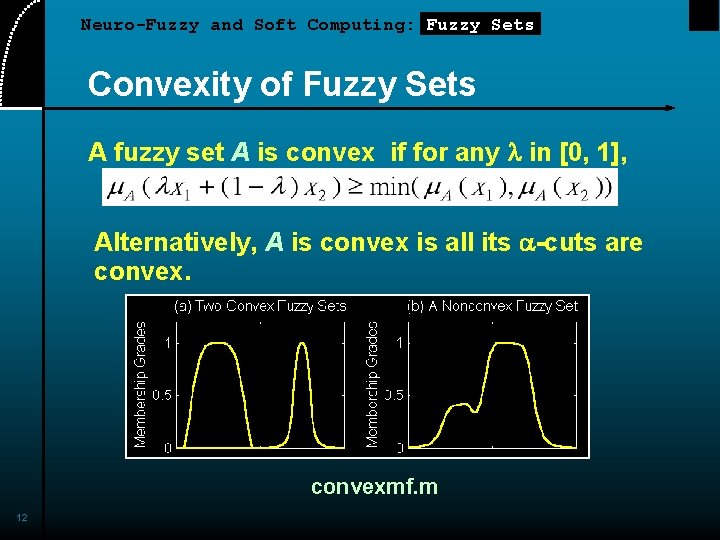
Neuro-Fuzzy and Soft Computing: Fuzzy Sets Convexity of Fuzzy Sets A fuzzy set A is convex if for any l in [0, 1], Alternatively, A is convex is all its a-cuts are convexmf. m 12
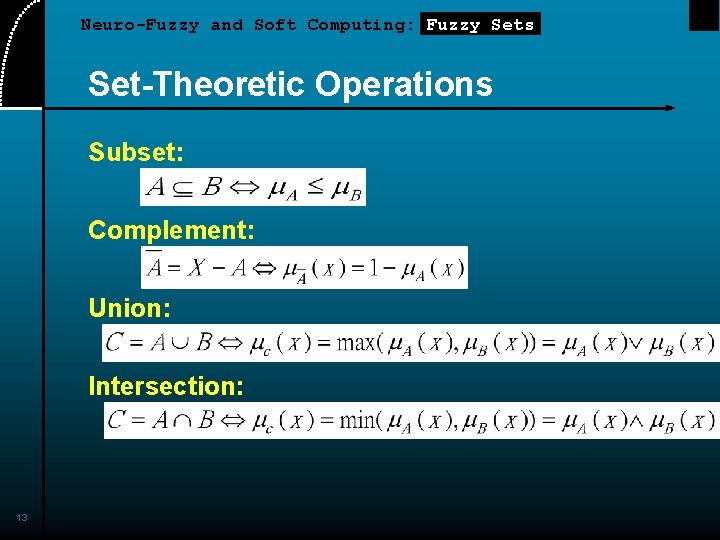
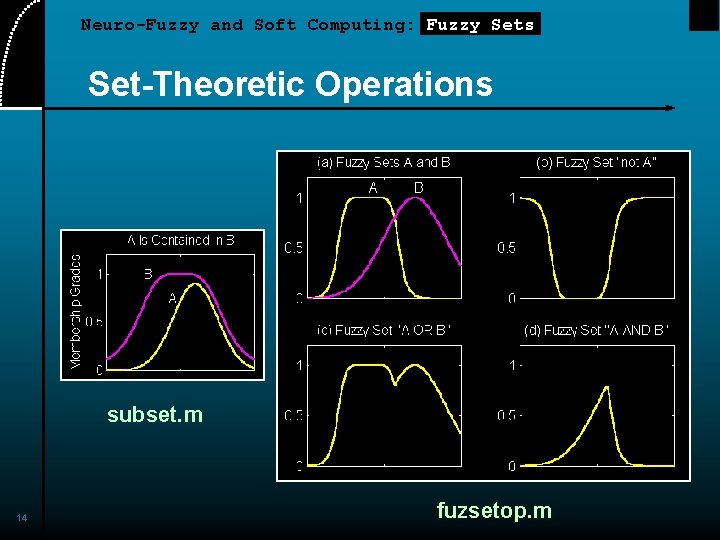
Neuro-Fuzzy and Soft Computing: Fuzzy Sets Set-Theoretic Operations Subset: Complement: Union: Intersection: 13
Neuro-Fuzzy and Soft Computing: Fuzzy Sets Set-Theoretic Operations subset. m 14 fuzsetop. m
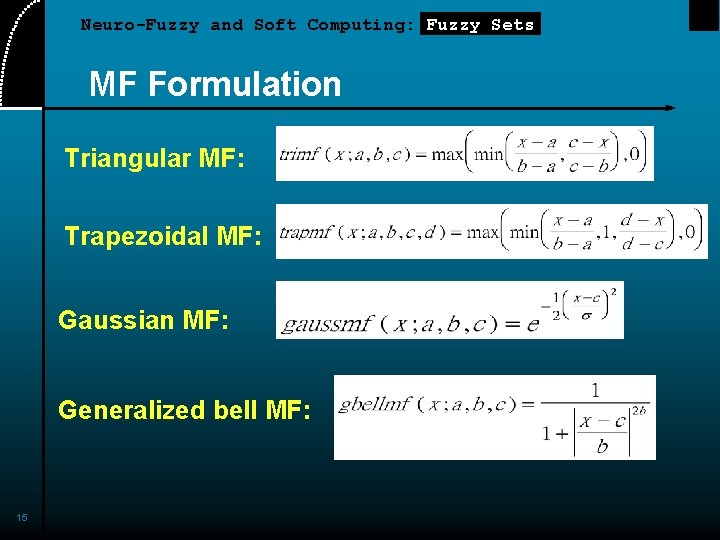
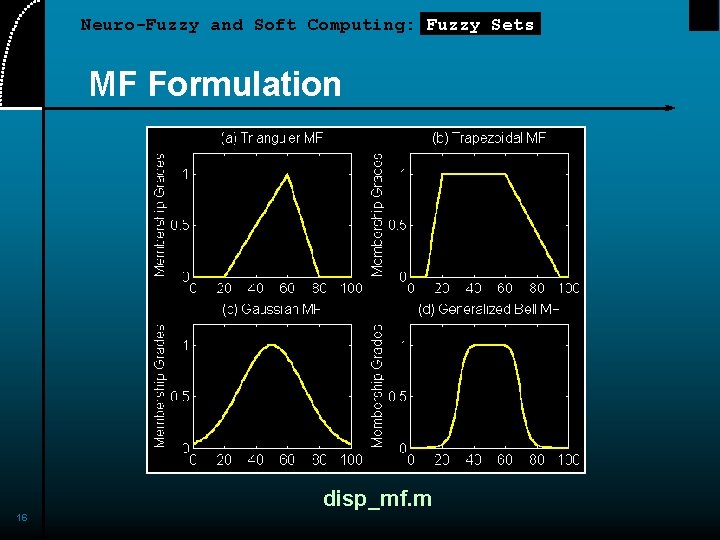
Neuro-Fuzzy and Soft Computing: Fuzzy Sets MF Formulation Triangular MF: Trapezoidal MF: Gaussian MF: Generalized bell MF: 15
Neuro-Fuzzy and Soft Computing: Fuzzy Sets MF Formulation disp_mf. m 16
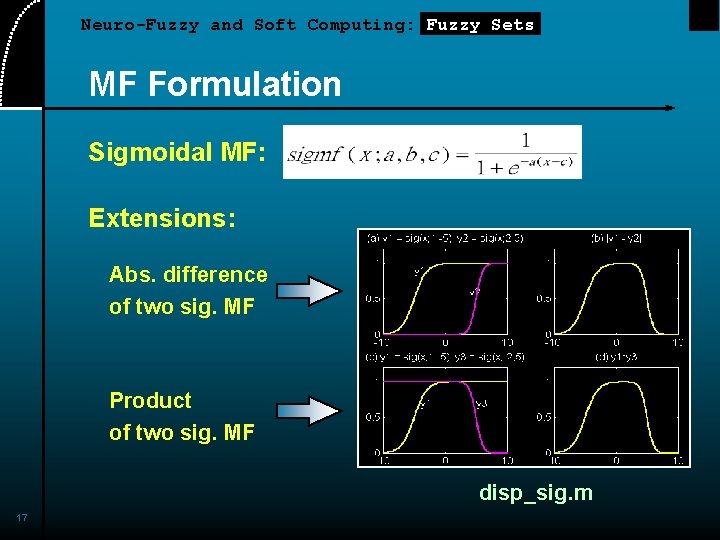
Neuro-Fuzzy and Soft Computing: Fuzzy Sets MF Formulation Sigmoidal MF: Extensions: Abs. difference of two sig. MF Product of two sig. MF disp_sig. m 17
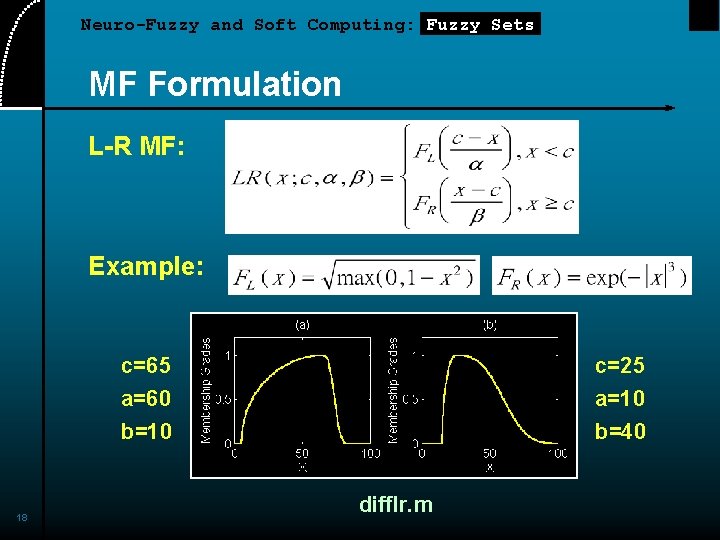
Neuro-Fuzzy and Soft Computing: Fuzzy Sets MF Formulation L-R MF: Example: 18 c=65 c=25 a=60 b=10 a=10 b=40 difflr. m
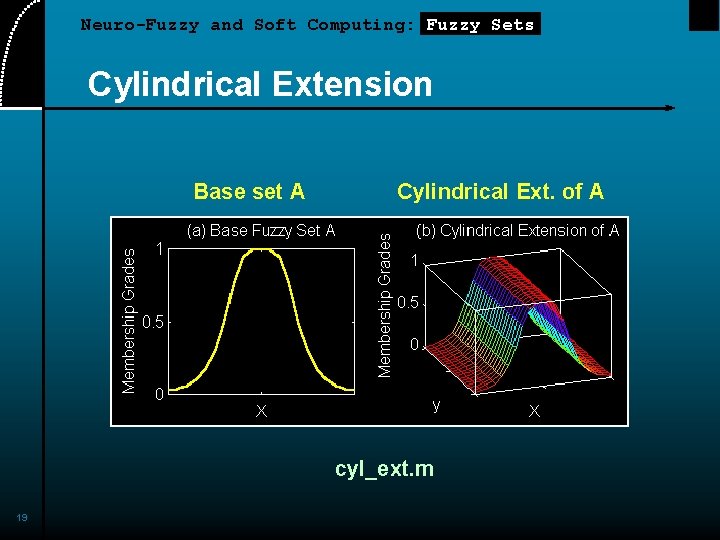
Neuro-Fuzzy and Soft Computing: Fuzzy Sets Cylindrical Extension Base set A Cylindrical Ext. of A cyl_ext. m 19
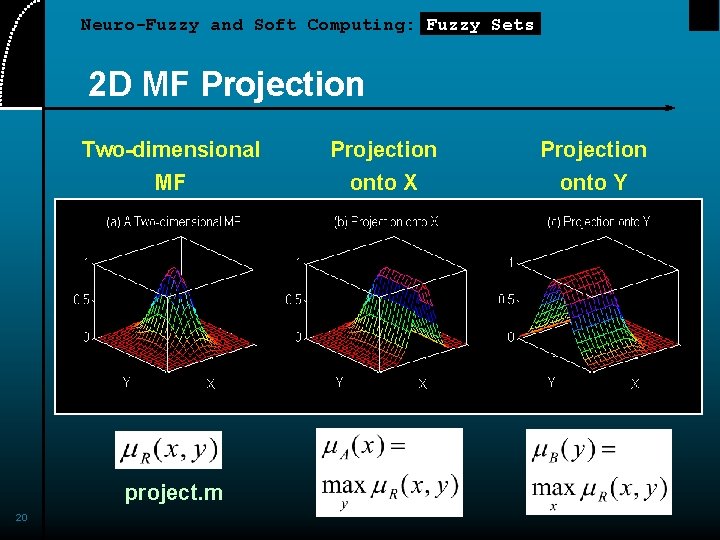
Neuro-Fuzzy and Soft Computing: Fuzzy Sets 2 D MF Projection Two-dimensional MF project. m 20 Projection onto X Projection onto Y
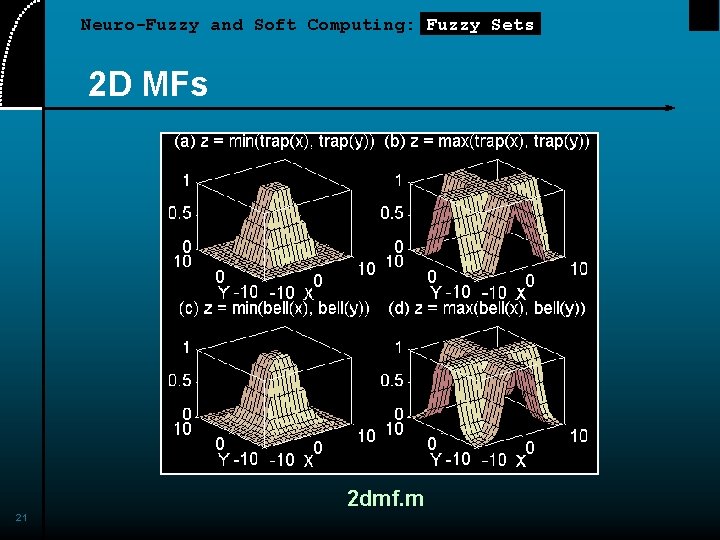
Neuro-Fuzzy and Soft Computing: Fuzzy Sets 2 D MFs 2 dmf. m 21
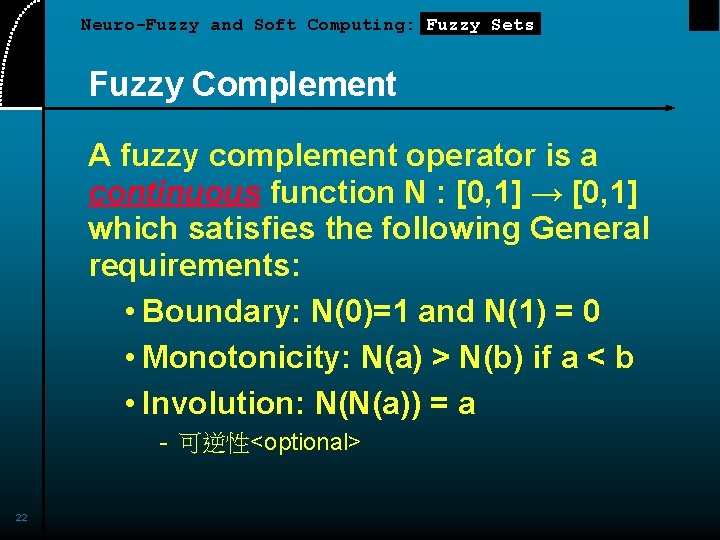
Neuro-Fuzzy and Soft Computing: Fuzzy Sets Fuzzy Complement A fuzzy complement operator is a continuous function N : [0, 1] → [0, 1] which satisfies the following General requirements: • Boundary: N(0)=1 and N(1) = 0 • Monotonicity: N(a) > N(b) if a < b • Involution: N(N(a)) = a - 可逆性<optional> 22
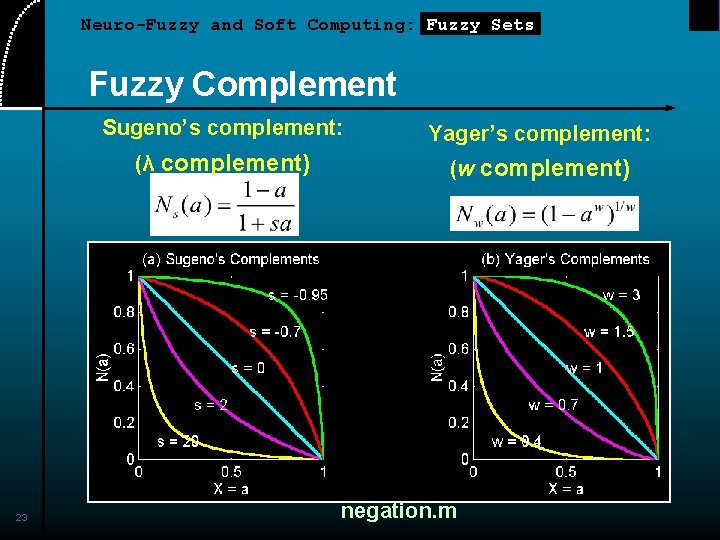
Neuro-Fuzzy and Soft Computing: Fuzzy Sets Fuzzy Complement 23 Sugeno’s complement: Yager’s complement: (λ complement) (w complement) negation. m
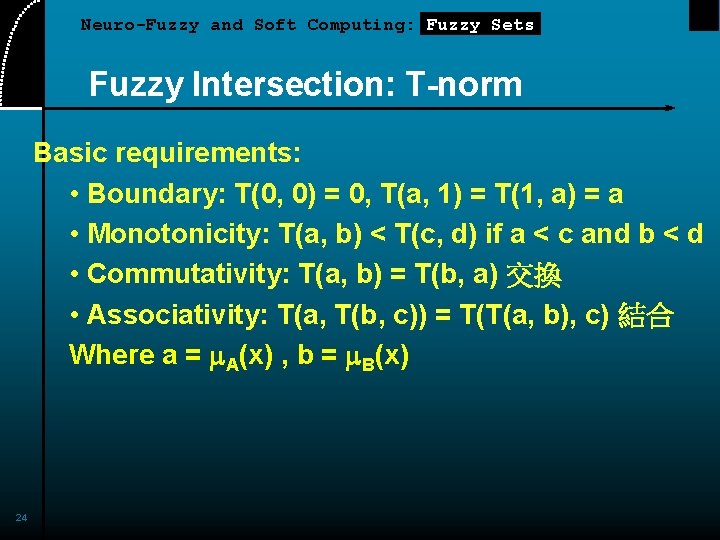
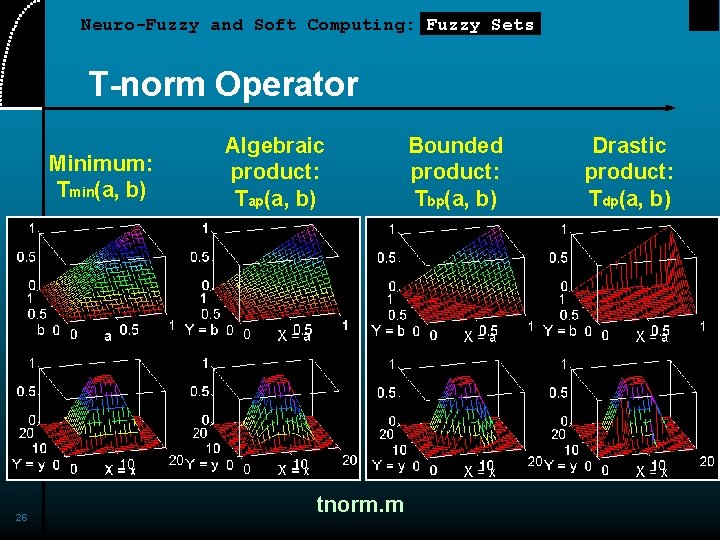
Neuro-Fuzzy and Soft Computing: Fuzzy Sets Fuzzy Intersection: T-norm Basic requirements: • Boundary: T(0, 0) = 0, T(a, 1) = T(1, a) = a • Monotonicity: T(a, b) < T(c, d) if a < c and b < d • Commutativity: T(a, b) = T(b, a) 交換 • Associativity: T(a, T(b, c)) = T(T(a, b), c) 結合 Where a = m. A(x) , b = m. B(x) 24
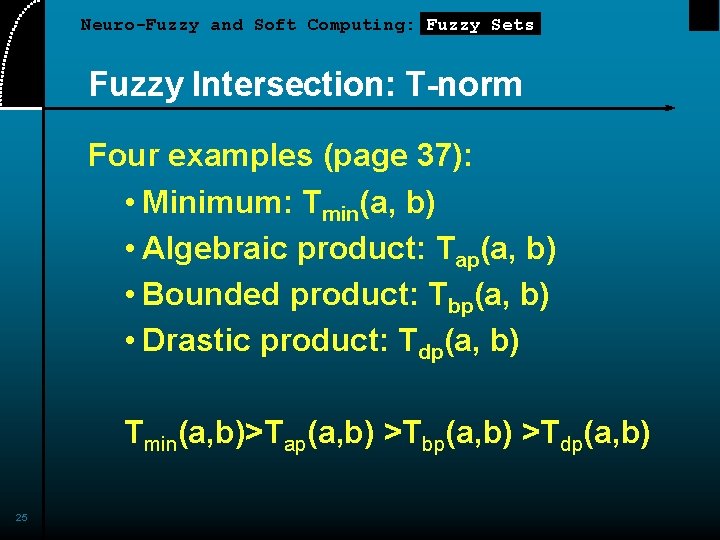
Neuro-Fuzzy and Soft Computing: Fuzzy Sets Fuzzy Intersection: T-norm Four examples (page 37): • Minimum: Tmin(a, b) • Algebraic product: Tap(a, b) • Bounded product: Tbp(a, b) • Drastic product: Tdp(a, b) Tmin(a, b)>Tap(a, b) >Tbp(a, b) >Tdp(a, b) 25
Neuro-Fuzzy and Soft Computing: Fuzzy Sets T-norm Operator Minimum: Tmin(a, b) 26 Algebraic product: Tap(a, b) tnorm. m Bounded product: Tbp(a, b) Drastic product: Tdp(a, b)
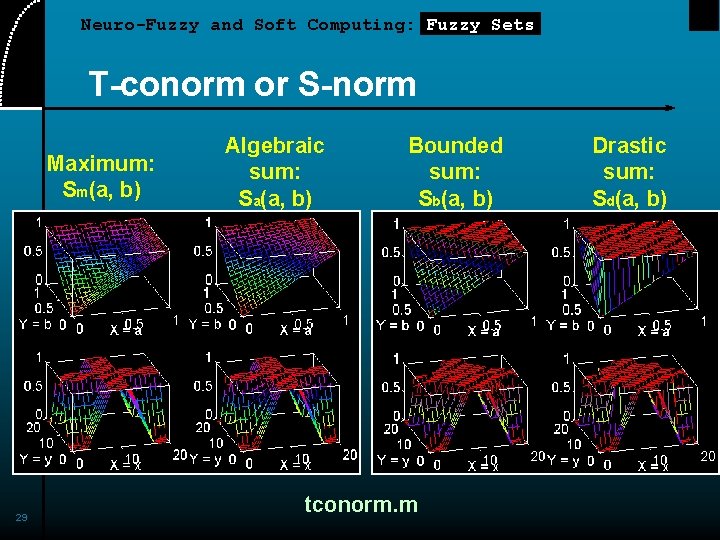
Neuro-Fuzzy and Soft Computing: Fuzzy Sets Fuzzy Union: T-conorm or S-norm Basic requirements: • Boundary: S(1, 1) = 1, S(a, 0) = S(0, a) = a - An union function should be in extreme cases • Monotonicity: S(a, b) < S(c, d) if a < c and b < d - ↑in M values in the two fuzzy set→ ↑in M values in the union • Commutativity: S(a, b) = S(b, a) - Order no influence • Associativity: S(a, S(b, c)) = S(S(a, b), c) - Extend to more than 2 fuzzy sets 27
Neuro-Fuzzy and Soft Computing: Fuzzy Sets Fuzzy Union: T-conorm or S-norm Four examples (page 38): • Maximum: Smax(a, b) • Algebraic sum: Sap(a, b) • Bounded sum: Sbp(a, b) • Drastic sum: Sdp(a, b) Smax(a, b)<Sap(a, b)<Sbp(a, b)<Sdp(a, b) 28
Neuro-Fuzzy and Soft Computing: Fuzzy Sets T-conorm or S-norm Maximum: Sm(a, b) 29 Algebraic sum: Sa(a, b) Bounded sum: Sb(a, b) tconorm. m Drastic sum: Sd(a, b)
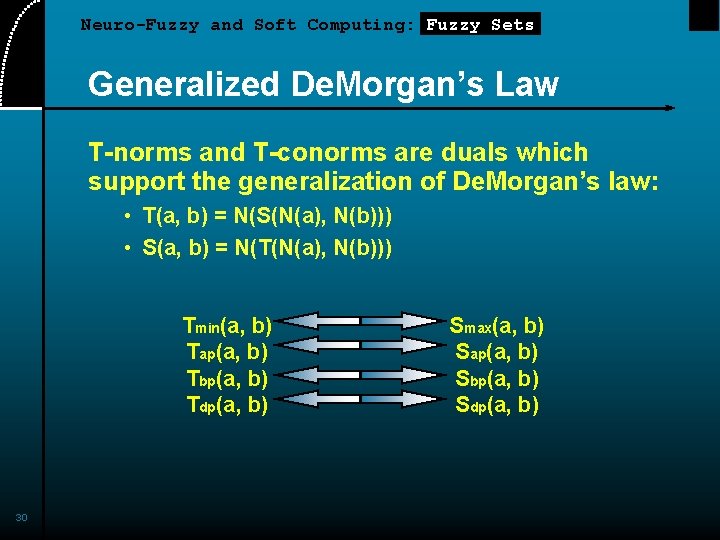
Neuro-Fuzzy and Soft Computing: Fuzzy Sets Generalized De. Morgan’s Law T-norms and T-conorms are duals which support the generalization of De. Morgan’s law: • T(a, b) = N(S(N(a), N(b))) • S(a, b) = N(T(N(a), N(b))) Tmin(a, b) Tap(a, b) Tbp(a, b) Tdp(a, b) 30 Smax(a, b) Sap(a, b) Sbp(a, b) Sdp(a, b)
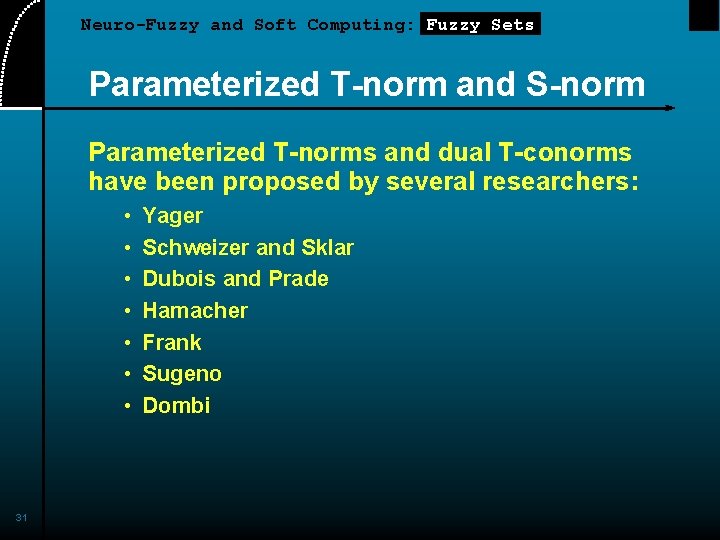
Neuro-Fuzzy and Soft Computing: Fuzzy Sets Parameterized T-norm and S-norm Parameterized T-norms and dual T-conorms have been proposed by several researchers: • • 31 Yager Schweizer and Sklar Dubois and Prade Hamacher Frank Sugeno Dombi