
NEURODIVERSITY CREATING AN INCLUSIVE COLLEGE CLASSROOM JOSH BURK
NEURODIVERSITY: CREATING AN INCLUSIVE COLLEGE CLASSROOM JOSH BURK, KARIN WULF, CHERYL DICKTER, JANICE ZEMAN
WHAT IS NEURODIVERSITY? • Neurodiversity is a philosophy that emphasizes differences in human neurologies. • Neurodiversity emphasizes that Autism and ADHD, for example, represent difference rather than deficits. • Neurodiversity invokes an emerging disability rights/ civil rights movement.
NEURODIVERSITY WWW. WM. EDU/NEURODIVERSITY • At W&M, The Neurodiversity Initiative seeks first to serve our campus community and ultimately to be a model for other campuses. • The Neurodiversity Working Group works to foster an inclusive campus culture, and organizes campus events and programs. • The Working Group also produces and supports resources for students, faculty, and staff.
WHY NEURODIVERSITY? • More students in college with learning differences, including autism. • More W&M students needing support. • We can offer effective, evidence-based support (ex. : “The Hidden Rules of Seminars. ” • It’s the right and good thing to do. (Human rights perspective) • Our community is enriched by diversity. (Maximizing human capital perspective)
WHAT IS AUTISM? • Autism is one form of neurological difference that we see on campus, although it is often combined with ADHD. • Autism Spectrum Disorders are marked by social and communication difficulties. Autistic people have more challenges interpreting implicit social communication. • Autism is also characterized by intensely focused or restricted interests and behaviors. • Autism, autistic people and autistic behaviors are often profoundly misunderstood.
STRENGTHS OF A STUDENT WITH AUTISM SPECTRUM DISORDER • “Out of the box” thinkers • Intelligent • Reliable (once expectations are understood) • Strong attention to detail • Ability to maintain prolonged focus on topics of interest • Excellent long-term and rote memory
CHALLENGES OF A STUDENT WITH AUTISM SPECTRUM DISORDER • May misread social cues or facial expressions • Social interactions/group work may be stressful • Stress-relieving activities may make others uncomfortable • Sensory perceptions can interfere with learning • Nebulous sense of time (can impact multi-tasking) • Difficulty with changes and transitions
WHAT ASD CAN LOOK LIKE IN THE CLASSROOM • Student may appear inattentive or bored • May see repetitive behaviors • Intense focus on topics of interest • May display unexpected emotion when stressed • Difficulty with organization • Difficulty with group work • Poor awareness of body space
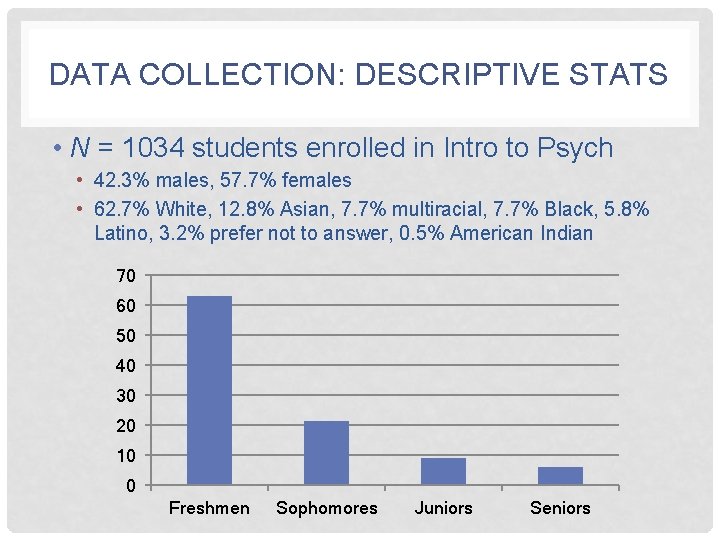
DATA COLLECTION: DESCRIPTIVE STATS • N = 1034 students enrolled in Intro to Psych • 42. 3% males, 57. 7% females • 62. 7% White, 12. 8% Asian, 7. 7% multiracial, 7. 7% Black, 5. 8% Latino, 3. 2% prefer not to answer, 0. 5% American Indian 70 60 50 40 30 20 10 0 Freshmen Sophomores Juniors Seniors
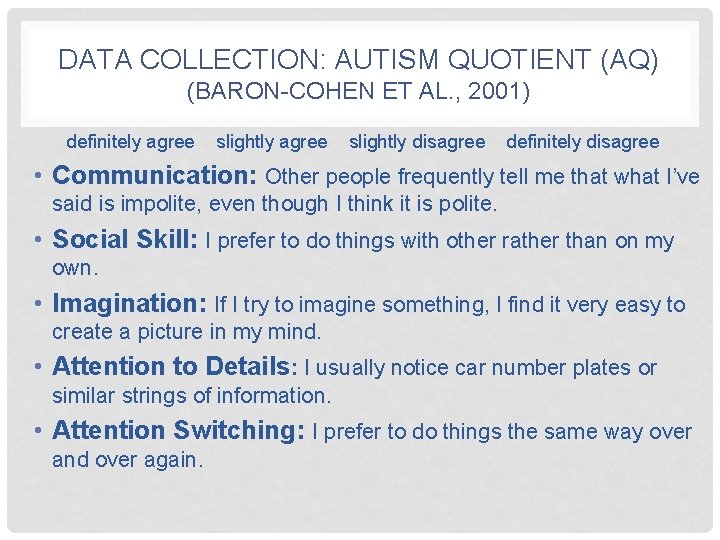
DATA COLLECTION: AUTISM QUOTIENT (AQ) (BARON-COHEN ET AL. , 2001) definitely agree slightly disagree definitely disagree • Communication: Other people frequently tell me that what I’ve said is impolite, even though I think it is polite. • Social Skill: I prefer to do things with other rather than on my own. • Imagination: If I try to imagine something, I find it very easy to create a picture in my mind. • Attention to Details: I usually notice car number plates or similar strings of information. • Attention Switching: I prefer to do things the same way over and over again.
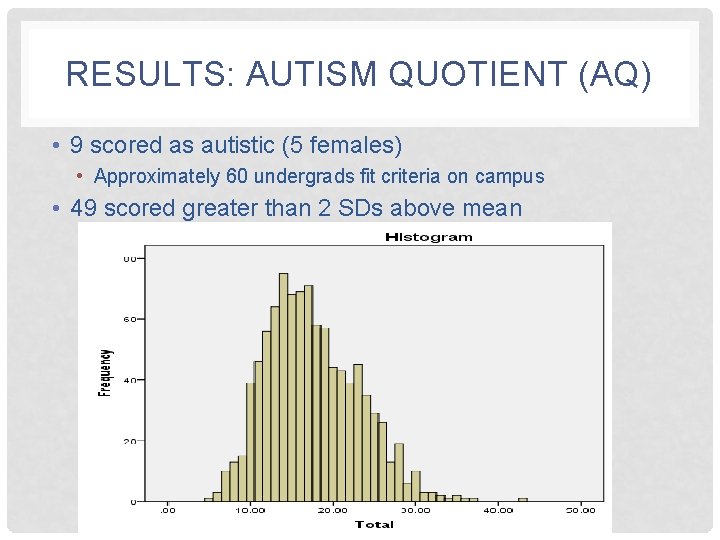
RESULTS: AUTISM QUOTIENT (AQ) • 9 scored as autistic (5 females) • Approximately 60 undergrads fit criteria on campus • 49 scored greater than 2 SDs above mean

RESULTS: AUTISM QUOTIENT (AQ) W&M Student Average National Student Average Communication Social Skill Imagination 2. 5 (1. 9) 2. 7 (1. 9) 2. 3 (1. 7) 2. 9 (2. 0) 2. 3 (2. 2) 2. 5 (1. 9) Attention to Detail 5. 3 (2. 2) Attention Switching 4. 8 (2. 0) 4. 5 (2. 0) Total AQ 17. 6 (5. 6) 17. 6 (6. 4)
DATA COLLECTION: SPECTRUM QUESTIONS • Have you been diagnosed on the autism spectrum (including Asperger’s Syndrome)? • Yes • As an autistic individual, what challenges do you face in the classroom, if any?
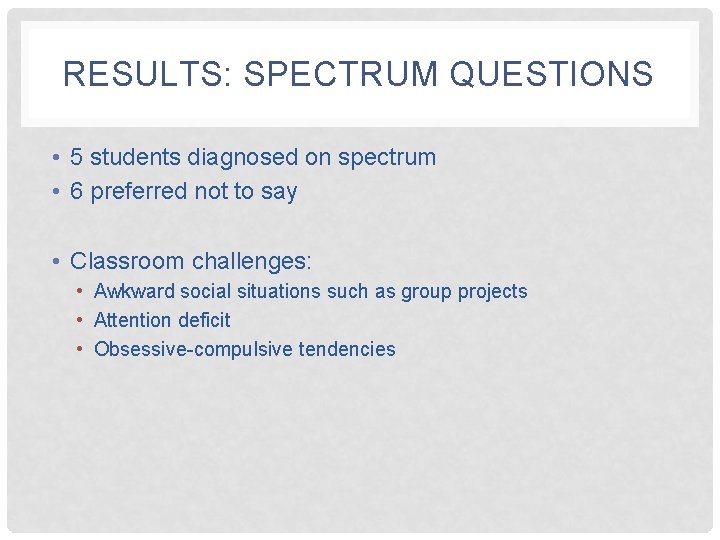
RESULTS: SPECTRUM QUESTIONS • 5 students diagnosed on spectrum • 6 preferred not to say • Classroom challenges: • Awkward social situations such as group projects • Attention deficit • Obsessive-compulsive tendencies
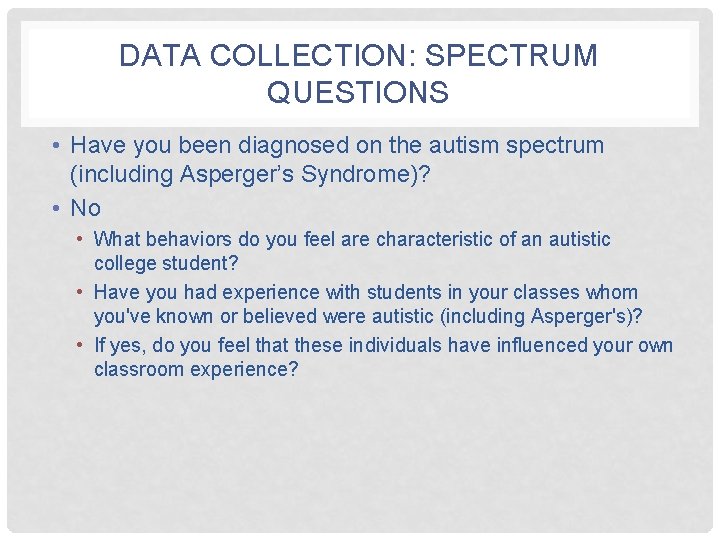
DATA COLLECTION: SPECTRUM QUESTIONS • Have you been diagnosed on the autism spectrum (including Asperger’s Syndrome)? • No • What behaviors do you feel are characteristic of an autistic college student? • Have you had experience with students in your classes whom you've known or believed were autistic (including Asperger's)? • If yes, do you feel that these individuals have influenced your own classroom experience?
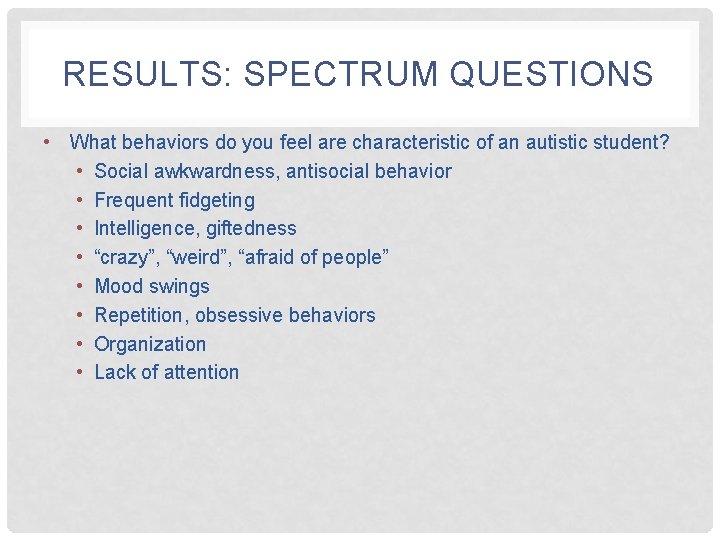
RESULTS: SPECTRUM QUESTIONS • What behaviors do you feel are characteristic of an autistic student? • Social awkwardness, antisocial behavior • Frequent fidgeting • Intelligence, giftedness • “crazy”, “weird”, “afraid of people” • Mood swings • Repetition, obsessive behaviors • Organization • Lack of attention
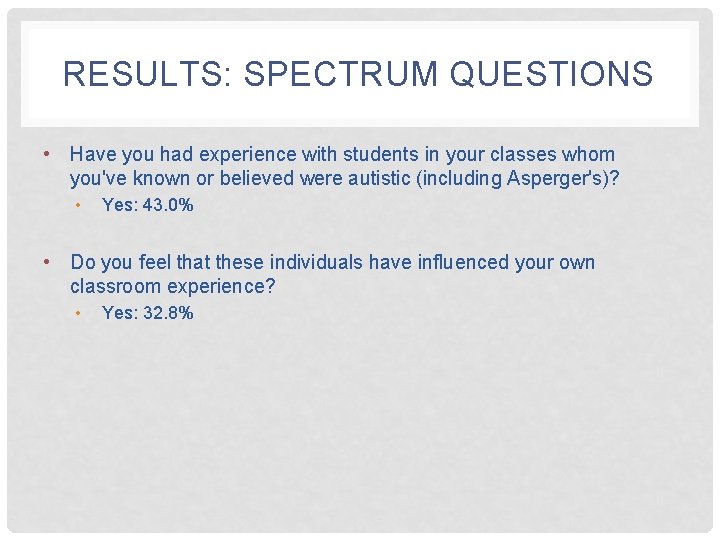
RESULTS: SPECTRUM QUESTIONS • Have you had experience with students in your classes whom you've known or believed were autistic (including Asperger's)? • Yes: 43. 0% • Do you feel that these individuals have influenced your own classroom experience? • Yes: 32. 8%
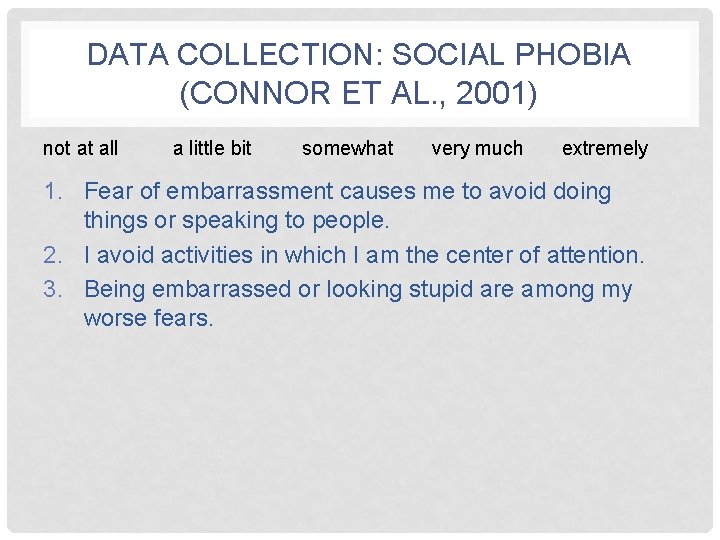
DATA COLLECTION: SOCIAL PHOBIA (CONNOR ET AL. , 2001) not at all a little bit somewhat very much extremely 1. Fear of embarrassment causes me to avoid doing things or speaking to people. 2. I avoid activities in which I am the center of attention. 3. Being embarrassed or looking stupid are among my worse fears.
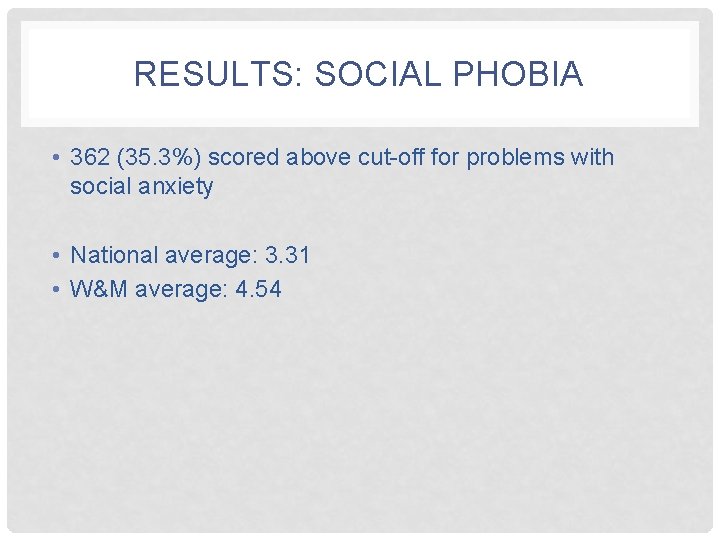
RESULTS: SOCIAL PHOBIA • 362 (35. 3%) scored above cut-off for problems with social anxiety • National average: 3. 31 • W&M average: 4. 54
PROVISOS • Spectrum means spectrum • Best practices • Best if student initiates contact
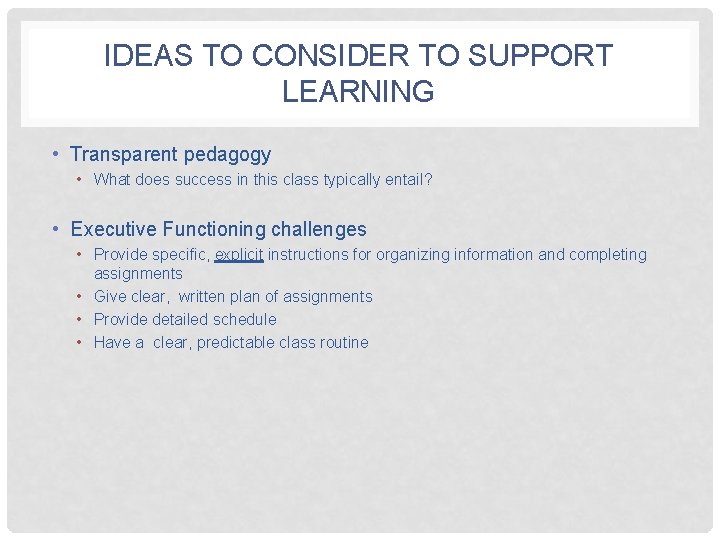
IDEAS TO CONSIDER TO SUPPORT LEARNING • Transparent pedagogy • What does success in this class typically entail? • Executive Functioning challenges • Provide specific, explicit instructions for organizing information and completing assignments • Give clear, written plan of assignments • Provide detailed schedule • Have a clear, predictable class routine
CLASSROOM SUGGESTIONS • Fine motor challenges • Provide printed or online accessible notes • Allow use of laptop or other voice-activated technology to take notes • Sensitivity to Environment • Provide quieter testing environment • Allow use of headphones to block out sounds during exam • Easing Transitions • Begin class with discussion of diversity • Allow for extra transition time • Allow for sensory or comfort items (e. g. , a fidget)
CLASSROOM SUGGESTIONS • Social situations in class • Provide explicit instructions on how to work in groups including • • • How to divide up work Being flexible when scheduling meetings How to make decisions about work load, etc. Sharing personal contact information Communicating with each other Adopting a collaborative mind set • Provide additional options for class participation such as electronic comments, coming to office hours • Directly address non-verbal and verbal inappropriate behavior that may be distracting to other students by discussing with the student
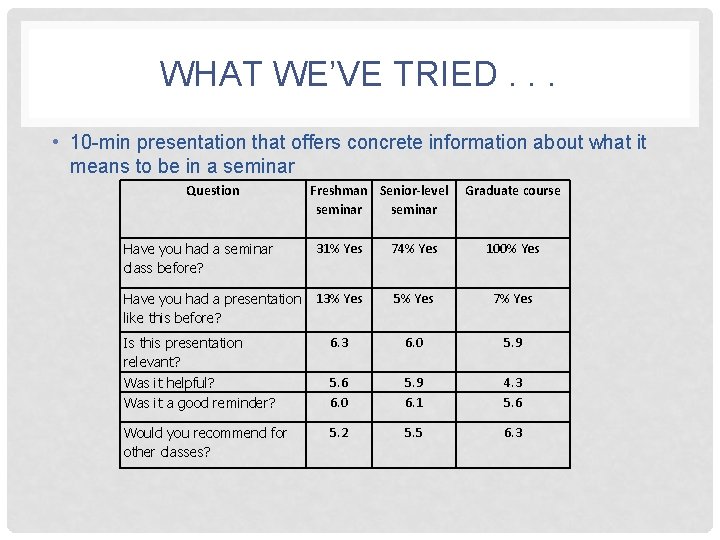
WHAT WE’VE TRIED. . . • 10 -min presentation that offers concrete information about what it means to be in a seminar Question Freshman Senior-level seminar Graduate course 31% Yes 74% Yes 100% Yes Have you had a presentation 13% Yes like this before? 5% Yes 7% Yes Have you had a seminar class before? Is this presentation relevant? Was it helpful? Was it a good reminder? 6. 3 6. 0 5. 9 5. 6 6. 0 5. 9 6. 1 4. 3 5. 6 Would you recommend for other classes? 5. 2 5. 5 6. 3
CONTACT US! • www. wm. edu/neurodiversity • neurodiversity@wm. edu
- Slides: 25