
Neurobiophysics Cable Equation Passive Membrane Action Potential Propagation
Neurobiophysics Cable Equation (Passive Membrane) Action Potential Propagation Hodgkin & Huxley Action Potential Model 1
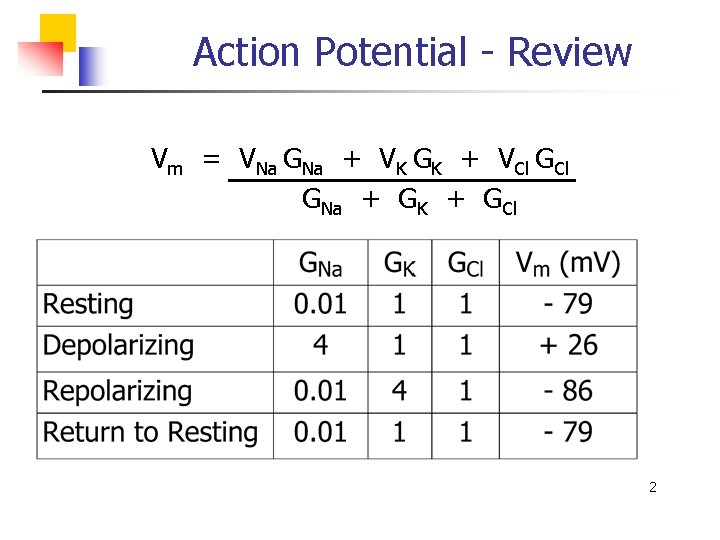
Action Potential - Review Vm = VNa GNa + VK GK + VCl GNa + GK + GCl 2
Current Paths Response to an injected step current charge Capacitor (IRm = 0) Transmembrane Ionic Flux (IRm) Along Axoplasm (DV) 3
Current Flow - Initial All current flows thru the capacitor (low resistant path to injected step current) Redistributed charges change Vm Current begins to flow thru Rm and spreads laterally, affecting adjacent membrane capacitance. At injection point, dv/dt 0, Ic = 0 Transmembrane current carried only by Rm, remainder of current spread laterally along axon. 4 (Rm relatively high resistance, axon relatively low)
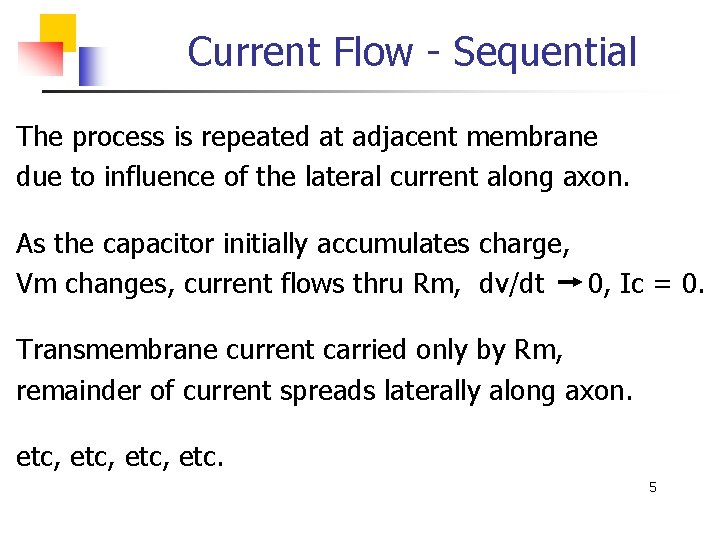
Current Flow - Sequential The process is repeated at adjacent membrane due to influence of the lateral current along axon. As the capacitor initially accumulates charge, Vm changes, current flows thru Rm, dv/dt 0, Ic = 0. Transmembrane current carried only by Rm, remainder of current spreads laterally along axon. etc, etc. 5
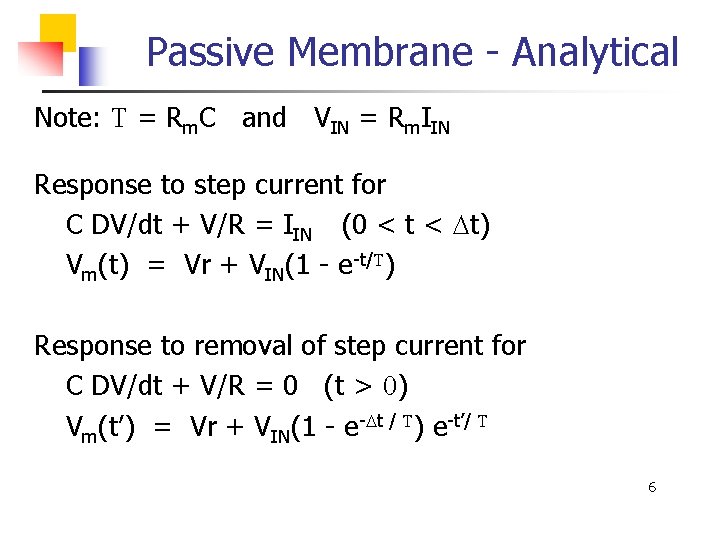
Passive Membrane - Analytical Note: T = Rm. C and VIN = Rm. IIN Response to step current for C DV/dt + V/R = IIN (0 < t < Dt) Vm(t) = Vr + VIN(1 - e-t/T) Response to removal of step current for C DV/dt + V/R = 0 (t > 0) Vm(t’) = Vr + VIN(1 - e-Dt / T) e-t’/ T 6
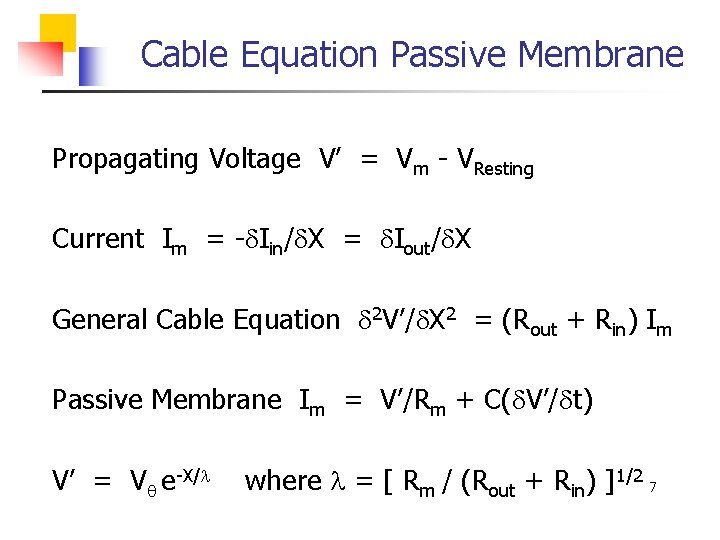
Cable Equation Passive Membrane Propagating Voltage V’ = Vm - VResting Current Im = -d. Iin/d. X = d. Iout/d. X General Cable Equation d 2 V’/d. X 2 = (Rout + Rin) Im Passive Membrane Im = V’/Rm + C(d. V’/dt) V’ = Vq e-X/l where l = [ Rm / (Rout + Rin) ]1/2 7
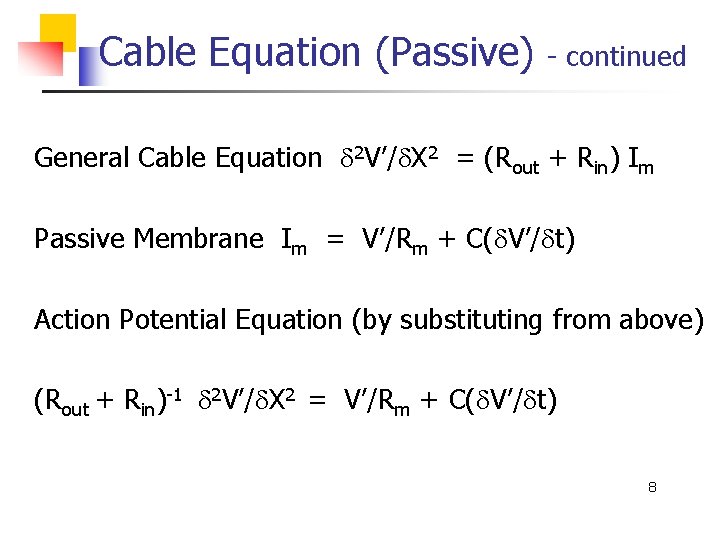
Cable Equation (Passive) - continued General Cable Equation d 2 V’/d. X 2 = (Rout + Rin) Im Passive Membrane Im = V’/Rm + C(d. V’/dt) Action Potential Equation (by substituting from above) (Rout + Rin)-1 d 2 V’/d. X 2 = V’/Rm + C(d. V’/dt) 8
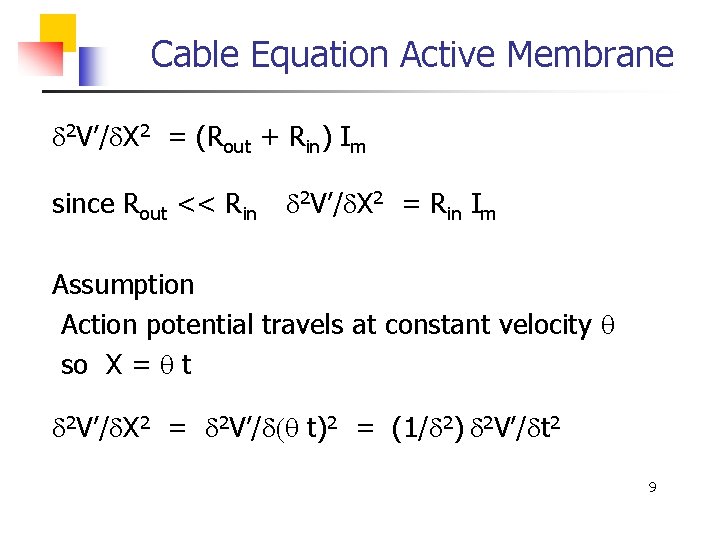
Cable Equation Active Membrane d 2 V’/d. X 2 = (Rout + Rin) Im since Rout << Rin d 2 V’/d. X 2 = Rin Im Assumption Action potential travels at constant velocity q so X = q t d 2 V’/d. X 2 = d 2 V’/d(q t)2 = (1/d 2) d 2 V’/dt 2 9
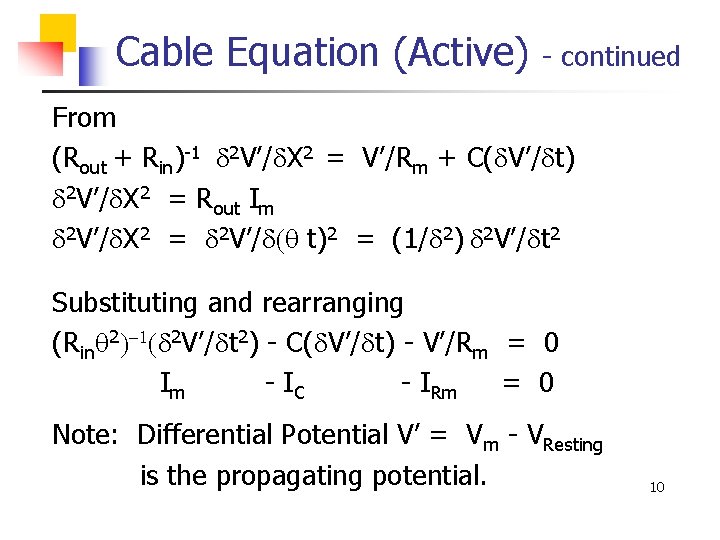
Cable Equation (Active) - continued From (Rout + Rin)-1 d 2 V’/d. X 2 = V’/Rm + C(d. V’/dt) d 2 V’/d. X 2 = Rout Im d 2 V’/d. X 2 = d 2 V’/d(q t)2 = (1/d 2) d 2 V’/dt 2 Substituting and rearranging (Rinq 2)-1(d 2 V’/dt 2) - C(d. V’/dt) - V’/Rm = 0 Im - IC - IRm = 0 Note: Differential Potential V’ = Vm - VResting is the propagating potential. 10
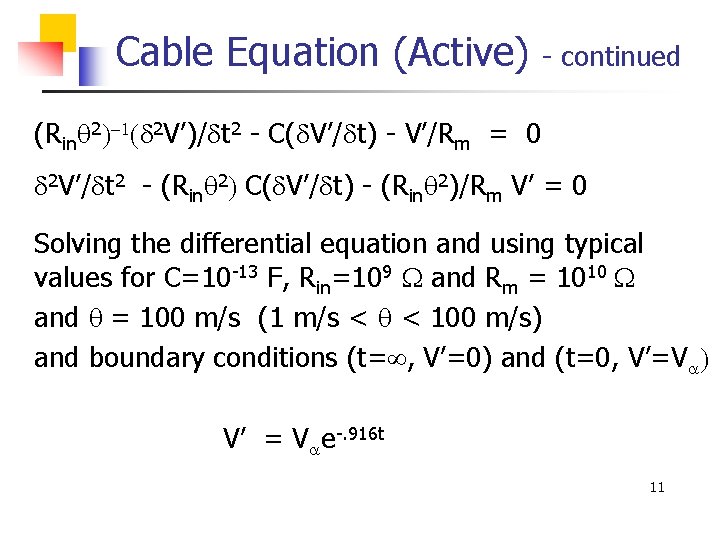
Cable Equation (Active) - continued (Rinq 2)-1(d 2 V’)/dt 2 - C(d. V’/dt) - V’/Rm = 0 d 2 V’/dt 2 - (Rinq 2) C(d. V’/dt) - (Rinq 2)/Rm V’ = 0 Solving the differential equation and using typical values for C=10 -13 F, Rin=109 W and Rm = 1010 W and q = 100 m/s (1 m/s < q < 100 m/s) and boundary conditions (t=¥, V’=0) and (t=0, V’=Va) V’ = Vae-. 916 t 11
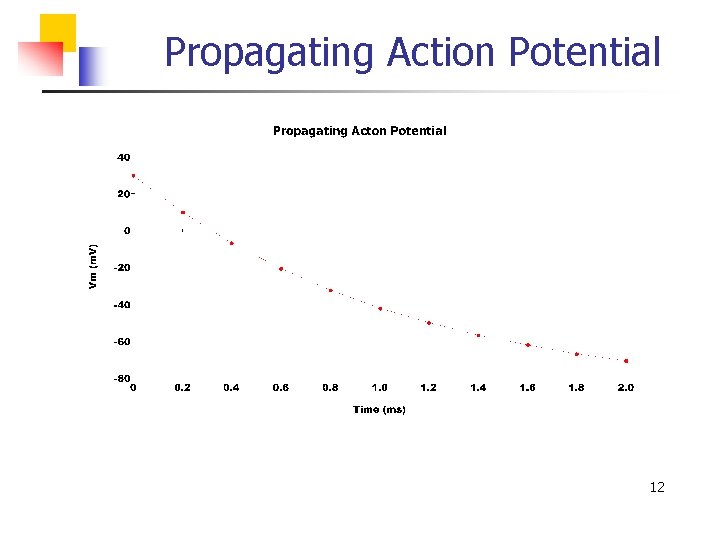
Propagating Action Potential 12
Action Potential If a stimulus exceeds threshold voltage, then a characteristic non-linear response occurs. An voltage waveform the so called electrogenic “Action Potential” is generated due to a change in the membrane permeability to sodium and potassium ions. The action potential is propagated undiminished and wit constant velocity along the nerve axon. 13
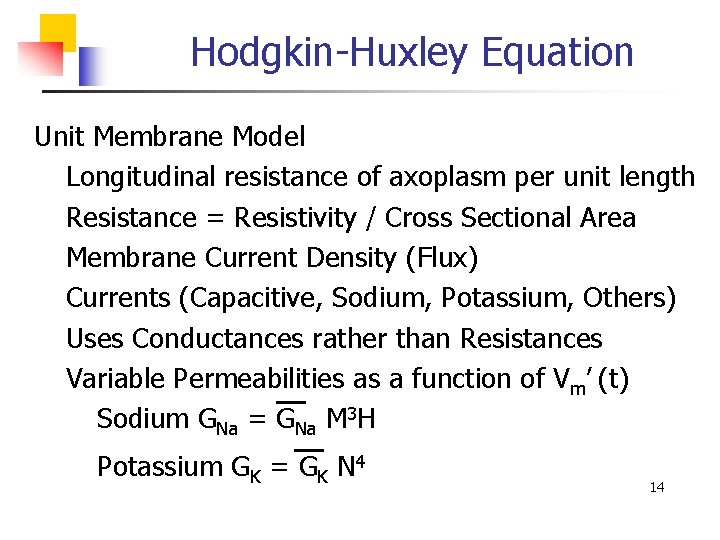
Hodgkin-Huxley Equation Unit Membrane Model Longitudinal resistance of axoplasm per unit length Resistance = Resistivity / Cross Sectional Area Membrane Current Density (Flux) Currents (Capacitive, Sodium, Potassium, Others) Uses Conductances rather than Resistances Variable Permeabilities as a function of Vm’ (t) Sodium GNa = GNa M 3 H Potassium GK = GK N 4 14
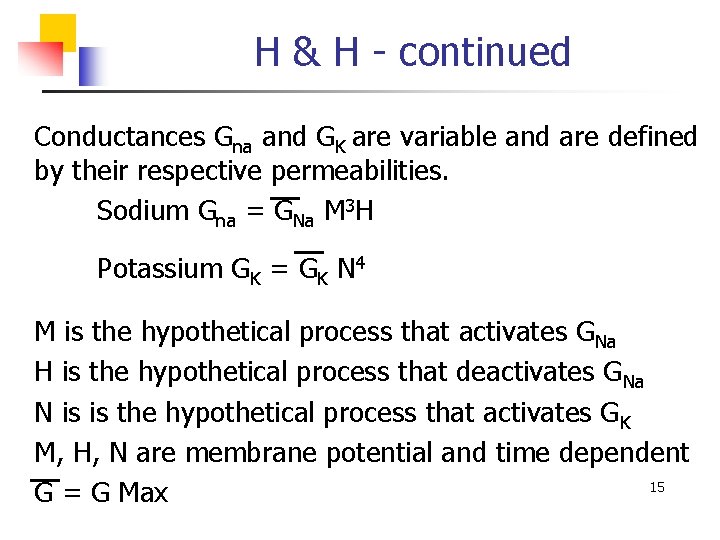
H & H - continued Conductances Gna and GK are variable and are defined by their respective permeabilities. Sodium Gna = GNa M 3 H Potassium GK = GK N 4 M is the hypothetical process that activates GNa H is the hypothetical process that deactivates GNa N is is the hypothetical process that activates GK M, H, N are membrane potential and time dependent 15 G = G Max
H & H - Concluding Remarks The Hodgkin-Huxley Model was first developed in the 1940’s and published in the 1950’s. It does not explain how or why the membrane permeabilities change, but it does model the shape and speed of the action potential quite faithfully. Empirical values were developed for the GNa, GK, GL as well as the hypothetical permeability relationships for M, H, N using the giant squid axon. 16
- Slides: 16