
Neurobiology of Learning and Memory Prof Stephan Anagnostaras
Neurobiology of Learning and Memory � Prof. Stephan Anagnostaras Lecture 3: HM, the medial temporal lobe, and amnesia
Serial model � Memory terminology based on information processing models e. g. , Serial Model Can test these models in brain damaged subjects
Amnesia � Amnesia Partial or total loss of memory, usually resulting from shock, psychological disturbance, brain injury, or illness. Organic caused by shock, brain injury, illness • hypoxic episode, herpes encephalitis • epilepsy, brain injury, Alzheimer’s disease Psychogenic caused by psychological trauma • dissociative disorders • psychogenic fugue • multiple personality disorder
Amnesia � Amnesia can be global or material-specific Global any kind of information is affected Material-specific certain kinds of material (e. g. , faces) Amnesia can be anterograde or retrograde Anterograde amnesia inability to learn anything new since the time of the trauma (usually organic) Retrograde amnesia loss of memory for events prior to the time of the trauma (psychogenic or organic)
HM � Most famous case reported by Scoville & Milner (1957) Scoville did the surgeries for psychosis but didn’t work, so tried it for epilepsy on about 30 patients. Patients studied by Brenda Milner HM: bilateral medial temporal lobe lesion for status epilepticus in 1953
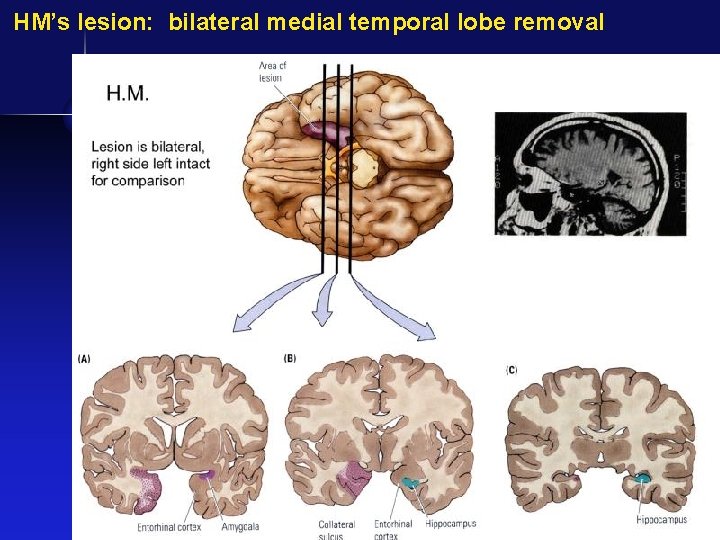
HM’s lesion: bilateral medial temporal lobe removal �
HM = no hippocampus, amygdala, overlying (rhinal) cortex � normal hpc HM = no hpc, no rhinal ctx
HM = no hippocampus, amygdala, overlying (rhinal) cortex �
HM’s amnesic syndrome � Severe deficit (global anterograde amnesia) • show word or face, ask later, doesn’t know • reads newspapers repeatedly • doesn’t remember own physician • see on formal tests or everyday life • word lists • faces and objects • recall or recognition Only mild retrograde amnesia • loss of memories that are a up to 2 -3 years old at the time of the lesion, but childhood memories in tact • known as a time-limited or temporally-graded retrograde amnesia
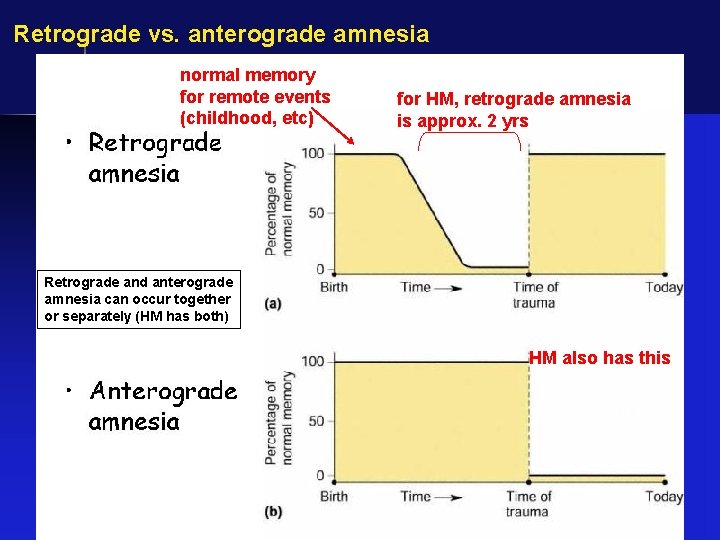
Retrograde vs. anterograde amnesia normal memory for remote events (childhood, etc) for HM, retrograde amnesia is approx. 2 yrs � Retrograde and anterograde amnesia can occur together or separately (HM has both) HM also has this
Remote versus Recent Memory: HM, Loss of Recent memory �
Medial temporal lobe amnesia: what’s special? � Deficit very specific for Long-Term Memory (LTM) • not dementia • IQ normal and unchanged • perceptual skills excellent • social skills and personality intact • Short-Term Memory (STM = 3 min, 7± 2 items) good (e. g. , digit span) • forgetting curve for STM normal • Memory scale more than 3 std dev from controls!
Rey-Osterrieth Figure �
Rey-Osterrieth Figure �
Famous Faces test of explicit memory and retrograde amnesia NF = non-famous (control) �
Retrograde amnesia often shows a gradient: memory for older events (1950’s) is better than memory for newer events (1980’s) � Amnesics worse than controls Damage to hpc = Memory that was still in hpc “buffer”got lost before it could be consolidated into permanent memory elsewhere in the brain
Spared learning � Learns some things normally: • visual motor pursuit • priming • mirror drawing task • normal eyeblink classical conditioning (e. g. , puff of air/tone on eye but not fear) • but doesn’t ever remember doing task before (source amnesia) These tasks do not necessarily share anything in common.
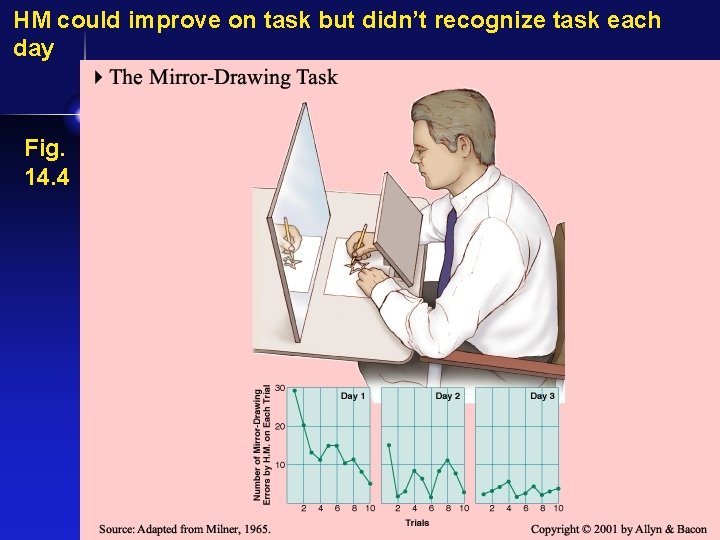
HM could improve on task but didn’t recognize task each day � Fig. 14. 4
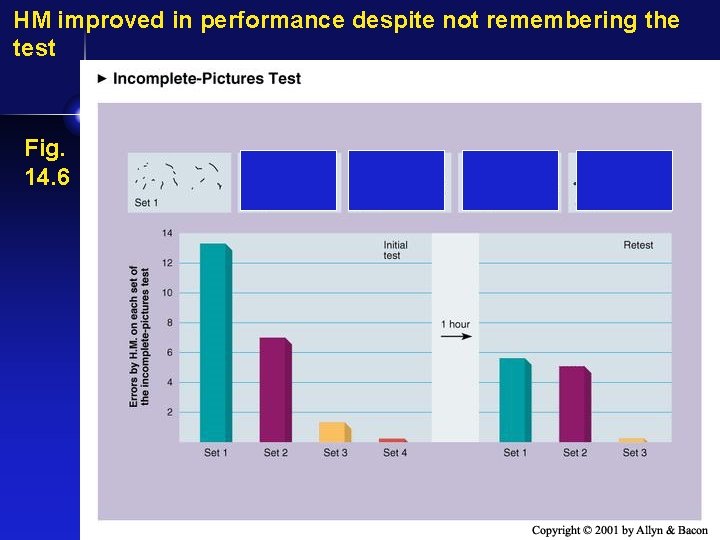
HM improved in performance despite not remembering the test � Fig. 14. 6
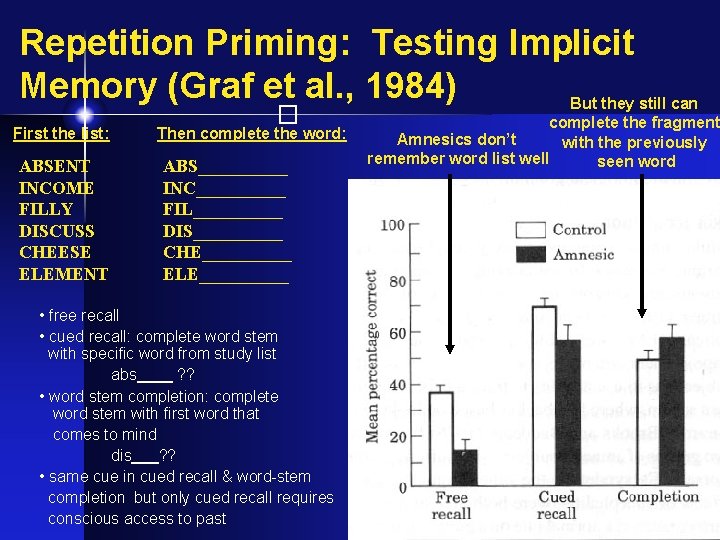
Repetition Priming: Testing Implicit Memory (Graf et al. , 1984) But they still can ABSENT INCOME FILLY DISCUSS CHEESE ELEMENT � First the list: Then complete the word: ABS_____ INC_____ FIL_____ DIS_____ CHE_____ ELE_____ • free recall • cued recall: complete word stem with specific word from study list abs____ ? ? • word stem completion: complete word stem with first word that comes to mind dis___? ? • same cue in cued recall & word-stem completion but only cued recall requires conscious access to past complete the fragment Amnesics don’t with the previously remember word list well seen word
Mirror Reading �
� Some spatial memory
Explicit versus Implicit Memory � Memory impacted by the lesion termed explicit (or declarative) memory - must be stated verbally and requires conscious recollection (note: doesn’t work for animals) -includes semantic (facts, knowledge) and episodic (events, memory) memory Not disrupted: implicit memory (procedural or nondeclarative) - learning is demonstrated through performance and may not be available to verbal recollection (e. g. , tying your shoelaces) Note that implicit memory is a junk term that includes several different forms of memory, including most forms of classical conditioning
Neuroanatomy � • The hippocampus is the critical structure for explicit memory Patient RB: damage only to CA 1 • Disruption of hippocampal-circuitry can give a similar deficit (dorsomedial thamalus) • The greater the disruption to surrounding cortex the more severe the amnesia • Anterograde and retrograde amnesia usually correlated (HM is an exception)
More selective brain damage can produce explicit memory problems (amnesia), also � Korsakoff’s amnesia: damage to MD thalamus (diencephalon area of brain) Pt R. B. : damage to CA 1 area of hpc (very selective) Zola-Morgan, Squire, & Amaral, 1986 medial diencephalic amnesia (Korsakoff’s and Pt N. A. )
RB’s brain �
Herpes encephalitis � Normal Herpes Simplex Encephalitis Reed & Squire (1998)
Alzheimer’s disease: plaques & tangles in memory areas � • severe and more general memory loss (explicit + verbal implicit, e. g. , priming) • affects entorhinal ctx (1), then hpc (2), frontal (3), parietal (3) lobes
Other forms of amnesia � Unilateral hippocampal damage results in material-specific deficits left = words, names, etc. right = faces, objects, etc. Korsakoff’s psychosis results in similar amnesia plus confabulation Frontal lobes STM, working memory, temporal order, confabulation Electroconvulsive Therapy (ECT, ECS)
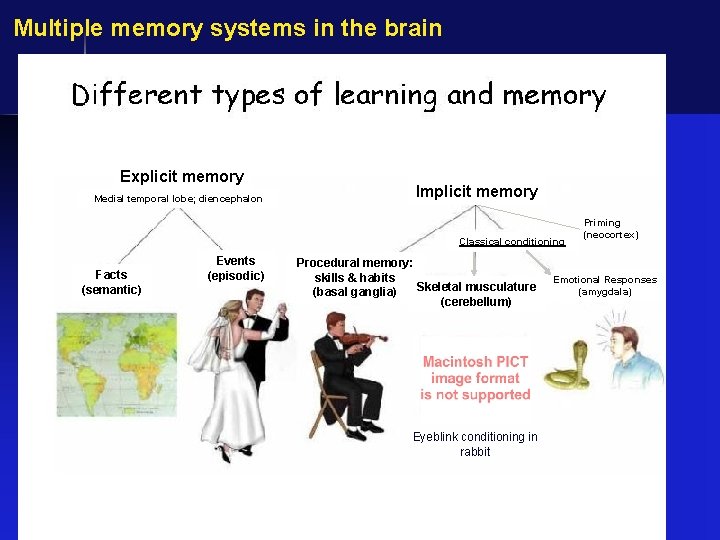
Multiple memory systems in the brain � Explicit memory Medial temporal lobe; diencephalon Implicit memory Classical conditioning Facts (semantic) Events (episodic) Procedural memory: skills & habits Skeletal musculature (basal ganglia) (cerebellum) Eyeblink conditioning in rabbit Priming (neocortex) Emotional Responses (amygdala)
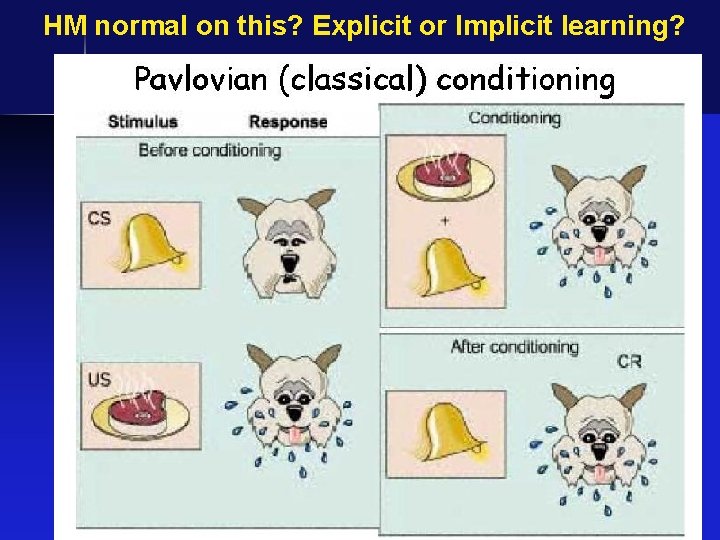
HM normal on this? Explicit or Implicit learning? �
Classical (Pavlovian) conditioning and memory � There are many different forms of classical conditioning and the responsible brain structure depends on the form Examples: a) Pavlovian fear conditioning: Tone --> Shock Then: Tone --> freeze (CS) (US) (CR) • Depends on the amygdala • + the hippocampus with trace procedure • + the hippocampus if the CS is a context b) Eyeblink conditioning Tone --> puff of air to eye Then: Tone --> eyeblink (CS) (US) (CR) c) • Depends on cerebellum d) • + hippocampus with trace procedure • Declarative knowledge of task always depends on hippocampus
- Slides: 32