
NEUROBIOLOGY AND BEHAVIOR E 1 Stimulus and response
NEUROBIOLOGY AND BEHAVIOR E. 1 Stimulus and response E. 1. 1 Define the terms stimulus, response and reflex in the context of animal behavior • A stimulus is a change in the environment (internal or external) that is detected by a receptor and elicits a response (the reaction to the stimulation) • A reflex is a rapid, unconscious response • Behavior is the response of animals to the stimuli they receive • Animals respond to stimuli in order to survive and maintain the organism’s state of homeostasis

• Many animals deal with environmental variations by moving from one habitat region to another or by avoiding areas that are unsuitable • Examples: - Lizards will move from one habitat to another with variations in temperature - Spadefoot toads that live in the deserts of N. America burrow as much as a meter below the surface and remain there, metabolic rates reduced and living on fat reserves, until moist cool air returns and they emerge to breed

Spadefoot toad burrowing
E. 1. 2 Explain the role of receptors, sensory neurons, motor neurons, synapses, and effectors in the response of animals to stimuli. • Homeostasis depends on the ability of the nervous system to detect, interpret, and respond to, internal and external conditions • Sensory receptors relay information about the environment to the CNS where it is interpreted and responses are coordinated • The information is transmitted along neurons as electrical impulses
• Sensory (afferent) neurons transmit impulses from sensory receptors to the CNS • Motor (efferent) neurons carry impulses or “commands” from the CNS to muscles or glands (effectors) • The synapse is an intercellular junction where the transmitting neuron’s axonal branches communicate via neurotransmitters with another neuron or an effector • The effector is generally a muscle or a gland that changes the conditions in response to the impulse ( in other words, it responds)
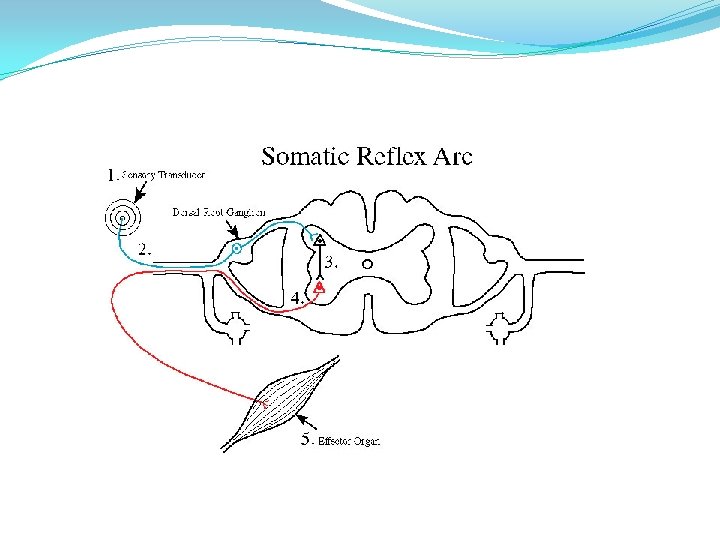
E. 1. 3 Draw and label a diagram of a reflex arc for a pain withdrawal reflex, including the spinal cord and its spinal nerves, the receptor cell, sensory neuron, relay neuron, motor neuron, and effector • The flexor, or withdrawal reflex, is initiated by a painful stimulus (actual or perceived) • It causes an automatic withdrawal of the threatened body part from the stimulus • Examples include the response that occurs when you prick or burn your finger, or the trunk flexion that occurs when someone pretends to “throw a punch” at your abdomen • See example below
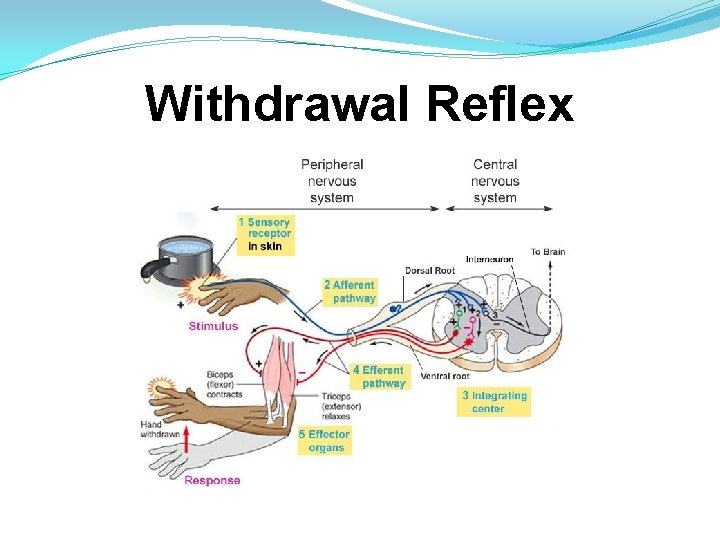
Withdrawal Reflex
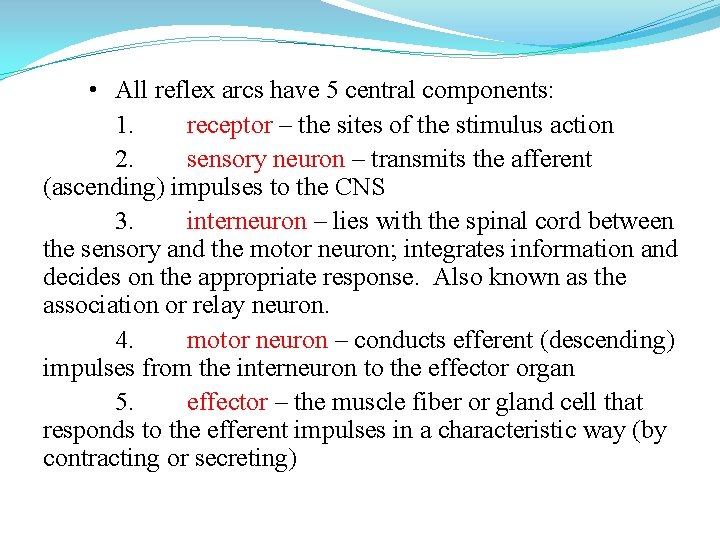
• All reflex arcs have 5 central components: 1. receptor – the sites of the stimulus action 2. sensory neuron – transmits the afferent (ascending) impulses to the CNS 3. interneuron – lies with the spinal cord between the sensory and the motor neuron; integrates information and decides on the appropriate response. Also known as the association or relay neuron. 4. motor neuron – conducts efferent (descending) impulses from the interneuron to the effector organ 5. effector – the muscle fiber or gland cell that responds to the efferent impulses in a characteristic way (by contracting or secreting)
E. 1. 4 Explain how animal responses can be affected by natural selection using two examples • Innate behavior patterns (instincts) are inherited and are stereotyped responses to environmental stimuli (appearing the same way in different individuals of a species) • The behavior patterns are adaptive and suit the organism to its environment • Possessing a certain gene makes it more likely that a specific behavior pattern will develop, thus reflecting the role of natural selection • See pg. 1122; Evolutionary forces shape behavior
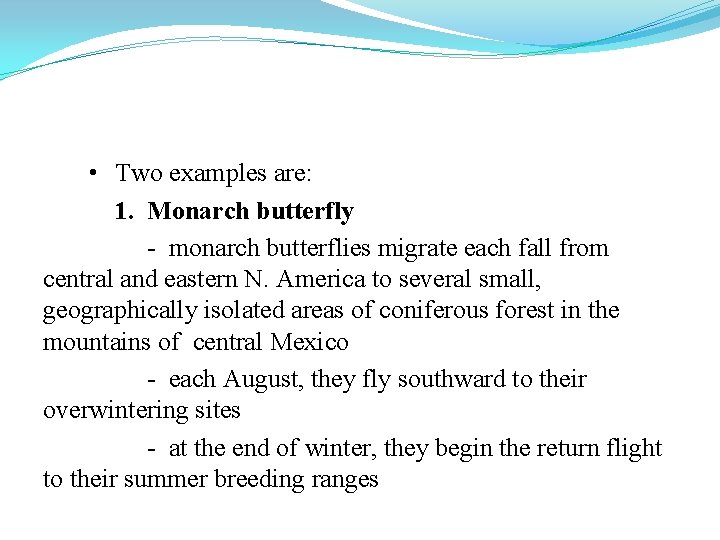
• Two examples are: 1. Monarch butterfly - monarch butterflies migrate each fall from central and eastern N. America to several small, geographically isolated areas of coniferous forest in the mountains of central Mexico - each August, they fly southward to their overwintering sites - at the end of winter, they begin the return flight to their summer breeding ranges

- 2 -5 generations may be produced as they fly north; yet, they migrate in the autumn to the precisely located overwintering grounds in Mexico where they have never been before - See handout (there are many other sites on the web where you can get information on this organism); use them!
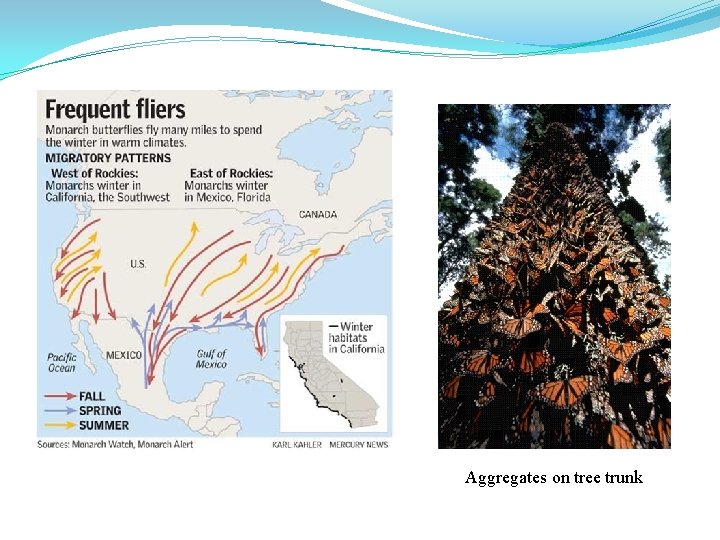
Aggregates on tree trunk
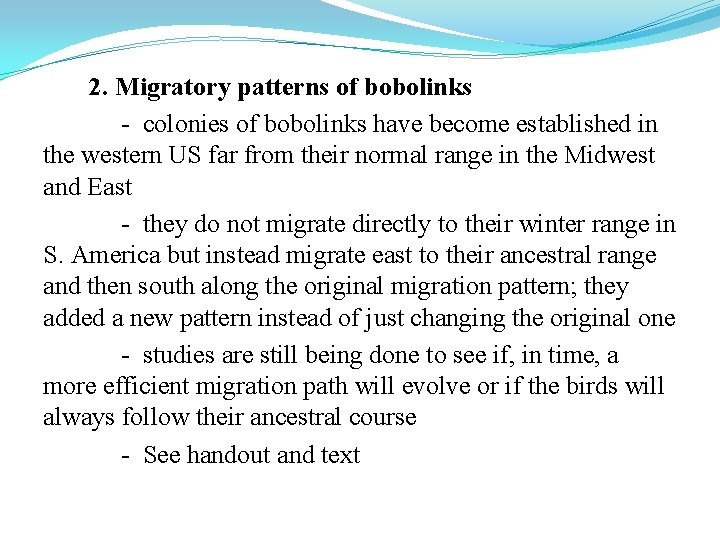
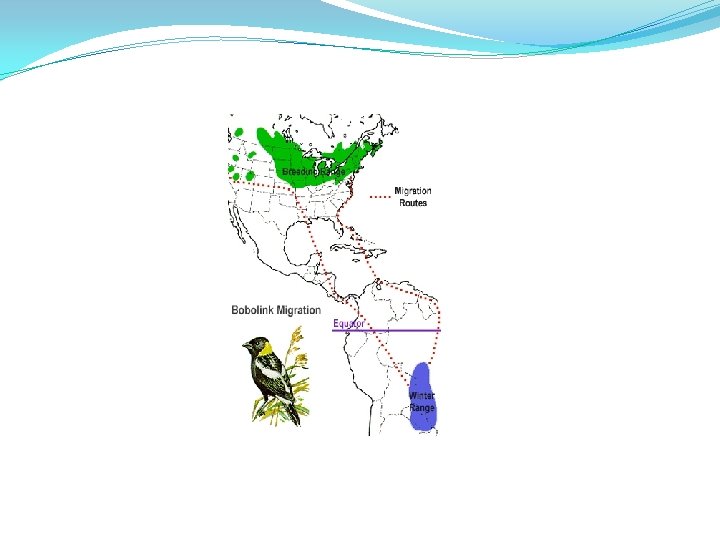
2. Migratory patterns of bobolinks - colonies of bobolinks have become established in the western US far from their normal range in the Midwest and East - they do not migrate directly to their winter range in S. America but instead migrate east to their ancestral range and then south along the original migration pattern; they added a new pattern instead of just changing the original one - studies are still being done to see if, in time, a more efficient migration path will evolve or if the birds will always follow their ancestral course - See handout and text
3. Another example - the bird, Sylvia atricapilla (blackcap) breeds during the summer in Germany and, until recently, migrated to Spain or other Mediterranean areas for winter - studies show that 10% of blackcaps now migrate to the UK instead - to test whether this change is genetically determined or not (and, therefore, whether it could have developed by natural selection or not), eggs were collected from parents who had migrated to the UK in the previous winter and from parents who migrated to Spain
- the young were reared and the directions in which they set off, when the time for migration came, was recorded - birds whose parents had migrated to the UK flew west regardless of where they had been reared and birds whose parents had migrated to Spain flew southwest - despite not being able to follow their parents at the time of migration, all the birds tended to fly in the direction that would take them on the same migration route as their parents
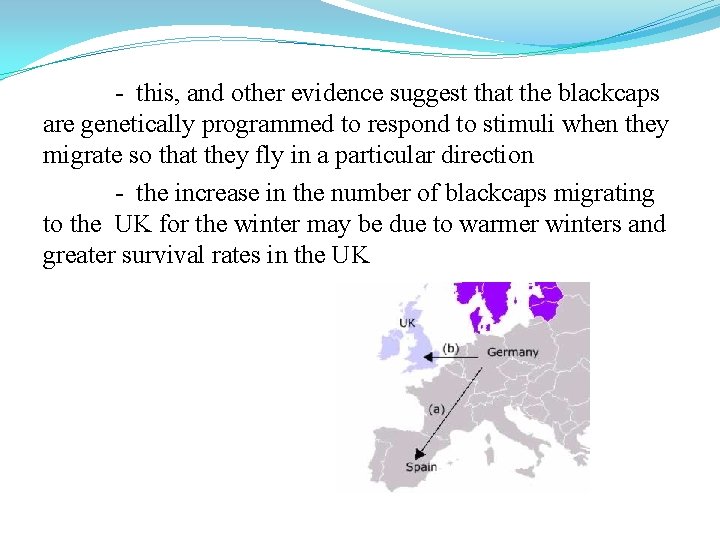
- this, and other evidence suggest that the blackcaps are genetically programmed to respond to stimuli when they migrate so that they fly in a particular direction - the increase in the number of blackcaps migrating to the UK for the winter may be due to warmer winters and greater survival rates in the UK
- Slides: 18