
Neural Speech Synthesis with Transformer Network Naihan Li




- Slides: 20
Neural Speech Synthesis with Transformer Network Naihan Li, Shujie Liu, Yanqing Liu, Sheng Zhao, Ming Liu University of Electronic Science and Technology of China Microsoft Research Asia Microsoft STC Asia
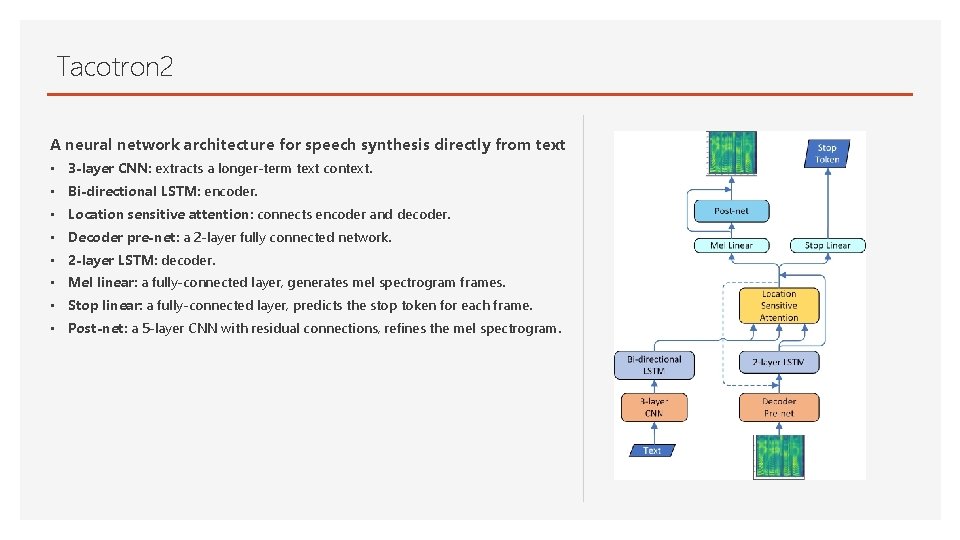
Tacotron 2 A neural network architecture for speech synthesis directly from text • 3 -layer CNN: extracts a longer-term text context. • Bi-directional LSTM: encoder. • Location sensitive attention: connects encoder and decoder. • Decoder pre-net: a 2 -layer fully connected network. • 2 -layer LSTM: decoder. • Mel linear: a fully-connected layer, generates mel spectrogram frames. • Stop linear: a fully-connected layer, predicts the stop token for each frame. • Post-net: a 5 -layer CNN with residual connections, refines the mel spectrogram.
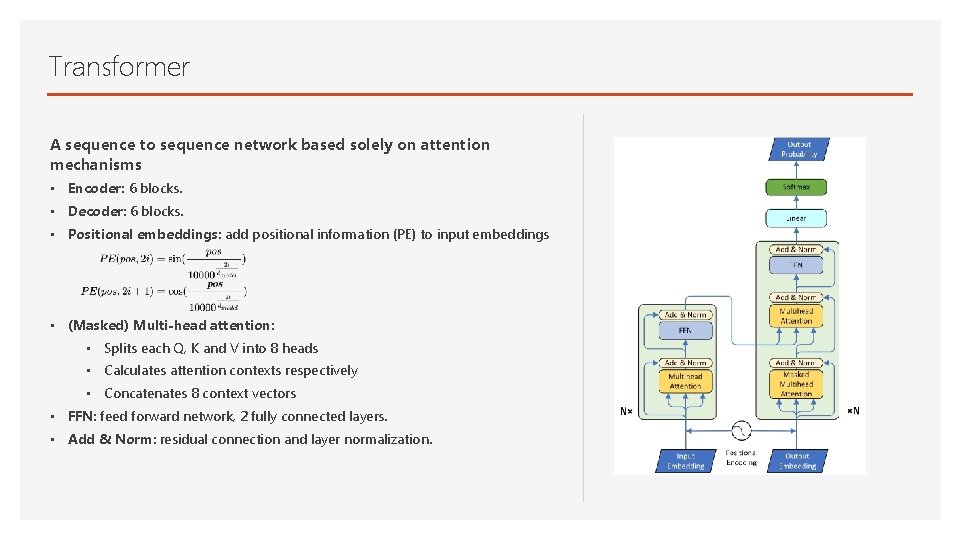
Transformer A sequence to sequence network based solely on attention mechanisms • Encoder: 6 blocks. • Decoder: 6 blocks. • Positional embeddings: add positional information (PE) to input embeddings • (Masked) Multi-head attention: • Splits each Q, K and V into 8 heads • Calculates attention contexts respectively • Concatenates 8 context vectors • FFN: feed forward network, 2 fully connected layers. • Add & Norm: residual connection and layer normalization.
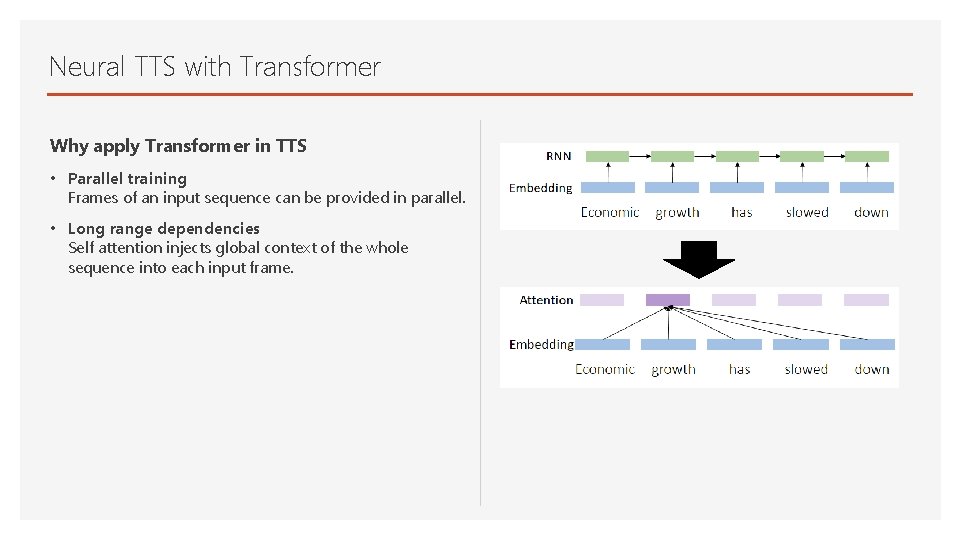
Neural TTS with Transformer Why apply Transformer in TTS • Parallel training Frames of an input sequence can be provided in parallel. • Long range dependencies Self attention injects global context of the whole sequence into each input frame.
Neural TTS with Transformer
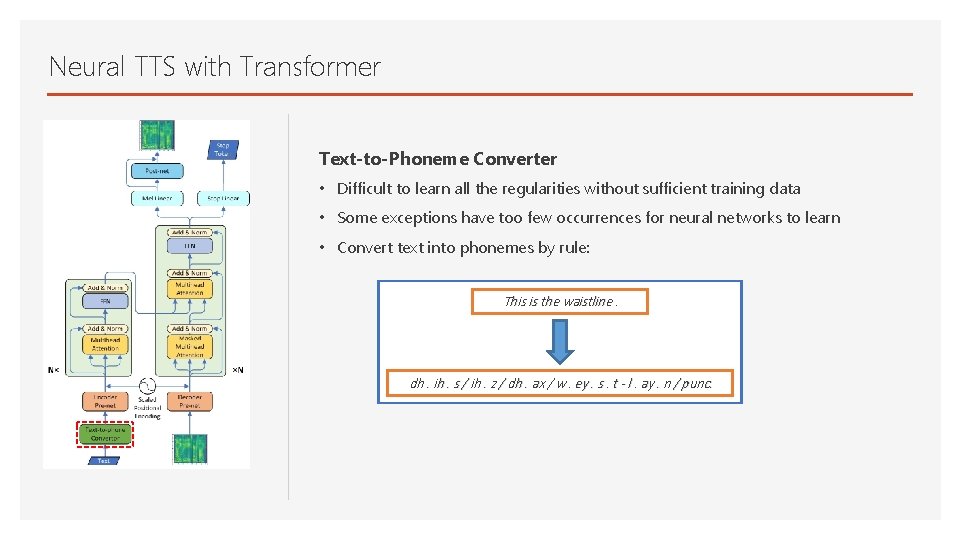
Neural TTS with Transformer Text-to-Phoneme Converter • Difficult to learn all the regularities without sufficient training data • Some exceptions have too few occurrences for neural networks to learn • Convert text into phonemes by rule: This is the waistline. dh. ih. s / ih. z / dh. ax / w. ey. s. t - l. ay. n / punc.
Neural TTS with Transformer
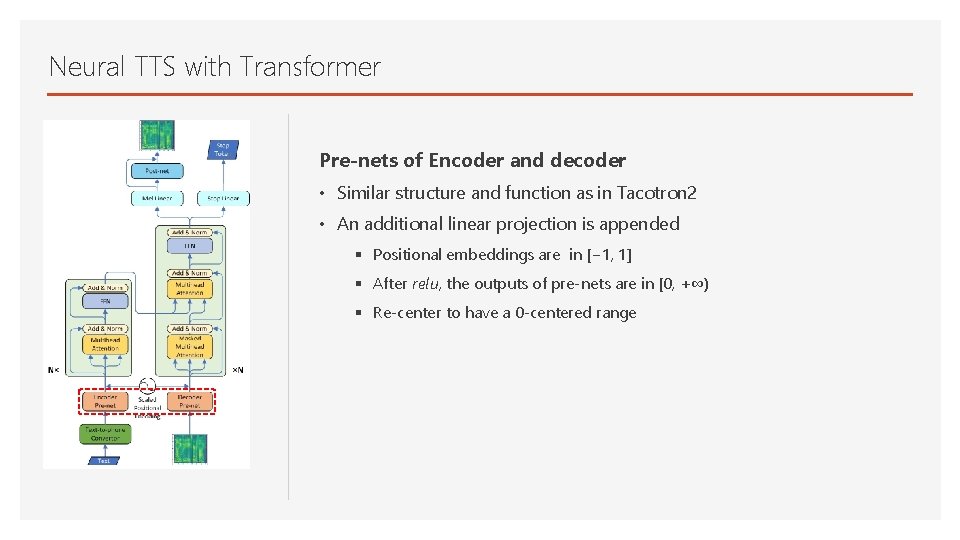
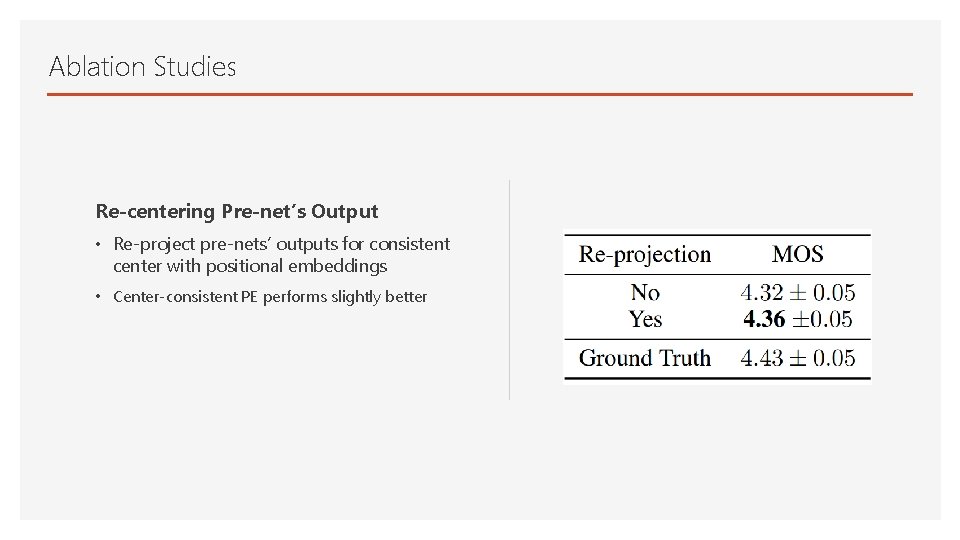
Neural TTS with Transformer Pre-nets of Encoder and decoder • Similar structure and function as in Tacotron 2 • An additional linear projection is appended § Positional embeddings are in [− 1, 1] § After relu, the outputs of pre-nets are in [0, +∞) § Re-center to have a 0 -centered range
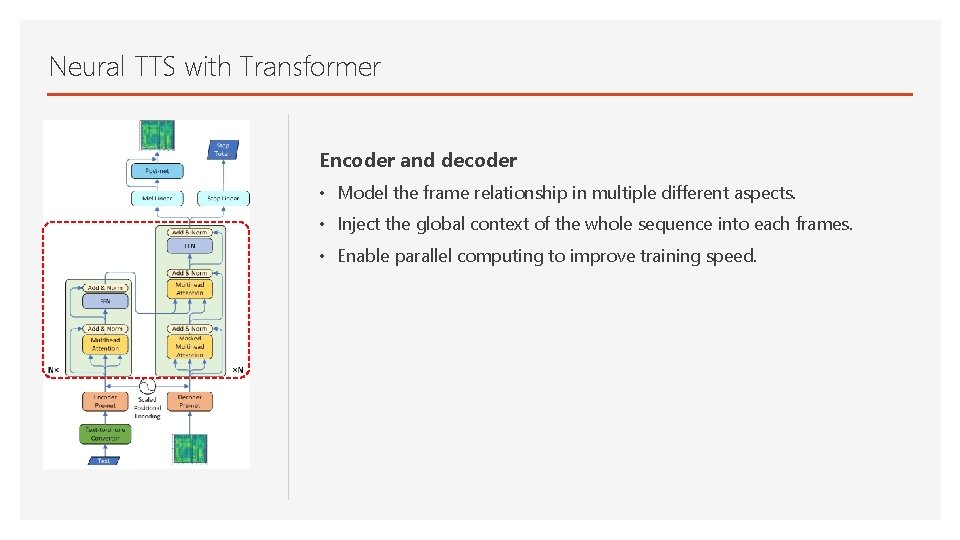
Neural TTS with Transformer Encoder and decoder • Model the frame relationship in multiple different aspects. • Inject the global context of the whole sequence into each frames. • Enable parallel computing to improve training speed.
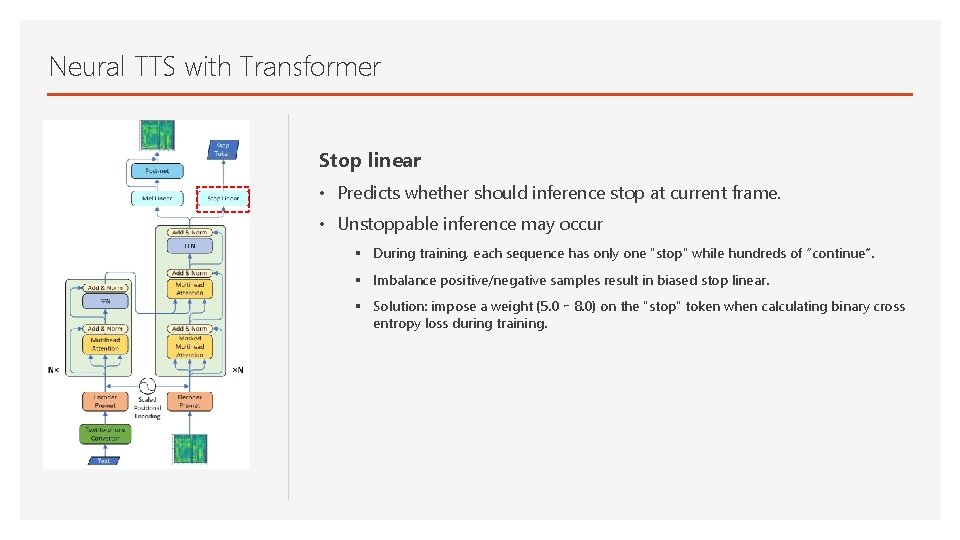
Neural TTS with Transformer Stop linear • Predicts whether should inference stop at current frame. • Unstoppable inference may occur § During training, each sequence has only one "stop" while hundreds of “continue”. § Imbalance positive/negative samples result in biased stop linear. § Solution: impose a weight (5. 0 ∼ 8. 0) on the "stop" token when calculating binary cross entropy loss during training.
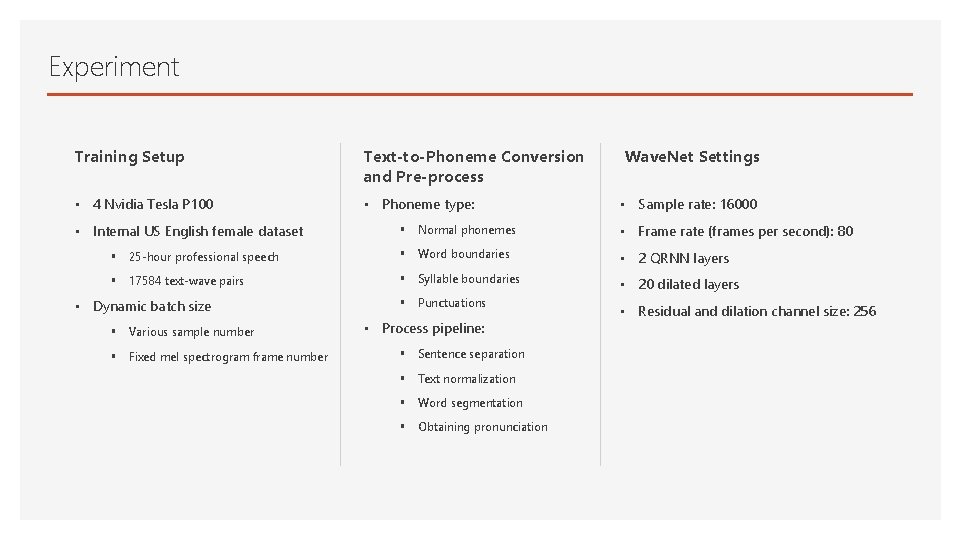
Experiment Training Setup Text-to-Phoneme Conversion and Pre-process • 4 Nvidia Tesla P 100 • Phoneme type: • Internal US English female dataset Wave. Net Settings • Sample rate: 16000 § Normal phonemes • Frame rate (frames per second): 80 § 25 -hour professional speech § Word boundaries • 2 QRNN layers § 17584 text-wave pairs § Syllable boundaries • 20 dilated layers • Dynamic batch size § Various sample number § Fixed mel spectrogram frame number § Punctuations • Process pipeline: § Sentence separation § Text normalization § Word segmentation § Obtaining pronunciation • Residual and dilation channel size: 256
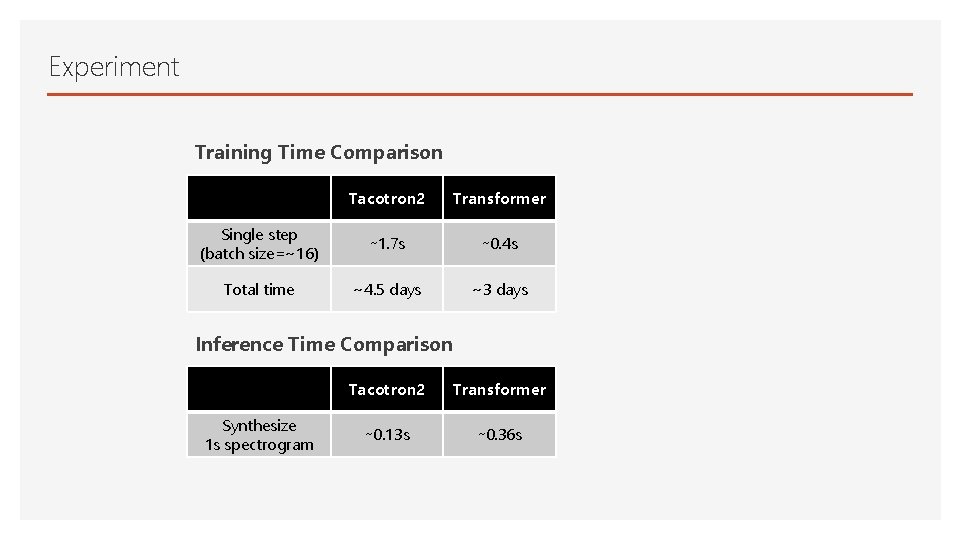
Experiment Training Time Comparison Tacotron 2 Transformer Single step (batch size=~16) ∼ 1. 7 s ∼ 0. 4 s Total time ~4. 5 days ~3 days Inference Time Comparison Synthesize 1 s spectrogram Tacotron 2 Transformer ∼ 0. 13 s ∼ 0. 36 s
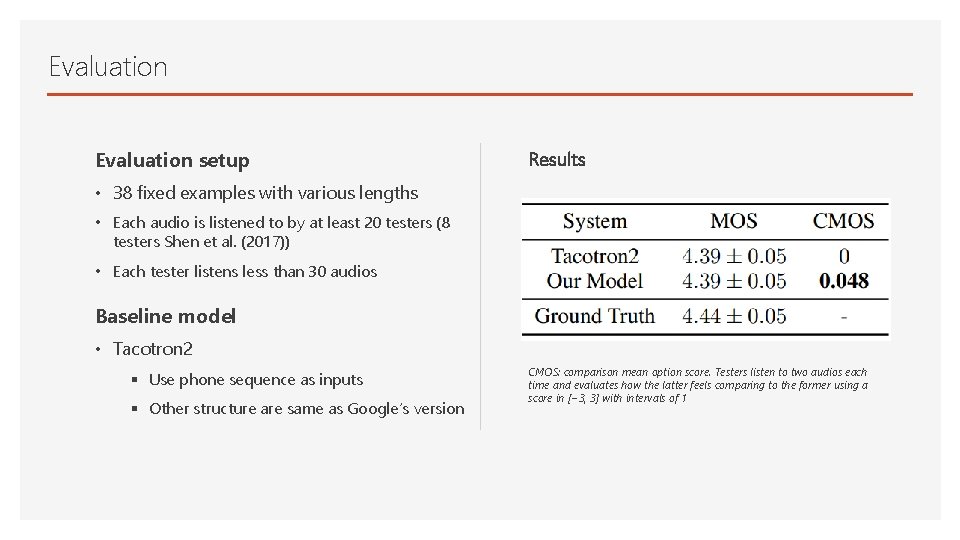
Evaluation setup Results • 38 fixed examples with various lengths • Each audio is listened to by at least 20 testers (8 testers Shen et al. (2017)) • Each tester listens less than 30 audios Baseline model • Tacotron 2 § Use phone sequence as inputs § Other structure are same as Google’s version CMOS: comparison mean option score. Testers listen to two audios each time and evaluates how the latter feels comparing to the former using a score in [− 3, 3] with intervals of 1
Evaluation Generated sample comparison Our model Tacotron 2 More samples at https: //neuraltts. github. io/transformertts/
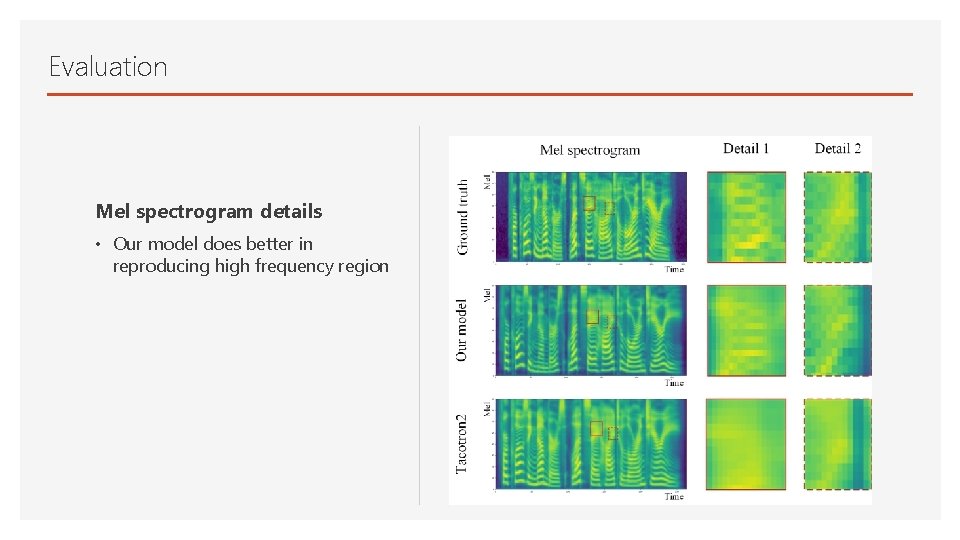
Evaluation Mel spectrogram details • Our model does better in reproducing high frequency region
Ablation Studies Re-centering Pre-net’s Output • Re-project pre-nets’ outputs for consistent center with positional embeddings • Center-consistent PE performs slightly better
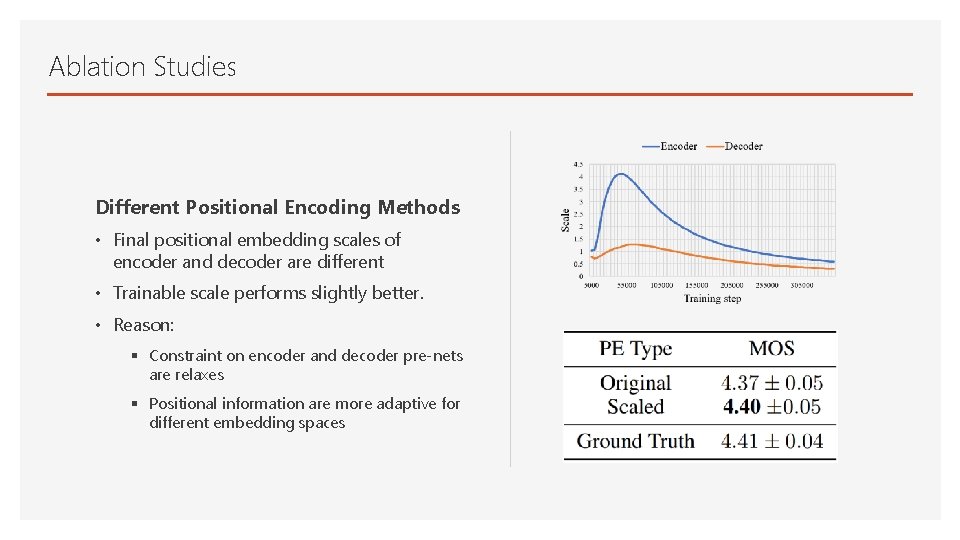
Ablation Studies Different Positional Encoding Methods • Final positional embedding scales of encoder and decoder are different • Trainable scale performs slightly better. • Reason: § Constraint on encoder and decoder pre-nets are relaxes § Positional information are more adaptive for different embedding spaces
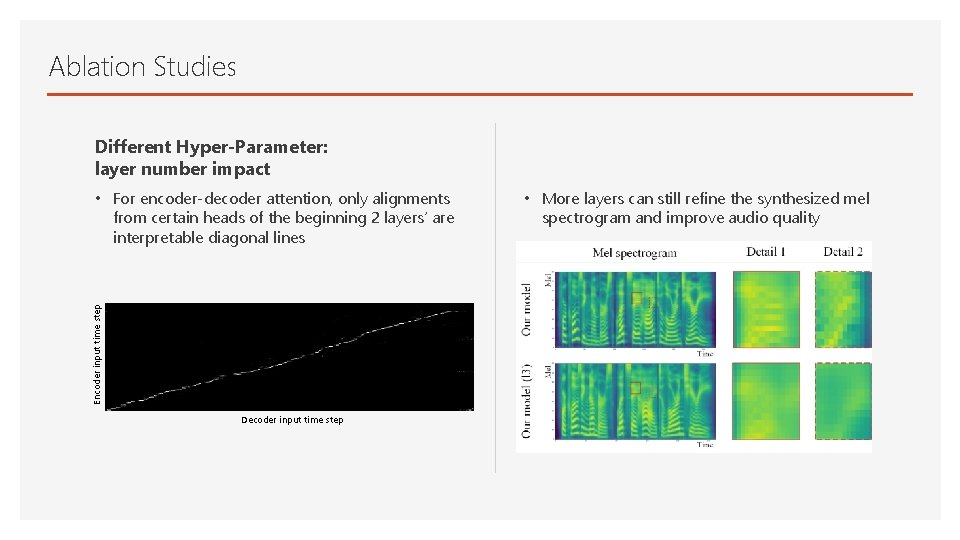
Ablation Studies Different Hyper-Parameter: layer number impact Encoder input time step • For encoder-decoder attention, only alignments from certain heads of the beginning 2 layers’ are interpretable diagonal lines Decoder input time step • More layers can still refine the synthesized mel spectrogram and improve audio quality
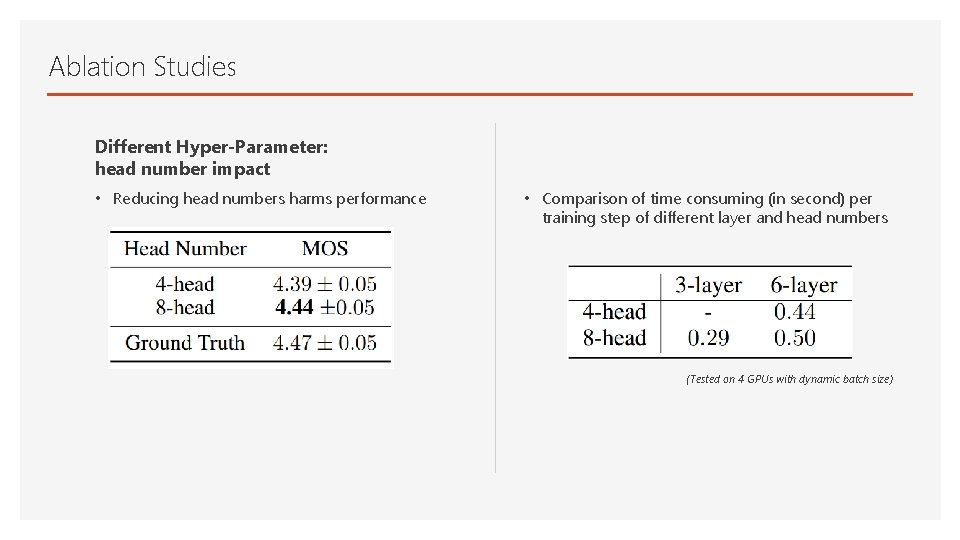
Ablation Studies Different Hyper-Parameter: head number impact • Reducing head numbers harms performance • Comparison of time consuming (in second) per training step of different layer and head numbers (Tested on 4 GPUs with dynamic batch size)
Thank you!